

Company Scoring: How to Rank, Prioritize, and Close the Right Accounts
A founder on r/hubspot built an elaborate company scoring model. Their "perfect prospect" hit 100 points. Their biggest deal that quarter? It came from a lead scored 12 out of 100 - someone who booked a demo from a cold outreach message and never touched the website. Students were racking up perfect scores while actual buyers flew under the radar.
That story captures everything wrong with how most teams approach company scoring. The model itself wasn't broken. The inputs were.
What You Need (Quick Version)
Company scoring ranks organizations, not individual leads. It answers one question: which accounts deserve your team's time right now?
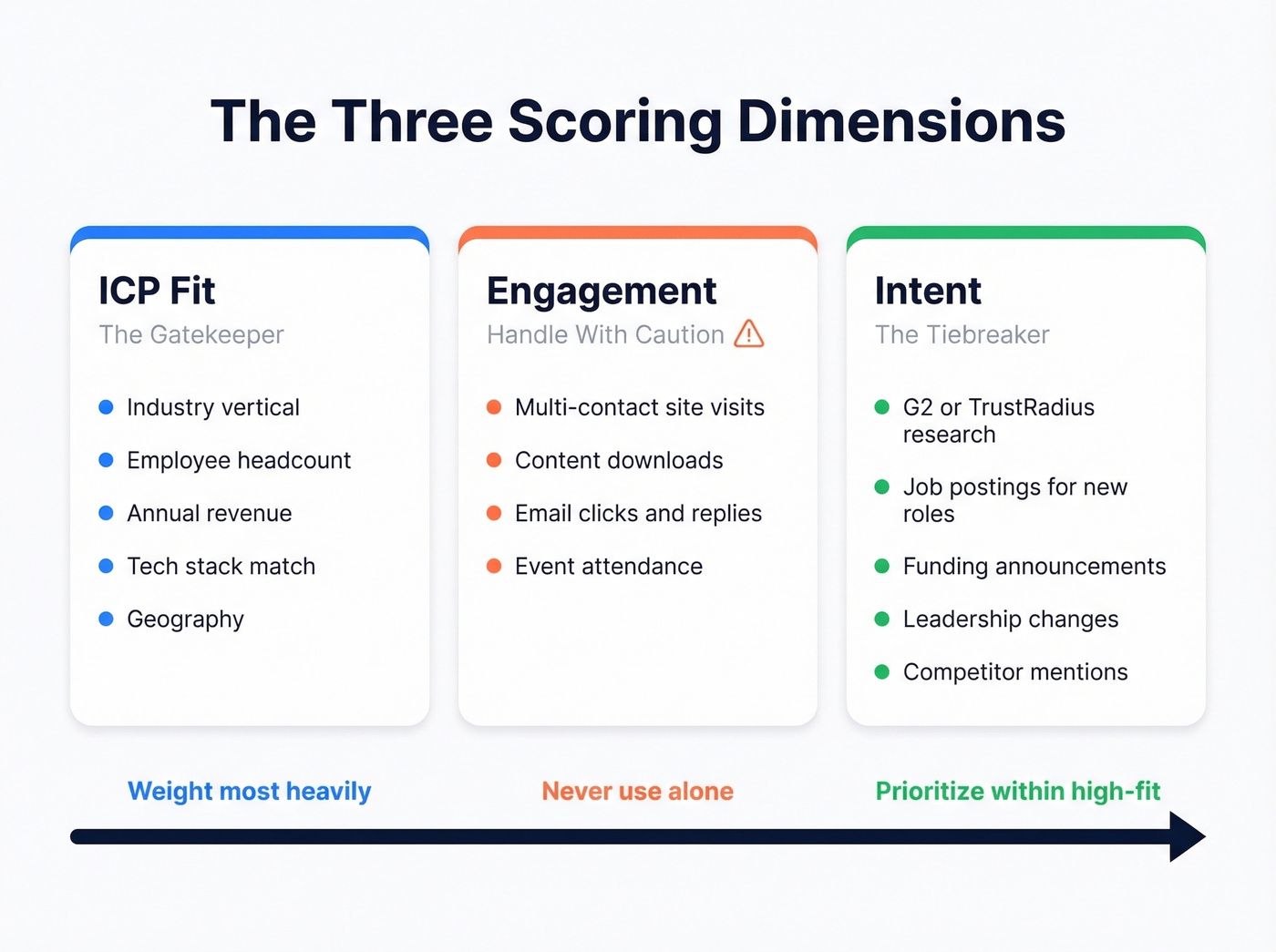
Three dimensions matter. ICP fit tells you whether the company matches your ideal customer profile. Engagement tells you whether they're paying attention. Intent tells you whether they're actively researching a solution. Fit is the gatekeeper. Intent is the tiebreaker.
Before you build any model, fix your data. Stale CRM records will poison every score you generate. If 40% of your accounts have the wrong industry code, your model is ranking fiction. Jump to the template section if you want a copy-paste rubric right now.
What Is Company Scoring?
Company scoring assigns a numerical value to an organization based on specific attributes and behaviors, then ranks it against every other organization in your pipeline or total addressable market. Think of it like a credit score, but for businesses - and the "creditworthiness" you're measuring depends entirely on your use case.
The term means different things to different teams:
| Interpretation | Who Uses It | What It Measures |
|---|---|---|
| Sales/marketing account scoring | Revenue teams | Likelihood to buy |
| Financial health scoring | Credit, procurement | Risk and stability |
| Investment target scoring | PE, M&A, VC | Acquisition fit |
For perspective, VantageScore was used over 27 billion times in 2023 by 3,400+ financial institutions. Scoring models at that scale work because they're built on clean, standardized data with regular recalibration. The same principles apply to B2B account scoring - just at a smaller scale and with messier inputs.
Sales & Marketing Account Scoring
This is the interpretation most B2B teams care about. You're ranking companies by their likelihood to buy your product and deliver revenue. The average B2B buying committee now includes 6 to 13 decision-makers per Gartner's research, which is exactly why scoring at the company level matters more than scoring individual leads. One contact's behavior doesn't tell you much. The aggregate behavior of an entire account tells you everything.
The payoff is real: teams using lead + account scoring see a 77% boost in lead generation ROI compared to teams that don't.
Financial Health Scoring
Credit and procurement teams use this approach to assess financial risk. Products like Company Watch's H-Score assign numerical health ratings based on financial and risk signals. If you're in supply chain management or vendor due diligence, this is your version of account scoring.
Investment Target Scoring
Private equity and M&A teams score companies to find acquisition targets. SourceScrub found that 75% of their customers see an increase in deal flow after implementing custom scoring algorithms across large private-company datasets. Same concept, different buyer.
Company Scoring vs. Lead Scoring
Lead scoring ranks contacts. Account scoring ranks organizations. They solve different problems, and most mature teams need both - the account-level model picks the companies, lead scoring picks the people within them.
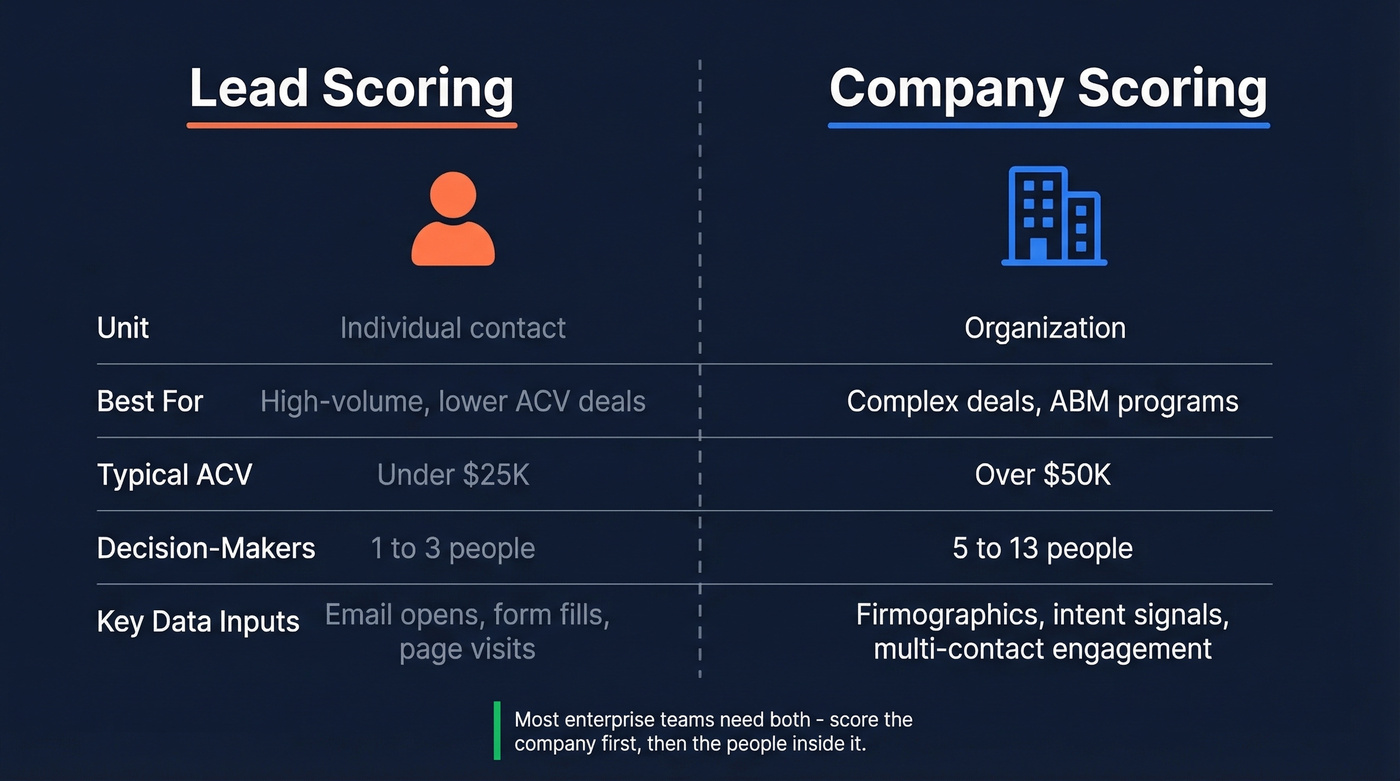
| Dimension | Lead Scoring | Company Scoring |
|---|---|---|
| Unit | Individual contact | Organization |
| Best for | High-volume, lower ACV | Complex deals, ABM |
| Typical ACV | Under $25K | Over $50K |
| Decision-makers | 1-3 | 5-13 |
| Data inputs | Email opens, form fills | Firmographics, intent, multi-contact engagement |
The decision framework is simple. If your average deal is under $25K with one or two decision-makers, start with lead scoring. If you're selling $50K+ deals into buying committees, start with account-level scoring. Most enterprise teams land on both.
For ABM, the tiers are straightforward. Tier 1 accounts (1:1 treatment) should be 50-100 companies max. Tier 2 (1:few) covers a few hundred. Tier 3 (1:many) is the rest of your TAM, handled programmatically. ABM programs with account prioritization consistently report 21-50% higher ROI, with some teams seeing 200%+ returns. The scoring model is what makes that prioritization possible.
Mark Roberge's logic still holds: an intern at a perfect-fit company is a better signal than a VP at a company that'll never buy. That's the whole argument for scoring the company first, then the person.
The Three Scoring Dimensions
Most scoring models fail because they collapse everything into a single number. Clearbit's 2D scoring framework gets this right - keep fit and intent as separate scores so you can adjust thresholds independently. Fit is the gatekeeper for sales attention. Intent helps prioritize within high-fit accounts.
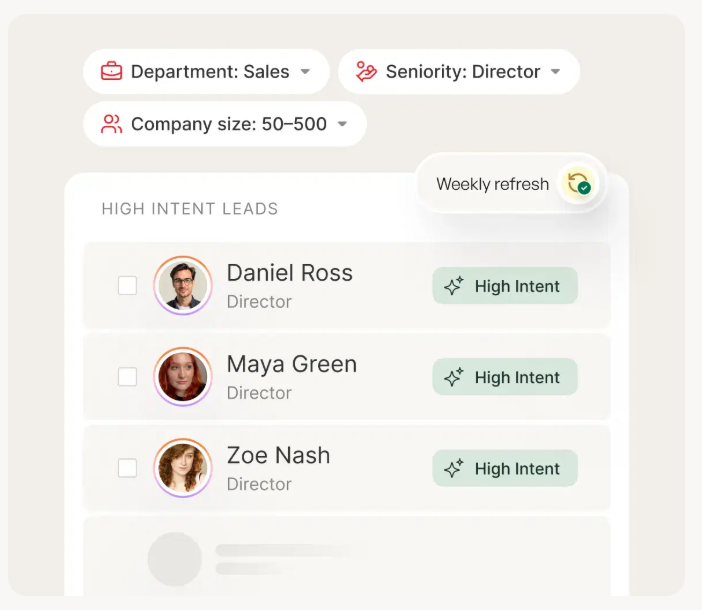
ICP Fit (Firmographics + Technographics)
Fit answers the question: does this company look like our best customers? The signals are relatively stable and don't decay quickly.
- Industry - are they in a vertical you serve well?
- Headcount - do they match your sweet spot (e.g., 50-500 employees)?
- Revenue - can they afford your solution?
- Tech stack - are they running tools that complement or compete with yours?
- Geography - are they in a region you can sell into and support?
Fit is the dimension you should weight most heavily. A company that doesn't match your ICP will waste your team's time regardless of how many webinars they attend.
Engagement (Behavioral Signals)
Engagement measures whether the account is paying attention to you. The key is aggregating signals across multiple contacts at the same company, not just tracking one person - multiple contacts visiting your site in the same week, content downloads across different roles, email clicks and replies from several stakeholders, event attendance or ad engagement.
Here's the thing: engagement is the most dangerous dimension to over-weight. The Reddit founder's story proves it - high engagement often means curiosity, not buying intent. Students, competitors, and job seekers all generate engagement signals. Never let engagement alone push an account into Tier A.
Intent (Buying Signals)
Intent signals indicate that a company is actively researching solutions in your category, whether or not they've engaged with your brand directly. This includes researching your category on G2 or TrustRadius, posting job openings that signal a new initiative, funding rounds or expansion announcements, leadership changes in your buyer's department, and competitive mentions in earnings calls.
Third-party intent data from providers like Bombora tracks thousands of topics across the web. When a company's research activity spikes in your category, that's a signal worth acting on - even if they've never visited your site.
How to Build a Scoring Model
There are four model types, and you should pick the simplest one that works for your stage. Point-based models assign flat values to each signal. Weighted models let you emphasize certain dimensions. Tiered models bucket accounts into A/B/C without precise scores. Predictive models use ML to find patterns in your historical data.
Most teams should start with a weighted point-based model.
Step 1 - Fix Your Data First
This is step zero, and it's non-negotiable. If your CRM has stale records - wrong industries, outdated headcounts, missing tech stack data - your model will score garbage confidently. We've seen teams spend weeks building elegant scoring models only to discover that 40% of their "qualified" accounts had incorrect firmographic data.
Step 2 - Define Your ICP Attributes
Pick 5-8 firmographic and technographic attributes that correlate with your best customers. Look at your last 20 closed-won deals and find the patterns. What industries? What headcount range? What tools were they already using?
Don't overthink this. Five strong attributes beat fifteen weak ones.
Step 3 - Assign Weights and Points
Use a 4-dimension model that sums to 100:
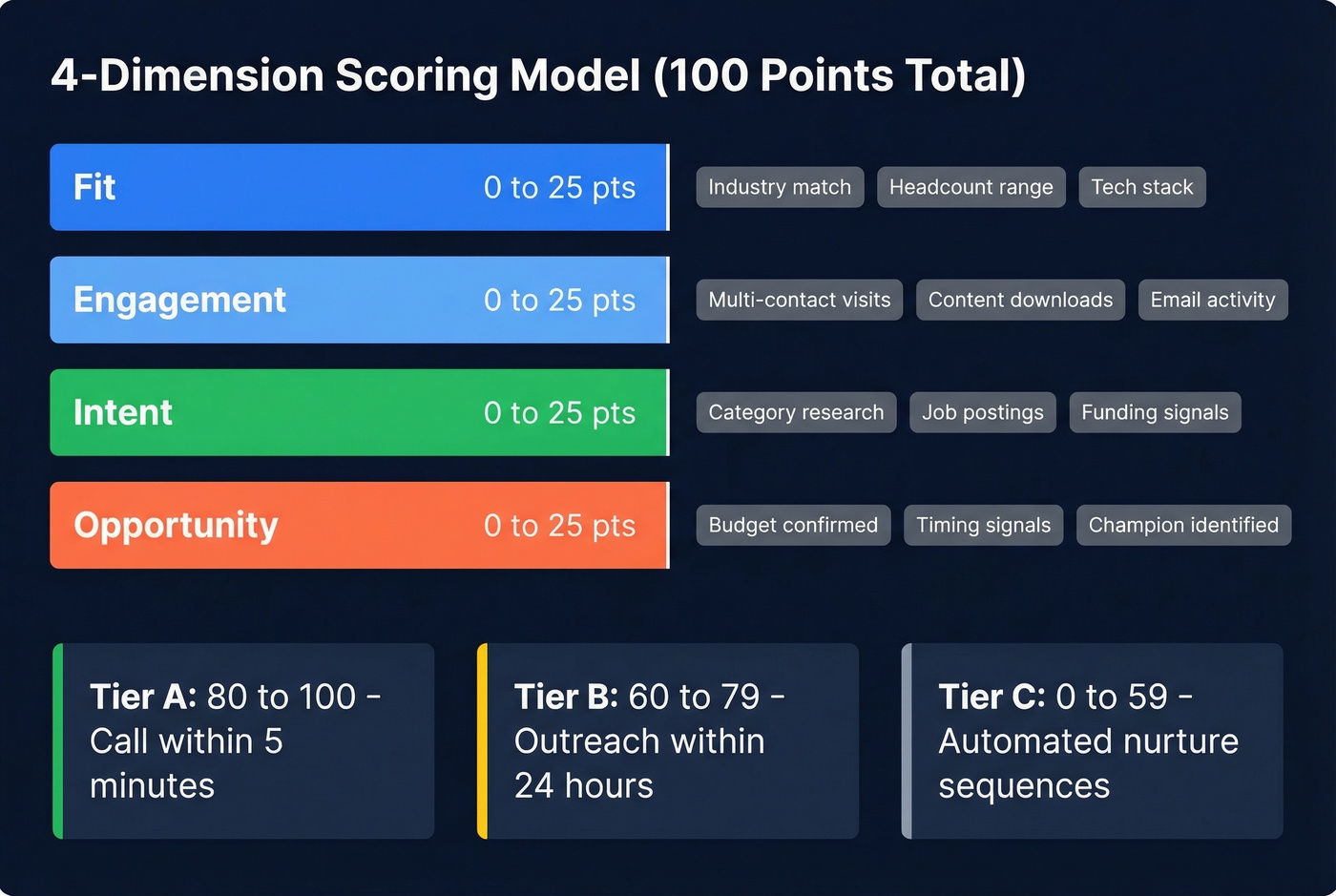
- Fit: 0-25 points (firmographic and technographic match)
- Engagement: 0-25 points (multi-contact behavioral signals)
- Intent: 0-25 points (third-party research and buying signals)
- Opportunity: 0-25 points (budget indicators, timing signals, champion identified)
Each dimension gets its own sub-criteria with point allocations. A company matching 3+ ICP attributes should score 15+ on fit. A company outside your ICP entirely should score below 5.
Step 4 - Set Tier Thresholds and Routing Rules
Define what happens at each score level:
- Tier A (80-100): Hot. SDR calls within 5 minutes. Full 1:1 ABM treatment.
- Tier B (60-79): Warm. Outreach within 24 hours. 1:few campaigns.
- Tier C (0-59): Nurture. Automated sequences. Revisit when signals change.
The routing SLAs matter as much as the scores themselves. A Tier A account that sits in a queue for three days is a wasted signal.

Your scoring model ranks fiction when 40% of accounts have stale data. Prospeo's 7-day refresh cycle and 98% email accuracy mean every firmographic, technographic, and intent signal feeding your model reflects reality - not last quarter's CRM snapshot.
Stop scoring ghost accounts. Start with data that's actually current.
Company Scoring Template
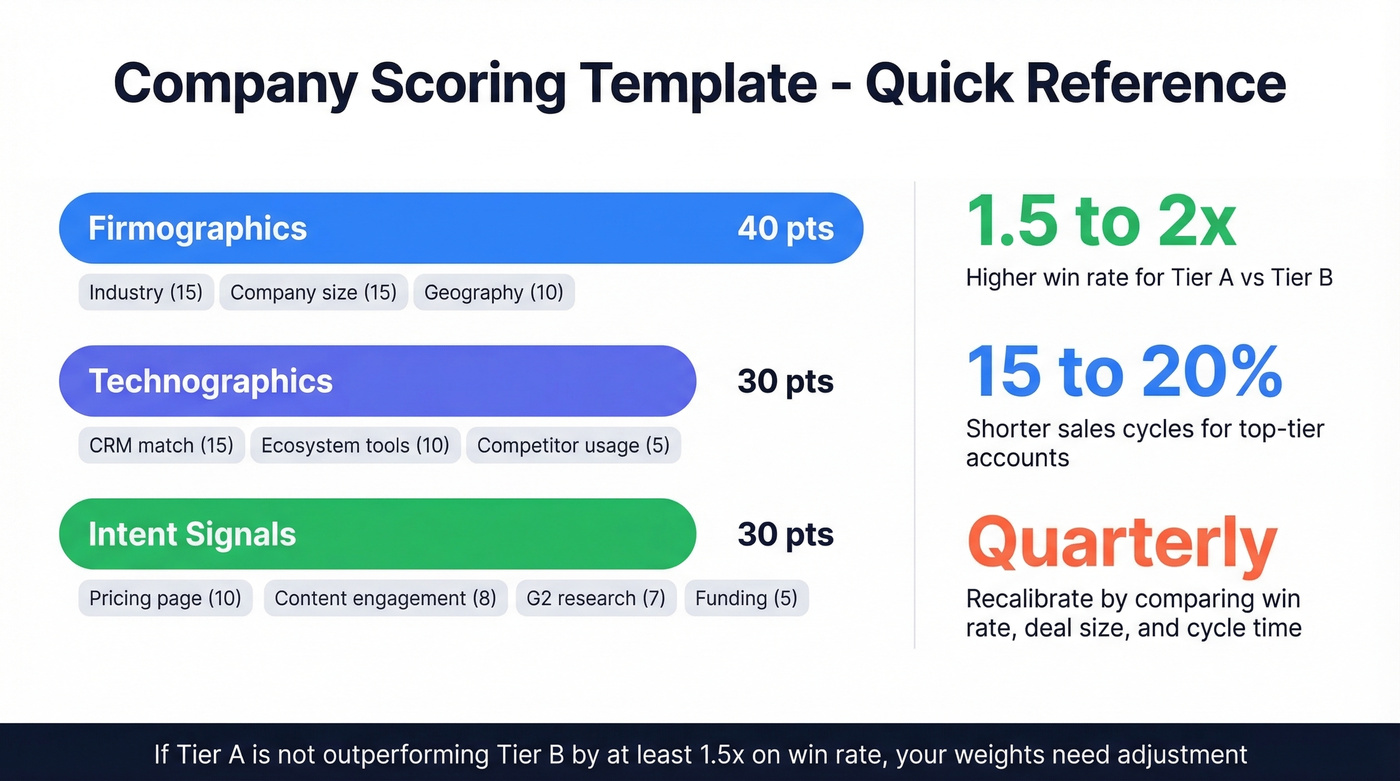
Here's a copy-paste rubric you can adapt for your team. This example is calibrated for a B2B SaaS company, but the structure works across industries. Firmographics (40 points)
| Attribute | Criteria | Points |
|---|---|---|
| Industry | Target vertical | Up to 15 |
| Company size | 50-500 employees | Up to 15 |
| Geography | Tier 1 markets | Up to 10 |
Technographics (30 points)
| Attribute | Criteria | Points |
|---|---|---|
| CRM | Uses Salesforce or HubSpot | Up to 15 |
| Complementary tools | Uses tools in your ecosystem | Up to 10 |
| Competitor products | Currently using a competitor | Up to 5 |
Intent Signals (30 points)
| Signal | Criteria | Points |
|---|---|---|
| Pricing page visit | Multiple contacts | 10 |
| Case study/webinar | Downloaded or attended | 8 |
| G2/Gartner research | Active in your category | 7 |
| Funding/expansion | Recent round or hiring surge | 5 |
Tier thresholds: A = 80-100, B = 50-79, C = 0-49.
Validation benchmarks: Top-performing teams see Tier A win rates 1.5-2x higher than Tier B, with 15-20% shorter sales cycles. If your Tier A accounts aren't outperforming Tier B by at least 1.5x on win rate, your weights need adjustment. Recalibrate quarterly by comparing win rate, deal size, and cycle time across tiers.
Your Data Is the Model's Foundation
Most scoring failures are data quality failures, not model design failures. You can build the most sophisticated weighted model in the world, and it'll produce garbage if your CRM records haven't been updated in six months.
Let's be honest - the industry average for B2B data refresh is six weeks. That means most teams are scoring accounts based on firmographic data that's already stale by the time the model runs. We've watched a VP of Sales discover that 40% of "qualified" accounts had the wrong industry classification. Suddenly the entire scoring model was suspect, and the quarter's pipeline projections fell apart.
Prospeo runs on a 7-day refresh cycle, returns 50+ data points per record at an 83% enrichment match rate, and tracks 15,000 intent topics via Bombora - so you can layer buying signals directly into your scoring model without bolting on a separate intent provider. When your enrichment data refreshes weekly instead of every six weeks, your model stays calibrated to reality.
Advanced Scoring Tactics
Not every tactic here is worth implementing on day one. Match the tactic to your maturity level.
The Six-Dimension Model
Once you've validated a basic four-dimension model for at least one quarter, upgrade to six dimensions:
| Dimension | Weight | What It Captures |
|---|---|---|
| Firmographic fit | 30% | Industry, headcount, revenue, geography |
| Technographic overlap | 20% | Tech stack compatibility, competitor tools |
| Intent signals | 15% | Third-party research, G2/Gartner activity |
| Engagement behavior | 15% | Multi-contact site visits, content downloads |
| Buying triggers | 10% | Funding rounds, leadership changes, hiring surges |
| Economic outcome | 10% | Predicted deal size, LTV potential, expansion likelihood |
The first four dimensions are familiar. Buying triggers and economic outcome are what separate good models from great ones. Buying triggers catch timing - a company that just raised a Series B and is hiring five SDRs is a fundamentally different prospect than one that's been static for two years. Economic outcome forces you to weight accounts not just by likelihood to close, but by how much revenue they'll actually generate. A 200-person company in your sweet spot with expansion potential should outscore a 50-person company that'll buy your smallest plan and never upgrade.
In our experience, most teams over-invest in model complexity and under-invest in data freshness. A simple three-attribute fit model running on weekly-refreshed data will outperform a 20-variable predictive model running on six-month-old CRM records. Every time.
Event Scoring Values
Use this reference table when assigning point values to specific signals:
| Event | Points | Decay |
|---|---|---|
| Pricing page visit | +10 | -50% after 30 days |
| Webinar attendance | +8 | -50% after 30 days |
| Direct email reply | +5 | -50% after 30 days |
| Two-week inactivity | -7 | Resets on new activity |
Score Decay and Negative Signals
Adopt this if you've been running a scoring model for at least one quarter and notice stale accounts clogging your Tier A pipeline. Skip this if you're still validating your basic model - adding decay before you've confirmed your weights work just adds noise.
Signals older than 30 days should lose 50% of their value. A pricing page visit from last week is gold. The same visit from two months ago is background noise. On the negative side, two weeks of complete inactivity should subtract points - -7 is a reasonable starting penalty.
Predictive Scoring
Adopt this if you have 12+ months of historical win/loss data, 500+ closed opportunities, and a dedicated RevOps resource to maintain the model. Skip this if you're pre-Series B or have fewer than 200 closed deals. ML models need volume to find real patterns - with thin data, they'll overfit to noise.
Tools like 6sense and MadKudu offer predictive scoring out of the box, but they're only as good as the data you feed them. The prerequisite is always the same: clean, complete historical data.
Quarterly Recalibration
Do this always. No exceptions.
Every quarter, pull your win rate, average deal size, and sales cycle length by tier. If Tier A accounts aren't converting at 1.5-2x the rate of Tier B, your weights are off. If Tier B deals are closing faster than Tier A, you've probably over-weighted engagement relative to fit. Adjust weights, re-score your pipeline, and repeat.
Common Mistakes to Avoid
Five mistakes kill most scoring models:
Over-weighting engagement. Curiosity isn't intent. The Reddit founder's model gave students perfect scores while real buyers scored 12. Weight fit and intent higher than engagement, always. This is the most common complaint in RevOps communities on Reddit - scoring models that reward page views over buying signals.
Never recalibrating. Static models decay fast as your market shifts, your ICP evolves, and signal patterns change. Quarterly recalibration isn't optional - it's maintenance.
Ignoring data quality. Stale CRM records mean you're ranking fiction. If you haven't enriched your account data in the last 30 days, your model is already degrading.
Collapsing fit and intent into one score. Keep them separate. A high-fit, low-intent account needs nurturing. A low-fit, high-intent account needs disqualification. Combining them hides both signals.
Building complex models before you have volume. For teams with fewer than 100 closed deals, a simple three-attribute fit model will outperform any 20-variable weighted formula. Complexity requires data to validate.
ICP fit, engagement, and intent scoring all depend on one thing: clean, enriched account data. Prospeo returns 50+ data points per contact across 300M+ profiles - headcount, tech stack, funding, revenue, and Bombora intent signals across 15,000 topics. Every dimension of your scoring model, fed automatically.
Layer intent data on firmographics for scores that actually predict revenue.
Best Tools for Account Scoring
You don't need a dedicated scoring platform to get started. Most teams already have one.
| Tool | Best For | Scoring Type | Starting Price |
|---|---|---|---|
| HubSpot | SMB-mid-market | Native scoring | ~$890/mo |
| Salesforce | Enterprise CRM users | Native scoring + Einstein AI add-on | $165/user/mo |
| 6sense | Large enterprise ABM | Predictive account scoring | ~$60K/yr |
| Demandbase | Mid-market+ ABM | Intent + account scoring | ~$30K-$100K+/yr |
| MadKudu | PLG + growth-stage | Predictive lead + account | ~$1K-$3K/mo |
If you're already on HubSpot or Salesforce, use their native scoring. HubSpot supports scoring for companies and offers fit, engagement, and combined scoring; AI scoring is available in their Enterprise tier. Salesforce supports native scoring workflows, with Einstein AI typically purchased as an add-on.
6sense and Demandbase are overkill for most teams. At $60K+/year, they make sense only if you have 200+ employees and a dedicated RevOps team running full-stack ABM. For everyone else, a native CRM scoring model paired with clean enrichment data gets you 80% of the value at a fraction of the cost.
MadKudu sits in an interesting middle ground for product-led growth companies. If you're trying to score both self-serve signups and enterprise accounts, it's worth evaluating - but expect to invest in the integration work.
Real talk: the tool matters less than the data feeding it. A $60K predictive platform running on stale firmographic data will underperform a simple spreadsheet model built on freshly enriched records. Teams like Snyk saw AE-sourced pipeline jump 180% after switching their enrichment to Prospeo - largely because their account prioritization finally ran on accurate data.
FAQ
What's the difference between company scoring and lead scoring?
Company scoring ranks organizations by their likelihood to buy and deliver revenue. Lead scoring ranks individual contacts by their engagement and fit. Use both - account-level scoring selects the companies worth pursuing, and lead scoring identifies the right people within those accounts to contact first.
How many scoring dimensions should I start with?
Start with three: fit, engagement, and intent. Add opportunity, buying triggers, and economic outcome only after you've validated the basic model for at least one full quarter. Complexity without validation data just creates false precision.
How often should I recalibrate my model?
Quarterly at minimum. Compare win rate, deal size, and cycle time by tier. If Tier A accounts aren't converting at 1.5-2x the rate of Tier B, your weights need adjustment. Markets shift, ICPs evolve, and signal patterns change faster than most teams expect.
What data do I need before building a scoring model?
Clean firmographic data - industry, headcount, revenue, tech stack - for every account in your pipeline. An enrichment tool that returns 50+ data points per record at a high match rate ensures your model scores reality instead of stale entries from two years ago.
Can I score accounts without an expensive ABM platform?
Yes. HubSpot and Salesforce Enterprise both support native scoring. Pair either with a solid data enrichment layer and you'll get 80% of the value of a dedicated ABM platform at roughly 10% of the cost.