

Competitive Analytics: The 2026 Practitioner's Guide
Nearly half of sales reps don't know who they're competing against until the negotiation stage. Thirteen percent never find out - even after the deal closes. That's not a training problem. It's a competitive analytics problem, and it's costing you deals right now.
Most guides on this topic hand you a definition and a list of frameworks. This one gives you a buildable program, real pricing, and the tools to act on what you find.
Quick Stack by Company Size
- Enterprise: Klue or Crayon for battlecards and CI dashboards, AlphaSense for AI-powered market research
- Startup/SMB: Google Alerts (free) + SpyFu ($9/mo) - under $50/month total
Let's break down how to build a program that actually sticks.
What Is Competitive Analytics?
Competitive analytics is a set of quantitative tools, analytical techniques, and frameworks used to diagnose performance issues, identify vulnerabilities, and predict outcomes. It's the data-driven engine within the broader competitive intelligence discipline - not a synonym for it.
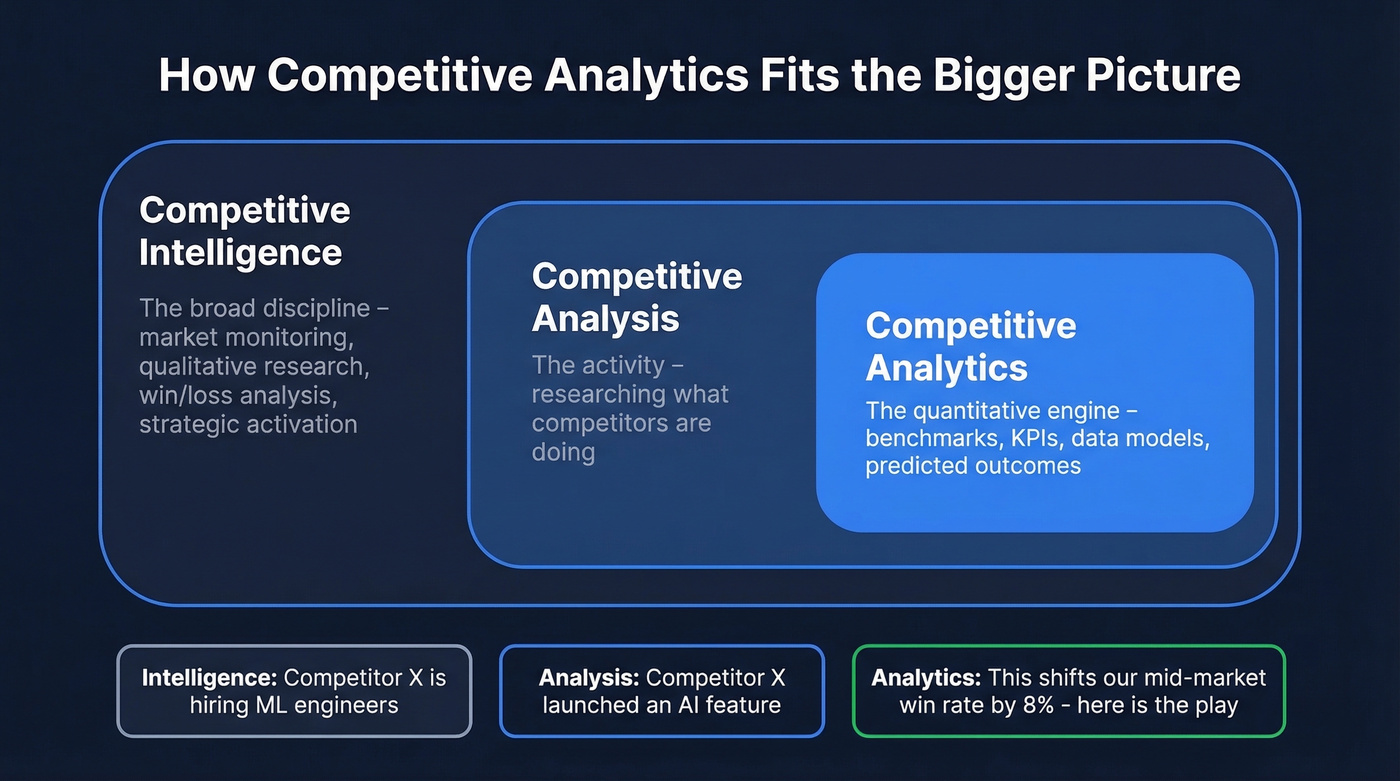
The distinction matters. Competitive intelligence is the broader discipline: market monitoring, qualitative research, win/loss analysis, strategic activation. Competitive analysis is the activity - researching competitors. The analytics layer is specifically quantitative: the benchmarks, the KPIs, the data models that turn raw competitor information into action.
Competitive analysis tells you what a competitor is doing. The analytics side tells you how much it matters and what you should do about it. The best programs go beyond diagnostics into predicted outcomes and implementation scenarios - not just "Competitor X launched a feature," but "here's how that shifts our win rate in the mid-market segment, and here's the play."
Why It Matters in 2026
The competitor analysis tools market keeps expanding, and 94% of organizations now invest in some form of competitive intelligence. Not surprising when you consider the alternative: flying blind.
A well-built CI function acts as an early-warning system. It flags pricing shifts, emerging technologies, and regulatory changes before they hit your pipeline. Without it, you're reactive - you find out a competitor undercut your pricing when a prospect tells you during negotiation. Too late.
Companies using AI-driven competitor benchmarking are 2.5x more likely to outperform peers. A Klue survey of 300+ revenue leaders paints a brutal picture: nearly half of reps don't know who they're competing with until the negotiation stage. The gap between teams that invest in structured CI programs and teams that don't is widening every quarter.
How to Build a CI Program
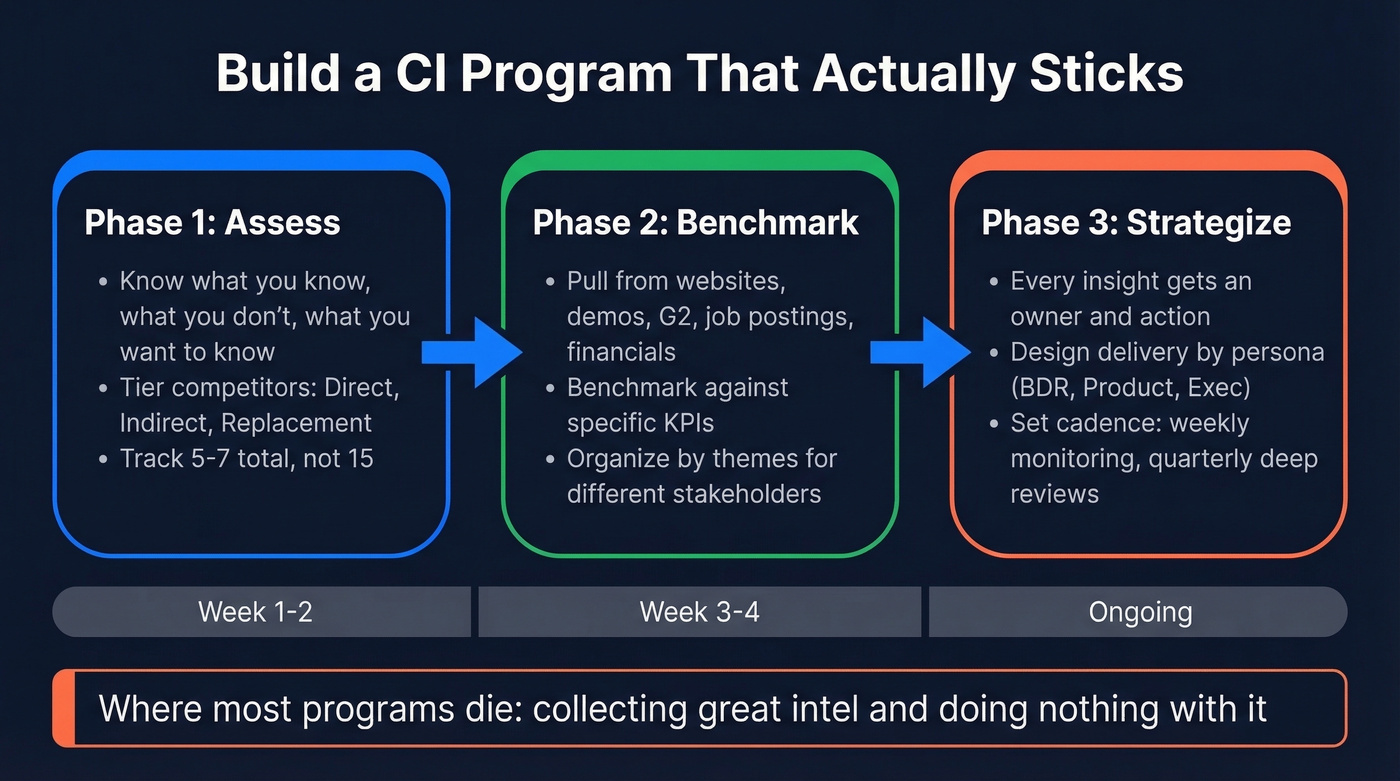
The best framework follows three phases: Assess, Benchmark, Strategize. Most teams skip straight to tools and wonder why nothing sticks.
Phase 1: Assess
Start with Crayon's K-cubed theory: Know what you know. Know what you don't know. Know what you want to know. This forces you to confront gaps before you start collecting data.
Next, identify and tier your competitors. Airtable's taxonomy works well here: direct competitors who sell the same product to the same market, indirect competitors who solve the same problem differently, and replacement competitors that customers choose instead of any solution in your category. Tier 1 gets weekly monitoring, Tier 2 monthly, Tier 3 quarterly. Track five to seven total - more than that and coverage quality collapses.
Phase 2: Benchmark
This is where competitive analytics earns its name. You're benchmarking performance against specific KPIs, not just collecting information.
Pull from competitor websites, product demos and trials, review sites like G2 and Capterra, social channels, job postings (hiring signals are gold for roadmap prediction), financial filings, and SEO/traffic tools. Organize by themes so different stakeholders can pull what they need. Don't dump everything into a single spreadsheet and call it a day.
Phase 3: Strategize
Here's where most programs die. Teams collect great intel and then do absolutely nothing with it. Every insight needs an owner, a recommended action, and a delivery channel.
Design delivery around personas. A BDR needs quick competitive positioning snippets and objection-handling scripts. A product leader needs feature gap analysis and roadmap implications. An executive needs market share trends and strategic recommendations. We've seen the same failure pattern dozens of times: six versions of the same battlecard scattered across Google Docs, Notion, and Slack, none of them current, all of them slightly wrong.
Set a cadence: weekly monitoring for news, pricing changes, and product launches; quarterly deep reviews for positioning shifts, roadmap analysis, and strategic benchmarking. Without a cadence, your program becomes a one-time project that goes stale within weeks.

Your CI program identified the right accounts. Now reach the decision-makers. Prospeo gives you 98% verified emails and 125M+ direct dials so competitive insights turn into booked meetings, not stale battlecards.
Stop analyzing competitors. Start winning their deals.
Mistakes That Kill CI Programs
The same five mistakes kill programs over and over:
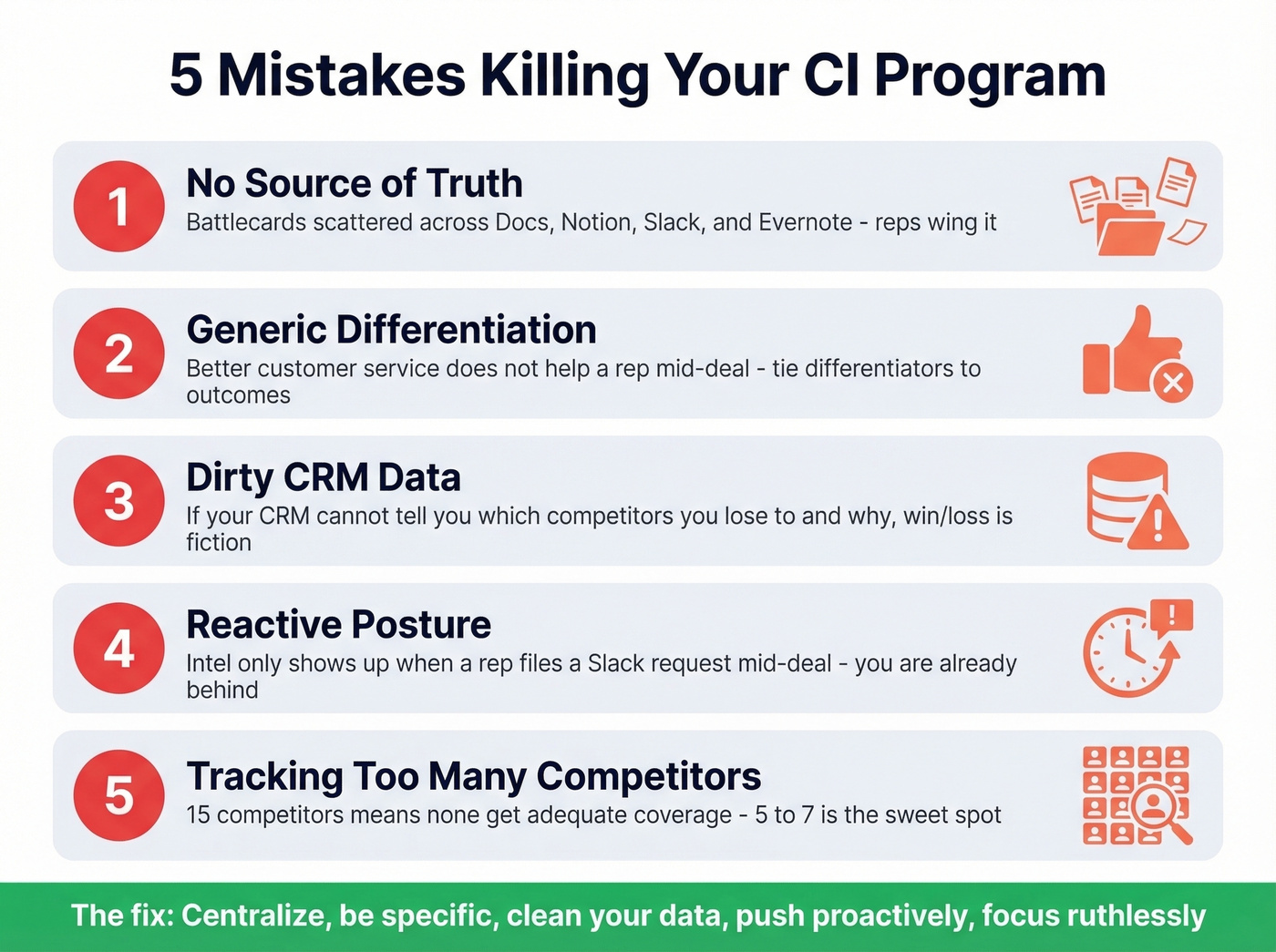
No source of truth. Battlecards live in Google Docs, Notion, Slack threads, and someone's personal Evernote. Reps can't find the latest version, so they wing it. Centralize or die.
Generic differentiation. "We have better customer service" doesn't help a rep in a competitive deal. Neither does a 47-row feature comparison matrix nobody reads. Find specific, memorable differentiators tied to customer outcomes.
Dirty CRM data. If your CRM can't tell you which competitors you're losing to and why, your win/loss analysis is fiction. (If this is a recurring issue, CRM automation software can help enforce cleaner inputs.)
Reactive posture. If intel only shows up when a rep files a Slack request mid-deal, you're already behind. The best programs push insights proactively.
Tracking too many competitors. Fifteen competitors on your radar means none of them get adequate coverage. Five to seven is the sweet spot.
Tools and Pricing for 2026
Look - the tool doesn't matter if you don't have a process. But once you do, the right tools make the difference between a program that takes 40 hours a month and one that takes 10.
| Tool | Category | Starting Price | Best For |
|---|---|---|---|
| Google Alerts | Monitoring | Free | Basic competitor tracking |
| SpyFu | SEO/Traffic | $9/mo | Keyword + ad intel on a budget |
| Competely | AI-Native CI | $39/mo | Automated competitor analysis |
| Prospeo | B2B Data | Free tier available | Verified contacts for outreach |
| SEMrush | SEO/Traffic | $129.95/mo | SEO + traffic benchmarks |
| Similarweb | SEO/Traffic | $125/mo | Traffic + audience intel |
| Crayon | Enterprise CI | ~$20k-$40k/yr | Revenue enablement |
| Klue | Enterprise CI | ~$20k-$40k/yr | Sales enablement + CI |
| AlphaSense | Enterprise CI | ~$30k-$100k+/yr | AI-powered market research |
SEMrush vs. Similarweb vs. SpyFu
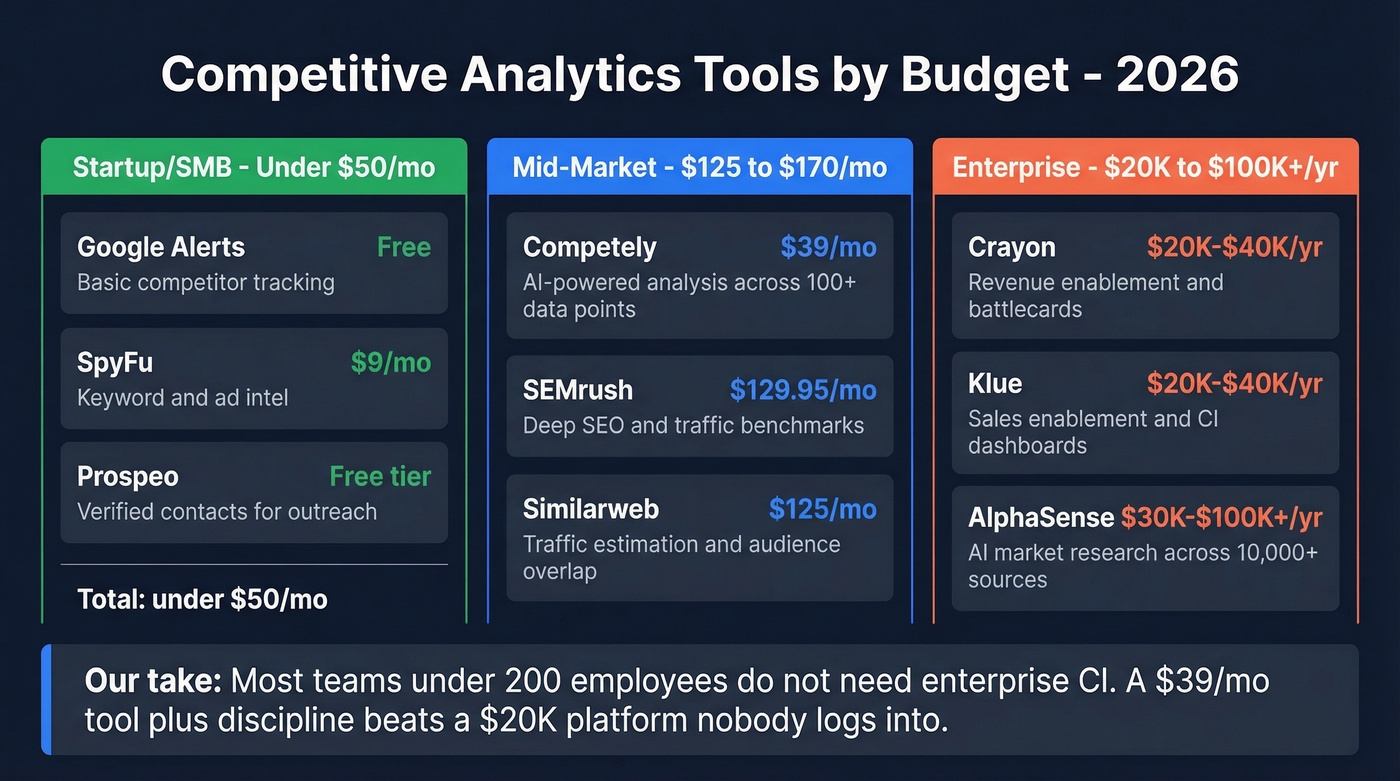
The SEO and traffic tool decision comes down to budget and depth. SEMrush at $129.95/mo is the default for deep SEO and traffic benchmarking - keyword gaps, backlink analysis, the works. Similarweb at $125/mo excels at website traffic estimation and audience overlap, which matters more for market positioning than SEO tactics. SpyFu at $9/mo is the budget pick that punches above its weight for keyword and ad intelligence.
If you're a startup, SpyFu plus Google Alerts covers 80% of what you need for digital competitor tracking. We've recommended this combo to early-stage teams for years and it holds up.
AI-Native: Competely
Competely is the most interesting newcomer in this space. At $39/mo with no long-term commitment, it automates competitor analysis across 100+ data points - messaging, pricing, product features, audience, sentiment, and SWOT. Enter your product, select competitors, get an analysis in minutes. It re-analyzes every two to four weeks and sends brief email summaries so you don't have to log in constantly.
Enterprise CI Platforms
Crayon focuses on revenue enablement with landscape visualizations, AI-scored newsfeeds, and battlecard management - expect ~$20k-$40k/year. Klue is the go-to for sales enablement teams needing CI dashboards, real-time alerts, and CRM integration in a similar range. AlphaSense typically lands in the ~$30k-$100k+/year range and searches across 10,000+ public, private, and proprietary sources with generative AI summaries - built for strategy and research teams that need depth over speed.
Our take: Most teams under 200 employees don't need an enterprise CI platform. A $39/mo tool plus a disciplined process will outperform a $20K platform that nobody logs into. Save the enterprise spend until your CI program has been running for at least six months and you've proven the workflow.
Skip the Enterprise Tier If...
You're a startup or SMB with fewer than five competitive deals per quarter. Google Alerts is still the best free monitoring tool for competitor tracking. Set alerts for competitor brand names, key executive names, and product launch keywords. Pair it with Airtable or Notion to organize intel by competitor and theme. It's not sophisticated, but it costs nothing and builds the habit.
How AI Is Reshaping CI
60% of CI teams now use AI daily, with adoption growing 76% year-over-year. The use cases are practical: real-time monitoring automation, launch-signal detection across websites, social channels, patents, and hiring posts, and role-specific insight delivery that routes the right intel to the right persona automatically.
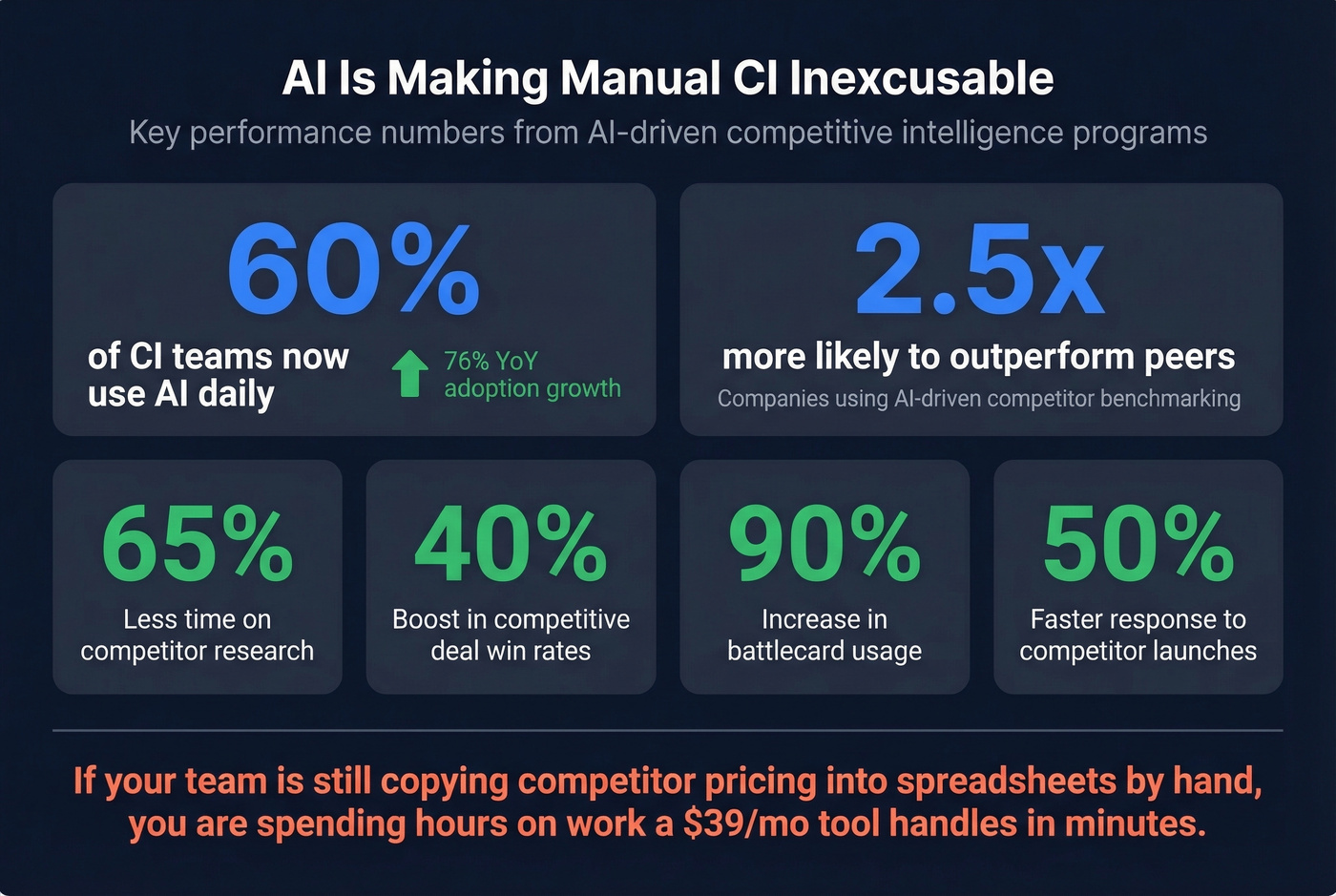
The performance numbers are striking. One SaaS case study reported a 65% reduction in competitor research time, a 40% boost in competitive deal win rates, a 90% increase in battlecard usage, and 50% faster response times to competitor launches. Even accounting for some vendor optimism, the directional trend is undeniable.
AI didn't invent this discipline - it just made the manual version inexcusable. If your team is still copying competitor pricing into spreadsheets by hand, you're spending hours on work that a $39/mo tool handles in minutes.
From Insight to Outreach
Every competitive analytics program eventually surfaces an insight that demands action. You discover you're losing enterprise deals to Competitor X. Your next move is outbound to those accounts - multi-threading into the buying committee with tailored messaging that addresses exactly why you're losing.
If 35% of your emails bounce, you've wasted the insight. I've heard some version of this from CI practitioners at every conference: "We built the perfect battlecard, identified the right accounts, and then half our emails never arrived."

This is where a verified data layer matters. Prospeo's 98% email accuracy and 7-day refresh cycle mean that when your analysis surfaces a target account, the outreach actually lands. The free tier gives you 75 verified emails per month to test the workflow before committing a dollar. (If you're comparing providers, start with a verified contact database shortlist.)
Dirty CRM data kills CI programs. Prospeo enriches your CRM with 50+ data points per contact at a 92% match rate - so your win/loss analysis reflects reality, not garbage fields. Data refreshes every 7 days, not 6 weeks.
Clean data makes competitive intelligence actually intelligent.
FAQ
What is competitive analytics?
It's the use of quantitative tools, frameworks, and data models to benchmark performance against competitors, identify vulnerabilities, and predict outcomes. Think KPIs, win-rate models, and traffic benchmarks - the numbers layer within the broader competitive intelligence discipline.
How does it differ from competitive intelligence?
Competitive analytics is quantitative - benchmarks, KPIs, predictive models. Competitive intelligence is the broader discipline that also includes qualitative research, win/loss interviews, and strategic activation. Analytics is one component of a full CI program.
How many competitors should you track?
Five to seven. Tier 1 direct rivals get weekly monitoring, Tier 2 monthly, Tier 3 quarterly. Tracking more than seven means none get adequate coverage, and your team burns out on data collection instead of acting on insights.
What's a good free tool to start with?
Google Alerts covers basic monitoring at zero cost. For acting on insights through outbound, Prospeo's free tier includes 75 verified emails and 100 Chrome extension credits per month - enough to test whether your CI-driven targeting actually converts before investing in paid tools.
How often should you update your analysis?
Weekly for news, pricing changes, and product launches. Quarterly for positioning shifts, roadmap analysis, and strategic benchmarking. Without a set cadence, even the best program goes stale within weeks.