

The Best Competitive Intelligence Tools for Every Budget
A deal slips to "no decision," and the post-mortem is awkwardly vague: "They went with a competitor." You ask the rep which one. Shrug. That's not a rep problem - it's a system problem.
Klue surveyed 300+ revenue leaders and found nearly half of reps don't know who they're competing against until negotiation. Thirteen percent don't know even after the deal closes. You can't fix messaging, pricing, or enablement when you don't know what you lost to.
Manual CI - random Slack screenshots, a "competitors" Notion page nobody updates, a quarterly battlecard sprint - always collapses under volume. Competitive intelligence tools turn scattered signals into something sellers and product teams actually use. The right CI software replaces guesswork with a repeatable system that scales alongside your GTM motion.
Our Top Picks
| Category | Tool | Best For | Starting Price |
|---|---|---|---|
| CI Enablement (Enterprise) | Klue | Enterprise battlecards & enablement | ~$20,000/yr |
| CI Enablement (Mid-Market) | Kompyte | Affordable competitor tracking | $300/yr |
| Digital Competitive Analysis | Semrush | SEO, ads, and content benchmarking | $129.95/mo |
| Financial & Strategic Research | AlphaSense | Market and earnings intelligence | ~$25,000/yr |
| Contact-Level Intelligence | Prospeo | CI insights to reachable contacts | Free (75 emails/mo) |
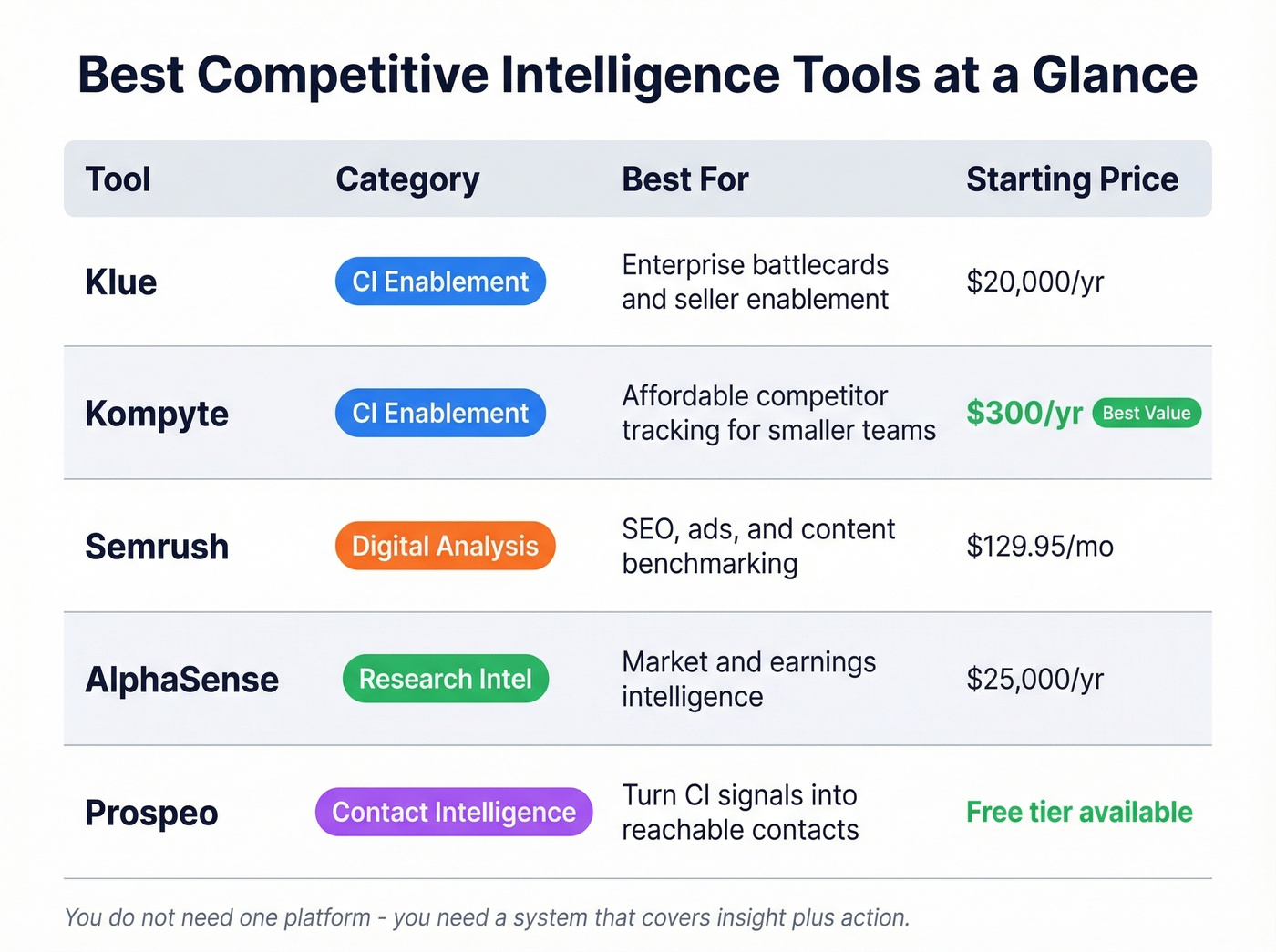
These picks aren't all the same "type" of tool. That's intentional.
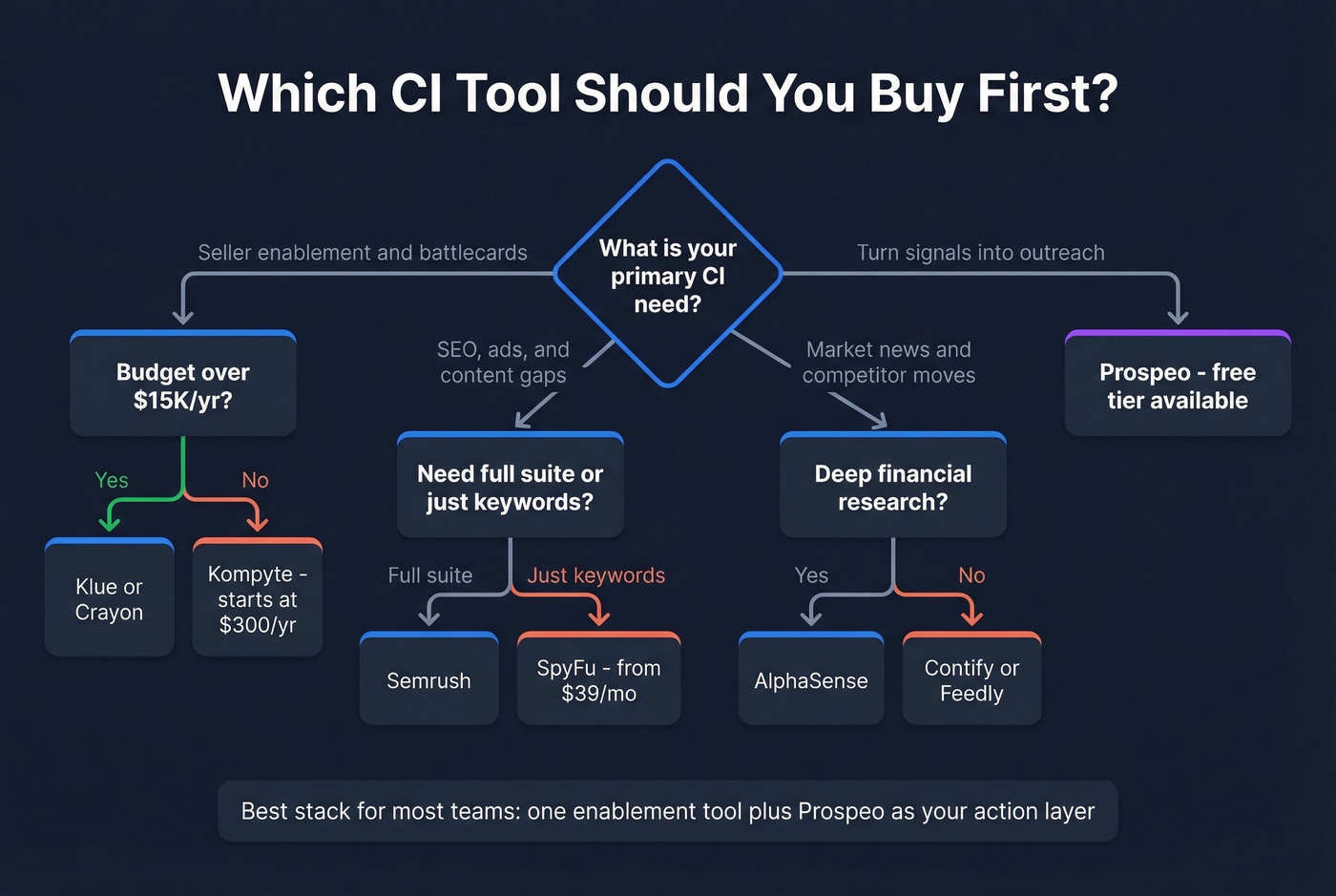
Here's the thing: you don't need a $30K platform - you need a system. Most CI programs fail because they buy a platform instead of building an operating cadence: what gets tracked, who tags it, where it gets distributed, and how it turns into action in active accounts. If you're building from scratch, start with one enablement tool plus an action layer that turns "competitor moved" into "here are the accounts impacted and the people to call."
Why CI Tools Pay for Themselves
Competitive intelligence is one of those rare GTM investments that shows up in revenue metrics fast - if you operationalize it.
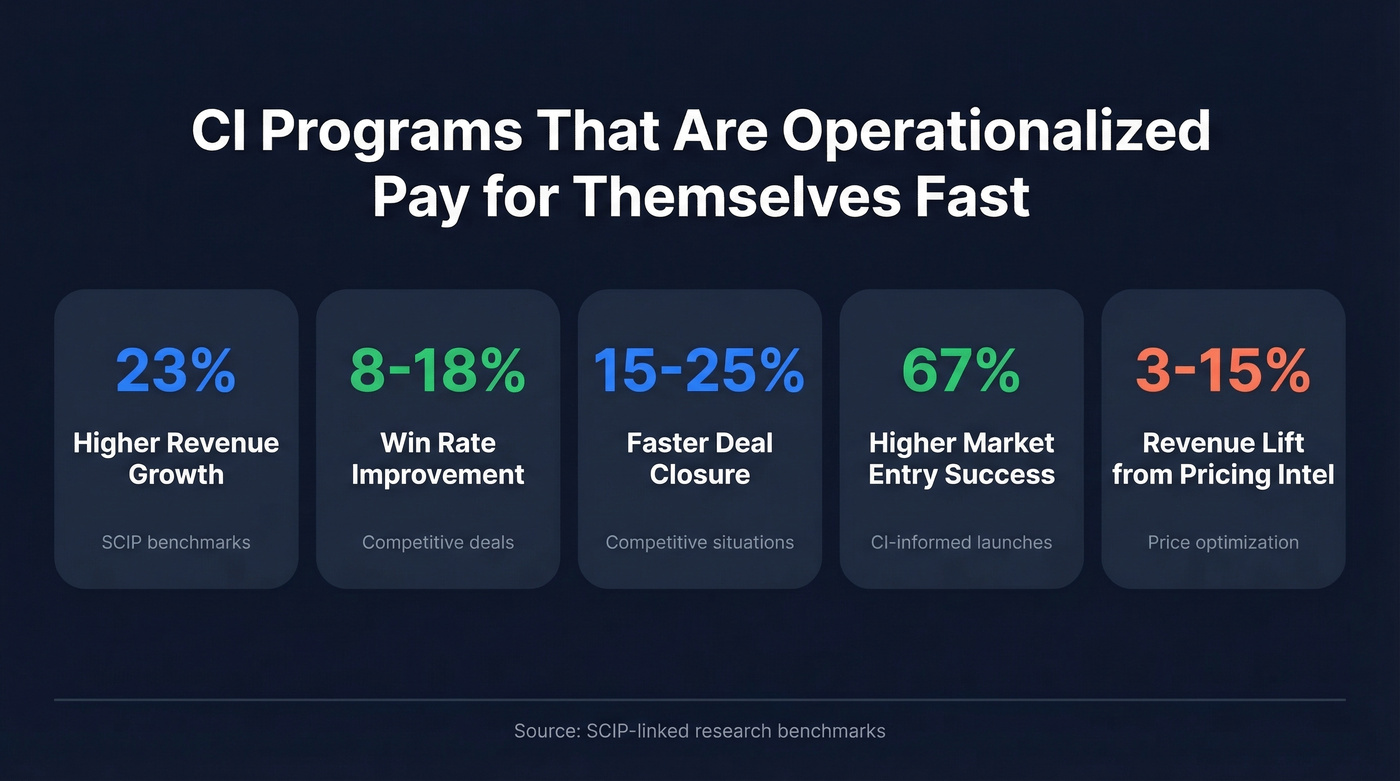
SCIP-linked benchmarks put well-run CI programs at 23% higher revenue growth, 8-18% win-rate improvement, and 15-25% faster closure in competitive deals. CI-informed market entries land with a 67% higher success rate, and pricing intelligence drives 3-15% revenue increases through better price optimization. That's the CFO story.
The operator story is simpler: fewer surprise competitors, fewer "we should've known" losses, and fewer reps winging it with outdated positioning.
We've seen CI pay for itself in a quarter when it's wired into the places people already work - CRM fields, Slack channels, call recordings, and the actual outbound motion - instead of living in a folder called "Competitive."

Which Type of CI Tool Do You Need?
Most teams buy the wrong category. They buy "a CI tool" when they really need one of four different jobs done.
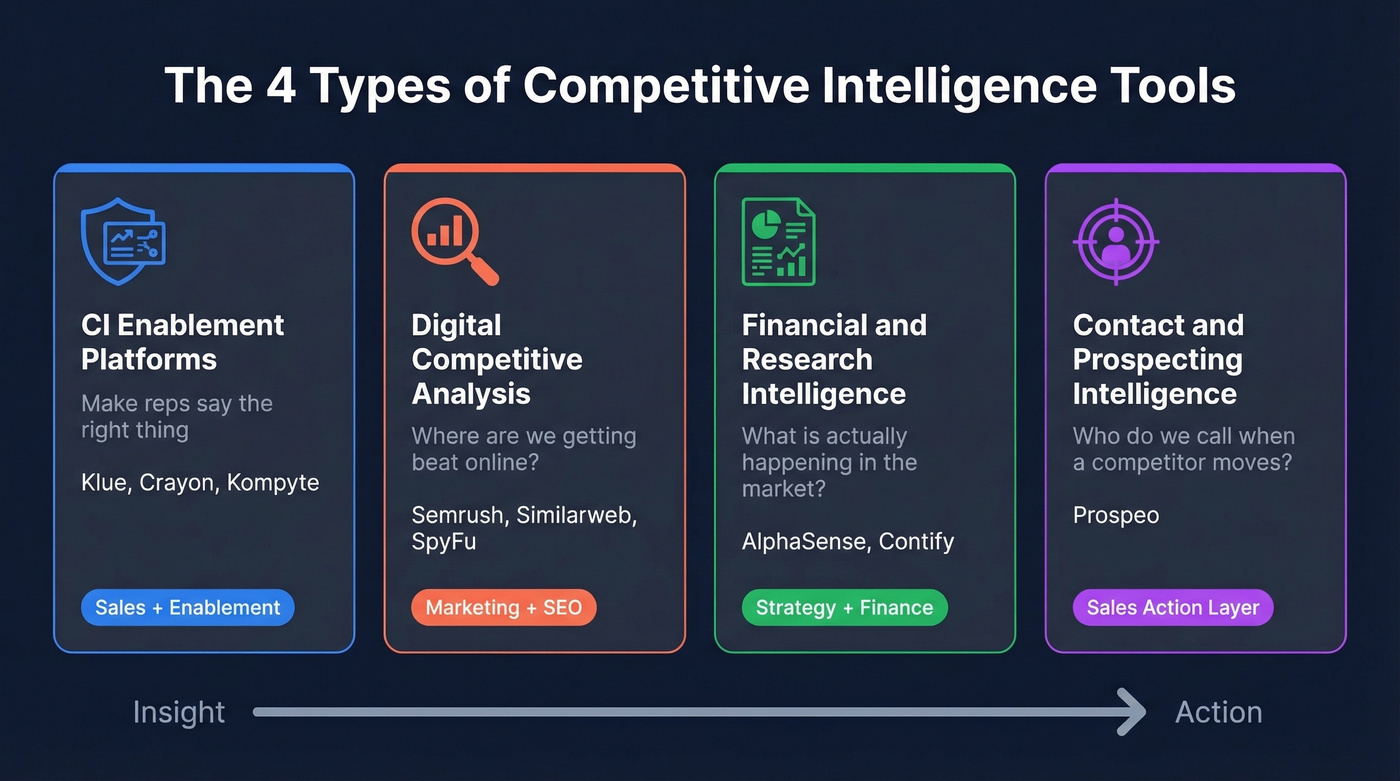
Here's the taxonomy we use:
CI Enablement Platforms (Klue, Crayon, Kompyte) - Battlecards, win/loss, competitive deal support, and distribution into seller workflows. The "make reps say the right thing" layer. Any serious platform here should integrate directly with your CRM.
Digital Competitive Analysis (Semrush, Similarweb, SpyFu) - SEO, paid search, traffic, content gaps, and share-of-voice. Marketing's "where are we getting beat online?" layer.
Financial & Research Intelligence (AlphaSense) - Earnings transcripts, filings, expert calls, and deep market research. Strategy's "what's actually happening in the market?" layer.
Contact & Prospecting Intelligence - The action layer most CI stacks miss entirely. Once you learn a competitor is moving - new pricing page, new product line, new vertical push - you still need to reach the right people at the right accounts. Without this layer, CI becomes shelfware: interesting insights nobody acts on.
G2's CI category snapshot is a useful sanity check: Semrush shows up as a Leader, Visualping as Highest Performer, and Contify as Top Trending. Different jobs, different winners.

CI tools tell you a competitor changed pricing or launched in your vertical. Prospeo tells you exactly who to call next. Layer 30+ filters - buyer intent, technographics, job changes, headcount growth - on top of 300M+ profiles with 98% verified emails. Turn every competitive signal into a targeted outbound list in minutes, not days.
Stop tracking competitors you can't outsell. Start reaching the accounts they're targeting.
The 12 Best Competitive Intelligence Software Options
Klue - Best Enterprise CI Enablement
Klue is what we recommend when you've got a real enablement function and 50+ sellers who need consistent competitive talk tracks. Battlecards are the headline, but the real value is distribution: getting the right intel into Salesforce, Slack, and Microsoft Teams so it shows up where deals happen.
The platform forces discipline around win/loss analysis, which is where most CI programs actually break down. If nobody's tagging why deals were lost to specific competitors, your battlecards are just creative writing.
Pros
- Strong battlecard delivery and competitive deal support
- Win/loss structure that forces discipline
- Integrations that reduce "CI lives in a doc" syndrome
Cons
- Pricing opacity is frustrating - and it's a tell: this is sold, not bought
- Review themes include alert fatigue when tracking gets too broad
- Smaller teams will feel the overhead of a platform designed for enterprise workflows
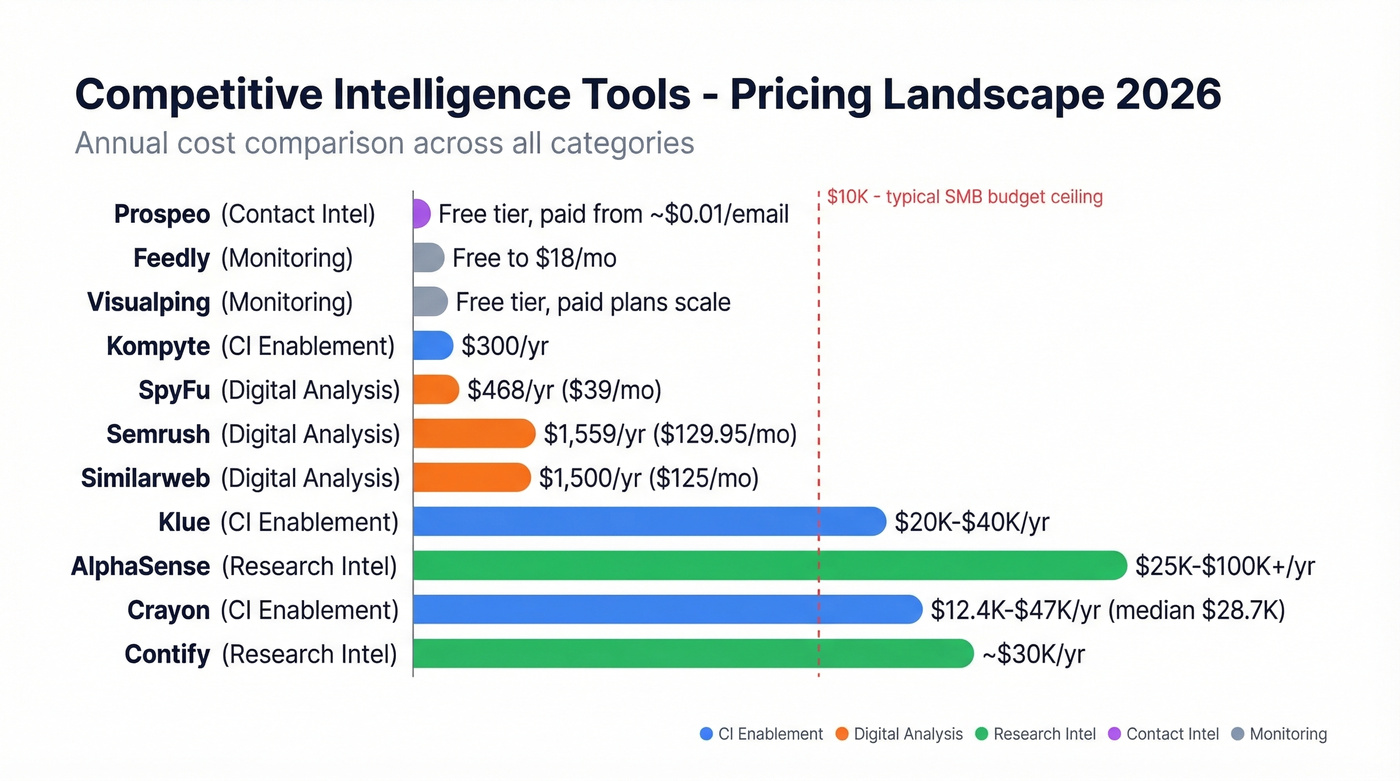
Pricing typically runs ~$20,000-$40,000/year depending on seats and scope. Klue won't replace your contact database, but it's better at enablement workflows than any "everything platform" approach.

Crayon - Best Automated Competitor Monitoring
Crayon's core strength is automated monitoring at scale - lots of sources, lots of competitors, lots of change detection - then packaging that into battlecards and updates your org can consume. If you're tracking 20+ competitors across web, messaging, and product surfaces, Crayon's breadth is hard to match.
The tradeoff is noise. We've run bake-offs where teams loved the coverage for a week, then stopped opening alerts because the signal-to-noise ratio wasn't tuned. You need someone who owns the filtering, or the volume becomes a liability.
Vendr's contract data across 90 purchases puts Crayon at a $28,750/year median, with a $12,450-$47,100 range. Enterprise deployments can run $100,000+/year, and add-ons often tack on 15-30%.

Kompyte - Best Value CI Platform
Kompyte is the budget-friendly option that still feels like a real system, not a pile of bookmarks. Software Advice reviewers consistently call it easy to use for accessing competitor battlecards, and it holds a 4.6/5 rating across 37 reviews.
Use it if you want structured competitor tracking with clear tiering: Essentials (10 companies, 25 users), Professional (20 companies, 100 users), and Unlimited. You'll start seeing insights in 24-48 hours, and full deployment usually lands in a week or two.
Skip it if social coverage is your primary requirement - reviews consistently flag limited social media monitoring and occasional slow performance.
Pricing starts at $300/year.
Prospeo - Best for Turning CI Into Sales Action
Most competitor tracking platforms stop at "here's what changed." Prospeo picks up where they leave off - connecting competitive signals to the people you need to reach. When a rival launches new pricing or enters your vertical, Prospeo's 300M+ professional profiles and intent data across 15,000 Bombora topics let you identify in-market accounts and pull verified contacts in minutes.
Why it belongs in a CI stack: 98% email accuracy and 125M+ verified mobile numbers mean outreach actually lands. Thirty-plus search filters - including technographics, job changes, headcount growth, and funding - let you slice accounts by the exact competitive signal you're acting on. The 7-day data refresh cycle keeps contacts current when the industry average sits at six weeks. And self-serve pricing at ~$0.01/email with a free tier means there's no procurement friction slowing you down.
The gap between "we know the competitor moved" and "we called the 12 impacted accounts" is where most CI programs lose their value.
Contify - Best for News & Market Intelligence
Contify is the "market and news intelligence" flavor of CI, strong when stakeholders care about narratives: competitor moves, category shifts, and curated briefings. G2 flags it as Top Trending in the CI category. Integrations cover Slack, Salesforce, and Teams. Expect around $30K/year for many mid-market deployments. Capterra rating sits at 4.0/5.
AlphaSense - Best for Finance & Strategy Teams
AlphaSense is premium research intelligence: earnings transcripts, SEC filings, expert calls, and deep search across financial and market content. When corporate strategy asks "what's the competitor's real direction and budget?" this is the tool that answers it.
Overkill for most product marketing teams doing weekly battlecards, but for corp dev and finance, it compresses research cycles dramatically. Pricing runs ~$25,000-$100,000+/year depending on seats and content packages.
Semrush - Best Digital Competitive Analysis
Use Semrush when "competitive intelligence" really means SEO, PPC, and content benchmarking: keyword gaps, ad copy history, backlink profiles, and content opportunities. It's a G2 CI category Leader for good reason.
Skip it if you need battlecards in your CRM or seller-facing competitive positioning. Semrush is a marketing intelligence tool, not a sales enablement platform.
Pricing is clean and self-serve: Pro $129.95/mo, Guru $249.95/mo, Business $499.95/mo.
Similarweb - Best for Traffic & Market Share
The fastest way to sanity-check competitive web performance: traffic estimates, audience overlap, referral sources, and channel mix. Especially useful when you're trying to quantify "they're everywhere" into actual numbers. Starter runs $125/mo, Professional $333/mo on annual billing, and enterprise is custom.
SpyFu - Budget SEO/PPC Intel
The scrappy alternative for keyword and ad history tracking when Semrush feels like too much tool. Basic $39/mo, Professional $79/mo. Competitor keyword overlap plus PPC intel, nothing more. If that's all you need, don't overspend.
Feedly - Content & News Monitoring
The cleanest way to aggregate competitor blogs, press, and category news, with AI-driven topic tracking on paid plans. Free tier available, Pro runs $6-$18/mo, enterprise is custom.
Visualping - Website Change Detection
Monitor competitor page changes on pricing, product pages, docs, and careers pages. G2's Highest Performer in the CI category snapshot - it does one job well. Free tier available, paid plans scale by checks and alerts.
Google Alerts + Owler - Free Starting Point
The $0 baseline CI stack. Alerts catches web mentions; Owler adds company news and funding updates. Not enterprise CI, but enough to build the habit of tracking competitors before you buy anything. If you're not doing even this, start here today.
Full Pricing Comparison
The fact that Klue, Crayon, and Contify all hide their pricing tells you everything about how they sell. If procurement friction is a real constraint, self-serve pricing is the difference between "we'll trial this next week" and "we'll revisit next quarter."
| Tool | Best For | Starting Price | Pricing Model |
|---|---|---|---|
| Klue | Enablement (Ent) | ~$20k/yr | Quote-based |
| Crayon | Monitoring | ~$12.5k-$47.1k/yr | Quote-based |
| Kompyte | Value CI | $300/yr | Quote-based |
| Contify | News + market | ~$30k/yr | Quote-based |
| AlphaSense | Research | ~$25k/yr | Quote-based |
| Semrush | SEO/PPC | $129.95/mo | Self-serve |
| Similarweb | Traffic intel | $125/mo | Self-serve |
| SpyFu | Budget SEO | $39/mo | Self-serve |
| Feedly | News monitor | Free / $6-$18/mo | Freemium |
| Visualping | Change detect | Free | Freemium |
| Google Alerts + Owler | Free CI | $0 | Free |
| Prospeo | Contact + intent | Free / ~$0.01/email | Freemium |
How to Build Your CI Stack
Most teams don't need "one platform to rule them all." They need a layered stack where each tool has a job, and someone owns the weekly rhythm.
Startup stack (~$500/year): Google Alerts + Owler for baseline monitoring, Feedly for category and competitor content streams, and a free-tier contact data tool to turn "competitor moved" into verified contacts you can actually reach.
Mid-market stack (~$5K-$15K/year): Kompyte for battlecards and tracking across 5-20 competitors, Semrush for SEO/PPC and content gap analysis, and a contact data and intent layer so CI becomes outbound plays - not just internal docs. At this level, pairing competitor tracking with a contact action layer is what separates insight from pipeline.
Enterprise stack (~$50K-$150K/year): Klue or Crayon for enablement and automated monitoring at scale, AlphaSense for deep strategic and financial research, and a verified contact data platform for emails, mobiles, and intent topics to activate insights across named accounts. Enterprise teams often layer multiple platforms to cover enablement, digital analysis, and research in parallel.
Let's be honest: most teams get 80% of the value from Google Alerts + a shared Notion database + a contact data layer that turns insights into pipeline.
The best CI programs don't just monitor - they mobilize. When a competitor raises prices or loses a key exec, you need verified contacts at affected accounts now, not next quarter. Prospeo's 7-day data refresh means you're reaching decision-makers with current info while competitors work from stale lists. At $0.01 per email, the action layer costs less than one lost deal.
Every competitive insight is worthless until someone picks up the phone.
Mistakes That Kill CI Programs
That Klue stat from the intro - nearly half of reps flying blind on competitors - doesn't happen because teams lack tools. It happens because of broken process. Here's the 7-problem framework that shows up again and again:
- Decentralized CI - intel scattered across docs, Slack, and inboxes with no source of truth.
- No strategic direction - tracking everything, tying nothing to objectives.
- Reactive deal support - CI requests show up when the deal's already on fire.
- Unreliable CRM data - dirty fields make win/loss and prioritization meaningless.
- Poor differentiation - generic fluff or feature minutiae that doesn't help sellers.
- Inaccurate internal messaging - nobody validates positioning with real win/loss evidence.
- Too reactive overall - the team becomes a competitor news desk, not a GTM advantage.
One more practical mistake worth flagging: teams try to "AI their way" out of process. A recurring theme in r/ProductMarketing threads is that people feed competitor data into ChatGPT or NotebookLM, get decent output, but the manual effort of keeping it current kills the habit within weeks. Without a cadence, even the best tools become expensive shelfware.
FAQ
What is competitive intelligence software?
Competitive intelligence software systematically tracks, analyzes, and distributes information about competitors - pricing changes, product moves, hiring patterns, marketing shifts, and positioning - so teams can act on it. Options range from free monitoring setups to enterprise enablement platforms costing $100K+/year with full CRM integration. Gartner's market guide provides a useful framework for evaluating categories.
How much do CI tools cost?
CI tools range from $0 (Google Alerts + Owler) to $100,000+/year for enterprise Crayon or AlphaSense deployments. Vendr benchmark data puts the median Crayon contract at ~$28,750/year. Budget options like Kompyte start at $300/year, and Prospeo offers a free tier with 75 verified emails per month for contact-level intelligence.
What's the difference between CI and market intelligence?
Competitive intelligence focuses on specific competitors - their moves, strengths, weaknesses, and how to win against them in deals. Market intelligence covers broader industry trends, segments, and macro forces. Most teams need both, and they usually come from different tools and different owners inside the company. SCIP's resource library is a solid starting point for understanding the distinction.
How do I turn competitive insights into sales action?
Map insights to accounts, then reach the right stakeholders fast. Pair your CI enablement tool with a contact data platform to pull verified emails and direct dials for decision-makers at affected accounts, then launch targeted sequences while the signal is fresh.