

How to Build a Competitive Landscape Analysis That Actually Gets Used
A Fortune 500 PM posted on r/ProductManagement asking what "managing all competitive analysis" even means. No direction on deliverables. No frameworks. Just a vague mandate and a blank slide deck. That post captures the state of competitive landscape analysis at most companies - everyone agrees it matters, nobody agrees on what it should look like.
Here's the thing: 68% of B2B deals involve at least one competitor, and 38% of B2B deals are lost to "no decision" - often because reps couldn't articulate why their solution beats the alternative of doing nothing. Average sales team competitive preparedness scores just 3.8 out of 10. This guide closes that gap with a process you can run in two to four weeks, frameworks that earn their complexity, and a tool stack that doesn't require a six-figure budget.
What You Need (Quick Version)
If you're short on time, here's the minimum viable competitive landscape:
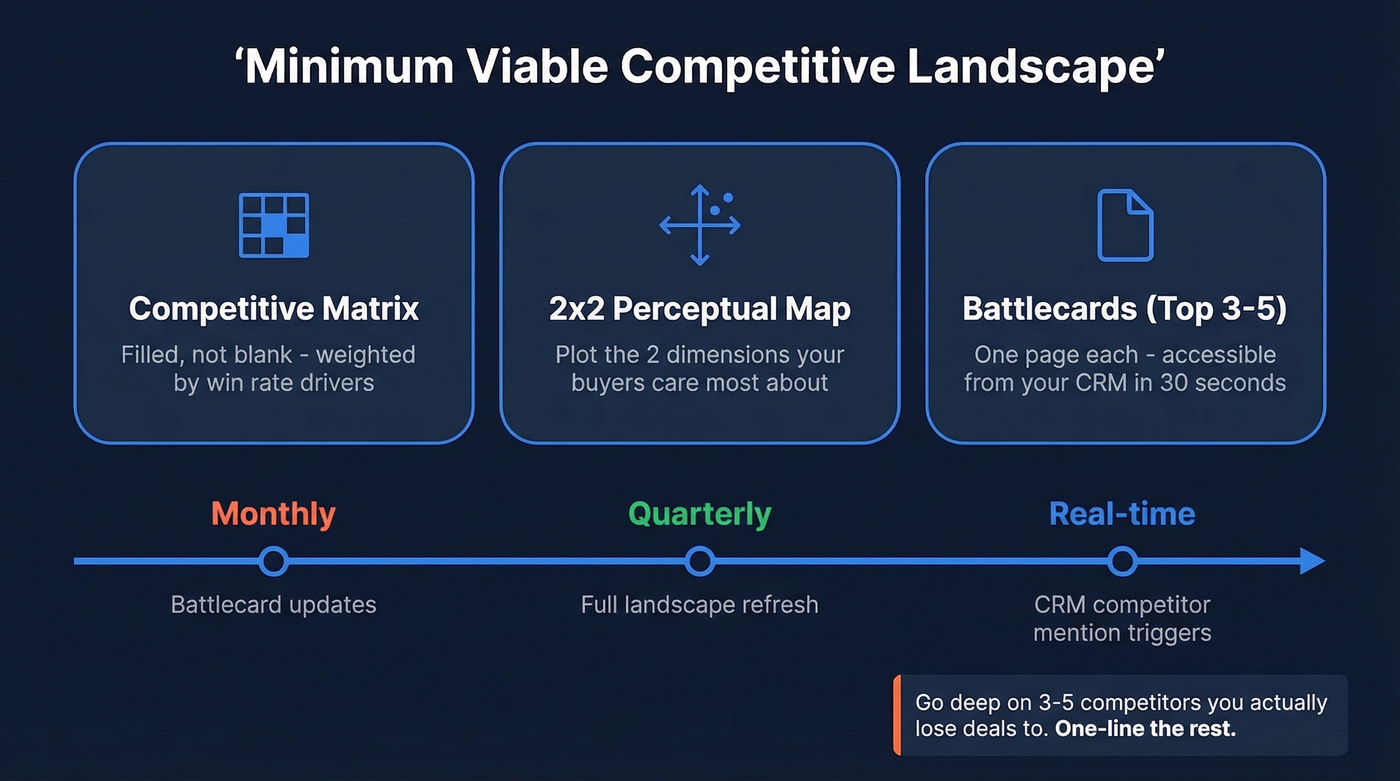
- Three deliverables: a competitive matrix (filled, not blank), a 2x2 perceptual map, and one-page battlecards for your top 3-5 competitors.
- Two frameworks: Porter's Five Forces for macro market dynamics, and a perceptual positioning map for head-to-head differentiation. SWOT is optional - it's a summary format, not an analytical engine.
- Quarterly refresh minimum. Monthly battlecard updates if you're in a fast-moving market. Set CRM triggers for real-time competitor mentions in deals.
- The one mistake to avoid: analyzing 15 competitors at equal depth. Go deep on 3-5 you actually lose deals to. One-line the rest.
- Tool stack under ~$200/mo: Semrush for digital intelligence ($139.95/mo), G2 for review monitoring (free), and your CRM for deal-level competitor tracking.
What Does Competitive Landscape Mean?
The definition is straightforward: it's the process of identifying who you compete with and comparing how each player wins - their positioning, pricing, ICP, strengths, and vulnerabilities - to spot threats, gaps, and differentiation opportunities. The concept extends beyond a simple list of rivals. It covers the full ecosystem of forces shaping your market position.
There's a useful distinction between landscape analysis and competitive intelligence: landscape analysis is a point-in-time snapshot, while CI is the ongoing practice of collecting, analyzing, and distributing competitor insights across the organization. You need both, but the snapshot comes first. You can't build a CI program without knowing who you're watching and why.
The CI market has grown to roughly $50.9B, with projections hitting $122.8B by 2033. Companies are treating competitive insight as infrastructure, not a one-off project. But the infrastructure starts with a well-built landscape.
The 7-Step Process
1. Audit Your Own Position First
Before you map competitors, map yourself. Most teams skip this and jump straight to Googling competitors, which means they're comparing others against an undefined baseline.
Three questions to answer honestly: What are the top 3 pains your ICP actually pays to solve - not what your marketing site says, but what closed-won customers tell you? What's your real value proposition, stripped of buzzwords? And where in the buying journey do prospects first encounter you, and where do they drop off?
We've seen teams spend weeks building a landscape against a value proposition that doesn't match how customers actually describe the product. Do the internal work first.
2. Identify and Categorize Competitors
Not all competitors deserve equal attention. Startups fail at a rate of 21.5% in year one and 48.4% within five years - half the companies on your radar today won't exist in three years. Categorize before you invest research time.
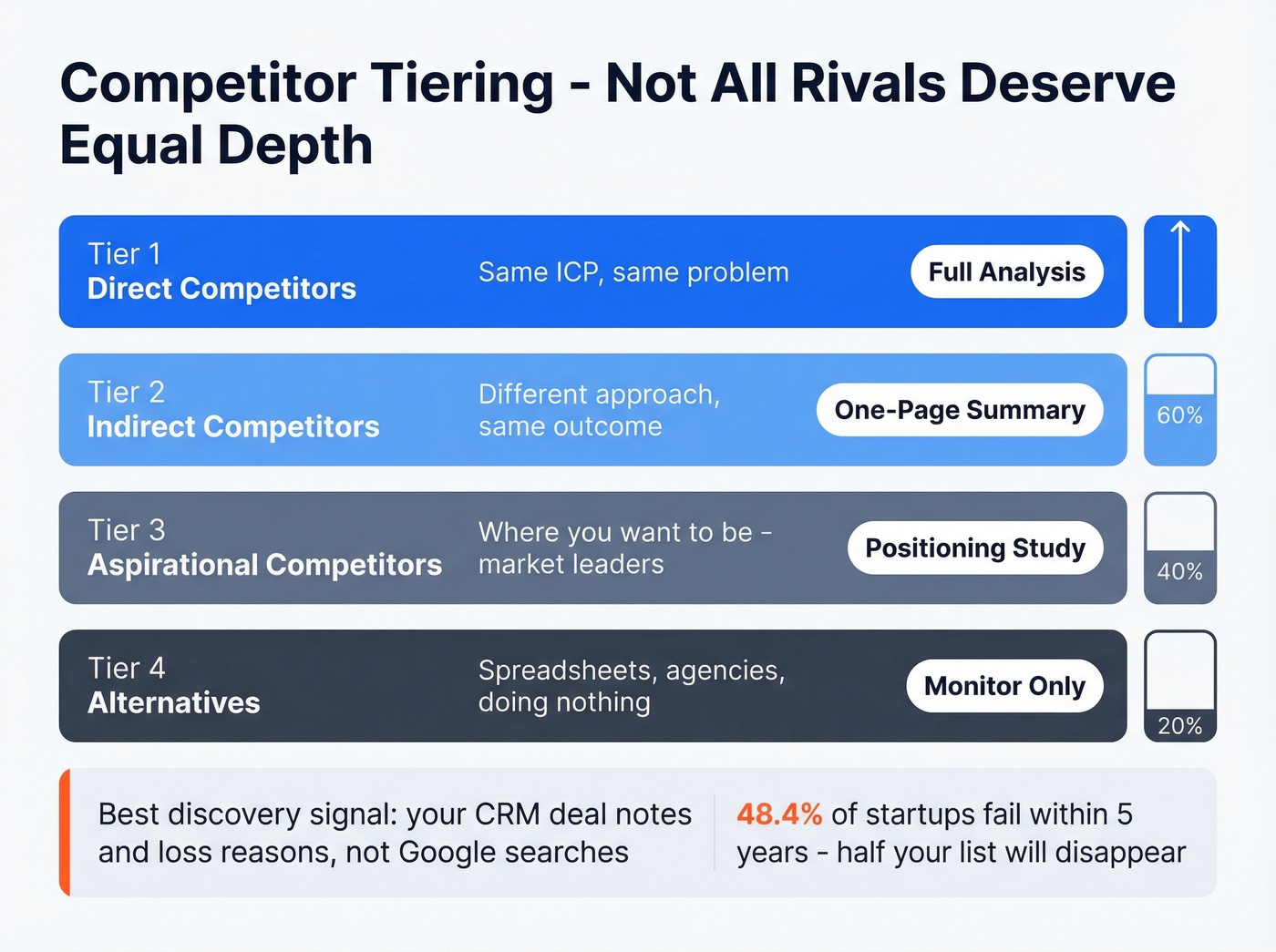
| Tier | Definition | Example | Depth |
|---|---|---|---|
| Direct | Same ICP, same problem | Your closest 3-5 | Full analysis |
| Indirect | Different approach, same outcome | Adjacent categories | One-page summary |
| Aspirational | Where you want to be | Market leaders | Positioning study |
| Alternatives | Non-software substitutes | Spreadsheets, agencies | Monitor only |
The best discovery signal isn't Google - it's your CRM. Look at competitor mentions in deal notes, loss reasons, and call recordings. That tells you who you're actually losing to, not who you think you're losing to. Some guides recommend comparing against 5-10 competitors, and that works if you have a dedicated CI team. For most PMMs running this alongside other work, 3-5 is the realistic ceiling.
You can also borrow Crayon's leadership-label approach: tag each competitor as an "Industry Billboard" (highest visibility), "Market Leader" (highest estimated revenue among public companies), or "Top Challenger" (highest estimated revenue among private companies). This makes prioritization conversations with leadership much faster.
3. Collect Data
Your competitive matrix is only as good as the data feeding it.
Internal sources come first. CRM deal notes with competitor mentions, win/loss interview transcripts, and sales call recordings give you ground truth about how competitors actually show up in deals. Customer success teams hear competitive chatter constantly - ask them.
Review sites are underrated. G2 and Capterra reviews surface competitor weaknesses that no amount of website analysis will reveal. Pay attention to 2-3 star reviews. That's where the real complaints live.
Digital intelligence tools like Semrush or Similarweb give you traffic estimates, keyword gaps, content strategy signals, and ad spend patterns. These are proxies, not gospel, but useful ones.
Primary research is where most teams fall short. Win/loss interviews with recent prospects - both won and lost - are the single highest-value input to any competitor study. The problem is stale contact data. If you're trying to reach a prospect who evaluated you six months ago and their email bounces, that interview never happens. Prospeo handles this with 98% email accuracy on a 7-day data refresh cycle, and the free tier gives you 75 verified emails plus 100 Chrome extension credits per month - enough for a solid round of competitive interviews.

Social monitoring rounds out the picture. Track competitor mentions on Reddit, industry Slack communities, and X. The unfiltered sentiment there is often more honest than any analyst report.
4. Build Your Competitive Matrix
A blank template is useless. Here's a filled example for a hypothetical project management SaaS market:
| Dimension | Your Product | Competitor A | Competitor B | Competitor C | Competitor D |
|---|---|---|---|---|---|
| Positioning | "PM for eng teams" | "All-in-one work OS" | "Simple task mgmt" | "Enterprise PPM" | "Agile-native PM" |
| Primary ICP | Mid-market eng orgs | SMB to enterprise | Freelancers, SMBs | Enterprise PMOs | Dev teams, startups |
| Pricing model | Per-seat, $15/mo | Per-seat, $10/mo | Freemium, $8/mo | Custom, ~$40K/yr | Per-seat, $12/mo |
| Core differentiator | Dev tool integrations | Breadth of features | Simplicity, speed | Governance, reporting | Sprint workflows |
| Key weakness | No resource mgmt | Complexity, bloat | Lacks enterprise features | Slow implementation | Narrow use case |
The scoring methodology matters more than the table itself. Weight each dimension by how much it influences win rates in your deals. If integrations drive 40% of your wins, assign a 0.4 weight. A competitor scoring 8/10 on integrations gets a weighted score of 3.2, while one scoring 5/10 gets 2.0. Multiply across all dimensions, sum the weighted scores, and you've got a competitive index that reflects reality - not gut feel. Most templates skip this step entirely, which is why they produce pretty charts that don't drive decisions.
5. Apply the Right Frameworks
Porter's Five Forces, introduced in 1979, is a macro tool. Use it when you need to understand the structural dynamics of your market - supplier power, buyer power, threat of substitutes, threat of new entrants, and competitive rivalry. It answers "how attractive is this market?" not "how do we beat Competitor X." Use it when entering a new market, evaluating an acquisition, or presenting to the board. Skip it for quarterly battlecard updates.
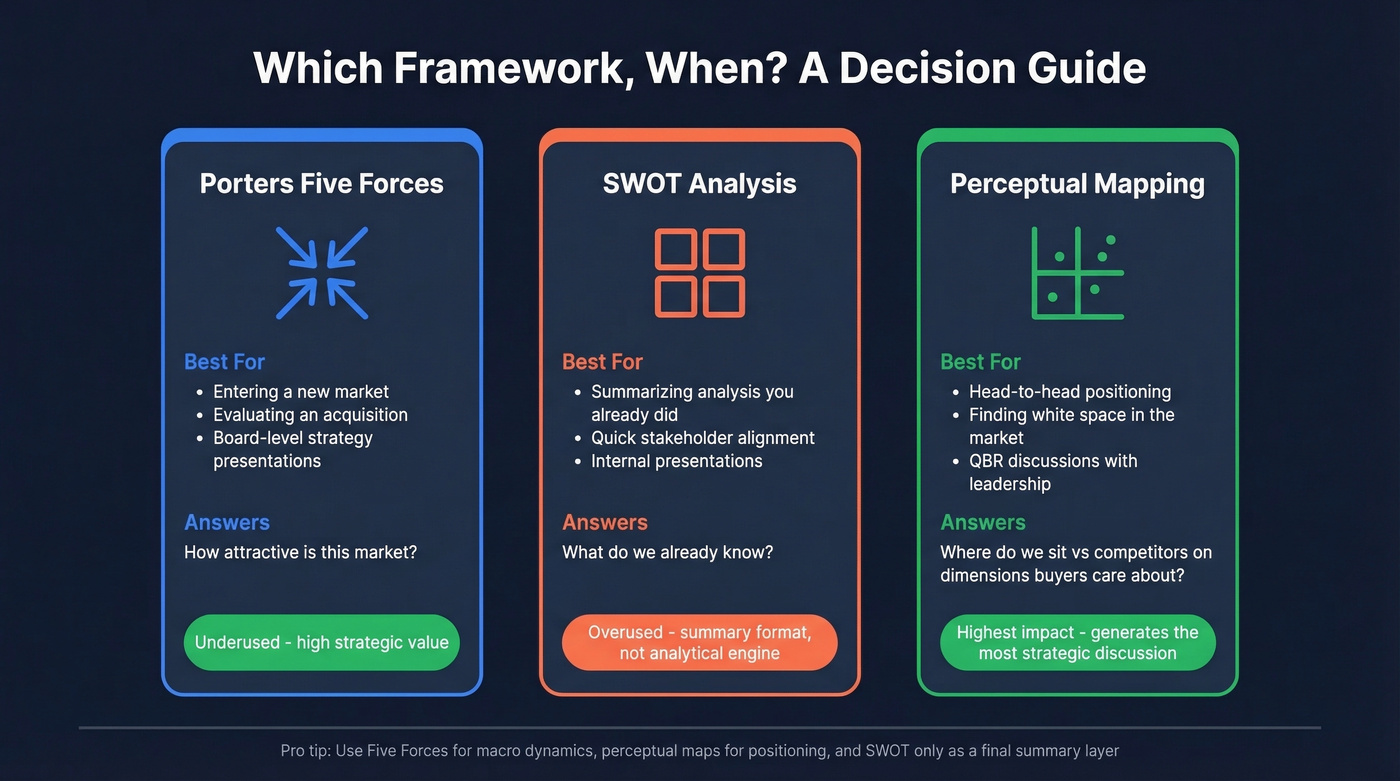
SWOT is overused. Teams default to it because it's familiar, not because it's the most useful framework. Five Forces is underused and far more revealing for strategic planning. SWOT works fine as a summary format after you've done the real analysis - just don't mistake it for the analysis itself.
Perceptual mapping is the framework that changes conversations. Plot competitors on a 2x2 grid using the two dimensions your buyers care most about. For a SaaS example: X-axis is "ease of implementation" (low to high), Y-axis is "depth of analytics" (basic to advanced). Where you sit relative to competitors - and where the white space is - becomes immediately visible. We've found this single artifact generates more strategic discussion in QBRs than any other deliverable.
6. Turn Findings Into Deliverables
A landscape that lives in a slide deck never gets opened again.
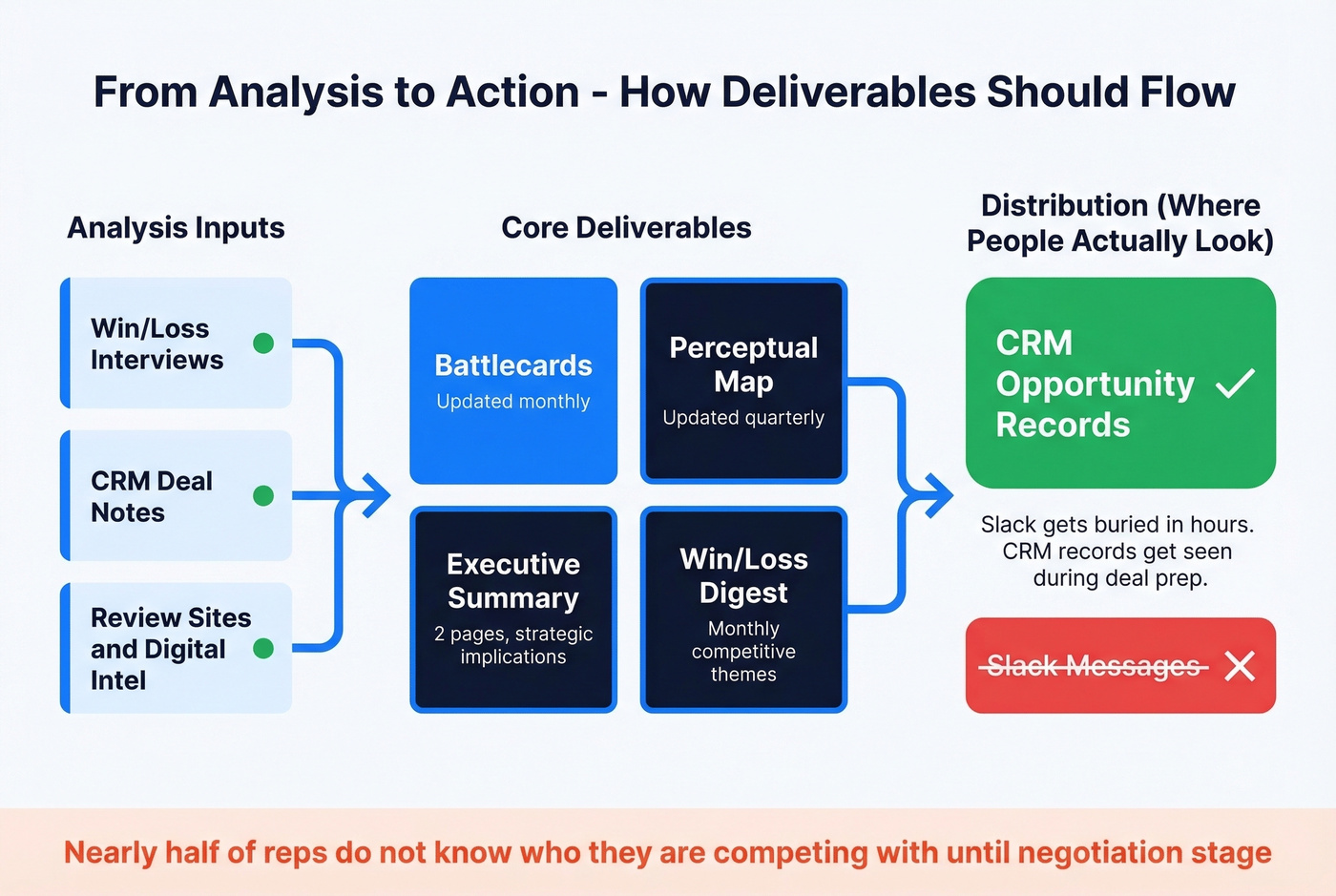
Your analysis needs to produce artifacts people actually use during their workday: one-page battlecards for each top competitor (updated monthly, accessible from your CRM), a perceptual positioning map (updated quarterly, shared in QBRs), a two-page executive summary focused on strategic implications, and a monthly win/loss digest of competitive themes from closed deals.
Venngage offers solid templates if you need a visual starting point. But the format matters less than the distribution. If reps can't find the battlecard in the 30 seconds before a call, it doesn't exist.
7. Operationalize and Refresh
The landscape is a living document. Run a full refresh quarterly, update battlecards monthly, automate CRM competitor tracking through RevOps, and conduct win/loss interviews after every lost deal.
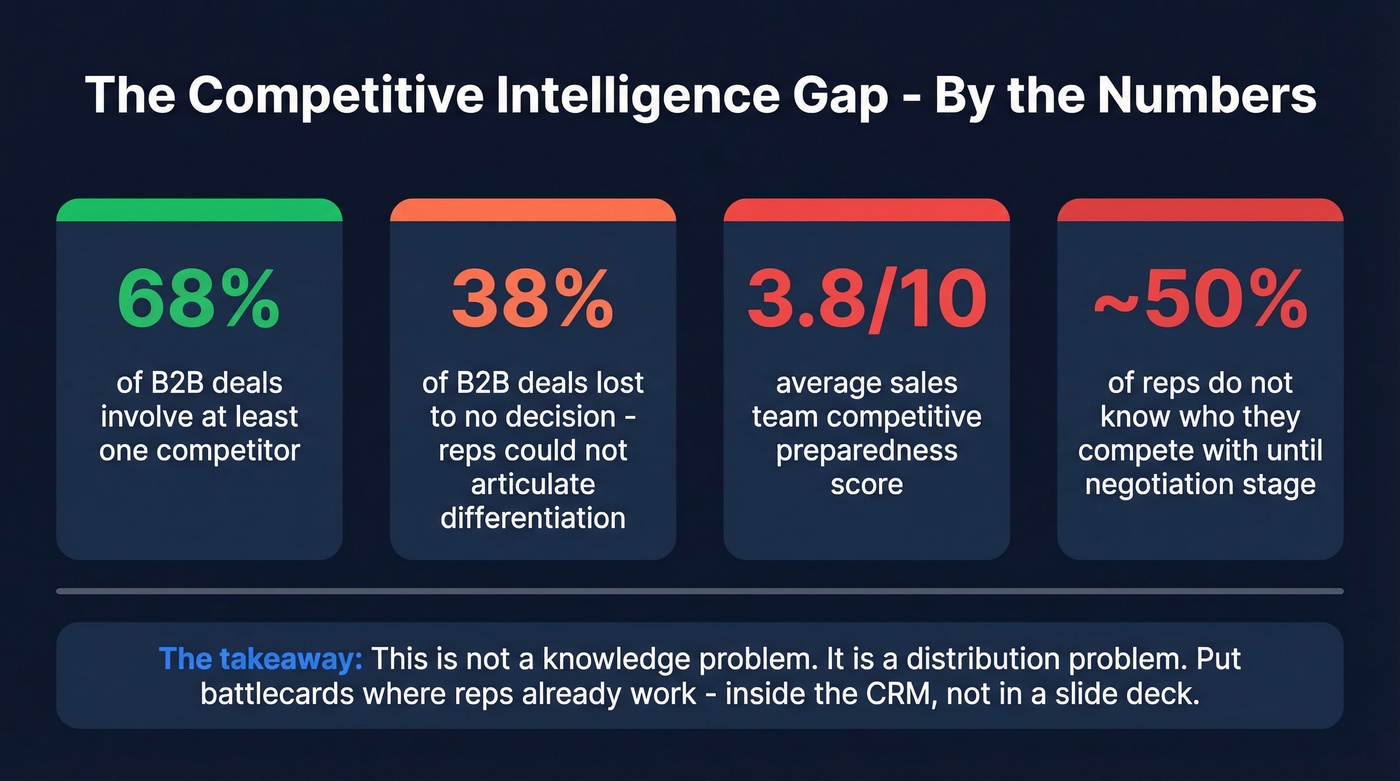
Distribute through your CRM, not Slack. Slack messages get buried in hours. A battlecard pinned to a CRM opportunity record gets seen when it matters - during deal prep.
A stat that should frustrate you: nearly half of reps don't know who they're competing with until negotiation stage, and 13% don't know even after the deal closes. That's not a knowledge problem. That's a distribution problem.

Win/loss interviews are the highest-value input to any competitive landscape analysis - but they never happen when prospect emails bounce. Prospeo's 7-day data refresh and 98% email accuracy mean you actually reach the buyers who evaluated you.
Stop losing competitive insights to stale contact data.
How CI Grew a SaaS Company 62%
DocPulse (anonymized, per a case study published by Octopus Intelligence) was a B2B SaaS company in digital document workflow automation for mid-sized law firms. They hit a wall in year two. Revenue was $2.6M ARR, growth had slowed to 4% quarter-over-quarter, churn was creeping toward 7%, and they had nine months of runway.
The findings from their competitive landscape analysis were humbling. Their top five direct competitors weren't who they thought. 47% of their customers used DocPulse alongside a competitor - not as a replacement. And their messaging was indistinguishable from every other player in the space: "secure, compliant, efficient." The same words, on every website.
The team repositioned based on the CI findings, rewrote messaging to emphasize their actual differentiator (workflow automation depth for legal-specific use cases), and rebuilt battlecards around the competitors they were actually losing to. A/B testing showed CTR up 60% and demo bookings up 41% in the first month. Nine months later: ARR hit $4.2M (62% YoY growth), churn dropped to 3.1%, CAC fell 27%, and the average sales cycle compressed from 38 to 25 days.
The landscape analysis didn't just inform strategy. It rewrote it.
5 Mistakes That Ruin Your Analysis
Price-only mapping. A product marketer on r/ProductMarketing described leadership mapping the competitive landscape almost exclusively by price brackets, then dictating "build a $100-$120 product that beats these competitors." This drives incremental feature copying and misses the real competition. Customers compare across categories and price points - integrations, brand trust, and problem-fit matter more than being $20 cheaper.
No defined deliverables. That r/ProductManagement post about "managing all competitive analysis" with zero direction? More common than you'd think. If you don't define what artifacts the landscape should produce before you start, you'll spend weeks collecting data and produce nothing actionable.
Stale intelligence. Battlecards in forgotten Google Docs. Multiple versions floating across Slack channels. No single source of truth. This is the "decentralized intel" problem, compounded by internal messaging that doesn't match what prospects actually experience. Win/loss data is the antidote.
Confirmation bias. We've seen teams build entire landscapes that conveniently confirm their existing strategy - collecting data that supports what leadership already believes and quietly ignoring signals that challenge it. The fix: assign someone to argue the opposite position during the analysis review. If nobody pushes back, the analysis isn't honest.
Ignoring indirect competitors. Remember DocPulse? 47% of their customers used them alongside a competitor. The competitive threat wasn't replacement - it was coexistence. If you only map direct competitors, you miss the tools and workflows your customers are stitching together around you.
AI's Role in Competitive Research
AI adoption in CI is up 76% year-over-year, with 60% of CI teams using AI daily. CI team sizes have grown 24% alongside that adoption - AI isn't replacing analysts, it's making them more productive. Teams using CI tools report saving 8-12 hours per month on competitor research alone.
Where AI genuinely helps: monitoring competitor website changes, summarizing earnings calls, detecting pricing shifts across review sites, and flagging anomalies in competitor hiring patterns. Roughly 90% of competitive data is unstructured - buried in call transcripts, review sites, social posts, and job listings. AI is the only practical way to process that volume at speed.
Where AI falls short: it can't replace a win/loss interview. It can't tell you why a prospect chose Competitor B over you - not with the nuance that a 20-minute conversation reveals. And it can't make the strategic judgment call about whether to reposition or double down. Let's be honest: AI handles the grunt work. Strategy still requires humans who know the market.
Tools and What They Cost
| Tool | Category | Starting Price | Best For |
|---|---|---|---|
| Prospeo | Contact data | Free; ~$0.01/verified email | Win/loss outreach |
| Semrush | SEO intelligence | $139.95/mo | Keyword gaps, traffic |
| Similarweb | Traffic intel | $199/mo | Market share estimates |
| Klue | CI platform | ~$16K-$40K/yr | Enterprise battlecards |
| Crayon | CI platform | ~$20K-$40K/yr | Competitive monitoring |
| AlphaSense | Market intel | ~$10K-$24K/yr/user | Financial research |
| ZoomInfo | B2B data | $15K-$40K+/yr | Large-scale contact data |
| Gong | Revenue intel | $120-$250/user/mo | Call analysis |
| G2 / Capterra | Review monitoring | Free | Sentiment tracking |
You don't need a $30K CI platform to do this well.
Free / under $100/mo gets you surprisingly far: Google Alerts for basic monitoring, G2 reviews for competitor sentiment, and your CRM for deal-level tracking.
$100-$500/mo adds Semrush or Similarweb for digital intelligence and higher-volume research outreach.
$500-$2K/mo layers in Klue or Crayon for automated monitoring and Gong for competitive mentions in sales calls.
$2K+/mo is the full CI stack with a dedicated platform, multiple data sources, and analyst headcount.
Our hot take: if your average deal size is under $15K, you almost certainly don't need an enterprise CI platform. A PMM with Semrush, G2, and a disciplined win/loss interview process will outperform a $40K/year tool that nobody logs into.
Building battlecards and competitive matrices requires reaching decision-makers at rival customers, churned accounts, and lost deals. Prospeo gives you 300M+ verified profiles with 30+ filters - find exactly who you need to interview, at $0.01 per email.
Turn your competitive analysis from guesswork into ground truth.
FAQ
What is a competitive landscape analysis?
It's a structured evaluation of the companies competing for your same customers - examining positioning, pricing, strengths, weaknesses, and go-to-market strategies to identify differentiation opportunities. The output includes battlecards, positioning maps, and competitive matrices that sales and product teams use daily.
How often should you refresh your competitor research?
Quarterly minimum for the full landscape. Monthly for battlecard updates - competitors change pricing and messaging faster than most teams track. Set CRM triggers to flag competitor mentions in deal notes automatically so you catch real-time signals between formal refreshes.
How many competitors should you analyze in depth?
Go deep on 3-5 that you actually lose deals to. Catalog the rest in a one-line taxonomy. A thorough analysis of three direct rivals is infinitely more useful than a shallow scan of fifteen - most teams spread themselves too thin and produce nothing actionable.
Can you run competitive intelligence without a dedicated CI team?
Yes. A single PM or PMM can build an effective landscape in two to four weeks using free and low-cost tools - Semrush ($139.95/mo), G2 (free), and a contact data provider's free tier for win/loss interview outreach. What matters is analytical rigor and deliverable quality, not headcount.
What's the biggest mistake teams make with competitor analysis?
Treating it as a one-time project instead of a living program. Nearly half of sales reps don't know who they're competing against until negotiation stage. The fix is distribution - pin battlecards to CRM opportunity records, not buried Slack threads - and a quarterly refresh cadence.