

How to Run a Competitor Analysis That Doesn't Die After Week One
Your CEO just asked "what are our competitors doing?" and you don't have a good answer. Not because you haven't done the work - you built that 40-page competitor analysis six months ago. It's just that nobody's touched it since week two, and half the pricing data is wrong now.
This is the most common failure mode in competitive intelligence, and it's almost entirely preventable. The problem isn't effort. It's architecture. Most teams treat competitor analysis as a project when it needs to be a system. Let's build the system.
The Quick Version
If you're short on time, here's the framework in three lines:
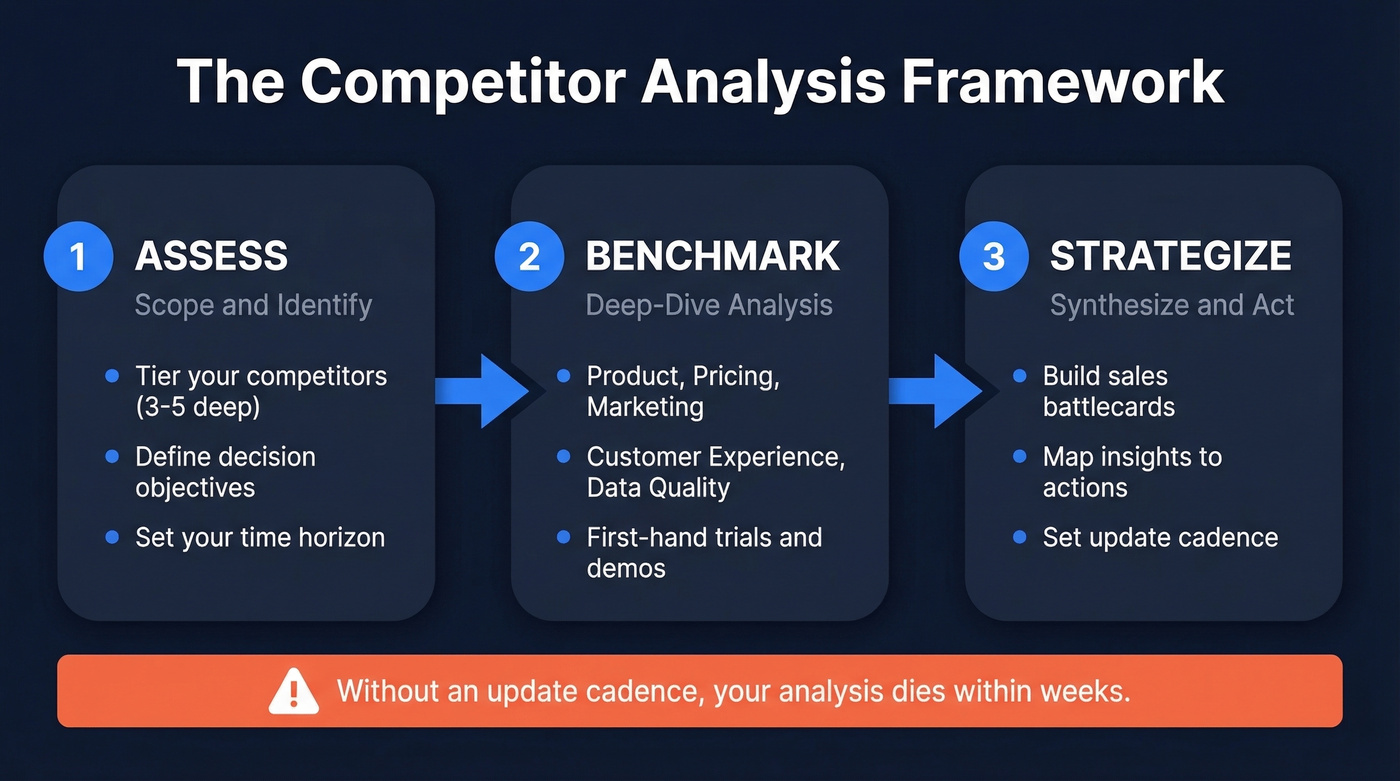
- Assess - scope the project, tier your competitors ruthlessly (3-5 deep, 5-10 monitored, the rest on a watchlist), and define what decisions this analysis needs to inform.
- Benchmark - deep-dive each Tier 1 competitor across five dimensions: product, pricing, marketing, customer experience, and data quality.
- Strategize - synthesize findings into battlecards and actionable recommendations that change how your team sells, markets, or builds.
The #1 mistake to avoid: treating this as a one-and-done deliverable. If it doesn't have an update cadence, it'll be dead within weeks.
Your five-tool stack by category:
- Semrush or Ahrefs - SEO and content intelligence
- Similarweb - traffic and market share
- BuiltWith - tech stack analysis
- Crayon or Klue - CI platform (enterprise)
- Prospeo - contact data and enrichment for competitive displacement campaigns
Now let's go deep on each piece.
What Competitor Analysis Actually Is
Competitor analysis is the systematic process of evaluating your rivals' strategies, strengths, weaknesses, and market positioning to inform your own decisions. That's the textbook version. The practical version: it's how you stop guessing and start knowing why you're winning or losing deals.
There's an important distinction most teams blur. Competitive analysis is a project - a point-in-time evaluation. Competitive intelligence is the ongoing system of collecting, analyzing, and distributing those insights across your organization. You need both, but the system matters more than any single evaluation. A mature CI process ensures that insights flow continuously from raw data to decision-makers, rather than sitting in a forgotten slide deck.
The market agrees. Companies using market research to identify key competitors have increased by 57% in the last three years, and over 80% of companies say competitive research is essential for growth. This isn't a nice-to-have anymore.
The 3-Phase Framework
This framework - Assess, Benchmark, Strategize - gives you a repeatable structure that scales from a two-person startup to a 200-person GTM org.
Phase 1: Assess (Scope and Identify)
Before you research a single competitor, define three things: your objectives, your scope, and your time horizon. Are you building battlecards for sales? Informing a pricing change? Evaluating a new market entry? The answer shapes everything downstream.
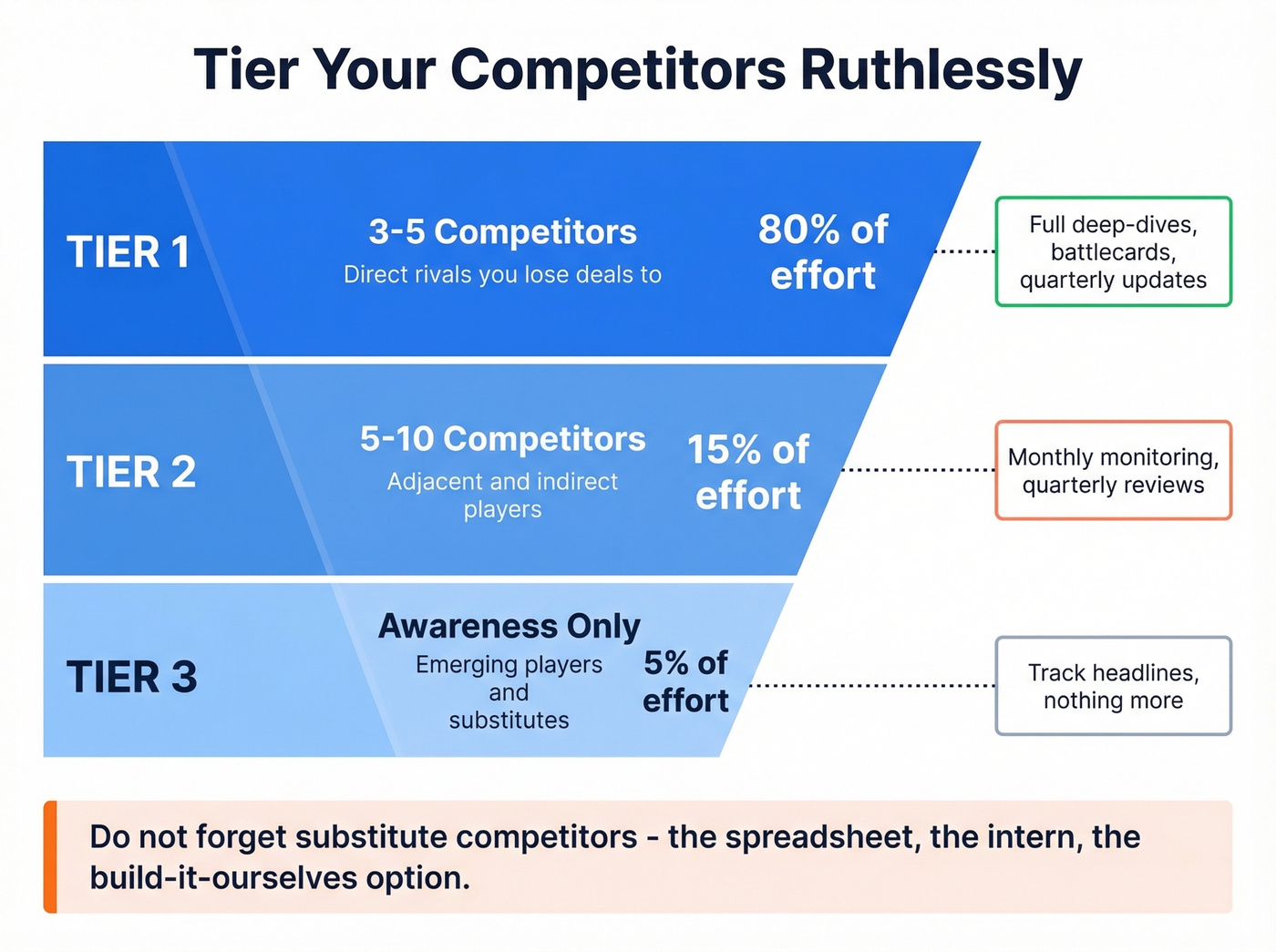
The biggest scoping mistake is trying to analyze 20 competitors with equal depth. Tier ruthlessly instead:
- Tier 1 (3-5 competitors): Direct competitors you lose deals to. These get full deep-dives.
- Tier 2 (5-10 competitors): Adjacent players and indirect competitors. Monthly monitoring, quarterly reviews.
- Tier 3 (awareness only): Emerging players, substitutes, and tangential threats. Track headlines, nothing more.
Spend 80% of your effort on Tier 1. The temptation to go wide is strong - resist it. A shallow review of 15 competitors is less useful than a thorough analysis of four. And don't forget substitute competitors: the spreadsheet, the intern, the "we'll just build it ourselves" option. Those kill more deals than most named competitors.
Define your time horizon upfront. A snapshot analysis for a board meeting looks completely different from a three-year strategic outlook. Without this constraint, the project balloons - and ballooning is how competitive analyses die.
Here's the thing: if your average deal size is under $15K, you probably don't need more than three Tier 1 competitors. The deals move too fast for nuanced battlecards to matter. Focus on the two or three names that come up in every lost deal, nail those, and move on.
Phase 2: Benchmark (Deep-Dive Each Competitor)
This is where most teams either go too shallow or too deep. The sweet spot is five dimensions, evaluated consistently across every Tier 1 competitor:
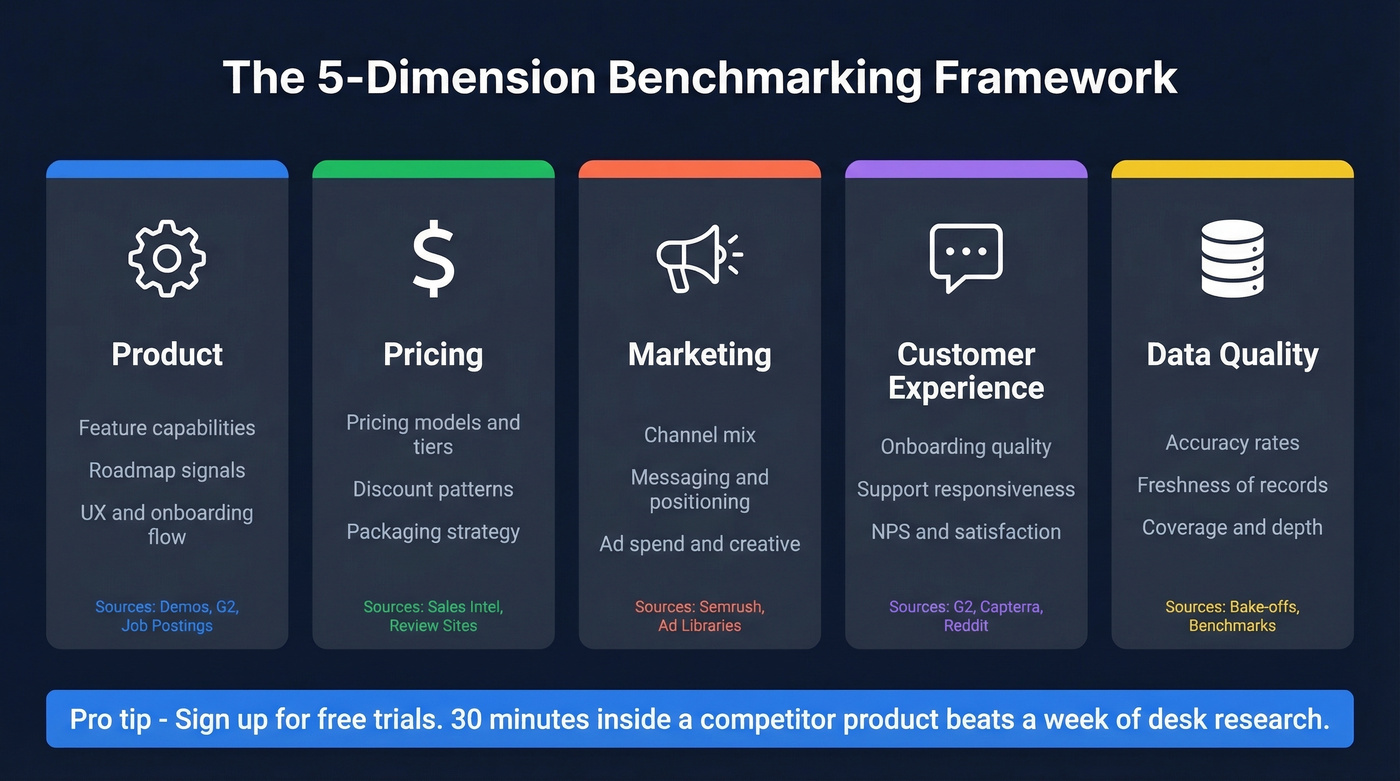
| Dimension | What to Evaluate | Key Sources |
|---|---|---|
| Product/Features | Capabilities, roadmap, UX | Demos, G2, job postings |
| Pricing | Models, tiers, discounting | Sales intel, review sites |
| Marketing | Channels, messaging, ad spend | Semrush, ad libraries |
| Customer Experience | Onboarding, support, NPS | G2/Capterra, Reddit |
| Data Quality | Accuracy, freshness, coverage | Bake-offs, benchmarks |
Don't just research competitors from the outside. Sign up for their free trials, go through their onboarding, subscribe to their emails. First-hand experience reveals friction points and messaging strategies that no amount of desk research can surface. We've learned more from 30 minutes inside a competitor's product than from a week of reading their marketing site.
Pricing is the most under-analyzed dimension. Simon-Kucher, the pricing strategy firm, emphasizes that competitive evaluation should explicitly include pricing strategies as a core area - yet most teams treat it as an afterthought. If you don't know how a competitor prices, discounts, and packages, you're guessing in negotiations.
For marketing benchmarking, use hard numbers wherever possible. WordStream's analysis of 16,000+ Google Ads campaigns found an average CTR of 6.66%, with CPC increasing for 87% of industries. If your competitor's paid search CTR is 9% and yours is 4%, that's a meaningful signal about their messaging and targeting - not just a vanity metric.
Estimating private company revenue. For competitors that don't publish financials, a useful heuristic popularized by SaaStr: multiply their employee count by $150K-$250K depending on funding stage. A 200-person Series B startup likely generates $30M-$50M in revenue. It's rough, but it's better than nothing - and it helps you calibrate whether a competitor is a real threat or a well-funded ghost.
Don't limit your inputs to websites and marketing materials. The richest competitive intel often lives in places you're not looking: analyst reports, G2/Capterra/TrustRadius reviews, demo recordings, and comparables lists from deals where you actually compete head-to-head.
Phase 3: Strategize (Synthesize and Act)
A beautifully formatted competitive matrix that sits in a Google Drive folder is worthless. The entire point of the first two phases is to produce outputs that change behavior.
Start with a SWOT synthesis for each Tier 1 competitor, but don't stop there. SWOT is a starting point for organizing your thinking, not an endpoint. The real deliverables are battlecards - concise, sales-ready documents that tell reps exactly how to position against each competitor.
The need is urgent. In a survey of 300+ revenue leaders, nearly half said reps don't know who they're competing with until they're already in negotiation. Thirteen percent said reps don't know even after the deal closes. That's not a knowledge gap - it's a revenue leak.
If your competitive intelligence doesn't change how your team sells, it was a waste of time. Every insight should map to a specific action: a talk track, a positioning shift, a feature prioritization, a pricing adjustment. If you can't draw that line, the insight isn't actionable enough.
We recommend building a competitive spreadsheet using the five-dimension framework from Phase 2. One tab per Tier 1 competitor, one row per dimension, columns for current state, trend direction, and recommended action. Simple, updatable, and infinitely more useful than a slide deck nobody reopens.
Beyond SWOT: Better Frameworks
SWOT is familiar, which is both its strength and its limitation. It's often static, internally biased, and it lacks built-in action steps. You end up with four quadrants of observations and no clear next move.
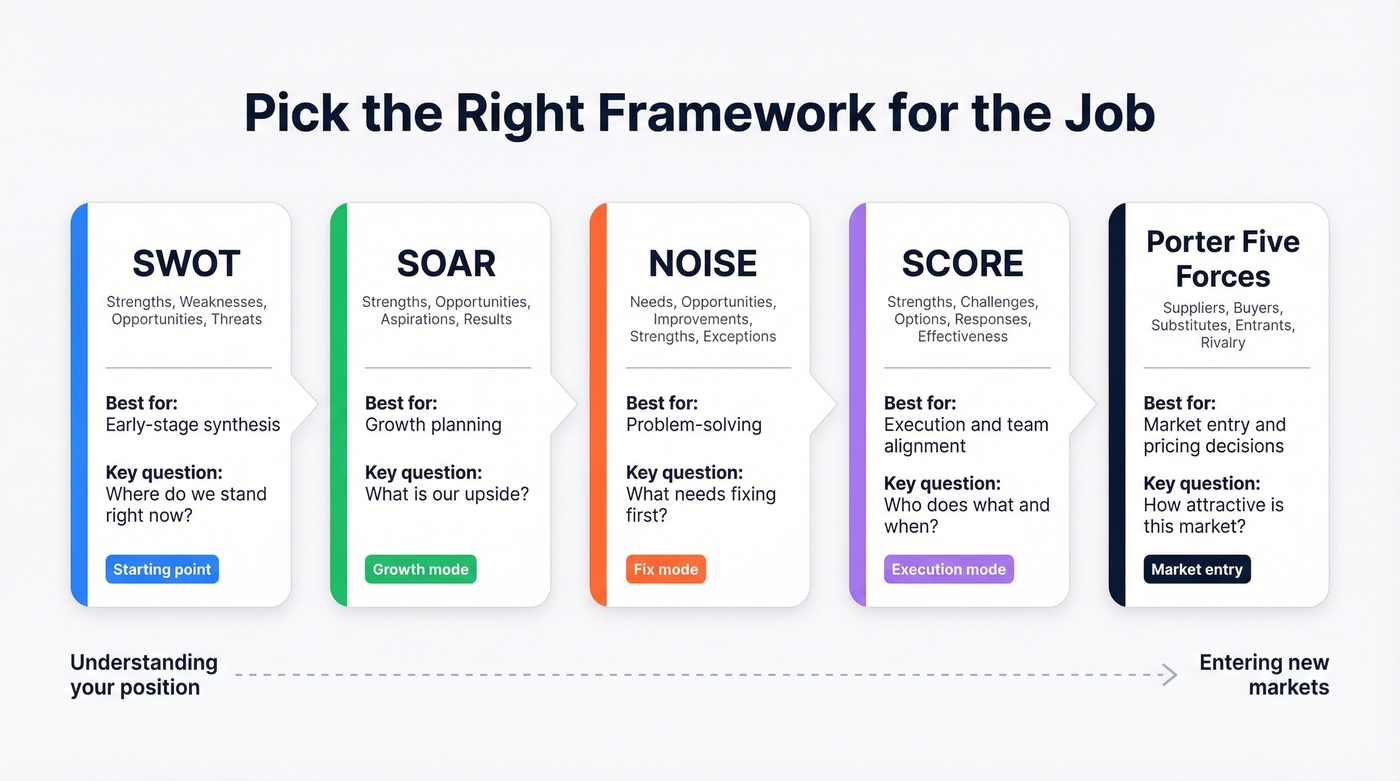
| Framework | Best For | Key Question |
|---|---|---|
| SWOT | Early-stage synthesis | Where do we stand? |
| SOAR | Growth planning | What's our upside? |
| NOISE | Problem-solving | What needs fixing? |
| SCORE | Execution and teams | Who does what? |
| Porter's Five Forces | Market entry and pricing | How attractive is this market? |
SOAR (Strengths, Opportunities, Aspirations, Results) works well when you're in growth mode and want to focus on what's possible rather than what's broken. NOISE (Needs, Opportunities, Improvements, Strengths, Exceptions) is better for teams in problem-solving mode - it's strength-based but action-oriented. SCORE adds a relationship and execution layer that SWOT ignores entirely.
For competitive market entry decisions, Porter's Five Forces remains the gold standard. It forces you to evaluate supplier power, buyer power, substitutes, new entrants, and rivalry intensity - dimensions that SWOT doesn't naturally surface. Use SWOT for your first pass, Porter's for new markets, and SOAR when you're planning your next growth phase.

Competitor analysis reveals where rivals are weak. Prospeo turns that into pipeline. Build targeted lists of your competitors' customers using 30+ filters - including technographics, intent data, and job changes - then reach them with 98% accurate emails at $0.01 each.
Turn competitive intel into booked meetings, not just slide decks.
Where to Find Competitor Data
The quality of your evaluation depends entirely on the quality of your inputs. Garbage in, garbage out applies here more than anywhere.
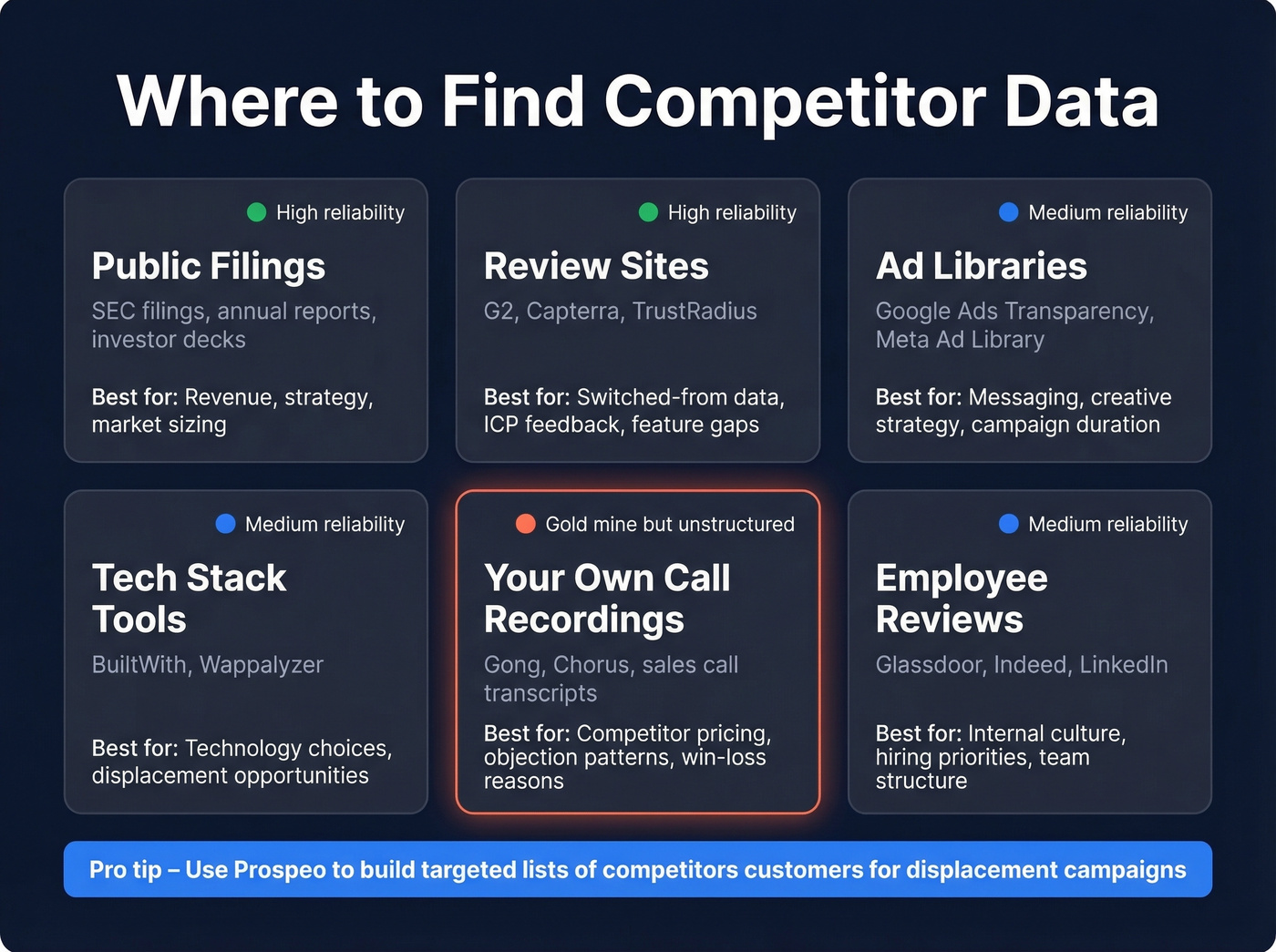
Public filings and financials. SEC filings, annual reports, investor presentations. For public companies, this is the most reliable data you'll find. The U.S. Small Business Administration maintains a solid primer on using public data for competitive research.
Review sites. G2, Capterra, and TrustRadius are invaluable - not for the star ratings, but for the written reviews. Filter by company size and role to find feedback from buyers who look like your ICP. Pay attention to "switched from" and "compared to" fields.
Ad libraries. Google Ads Transparency Center and Meta Ad Library let you see what creative your competitors are running, how long campaigns have been active, and where ads are shown. Free and underused.
Tech stack tools. BuiltWith shows you what technology a competitor or their customers run. Especially useful for identifying displacement opportunities.
Call recordings. If your team uses Gong or a similar platform, your own sales calls are the single best source for hard-to-find intel like competitor pricing and objection patterns. Set up alerts for competitor mentions and mine them quarterly.
Employee reviews. Glassdoor and Indeed reveal internal culture, hiring priorities, and sometimes strategic direction. A competitor suddenly hiring 15 ML engineers tells you something their marketing site won't.
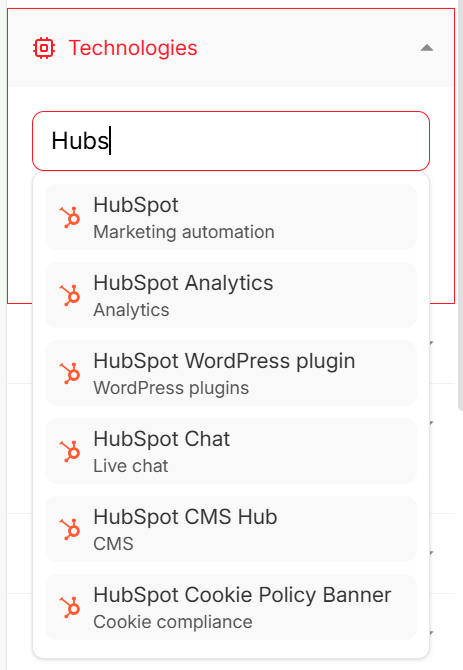
B2B data platforms for contact intelligence. When you're building prospect lists for competitive displacement campaigns - targeting a rival's customers - or conducting win/loss outreach, you need verified contact data. Prospeo's 30+ search filters, including technographics, let you find companies running a competitor's product and pull verified contacts in minutes. The free tier gives you 75 verified emails per month to start.
Reddit and community forums. Don't sleep on r/sales, r/startups, and industry-specific subreddits. The consensus on Reddit is that most competitive research efforts fail because they become lower priority than product and sales work within weeks. That's a process problem, not a data problem - and it's exactly why the cadence section below matters so much.
Best Tools for Competitor Analysis in 2026
You don't need 15 tools. You need four or five that cover distinct categories without overlap.
SEO and Content Intelligence. Semrush is widely used (over 10 million marketing professionals) and its competitive toolkit - keyword gap, backlink gap, traffic estimation, ad research - is best-in-class for understanding a competitor's digital footprint. Plans start around $139/mo. Ahrefs (~$129/mo, with limited free tools) is a strong alternative if your team prefers its UI, though Semrush edges it on competitive reporting depth.
Traffic and Market Share. Similarweb gives you traffic estimates, referral sources, audience overlap, and market share data that no other tool replicates well. The free tier is surprisingly useful for quick checks. Paid plans start around $149/mo.
Social Listening. Sprout Social (around $200-$300/mo per seat, 30-day trial) handles social competitive benchmarking well, though it's expensive for teams that only need the competitive features. If social isn't a primary battleground, skip this category entirely. Metricool tracks up to 5 competitors on its free plan and up to 100 on paid - a much cheaper option for social-only monitoring.
Tech Stack Analysis. BuiltWith (free basic lookups; around $300/mo for paid plans) is the go-to for understanding what technology competitors and their customers use. Essential for competitive displacement plays.
CI Platforms (Enterprise). Crayon and Klue are purpose-built for competitive intelligence at scale - automated monitoring, battlecard management, sales enablement integration. Neither is cheap (expect $20K-$100K/yr), and neither publishes pricing openly. These make sense for teams with dedicated CI headcount. For everyone else, a combination of the tools above plus Google Alerts covers 80% of the same ground.
AI Visibility Monitoring. Riff Analytics is an emerging player tracking where brands appear in AI-generated answers across ChatGPT, Perplexity, Gemini, and Google AI Overviews. Seven-day free trial. We haven't tested this one deeply enough to recommend it confidently, but it's on our radar.
| Tool | Starting Price | Free Option |
|---|---|---|
| Semrush | ~$139/mo | - |
| Ahrefs | ~$129/mo | Limited free tools |
| Similarweb | ~$149/mo | Free tier |
| Prospeo | ~$0.01/email | 75 emails/mo free |
| BuiltWith | ~$300/mo | Free basic lookups |
| Sprout Social | ~$200-$300/mo per seat | 30-day trial |
| Crayon | ~$30K-$100K/yr | No |
| Klue | ~$20K-$80K/yr | No |
AI Visibility: The New Competitive Dimension
In 2026, tracking SERP rankings isn't enough. You need to monitor where competitors appear in AI-generated answers.
When a prospect asks ChatGPT "what's the best [your category] tool?", the answer shapes perception before your sales team ever gets a chance to pitch. This "share of voice" in AI answers is becoming a distinct competitive dimension - separate from organic search, paid search, or social presence. Google AI Overviews, Perplexity, and Gemini each pull from different source hierarchies and weight brand mentions differently, so a competitor that's invisible in traditional search might dominate AI-generated recommendations.
Most teams are still ignoring AI visibility entirely, which means there's an asymmetric advantage for those who start monitoring now. We've started incorporating AI answer audits into our quarterly competitive reviews. It takes 30 minutes to manually check the top 10 category queries across ChatGPT and Perplexity. That's enough to spot trends before investing in dedicated tooling.
Mistakes That Kill Your Research
Five patterns we see repeatedly - and the fact that less than half of CI teams have KPIs in place tells you everything about how organizations treat competitive intelligence.
The one-and-done trap. One Reddit thread captures this perfectly: a startup founder builds a comprehensive competitive doc, plans monthly updates, and watches it become lower priority than product and sales within weeks. If your analysis doesn't have a named owner and a calendar cadence, it's already dead.
Too generic or too granular. "Competitor X has a strong brand" is useless. But listing every widget and feature toggle is equally useless. The sweet spot is insight that a rep can use in a live conversation - specific enough to be credible, concise enough to remember.
Decentralized intel. When competitive insights are scattered across Slack threads, email chains, and random Google Docs, you end up with multiple inconsistent battlecards and no single source of truth. Centralizing your competitive intelligence process is the single fastest way to fix this.
No KPIs. If you can't measure competitive win rate, battlecard usage, or time-to-insight, you can't prove the program's value - and you can't improve it. The fact that most CI teams operate without measurement is staggering, and it's the primary reason CI programs get defunded.
Ignoring data quality as a competitive dimension. Look - if your outbound bounce rate is 35% and a competitor's is under 5%, they're booking more meetings with the same effort. Data freshness and accuracy aren't just operational concerns. They're competitive advantages that compound over every campaign you run. If you're running outbound, treat deliverability and list hygiene as part of your outbound email automation system, not an afterthought.
Your battlecards are only as good as your ability to act on them. Prospeo's 300M+ profiles and Bombora-powered intent data let you find accounts actively researching competitors - then connect with decision-makers through verified emails and 125M+ direct dials.
Stop analyzing competitors. Start winning their customers.
How to Keep Your Analysis Alive
A competitive analysis is a system, not a deliverable. Here's the cadence that works:
Monthly lightweight scans. Check for pricing changes, new feature launches, major hiring shifts, and new ad creative. This takes 2-3 hours with the right tool stack and Google Alerts set up. Assign it to someone specific - "the team" doesn't update anything.
Quarterly deep refreshes. Revisit your Tier 1 competitor profiles end-to-end. Update battlecards. Run a fresh keyword gap analysis. Review win/loss data from the quarter.
Competitive office hours. Recurring sessions where sales reps surface what they're hearing in deals are one of the highest-ROI CI activities you can run. They turn your entire sales team into a competitive sensor network, and the intel that surfaces in these sessions is often more current than anything you'll find online.
Auto-updated battlecards. Enterprise CI platforms now offer battlecards that update automatically as new intel flows in. If you're at the scale where those tools make sense, the automation pays for itself in consistency alone. Skip this if you're under 50 reps - the manual approach works fine at smaller scale.
Call recording mining. If you're running Gong, set up alerts for competitor mentions. A rep hearing "we're also looking at [Competitor X]" is a data point. Aggregate enough of those and you've got a real-time competitive picture.
The tools matter less than the habit. Google Alerts is free. A shared Notion doc costs nothing. The expensive part is the discipline to show up every month and update what you know. Build that muscle first, then invest in enterprise tooling.
FAQ
What's the difference between competitive analysis and competitive intelligence?
Competitive analysis is the process of evaluating competitors at a point in time - their products, pricing, positioning, and strategy. Competitive intelligence is the ongoing organizational function of collecting, analyzing, and distributing those insights. Analysis is a project you complete; intelligence is a system you maintain. Most teams need both, but the system creates lasting value.
How often should you update a competitor analysis?
Monthly lightweight scans covering pricing changes, new features, and hiring patterns take two to three hours. Full deep-dives should happen quarterly, and battlecards need continuous updates - ideally automated through a CI platform or at minimum through a monthly manual review cycle.
What's the best free tool for competitive research?
Similarweb's free tier handles traffic estimates well. Google Ads Transparency Center shows competitor ad creative at no cost. Prospeo's free plan includes 75 verified emails monthly, which is useful for displacement campaign targeting. Combined, these three cover most of what you need without spending a dollar.
How many competitors should I include?
Tier 1 (deep analysis): 3-5 direct competitors. Tier 2 (monitoring): 5-10 adjacent players. Tier 3 (awareness): as many as relevant, with minimal time investment. Spend 80% of effort on Tier 1. Going wide and shallow produces a document that looks comprehensive but helps nobody.
Can you run competitor analysis without paid tools?
Yes. Google Alerts, review sites like G2 and Capterra, ad transparency libraries, SEC filings, and Glassdoor cover most bases for free. Paid tools save time and add depth - especially for SEO benchmarking and automated monitoring - but a disciplined team with free tools will outperform a lazy team with a $100K CI platform every time.