

How to Write a Connection Email That Actually Gets Replies
Out of every 157 people you email cold, one will actually be interested in talking to you - based on an [analysis of 2M+ cold emails]. That's a 0.64% interested reply rate. Most connection emails fail for fixable reasons: they're too long, too formal, and too vague about what they want. The data on what works is surprisingly clear, and almost nobody follows it.
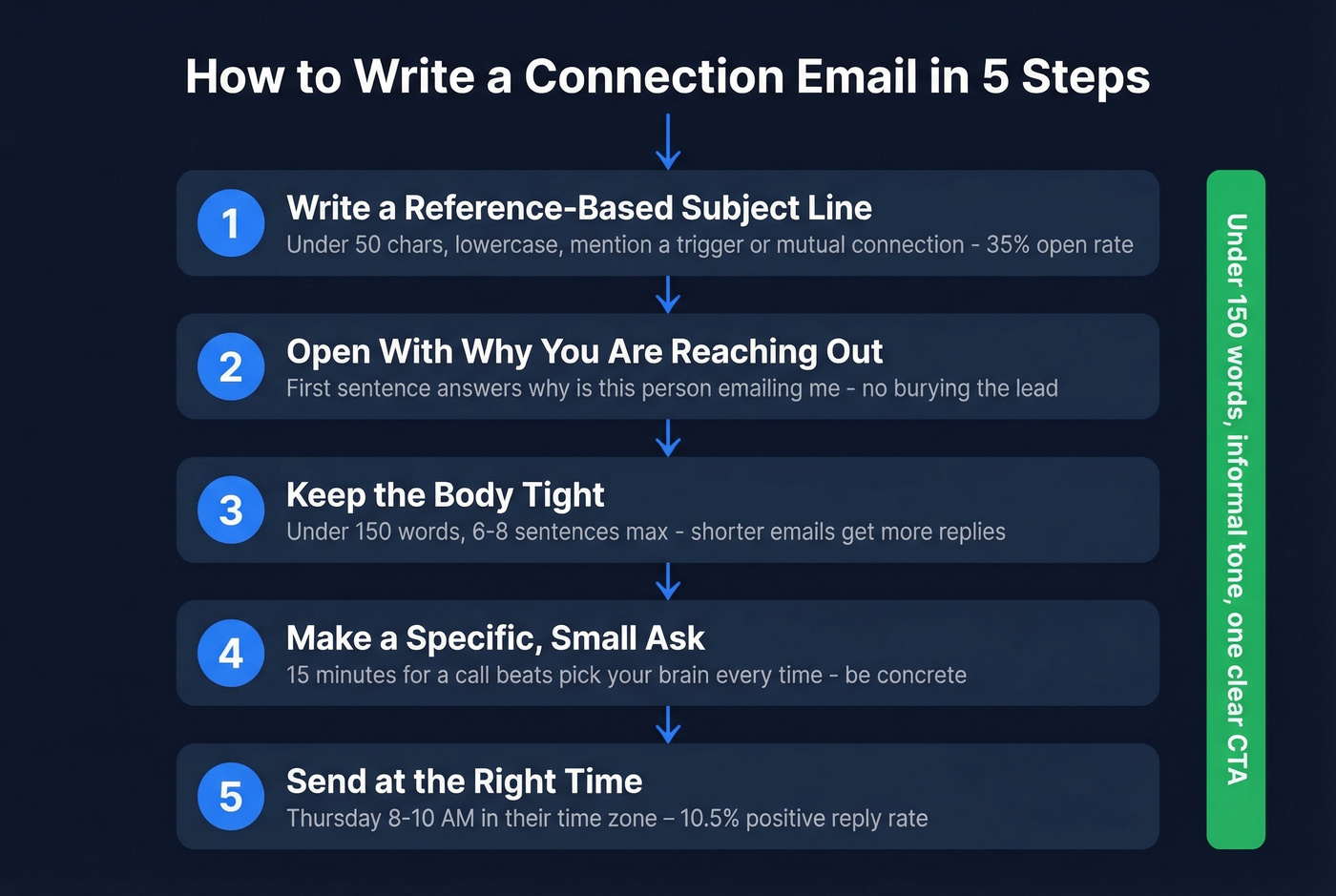
Three changes move the needle most: keep it short, use an informal tone, and reference something specific about the recipient.
What Is a Connection Email?
The term covers two distinct things. First, a cold outreach email - you're reaching out to someone you don't know to start a professional relationship. Networking, business partnerships, informational interviews. The common thread is that you're initiating contact with a stranger and hoping they'll respond.
Second, there's the introduction email where you're connecting two people who should know each other. You're the bridge, not the destination. Different format, different etiquette, same goal. This guide covers both, with networking email tips drawn from real performance data.
What the Data Says About Reply Rates
Most advice about networking emails boils down to "be personalized" and "add value." That's not wrong, but it's not useful either. Here's what the numbers show.
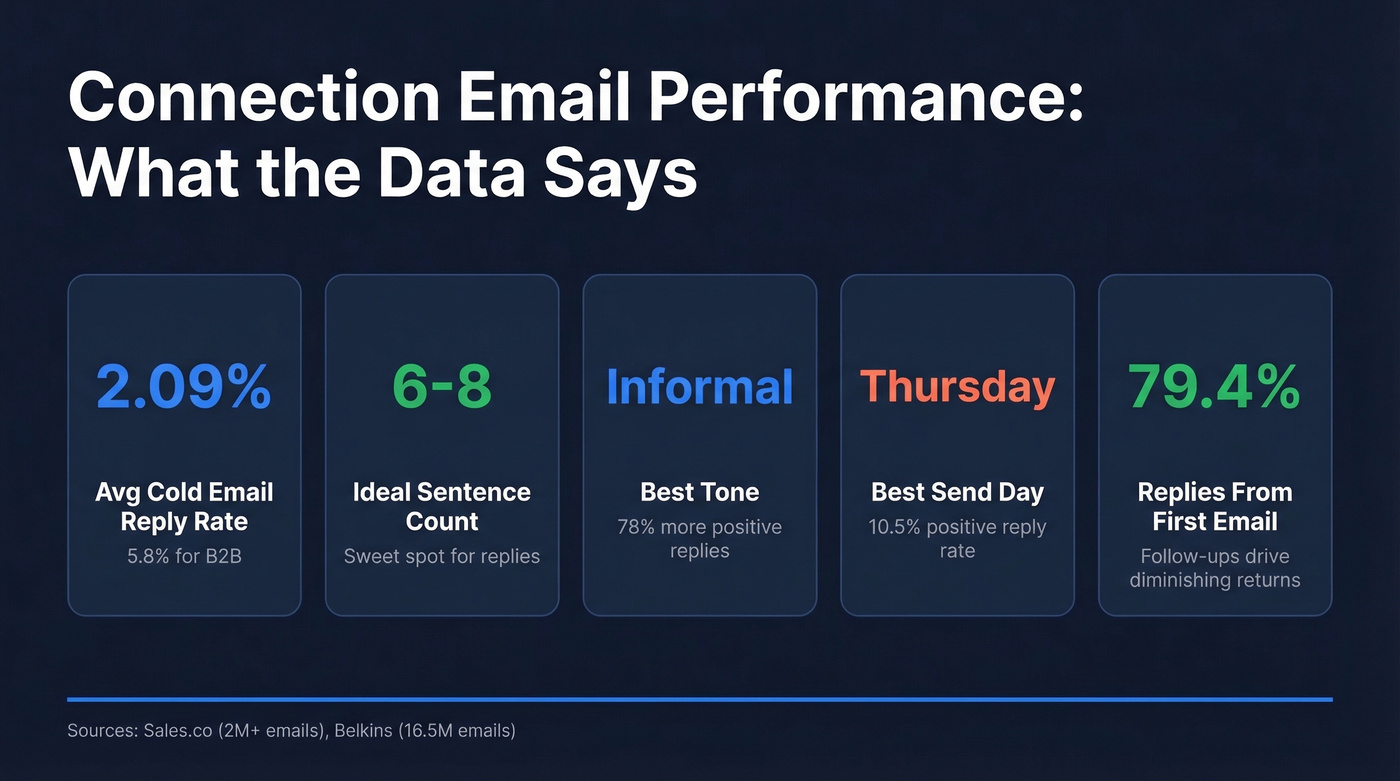
| Metric | What the Data Says | Source |
|---|---|---|
| Avg reply rate | 2.09% cold; 5.8% B2B | Sales.co; Belkins |
| Best email length | 6-8 sentences, under 200 words | Belkins (16.5M emails) |
| Best tone | Informal - 78% more positive replies | Sales.co |
| Best send day | Thursday (6.87% reply rate; 10.5% positive rate) | Belkins; Sales.co |
| First email vs follow-ups | Initial outreach drives 79.4% of all replies | Sales.co |
Sales.co tracked 2M+ emails across multiple years; Belkins analyzed 16.5M B2B emails in a more recent window. Different datasets, different time periods, different definitions of "reply." Both confirm that most cold emails get ignored.
Belkins found that messages in the 6-8 sentence range hit a 6.9% reply rate - the sweet spot. Go longer and replies drop.
The tone finding is the one most people ignore. Informal emails produce a 10.36% positive reply rate versus 5.83% for formal ones. "I hope this email finds you well" is the fastest way to get archived. Write like a human, not a press release.
Here's what we see teams get wrong over and over: they treat follow-ups as the main strategy. Your first email generates nearly 80% of all replies. One follow-up is reasonable. After that, you're annoying someone who already decided not to respond - and driving spam complaints up from 0.5% on the first email to 1.6% by the fourth. The single biggest killer of outreach campaigns isn't bad copy. It's sending too many follow-ups to people who've already moved on.
How to Write a Connection Email
Five steps, each backed by data. Whether you're crafting an email to build professional connections or following up after a conference, the fundamentals don't change.
Write a Reference-Based Subject Line
Reference-based subject lines - ones that mention a mutual connection, shared event, or specific work - hit a 35% open rate and 4.8% reply rate across 10.4M emails analyzed by Prospectory. Generic subject lines? 18% opens, 1.2% replies. That's a 4x gap from the subject line alone.
Keep it under 50 characters. Use lowercase - it tested 21% higher on opens than title case in a 50,000-email A/B test. And if you're referencing a trigger event (new funding, product launch, job change), send within 48 hours. Trigger-based subject lines sent within that window had 2.3x the reply rate versus sending after a week.
Open With Why You're Reaching Out
Don't bury the lead. Your first sentence should answer "why is this person emailing me?" in a way that feels relevant, not salesy. Mention how you found them, what caught your attention, or who referred you. State your purpose upfront - don't make them guess.
Keep the Body Tight
Stay under 150 words. Belkins' analysis found 6-8 sentences performed best, and emails under 200 words outperformed longer messages across the board. A personalized networking email that's concise will always beat a long, generic one.
Make a Specific, Small Ask
"Can I pick your brain?" is vague and slightly off-putting. "Would you have 15 minutes this week to share how your team handled [specific thing]?" is concrete and easy to say yes to. The 4degrees networking guide nails this: be specific about what you're asking, and don't ask for too much. A 15-minute call is reasonable. "Be my mentor" is not.
Send at the Right Time
Thursday has the highest reply rate at 6.87%, and the highest positive reply rate at 10.5%. Send between 8-10 AM in the recipient's time zone. Weekend replies drop 27%.
Your signature should include your name, title, and one way to reach you. Skip the inspirational quote.
Subject Lines That Work
41% of cold emails get deleted without being opened. Your subject line is doing most of the heavy lifting.
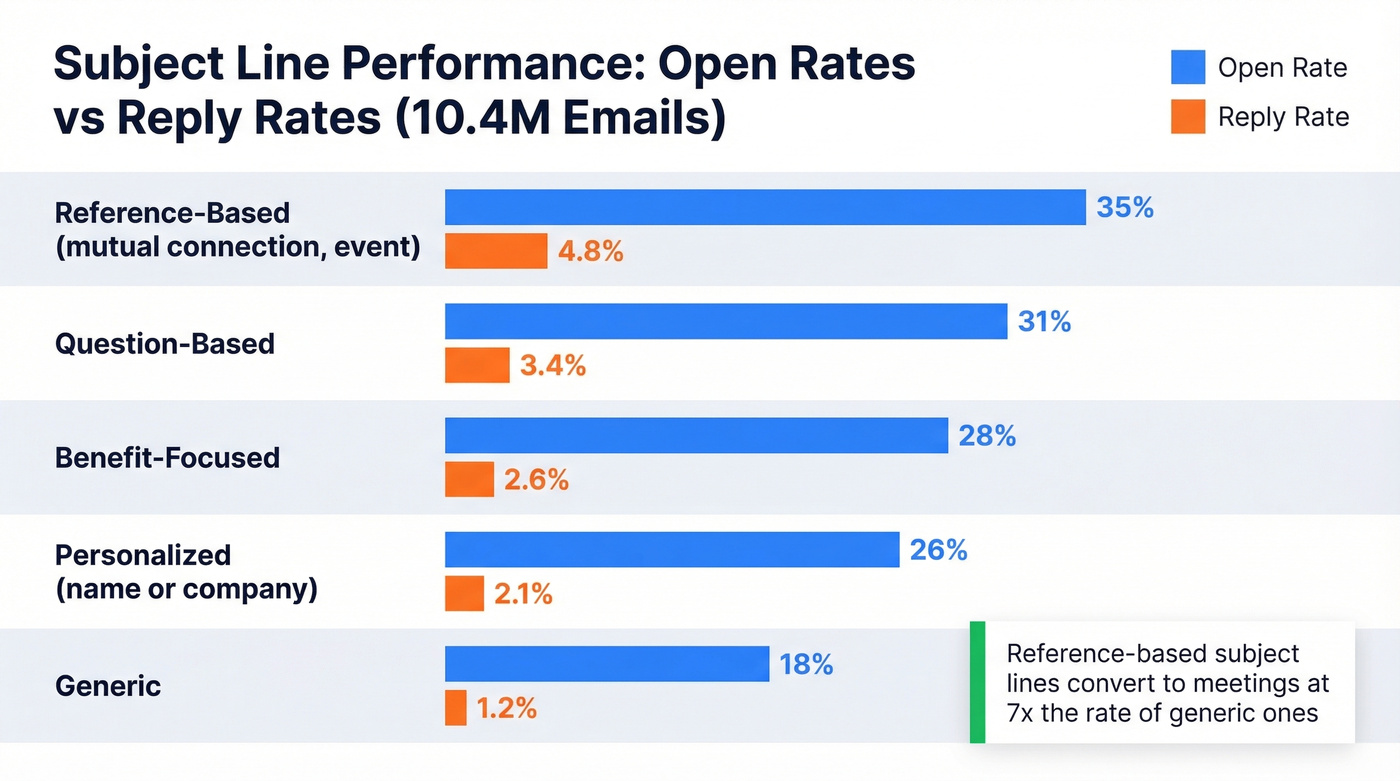
| Subject Line Type | Open Rate | Reply Rate | Meeting Conversion |
|---|---|---|---|
| Generic | 18% | 1.2% | 0.3% |
| Personalized (name/company) | 26% | 2.1% | - |
| Reference-based (mutual connection/event) | 35% | 4.8% | 2.1% |
| Question-based | 31% | 3.4% | - |
| Benefit-focused | 28% | 2.6% | - |
Reference-based subject lines convert to meetings at 7x the rate of generic ones. That alone should settle any debate about whether personalization is "worth the effort."
Here are 10 subject lines organized by scenario, all under 50 characters:
Warm outreach:
- "sarah suggested we connect"
- "great talk at saastr - quick question"
- "referred by mark at acme"
- "it's been a while - catching up"
Cold outreach:
- "your work on [project] - impressed"
- "15 min to learn about [role/team]?"
- "[shared interest] - worth a quick chat?"
- "loved your take on [topic]"
Business and follow-up:
- "quick intro - [your company] + [their company]"
- "re: my note last week"
Every one references something concrete rather than defaulting to "introduction" or "networking opportunity."

Reference-based subject lines get 4.8% reply rates - but only if your email actually reaches the inbox. Prospeo's 98% email accuracy and 7-day data refresh mean your connection emails land with real, verified addresses, not bounces that tank your domain reputation.
Stop crafting the perfect connection email for an address that doesn't exist.
Connection Email Templates
Ten templates covering the major scenarios. Each one stays under 150 words, uses informal tone, and includes a specific ask.
Career Networking
Subject: your path from [previous role] to [current role] - curious
Hi [Name],
I came across your profile while researching [industry/company] and was impressed by your move from [previous role] to [current role]. I'm exploring a similar transition and would love to hear what made the biggest difference.
Would you have 15 minutes this week for a quick call?
Thanks, [Your name]
Sales / Business Outreach
Subject: [mutual interest or trigger] - quick question
Hi [Name],
Noticed [specific trigger - new funding, product launch, job posting]. We help [type of company] with [specific outcome], and the timing seemed right.
Would a 10-minute call make sense to see if there's a fit? No pressure either way.
Best, [Your name]
The trigger reference proves you didn't mass-blast this. The "no pressure" close lowers the commitment bar.
Mutual Connection Referral
Subject: [referrer's name] suggested we connect
Hi [Name],
[Referrer] mentioned you'd be a great person to talk to about [topic]. Your name came up as someone who's done this well.
Would you be open to a quick call this week?
Thanks, [Your name]
Bad vs. Good: Post-Event Follow-Up
What most people send:
Subject: Nice meeting you
Hi [Name], It was great meeting you at the conference. I'd love to stay in touch. Let me know if you ever want to chat.
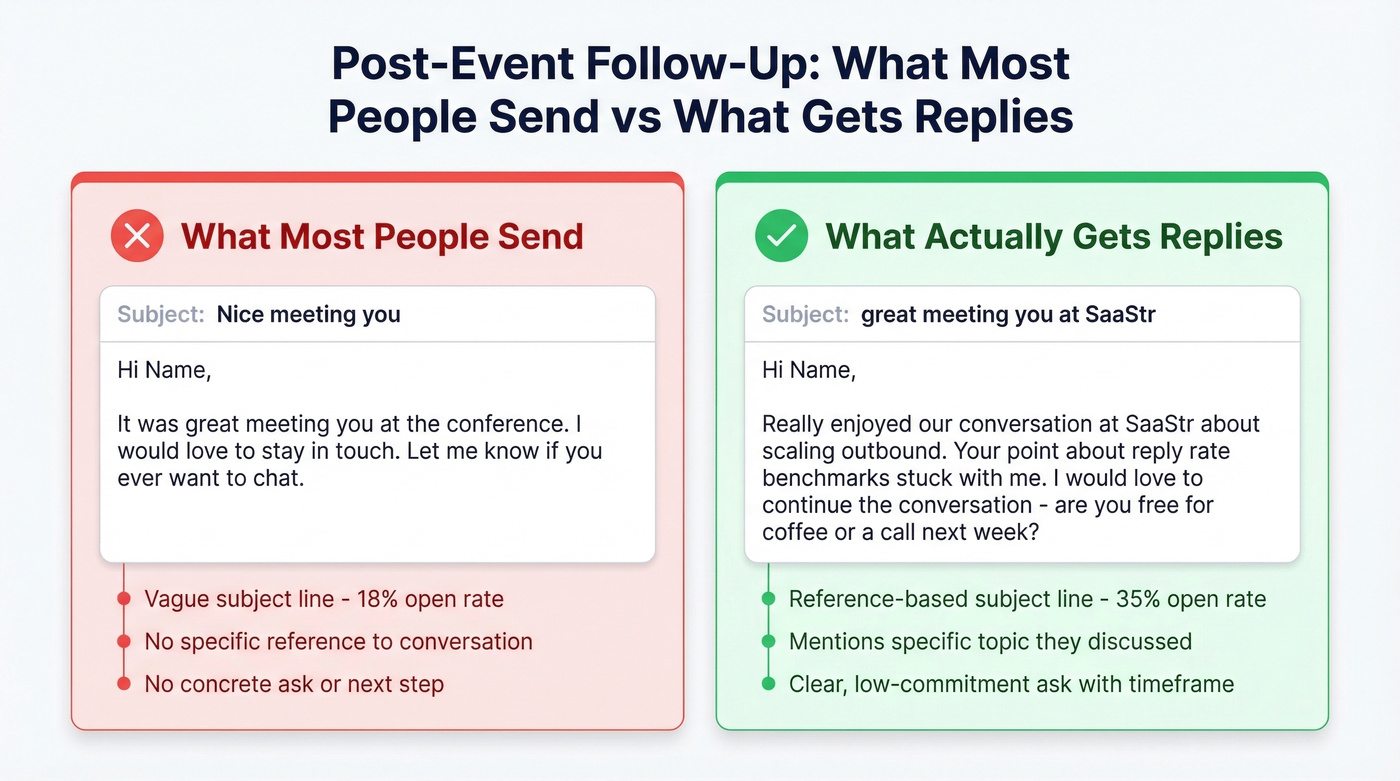
What actually gets replies:
Subject: great meeting you at [event]
Hi [Name],
Really enjoyed our conversation at [event] about [specific topic]. Your point about [specific thing they said] stuck with me.
I'd love to continue the conversation - are you free for coffee or a call next week?
Best, [Your name]
The difference is specificity. Mentioning what they actually said proves you were listening, not just collecting business cards.
Reconnecting With an Old Contact
Subject: it's been a while - hope you're well
Hi [Name],
It's been a while since we connected at [context]. I saw you're now at [company] doing [role] - congrats.
I'm working on [brief context] and thought of you. Would love to catch up if you have 15 minutes.
Cheers, [Your name]
Informational Interview Request
Subject: 15 min to learn about [their team/role]?
Hi [Name],
I'm researching [field/industry] and your work at [company] stood out - especially [specific project]. I'm not looking for a job ask, just trying to learn from people doing this well.
Would you have 15 minutes for a quick call?
Thanks, [Your name]
"I'm not looking for a job ask" defuses the most common reason people ignore these. You're removing the biggest objection before they even think it.
Introduction Email (Connecting Two People)
Subject: [Name 1] <> [Name 2] introduction
Hi [Name 1] and [Name 2],
Wanted to connect you two. [Name 1] is [brief context]. [Name 2] is [brief context]. I think you'd have a lot to talk about around [shared interest].
I'll let you two take it from here.
Best, [Your name]
Asking for an Introduction
Subject: quick favor - intro to [target person]?
Hi [Name],
I noticed you're connected with [target person] at [company]. I'm working on [brief context] and think a conversation with them would be valuable.
Would you be comfortable making an introduction? Happy to send a short blurb they can review first.
Thanks, [Your name]
Follow-Up After No Response
Subject: re: [original subject line]
Hi [Name],
Just bumping this in case it got buried. Still interested in [original ask] if you have a few minutes. If the timing's off, no worries - just let me know.
Best, [Your name]
Thank You / Relationship Maintenance
Subject: thanks for the chat - one thing that stuck
Hi [Name],
Really appreciated you taking the time today. Your advice about [specific takeaway] was exactly what I needed.
I'll keep you posted on how [thing you discussed] goes. If there's anything I can help with on your end, don't hesitate.
Thanks again, [Your name]
How to Introduce Two People
The biggest etiquette mistake with introduction emails is skipping the double opt-in. Don't just connect two people without asking both of them first.
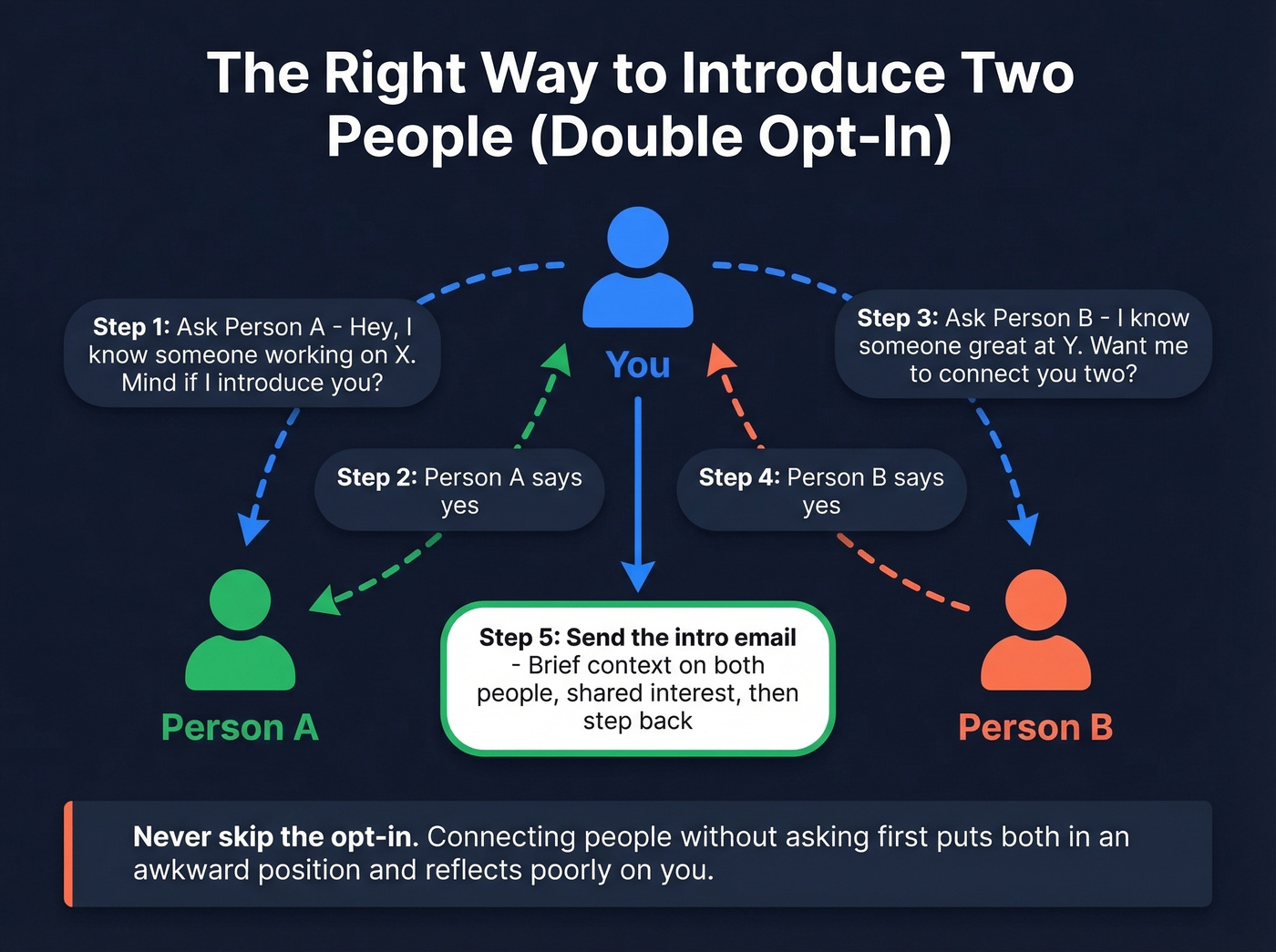
Reach out to each person separately. Here's a template for the permission ask:
Hi [Name],
I'd love to introduce you to [Other Person] - they're working on [context] and I think you'd have a great conversation. Would it be alright if I sent over the intro?
Once both say yes, send the introduction using the "[Name 1] <> [Name 2] introduction" subject line format. Keep it brief - two sentences about each person, why they should talk, and then hand it off. Triple-check names and titles before sending. Getting someone's name wrong in an introduction email is a credibility killer for everyone involved.
Mistakes That Kill Your Reply Rate
Writing over 200 words. Belkins' data is clear: shorter emails get more replies. If your outreach reads like a cover letter, it's getting archived.
Using formal, robotic language. "I hope this email finds you well" signals mass outreach. Informal tone produces 78% more positive replies.
Making a vague ask. "I'd love to pick your brain" gives the recipient nothing to work with. Ask a specific question about a specific topic.
Following up too many times. Spam complaints jump from 0.5% on the first email to 1.6% by the fourth. One follow-up is enough. Let's be honest - if someone hasn't replied after two emails, they're not going to.
Spraying 10+ contacts at one company. Reply rates drop from 7.8% to 3.8% when you email more than 10 people at the same organization. Pick your best 1-2 contacts.
Using a generic subject line. The difference between "introduction" and a reference-based subject line is 1.2% vs 4.8% reply rate. That's 4x.
Build a Networking Strategy That Scales
A quick pre-flight checklist before you hit send:
Verify the email address. This is step zero. You can write the perfect professional networking email, but it's worthless if it bounces. Use a real-time verification tool - paste a URL or upload a CSV and you'll know in seconds which emails are valid.
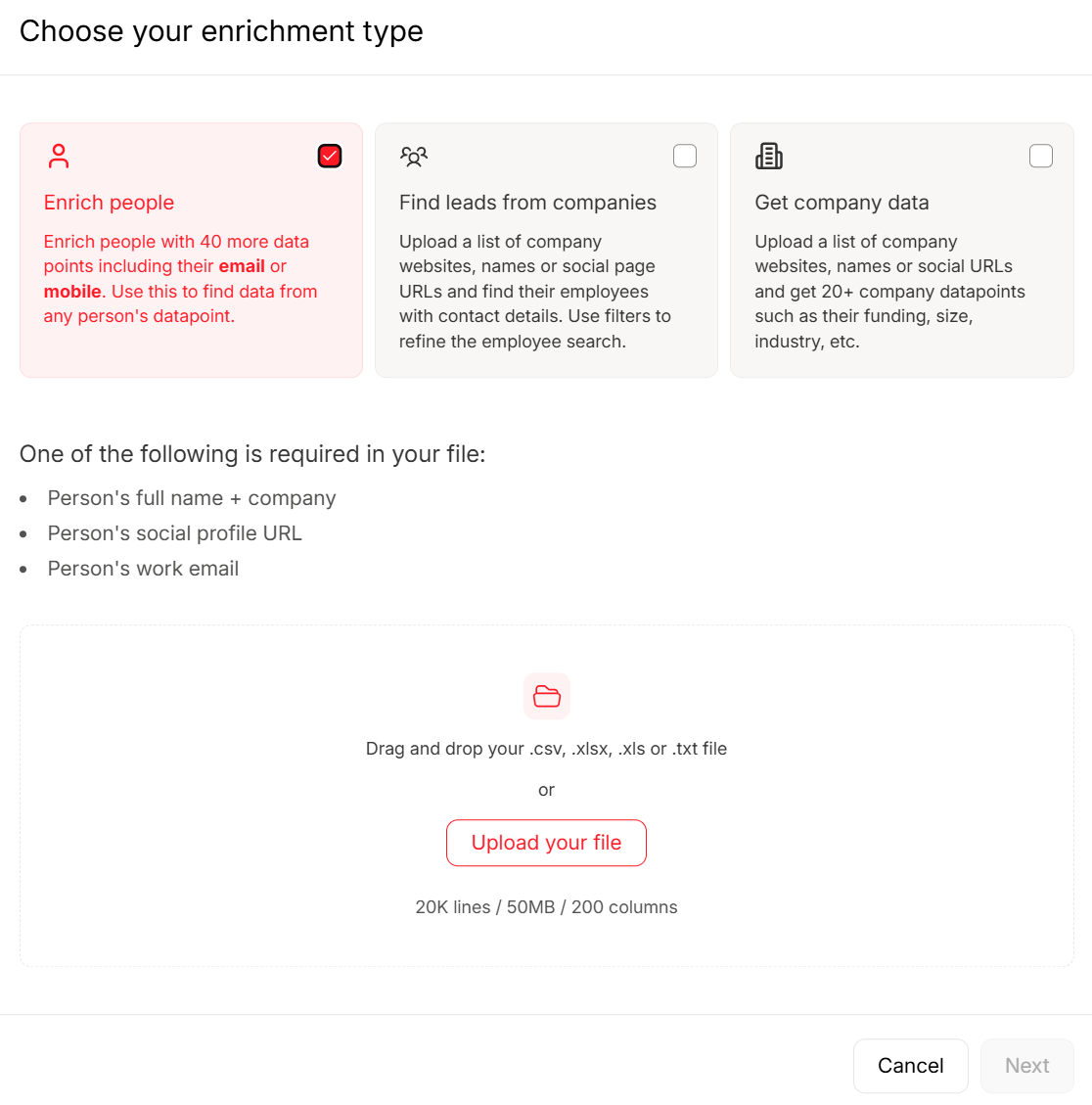
Check your sender reputation. If your domain is new or flagged, even great emails land in spam. Google Postmaster is free and shows your domain health.
Proofread names, titles, and company. Nothing kills credibility faster than "Hi Michael" when their name is Mitchell. I once sent a connection email to a VP at a target account and misspelled their company name in the subject line. Never heard back. Don't be me.
Confirm timing. Thursday between 8-10 AM in the recipient's time zone. (If you want to go deeper, see our guide on the best time to send cold emails.)
Handle compliance basics. For CAN-SPAM, include a way for the recipient to opt out. For GDPR, make sure you have a legitimate interest basis for reaching out. (More on deliverability and compliance in our email deliverability guide.)
Here's our hot take: if your average deal size is under $5K, you probably don't need a 12-step sequence with A/B tested subject lines and automated follow-ups. Write one good connection email, verify the address, send it on Thursday morning, and follow up once. That's the whole system. The people overcomplicating this are the ones getting 0.64% interested reply rates.
Skip the elaborate multi-touch cadence if you're doing targeted networking - it's built for volume outbound, not relationship-building. One thoughtful email beats five mediocre ones every time.
You just spent time personalizing a connection email with the right tone, length, and subject line. Don't waste it on stale data. Prospeo gives you 143M+ verified emails refreshed every 7 days - at $0.01 per email - so every send counts.
Great outreach deserves accurate data. Start finding emails for free.
FAQ
How long should a connection email be?
Keep it to 6-8 sentences, under 200 words. Belkins' analysis of 16.5M emails found this range hits a 6.9% reply rate - the highest of any length bracket. Anything longer and responses drop measurably.
When should I follow up?
Wait 3-5 days, then send one follow-up in the same thread. Your first email generates roughly 80% of all replies. After one follow-up, spam complaints triple and returns diminish sharply.
What's the best day to send a networking email?
Thursday consistently outperforms every other day. The data shows a 6.87% reply rate on Thursday versus 5.29% on Monday. Send between 8-10 AM in the recipient's time zone for best results.
How do I find someone's verified email before reaching out?
Use a dedicated email finder with real-time verification. Prospeo searches 300M+ profiles at 98% accuracy - paste a professional profile URL or company domain and get a verified address in seconds. The free tier includes 75 lookups per month, enough for targeted networking.