

The Best Contact Info Finder Tools in 2026 (Tested)
Your last outbound campaign bounced 12%. Your sender reputation took a hit, your sequences stalled, and half the "verified" contacts in your CRM turned out to be dead ends. You're not alone - 91% of organizations experience revenue losses tied to inaccurate or incomplete contact data. The contact info finder market has ballooned from $1.4B in 2020 to $3.4B by 2026, and the tool sprawl is real. There are 50+ options out there, most mediocre, with pricing models that seem designed to confuse you.
We tested the ones that matter. Here are the 10 worth evaluating - sorted by what actually works, not who has the best marketing page.
Our Top Picks
If you don't want to read 2,000 words, here's the short version:
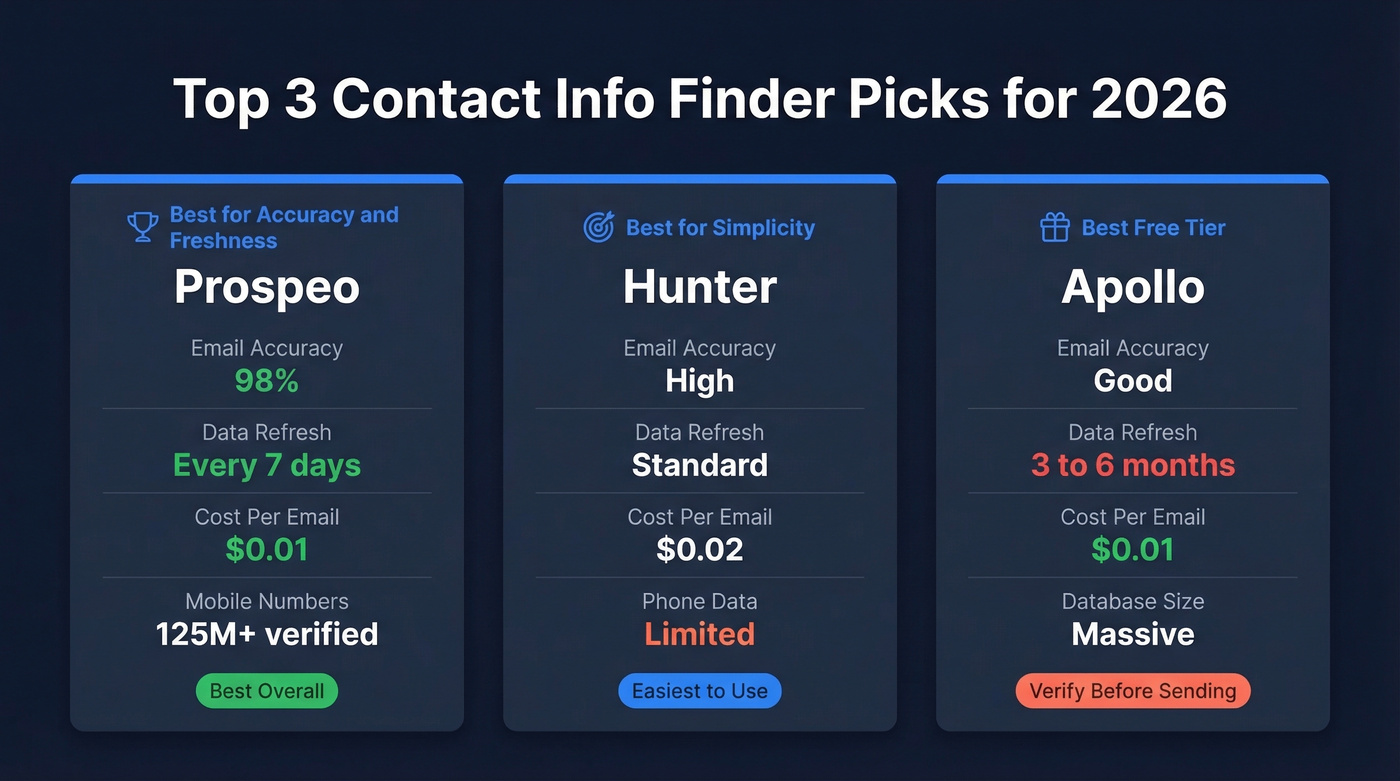
- Best for email accuracy and data freshness: Prospeo - 98% email accuracy, 7-day data refresh, ~$0.01/email. The data actually stays current, which is rarer than vendors want you to believe.
- Best for simplicity and domain lookups: Hunter - transparent credit system, unlimited users on every plan, and a solid free tier. No surprises.
- Best free tier: Apollo - generous free plan with a massive database. The catch? Data freshness is a known weak spot, so verify before you send.
Pricing at a Glance
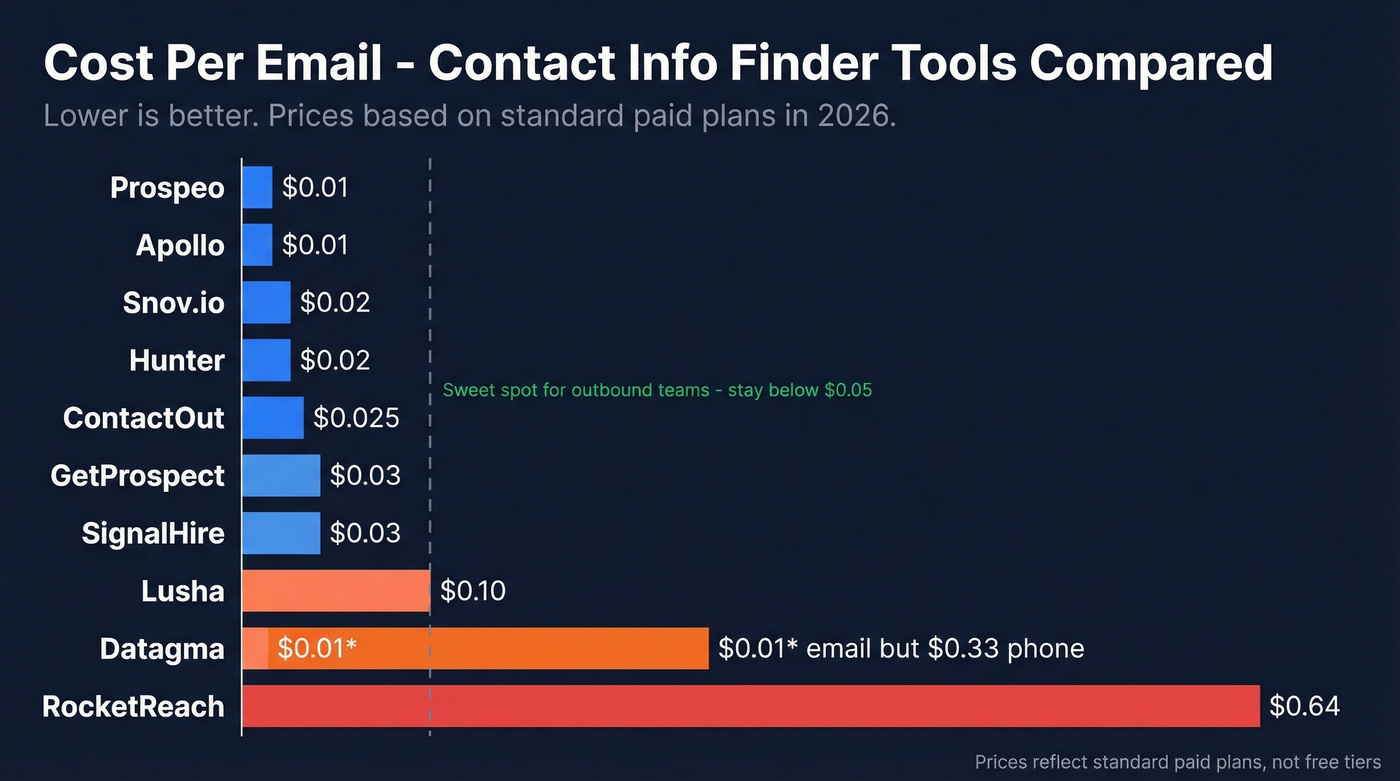
Every contact finding tool uses credits, but "credit" means something different everywhere. Hunter charges 0.5 credits for a verification-only lookup. Datagma charges 30 credits for a single phone number. ContactOut says "unlimited" but caps you at 2,000 emails per month. You shouldn't need a PhD in credit math to figure out what a tool costs.
| Tool | Free Tier | Starting Price | Cost/Contact | Key Limit |
|---|---|---|---|---|
| Prospeo | 75 emails + 100 ext. credits/mo | ~$39/mo | ~$0.01 email / ~$0.10 phone | No contracts |
| Hunter | 50 credits/mo | $34/mo (annual) | ~$0.02 email / phones thin | Credits reset monthly |
| ContactOut | 5 emails/day | $49/mo (annual) | ~$0.025 email / ~$0.10 phone | 2K email fair-use cap |
| Apollo | Yes (generous) | ~$49/mo | ~$0.01 email / varies phone | Data freshness risk |
| SignalHire | 5 credits | ~$57/mo (annual) | ~$0.03 email / ~$0.06 phone | 5K credits/mo cap |
| Datagma | 90 emails/mo | $39/mo (annual) | ~$0.01 email / ~$0.33 phone | 30 credits per phone |
| RocketReach | No | $80/user/mo (individual) | ~$0.64 email / ~$0.40 phone | Per-seat pricing |
| Lusha | 5 credits/mo | ~$29-$49/mo | ~$0.10 email / ~$0.20 phone | Per-user pricing |
| GetProspect | 50 emails/mo | ~$34-$49/mo | ~$0.03 email / N/A | Credit-back guarantee |
| Snov.io | Yes (limited) | ~$39/mo | ~$0.02 email / N/A | Includes warm-up |
The cost-per-email column matters most for outbound teams. Anything above $0.05/email gets expensive fast when you're running sequences at scale.
Best Contact Info Finder Tools
Prospeo
Use it if: You need verified data that's actually fresh, you're tired of bounces destroying your sender domain, or you want intent data baked into your prospecting workflow.
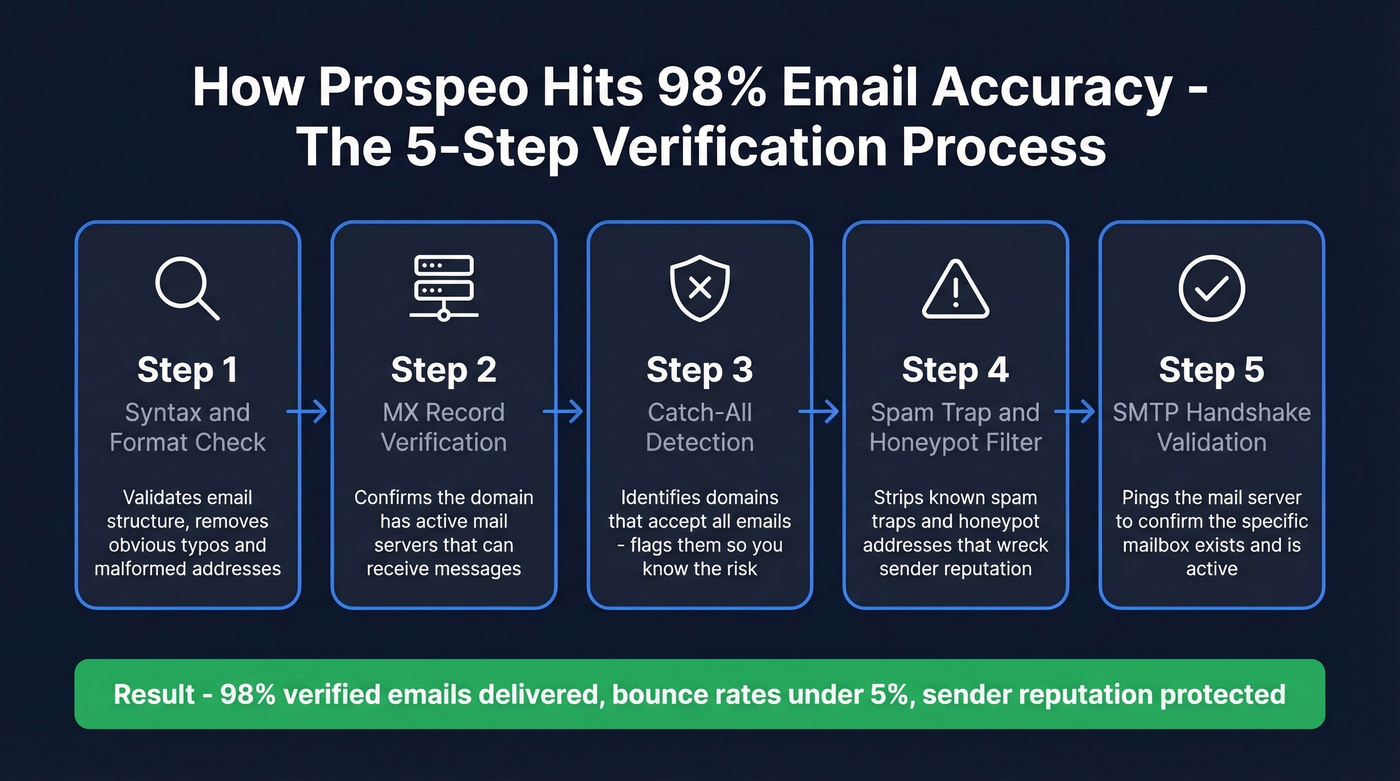
Prospeo's database covers 300M+ professional profiles, 143M+ verified emails, and 125M+ verified mobile numbers. The 7-day data refresh cycle is the headline differentiator - most competitors refresh every 4-6 weeks, which means you're emailing people who changed jobs a month ago. In our experience, that stale-data problem is the single biggest reason outbound campaigns underperform, and it's the hardest thing to spot until your bounce rate spikes.
The 5-step verification process handles catch-all domains, strips spam traps, and filters honeypots before delivering a contact. That's how they hit 98% email accuracy. Snyk's team saw their bounce rate drop from 35-40% to under 5% after switching, with AE-sourced pipeline up 180%. Mobile numbers hit a 30% pickup rate - roughly 3x the industry average - making this a strong pick for teams that cold call, not just cold email.
The 30+ search filters include buyer intent powered by 15,000 Bombora topics, technographics, job changes, and headcount growth signals. The Chrome extension has 40K+ users and works across company websites and professional profiles. CRM enrichment returns 50+ data points, with a 92% API match rate. Native integrations cover Salesforce, HubSpot, Smartlead, Instantly, Lemlist, Clay, Zapier, and Make - so it drops into most existing stacks without friction.
Pricing starts free (75 emails + 100 Chrome extension credits/month), with paid plans at roughly $0.01 per email. No annual contracts, no sales calls required.
Hunter
Use it if: You want a dead-simple domain-based email finder with transparent pricing and built-in outreach tools.
Skip it if: You need phone numbers. Hunter's phone data is thin to nonexistent.
Hunter does one thing exceptionally well: find emails associated with a company domain. One credit gets you up to 10 emails via bulk domain search, and verification costs just 0.5 credits. Failed searches don't cost a credit - you only pay when Hunter actually finds an email. The credit math is refreshingly straightforward.

Pricing runs $0 (50 credits/mo) through $209/mo billed annually for 25,000 credits. Every plan includes unlimited users - your whole team shares a credit pool without per-seat charges. The Starter plan at $34/mo annual gives you 2,000 credits, which translates to roughly 4,000 verifications or 2,000 email finds.
The built-in cold email campaigns are a nice bonus if you don't already run Instantly or Lemlist. Where Hunter falls short is breadth - it's an email lookup platform, not a full-stack prospecting suite. If you need mobile numbers or intent data, pair it with something else.
ContactOut
ContactOut's recruiter-focused interface bundles email and phone data on its Email + Phone plan ($99/month billed annually). The Chrome extension works well for candidate sourcing, and getting both data types in one plan simplifies the stack.
The problem is the fine print. "Unlimited" plans aren't unlimited - fair-use caps can limit you to 2,000 emails and 1,000 phones per month, and export limits of 300-600/mo are separate. Individual plans are locked to a single user.

At $49/mo with a 2,000-email cap, you're paying $0.025 per email. Not bad, but not "unlimited" either. If you're a recruiter sourcing 50-100 candidates per week, ContactOut works well. If you're running high-volume outbound, you'll hit the wall fast. The Team/API tier removes the single-user limitation and includes API access across 700 million+ profiles, but requires a sales conversation.
Apollo
Apollo's free tier is the most generous in the category - a large database, decent credit allotment, and a G2 rating of 4.8/5. For a solo founder or early-stage team that needs to find prospect contact details without spending money, it's the obvious starting point.
The database is massive, and the all-in-one platform covers search, sequences, a dialer, and analytics, so you can run your entire outbound motion from one tool. The API benchmark from Lobstr showed Apollo finding 430 emails per 1,000 leads at just $11.80 per 1K - the cheapest option tested.
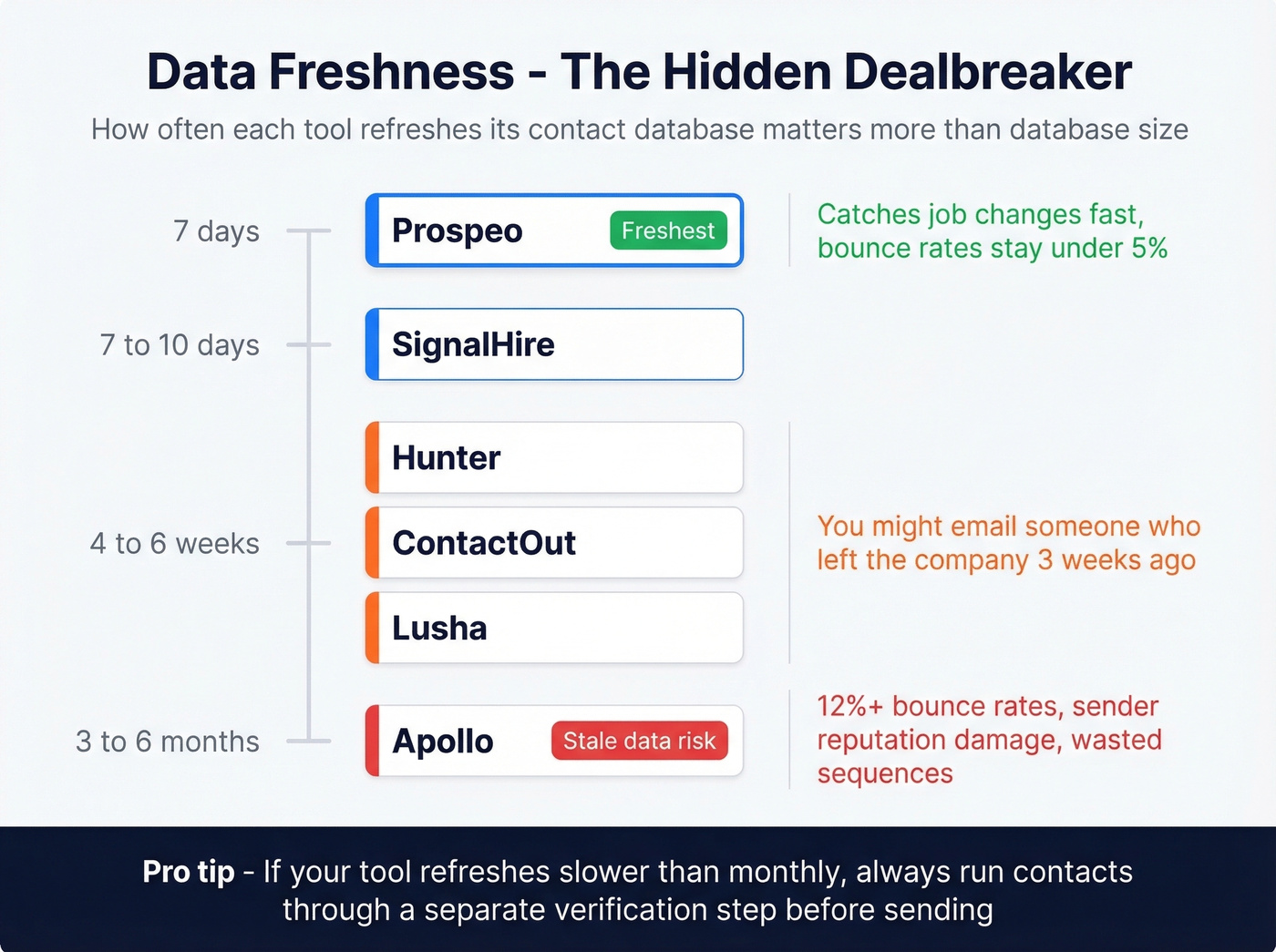
Here's the thing: data freshness is Apollo's Achilles' heel. Stale contacts are a recurring complaint on r/sales and in RevOps communities - records can be 3-6 months out of date, especially for mid-market companies with high turnover. If you're using Apollo, run everything through a verification layer before sending. We've seen teams pair Apollo's free prospecting with a separate verification tool and get solid results without spending much.
SignalHire
Use it if: You have a large team and refuse to pay per seat. SignalHire's unlimited-users model means your 20-person sales floor shares one subscription.
Skip it if: You need more than 5,000 credits per month - SignalHire's fair-use policy caps you there.
Paid plans start around $57/mo billed annually. One credit returns every available contact for a profile - email and phone together, not charged separately - and you're only charged on success. The 7-10 day data refresh is competitive, and for recruiting teams or sales orgs where per-seat pricing would balloon costs, it's a smart pick.
If you're comparing it head-to-head, see our breakdown of SignalHire and how it stacks up on accuracy and pricing.
Datagma
Instead of pulling from a static database, Datagma retrieves data in real time from the public web. It also verifies emails in real time using NeverBounce and UseBouncer. Credit rollover for up to 12 months is a genuine differentiator for teams with uneven prospecting volume, and catch-all emails come back free.
The gotcha is phone numbers. One email costs 1 credit. One phone number costs 30. Datagma's $99/mo plan includes 250 mobile numbers per month, so if direct dials are critical to your workflow, the math gets ugly fast. Pricing starts at $39/mo billed annually. (If you want the full credit math, see our Datagma pricing breakdown.)
RocketReach
Let's be honest: RocketReach is overpriced for what you get. Individual plans run $80-$300/user/month, and additional credits cost $0.30-$0.45 each. The Team Pro plan at $83/user/mo annual sounds reasonable until you multiply by headcount - a 10-person team is paying nearly $10K/year before overages. Annual commitments are standard on team tiers.
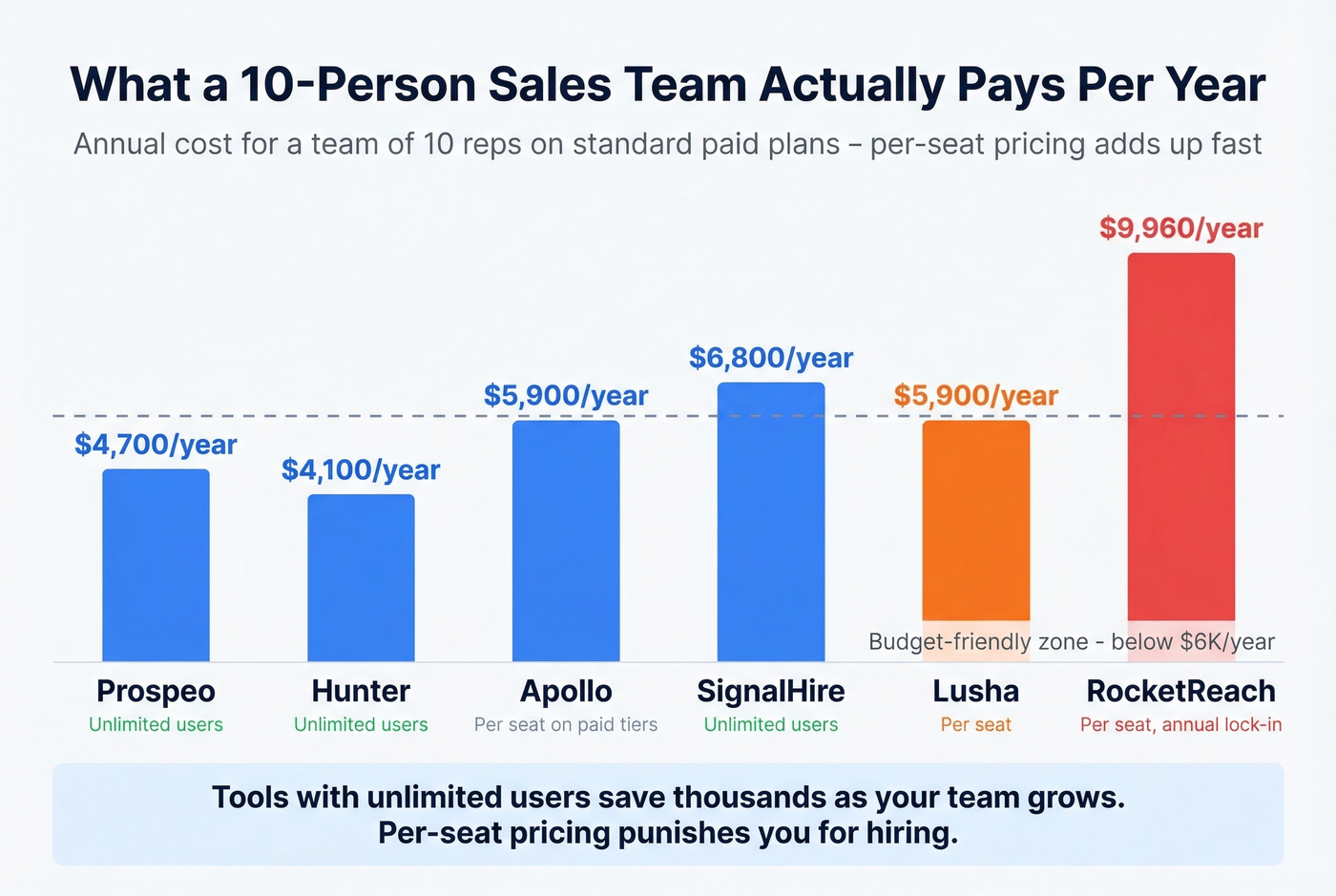
The database is decent and the UI is clean. Team Pro includes 3,600 lookups per user per year. But you're dealing with annual-only plans and per-seat math that adds up fast. Unless your company already has a RocketReach contract and switching costs are high, there are better options at every price point.
Lusha
Simple Chrome extension, quick lookups, easy to use. Free tier gives you 5 credits/month - enough to test, not enough to work with. Paid plans start around $29/mo per user. Good for individual reps who need occasional lookups, not for teams running systematic outbound.
GetProspect
50 free emails per month, paid plans from ~$34-$49/mo. The standout feature is a 95% accuracy guarantee with a credit-back policy - if the email bounces, you get the credit returned. That's a confidence signal most competitors won't match. For teams focused on B2B contact discovery at a predictable cost, the credit-back model removes a lot of risk.
Snov.io
Budget-friendly at ~$39/mo with a free tier included. Snov.io bundles email finding with warm-up tools and drip campaigns, making it a lightweight all-in-one for teams that don't want to pay for separate tools. The database is smaller than Apollo or the top-tier platforms, but the price-to-feature ratio is solid for early-stage teams running lean.

You just saw the pricing breakdown - most contact info finders charge 2-60x more per email with worse accuracy. Prospeo delivers 98% verified emails at ~$0.01 each, 125M+ mobile numbers with a 30% pickup rate, and a 7-day data refresh that kills the stale-data problem before it starts.
Find contacts that actually connect. Start with 75 free emails today.
Bounce rates above 5% wreck your sender reputation and stall your pipeline. Snyk's 50-person sales team cut bounces from 35-40% to under 5% and grew AE-sourced pipeline 180% - because every contact was verified through Prospeo's 5-step process with catch-all handling, spam-trap removal, and honeypot filtering.
Stop guessing which contacts are real. Verify before you send.
How Accurate Are These Tools, Really?
Every vendor claims 95-99% accuracy. Almost none of them prove it.
The only large-sample benchmark worth citing is Dropcontact's 20,000-contact test, updated February 2026. They tested 15 email finders using only first name, last name, and company name as inputs - no domains, no profile URLs. Verification was done via live email sending, not validator-based checks, and wrong domains were caught through a dual-operator manual audit. The results are sobering.
| Tool | Effective Rate | Error Rate | Hard Bounce | Wrong Domain |
|---|---|---|---|---|
| Dropcontact | 54.9% | 1.9% | 0.9% | 1.0% |
| Fullenrich | 48.3% | 15.3% | 3.6% | 11.7% |
| Enrow | 40.9% | 8.1% | 2.3% | 5.8% |
| Findymail | 39.9% | 6.2% | 1.1% | 5.2% |
| Icypeas | 31.6% | 6.8% | 1.0% | 5.8% |
Transparency note: this study was funded by Dropcontact, who also ranked first. Take the exact numbers with appropriate skepticism. But one data point jumps out - Fullenrich's 48.3% find rate came with a 15.3% error rate, meaning nearly 1 in 6 emails were wrong. Volume means nothing if accuracy is poor.
What does this mean in practice? "Real enrichment rates" - the percentage of contacts where you actually get a correct, deliverable email - run 30-55%. That's a far cry from the 95-99% accuracy numbers on vendor websites. These are different metrics, and conflating them is how teams end up with trashed sender domains. Enrichment rate measures how often a tool finds an email at all. Verification accuracy measures whether the emails it does find actually reach inboxes. A 98% verification rate means fewer bounces and better domain health, even if no tool on earth finds a valid email for every contact you search.
Hidden Gotchas
Before you sign up for anything, watch for these:
- ContactOut's "unlimited" isn't unlimited. Fair-use caps limit you to 2,000 emails and 1,000 phones per month. The word "unlimited" is doing a lot of heavy lifting.
- Datagma's phone credits are 30x email credits. One phone number = 30 credits. That $99/mo plan includes 250 mobiles. Read the fine print.
- RocketReach per-seat pricing balloons fast. $83/user/mo sounds manageable until you're paying for 15 seats. That's $15K/year - approaching ZoomInfo territory without ZoomInfo's database depth.
- Annual contract lock-ins are the norm. RocketReach, ZoomInfo, and several others require annual commitments. If the tool doesn't work out in month three, you're stuck paying for nine more.
- Export limits are separate from credit limits. You might have 5,000 credits but only 600 exports per month. Credits don't equal exports don't equal contacts in your CRM.
- "Accuracy" without methodology is marketing. If a vendor claims 95% accuracy but won't explain how they measure it, that number is meaningless.
How to Choose the Right Tool
You don't need 10 tools. You need one good one and a verification layer.
Here's our hot take: if your average deal size is under $10K, you probably don't need ZoomInfo-level data. A focused contact info finder with strong verification will outperform a bloated platform you only use at 20% capacity. Match the tool to the motion, not the brand name.
Solo founder or small team on a budget: Start with Apollo's free tier for prospecting, then verify contacts through a dedicated tool before sending. You'll spend close to nothing and avoid bounce-rate damage. (If you're building a $0 stack, start with these free lead generation tools too.)
Sales team scaling outbound: You need verified emails, mobile numbers, intent data, and CRM enrichment without per-seat pricing traps. A 7-day data refresh means your contacts don't go stale between campaign cycles - that's the difference between a 5% bounce rate and a 15% one. If bounces are already hurting you, use this guide on email bounce rate and how to fix it.
Recruiter sourcing candidates: ContactOut or SignalHire. ContactOut has the deeper recruiter-specific feature set; SignalHire wins on team pricing with unlimited users.
Developer or API-first workflow: Hunter's API is well-documented and cost-effective at ~$50 per 1K emails. For higher find rates, the Lobstr API benchmark showed Findymail hitting 492 emails per 1K leads at similar pricing. If you're building a broader stack, compare options in our guide to data enrichment services.
FAQ
Are contact info finders legal?
Yes - GDPR and CCPA allow processing publicly available business contact data under legitimate interest. Look for tools that offer Data Processing Agreements, enforce opt-outs globally, and maintain GDPR compliance documentation. Prospeo, Hunter, and ContactOut all provide DPAs on request.
How accurate are email finder tools really?
Self-reported accuracy of 95-99% is marketing. The only large-sample benchmark testing 20,000 contacts with live email sending showed real enrichment rates of 30-55%. The more important metric is verification accuracy - whether delivered emails actually reach inboxes. A 98% verification rate means fewer bounces and better domain health.
Free vs. paid - is it worth upgrading?
Free tiers giving 5-75 credits per month are fine for testing quality. If you're sending more than 50 cold emails per week, you'll exhaust free credits in days. Paid plans typically drop cost-per-contact to $0.01-$0.05, which pays for itself if outbound is a real revenue channel for you.
What's a credit and how do credits work?
Most tools charge per lookup - one credit equals one email found. Phone numbers cost more everywhere. Datagma charges 30 credits per phone; Hunter charges 0.5 credits for verification-only lookups. Always check the credit-to-contact conversion before comparing prices, because a "$49/mo for 3,000 credits" plan means very different things depending on the vendor.
Which contact info finder has the best free plan?
Apollo offers the most generous free tier with a large database and decent credit allotment. Prospeo's free plan (75 emails + 100 Chrome extension credits/month) includes full verification - meaning fewer wasted credits on emails that bounce. Test both against your actual target list and compare deliverability, because the "best" free plan is the one that finds accurate data for your ICP.