

Conversational Selling: What It Is, Why It Works, and How to Do It Right
A rep on r/sales recounted using the classic consultative opener - "What's keeping you up at night?" - and the prospect immediately fired back: "Are you reading from a script?" Then hung up. With 57% of the buying journey already complete before a prospect picks up the phone, the reps who win don't recite dialogues. They hold them.
The Short Version
Target a 43/57 talk-to-listen ratio. Top closers talk 43% of the time and listen 57%. More important than the exact number is keeping it consistent across every call.
Follow a 5-step flow: Prepare, Insight, Ask, Value, Next Step. Not a rigid script - a flexible skeleton that keeps conversations productive.
Preparation beats personality. The rep who researched the prospect's last funding round will always outperform the rep who "wings it" with charm. Selling through conversation doesn't mean casual - it means being so prepared you don't need a script.
What Is Conversational Selling?
Conversational selling is a sales communication style built on real-time, two-way dialogue. The rep listens more than they talk, asks questions rooted in genuine curiosity, and tailors responses to what the prospect actually says - not what a slide deck told them to say. It's selling through curiosity, letting the prospect's answers steer the conversation rather than forcing a predetermined path.
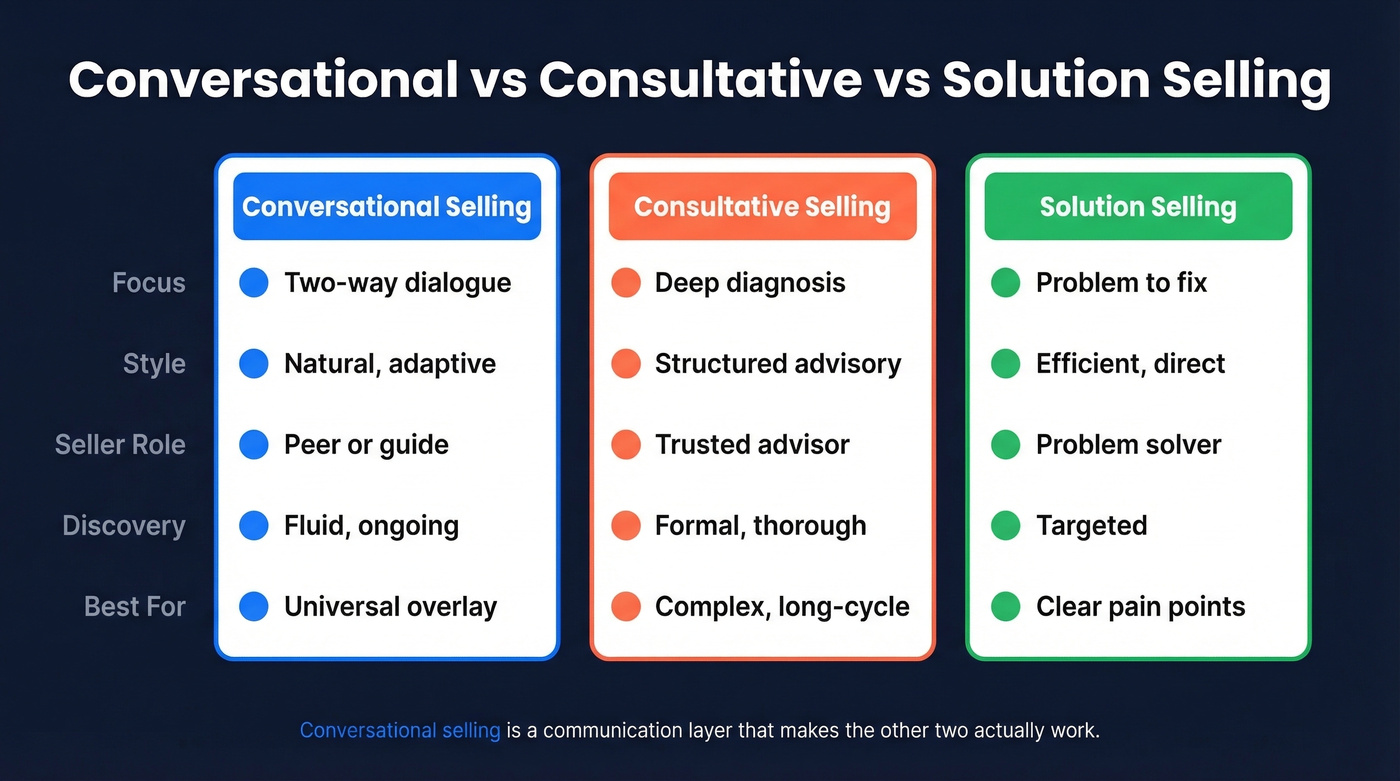
It's not a methodology like MEDDIC or Sandler. Think of it as a layer that sits on top of any methodology. You can run a consultative process and still sound conversational - or sound like a robot reading discovery questions off a laminated card. The difference is preparation and adaptability.
There's a real debate among reps about whether any sales framework is inherently manipulative. Here's the thing: this isn't a technique. It's the absence of performing one. The goal is to be so prepared that you can respond like a human, not execute a flowchart.
71% of buyers research everything before contacting sales. They don't need you to explain what your product does. They need you to understand their situation well enough to have a conversation worth their time.
| Conversational | Consultative | Solution | |
|---|---|---|---|
| Focus | Two-way dialogue | Deep diagnosis | Problem to fix |
| Style | Natural, adaptive | Structured advisory | Efficient, direct |
| Seller role | Peer / guide | Trusted advisor | Problem solver |
| Discovery | Fluid, ongoing | Formal, thorough | Targeted |
| Best for | Universal overlay | Complex, long-cycle | Clear pain points |
Consultative selling is a formal advisory process. Solution selling matches a specific pain to a specific fix. Conversational sales is the communication style that makes either one actually work.
Why the Data Backs It
Gong's analysis of 7.1M opportunities found the optimal talk-to-listen ratio is 43% talk / 57% listen. But the insight most people miss isn't the ratio - it's consistency. High performers keep similar talk ratios in wins and losses. Low performers swing 10 points, jumping from 54% talk in won deals to 64% in lost deals. They panic, over-explain, and fill silence with noise.
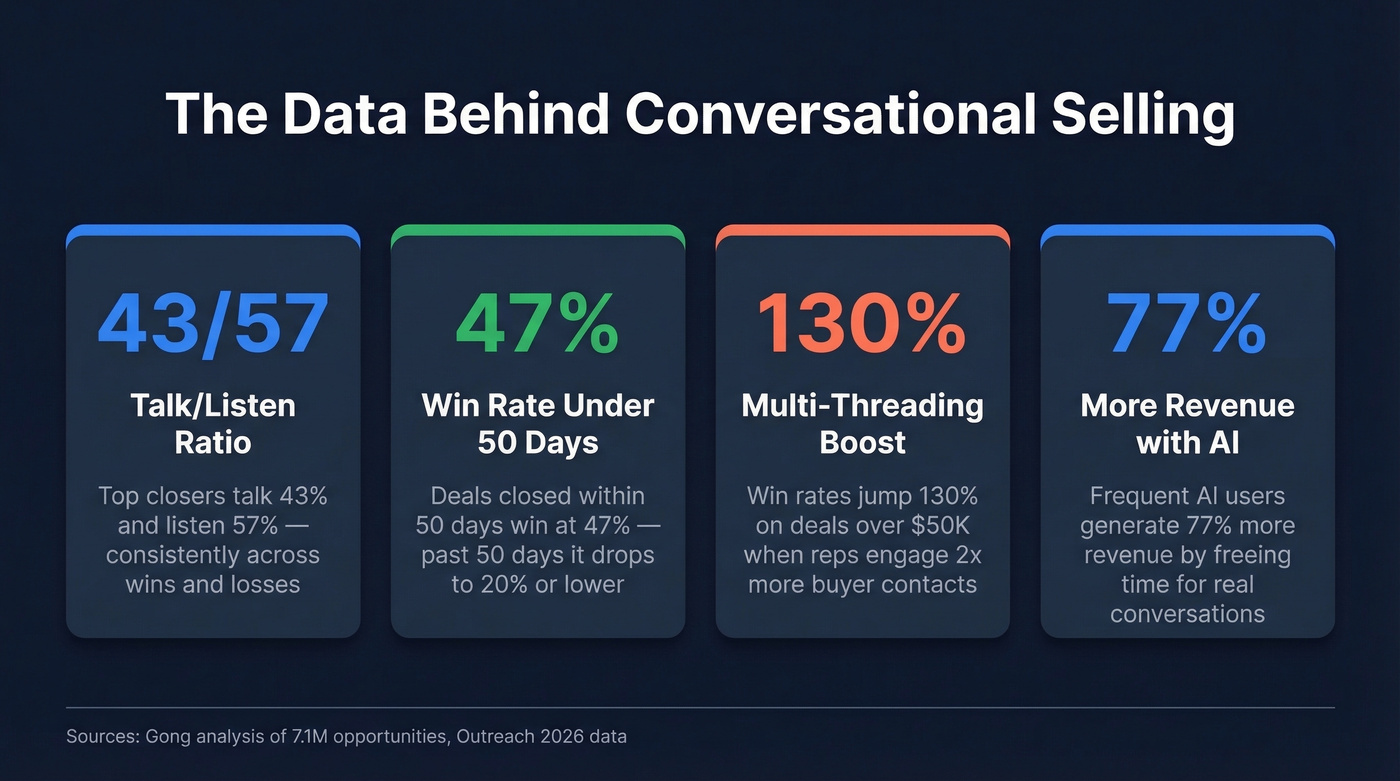
Speed matters too. Outreach's 2026 data shows opportunities closed within 50 days carry a 47% win rate. Past 50 days, that drops to 20% or lower. Genuine dialogue keeps deals moving because prospects feel heard, objections surface early, and next steps get locked in - nobody leaves the call with a vague "let me think about it."
Then there's multi-threading. An analysis of 1.8M opportunities found closed-won deals involve roughly 2x the buyer contacts compared to lost deals. For deals over $50K, multi-threading boosts win rates by 130%. You can't multi-thread effectively without strong conversational skills - every new stakeholder is a new relationship to build quickly, often with zero warm-up time. And frequent AI users generate 77% more revenue than non-users, largely because AI handles the admin that used to eat into actual selling time.

Conversational selling only works when you reach the right person. Bounced emails and gatekeepers kill momentum before the dialogue even starts. Prospeo gives you 98% accurate emails and 125M+ verified mobile numbers - refreshed every 7 days - so your first touchpoint is a real conversation, not a voicemail.
Stop prepping for calls that never connect. Fix the data first.
The 5-Step Framework
1. Prepare Before You Dial
The whole approach starts before the call. The rep who researched the prospect's role, recent company triggers, and tech stack walks in with context. The rep who didn't walks in with a script - and it shows within 30 seconds.
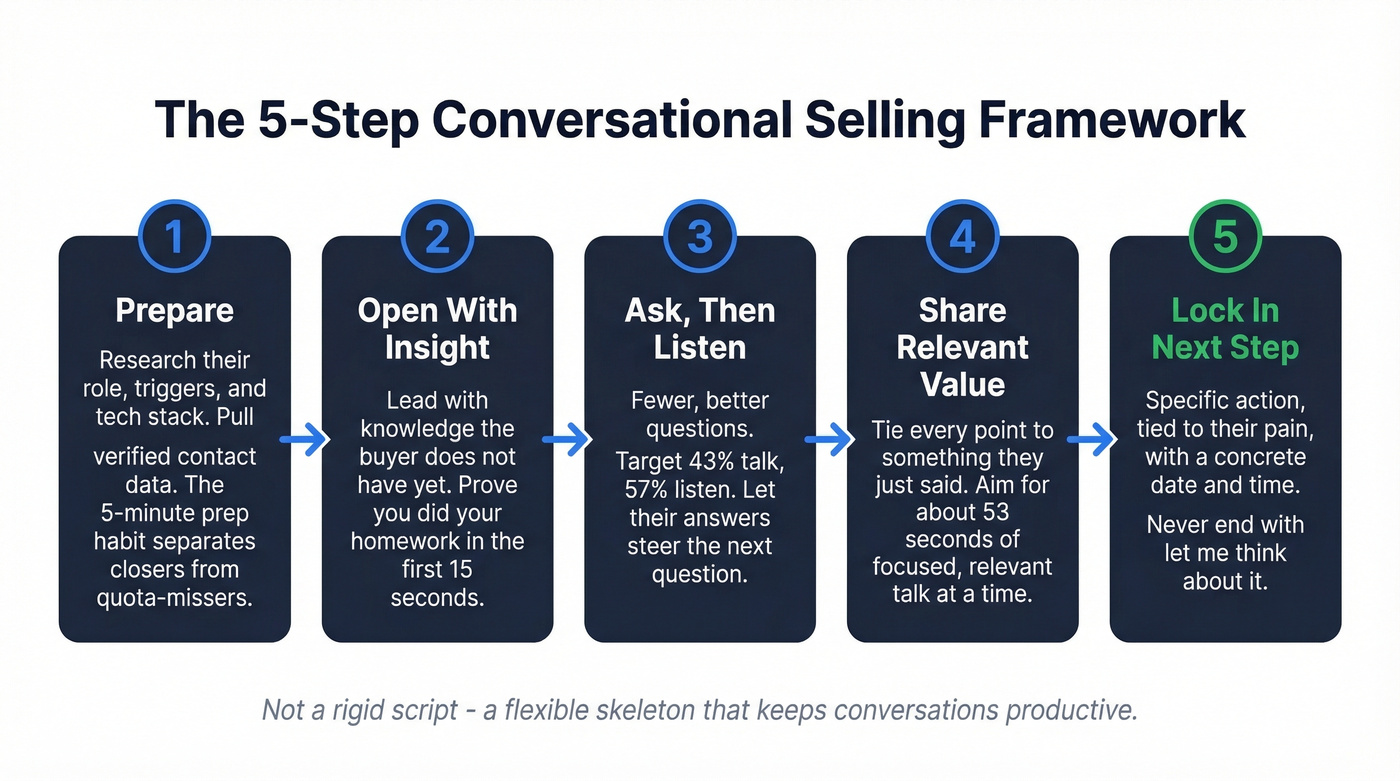
In our experience, the 5-minute prep habit separates closers from quota-missers. Know what tools they're using, whether they just raised a round, if they're hiring aggressively. Use Prospeo to pull verified emails and direct dials so your first touchpoint isn't a bounce or a gatekeeper - with a 7-day data refresh cycle, the contact info you pull today is still accurate next week.
This is where the contrarian thesis proves itself: being conversational doesn't mean winging it. It means being so prepared you can improvise.
2. Open With Insight
Anthony Iannarino calls this being "One-Up" - walking into the conversation with knowledge the buyer doesn't have yet. Your opener should prove you've done your homework, not announce that you're selling something.
"Hey [Name], I know I'm catching you cold. I noticed [Company] just opened a new SDR team in EMEA - we helped [similar company] cut their ramp time in half when they did the same thing. Do you have 30 seconds?"
The anti-pattern? "What's keeping you up at night?" That question signals you haven't prepared. It asks the prospect to do your job for you.
3. Ask, Then Listen
This is where the 43/57 ratio lives. Ask fewer, better questions - then shut up long enough to hear the real answer.
"What's your current process for [specific workflow]?"
"Walk me through what happens after a lead comes in."
The best follow-up question is always the one the prospect's last answer just handed you. Each answer opens a door you didn't know existed, and walking through it builds trust faster than any pitch deck ever will.
4. Share Relevant Value
When it's your turn to talk, make it count. One benchmark breakdown found successful calls average about 53 seconds of uninterrupted talk at a time, versus about 25 seconds in unsuccessful calls.
The difference isn't length - it's relevance. Tie your value statement directly to what the prospect just told you. As Iannarino puts it: never engage in a conversation that doesn't create value for your contacts. If you can't connect your point to something they said in the last two minutes, don't say it yet.
5. Lock In the Next Step
The most common way a good conversation dies? No follow-up plan. The call ends with "let me think about it" and the deal stalls for three weeks.
"Based on what you shared about [specific pain], I think a 20-minute demo with your team lead would make sense. Does Thursday at 2 work?"
Specific, tied to their pain, with a concrete time. Not "I'll follow up soon."
Mistakes That Kill the Conversation
Reciting scripted questions verbatim. Frameworks are guides, not teleprompters. If your discovery sounds rehearsed, the prospect checks out.
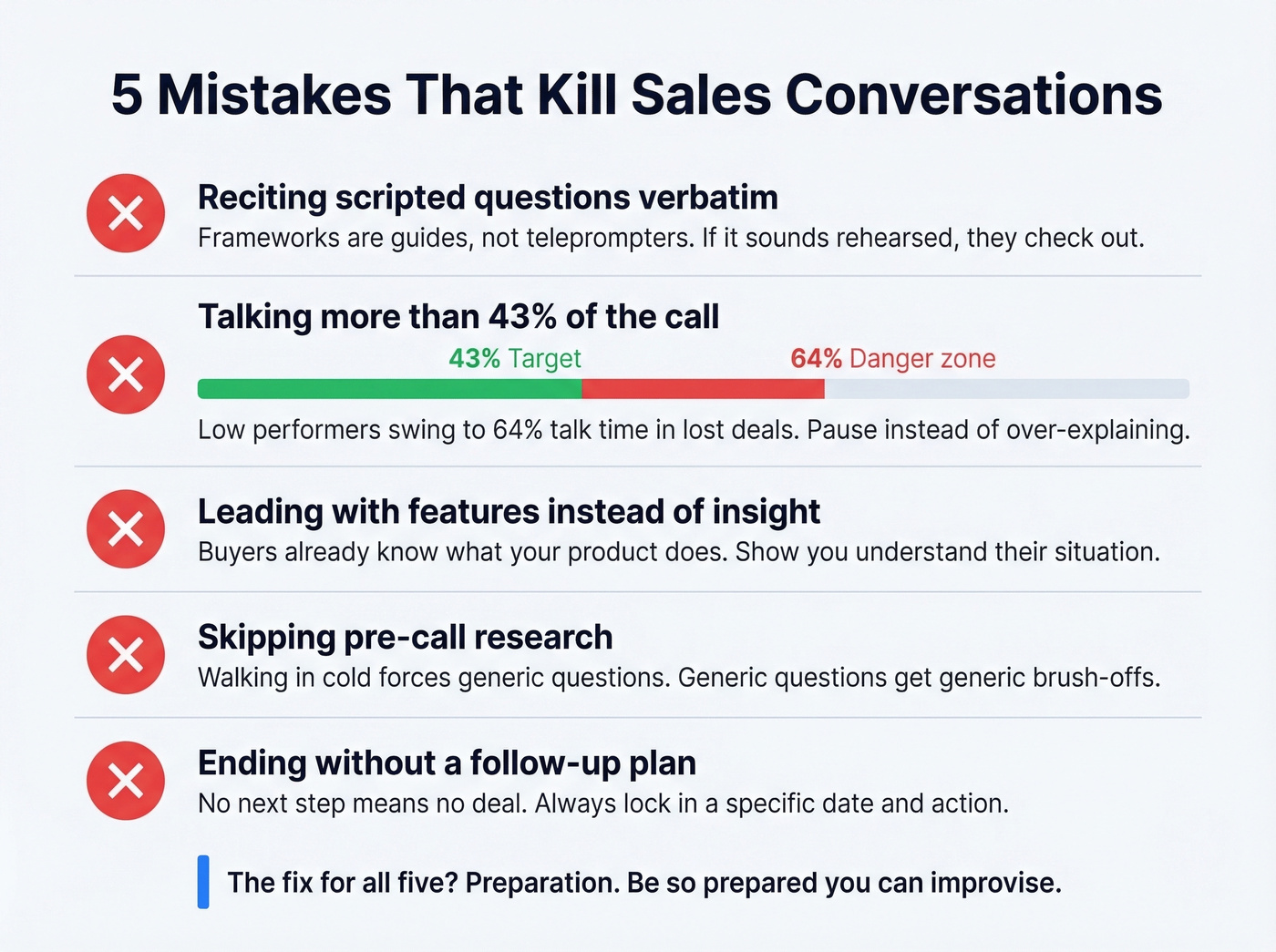
Talking more than 43% of the call. Low performers swing to 64% talk time in lost deals. When you feel the urge to over-explain, pause instead. Silence is uncomfortable. It's also effective.
Leading with features instead of insight. Buyers already know what your product does. They need you to understand their situation.
Skipping pre-call research. Walking in cold forces generic questions. Generic questions get generic answers. Generic answers don't close deals - they generate polite brush-offs.
Ending without a follow-up plan. Persolog's research flags this as one of the most common sales conversation failures. No next step, no deal.
Let's be honest: if your deal sizes sit below $10K, you probably don't need a 12-step sales methodology. You need a rep who can hold a genuine 15-minute dialogue and ask for the next meeting. A conversational approach scales down better than any enterprise framework.
Engaging Customers in Sales Conversations in 2026
45% of sales teams are already running a hybrid AI-SDR model. Teams using conversational AI tools see 25% higher productivity and 30% shorter sales cycles.
Reps spend only 28% of their time actually selling. AI handles the rest - real-time coaching during calls, automated follow-up drafts, pre-call briefings pulled from CRM data. That frees reps to focus on the one thing AI can't do yet: hold a genuinely human conversation. We've seen teams transform their outbound results by pairing AI coaching with fresher contact data, removing friction at both ends of the call.
The biggest shift for 2026 isn't learning a new framework. It's that conversational skill - the ability to listen, adapt, and respond like a real person - is the core differentiator between reps who thrive alongside AI and those AI replaces entirely. Skip this if you're in a purely inbound, self-serve motion where buyers never talk to a human. For everyone else, it's table stakes.
Multi-threading boosts win rates by 130% on $50K+ deals, but every new stakeholder means another number to find. Prospeo's 30+ search filters let you map entire buying committees in minutes - direct dials, verified emails, job titles - at $0.01 per email. Spend your prep time on insight, not hunting for contact info.
Build the full buyer map before your next discovery call.
FAQ
How is conversational selling different from consultative selling?
Consultative selling is a structured advisory process with formal discovery phases. Conversational selling is a communication style - natural, two-way dialogue that works within any methodology, including consultative frameworks. You can be consultative and conversational at the same time; they aren't competing approaches.
What's the ideal talk-to-listen ratio?
Top closers maintain a 43% talk / 57% listen split, based on Gong's analysis of 7.1M opportunities. More important than the exact number: keep your ratio consistent across calls rather than swinging when deals go sideways.
How do I prepare for a conversational sales call?
Spend five minutes researching the prospect's role, company triggers like funding or hiring surges, and relevant pain points. Use a tool like Prospeo to verify contact details upfront so you're not wasting prep time on bad numbers. Walk in ready to have a real dialogue, not to read from a playbook.
Can small teams use this approach without enterprise tools?
Absolutely - teams closing deals under $15K often see the biggest lift. You don't need a 12-step methodology. One rep with solid pre-call research, a verified direct dial, and genuine curiosity will outperform a scripted team twice the size.