


Coresignal vs CUFinder: Which B2B Data Tool Do You Actually Need in 2026?
At entry-level pricing, Coresignal runs roughly 2.7-4.0x more expensive per record than CUFinder. That alone should tell you this isn't an apples-to-apples comparison - they're different categories wearing the same "B2B data" label.
30-Second Verdict
Pick Coresignal if you're a data engineer building intelligence pipelines, feeding ML models, or querying employee datasets at scale via Elasticsearch.
Pick CUFinder if you're an SDR who needs verified contacts, CRM enrichment, and a Chrome extension today.
The Real Difference
Comparing these two is like comparing AWS S3 to Dropbox. Both store files. The buyer profiles couldn't be more different.
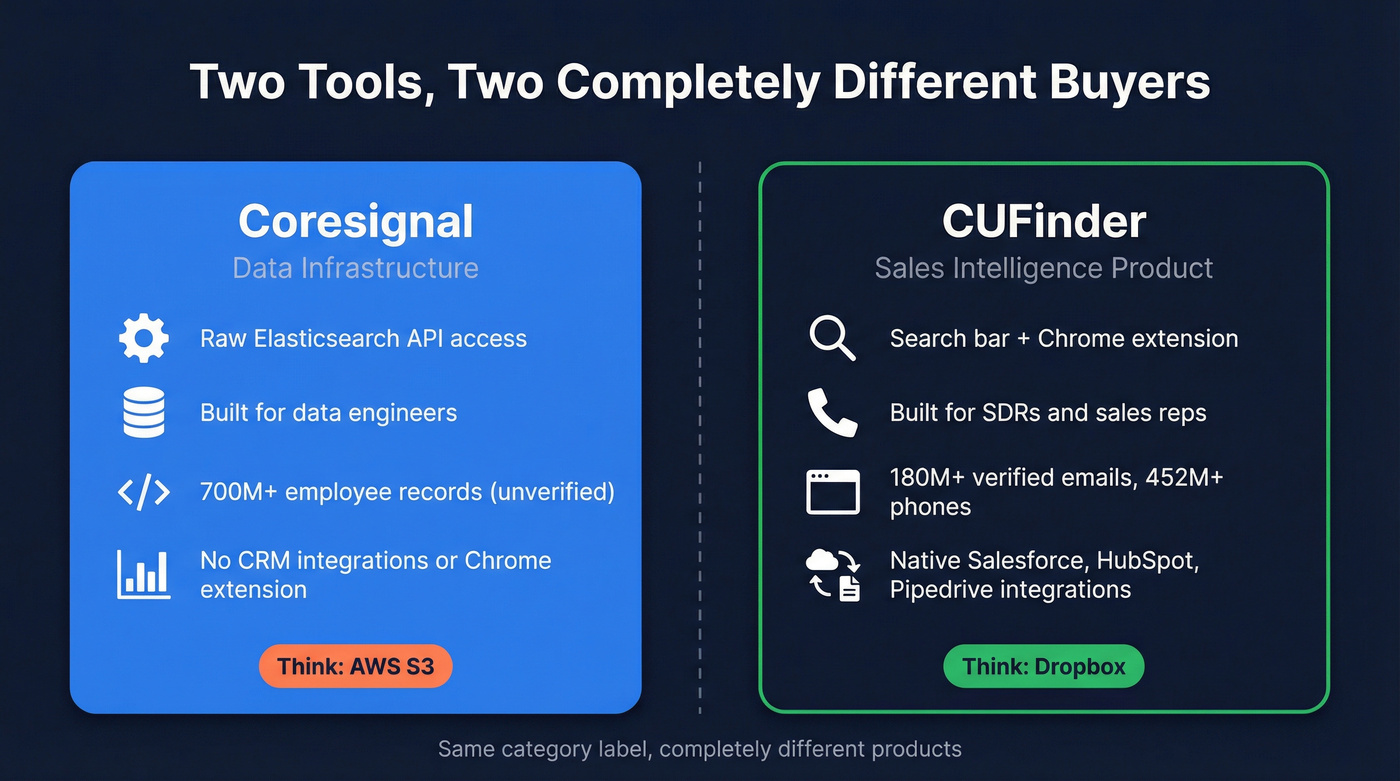
Coresignal is data infrastructure. You get raw, multi-source datasets queried via Elasticsearch DSL - no Chrome extension, no native CRM integrations. Verified emails and phones typically require layering another tool on top rather than coming ready to use out of the box. It's built for developers who want to build things on top of the data, not sales reps who need a phone number by 2 PM.
CUFinder is a finished sales intelligence product. Search bar, browser extension, CRM enrichment - the whole package. We've seen teams waste weeks trying to use infrastructure tools like Coresignal for direct outbound. Don't make that mistake.
Feature-by-Feature Comparison
| Feature | Coresignal | CUFinder | Winner |
|---|---|---|---|
| Database size | 700M-840M employee records | 419M+ individual profiles | Coresignal (raw volume) |
| Verified emails | Not standard (requires layering) | Yes - 180M+ | CUFinder |
| Verified phones | Not standard (requires layering) | 452M+ | CUFinder |
| API response | ~176ms | <500ms | Coresignal |
| Data refresh | ~30-day cycles | Not specified | Coresignal |
| Compliance | EWDCI certified | GDPR/CCPA/SOC 2 Type II | CUFinder (broader) |
| CRM integrations | None native | Salesforce, HubSpot, Pipedrive, Zoho, +5 more | CUFinder |
| Chrome extension | No | Yes | CUFinder |
| G2 rating | No G2 profile | 4.8/5 (988 reviews) | CUFinder |
| Best for | Data engineers | Sales teams | Depends on role |
Coresignal's larger record count is easy to misread if you're shopping for an outbound tool. It's raw, multi-source data that often needs cleanup. CUFinder's smaller dataset comes with verified contact data attached, which is immediately useful for sales.
Pricing Breakdown
| Plan | CUFinder | Coresignal |
|---|---|---|
| Free | $0 (50 credits/mo) | $0 (200 Collect + 400 Search credits; 14-day trial) |
| Starter | $49/mo (1,000 credits) | From $49/mo (at least 250 Collect + 500 Search credits) |
| Production | $299/mo (10K credits) | From $800/mo |
| Enterprise | - | Premium from $1,500/mo; datasets are agreement-based (starting from $1,000) |
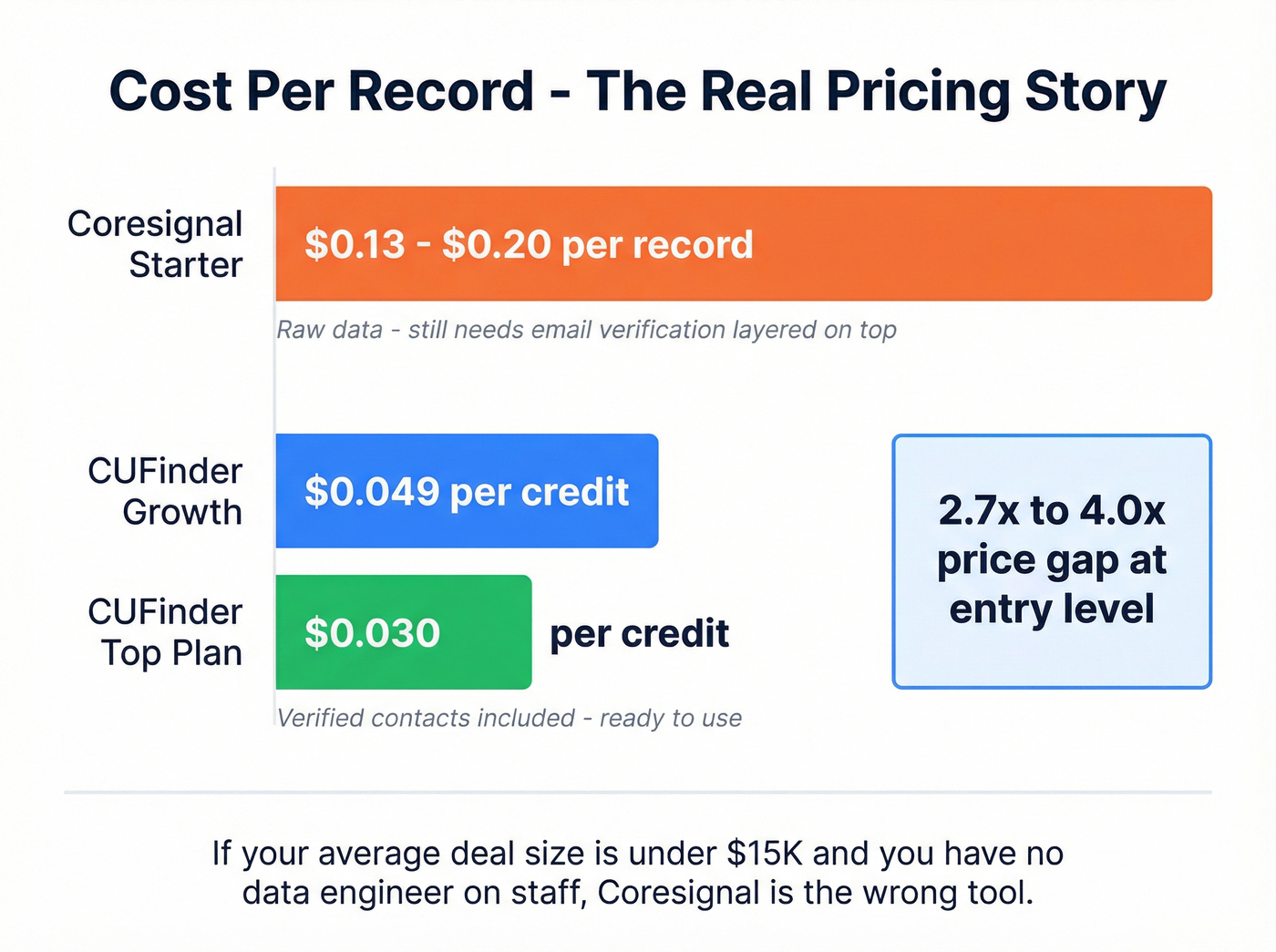
The cost-per-record math tells the real story. Coresignal's Starter pricing works out to about $0.13-$0.20/record. CUFinder's Growth tier comes in at $0.049/credit, and the top plan drops to $0.030/credit. That's a ~2.7-4.0x gap at entry level - justified only if you need raw data for product development, not sales outreach.
Here's the thing: if your average deal size is under $15K and you don't have a data engineer on staff, Coresignal is the wrong tool. Full stop.

Coresignal charges $0.13-$0.20/record for raw data that still needs email verification layered on top. CUFinder caps you at 10K credits/month. Prospeo delivers 98% verified emails at ~$0.01 each with no credit caps, a 7-day data refresh, and native CRM integrations - no data cleanup required.
Skip the tradeoff between infrastructure complexity and outbound limits.
Coresignal: Use or Skip?
Use it if you're building data products or running large-scale market analysis. In our testing, the API response times are consistently fast, and Reddit practitioners praise its schema stability and transparent data sourcing.
Skip it if you expect ready-to-use contacts. One Reddit user gave the AI search a 6/10, noting it's glitchy and doesn't save results. Monthly refresh cycles can miss time-sensitive triggers like promotions or funding rounds, and raw data requires cleanup - expect duplicates, HTML artifacts, and inconsistent formatting. You'll almost certainly need to layer an email verification tool on top, which adds cost and complexity that most sales teams don't budget for.
CUFinder: Who It's Built For
CUFinder is the strongest option here for SMB sales teams who need to start prospecting this week. The 4.8/5 G2 rating across 988 reviews is backed by 4.9/5 scores on GetApp and Software Advice. CRM enrichment gets consistent praise - we've seen users enrich HubSpot records in seconds. One reviewer reported roughly 95% email accuracy and 90%+ phone accuracy, and the Company Email Finder API returns up to five role-based emails per query, which is a nice touch for account-based plays.
The limitations are real, though. G2 reviewers flag occasionally outdated data, and the 10,000 credits/mo cap on the top plan constrains high-volume outbound teams. If you're sending 500+ emails daily, you'll hit that ceiling fast.
Which Tool Should You Pick?
Three buyer profiles, three answers.
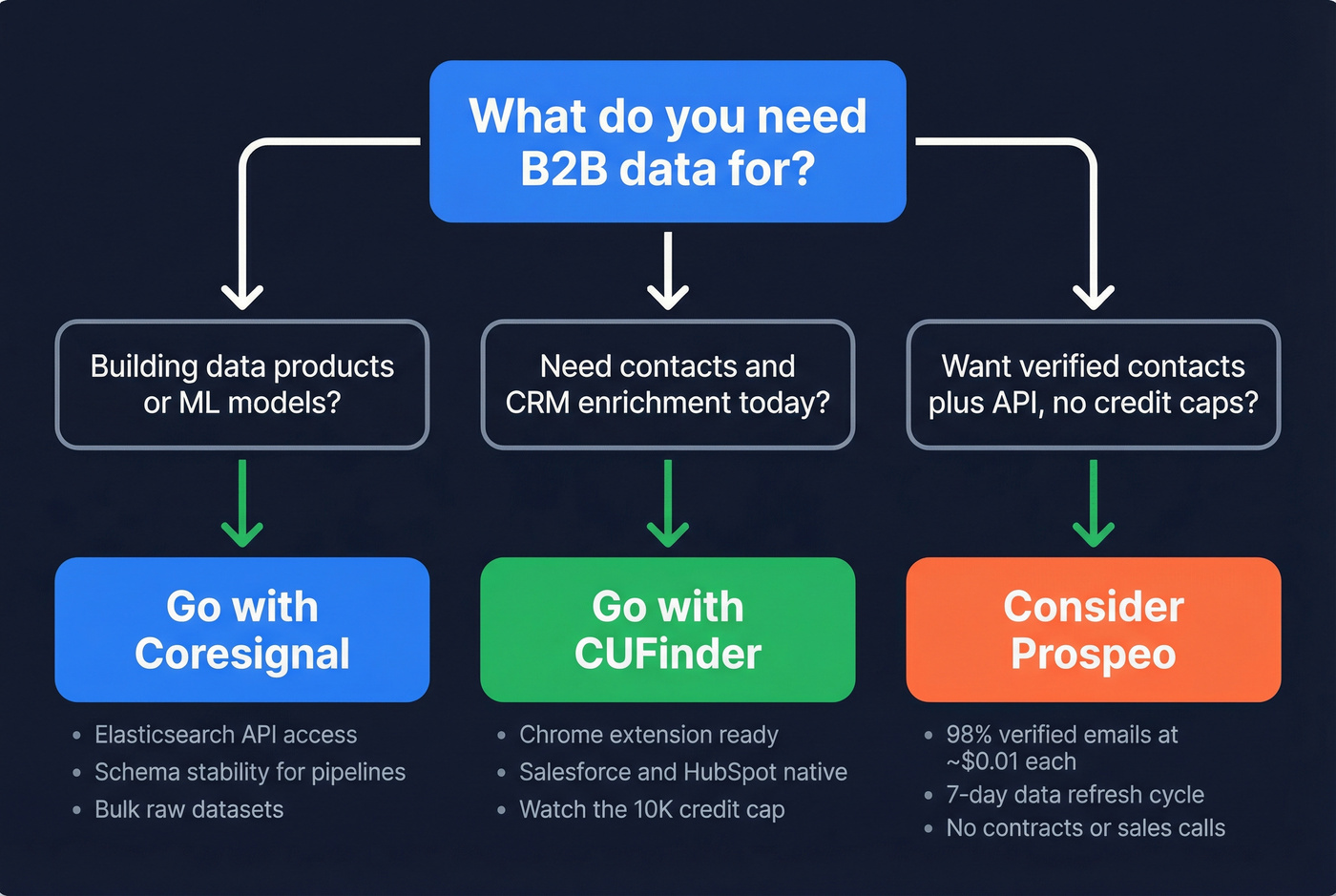
Data engineers building products or running market analysis should go with Coresignal. You need the raw data, schema stability, and bulk APIs. Nothing else here gives you Elasticsearch-level query flexibility.
Sales reps and SDRs who need contacts and CRM enrichment today should pick CUFinder. The Chrome extension, integrations, and self-serve pricing get you moving fast - though watch the credit caps if your team scales.
For teams wanting verified contacts plus API access without raw data cleanup or credit caps, Prospeo fills the gap between Coresignal's infrastructure approach and CUFinder's capped UI, with a 7-day data refresh cycle that beats both.
Why We'd Also Consider Prospeo
Prospeo covers 300M+ professional profiles with 143M+ verified emails at 98% accuracy and 125M+ verified mobiles hitting a 30% pickup rate. Data refreshes every 7 days - compared to Coresignal's ~30-day cycles and CUFinder's unspecified cadence, that's a meaningful edge for time-sensitive outbound. The API runs a 92% match rate, and self-serve pricing starts free with paid plans at roughly $0.01/email. No contracts, no sales calls required.
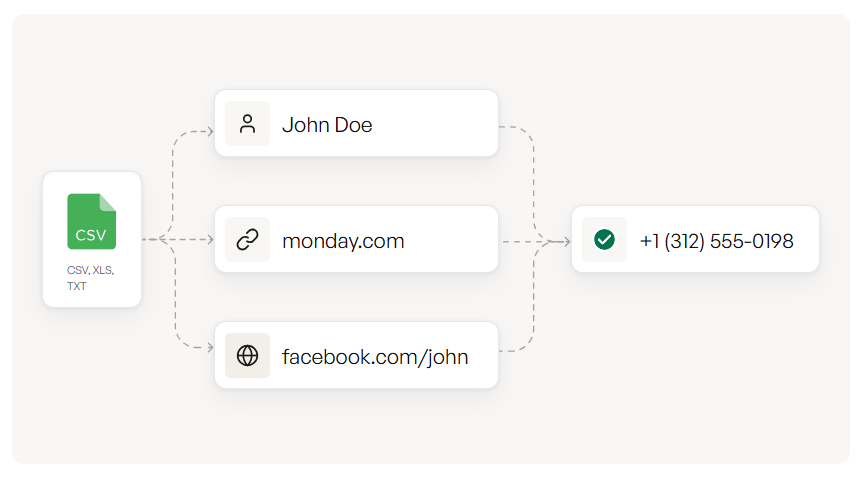
Coresignal refreshes every ~30 days. CUFinder won't say. Prospeo refreshes all 300M+ profiles every 7 days - so your outbound hits real buyers, not stale records. Plus 125M+ verified mobiles with a 30% pickup rate, no layering required.
Get contacts that connect - 75 free verified emails, no credit card.
FAQ
Is Coresignal better than CUFinder?
They serve fundamentally different buyers. Coresignal is data infrastructure for developers building products with bulk Elasticsearch APIs. CUFinder is sales intelligence for reps who need verified contacts and CRM enrichment. Pick based on whether you're building a data pipeline or filling a sales pipeline.
Can I use Coresignal and CUFinder together?
You can - Coresignal for market intelligence, CUFinder for contact enrichment. But the combined cost ($800+/mo plus $49-$299/mo) is steep for most teams. A single platform with both API access and verified contacts at ~$0.01/email is usually more practical.
What's the cheapest way to get verified B2B emails?
CUFinder starts at $49/mo for 1,000 credits ($0.049 each). Prospeo offers 75 verified emails/month free, with paid plans at ~$0.01/email - the lowest cost-per-record option with 98% accuracy and no annual commitment.