

Corteza vs Salesforce: The Comparison Nobody Else Will Write
Most Corteza vs Salesforce comparisons you'll find online are published by Planet Crust - the company behind Corteza's commercial cloud offering. That's not a comparison; it's a sales pitch wearing a blog post costume. Here's an honest breakdown of both platforms, including real user feedback from Reddit that vendor pages won't surface.
30-Second Verdict
| Scenario | Pick |
|---|---|
| Small team with a developer + tight budget | Corteza |
| Enterprise needing ecosystem + compliance | Salesforce |
| Mid-market team without dev resources | Skip both - consider HubSpot |
Corteza is a real option if you've got developers and want to own your data. Salesforce is the safe enterprise bet. But here's our hot take: if your average deal size sits below $15K, you probably don't need either platform's complexity. A lightweight CRM plus clean contact data will outperform a bloated Salesforce instance every time.
Pricing Compared
This is where the conversation gets interesting. Corteza's flat-rate model looks radically cheaper until you factor in build costs.
| Corteza (Cloud) | Salesforce (Sales Cloud) | |
|---|---|---|
| Entry tier | ~$132/mo (up to 25 users) | $25/user/mo (Starter Suite) |
| Mid tier | ~$240/mo (up to 50 users) | $100/user/mo (Pro Suite) |
| Upper tier | ~$456/mo (up to 100 users) | $175/user/mo (Enterprise) |
| Top tier | ~$984/mo (up to 250 users) | $350/user/mo (Unlimited) |
| Self-hosted | Free (Apache 2.0; you still pay infra + labor) | N/A |
At 50 users on Enterprise, Salesforce runs $8,750/month before add-ons, billed annually. Corteza Cloud covers the same headcount for ~$240/month - roughly 97% cheaper on licensing alone.
But licensing isn't the whole story. Salesforce implementations commonly land in the $25K-$250K+ range depending on scope. Corteza's "free" self-hosted option still costs real money in developer time to get production-ready - $10K-$50K is a common range for a serious build, and it can go higher if you're building extensive custom workflow and UI. We've watched teams spend more on Salesforce customization than they budgeted for the entire CRM. The sticker price is never the real price.
Salesforce bumped Enterprise and Unlimited pricing roughly 6% in mid-2025, with Agentforce add-ons starting at $125/user/month on top.
Where Corteza Wins
| Strength | Detail |
|---|---|
| Flat-rate pricing | User #26 costs $0 until the next tier threshold |
| Data sovereignty | Self-host anywhere; Apache 2.0 lets you fork, modify, even sell apps |
| Modern stack | Golang backend, Vue.js frontend, Docker deployment |
| Governance | Governed under Commons Conservancy, reducing single-vendor control risk |
The Apache 2.0 license is genuinely compelling for teams that want full control over their CRM infrastructure. On Software Advice, reviewers praise the flexibility and cost-effectiveness - though with only 2 reviews and a 5.0/5 rating, that's more of a signal than a dataset.
Skip Corteza if you don't have a developer who can commit weeks to setup and ongoing maintenance. No developer, no Corteza. It's that simple.

Whether you pick Corteza or Salesforce, your CRM is only as useful as the data inside it. Prospeo enriches both - 300M+ profiles, 98% email accuracy, 7-day refresh cycle. Native Salesforce integration or CSV/API enrichment for Corteza.
Stop configuring pipelines that run on stale data.
Where Corteza Falls Short
The deployment story has real problems. Namespace exports exclude workflow references and access control permissions, so moving changes across dev/test/prod environments isn't clean. Teams end up resorting to database dumps - a workaround that risks overwriting production data.
Workflow limitations compound this. Prompt or Delay steps make workflows asynchronous, breaking validation on create/update/delete actions. Field-level access control for specific records isn't supported. Federation remains experimental and disabled by default.
On r/selfhosted, a user trying to build a custom CRM on Corteza described feeling "over my head" despite having coding experience, calling it "a ton of work" to get something useful. A separate r/CRM post was blunter: "Do not use Corteza" - citing deployment gaps that made the platform impractical for their team. These aren't isolated complaints. They reflect a pattern: Corteza's flexibility demands serious technical investment that many teams underestimate.
Where Salesforce Wins - and Loses
Wins: AppExchange offers thousands of pre-built integrations that nothing else matches. Enterprise compliance certifications pass procurement scrutiny without a fight. Lightning and Flow deliver mature automation, and the global support infrastructure is battle-tested across every industry vertical you can name.
Loses: Feature gating is aggressive. Many advanced admin and dev capabilities are effectively Enterprise-tier or above, and costs climb fast once you add sandboxes, environments, and AI features. Vendor lock-in runs deep through proprietary APEX code, complex data exports, and switching costs that grow every quarter.
Look - Salesforce is the right choice for organizations that need the ecosystem and can absorb the cost. For everyone else, it's an expensive habit.
Who Should Choose Which
Choose Corteza if you have at least one dedicated developer, need data sovereignty or self-hosting, and can't absorb per-user pricing at scale. Government agencies, NGOs, and privacy-first teams are the sweet spot.
Choose Salesforce if you need enterprise compliance, a massive integration ecosystem, and you'd rather pay for polish than build it yourself.
Skip both if you're a mid-market team without dev resources. HubSpot's free CRM tier gets you moving faster. If you're in the self-hosted camp, keep an eye on Twenty - it's free, open-source, and Reddit's r/selfhosted community has been calling it "AMAZING" for lightweight CRM use cases.
The Data Problem Neither Solves
Both Corteza and Salesforce are CRM shells. They organize contacts, track deals, and run workflows - but neither generates or verifies the B2B data that makes those workflows valuable. If your contact records aren't refreshed frequently, your CRM turns into a graveyard of bounced emails and wrong numbers. Roughly 30% of B2B contacts change roles each year, so decay isn't a future risk - it's already happening in your database right now.
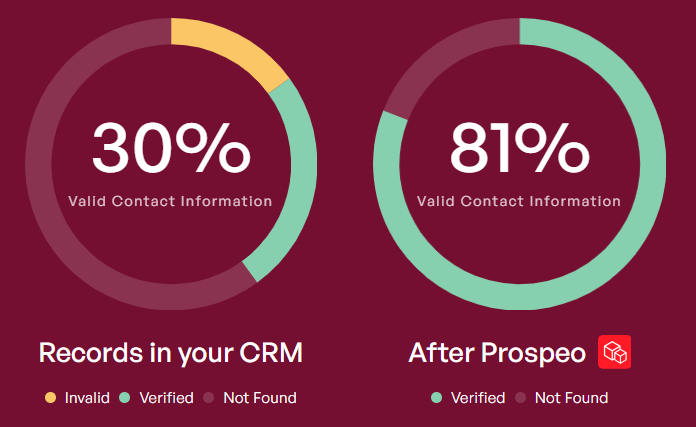
In our experience, this is where most CRM projects quietly fail. Teams spend months configuring pipelines and automations, then feed them stale data. Prospeo handles this layer with 300M+ professional profiles, 98% email accuracy, and a 7-day data refresh cycle. It integrates natively with Salesforce and connects to Corteza via API or CSV enrichment - returning 50+ data points per contact at a 92% match rate.
If you're trying to fix bounce rates and deliverability, start with an email deliverability checklist and a proper email reputation check before scaling outbound.
You just read about spending $10K-$250K on CRM setup. Prospeo costs $0.01 per verified email and returns 50+ data points per contact at a 92% match rate. No contracts, no sales calls - just clean data your CRM actually needs.
75 free verified emails - start in 30 seconds.
FAQ
Is Corteza really free?
The self-hosted Community Edition is free under Apache 2.0 - you pay for server infrastructure and developer time. Cloud hosting starts at ~$132/month for up to 25 users. Budget $10K-$50K in developer time for a production-ready build. "Free" is accurate for licensing; it's not accurate for total cost of ownership.
Can Corteza replace Salesforce for a 50-person team?
With developers on staff, yes - Corteza replicates core CRM functions like leads, accounts, contacts, and opportunities. Without them, consulting costs quickly close the licensing gap. You'll also lose AppExchange integrations, enterprise compliance certifications, and Salesforce's mature support infrastructure.
How do I keep CRM data accurate after choosing a platform?
Run regular enrichment cycles and audit bounce rates quarterly. Data decays fast, so any CRM needs a data layer feeding it fresh records. Let's be honest: most teams don't realize how bad their data has gotten until reply rates crater. A tool like Prospeo handles this with a 7-day refresh cycle and 98% email accuracy, integrating directly with Salesforce and connecting to Corteza via API or CSV.