

How to Create a Sales Plan That Doesn't Fail by February
You've been asked to "put together a sales plan" with zero guidance, no benchmarks, and a deadline that's probably next week. So you open a blank doc, write "Revenue Target: $X," list some initiatives, and call it done. By February, nobody's looking at it. By March, it's a running joke.
Every sales subreddit is full of the same post: "I've been handed a blank doc and told to present a Q1 strategy plan - where do I start?" The answer is always the same: start with math, not strategy. Only 52% of CEOs believe in their own growth plans, and 43.5% of reps actually hit quota. The gap between "plan" and "reality" isn't a motivation problem - it's a math problem.
What a Real Sales Plan Needs
A real sales plan needs three things:
- A capacity model - how much your team can actually produce, adjusted for ramp, turnover, and selling time
- An activity waterfall - reverse-engineered from your revenue target down to daily activities
- A quarterly review cadence - because no plan survives first contact with a real quarter
Everything else is refinement. Sales professionals using structured planning are 4x more likely to achieve objectives, and companies that nail their go-to-market strategy are 2x more likely to meet or exceed revenue expectations. That's not because the document is magic - it's because the math forces you to confront reality before the quarter starts.
Benchmarks Before You Plan
Before you touch a spreadsheet, internalize these numbers. They're the difference between a plan built on assumptions and one built on reality.
| Metric | Benchmark | Why It Matters |
|---|---|---|
| Quota attainment | 43.5% | Your "average rep" isn't average |
| Reps missing quota | 69% | Plan for the median, not the top |
| Non-selling time | 60-70% | Reps sell ~30% of the time |
| New rep ramp | ~7 months | Q1 hires aren't productive until Q3 |
| Healthy utilization | 65-75% | Above burns out; below wastes money |
| AI + quota impact | 3.7x more likely to hit quota | Real lift, but only with clean data |
| Pipeline coverage | 3x-5x standard | Below 3x and you're hoping, not planning |
| Territory optimization | 2-7% lift | Free revenue most teams miss |
The non-selling time stat wrecks the most plans. If your reps spend 60-70% of their week on admin, internal meetings, and CRM updates, your capacity model needs to reflect that. Selling time is a hard constraint on how much pipeline your team can realistically create and work. Ignore it and your entire waterfall is fiction.
How to Build a Strategic Sales Plan in 7 Steps
Step 1: Audit Current Performance
Start with what actually happened, not what you wish had happened. Pull the last four quarters of data: quota attainment by rep, win rates by stage, average deal size, sales cycle length, and pipeline coverage ratios.
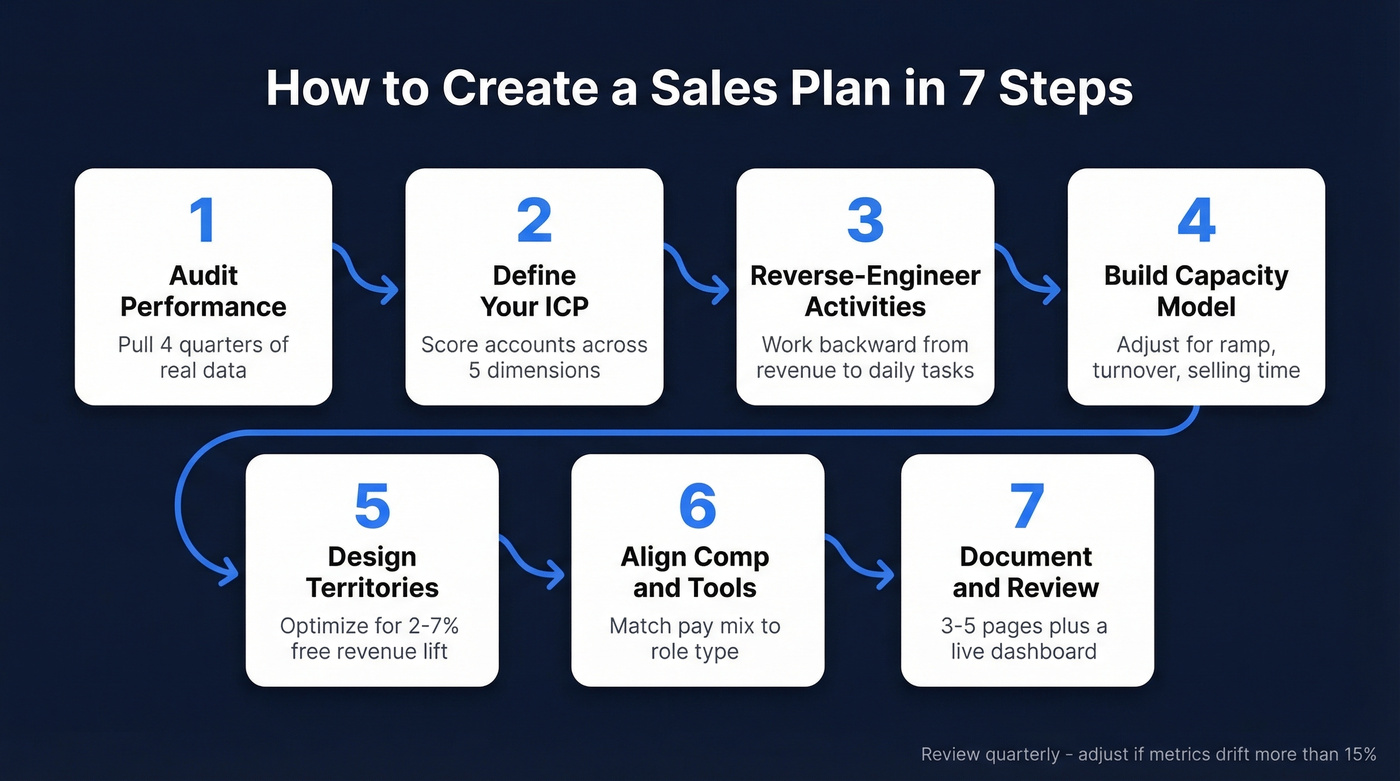
In our experience, the most diagnostic metric is quota attainment distribution. If a small slice of your reps carries most of the number, you don't have a "sales plan" problem - you have a hiring or enablement problem. If attainment clusters around 80-110%, your quotas are well-set and your plan can focus on volume and efficiency. Bimodal distribution, where a bunch of reps sit at 40% and another cluster hits 120%, means your territories are unbalanced. Every number in your plan downstream depends on honest inputs here.
Step 2: Define Your ICP and Target Market
Your plan's activity math is only as good as the list it targets. Define your ICP with enough specificity that a new SDR could build a prospect list without asking you questions.
Nail down these criteria: industry verticals, company size by revenue and headcount, geography, technology stack, buying triggers like funding rounds and leadership changes, plus the titles you're actually selling to. Go beyond firmographics - layer in behavioral signals like engagement patterns, expansion likelihood, and intent data showing which accounts are actively researching your category. Build a simple 1-3 scoring framework across five dimensions. The goal isn't perfection; it's consistency.
Step 3: Set Targets and Reverse-Engineer Activities
This is where most plans either get real or stay fictional.
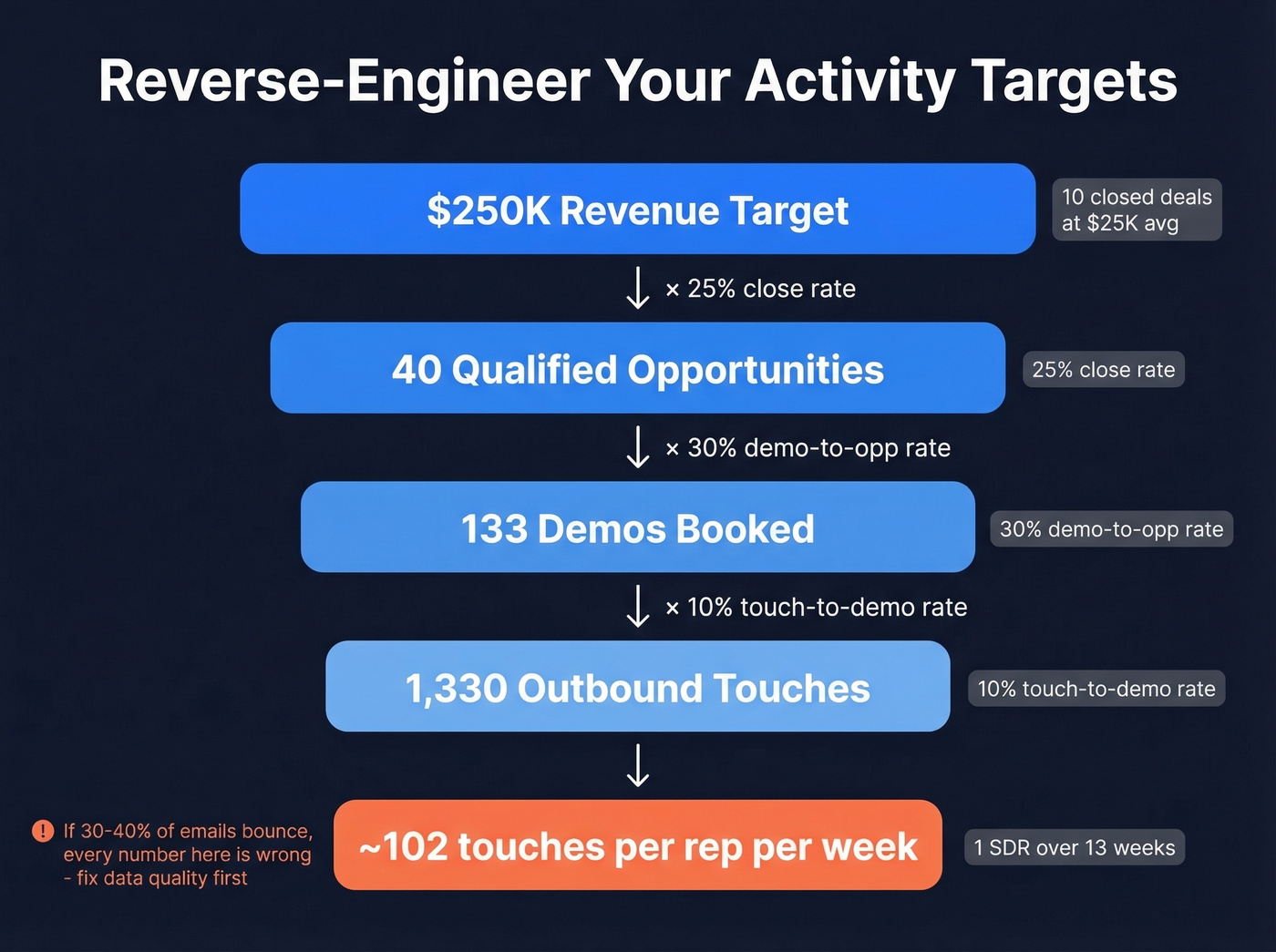
Say your quarterly target is $250K. Your average deal is $25K - that's 10 closed deals. If your close rate is 25%, you need 40 qualified opportunities. If 30% of demos convert to qualified opps, you need ~133 demos. If 10% of outbound touches book a demo, you need ~1,330 touches. Divide by reps and weeks, and you've got a weekly activity target tied directly to revenue.
Here's the thing: your activity math assumes your contact data is usable. If a big chunk of your emails bounce, your waterfall is off immediately. We've seen teams lose 30-40% of their outbound volume to bad data alone, which blows up the entire funnel before a single conversation happens. One bad data layer compounds through every stage.
Step 4: Build Your Capacity Model
The naive formula is seductive: $10M target / $1M per rep = hire 10 reps. It's also wrong. By Q2, you'll be behind because it ignores ramp time, turnover, and the fact that reps sell about 30% of the time.
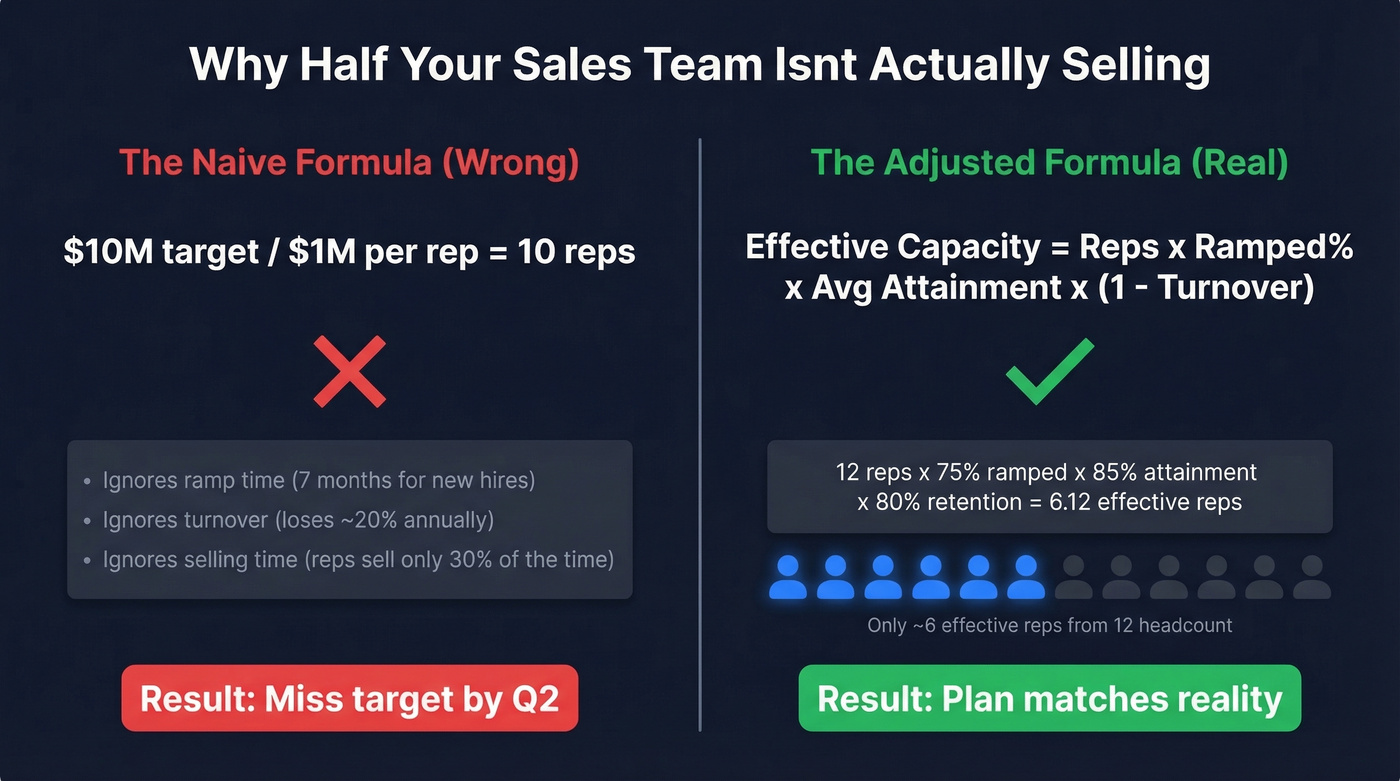
Use the adjusted formula instead:
Effective Capacity = Total Reps x Ramped% x Avg Quota Attainment x (1 - Turnover Rate)
If you have 12 reps, 75% are fully ramped, average attainment is 85%, and annual turnover is 20%, your effective capacity is: 12 x 0.75 x 0.85 x 0.80 = 6.12 fully productive rep-equivalents. That's roughly half your headcount. Anyone building a revenue plan without this adjustment is setting their team up to miss, and we've watched it happen quarter after quarter at companies that should know better.
Five capacity models exist. Top-down works for board-level targets. Bottom-up works for operational planning. Territory-based and workload-based models add precision for larger teams. Dynamic hybrid models combine elements and adjust quarterly - that's where most mature orgs land. The 65-75% utilization band is your guardrail: above it, you're burning people out; below it, you're wasting payroll.
Step 5: Design Territories and Quotas
Territory design is the most underinvested lever in sales planning. HBR research shows that optimizing territories can lift revenue 2-7% with zero additional headcount. That's free money, and most teams leave it behind because redrawing territories feels politically messy.
Track quota attainment distribution as your North Star metric. If some reps sit at 150% while others can't crack 60%, your territories are the problem, not your people. Bottom-up quota setting - based on territory potential and historical data - beats top-down allocation every time.
Step 6: Align Compensation, Tools, and Training
Start planning compensation for next year in Q1 of this year. That sounds aggressive, but the alternative is scrambling in November and rolling out a comp plan nobody trusts in January.
Match pay mix to role. Hunters with full-cycle closing responsibility should carry more variable comp - it aligns incentives with the behavior you want. Customer success and account management roles need more base, because their value accrues over longer time horizons. Factor in geographic risk tolerance too. A rep in a mature territory with a strong book of business doesn't need the same variable split as someone opening a new market.
Step 7: Document, Communicate, Review
Stop writing 25-page sales plans. The best plan fits on 3-5 pages with a linked dashboard. Nobody reads a 25-page document.
Your plan document should cover revenue targets, capacity model, territory assignments, quota methodology, activity waterfall, comp structure summary, and review cadence. Link out to the detailed spreadsheets for anyone who wants to go deeper.
Review quarterly at minimum, with RevOps owning the data pull and sales leadership owning the narrative. Compare actual quota attainment distribution against plan. If key metrics drift more than 15%, adjust immediately rather than waiting for the next cycle. A sales plan isn't a document you write once - it's an operating system you run every week.

Your activity waterfall breaks the moment bad data enters the funnel. Teams lose 30-40% of outbound volume to bounced emails - blowing up every number downstream. Prospeo delivers 98% email accuracy with a 7-day refresh cycle, so your capacity model reflects reality, not fiction.
Build your sales plan on data that won't collapse by February.
Worked Example: $250K Quarter
Let's walk through a real scenario.
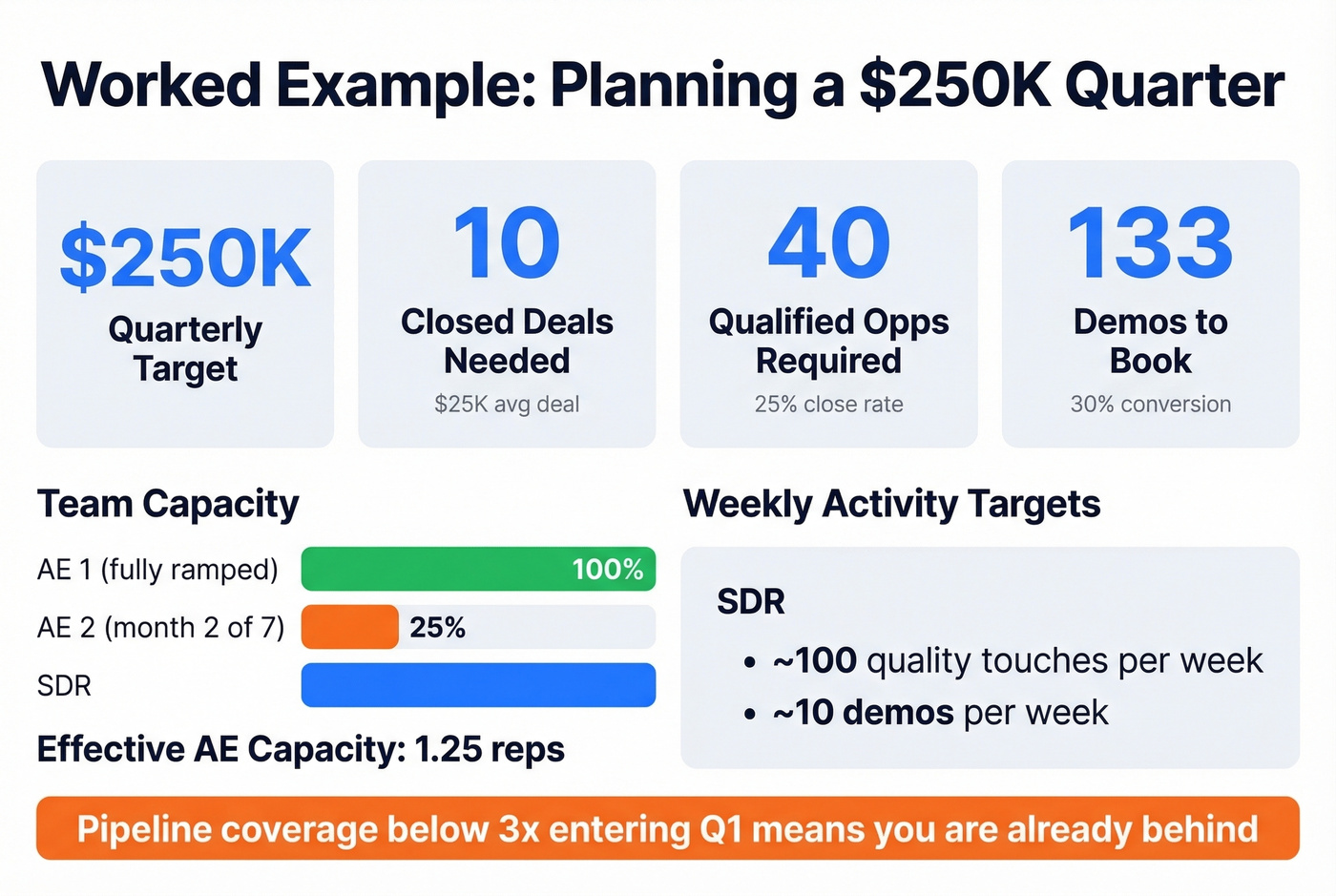
Your target is $250K in new business next quarter. Average deal size is $25K, so you need 10 closed deals. Your historical close rate is 25%, meaning you need 40 qualified opportunities. Your demo-to-qualified-opp conversion rate is 30%, so you need roughly 133 demos booked. And if 10% of outbound touches result in a demo, you need ~1,330 meaningful touches across the quarter.
Now layer in capacity. You have 2 AEs and 1 SDR. One AE started last month - she's in month two of a seven-month ramp, so call her 25% productive. Your effective AE capacity is 1.25 AEs.
The SDR needs to generate ~133 demos over 13 weeks - roughly 10 per week. At a 10% touch-to-demo rate, that's about 100 quality touches per week across calls, emails, and social. Each AE needs to work ~20 qualified opps through the quarter. With a 60-day average sales cycle, you need meaningful pipeline in place before the quarter starts. If your pipeline coverage entering Q1 is below ~3x, you're already behind.
This is exactly why grounding your plan in real numbers matters more than any motivational kickoff.
Five Mistakes That Kill Sales Plans
Planning in silos. 47% of companies cite market uncertainty as their top challenge, but only 30% say their comp strategy is prepared for volatility. When GTM, finance, and ops build plans independently, the numbers never reconcile.
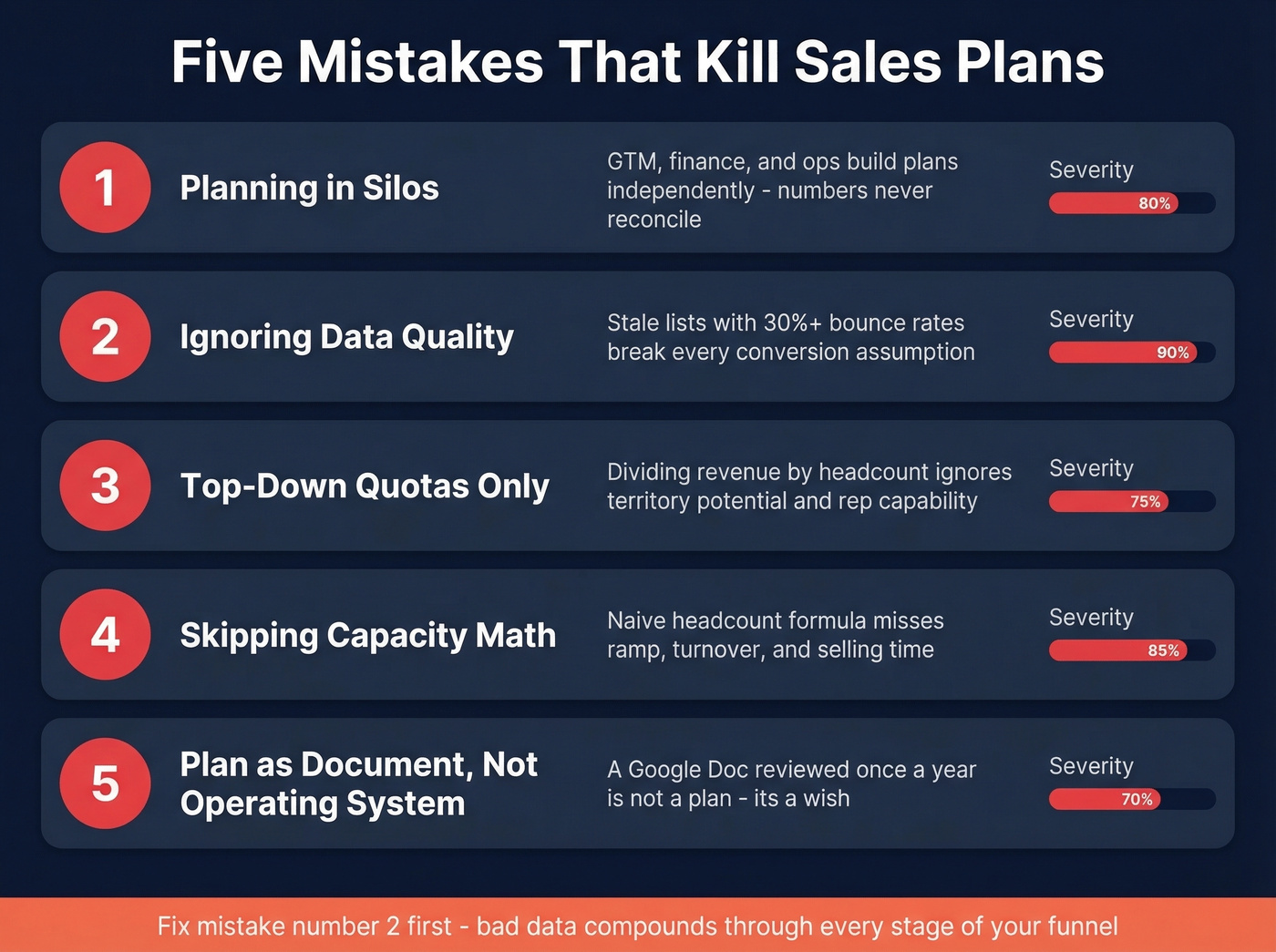
Ignoring data quality. Your plan is only as good as the inputs feeding it. If your reps are working stale lists with 30%+ bounce rates, every conversion assumption in your waterfall is wrong. Fix the data layer first.
Setting quotas top-down only. "We need $50M, divide by 50" ignores territory potential, market density, and rep capability. It guarantees an unfair distribution that demoralizes your middle performers - the exact group you need to move the needle.
Skipping capacity math. We've seen teams hire aggressively in Q1 and still miss Q3 targets because nobody modeled the ramp gap. The naive headcount formula ignores ramp, turnover, and selling time. Don't use it.
Treating the plan as a document instead of an operating system. A plan that lives in a Google Doc and gets reviewed annually isn't a plan. It's a wish. Build a linked dashboard, review weekly metrics, and adjust quarterly.
AI in Sales Planning for 2026
Let's be honest about what AI actually does for sales planning right now.
The good news: 94% of sales leaders with AI agents say they're essential for meeting business demands, and 88% of reps with agents say the tech increases their odds of hitting targets. Practical use cases that deliver today include forecasting accuracy, lead routing, territory optimization, and anomaly detection.
The problem: 51% of sales pros say data security concerns halt AI initiatives, and another 51% say tech silos delay rollout. AI doesn't fix bad data - it just makes bad decisions faster. The biggest driver of forecast accuracy is data quality, not model sophistication. That's why 74% of sales teams with AI are prioritizing data hygiene first. If your CRM is full of stale contacts and duplicate records, no AI agent will save your forecast. Prefer dropdowns and checkboxes over freeform text fields - they're what AI can actually parse.
If you're closing deals under $15K, you probably don't need an AI-powered planning suite. A clean spreadsheet with honest inputs will outperform a $50K platform running on dirty data every single time.
Sales Planning Tools
The sales planning software market is projected to grow from $15B to ~$45B by 2033. More tools, more categories, more confusion. When evaluating platforms, look for five capabilities: territory management, quota modeling, capacity planning, CRM sync, and real-time adjustments. Not every team needs all five - but knowing the checklist keeps you from buying a tool that solves the wrong problem.
| Tool | Category | Best For | Starting Price |
|---|---|---|---|
| Prospeo | Data quality | Verified contact data for outbound | Free tier; ~$0.01/email |
| Salesforce Sales Cloud | CRM planning | Salesforce ecosystem teams | Varies by edition |
| Anaplan | Enterprise planning | Complex territory/quota | Custom pricing |
| CaptivateIQ | Sales performance | Comp + quota alignment | Custom pricing |
| Monday CRM | Lightweight CRM | SMBs wanting visual pipelines | Varies by plan |
| Cube | Financial planning | FP&A revenue modeling | $1,250/mo |
For most teams under 50 reps, start with clean data and your existing CRM. You don't need Anaplan until you're running 100+ reps across multiple territories. Skip it if your team is under 20 - the implementation cost alone will eat a quarter's worth of pipeline investment.
Step 2 says your ICP needs intent signals, tech stack filters, and buying triggers - not just firmographics. Prospeo's 30+ search filters cover all of it: buyer intent across 15,000 topics, technographics, funding rounds, headcount growth, and job changes. One platform, zero guesswork.
Turn your ICP definition into a ready-to-work prospect list in minutes.
FAQ
What's the difference between a sales plan and a sales strategy?
A sales strategy defines your approach to winning deals - channels, messaging, positioning. A sales plan operationalizes that strategy with specific targets, timelines, capacity math, and activity goals. You need both: the strategy says "what," the plan says "how many and by when."
How often should I update my sales plan?
Review quota attainment distribution, pipeline coverage ratios, and capacity utilization every quarter at minimum. If key metrics drift more than 15% from plan, adjust immediately rather than waiting for the next cycle. Weekly dashboard check-ins catch drift early before it becomes a crisis.
How do I create a sales plan for a small team?
The math is identical - you just have fewer variables. Run the activity waterfall from your revenue target down to daily touches, build a capacity model for your actual headcount including ramp, and set pipeline coverage targets. Small teams benefit more from this discipline because there's zero margin for error. Prospeo's free tier gives you 75 verified emails per month, which eliminates waste from bounced emails without adding cost.
How does a strategic sales plan differ from a basic one?
A basic plan covers targets and activities. A strategic version layers in market analysis, competitive positioning, ICP segmentation, and multi-quarter capacity modeling - tying every activity back to a defensible market thesis. Start with the seven steps above, then add the strategic context that justifies your resource allocation.
What's the fastest way to fix bad data in my plan?
Run your existing contact list through a verification tool before the quarter starts. Teams like Snyk cut bounce rates from 35-40% to under 5% and added 200+ new opportunities per month after cleaning their data layer. The fix isn't complicated - it just needs to happen before you start executing, not after your first campaign tanks.