

How to Run a CRM Data Audit That Actually Fixes Your Pipeline
It's the night before the board meeting, and your VP of Sales is manually "adjusting" the forecast - again. Twenty percent of deals are past realistic close dates. Duplicates are inflating attribution numbers, and everyone knows the pipeline number is fiction. A CRM data audit would've caught every one of these issues. This isn't a rep problem. It's a data problem, and 37% of CRM users report losing revenue directly because of it.
The Mistake Everyone Makes First
A RevOps practitioner on r/revops shared a painful lesson: they spent two weeks cleaning exported CRM data - formatting names, deduping emails, fixing phone numbers - before realizing roughly 30% of the fields they were scrubbing weren't used by anyone on the team.
The fix was embarrassingly simple. One hour talking to daily CRM users revealed which fields actually mattered. We've seen this pattern at company after company. Audit relevance first, then clean what's left.
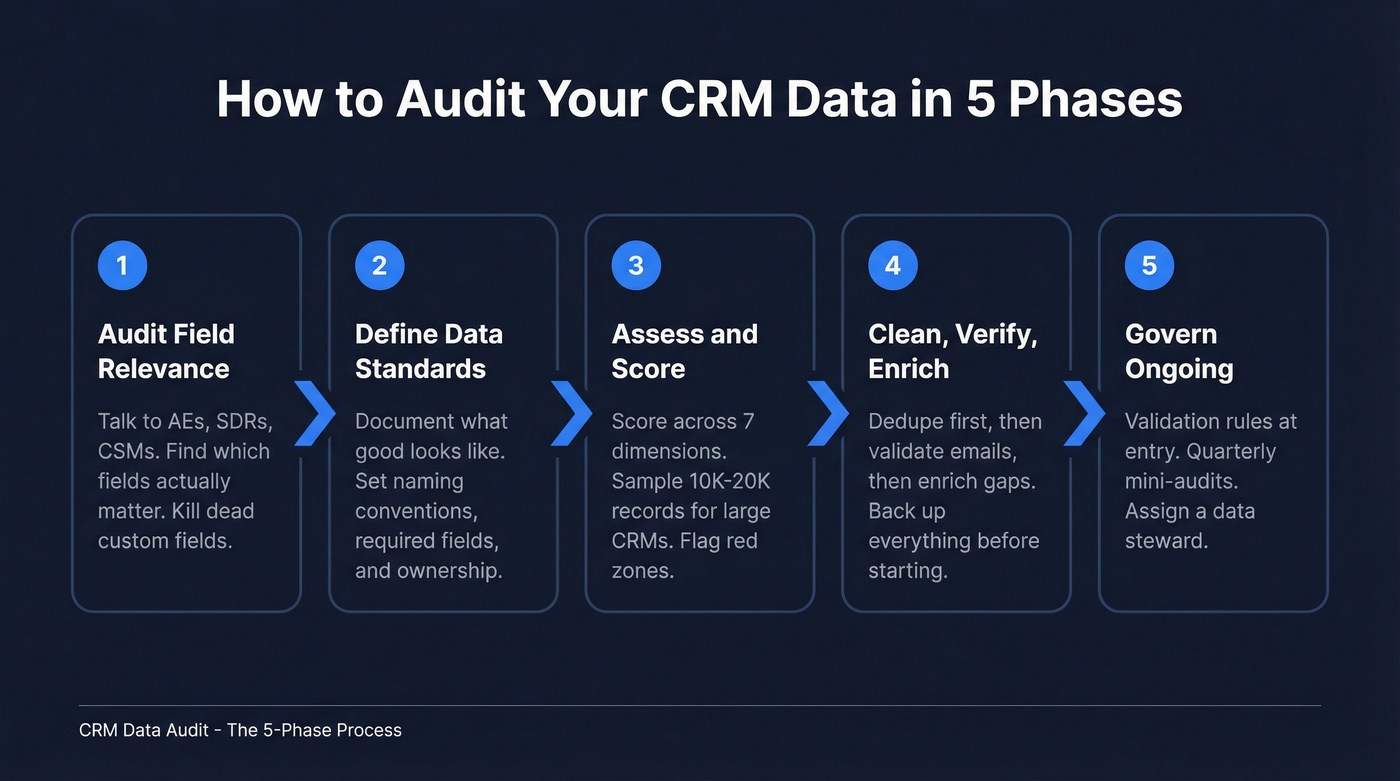
How to Audit CRM Data in 5 Phases
Phase 1 - Audit Field Relevance
Talk to the people who live in your CRM - AEs, SDRs, CSMs. Ask which fields they actually fill out and which they ignore. You'll find a surprising number of custom fields were created for a one-time campaign two years ago and never removed. This conversation takes an hour and saves weeks.
Phase 2 - Define Data Standards
Document what "good" looks like before you assess anything. Define core fields every record must have, establish naming conventions, set entry rules, and assign ownership. Who's responsible for account data? Who owns contact enrichment? Without standards, you're cleaning a mess that re-forms in 90 days - and poor data management is exactly how pipelines quietly rot from the inside. InTandem's audit playbook lays out a solid framework here.
Phase 3 - Assess and Score
Score your CRM across seven dimensions: completeness, accuracy, freshness, consistency, uniqueness, validity, and enrichment coverage. Most B2B CRMs score 45-60 out of 100 on their first audit. That's not unusual - it's the starting line.
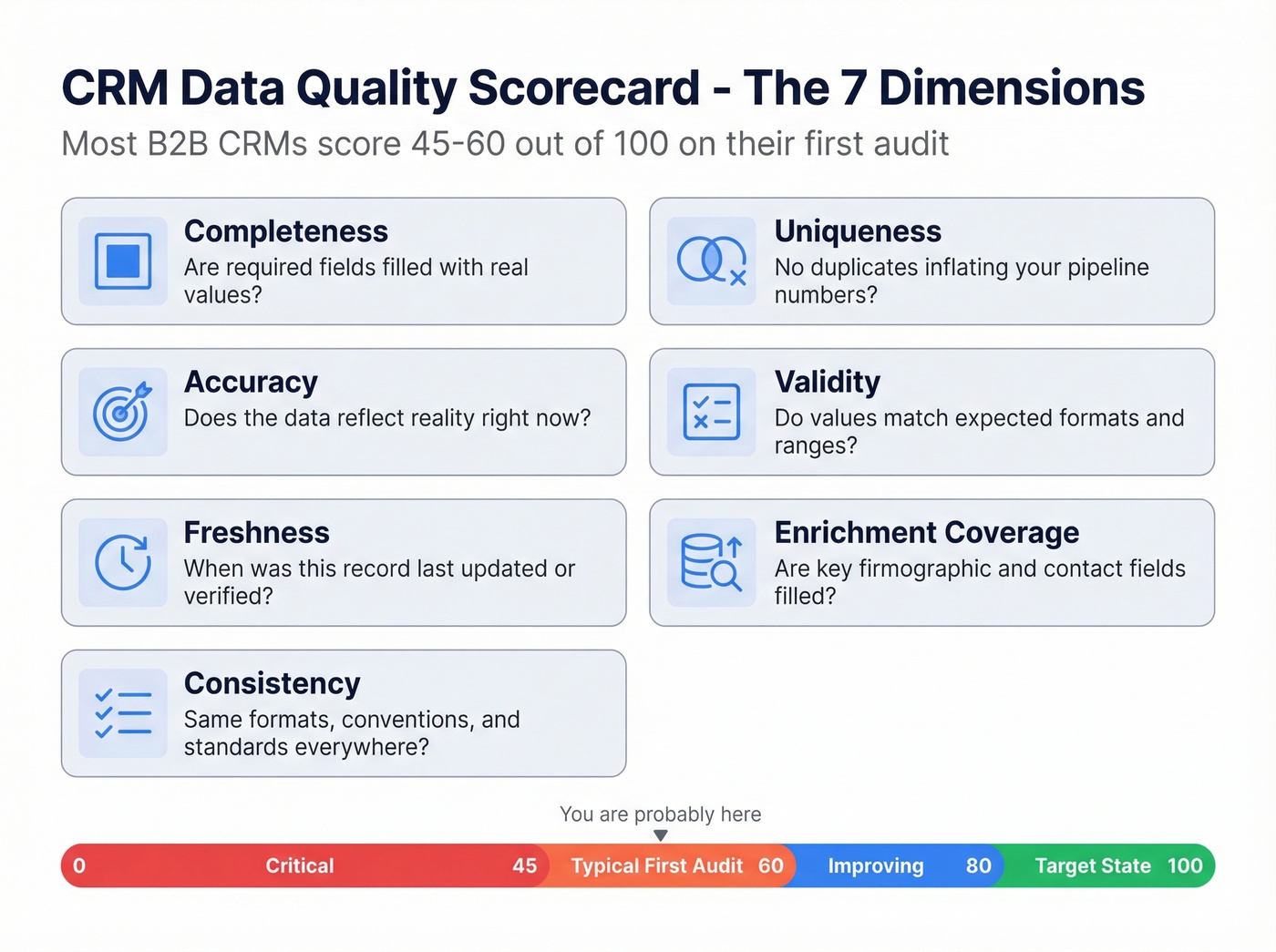
For CRMs under 100K records, a baseline assessment takes 1-2 hours. Larger databases need a different approach: sample 10K-20K records stratified by lead source and creation date. Here's what to flag immediately:
- Field fill rate below 70% - needs immediate attention. Below 50% is critical.
- Duplicate rate above 10% - dedupe is your first remediation priority.
- Email validity below 90% - actively hurting your outbound.
- Bounce rate above 2% - your sender reputation is taking damage right now.
Watch for "false completeness" too. Between 5-10% of "filled" fields contain placeholders like N/A, unknown, or test. Those aren't data - they're noise wearing a mask. These slip past teams that only check whether a field is populated rather than whether it's accurate.

Phase 4 - Clean, Verify, and Enrich
Back up everything first. Then sequence fixes by impact: deduplication first because it causes the highest pipeline distortion, then email validation to protect sender reputation, then enrichment to close coverage gaps. A good deletion heuristic: if a lead has had zero engagement for 18+ months and isn't strategically important, delete it.
Here's the thing - manual merging takes 10-20 minutes per record. If you've got 10,000 duplicates, that's 1,600+ hours of manual work. Automation isn't optional at that scale. For email verification and enrichment, Prospeo handles both in a single workflow: upload flagged records or connect via native Salesforce and HubSpot integrations, and it verifies emails at 98% accuracy while enriching incomplete contacts with 50+ data points. The 83% enrichment match rate means most gap records come back filled with direct dials, job titles, and company firmographics.
Phase 5 - Govern Ongoing
The audit is worthless if you don't prevent re-decay. Set validation rules at the point of entry - required fields, format checks, picklist enforcement. Schedule quarterly mini-audits on key metrics. Assign one person as your data steward with clear escalation paths. And make sure your governance process accounts for GDPR/CCPA data retention requirements, because compliance gaps compound just like data quality gaps.
B2B data decays roughly 30% per year. In our experience, teams that only audit annually are always working with stale information by month six. Organizations that implement proper CRM governance see 5-15% revenue growth and 15-30% efficiency gains on data-related workflows. That's not a rounding error.

Your audit just flagged thousands of invalid emails and incomplete records. Manually fixing them takes months. Prospeo verifies emails at 98% accuracy and enriches contacts with 50+ data points - 83% of records come back filled. Native Salesforce and HubSpot integrations mean you clean in-place.
Stop auditing the same bad data every quarter. Fix it once.
Data Quality Thresholds
| Metric | Red Flag | Target |
|---|---|---|
| Field fill rate | < 70% | > 90% |
| Duplicate rate | > 10% | < 5% |
| Email validity | < 90% | > 95% |
| Bounce rate | > 2% | < 1% |
| Placeholder values | > 5% | < 1% |
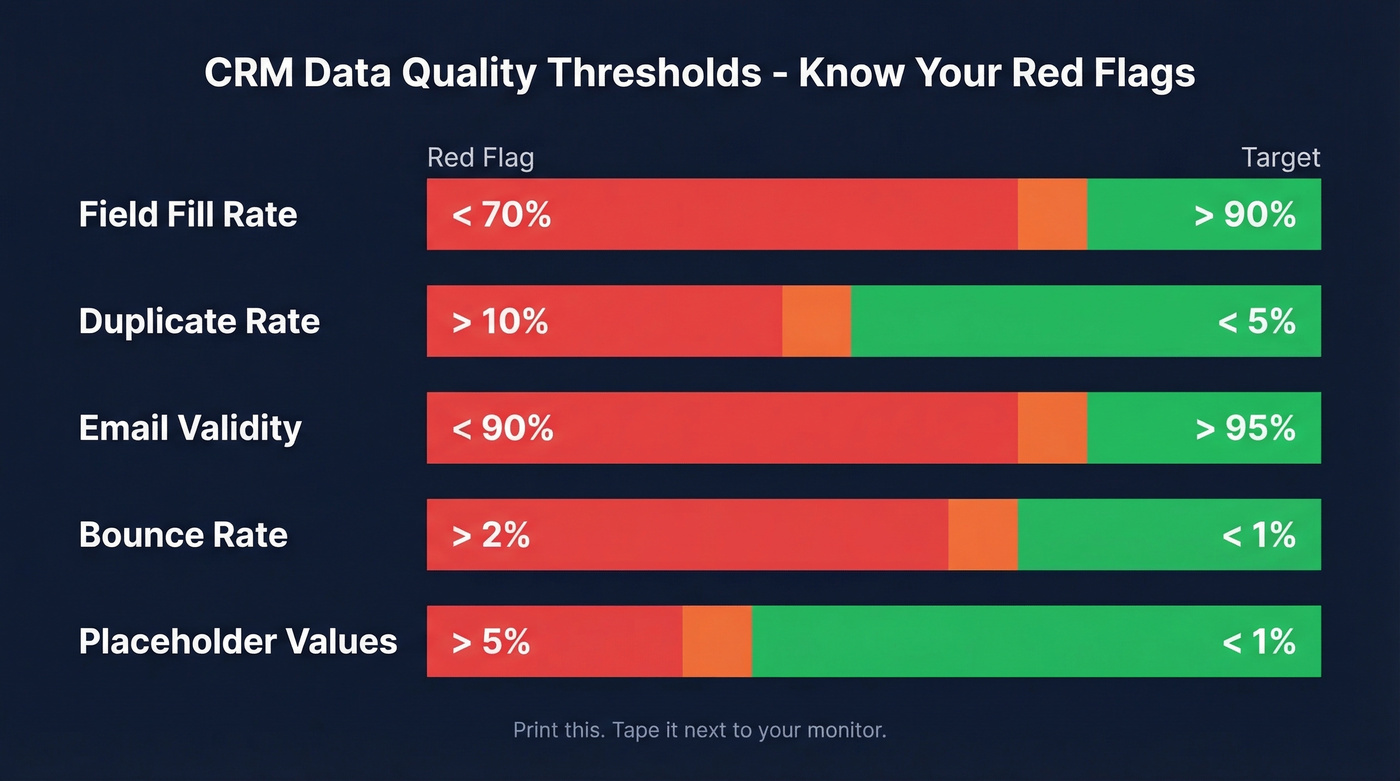
Print this. Tape it next to your monitor.
Reports to Build After Your Audit
HubSpot
- Contacts without email address
- Contacts where "Invalid email" is true
- Contacts with "Email hard bounce reason" grouped by owner
- Deals closed without close date
- Deals without amount, or with dummy amounts like 0 or 1
- Companies without company domain name
Salesforce
- Leads and contacts with blank email fields
- Accounts missing industry or employee count
- Opportunities past close date still in an open stage
- Duplicate report using native Duplicate Management
- Contacts with no activity logged in 12+ months
Tools Worth Using
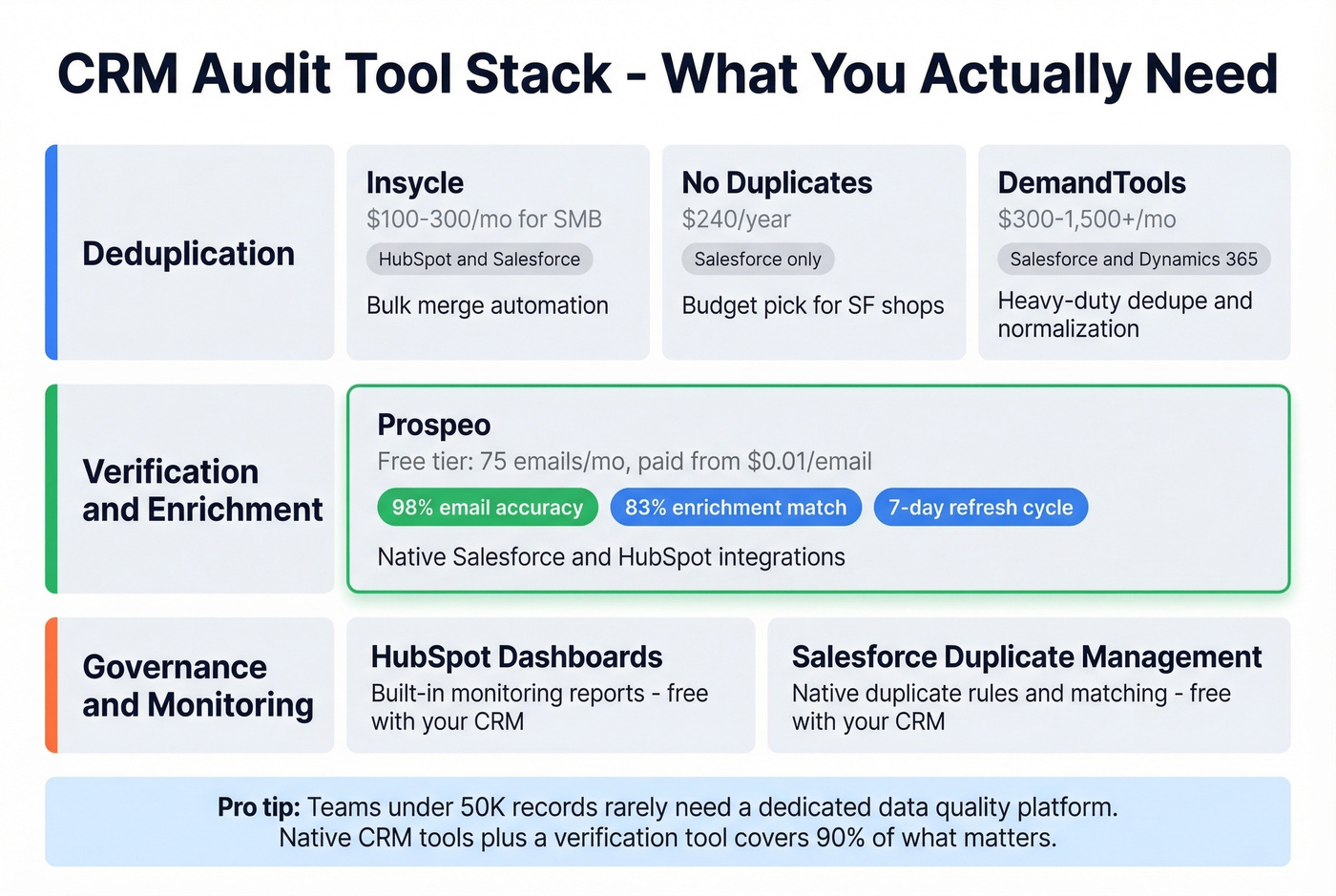
Deduplication:
- Insycle (~$100-300/mo for SMB) - bulk merge automation across HubSpot and Salesforce
- No Duplicates ($240/year, Salesforce-native) - the budget pick for Salesforce shops
- DemandTools (~$300-1,500+/mo depending on seats) - heavy-duty dedupe and normalization for Salesforce and Dynamics 365
Verification & Enrichment:
- Prospeo (free tier: 75 emails/mo; paid from ~$0.01/email) - 98% email accuracy, 83% enrichment match rate, native Salesforce and HubSpot integrations, 7-day data refresh cycle
Governance & Monitoring: HubSpot dashboards and monitoring reports plus Salesforce's native Duplicate Management are solid starting points. Don't buy another tool before using what's already in your CRM.
Let's be honest: most teams under 50K CRM records don't need a dedicated data quality platform. Native CRM tools for governance plus a verification and enrichment tool for accuracy covers 90% of what matters. Skip the enterprise spend until you actually have enterprise-scale problems.
B2B data decays 30% per year. Your CRM is rotting between audits. Prospeo refreshes every 7 days - not the 6-week industry average - so the contacts you just cleaned stay accurate. At $0.01 per email, ongoing verification costs less than one bad bounce to your sender reputation.
Keep your CRM clean between audits automatically.
FAQ
How often should you audit CRM data?
Full audit twice a year minimum. Run quarterly mini-audits on duplicate rate, email validity, and fill rate to catch decay before it compounds. B2B contact data decays roughly 30% annually, so annual-only reviews guarantee you're always behind.
How long does a full audit take?
For CRMs under 100K records, the baseline assessment takes 1-2 hours. The complete 5-phase process - from stakeholder interviews through governance setup - typically runs 1-2 weeks depending on team size and data volume.
What's the fastest way to fix bad email data?
Batch-verify flagged emails through a tool with native CRM integration so clean data flows back without manual re-entry. We've seen teams resolve their email quality issues in a single afternoon once the workflow is connected.
What are the costliest CRM data mistakes in B2B?
Letting duplicates inflate pipeline numbers, ignoring bounce rates until sender reputation tanks, and skipping governance after a cleanup so the same problems return within a quarter. A structured audit catches these before they cost you deals and credibility with the board.