

The Best CRM for Cold Calling - With Pricing You Can Actually Trust
A RevOps lead we know ran a 3-tool bake-off last quarter. The CRM with the best dialer had the worst data - reps burned two hours a day listening to disconnected numbers. The cheapest option had the best connect rates, but only because the team paired it with a standalone data provider that actually verified phone numbers. The lesson: your CRM choice matters less than the data feeding it.
68% of sales organizations use cold calling, and 63% of daily cold callers say volume increased year-over-year since 2024. But only 32% of those teams hit even a 6-10% call-to-appointment rate. The gap between "we cold call" and "cold calling works for us" comes down to two things: dialer capability and data quality.
Our Picks (TL;DR)
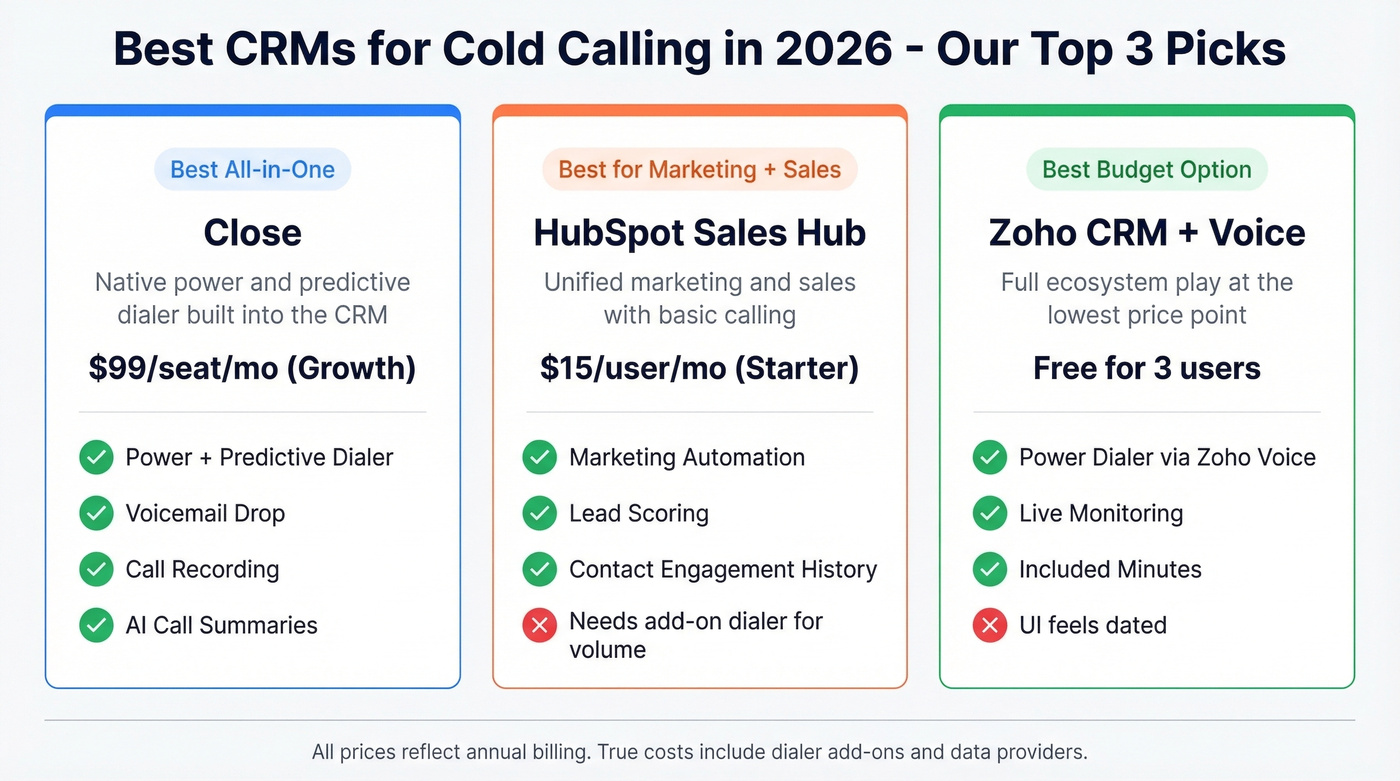
| Pick | Best For | Starting Price |
|---|---|---|
| Close | All-in-one CRM with native dialer | $99/seat/mo (Growth) |
| HubSpot Sales Hub | Marketing + sales alignment | $15/user/mo (Starter) |
| Zoho CRM + Voice | Budget-friendly ecosystem | Free (3 users) |
What Makes a CRM Good for Cold Calling
Not every CRM deserves the "cold calling" label just because it has a click-to-call button. Here's what separates the real contenders from the pretenders.
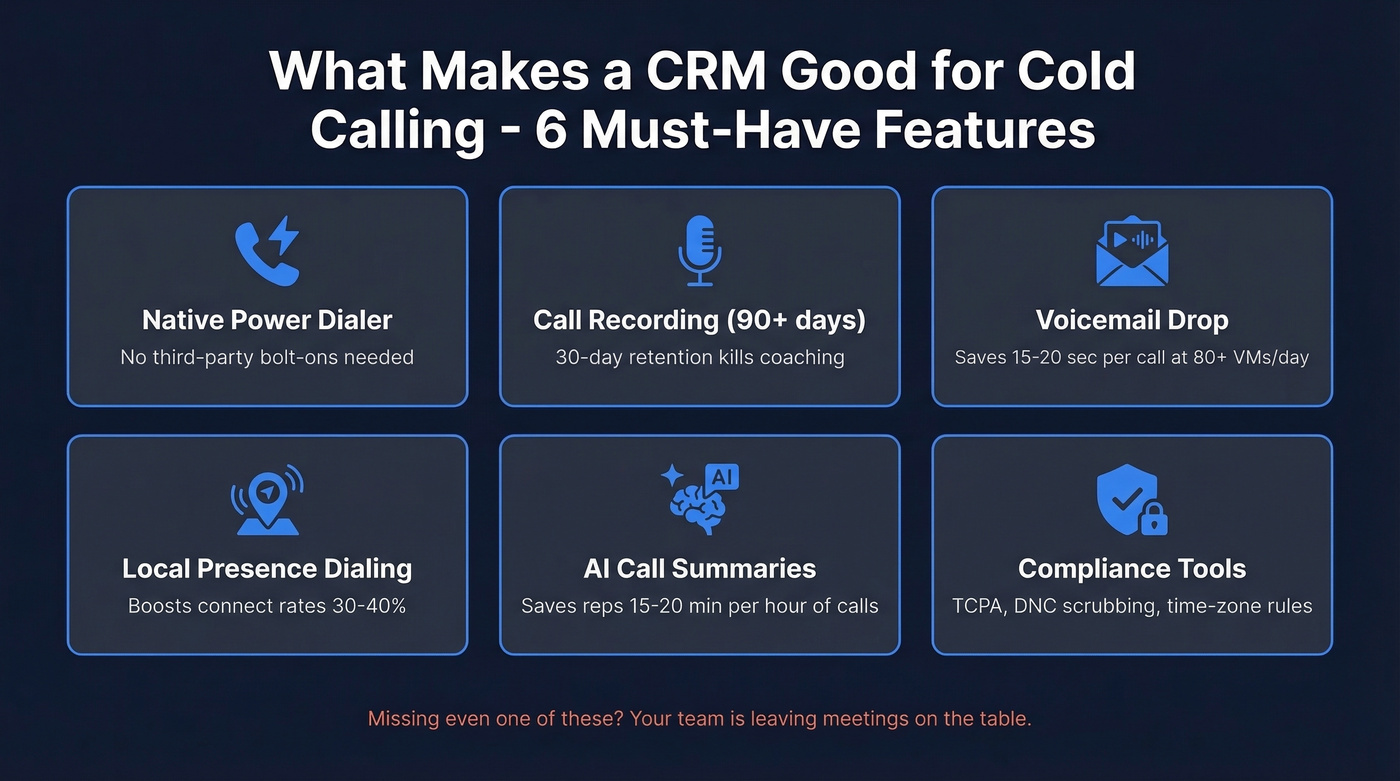
Built-in dialer vs. integration. A native power dialer eliminates context-switching. If you're bolting on Aircall or Kixie, factor $30-50/user/mo into your total cost.
Call recording and retention. 30-day retention is useless for coaching. You want 90 days minimum, ideally unlimited.
Voicemail drop. One-click voicemail drop is non-negotiable for high-volume teams leaving 80+ voicemails a day. Without it, reps waste 15-20 seconds per call just waiting for the beep and reciting the same script.
Local presence dialing. Displaying a local area code boosts connect rates by 30-40% over toll-free numbers. Not every platform supports this natively.
AI call summaries. Transcription and auto-generated notes save reps 15-20 minutes per hour of calling. Table stakes in 2026.
Compliance tools. TCPA, DNC list scrubbing, time-zone restrictions. You're one lawsuit away from a very bad quarter without these.
CRM integration reduces administrative time by 35%, enabling 15-20 additional daily calls. That's the difference between 50 dials and 70 - but only if those extra 20 numbers actually connect.
A note on Apollo and Salesloft: Many teams searching for a cold calling CRM are actually considering sales engagement platforms. Apollo, Salesloft, and Outreach aren't CRMs - they lack proper pipeline management and forecasting. If you're using one as a CRM substitute, you'll eventually hit a wall. Use them as a layer on top of a real CRM, not a replacement.
Dialer Types Explained
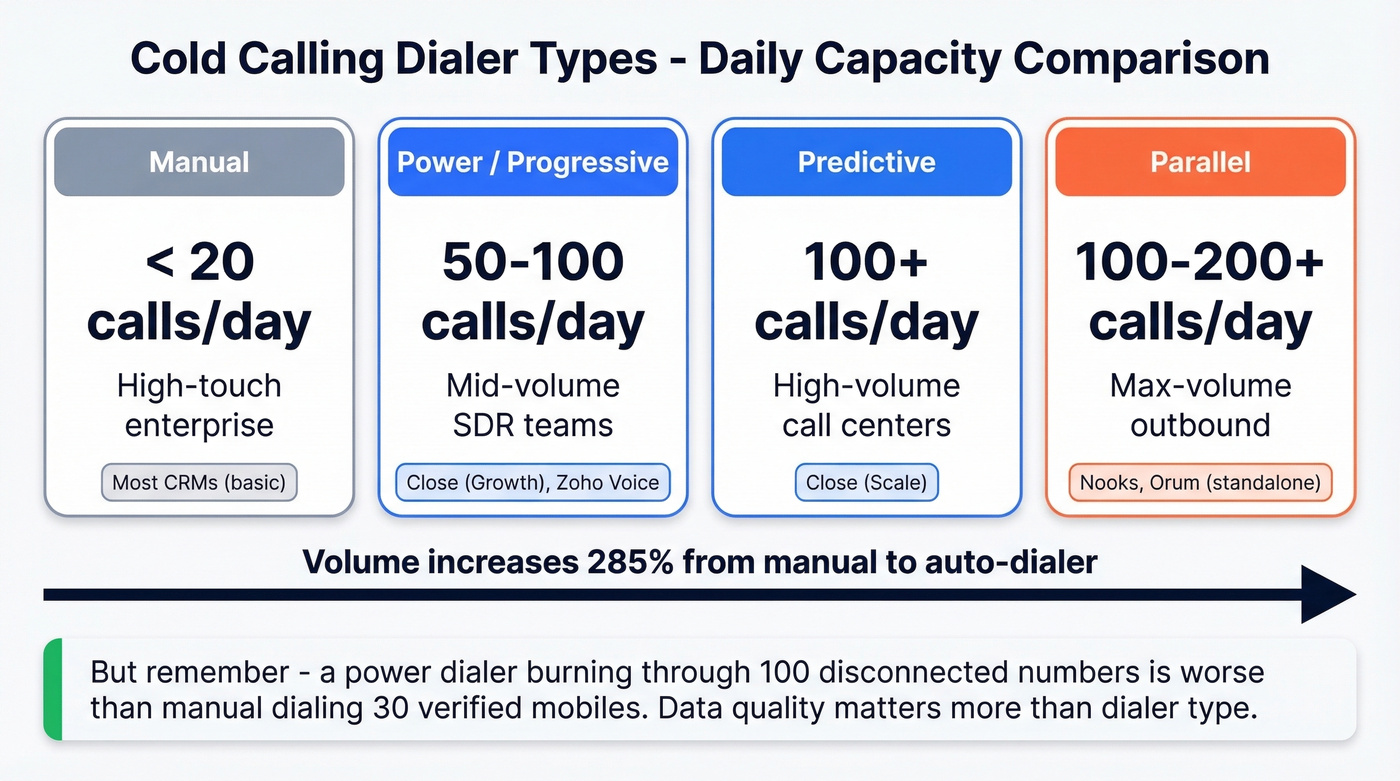
| Type | Daily Capacity | Best For | CRMs That Include It |
|---|---|---|---|
| Manual | < 20 calls | High-touch enterprise | Most CRMs (basic) |
| Power/Progressive | 50-100 calls | Mid-volume SDR teams | Close (Growth+), Zoho Voice |
| Predictive | 100+ calls | High-volume call centers | Close (Scale) |
| Parallel | 100-200+ calls | Max-volume outbound | Nooks, Orum (standalone) |
Manual dialing means a rep clicks a number, waits for it to ring, handles the call, then manually moves to the next contact. Fine for 15 calls a day to C-suite targets. Terrible for SDR teams trying to hit quota.
Power dialers auto-advance through a list, dialing the next number as soon as the rep finishes a call. Predictive dialers go further - they dial multiple numbers simultaneously and only connect the rep when someone picks up. Parallel dialers are the newest category: they dial 5-10 numbers at once across multiple lines, routing live pickups to available reps. Auto-dialer usage increases daily capacity by 285% compared to manual dialing. That's not a marginal improvement. It's a different business model.
Here's the thing: most teams obsess over dialer type when they should obsess over data quality. A power dialer burning through 100 disconnected numbers is worse than manual dialing 30 verified mobiles. We've seen teams double their connect rates just by switching data providers without touching their dialer setup.

You just read it: teams double connect rates by switching data providers, not dialers. Prospeo gives your CRM 125M+ verified mobile numbers with a 30% pickup rate - 3x higher than ZoomInfo or Apollo. At $0.01/lead, a 5-rep team stops burning hours on disconnected numbers and starts booking meetings.
Fix your data layer and watch every dialer in your stack perform.
Top CRMs for Cold Calling in 2026
Close - Best All-in-One
Close is the only CRM on this list where the dialer isn't an afterthought - it's the core product.
Use it if your team runs 50-100+ calls per day and needs power or predictive dialing without bolting on third-party software. The Power Dialer unlocks at the Growth plan ($99/seat/mo), and the Predictive Dialer at Scale ($139/seat/mo). Both include voicemail drop, call recording, and call disposition tracking. AI call summaries are available via Close's Call Assistant add-on. International calling supports nearly 200 countries with local presence numbers.
Skip it if you need advanced reporting or sophisticated inbox management. Close does offer a unified inbox for calls, emails, and texts, but G2 reviewers flag limited customization (150 mentions) and weak inbox features (271 mentions) as recurring pain points. Call-related complaints include charges during wait times and occasional recording failures. Close earns a 4.7/5 across 2,009 reviews, with "user-friendly" appearing 819 times - but teams with complex reporting needs often layer on third-party tools anyway.
For a 5-rep team on Growth with calling usage and premium phone numbers, expect ~$595/mo all-in. If you're evaluating a phone-native platform that keeps reps dialing instead of navigating menus, Close is the benchmark.

HubSpot Sales Hub - Best for Marketing + Sales
HubSpot is a great CRM. It's a mediocre cold calling tool.
If your team needs marketing automation, lead scoring, and pipeline management in one platform with some calling capability, HubSpot is the obvious choice. If you're running a 10-rep SDR floor doing 80 dials a day, it isn't. The built-in calling feature has minute limits, and most high-volume teams end up adding a dedicated dialer. Starter runs $15/user/mo, Professional jumps to $90/user/mo, and Enterprise hits $150/user/mo. The real cost for serious outbound calling is HubSpot plus a dedicated dialer like Aircall ($30/user/mo) or Kixie.
Where HubSpot wins: if inbound marketing feeds your pipeline and outbound calling supplements it, the unified view of a contact's marketing engagement plus call history is genuinely valuable. Reps can see which blog posts a prospect read before picking up the phone. That context converts.
Pipedrive - Best Budget CRM
Pipedrive does pipeline management well and calling poorly. It doesn't include a built-in power or predictive dialer - most teams add an integration like Aircall or JustCall, and you should budget $30-50/user/mo for the dialer layer. Plans start at $14/seat/mo (Lite), with Growth at $39 and Premium at $59. The 14-day free trial is generous enough to test the workflow.
True cost for a 5-rep cold calling team: $345-445/mo with Pipedrive Growth and CloudTalk. That's competitive, but you're managing two tools, two billing relationships, and an integration that occasionally hiccups. Teams on a tight budget who need a real CRM - not just a dialer - often land here. Just go in knowing the dialer is a separate line item.
Zoho CRM + Zoho Voice - Best Ecosystem Play
If you're already in the Zoho ecosystem, adding Zoho Voice to Zoho CRM creates a surprisingly capable cold calling stack. Zoho CRM is free for up to 3 users, with Standard at $20/user/mo and Professional at $35. Zoho Voice layers on power dialer, call queues, live monitoring with listen/whisper/barge, voicemail drop, voicemail transcription, IVR, and BYOC support.
Included minutes range from 1,000 to 5,000 per license per month depending on tier. Zoho telephony uses a credit-based model (1 credit = $1). For a 5-rep team, expect $175-350/mo all-in.
The catch: Zoho's UI feels dated compared to Close or HubSpot, and configuring Voice plus CRM integration isn't trivial. But the price-to-feature ratio is hard to beat for teams already bought into the ecosystem.
Salesforce - Best for Enterprise
Salesforce can do anything, including cold calling - if you have an admin and an enterprise budget. Starter runs $25/user/mo, Pro $100, Enterprise $165, and Unlimited $330. Expect $200+/user/month fully loaded once you add a third-party dialer.
For a 5-rep team, you're looking at $1,000-2,000+/mo. That's enterprise money for enterprise problems. If you're already on Salesforce, don't rip it out for cold calling - add a dialer integration and a verified data layer instead.
noCRM - Best for CRM Haters
noCRM starts at $19/user/month and strips away everything except what reps actually need: prospecting lists, click-to-call, embedded call scripts, and a lead-first workflow. Best for solo reps or teams under 5 who find full CRMs overkill. Limited automation and basic reporting mean you'll outgrow it, but it's the fastest path from "I need a system" to "I'm making calls."
folk - Best for Small Outbound Teams
folk offers a lightweight CRM at $20/user/mo with a 14-day free trial. Premium runs $40, Custom from $60. It's built for small outbound teams of 5-20 who want simplicity over feature depth. No native dialer - you'll need a standalone calling tool. folk frames cold calling as part of a multi-touch sequence (email, social, then call), which is the right philosophy even if the tool itself doesn't include a dialer.
Pricing Comparison - True Costs
Per-Seat Pricing (Annual Billing)
| CRM | Entry | Mid-Tier | Top Tier | Native Dialer? |
|---|---|---|---|---|
| Close | $9 (Solo) | $99 (Growth) | $139 (Scale) | Yes (Power + Predictive) |
| HubSpot | $15 (Starter) | $90 (Professional) | $150 (Enterprise) | Basic (minute caps) |
| Pipedrive | $14 (Lite) | $39 (Growth) | $79 (Ultimate) | No |
| Zoho CRM | Free (3 users) | $35 (Professional) | $50 (Enterprise) | Via Zoho Voice |
| Salesforce | $25 (Starter) | $165 (Enterprise) | $330 (Unlimited) | Add-on (~$200+) |
| noCRM | $19 | - | - | Click-to-call only |
| folk | $20 (Standard) | $40 (Premium) | $60+ (Custom) | No |
True Monthly Cost for a 5-Rep SDR Team
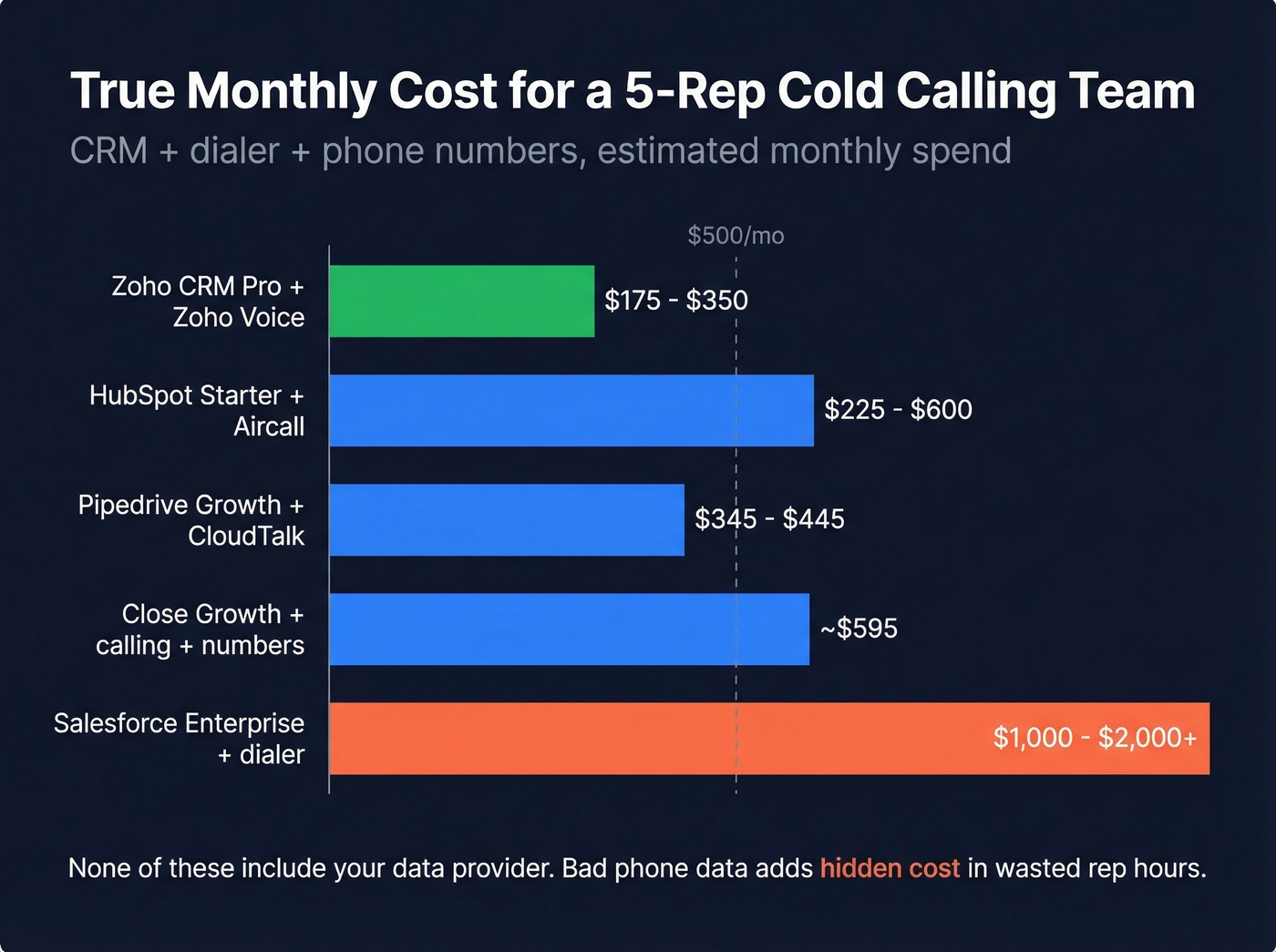
| Stack | Est. Monthly Cost |
|---|---|
| Close Growth + calling + 5 numbers | ~$595 |
| HubSpot Starter + Aircall | ~$225-600 |
| Pipedrive Growth + CloudTalk | ~$345-445 |
| Zoho CRM Professional + Zoho Voice | ~$175-350 |
| Salesforce Enterprise + dialer | ~$1,000-2,000+ |
Close's Solo plan is $9/seat/mo billed annually - but it caps you at 1 user, 10K leads, and no Power Dialer. Cold calling teams need Growth at minimum. Always price the tier that includes the dialer features you actually need, not the one that looks good on the pricing page.
Your CRM Is Only as Good as Your Data
Auto-dialers increase calling capacity by 285%. That multiplier is worthless if a third of your phone numbers are disconnected. You're not just wasting rep time - you're actively damaging your caller ID reputation with carriers, which tanks connect rates for the numbers that are real.
Let's run the math most teams never bother with. If 30% of your 70 daily dials are disconnected, that's 21 wasted calls at roughly 2 minutes each - 42 minutes per day, 14 hours per month of burned rep time. At $25/hour fully loaded, that's $350/month per rep in pure waste. For a 5-rep team, $1,750/month evaporating before anyone picks up.
A verified data layer like Prospeo eliminates most of that waste. With 125M+ verified mobile numbers refreshed every 7 days versus the 6-week industry average, teams see a 30% pickup rate compared to the 10-12% typical of stale B2B databases. At roughly $0.01 per lead, the economics aren't even close.
Peak calling windows are 10-11 AM on Tuesdays and Wednesdays, with a 22% connect rate. That's a narrow window. Every disconnected number in that window is a missed opportunity you can't get back. GreyScout cut their bounce rate from 38% to under 4% after switching to verified data, with pipeline up 140%. That wasn't a CRM upgrade - it was a data upgrade that made their existing CRM work.
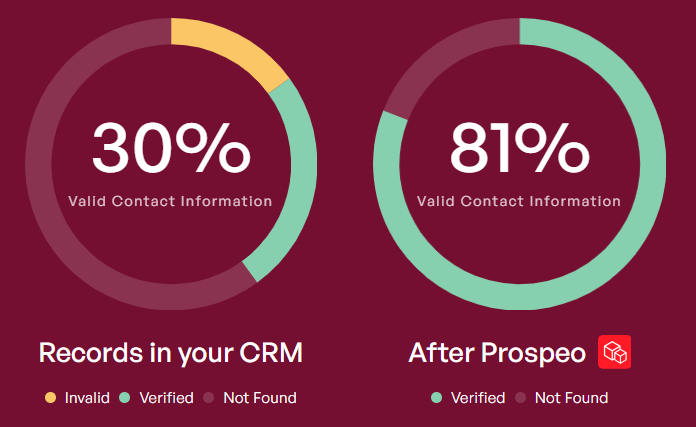
No CRM can fix bad phone data. Prospeo's 7-day refresh cycle means the numbers your reps dial this week are verified this week - not six weeks ago. 98% email accuracy, 125M+ verified mobiles, and native integrations with HubSpot, Salesforce, and every dialer stack on this list.
Stop paying for a power dialer to speed-dial disconnected numbers.
Which CRM Should You Pick?
5-rep SDR team, ~$500/mo budget: Pipedrive Growth + CloudTalk + a verified data layer. You get a solid CRM, a real dialer, and clean numbers for under $500/mo. This is the stack we'd recommend for most early-stage teams.
Need everything in one tool: Close Growth at $99/seat/mo. You sacrifice some reporting flexibility, but you eliminate integration headaches entirely. Pair it with a verified data source and you've got a two-tool stack that covers everything.
Already on Salesforce: Don't rip it out. Add a dialer integration and plug in verified contact data. Your Salesforce investment is sunk - make it work harder with better numbers.
Solo founder doing outreach: noCRM or folk plus a free-tier data provider. You don't need a $99/seat platform when you're the only seat. Keep it lean, keep the data clean, scale the stack when you hire rep #2.
The best CRM for cold calling isn't the one with the flashiest dialer - it's the one your reps actually use, paired with data they can trust.
FAQ
Do I need a separate dialer if my CRM has built-in calling?
Below 30 calls per day, built-in calling from HubSpot or Zoho works fine. For 50+ daily dials, you need a power or predictive dialer - either native like Close, or added via Aircall, Kixie, or CloudTalk at $30-50/user/month.
What's a good connect rate for cold calling?
Industry average sits at 5-8%. Top-performing teams hit 10-15% by combining verified mobile numbers with local presence dialing. Teams using verified mobiles report 30% pickup rates - roughly 3x the typical B2B database result.
How many cold calls should reps make per day?
The average across industries is 52 calls per day. SDRs average 68, BDRs 75. Teams using auto-dialers see 285% higher capacity versus manual dialing. The right CRM plus dialer combo should get reps to 60-80 calls without burnout.
Is cold calling still legal in 2026?
Yes, but regulated. TCPA requires consent for auto-dialed calls to mobile phones in the US, and the Do Not Call Registry must be honored. Rules vary by state and country - especially in the EU under GDPR. Always check local regulations before scaling.