CRM ROI: How to Calculate It, What to Expect, and Why Data Quality Is the Missing Variable
Your VP of Sales just asked you to justify the CRM renewal. You open the dashboard and half the contacts have no email, a third have outdated job titles, and the pipeline report looks like fiction. The CRM isn't broken - the data inside it is.
That's the real CRM ROI story most companies miss. It's the core reason so many organizations face unrealized returns year after year, and it's the variable that separates teams earning $5+ per dollar from those struggling to break even.
What CRM ROI Actually Means
CRM ROI measures the financial return your organization gets from its CRM investment relative to total cost:
ROI = (Gain from CRM - Cost of CRM) / Cost of CRM x 100
Here's the reframe that matters: this isn't a software problem. It's a data quality problem. The platform is just plumbing. If the data flowing through it is wrong - bad emails, stale titles, phantom companies - the ROI calculation will always disappoint. Before you can build a credible business case, you need to understand what's actually flowing through the pipes.
The Quick Version
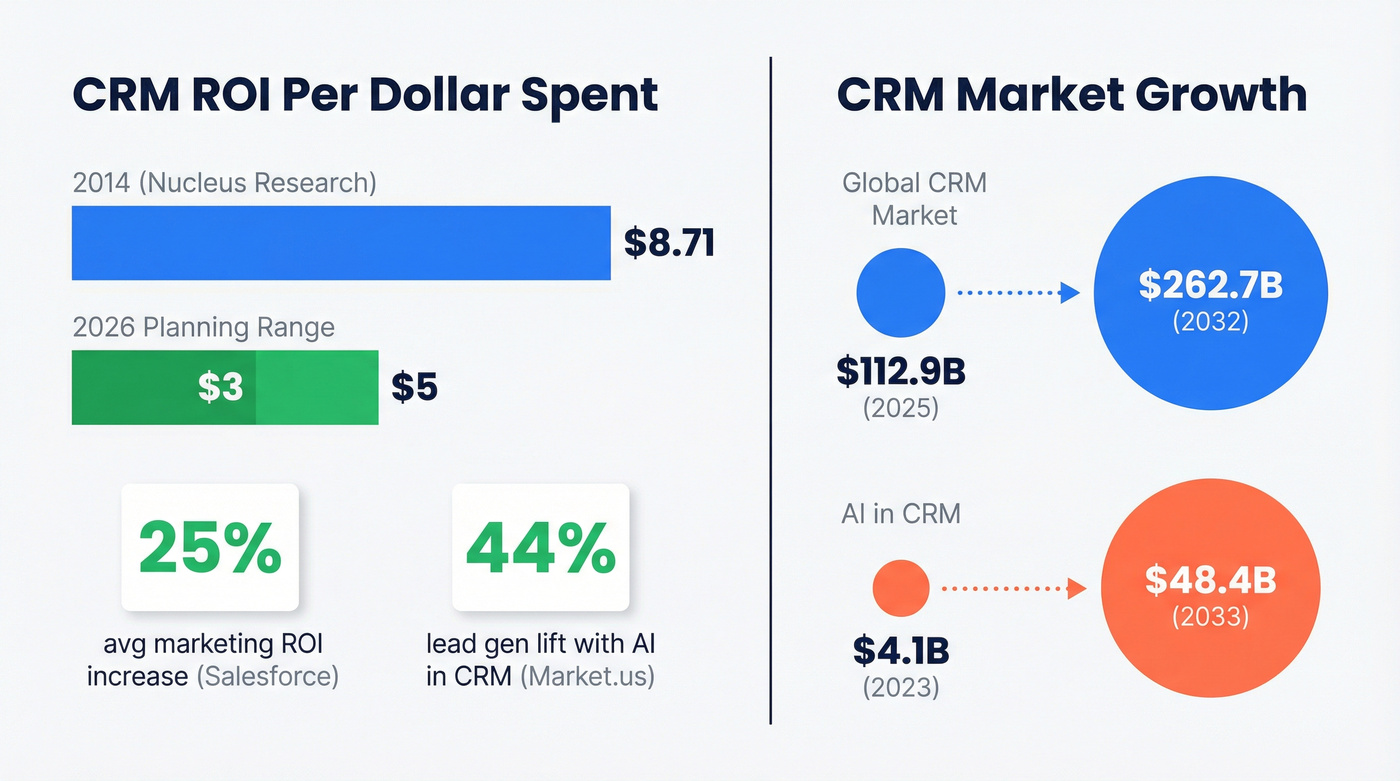
- Benchmark: Nucleus Research found CRM returned $8.71 per $1 spent back in 2014. For 2026 planning, most teams model $3-$5 per $1 as a practical target.
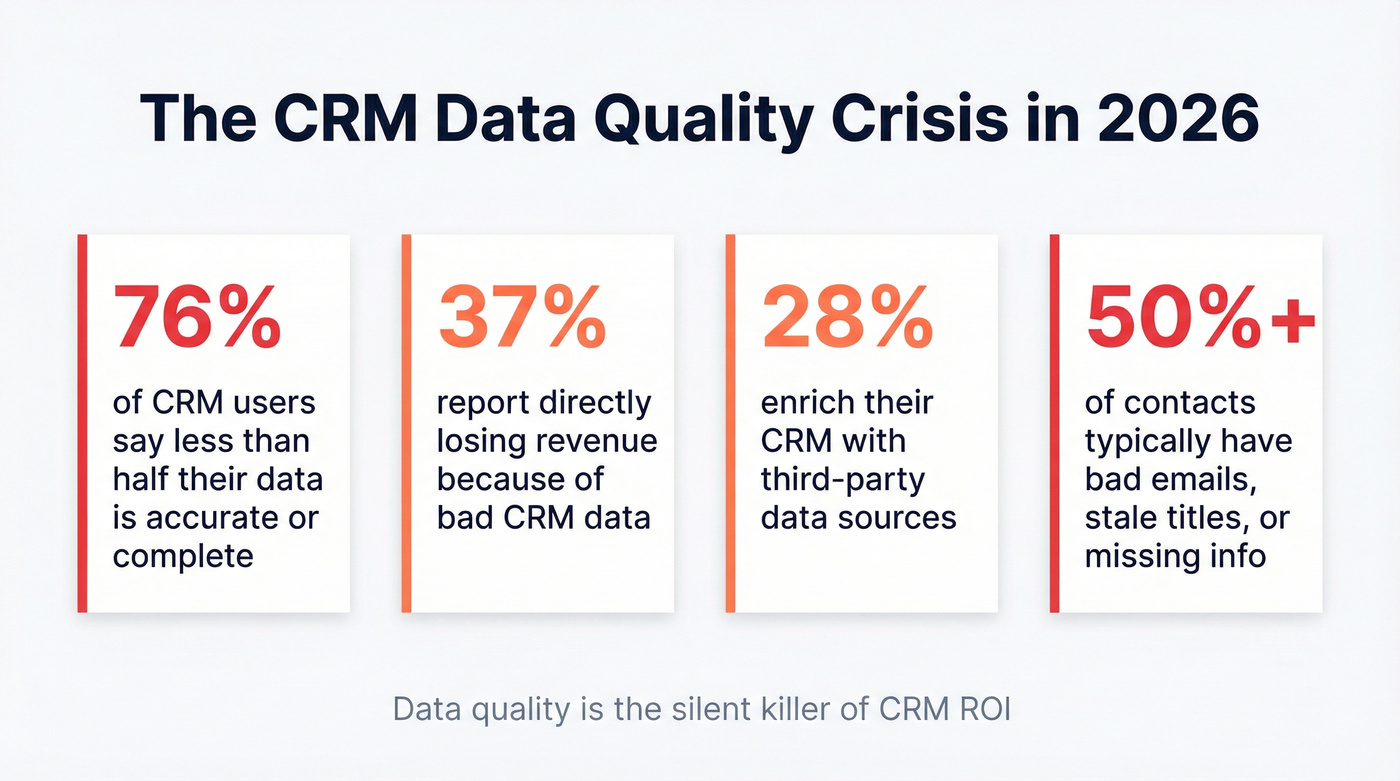
- The #1 problem: 76% of CRM users say less than half their data is accurate or complete. That tanks every downstream metric.
- The fix: Enrich and verify your CRM data continuously, not quarterly.
2026 Benchmarks Worth Knowing
That $8.71 figure is the most-cited number on the internet, and it's over a decade old. Still useful as a reference point, but don't treat it like a guaranteed outcome for every modern team.
| Benchmark | Figure | Source / Year |
|---|---|---|
| Return per $1 (legacy) | $8.71 | Nucleus Research, 2014 |
| Return per $1 (planning range) | $3-$5 | Industry estimates, 2024-2026 |
| Marketing ROI increase | 25% avg | Salesforce |
| AI-in-CRM lead gen lift | 44% | Market.us |
The global CRM market hit $112.91B in 2025 and is projected to reach $262.74B by 2032. AI in CRM is scaling fast too, growing from $4.1B in 2023 to a projected $48.4B by 2033. Teams using AI capabilities inside CRM workflows are seeing a 44% increase in lead generation, which directly inflates the ROI numerator.
Salesforce and HubSpot both hover around 71-72% user adoption rates according to G2 Winter Grid data. They're the most popular CRM tools on the market, though which platform sales teams prefer often depends on deal complexity and team size. As a rule, CRMs tend to pay back more in complex B2B motions - longer cycles, more stakeholders, more handoffs - because the system captures more of the work that actually drives revenue.
These benchmarks are averages. Your return depends almost entirely on two variables: adoption and data quality. Get both right and you can push into $5+ territory. Get either wrong and you'll struggle to break even.

Bad CRM data is the #1 reason your ROI underperforms. Prospeo's enrichment API returns verified emails, direct dials, and current job titles for 83% of contacts - with 98% email accuracy and a 7-day refresh cycle.
Stop calculating ROI on garbage data. Start enriching it.
How to Calculate CRM ROI
Think of CRM return across three pillars: revenue returned, productivity gained, and total cost of ownership. Most teams only measure the first and ignore the other two. That's how you end up with inflated projections that fall apart at renewal time.
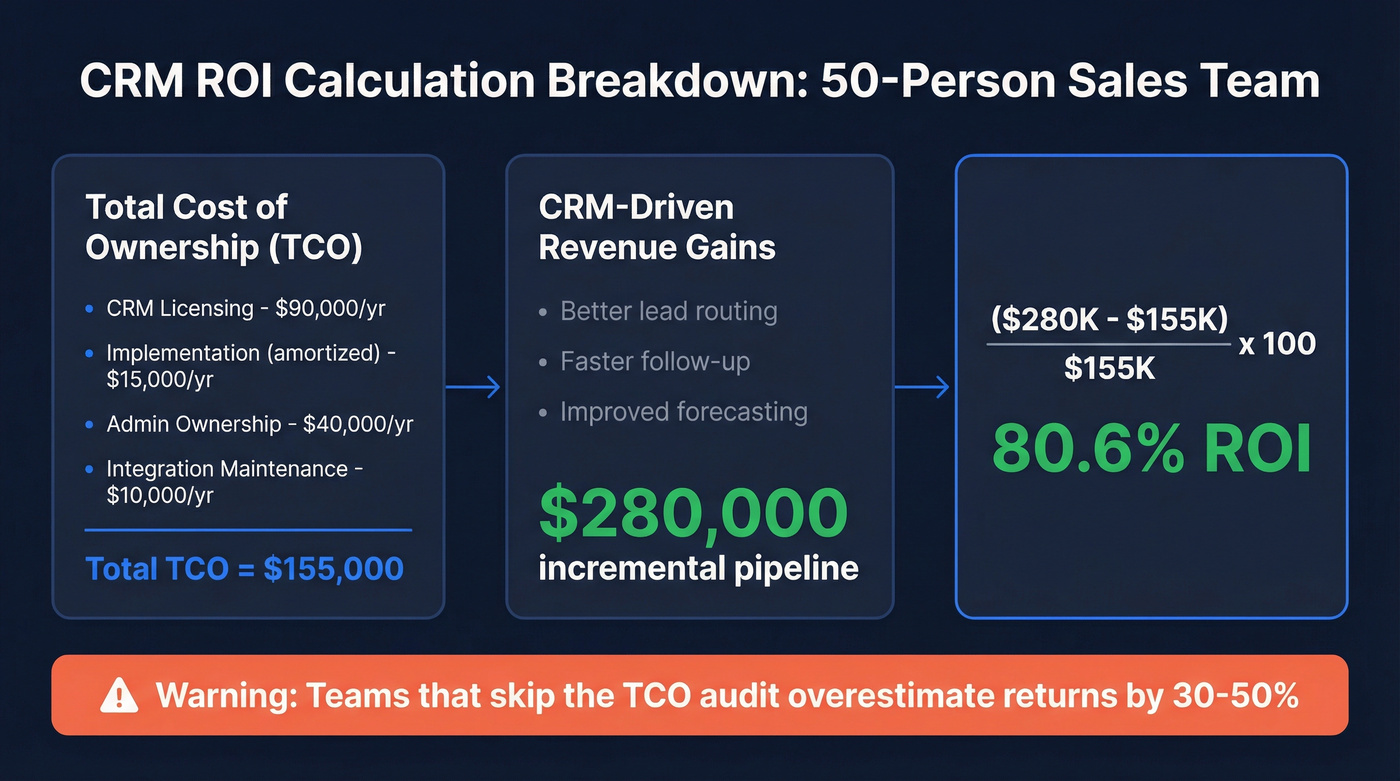
Let's walk through a worked example. Assume a 50-person sales team pays $90K/year in CRM licensing. Add $15K for implementation amortized over three years, $40K for admin ownership, and $10K for integration maintenance. That's $155K total cost of ownership.
If you can attribute $280K in incremental pipeline to CRM-driven workflows - better lead routing, faster follow-up, improved forecasting - your ROI looks like this:
($280K - $155K) / $155K x 100 = 80.6% ROI
In our experience, teams that skip the TCO audit overestimate their returns by 30-50%. Your checklist should include licensing, implementation staff time, ongoing training, admin headcount, integration maintenance, and partner/consulting fees. Miss any of these and your ROI looks artificially inflated - which is exactly how vendors want you to calculate it.
Why Your Returns Are Lower Than Expected
Data quality is the silent killer. 76% of CRM users say less than half their data is accurate or complete. 37% report directly losing revenue because of it. And only 28% enrich their CRM with third-party sources. If half your contacts have bad emails, your outbound sequences bounce, reps lose trust in the system, and pipeline reports become guesswork.

Low adoption compounds the problem. We've seen this pattern dozens of times: a team buys an expensive CRM, skips data hygiene, and within months the reps are back to spreadsheets. You're paying full licensing costs while getting a fraction of the value. Even a $100,000 CRM investment paired with only $40,000 in annual staffing savings shows how quickly returns disappoint if the benefits don't materialize fast enough.
Sales reps and management see the CRM differently. Leadership wants reporting and forecasting. Reps see data entry as a tax on selling time. This tension is the root of most adoption failures, and no amount of training fixes it if the underlying system feels like a burden rather than a tool.
Hidden costs inflate the denominator. Implementation consulting, the admin you hired in month three, the Zapier plan connecting your CRM to six other tools - none of this made it into the original projection. When you recalculate with real TCO, that impressive number shrinks fast.
How to Maximize Your CRM Investment
Stop buying more CRM features. Start fixing your CRM data.
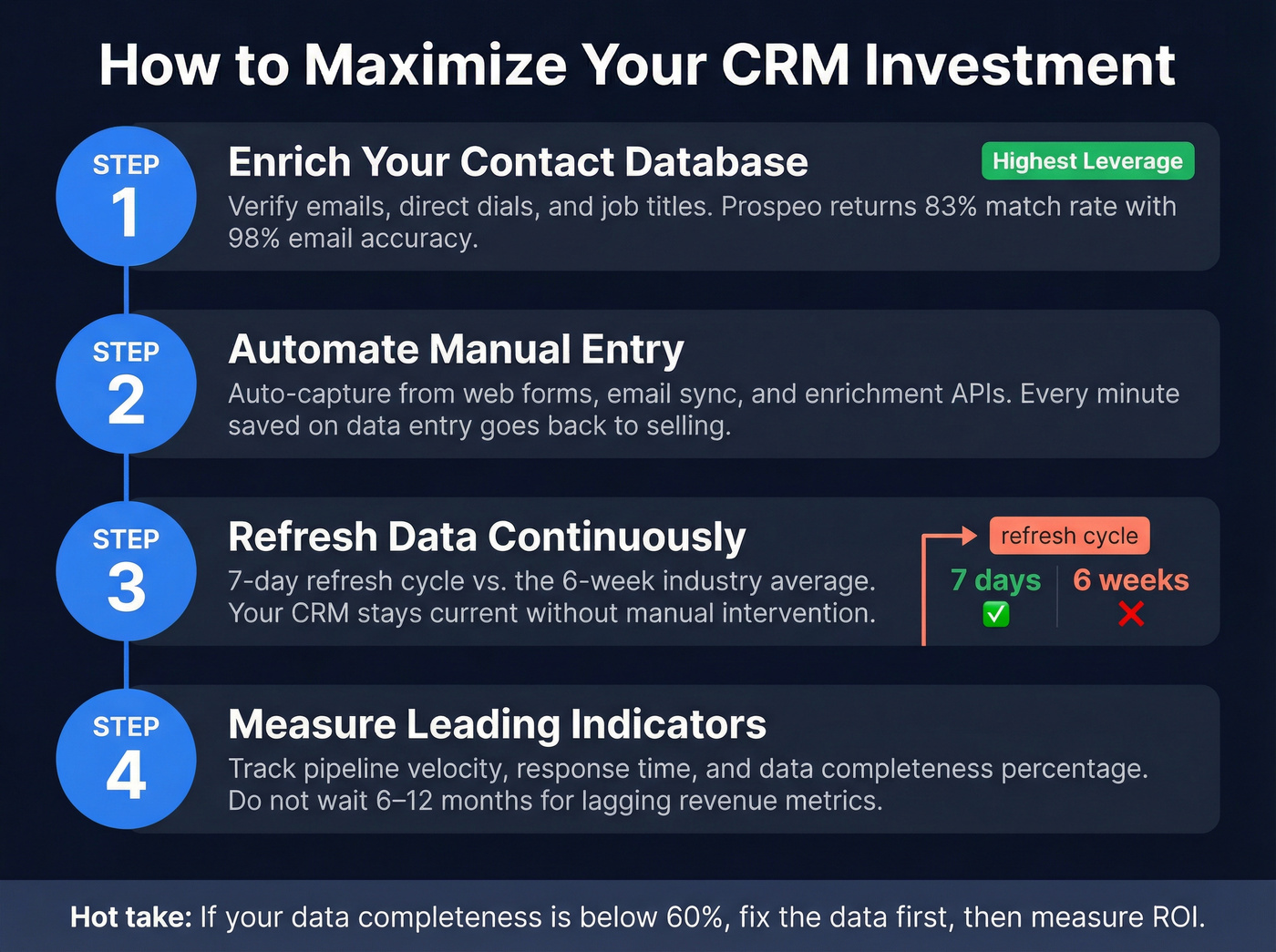
The highest-leverage move is enriching your contact database. We ran our own CRM contacts through Prospeo's enrichment API and 83% came back with verified contact data - emails, direct dials, and current job titles. That single step had more impact than any CRM add-on we'd tried in the previous two years. Snyk's 50-person sales team proved the same thing at scale: bounce rates dropped from 35-40% to under 5%, and AE-sourced pipeline jumped 180% after switching to continuously enriched data.
After enrichment, automate manual entry. Every minute a rep spends typing contact info is a minute they're not selling. Auto-capture from web forms, email sync, and enrichment APIs push that time back into pipeline. Removing friction for salespeople is one of the fastest ways to boost adoption - and adoption is half the ROI equation.
For teams running account-based motions, clean data is even more critical. When you're targeting a defined list of accounts, a single bad phone number or outdated title can stall an entire deal. A 7-day data refresh cycle - compared to the 6-week industry average most providers offer - means your CRM stays current without manual intervention.
Finally, measure leading indicators, not just revenue. Pipeline velocity, response time to inbound leads, and contact data completeness percentage are all metrics you can move this quarter. Lagging revenue metrics often take 6-12 months to reflect CRM improvements, so don't wait for the revenue number to tell you whether your investment is working.
Here's our hot take: if your CRM data completeness is below 60%, calculating ROI is a waste of time. Fix the data first, then measure. You can't optimize a system built on garbage inputs.
Snyk's 50 AEs dropped bounce rates from 35-40% to under 5% and grew AE-sourced pipeline 180% - just by switching to continuously enriched data. Prospeo returns 50+ data points per contact at $0.01/email.
Your CRM renewal is easier to justify when the data actually works.
CRM ROI FAQ
What's a good CRM ROI?
Nucleus Research found CRM returned $8.71 per $1 spent in 2014. For 2026 planning, most teams target $3-$5 per $1 depending on adoption and data quality. Anything above $3 is positive. Above $5 is strong. Teams with continuously enriched data consistently land in the upper range.
How long until a CRM pays for itself?
Expect 6-14 months for SMBs and 12-24 months for enterprise deployments. The biggest variable is adoption speed - if reps aren't using the system within the first 90 days, the payback period stretches indefinitely. Pre-populating contact data via enrichment tools cuts onboarding friction significantly because reps see value from day one instead of staring at empty fields.
How does data quality affect CRM returns?
Bad emails bounce, wrong titles mean wrong messaging, and pipeline reports become fiction. 76% of CRM users report incomplete data. Continuous enrichment fixes this by verifying and refreshing contact data weekly, turning your CRM from a liability back into an asset. The r/sales community on Reddit consistently points to dirty data as the top reason reps abandon CRM systems entirely.
How do you get a sales team to actually use CRM?
Make the CRM useful to reps, not just managers. Pre-populate contact data so reps don't have to type it. Surface insights that help them close deals. Remove busywork. When the system saves time instead of consuming it, the adoption objection disappears on its own. Skip the "mandatory logging" mandates - they create compliance theater, not real adoption.
What's the best CRM for sales teams in 2026?
There's no single answer. It depends on deal complexity, team size, and budget. Salesforce dominates enterprise. HubSpot is strong for mid-market. Tools like Pipedrive and Close appeal to teams that want simplicity without bloat. Regardless of platform, the return depends far more on data quality and adoption than on the software itself.