

CUFinder vs Generect: Honest Comparison (2026)
CUFinder at a Glance
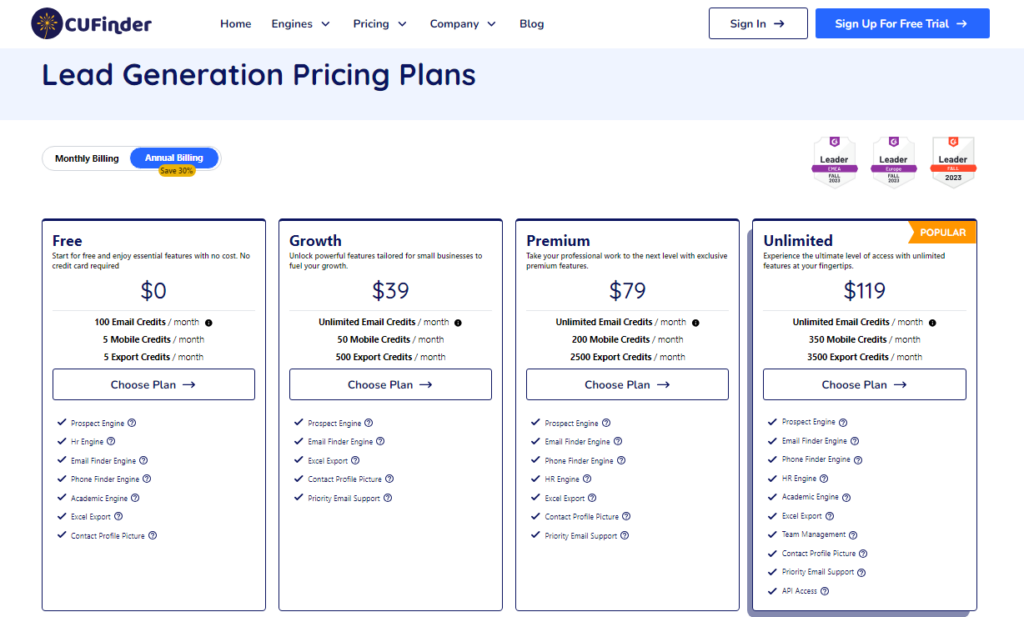
Use this if you want a subscription with a Chrome extension, Google Sheets integration, and API access bundled together. CUFinder's database covers 1B+ profiles with a marketed 98% accuracy rate, and it holds a 4.8/5 from 988 G2 reviews - solid social proof.
Pricing tiers run like this: Free (50 credits/mo), Growth ($49/mo, 1,000 credits), Premium ($129/mo, 3,000 credits), Unlimited ($299/mo, 10,000 credits).
Here's the thing we found when digging into the credit structure: those "credits" aren't interchangeable. Email credits, mobile credits, and export credits are separate pools. On the Free plan, your 50 credits break down to 25 email lookups, 5 mobile lookups, and 5 exports. The Growth plan's 1,000 credits include only 50 mobile credits and 500 export credits. That math matters when you're planning campaigns, and it's the kind of detail that trips people up after they've already committed to a plan.
Skip this if credit pool complexity will frustrate your team, or if you need transparent per-action pricing.
Generect at a Glance
Use this if you want to pay only for what you find. Generect charges $0.03 per valid email and $0.02 per export, with a $20 minimum deposit and a $5 onboarding grant. You're not charged if an email isn't found or comes back invalid.
Generect emphasizes real-time refresh, which can be a big plus if you care about up-to-date results. On-site materials highlight a 70%+ find rate, under 2% bounce rate, and a 73% success rate for locating emails. The Spend & Save model drops your per-action cost as volume increases, though exact tier thresholds aren't published.
The G2 rating is a perfect 5.0/5 - but from only 32 reviews. That's a thin sample. Reviewers love the speed and ease of use but flag a learning curve for advanced filtering and occasional missing contacts. Integrations are limited: just Salesforce and HubSpot on G2, with Pipedrive supported via API.
Skip this if you need deep CRM integrations out of the box, or if 32 reviews isn't enough confidence for a purchasing decision.
Feature-by-Feature Comparison
| Feature | CUFinder | Generect |
|---|---|---|
| Email finding | Separate credit pool | $0.03/valid email |
| Accuracy claims | "98% accuracy" (marketing) | ~70%+ find rate / 73% success rate |
| Phone numbers | Separate credit pool | Direct numbers |
| Email verification | Built-in | Built-in |
| Enrichment | 15+ services | Firmographics + tech |
| Chrome extension | Yes | No |
| API | Yes | REST API |
| CRM integrations | 10+ stated | Salesforce, HubSpot, Pipedrive |
| Data model | Large profile database (1B+) | Real-time refresh + wallet pricing |
| Compliance | Not detailed publicly | Not detailed |
| Intent data | No | No |
| Signals | - | Hiring trends |
The data model difference is the real fork in the road. CUFinder's large profile database gives you speed and breadth. Generect's real-time refresh focuses on freshness, but coverage varies by niche. Neither offers intent data worth mentioning.

Neither CUFinder's split credit pools nor Generect's 70% find rate solve the real problem: reaching verified buyers. Prospeo delivers 98% email accuracy on a 7-day refresh cycle, with intent data across 15,000 topics that neither tool offers.
Get 3x the accuracy at one-third the cost per email.
Pricing Breakdown
| 500 valid emails | $49/mo (Growth plan) | ~$15 (500 x $0.03) | ~$5 (~$0.01/email) |
| 1,000 valid emails | $49/mo (Growth plan)* | ~$30 (1,000 x $0.03) | ~$10 (~$0.01/email) |
| 3,000 valid emails | $129/mo (Premium plan)* | ~$90 (3,000 x $0.03) | ~$30 (~$0.01/email) |
*CUFinder plan credits aren't 1:1 with "emails found." Email, mobile, and export allowances are separate pools, so your practical email capacity depends on how much you use other actions.
At low volumes, Generect wins on cost. At higher volumes, CUFinder looks attractive on sticker price, but the split credit pools make apples-to-apples comparison genuinely difficult.
Let's be honest: if your monthly email volume is under 1,000, neither tool justifies the friction. Generect's wallet model is clever, but the find-rate numbers mean you're paying for misses in time, not money. CUFinder's credit pools will confuse at least one person on your team every month. Both are fine tools for their niches, but most teams outgrow them fast.
Watch Out for Bad Third-Party Data
We checked both official pricing pages and then compared what aggregator sites report - the discrepancies are wild. G2 lists CUFinder Premium at $99 when the official price is $129. GetApp lists a $99.99 one-time payment. One alternatives blog listed LinkedIn Learning prices as CUFinder's. Salesforge shows Generect with subscription tiers ($59/$120/$350) that contradict its official pay-as-you-go model entirely. GetApp's FAQ even claims CUFinder doesn't offer an API, which it clearly does. Always verify on the vendor's own site.
What Users Say
CUFinder has volume: 988 G2 reviews at 4.8/5, plus 4.9/5 on GetApp from 22 reviews. Users praise the all-in-one approach. The recurring complaint is credit confusion - people don't realize their credits split across pools until they run out of one type while sitting on unused credits in another. We've seen this exact frustration play out in our own evaluations of tools with opaque credit systems.
Generect has a perfect 5.0/5 on G2 from 32 reviews. Users highlight speed and simplicity. Negatives include integration limitations and missing contacts in some searches. Neither tool has meaningful Reddit discussion, so these G2 reviews are the best available user sentiment.
Both tools market high accuracy numbers. CUFinder claims 98%. Generect shows separate find-rate metrics (70%+ / 73% success rates) alongside its verification accuracy. Neither publishes a clear, standardized verification methodology you can audit end-to-end. That's a problem when you're making a data-driven decision about your data tools.
Consider Prospeo Instead
There's also intent data tracking 15,000 topics via Bombora - something neither CUFinder nor Generect offers. You can layer buyer intent with technographics, job changes, and headcount growth signals using 30+ search filters. Native integrations cover Salesforce, HubSpot, Smartlead, Instantly, Lemlist, Clay, Zapier, and Make - far broader than either competitor.
The free tier gives you 75 emails/month, and paid plans run about $0.01/email with no contracts. Real results back it up: Snyk cut bounce rates from 35-40% to under 5% and grew AE-sourced pipeline 180%. Stack Optimize built to $1M ARR with 94%+ deliverability and zero domain flags across all clients.
If you’re building repeatable outbound, it’s also worth tightening the rest of your motion: start with sales prospecting techniques, then standardize lead generation workflow, and track lead generation metrics so you can see where data quality is actually hurting conversion.
At $0.01/email with no split credit pools and no wallet minimums, Prospeo eliminates the pricing headaches from both CUFinder and Generect. Snyk cut bounce rates from 35-40% to under 5% - with 50 AEs prospecting on the same data.
75 free emails/month. No credit card. See the difference yourself.
FAQ
Is CUFinder better than Generect for small teams?
CUFinder suits teams wanting fixed monthly billing, but its split credit pools add complexity. Generect's pay-as-you-go wallet is simpler for teams sending under 500 emails/month - you'll spend roughly $15 versus CUFinder's $49 minimum. For the best value, Prospeo's free tier (75 emails/month) covers light prospecting at no cost.
Which tool has more accurate email data?
Neither publishes an auditable verification methodology. CUFinder markets 98% accuracy; Generect shows 70%+ find rates with under 2% bounce. Prospeo's 98% accuracy comes from a documented 5-step process with catch-all handling, spam-trap removal, and honeypot filtering - the most transparent approach of the three.
Does Generect have a Chrome extension?
No. Generect currently lacks a browser extension. CUFinder offers one, and Prospeo's Chrome extension (40,000+ users) lets you find verified emails and phone numbers from any website or CRM in one click with 40+ data points per contact.