

Customer Data Orchestration: What It Is, How It Works, and Why 36% of CDPs Fail
An 8-person data team recently posted on r/dataengineering about "slowly losing the overview." Scripts on Azure Data Factory, API jobs on a local server, queries managed in DataGrip and manually promoted to a cloud VM via GitHub. New pipelines spinning up daily with no single control plane. That's not a tooling problem - it's a customer data orchestration problem, and threads like this surface constantly across data engineering communities.
Quick version: This discipline isn't a product - it's how you design cross-system data flow. If you're evaluating CDPs, Salesforce Data Cloud and Tealium lead Gartner's 2026 Magic Quadrant. If you want to skip the six-figure platform, a composable stack (warehouse + reverse ETL + identity resolution) can start around $2K-$8K/month.
What Data Orchestration Actually Means
At its core, this practice is the design and management of how data flows between every system in your stack - warehouse, CRM, marketing automation, enrichment APIs, ad platforms, analytics. It's the control plane, not a single tool.
Don't confuse it with ETL. ETL moves data from point A to point B. Orchestration coordinates the entire cross-system workflow: dependencies, scheduling, monitoring, error handling, and recovery across dozens of jobs running in concert. dbt Labs frames it well as three phases: organize, transform, activate. The activation phase - delivering unified data to BI tools, CRMs, and outbound systems - is where most teams realize they've been doing ETL and calling it orchestration.
Why It Matters in 2026
The CDP market hit $7.4B in 2024 and is projected to reach $28.2B by 2028 - a 39.9% CAGR across 208 competing vendors. McKinsey's research on AI-powered journey orchestration shows 15-20% customer satisfaction lifts, 5-8% revenue increases, and 20-30% cost-to-serve reductions. Adobe's work with Signify drove a 55% jump in net merchandise value. These aren't theoretical - they're what happens when data actually flows to the right system at the right time.
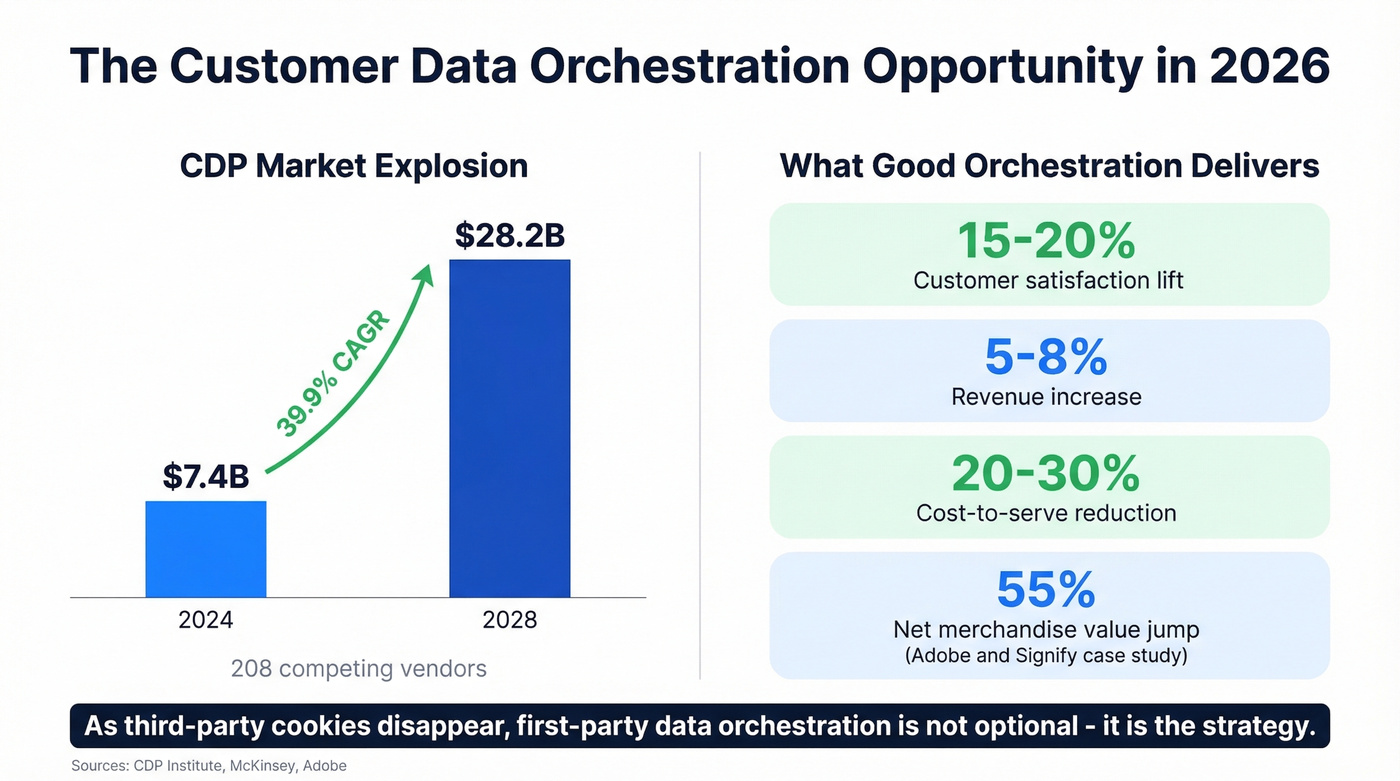
As third-party cookies disappear and privacy regulations tighten, a unified first-party and third-party data strategy becomes essential. Orchestration is the mechanism that merges behavioral signals you collect directly with enrichment data from external providers - and keeps both streams governed under a single set of consent rules.
The Orchestration Workflow
Here's the closed-loop framework that separates real orchestration from duct-taped pipelines:
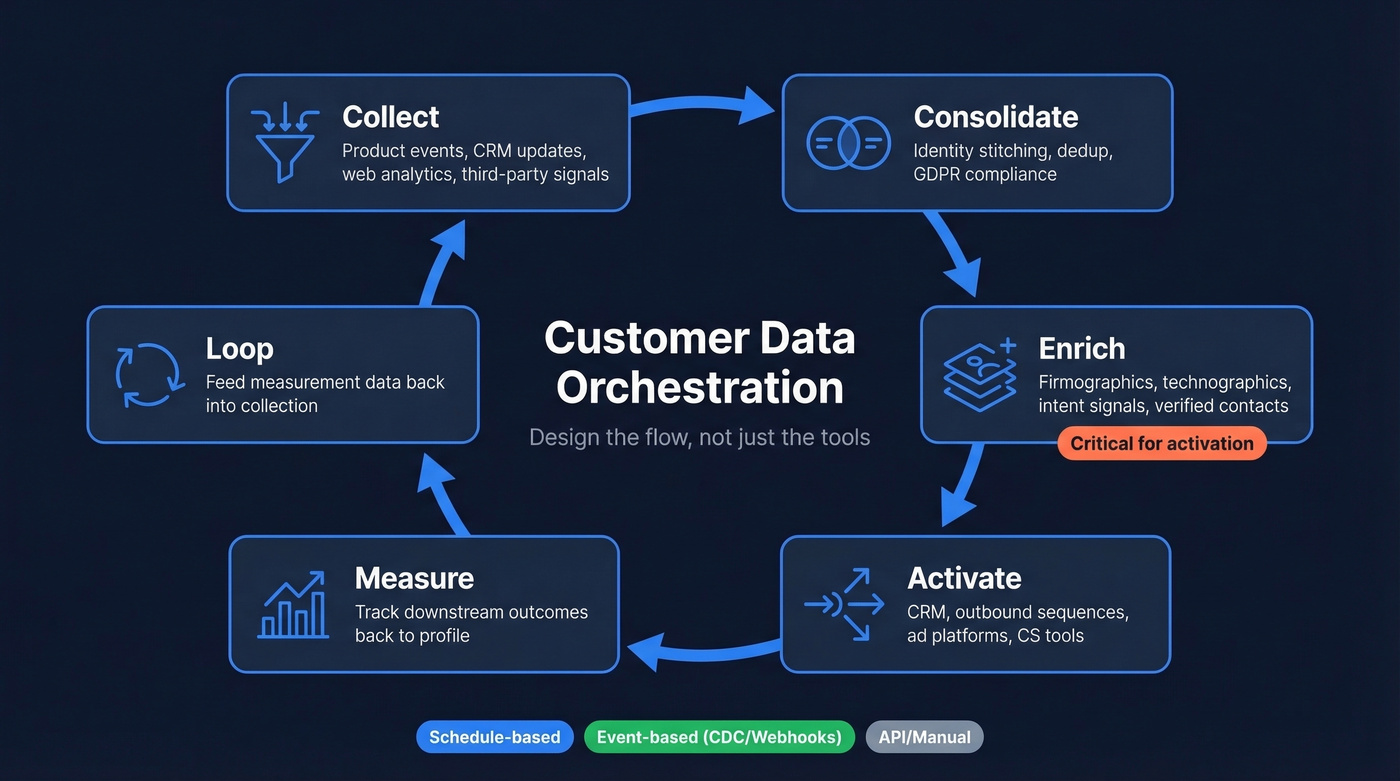
- Collect - Ingest from every source: product events, CRM updates, web analytics, third-party signals.
- Consolidate - Identity stitching and deduplication. Match anonymous sessions to known profiles to build consolidated customer records. Enforce GDPR purpose limitation and data minimization here, not after the fact.
- Enrich - Layer on firmographics, technographics, intent signals, and verified contact information. First-party data like site behavior, product usage, and support interactions forms the foundation, and enrichment APIs fill the gaps those signals can't cover.
- Activate - Push enriched profiles to CRM, outbound sequences, ad platforms, and customer success tools. For B2B teams, activation also means ensuring account lists have reachable contacts - tools like Prospeo enrich records with verified emails and direct dials so unified profiles actually convert to booked meetings.
- Measure - Track downstream outcomes back to the profile.
- Loop - Feed measurement data back into collection. Closed loop.
Triggers can be schedule-based, event-based via CDC or webhooks, or API/manual. The reliability primitives you need to get right: idempotency, circuit breaking, data contracts, and lineage tracking.

Enrichment is step 3 of every orchestration workflow - and the one that makes or breaks activation. Prospeo layers 50+ data points per contact with 98% email accuracy and 125M+ verified mobiles, refreshed every 7 days. Plug it into your composable stack via API with a 92% match rate.
Your orchestration deserves enrichment data that actually connects.
Composable vs. Packaged CDP
This decision defines your architecture for the next 3-5 years.
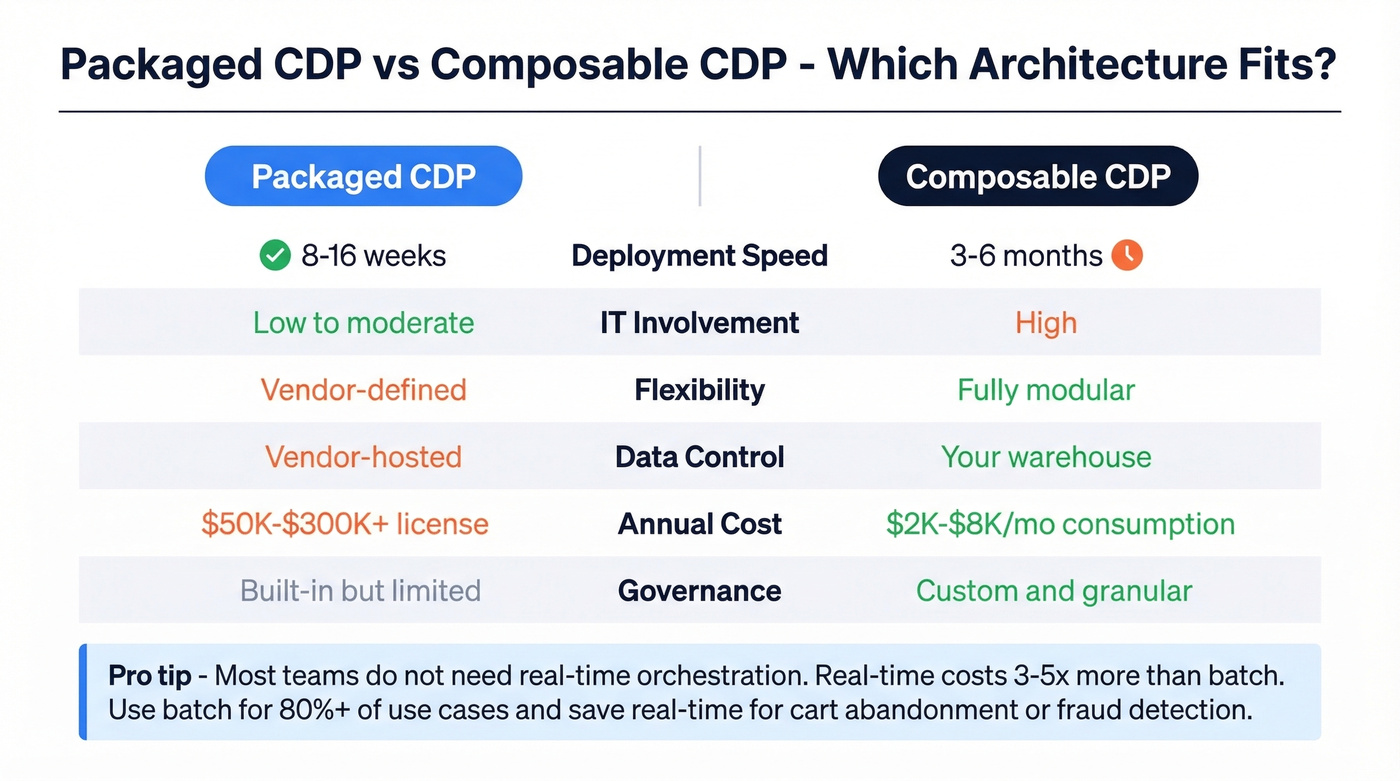
| Attribute | Packaged CDP | Composable CDP |
|---|---|---|
| Deployment speed | 8-16 weeks | 3-6 months |
| IT involvement | Low-moderate | High |
| Flexibility | Vendor-defined | Fully modular |
| Data control | Vendor-hosted | Your warehouse |
| Cost model | License, $50K-$300K+/yr | Consumption-based |
| Governance fit | Built-in, limited | Custom, granular |
The warehouse-first, zero-copy pattern is gaining serious traction. Instead of copying data into a CDP's proprietary storage, the CDP queries your warehouse directly, then activates via reverse ETL or event streaming. We've seen teams cut cloud costs by roughly 40% and reduce time-to-segment from weeks to hours by making this switch.
Here's the thing: most teams don't need real-time orchestration. Real-time costs 3-5x more than batch. Use it for cart abandonment or fraud detection. Batch handles the rest at a fraction of the cost.
On the market landscape, Gartner's 2026 Magic Quadrant for CDPs put Salesforce and Tealium in the lead. Adobe slid to visionary. Twilio, ActionIQ, and Amperity dropped to niche. Mid-market options like Segment and mParticle typically run $15K-$100K+/year depending on volume and add-ons.
Why Implementations Fail
[Only 64% of deployed CDPs deliver significant value](https://www.emarketer.com/content/faq-on-customer-data-platforms - composable-architectures - ai-integration - path-roi). Over a third are expensive shelf-ware. The top hurdles: 47% cite poor system integration, 34% cite underskilled teams.
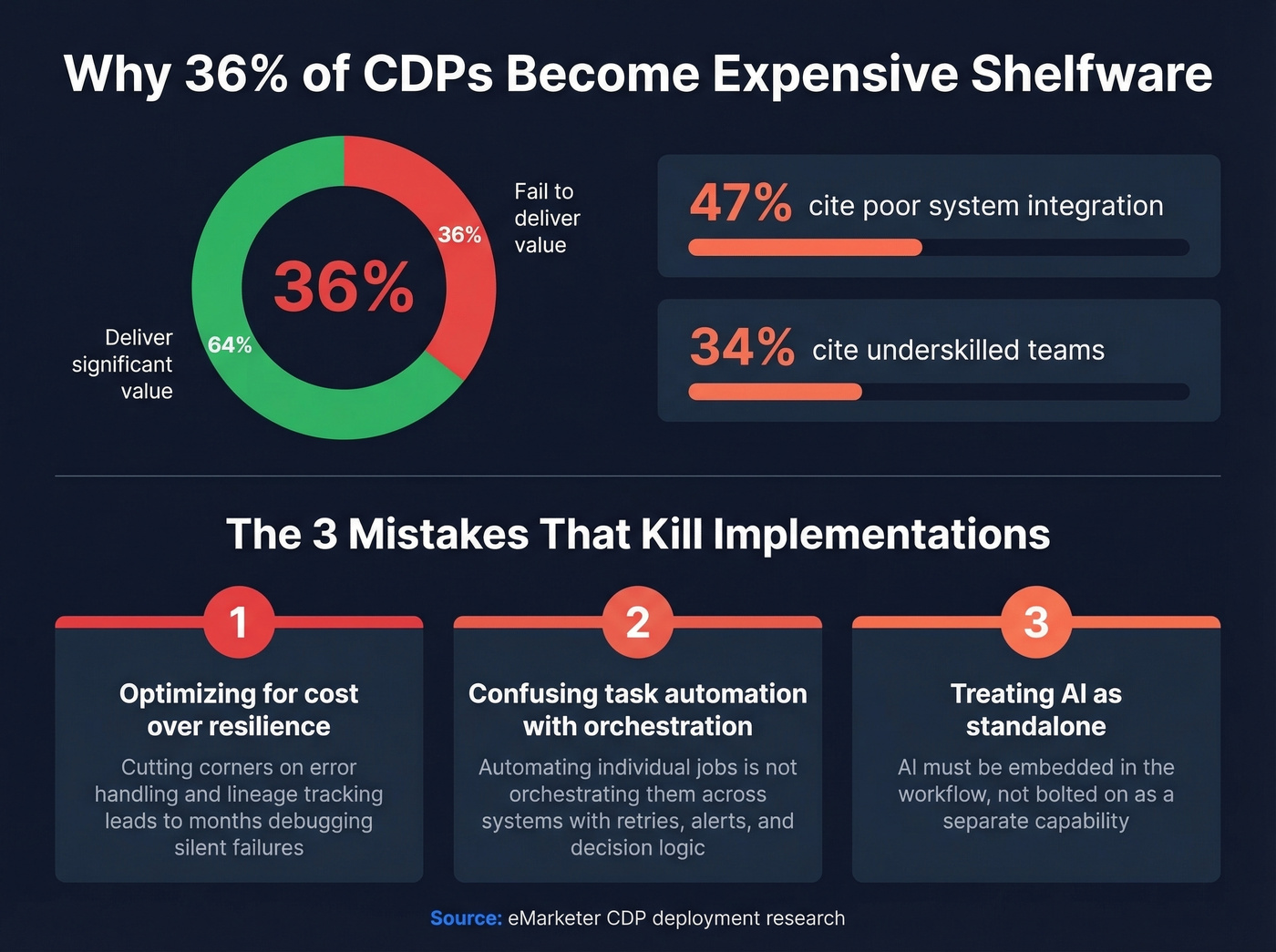
We see three mistakes repeatedly. First, optimizing for cost reduction over resilience - teams cut corners on error handling and lineage, then spend months debugging silent failures. Second, confusing task automation with end-to-end orchestration. Automating individual jobs isn't orchestration; coordinating those jobs across systems with retries, alerts, and decision logic is. That distinction sounds semantic until you're staring at a broken pipeline at 2 AM with no idea which upstream job caused the cascade.
Third, treating AI as a standalone capability instead of embedding it in the workflow.
This isn't a technology problem. It's a workflow design problem. The teams that fail buy a CDP and expect it to solve organizational dysfunction. It won't. The teams that succeed - and this matches what we consistently see in r/dataengineering discussions - treat data orchestration as a design discipline first and a tooling decision second.
The Last Mile: Reaching Contacts
Most orchestration guides stop at "activate in your CRM." But consolidated customer profiles are only as useful as the contact data attached to them. If the email bounces or the phone number is disconnected, your entire orchestration investment produces zero pipeline.
Let's be honest - we've watched teams spend six months building a beautiful orchestration layer, only to have outbound campaigns crater because 35% of their contact records were stale. Prospeo closes that gap with 98% email accuracy, 125M+ verified mobile numbers, and a 7-day data refresh cycle, turning unified profiles into conversations that actually happen.
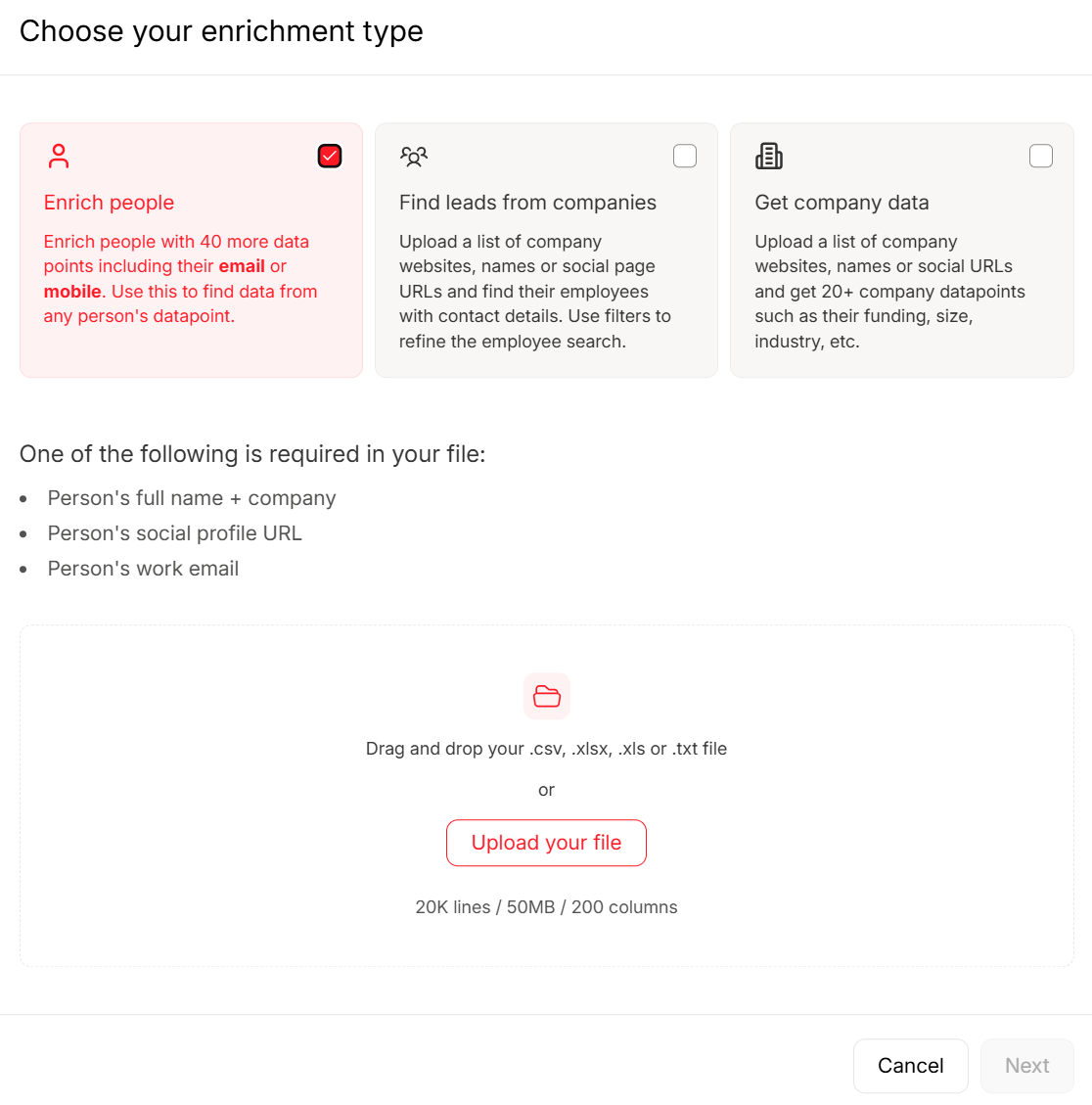
36% of CDPs fail because activation breaks down at the last mile - bounced emails and dead phone numbers. Prospeo's 5-step verification and 7-day refresh cycle ensure the contacts your orchestration layer pushes to CRM and outbound sequences are reachable. At $0.01 per email, it costs less than one failed pipeline debug session.
Stop orchestrating data into a wall of bounces.
FAQ
Is data orchestration the same as a CDP?
No. A CDP stores and segments customer profiles. Customer data orchestration is the broader discipline of designing how data flows between all systems - warehouse, CRM, CDP, and activation tools. You can orchestrate without a CDP using a composable stack built on your data warehouse, typically starting at $2K-$8K/month.
Do I need real-time orchestration?
For most teams, no. Real-time costs 3-5x more than batch processing. Reserve it for time-sensitive triggers like cart abandonment or fraud detection. Batch handles enrichment syncs, reporting, and audience builds at a fraction of the cost - and covers 80%+ of use cases.
What if orchestration works but sales can't reach contacts?
The last mile is verified contact data. Unified profiles don't generate pipeline if the email bounces. Enrichment tools that refresh weekly and verify at the point of delivery keep bounce rates under 4%, so outbound teams work off fresh, reachable records instead of stale CRM exports.
How long does a composable stack take to deploy?
Expect 3-6 months for a composable architecture versus 8-16 weeks for a packaged CDP. The tradeoff: composable stacks give you full data control in your warehouse and consumption-based pricing, while packaged CDPs offer faster time-to-value with less engineering lift.