

Best Customer Database Software in 2026 (15 Picks)
91% of companies with 10+ employees use a CRM. Yet 76% say less than half their customer database is accurate or complete. That gap - between having a tool and having useful data inside it - is the real problem most teams ignore.
A contractor tracking gas heater models and PDF invoices doesn't need a $40k platform. An ecommerce founder who wants name-address-order count doesn't either. They need the right container for their data and a way to keep it clean. CRMs return $8.71 for every $1 invested, but only when the data feeding them is current and verified.
Here are 15 tools that actually solve this, sorted by what matters.
Our Picks
If you're a 5-person B2B team and want a quick answer: start with Attio's free plan for your CRM and fall back to HubSpot if you need marketing automation baked in. For prospect data, layer Prospeo on top to keep contact records verified and current.
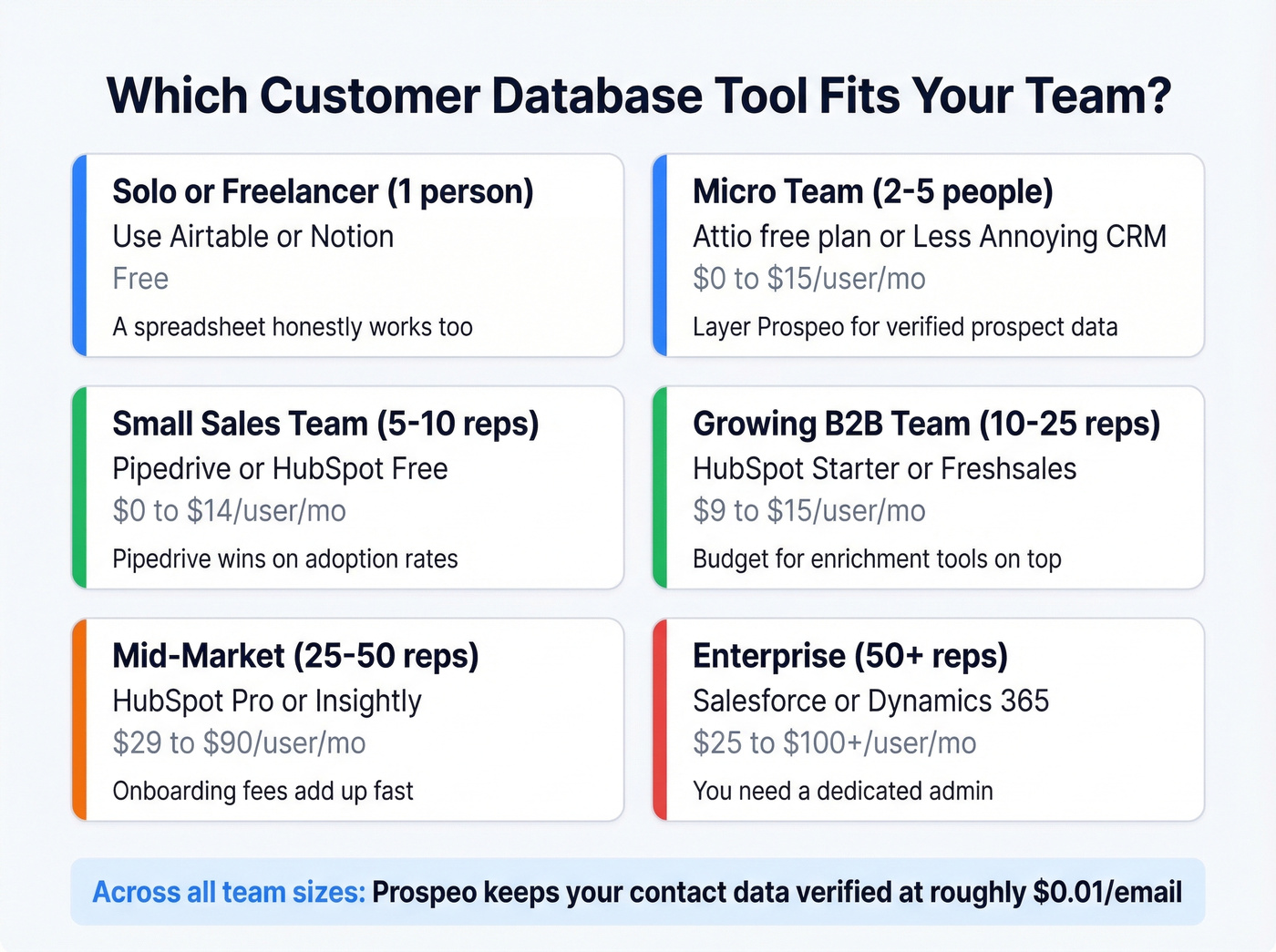
How we evaluated: We weighted pricing transparency, data quality, adoption ease, and real-world fit for teams of different sizes. No composite scores - just direct recommendations based on how these tools perform in practice.
| Tool | Best For | Starting Price | Free Tier |
|---|---|---|---|
| HubSpot CRM | All-in-one starter CRM | $0 (free CRM) | Yes |
| Prospeo | B2B contact data accuracy | ~$0.01/email | Yes (75/mo) |
| Attio | Modern, flexible CRM | $0 (3 seats) | Yes |
| Pipedrive | Sales pipeline visibility | ~$14/user/mo | No |
| Zoho Bigin | Budget pipeline CRM | $7/user/mo | Yes |
| Freshsales | AI lead scoring | $0 (free plan) | Yes |
What Is a Customer Database?
A customer database is any structured system that stores contact information, transaction history, and interaction records for your customers and prospects. That's it. The complexity comes from what you layer on top - and which program you choose to manage it all.
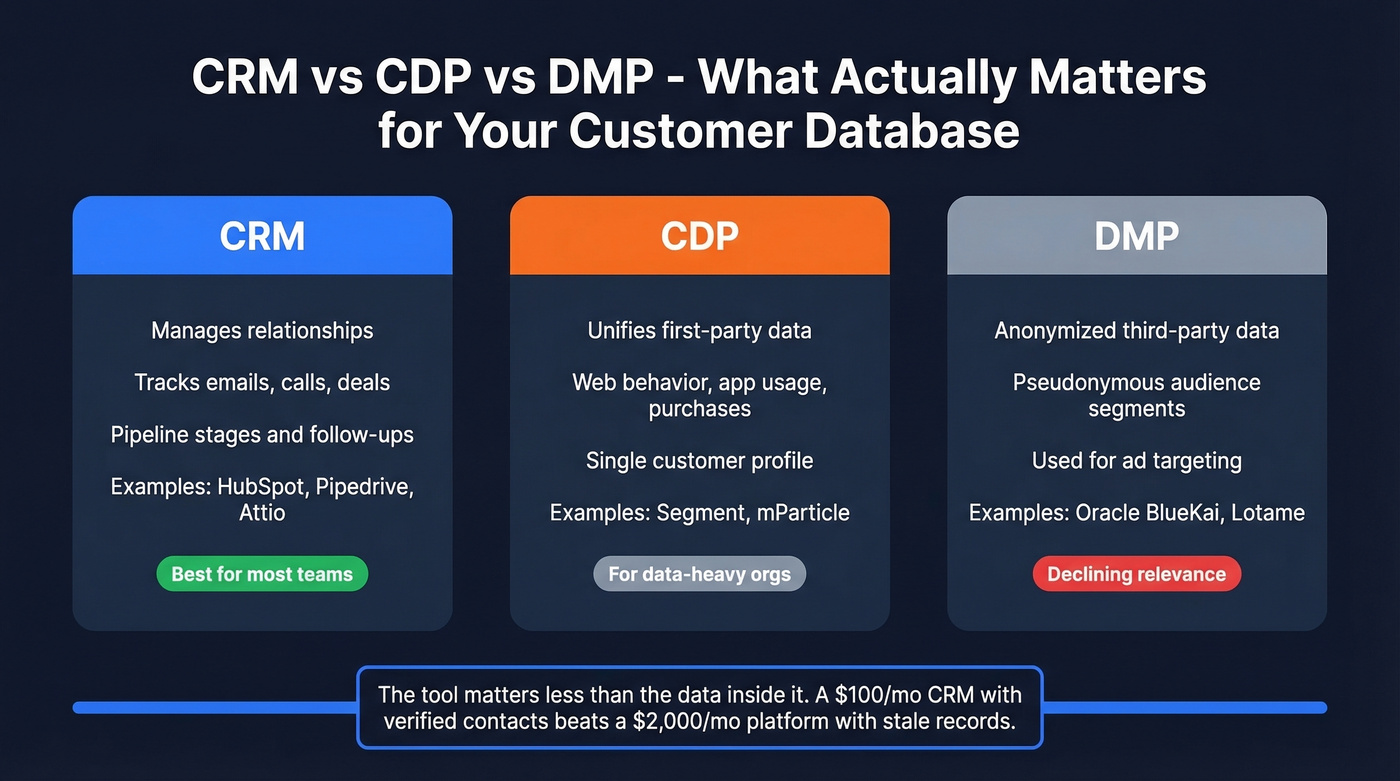
Three terms get conflated constantly. A CRM like HubSpot or Pipedrive manages relationships by tracking emails, calls, pipeline stages, and follow-ups. CRM vs CDP vs DMP is the comparison most teams actually need to understand. A CDP unifies first-party data from multiple sources - web behavior, app usage, in-store purchases - into a single customer profile. A DMP deals in anonymized, third-party audience data for advertising. CDPs emphasize first-party data and known identities; DMPs work with pseudonymous segments.
Here's the thing: for most teams reading this, the CRM is the container, but the data is what matters. A $100/month CRM with verified, current contact data will outperform a $2,000/month platform stuffed with stale records and duplicates every single time.
Top Customer Database Software for 2026
HubSpot CRM
Use this if you want CRM, email marketing, and basic automation in one platform without stitching together five tools. The free tier is genuinely generous - core CRM features like contacts, deals, and meeting scheduling all included. For a team of 3-5 reps just getting organized, it's the obvious starting point.
Skip this if you're price-sensitive beyond the free tier. The jump from free to Sales Hub Starter ($15/seat/mo) is reasonable, but Professional ($90/seat/mo plus a $1,500 onboarding fee) hits hard. We've seen teams get locked into HubSpot's ecosystem because migrating away from their marketing workflows feels painful - all those automated sequences and landing pages create real switching costs that compound over time.
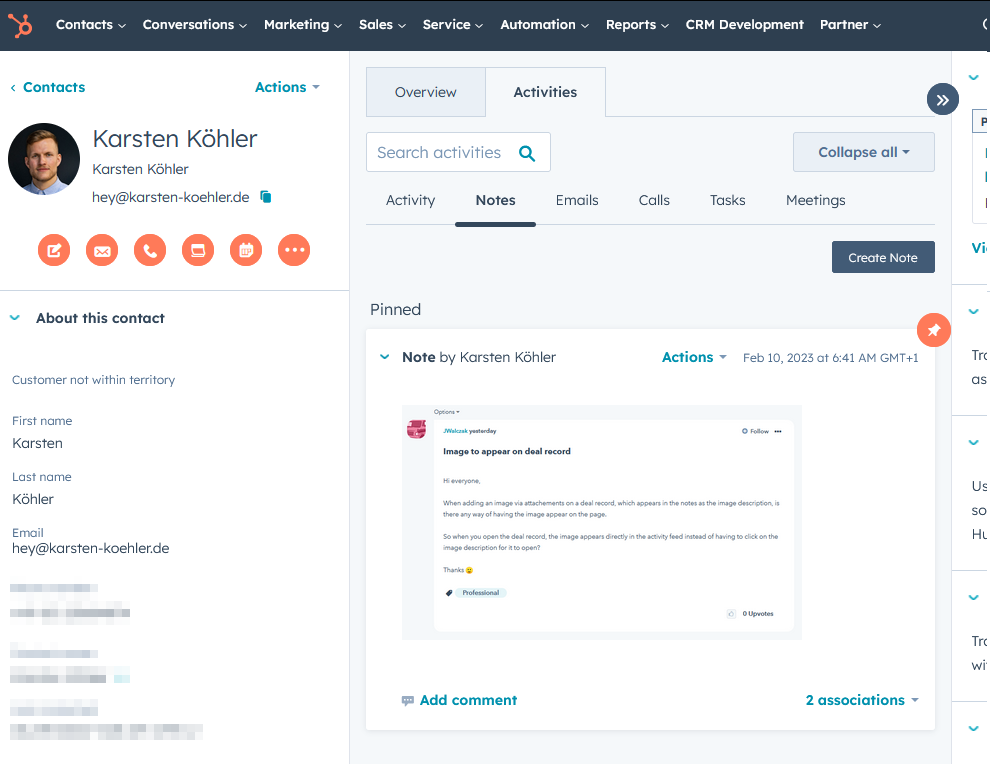
The free CRM is best-in-class for getting started. Just know that HubSpot's real business model is upgrading you to paid hubs, and once you're there, the annual commitment and per-seat pricing add up fast.
Prospeo
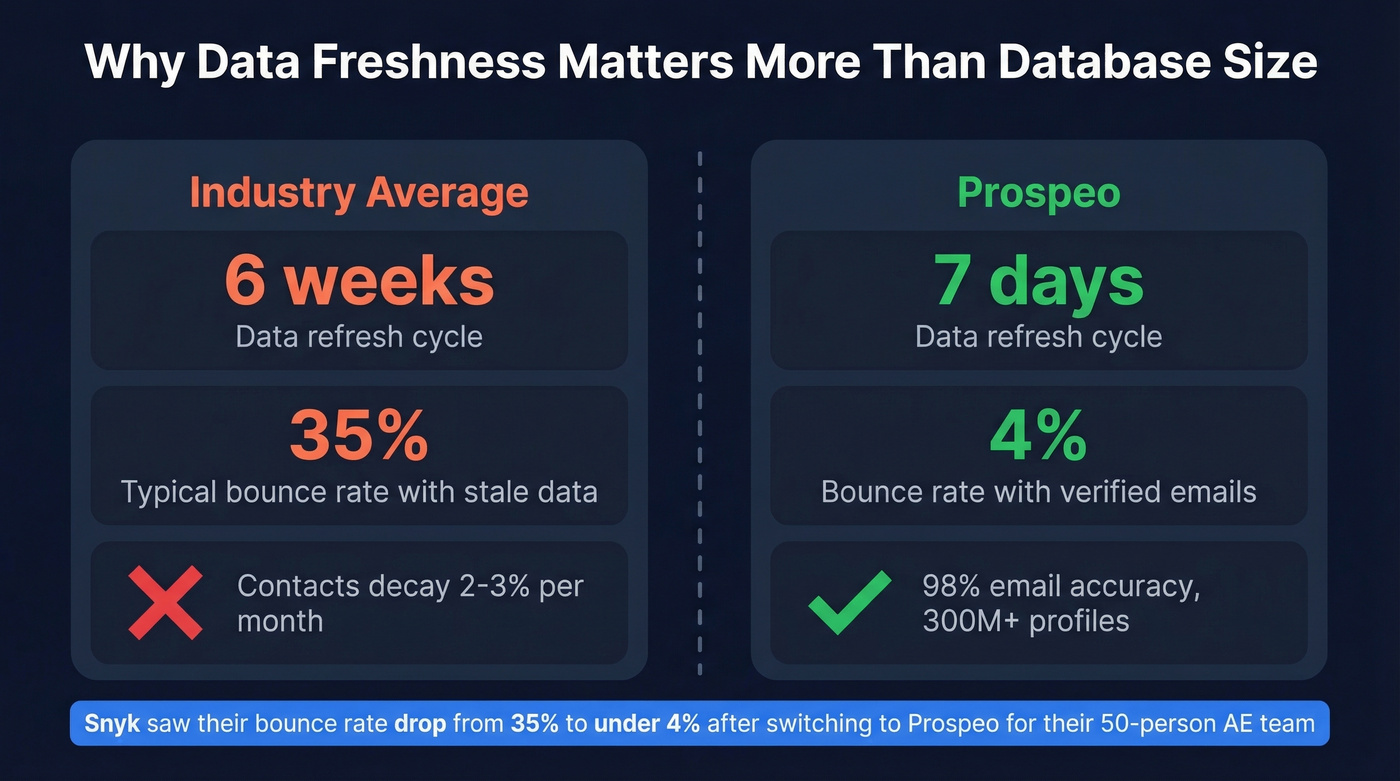
Most tools on this list manage existing customers. Prospeo builds the database of prospects you want to turn into customers - 300M+ professional profiles, 143M+ verified emails at 98% accuracy, and 125M+ verified mobile numbers with a 30% pickup rate across all regions.

The 7-day data refresh cycle is the real differentiator. Industry average is six weeks, which means most databases are serving you stale emails by the time you hit send. That's not a minor gap - it's the difference between a 4% bounce rate and a 35% bounce rate, which is exactly what Snyk's 50-person AE team saw after switching.
Native integrations push verified contacts directly into Salesforce, HubSpot, Lemlist, and Instantly, so your CRM starts clean and stays clean. Credit-based pricing at roughly $0.01 per email, free tier with 75 emails/month, no contracts. Pair it with any CRM on this list for a complete client database stack.
Attio
Think of Attio as what HubSpot would look like if it were built today. Its object-based architecture lets you model data however your business actually works - custom objects, flexible associations, and a UI that doesn't make you want to close the tab.

G2 rates it 4.4/5 from 269 reviews, with customizability and ease of use as the top themes. Free plan covers 3 seats. Plus runs $29/user/mo billed annually, Pro at $69/user/mo billed annually. The free tier is genuinely usable - not a crippled demo.
One thing to watch: SDR teams often spend $1,100-$5,200/mo on add-on tools for enrichment, sequencing, and intent data alongside their CRM. Attio's integration library is growing but still thinner than HubSpot's or Salesforce's, so factor in total stack cost. For pure CRM and contact management, though, it's the best-designed CRM since Pipedrive launched.
Pipedrive
Pipedrive's entire UX is built around the visual pipeline - drag deals between stages, see what's stuck, know what to follow up on. It's opinionated software, and that opinion is "sales reps should spend time selling, not configuring."
For a 5-10 person sales team that needs structure without complexity, Pipedrive consistently wins on adoption, which is half the battle with any CRM. Plans run ~$14-$99/user/mo depending on tier. No free plan, no marketing automation, and support ticketing requires add-ons. But reps actually use it, and that alone makes it worth considering over tools with longer feature lists and lower login rates.
Zoho Bigin
Zoho Bigin is the CRM for teams that need pipeline management for under $10/user/mo and don't want to learn Salesforce. It's Zoho's deliberately stripped-down offering, with a free plan and paid tiers starting at $7/user/mo billed annually. The mobile app is surprisingly good for field teams. If you're already in the Zoho ecosystem with Books, Desk, or Campaigns, Bigin slots in without friction. The trade-off is clear: you get simplicity at the cost of advanced reporting and complex automations.
Salesflare
Salesflare automates the data entry that kills CRM adoption. It pulls contact info, email history, and meeting data automatically, then builds a timeline without reps lifting a finger. Starts at $29/user/mo (Growth), $49/user/mo (Pro), billed annually. Best for small B2B teams of 2-10 who've tried a CRM before and abandoned it because nobody updated records.
Freshsales
Freshsales packs AI-powered lead scoring into a free plan - that's rare. The Freddy AI assistant ranks leads by engagement and fit, which becomes genuinely useful past 500+ contacts. Free tier covers basic CRM; paid plans start at $9/user/mo for Growth, scaling to $59/user/mo for Enterprise. Works best inside the Freshworks ecosystem. If you're not using Freshdesk or Freshmarketer, some cross-product value disappears.
monday CRM
If your team already runs projects in monday.com, their CRM module eliminates the "two tools that don't talk to each other" problem. Free for 2 seats, paid plans start at around $9/seat/mo billed annually. The CRM inherits Monday's visual, board-based interface - great for Kanban thinkers, less great for traditional sales reporting.
Capsule
Capsule is the CRM for people who want clean contact management without feature creep. Free plan available, paid from $18/user/mo billed annually. Contacts, sales pipeline, tasks, basic reporting - nothing more. Best for consultancies and service businesses that want a simple, tidy system.
Less Annoying CRM
$15/user/mo. No tiers. No contracts. No upsells.
That's the entire pricing page, and it's refreshing. Contacts, calendar, tasks, pipeline, and reporting without enterprise complexity. If you've bounced off HubSpot or Salesforce because they felt like overkill, this is your answer.
Salesforce
The 800-pound gorilla. Expect roughly $25-$100+/user/mo depending on the plan and bundle. Realistic mid-market deployments run $15-40K/year. Overkill for 90% of businesses searching for a simple client database. If you have 50+ reps and a dedicated admin, it's the standard. Everyone else should look elsewhere.
Keap
Bundles CRM with email marketing and payment processing. Plans typically run $249-399/mo. Expensive for what it is - best for solopreneurs running coaching or service businesses who want invoicing and automation in one tool.
Insightly
A solid mid-market CRM with project management baked in. Starts at $29/user/mo billed annually. Good for teams tracking post-sale delivery alongside the pipeline.
Act!
Act! has been around for decades, and it shows. Cloud plans run $30-60/user/mo billed annually, desktop at $40/user/mo. Best for legacy users who've been on it for years. New buyers should pick Capsule or Pipedrive instead.
Microsoft Dynamics 365
Enterprise-grade CRM typically starting at $65+/user/mo. If you're a Microsoft shop running Outlook, Teams, and Azure, Dynamics connects natively without middleware. For everyone else, it's overbuilt and overpriced for contact management.

Your CRM is only as good as the data inside it. Prospeo feeds 300M+ verified profiles into HubSpot, Salesforce, or any CRM on this list - 98% email accuracy, 7-day refresh cycle, $0.01/email. No stale records, no bounced campaigns.
Stop managing a database full of dead emails. Start with verified data.
When You Don't Need a CRM
If you're tracking fewer than 200 contacts, a spreadsheet is fine. Seriously. 32% of UK SMEs still use spreadsheets for customer data, and 50% of micro-businesses don't use a CRM at all. They're not all wrong.
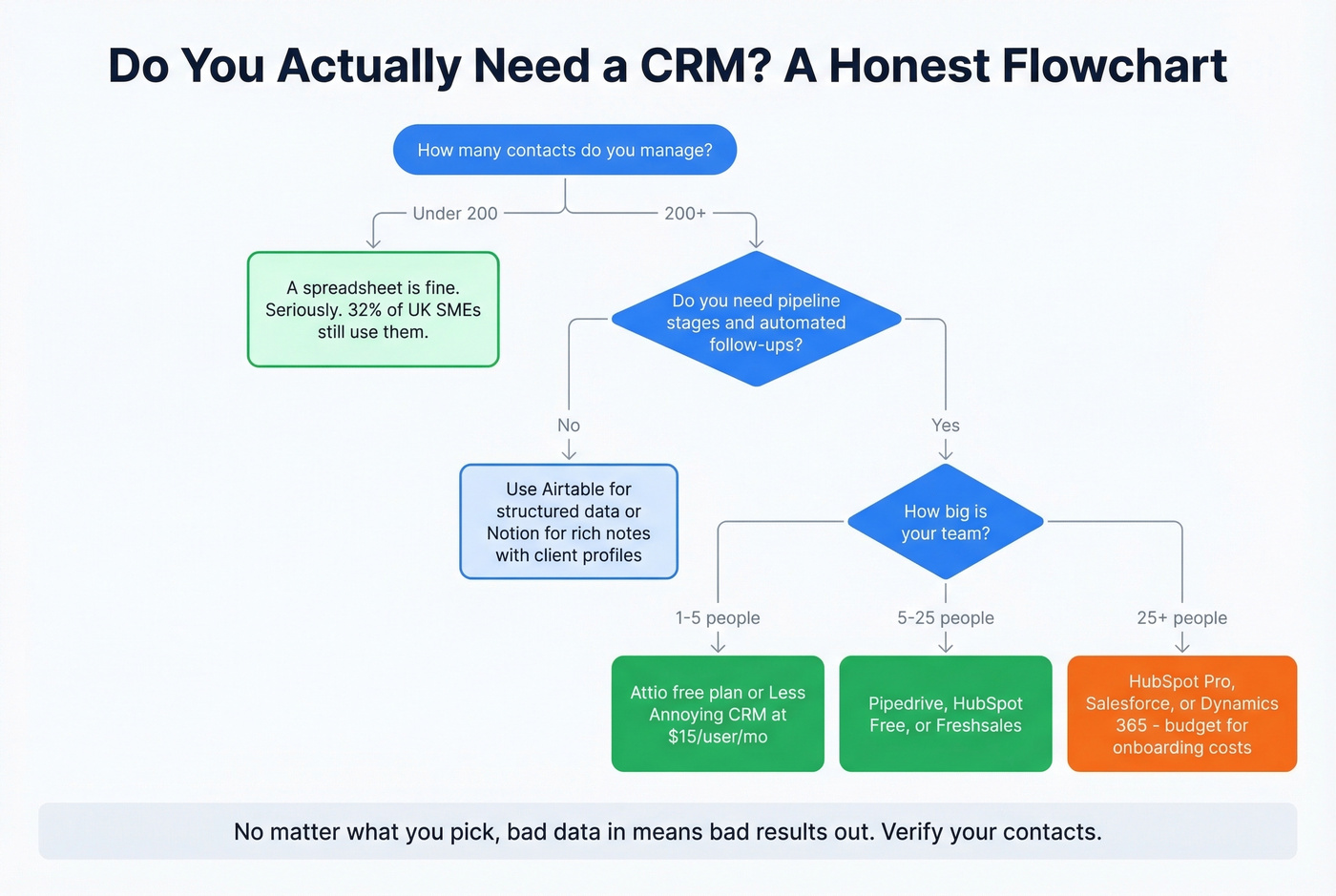
For something between a spreadsheet and a CRM, Airtable gives you structured, linked data with field types and relational tables - a spreadsheet with a database brain. On r/software, a contractor asked for a simple customer database program to store equipment specs and PDF invoices; Airtable handles exactly that use case. Notion is better for rich notes with basic database features, great for freelancers who want client profiles with embedded docs. Neither replaces a real CRM once you need pipeline stages, automated follow-ups, or multi-user permissions.
How to Choose the Right Tool
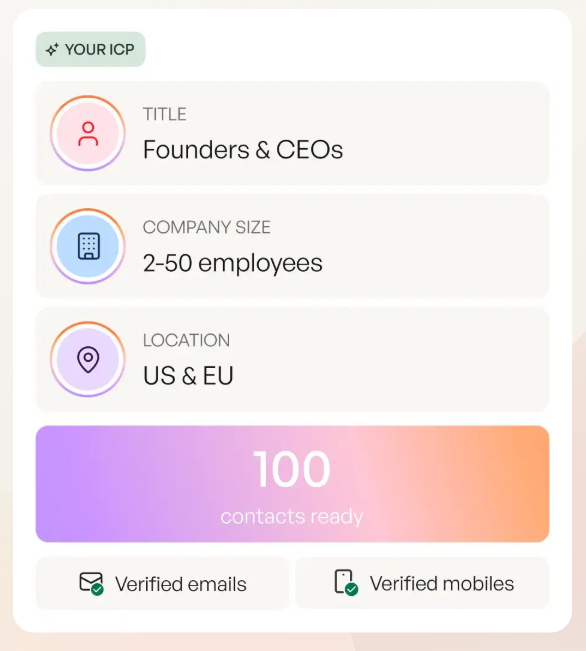
Let's be honest: if your average deal size is under $10k, you probably don't need anything beyond a free CRM and a verification tool. The teams that overspend on database software aren't the ones closing more deals - they're the ones stuck configuring dashboards instead of selling.
Factor in total cost of ownership - onboarding fees, per-seat scaling, and integration costs - not just the sticker price. Match the tool to your stage:
- Solopreneur with fewer than 200 contacts: Google Sheets, Notion, or Airtable. Don't overthink it.
- Small team of 2-10 people: Zoho Bigin ($7/user/mo), Capsule (free), or Attio's free plan. Budget: $0-30/user/mo.
- Growth team of 10-50 reps: HubSpot Sales Hub, Pipedrive, or Attio Plus. Budget: $15-90/user/mo.
- Enterprise with 50+ reps: Salesforce or Dynamics 365. Budget: $15-40K+/year.
The market in 2026 is moving toward API-first design, real-time data processing, and a shift from data storage to data activation. The winning stack isn't the biggest CRM - it's a lightweight CRM connected to specialized tools that keep your data fresh and actionable.
Database Management Mistakes That Cost Revenue
37% of companies report revenue loss from poor data quality, according to Gartner's data quality research. Good customer database management isn't just about picking the right tool - it's about the habits you build around it. In our experience, these are the five mistakes that show up most often:
Importing unverified data. Every list you import without verification introduces bounced emails, dead phone numbers, and duplicate records. Run your list through a verification tool before importing. Prevention is always cheaper than cleanup.
Prioritizing quantity over quality. Buying a 50,000-contact list feels productive. But low-quality data creates cascading problems - bad segmentation, wasted sequences, damaged sender reputation. A verified list of 5,000 outperforms a dirty list of 50,000 every time.
Running separate CRM and marketing databases. When sales uses Pipedrive and marketing uses Mailchimp with no sync, you get conflicting records, missed context, and reps emailing people who just unsubscribed. Pick tools that integrate or use a middleware layer like Zapier or Make.
No lead source tracking. If you can't tell which channel produced a contact, you can't optimize spend. Tag every record with its source on import - not three months later when nobody remembers.
Ignoring data decay and compliance. People change jobs, companies rebrand, phone numbers rotate. 90% of enterprise customer data goes untapped because it's stale or unstructured. Schedule quarterly cleanups at minimum. And stale data isn't just a performance problem - under GDPR and CCPA, holding outdated personal data without a retention policy is a compliance risk.
Teams spend $1,100-$5,200/mo on enrichment add-ons and still get 35% bounce rates. Prospeo delivers 143M+ verified emails and 125M+ mobile numbers with native CRM integrations - so your customer database stays accurate without the patchwork stack.
One layer of clean data beats five tools full of stale records.
GDPR, CCPA, and Compliance
Compliance isn't optional, and the penalties are real. GDPR fines reach EUR 20M or 4% of global turnover - whichever is higher. CCPA penalties hit $7,500 per intentional violation. Getting this right is both a legal requirement and a trust signal.
Practical checklist for your customer database:
- Consent must be granular. Pre-checked boxes violate GDPR. Bundled consent doesn't count. Each purpose needs its own opt-in.
- Collect only what you need. Data minimization is a legal requirement. "Improving user experience" isn't a specific enough purpose.
- Set retention policies. Marketing databases shouldn't hold inactive records indefinitely. If someone hasn't engaged in 12-18 months, archive or delete.
- Honor opt-out signals. CCPA requires recognizing Global Privacy Control browser signals automatically.
- Document everything. Audit trails for consent, processing purposes, and data access are what regulators ask for first.
81% of consumers say how a company handles personal data reflects how much it respects them. That stat alone should make compliance a priority, not an afterthought.
FAQ
What's a customer database vs. a CRM?
A customer database stores contact details and transaction records in a structured format. A CRM adds relationship management - tracking interactions, managing pipelines, and automating follow-ups. Every CRM contains a database, but a spreadsheet or Airtable base can serve as one without CRM features.
What's the best free option in 2026?
HubSpot CRM offers the most features at $0, Attio provides 3 free seats with a modern UI, and Zoho Bigin includes basic pipeline management on its free plan. For teams under 5 people, any of these works without spending a dollar.
How do I keep contact records clean?
Verify data before importing - catching bad addresses before they pollute your CRM is far cheaper than cleaning up afterward. Deduplicate monthly, enforce required fields on entry, and archive contacts inactive for 12+ months.
When should I upgrade from a spreadsheet?
Move to a CRM once you pass 200 contacts, need multiple team members accessing the same records, or start losing track of follow-ups. If a spreadsheet still works and you're the only user, don't overthink the upgrade.
Is storing customer data without consent legal?
Under GDPR, you need a lawful basis - usually consent or legitimate interest - to store personal data. CCPA lets you collect data but requires disclosure and honoring opt-out requests. Fines reach EUR 20M (GDPR) or $7,500 per intentional violation (CCPA). When in doubt, get explicit consent.