

Customer Qualification: How to Stop Wasting Time on Prospects Who'll Never Buy
Your SDR booked 40 meetings last month. Your AEs ran 35 of them. Seven became proposals. Two closed. That's a 5% booked-meeting-to-close rate - and 38 conversations that didn't turn into revenue.
Salesforce data shows reps spend only 28% of their week actually selling. Customer qualification is how you fix the ratio.
Pick the right framework for your sales motion - BANT for velocity deals, MEDDIC for enterprise. Ask consultative questions instead of running interrogation-style checklists. Use the post-demo "blocker question" (covered below) to surface no-decision deals before you invest another three hours. And verify your contact data before you qualify, because you can't qualify someone you can't reach. Benchmark: best-in-class companies close 30% of SQLs. If you're consistently under ~15%, qualification is usually the bottleneck.
What Is Customer Qualification?
It's the systematic process of determining whether a prospect has the budget, authority, need, and timeline to become a paying customer. It's not the same as lead qualification, which is a lighter, top-of-funnel filter.
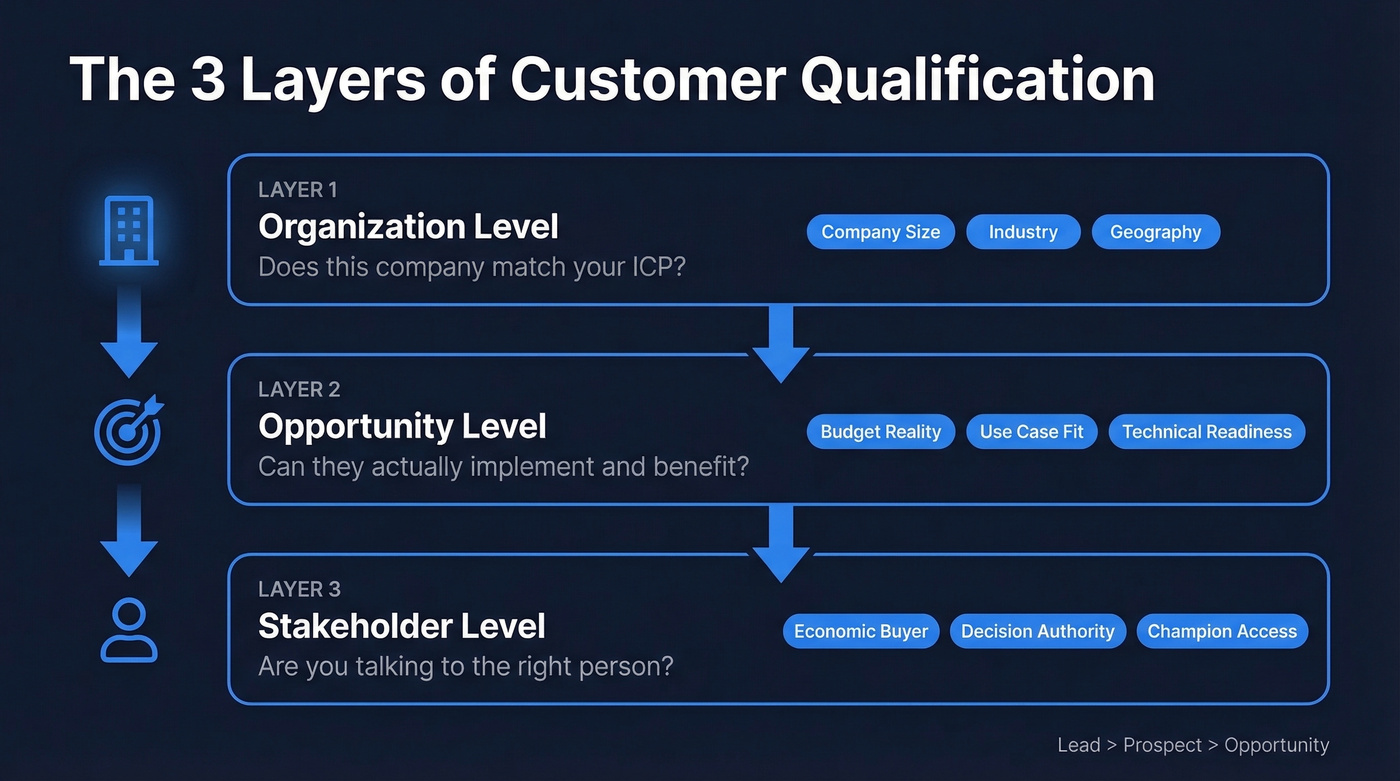
Here's the taxonomy that matters:
- Lead - a top-of-funnel contact. Not yet qualified. Could be anyone who downloaded a whitepaper or visited your pricing page.
- Prospect - a qualified contact who fits your ICP and has shown genuine interest.
- Opportunity - a qualified prospect with real budget, real timeline, and a real decision-maker engaged.
The qualification process runs three layers deep. Organization-level asks whether this company matches your ICP by size, industry, and geography. Opportunity-level asks whether they can actually implement and benefit from your solution. Stakeholder-level asks whether you're talking to someone with authority or someone three levels removed from the economic buyer.
How to Qualify a Customer in Sales
The right framework depends on your sales motion, deal size, and cycle length.
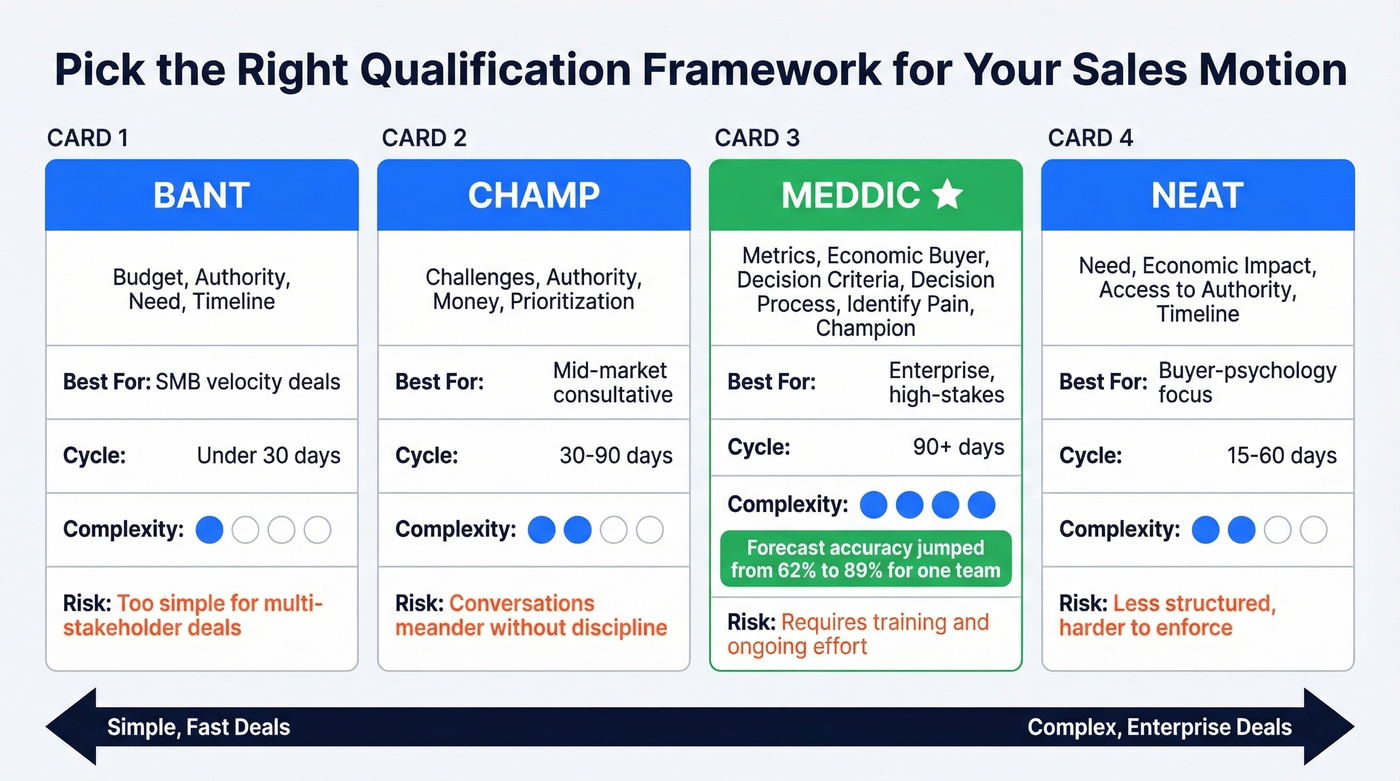
| Framework | Best For | Weakness | Cycle Fit |
|---|---|---|---|
| BANT | SMB velocity | Too simple for complex deals | Under 30 days |
| CHAMP | Mid-market consultative | Can get loose without discipline | 30-90 days |
| MEDDIC | Enterprise, high-stakes | Requires training + effort | 90+ days |
| NEAT | Buyer-psychology focus | Less structured | 15-60 days |
Here's the thing: most teams default to BANT because it's familiar, not because it fits. If your average deal involves more than two stakeholders and takes longer than a month, BANT is actively costing you revenue. Graduate to something that matches your actual motion.
BANT
Budget, Authority, Need, Timeline. Originated at IBM in the 1950s and still works for high-volume, transactional sales with cycles under 30 days. The weakness is obvious: modern B2B buying involves roughly seven stakeholders, and BANT assumes one decision-maker and a linear process. For a deal with a single buyer under five figures, it's perfect. For anything more complex, it breaks down fast.
CHAMP
Challenges, Authority, Money, Prioritization. CHAMP leads with the prospect's pain instead of your budget question - it's more consultative and works well for mid-market deals where the buyer needs to feel heard before they'll share financial details. The risk: without discipline, CHAMP conversations meander. You get great rapport and zero pipeline velocity.
MEDDIC
Metrics, Economic Buyer, Decision Criteria, Decision Process, Identify Pain, Champion. This is the enterprise workhorse, and it's the framework we've seen produce the most dramatic improvements for teams selling six-figure deals.
MEDDIC forces you to validate deal progress through Customer Verifiable Outcomes - buyer-confirmed signals that the deal is actually moving, not just your optimistic gut feeling. One team reported switching from BANT to MEDDIC and seeing forecast accuracy jump from 62% to 89%. That's not because MEDDIC is magic. It's because it matched their enterprise motion.
NEAT Selling
Need, Economic Impact, Access to Authority, Timeline. NEAT Selling is the modern alternative for teams that find BANT too rigid and MEDDIC too heavy. It's buyer-psychology oriented, built for a world where prospects show up with 90% of their research already done. If your current framework feels like a checklist rather than a conversation, start here.
Questions That Actually Work
Most qualification questions sound like a police interview. Prospects shut down because they feel interrogated, not consulted - and buyers are 67% more likely to purchase from salespeople who ask consultative questions. Let's break down how to rephrase the classics.
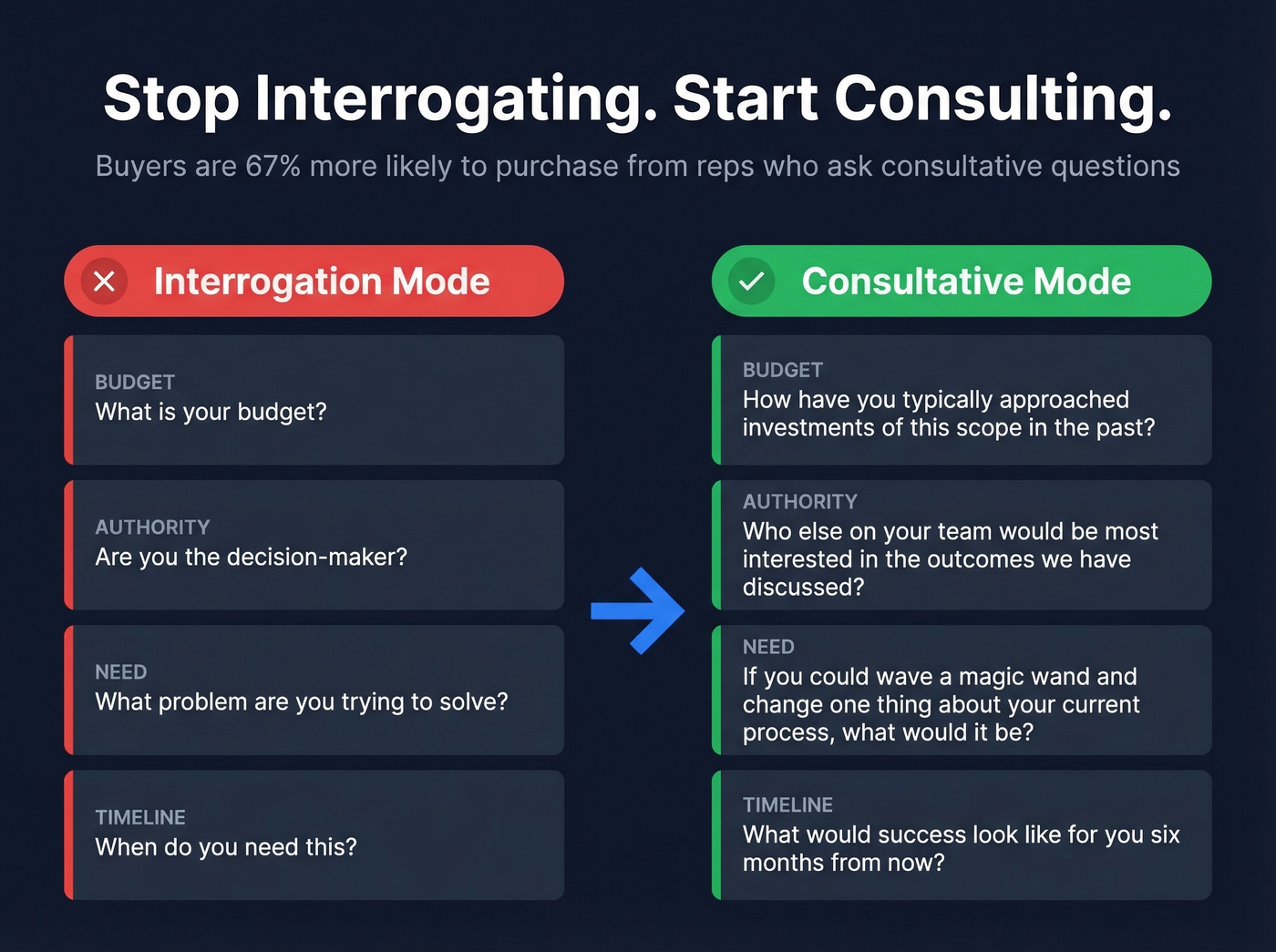
Budget - instead of "What's your budget?", try: "How have you typically approached investments of this scope in the past?"
Authority - instead of "Are you the decision-maker?", try: "Who else on your team would be most interested in the outcomes we've discussed?"
Need - instead of "What problem are you trying to solve?", try: "If you could wave a magic wand and change one thing about your current process, what would it be?"
Timeline - instead of "When do you need this?", try: "What would success look like for you six months from now?"
Qualifying through consultative dialogue rather than a rigid checklist builds trust and surfaces honest answers - which is the entire point.
The Post-Demo Blocker Question
The "polite prospect" is the most expensive person in your pipeline. They sit through demos, nod enthusiastically, say "we'll discuss internally," and then ghost you for six weeks. Right after your demo - before you discuss pricing - ask:
"Based on what you've seen, is there anything that would prevent you from moving forward if the price was right?"
This forces one of three outcomes: they reveal a real objection you can address, they admit they're in early research mode, or they confirm there's no blocker and you've got a real deal. A practitioner on r/sales reported moving close rates from 13% to 30% by consistently using this approach. We've seen similar results with our own outbound - the question works because it gives prospects permission to be honest instead of polite.

Qualification frameworks only work when you're talking to the right person. Prospeo gives you 98% accurate emails and 125M+ verified mobile numbers so your SDRs reach actual decision-makers - not gatekeepers, not dead inboxes. Data refreshes every 7 days, not 6 weeks.
Stop qualifying ghosts. Start with verified contacts at $0.01 per email.
Modern Qualification Signals
Stop asking more questions. Start qualifying your data first.
Intent data, job change alerts, and technographic signals tell you whether an account is in-market before your SDR ever picks up the phone. A tactic shared by enterprise reps on Reddit for seven-figure deals: monitor competitor employees' new connections on professional networking platforms using connection-tracking tools or manual weekly checks. If a target account's VP of Engineering just connected with three people at your competitor's implementation team, that account is deep in evaluation. You don't need to ask "what's your timeline?" - you already know.
Speed compounds the advantage. Following up within the first hour increases conversion to 53% versus 17% after 24 hours. But none of this works if your contact data is garbage. When 30-40% of your emails bounce, a third of your qualification conversations never start.
This is where data quality becomes a qualification prerequisite. Prospeo handles this with 98% email accuracy across 300M+ profiles, refreshed every seven days instead of the six-week industry norm. Filter by job title, seniority, and department so your SDRs reach the economic buyer - not a generic inbox. The intent layer tracks 15,000 topics through Bombora, so you know which accounts are actively researching before you dial. The free tier gives you 75 verified emails per month to test the workflow, plus 100 Chrome extension credits.

Intent data, job changes, and technographics let you qualify accounts before your SDR picks up the phone. Prospeo tracks 15,000 buyer intent topics and layers them with 30+ filters - so you know who's in-market, who just got funded, and who's evaluating competitors right now.
Qualify with data signals, not guesswork. 300M+ profiles with intent built in.
Sales Qualification Benchmarks
MQL-to-SQL conversion rates vary dramatically by industry:
| Industry | MQL to SQL |
|---|---|
| Consumer Electronics | 21% |
| FinTech | 19% |
| Automotive | 18% |
| Healthcare | 13% |
| Oil & Gas | 12% |
Top performers reach ~40% with advanced lead scoring and fast follow-up. If you're below your industry average, your qualification criteria are either too loose (pipeline inflation) or your data quality is too poor (conversations never happen).
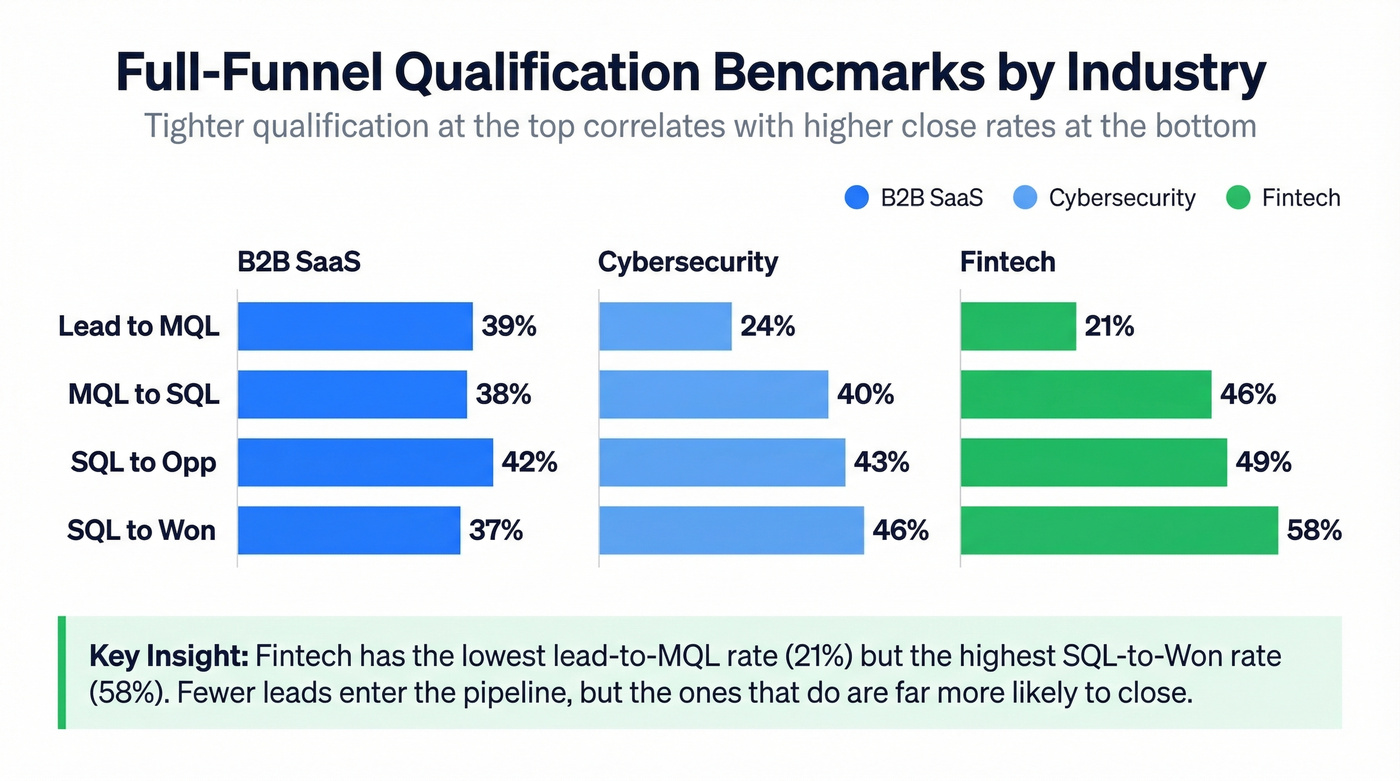
The full-funnel picture is even more revealing:
| Industry | Lead to MQL | MQL to SQL | SQL to Opp | SQL to Won |
|---|---|---|---|---|
| B2B SaaS | 39% | 38% | 42% | 37% |
| Cybersecurity | 24% | 40% | 43% | 46% |
| Fintech | 21% | 46% | 49% | 58% |
Notice that Fintech has a lower lead-to-MQL rate but a much higher SQL-to-won rate. That's what rigorous qualification looks like in practice - fewer leads enter the pipeline, but the ones that do are far more likely to close. In our experience working with sales teams across industries, the pattern is consistent: tighter top-of-funnel criteria almost always correlate with better close rates, even when it feels counterintuitive to shrink your pipeline.
When to Disqualify
Most sales teams under-qualify, not over-qualify. They're afraid to remove prospects from the pipeline because it makes the forecast look thin. Look - a bloated pipeline with 60% dead deals is worse than a lean one with 80% real opportunities. Every time.
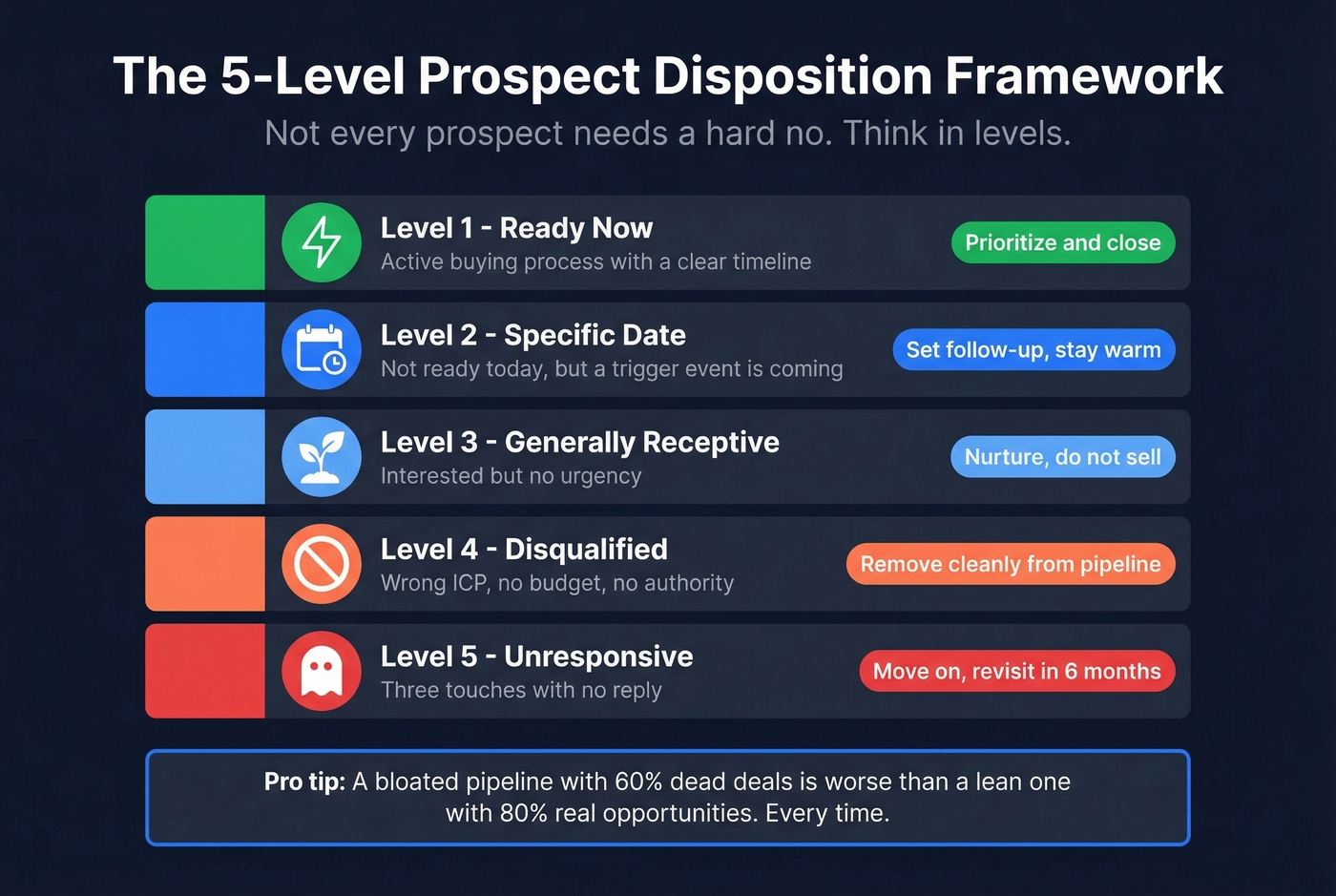
Not every prospect needs a hard "no." Think in five levels:
- Ready now - active buying process with a clear timeline
- Specific date - not ready today, but a trigger event is coming
- Generally receptive - interested but no urgency; nurture, don't sell
- Disqualified - wrong ICP, no budget, no authority; remove cleanly
- Unresponsive - three touches with no reply; move on
Skip the awkward breakup email templates you've seen floating around. For graceful disqualification, try something like: "It sounds like the timing isn't right. I'd love to reconnect in Q3 when [trigger event] is closer. Mind if I reach out then?" This preserves the relationship without wasting pipeline space.
One thing teams consistently miss: schedule re-qualification at every renewal, expansion conversation, and QBR. The buyer who was perfect 18 months ago may have changed roles, lost budget, or shifted priorities entirely. Qualification isn't a one-time gate - it's a recurring discipline.
FAQ
What is the goal of qualifying a customer?
The goal is to determine - as early as possible - whether a prospect has the budget, authority, need, and timeline to buy, so your team invests selling time only in deals with a realistic path to close. Without this filter, reps burn hours on prospects who were never going to convert, dragging down close rates and forecast accuracy.
What's the difference between lead qualification and customer qualification?
Lead qualification filters top-of-funnel contacts by ICP fit - industry, company size, basic demographics. Customer qualification goes deeper, assessing budget, authority, need, and timeline to determine if a prospect will actually buy. Lead qualification is step one; the full qualification process determines whether a deal is real.
Which framework works best for small teams?
BANT. It's simple, fast, and works for sales cycles under 30 days with a single decision-maker. Graduate to MEDDIC when you move upmarket and deal complexity increases - multiple stakeholders, longer timelines, and six-figure contracts demand a more rigorous framework.
How do you qualify prospects when your contact data is outdated?
You don't - that's the problem. When 30-40% of your emails bounce, a third of your conversations never happen. Tools that refresh records weekly with high email accuracy ensure you're always working with current data. Clean contact information is the foundation that makes every framework above actually functional.