

10 Data-Driven Marketing Examples With Real Numbers Behind Them
Data-driven marketing means using behavioral, transactional, and intent signals to decide what to say, to whom, and when - then measuring whether it worked. Most advice on the topic stops at "personalize your emails." These ten examples go deeper: real campaigns with real numbers, plus the benchmarks that tell you whether your own campaigns are in the right ballpark.
Three patterns worth studying first: Netflix's experimentation culture, Spotify Wrapped's data-as-content model, and NYT's first-party data monetization. Each represents a different way data creates compounding value.
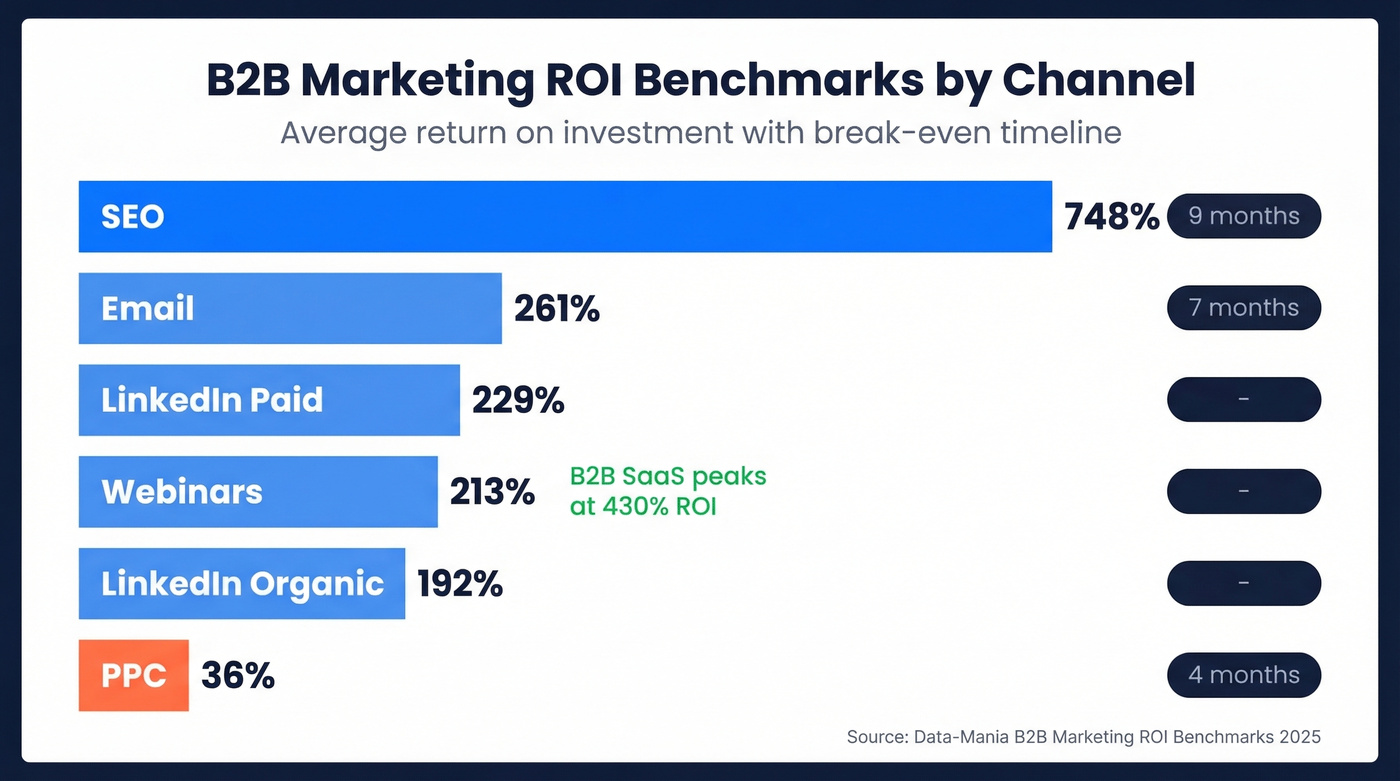
The benchmark to know: Average B2B marketing delivers 5:1 ROI. SEO leads at 748%, email at 261%. If you're below those lines, your channels aren't the problem - your execution is.
The mistake killing most campaigns: Dirty data. If your outbound bounce rate is above 4-5%, your "data-driven" strategy is built on garbage.
ROI Benchmarks by Channel
These B2B benchmarks give you a baseline for evaluating any data-driven initiative.
| Channel | Avg. ROI | Break-Even |
|---|---|---|
| SEO | 748% | 9 months |
| 261% | 7 months | |
| LinkedIn Paid | 229% | - |
| Webinars | 213% | - |
| LinkedIn Organic | 192% | - |
| PPC | 36% | 4 months |
SEO's ROI dwarfs everything else, but the 9-month break-even means you need patience. PPC breaks even fastest but delivers the weakest long-term return. Webinars are quietly dominant - B2B SaaS companies see peaks of 430% ROI from them, which surprises most teams we talk to. Average ecommerce conversion sits under 2% (and under 2%](https://www.hubspot.com/marketing-statistics), and email conversion runs 2.8% B2C / 2.4% B2B.
10 Real-World Examples to Study
1. NYT's First-Party Data Engine
First-party data collected through value exchange outperforms rented third-party audiences by a wide margin. The New York Times proved it. With 150M registered users and 11.5M subscribers, NYT built BrandMatch - an AI tool that translates brand briefs into audience segments and delivers up to 4x better campaign performance than traditional targeting.
Every company has some version of this asset: your CRM, your email list, your product usage data. The question is whether you're activating it or letting it rot in a database.
2. McDonald's Loyalty-Powered Targeting
McDonald's loyalty program has 170M active members and is targeting 250M. That's not a rewards program - it's a first-party data engine that rivals any publisher's audience. Every order, location visit, and menu preference feeds targeting models that reduce reliance on third-party cookies for measurement. The B2C parallel to NYT is striking: both realized owned audience data is the new competitive moat, not media spend.
3. Netflix: 250 A/B Tests Per Year
| Netflix | Typical Marketing Team | |
|---|---|---|
| A/B tests per year | ~250 | Far fewer |
| Test group size | ~100,000 users | A few hundred |
| Content classification | 76,897 alt-genres | 5-10 segments |
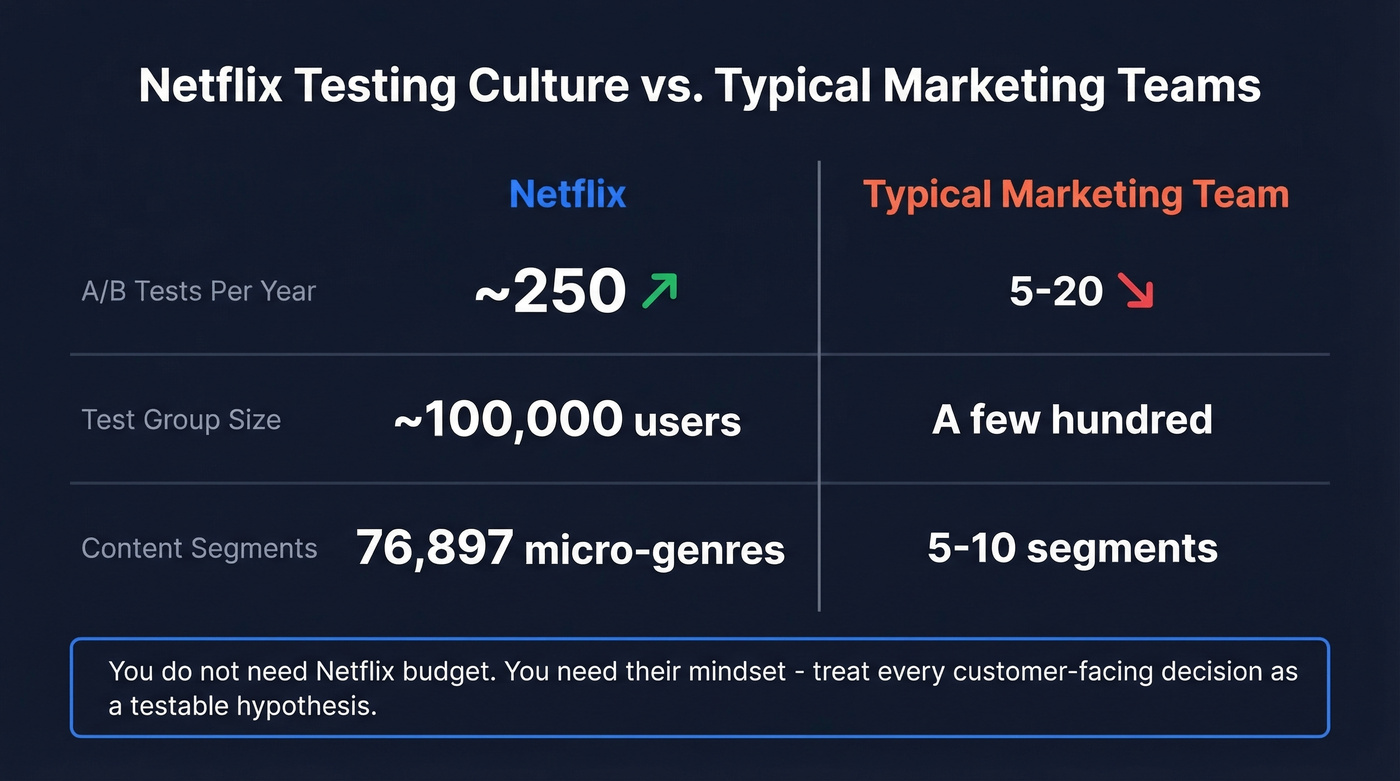
You don't need Netflix's budget. You need their mindset: treat every customer-facing decision as a testable hypothesis. Most marketing teams run far fewer real A/B tests than they should. Netflix averages about five per week.
4. Amazon's Recommendation Engine
About 35% of Amazon's sales come from personalized recommendations. Their repeat buyer rate sits at 56%, driven by recommendation relevance that improves with every purchase. Behavioral data - browsing, purchasing, searching - feeds collaborative filtering models that predict what you'll want next.
This is also one of the strongest cross-selling engines in existence: Amazon surfaces complementary products at checkout based on purchase patterns across millions of transactions, turning a single order into a multi-item basket. The scale is what makes it lethal. Every click trains the algorithm, and the algorithm drives more clicks.
5. Spotify Wrapped as Viral Data
Skip this example if you don't have a consumer product with personal usage data. Study it closely if you do - because Wrapped is the best example of turning a data product into earned media. Users share their data, not Spotify's. Millions voluntarily broadcast their listening habits to every social platform, generating massive organic reach. The format - multi-screen stories with listening personality types and visual refreshes - keeps it culturally relevant every December.
6. GreenPal's Geo-Demographic Targeting
Effective campaigns don't require enterprise budgets. GreenPal, a lawn care marketplace, used hyper-local demographic and geographic data to target ads at the neighborhood level, matching service availability with household income and property size. The result: a 200% lift in click-through rates compared to broad targeting.
Ask any performance marketer what kills their ROAS. The answer is always the same - targeting too broadly.
7. pCloud's Conversion Rate Optimization
pCloud treated their entire funnel as a data problem. Through systematic A/B testing of landing pages, pricing displays, and checkout flows, they achieved a 135% increase in conversion rates. No new traffic sources, no increased ad spend - just better use of behavioral data they already had.
Here's the thing: we've seen CRO deliver the fastest ROI improvement of any data-driven discipline. Doubling conversion rates is mathematically equivalent to doubling traffic at a fraction of the cost. Most teams obsess over top-of-funnel acquisition and ignore the lever sitting right in front of them.
8. Local Businesses Using Free Analytics
An HVAC company tracked local search behavior and seasonal demand patterns to time their Google Business Profile optimization, generating a 150% surge in Google Maps calls (June 2025 vs. 2024) and 250+ tracked SEO calls in a single month.
A tourism organization used Instagram analytics to optimize posting cadence and content types, hitting 20,000+ account views with a 44% year-over-year increase on zero ad spend. The data these businesses used was free - GA4, Google Business Profile insights, native social analytics. Discipline was the differentiator, not tooling.
9. Data-Driven Outbound Prospecting
The difference between a 35% bounce rate and a 4% bounce rate is contact data quality. Full stop.
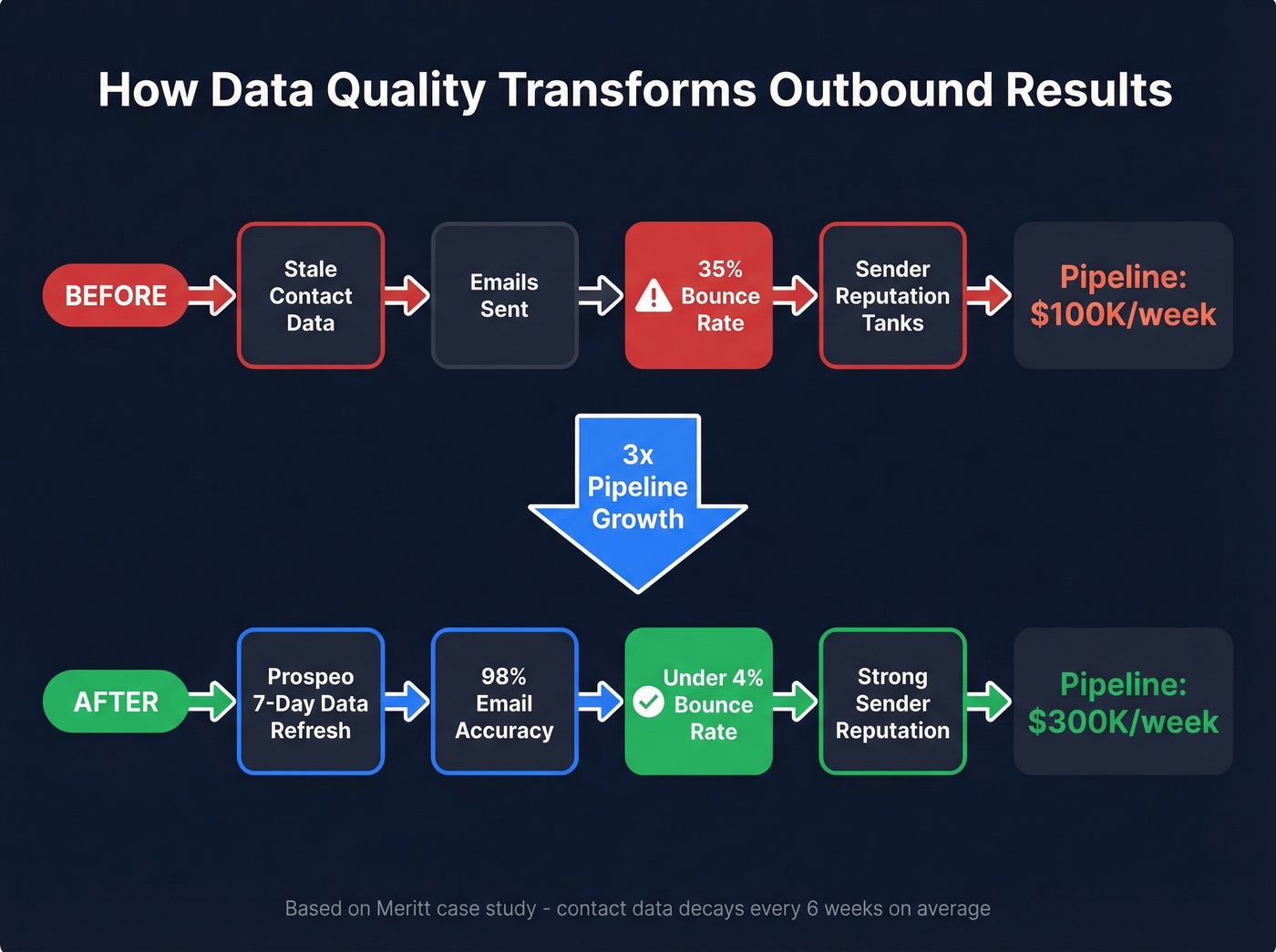
Meritt, a sales agency, was running outbound campaigns that bounced at 35%, which meant their sender reputation was tanking and every downstream metric was unreliable. After switching to Prospeo for contact sourcing - using its 7-day data refresh cycle and 98% email accuracy - their bounce rate dropped under 4% and pipeline tripled from $100K to $300K per week.
We've seen this pattern repeatedly: teams blame their messaging or their offer when the real problem is they're emailing dead addresses. Contact data decays every six weeks on average, so your outbound is running on stale information by week three if you aren't refreshing it.
10. Retargeting With First-Party Data
Cookie-based tracking misses 15-20% of conversions due to opt-outs and browser restrictions. Post-cookie retargeting closes that gap using server-side tracking and CRM audience matching instead of browser cookies. Instead of dropping a pixel and hoping the browser cooperates, you match known contacts from your CRM against ad platform audiences directly. It's more accurate, more privacy-compliant, and it captures the conversions that cookie-based attribution was silently missing.

Example #9 proves it: the gap between a 35% bounce rate and under 4% is data quality. Prospeo's 7-day refresh cycle and 98% email accuracy turned $100K/week pipelines into $300K/week pipelines. Your data-driven marketing strategy is only as good as the contacts behind it.
Stop emailing dead addresses. Start with data that actually connects.
The Privacy-First Reality
Look - every example above exists in a world where third-party cookies are disappearing. Disney's Bridge ID integration with Unified ID2 revealed that traditional matching only connected 9% of their audience. Nine percent.
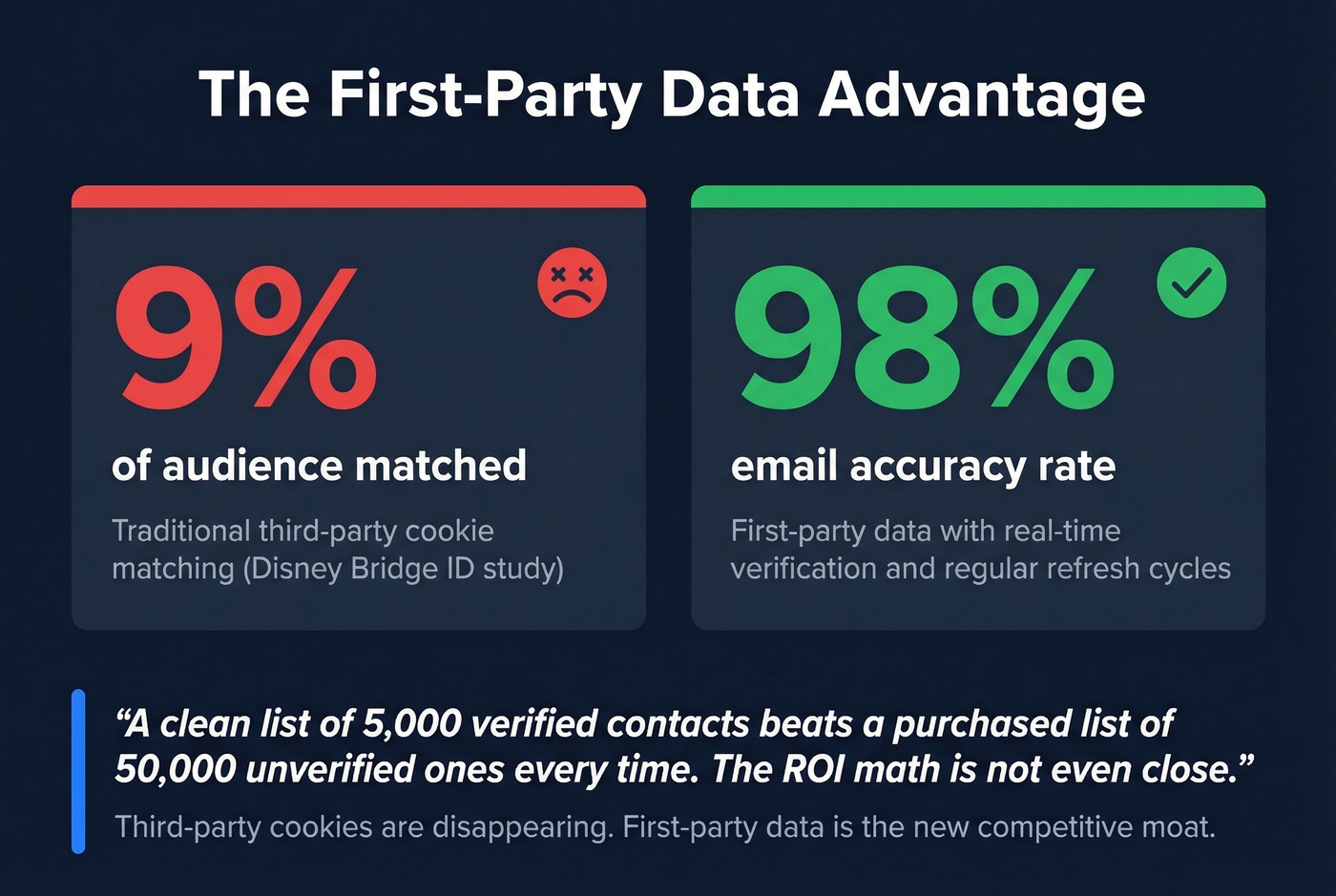
The brands winning with data-driven marketing aren't the ones with the most data. They're the ones with the best first-party data, collected with consent, refreshed frequently, and activated across channels. If your strategy still depends on third-party cookies or rented audience data, you're building on a foundation that's actively eroding.
I'd take a clean list of 5,000 verified contacts over a purchased list of 50,000 unverified ones every single time. The ROI math isn't even close.
Mistakes That Kill Data-Driven Campaigns
Garbage data, garbage decisions. If your CRM has outdated emails, wrong job titles, or duplicate records, every analysis built on that data is compromised. Audit and clean your data regularly, and use tools that verify in real time.
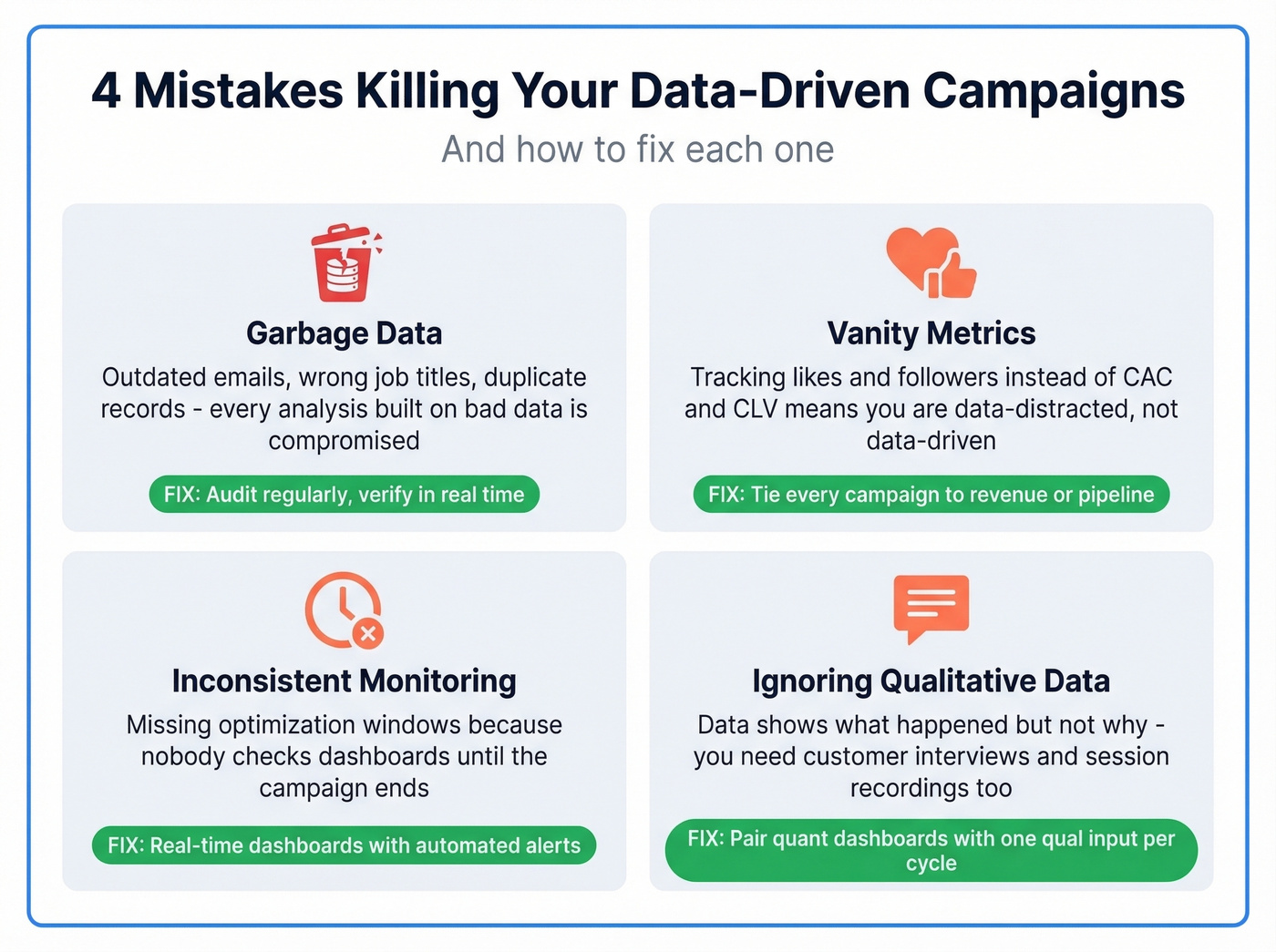
Tracking vanity metrics instead of business KPIs. If your dashboard shows likes and followers but not CAC and CLV, you're not data-driven - you're data-distracted. Tie every campaign to revenue or pipeline impact.
Inconsistent monitoring. This means you miss optimization windows entirely. Set up real-time dashboards with automated alerts for key metric thresholds. Slow approval chains during live campaigns cost conversions - pre-approve variation ranges so your team can optimize without waiting for sign-off.
Ignoring qualitative feedback. Data tells you what happened. Customer interviews, support tickets, and session recordings tell you why. Pair quantitative dashboards with at least one qualitative input per campaign cycle. The Reddit consensus on r/analytics backs this up - the threads that get the most engagement are almost always about combining quant data with qual insights, not choosing one over the other.
Tools That Power These Campaigns
You don't need a CDP, a DMP, and an AI attribution platform. You need clean data, one analytics tool, and the discipline to look at the numbers every week.
Web analytics: GA4 is free and covers 90% of what most teams need. If you aren't using event tracking and custom audiences yet, start there before buying anything else.
Qualitative insights: Hotjar has a free tier; paid plans start around $39/mo. It answers the "why" behind your GA4 numbers with heatmaps, session recordings, and surveys.
Marketing automation: HubSpot's free CRM handles basic segmentation and email. Marketing Hub runs around $800/mo for serious automation. ActiveCampaign from $29/mo is the leaner alternative for teams that just need email sequences and behavioral triggers.
Contact data quality: For outbound and ABM campaigns that depend on reaching the right people with valid contact info, Prospeo covers 300M+ professional profiles with a 92% API match rate at roughly $0.01 per email, free tier included.
Every example above shares one truth: better data compounds into better results. Prospeo gives you 300M+ verified profiles, 30+ targeting filters including buyer intent and technographics, and emails at $0.01 each - so your data-driven campaigns start on a foundation that doesn't crumble.
Build your next campaign on data refreshed weekly, not monthly.
FAQ
What separates data-driven from traditional marketing?
Traditional marketing relies on assumptions and broad demographics. Data-driven marketing uses actual behavioral and intent signals - purchase history, site engagement, search patterns - to decide targeting, messaging, and timing, then measures revenue impact. The shift is from "we think this audience wants X" to "the data shows this segment converts at 3.2%."
How do I start on a small budget?
Start with free tools: GA4, Hotjar's free tier, and your email platform's built-in segmentation. Pick one campaign, set a measurable KPI tied to revenue, run a single A/B test, and measure the result. GreenPal's 200% CTR lift came from free demographic data - discipline matters more than tooling.
How does contact data quality affect campaign performance?
Dirty contact data sabotages outbound campaigns before they start. A 35% bounce rate damages sender reputation and skews every metric downstream. Clean, frequently refreshed data keeps bounce rates under 4-5%, the threshold where deliverability stays intact and your analytics actually mean something.
What's the best channel ROI for data-driven campaigns?
SEO delivers the highest average B2B ROI at 748%, followed by email at 261% and LinkedIn Paid at 229%. SEO takes roughly 9 months to break even, though. PPC breaks even in 4 months but returns only 36% long-term. Let's be honest - there's no universal "best" channel. Choose based on your timeline, budget, and whether you can sustain the investment through the break-even window.