Data Enhancement vs Data Enrichment: What's Actually Different?
85% of businesses say poor-quality customer data hurts their operational efficiency. The real problem is that most teams treat data enhancement and data enrichment as the same thing, buy one tool expecting both, and end up with a database that's either clean but shallow or rich but full of garbage.
Let's fix that.
What Is Data Enhancement?
Data enhancement fixes what you already have. Think of it as database hygiene - you're not adding net-new context, you're correcting, updating, standardizing, and filling gaps in existing records so they're accurate and usable.
Here's what that looks like in practice:
- Deduplication - merging three records for the same person into one
- Email validation - flagging bounced addresses before they tank your sender reputation
- Phone normalization - fixing field mix-ups where a mobile ends up in the office phone column
- Format standardization - making "US," "U.S.," and "United States" all match
- Address/field correction - fixing outdated fields and filling missing fields on existing accounts
What Is Data Enrichment?
Data enrichment adds new information from external sources to records you already have. You're expanding the picture, not cleaning it.
Common enrichment outputs include firmographics like revenue and headcount, technographics showing what tools a company runs, intent signals revealing who's actively researching your category, job titles, funding history, and direct phone numbers. The goal is turning a name-and-email into a fully qualified prospect. Teams sometimes debate whether enrichment is just "extra context" or something that drives actual workflows - it's both, and the distinction matters less than whether your data is actionable.
One concept worth knowing: waterfall enrichment. Instead of relying on a single data provider, you query multiple sources sequentially until you find verified info. This matters because a single source typically leaves 40-60% of qualified prospects unreachable.

Most teams enrich before they enhance - and waste budget appending data to dead records. Prospeo's 5-step verification cleans your list first, then enriches with 50+ data points per contact at an 83% match rate. All on a 7-day refresh cycle, not the 6-week industry average.
Enhancement and enrichment in one pass - starting at $0.01 per email.
Side-by-Side Comparison
| Dimension | Enhancement | Enrichment |
|---|---|---|
| Purpose | Fix existing data | Add new data points |
| Data source | Internal records | External providers |
| Scope | Accuracy, consistency | Completeness, depth |
| Outcome | Cleaner database | Richer profiles |
| Best for | Deduping, validation | Firmographics, intent |
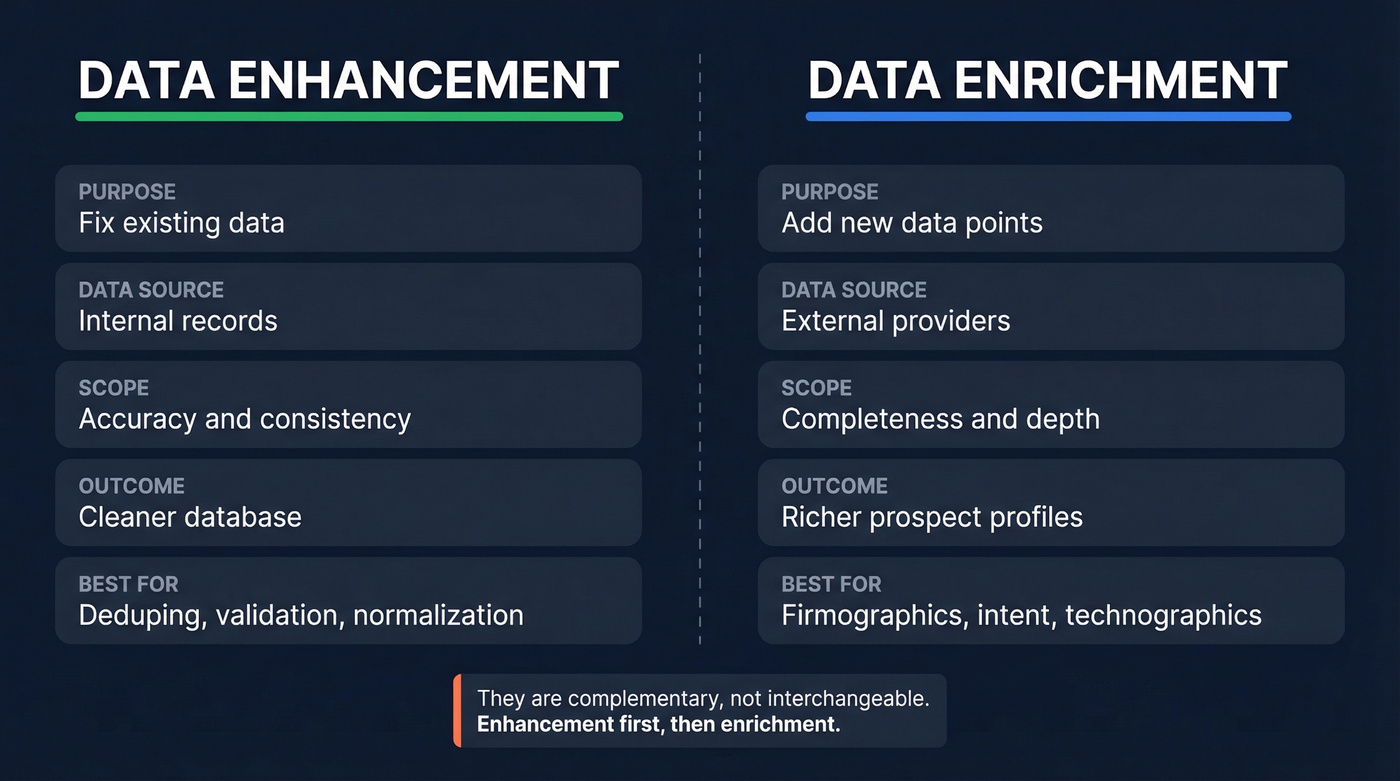
Enhancement addresses accuracy, consistency, uniqueness, and validity. Enrichment addresses completeness, freshness, and usefulness. They're complementary - not interchangeable. Understanding these as two distinct stages of the same pipeline is what separates high-performing RevOps teams from everyone else.
Why Enhancement Comes First
Enriching dirty data is like decorating a house with a cracked foundation. You'll spend money appending 50 data points to a contact whose email bounced six months ago. An HBR study found only 3% of corporate data met basic quality standards - enhancement closes that gap before enrichment can add value.

ZeroBounce analyzed 11+ billion email addresses verified in 2025 and found at least 23% of an email list degrades yearly - and they call that a low-end estimate. Annual decay rates by field tell the real story:
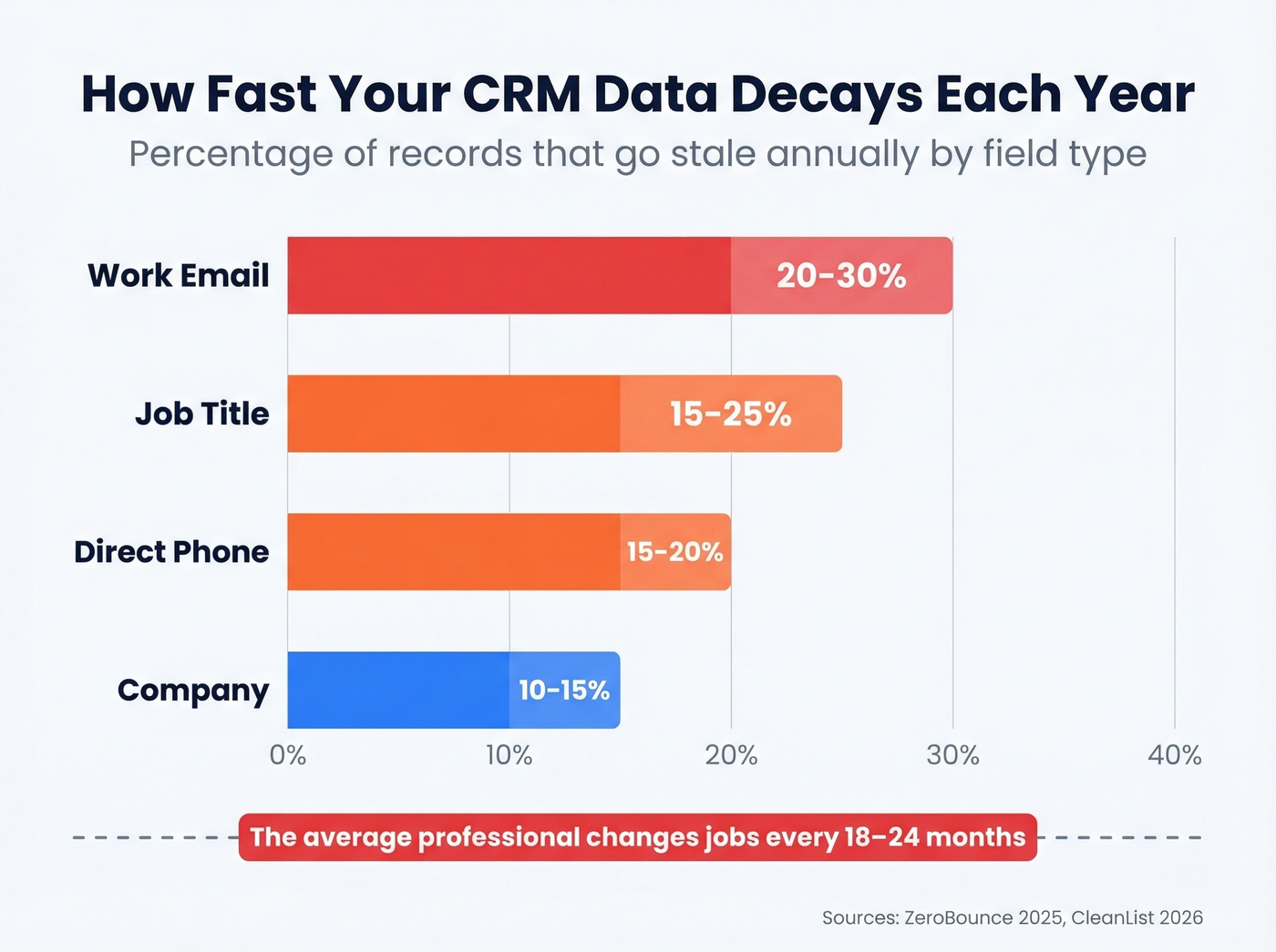
- Work email: 20-30%
- Job title: 15-25%
- Direct phone: 15-20%
- Company: 10-15%
The average professional changes jobs every 18-24 months, and 32% of sales rep time gets wasted contacting wrong prospects as a result. Gartner estimates companies lose roughly $12M annually to poor-quality data. Validation, deduplication, and normalization are the cheapest way to stop that bleeding before you invest in enrichment.
Here's the thing: if your CRM hasn't been cleaned in the last 90 days, don't buy an enrichment tool yet. You're lighting money on fire.
How to Choose a Provider
Start with a bake-off. Pull 100 contacts from your CRM and run them through two or three providers. Compare real match rates, not marketing claims. We've seen match rates swing from 72% to 98% depending on geography and provider - that gap is the difference between a working outbound program and wasted sequences. Salesforce admins on r/salesforce consistently ask for the same things: auto-fill missing fields, fix phone mix-ups, and get job-change alerts. Your provider should handle all three.
Look for providers that support continuous enrichment rather than quarterly batch jobs. Stale data compounds fast, and a 30-day refresh cycle is the bare minimum you should accept.
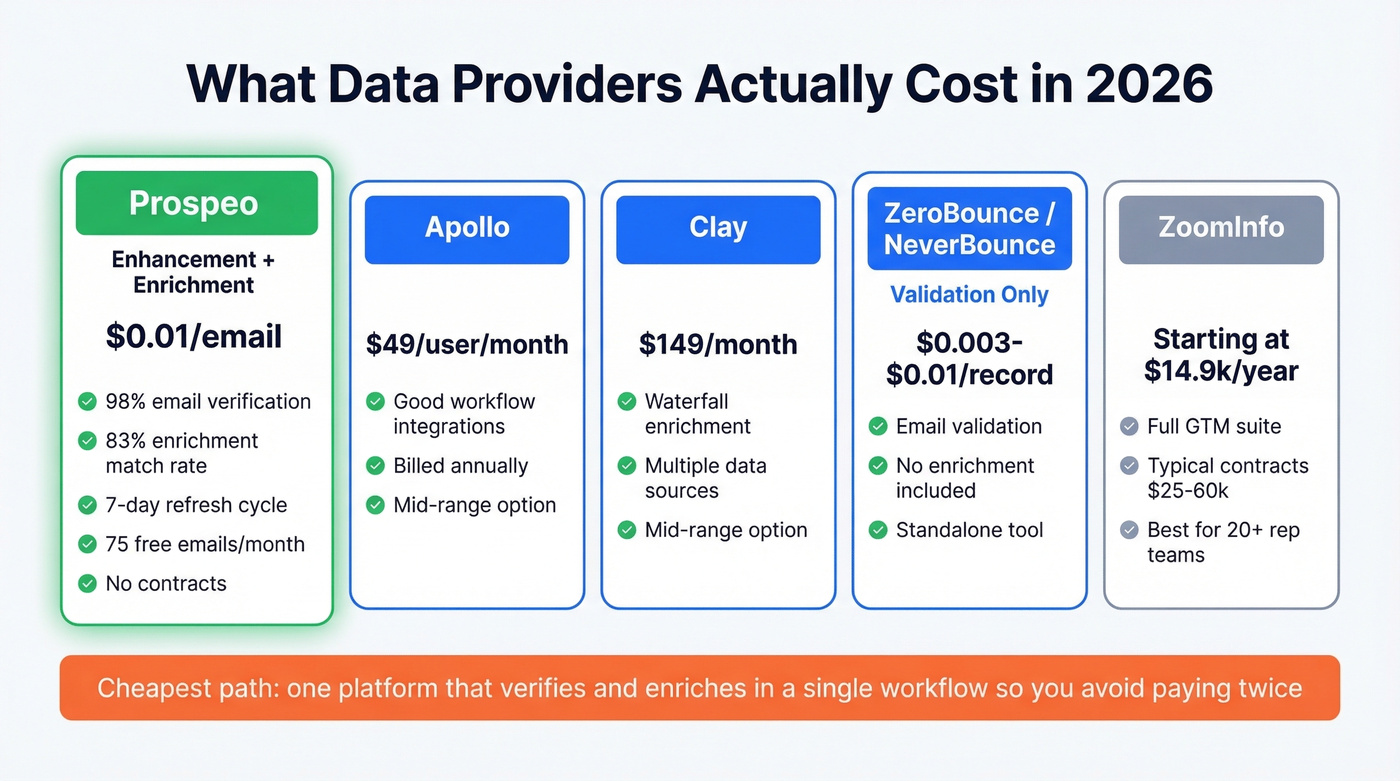
Prospeo handles both sides of this equation - 98% email verification accuracy, an 83% enrichment match rate returning 50+ data points per contact, and a 7-day refresh cycle that's roughly six times faster than the industry average. It starts free at 75 emails/month, with paid plans running about $0.01/email and no contracts. Apollo at $49/user/month (billed annually) and Clay at $149/month are solid mid-range options if you need different workflow integrations. ZoomInfo covers both enhancement and enrichment but starts around $14.9k/year, with typical mid-market contracts running $25-60k - overkill for teams that don't need the full GTM suite.
Skip ZoomInfo if you're a team under 20 reps. The ROI math rarely works at that scale.
If you're enriching EU contacts, GDPR Article 14 requires informing individuals within one month or at first communication - see FAQ below for specifics.
Your CRM decays 25% per year. Quarterly batch jobs can't keep up. Prospeo refreshes every 7 days, verifies emails at 98% accuracy, and returns firmographics, technographics, and intent data in a single enrichment call. No contracts, no sales calls - free tier included.
Stop decorating a cracked foundation. Fix and enrich your data in one step.
FAQ
Can one tool handle both enhancement and enrichment?
Yes. Some platforms combine real-time email verification with CRM enrichment that appends firmographics, technographics, and intent data in one pass. The key differentiator to look for is a verify-first approach - tools that validate before appending so you never enrich records that are already dead.
How often should I re-enrich my CRM?
Quarterly at minimum, but continuous is better. B2B contact data decays roughly 2.1% per month - about 25% per year. If your refresh cycle is longer than 30 days, a meaningful slice of your database is already stale. In our experience, teams that move to weekly refresh cycles see bounce rates drop by half within the first quarter.
Is data enrichment GDPR compliant?
It can be, but you need to do the work. Under Article 14, you must inform individuals within one month or at first communication when you obtain their data from a third party. Document a Legitimate Interests Assessment and maintain a suppression list for anyone who objects under Article 21.
What's the real cost difference between enhancement and enrichment tools?
Standalone validation tools like ZeroBounce and NeverBounce run $0.003-$0.01 per record. Full enrichment platforms range from $0.01/lead up to roughly $1/lead at the enterprise tier. The cheapest path is a single platform that verifies and enriches in one workflow - you avoid paying twice and eliminate sync issues between separate tools.