

Datanyze vs ListKit: Which One Actually Gets You Replies?
You won't find many direct Datanyze vs ListKit comparisons because these tools don't really compete. Datanyze is a Chrome extension for pulling contact info while you browse. ListKit is a B2B data platform built for volume outbound with intent signals baked in. Comparing them is less "which is better" and more "which workflow do you actually need?" - and getting that wrong is the real reason teams churn off either tool.
Replies depend on three things: deliverability, relevance, and volume. Each tool optimizes for a different slice of that equation.
30-Second Verdict
| Criterion | Datanyze | ListKit |
|---|---|---|
| Best for | Solo SDRs, tight budget | Teams doing volume outbound |
| Price | From $29/mo (80 credits) or $55/mo (160 credits) | From $97/mo (2,000 credits) or $83/mo billed annually |
| G2 Rating | 4.1/5 (446 reviews) | 4.7/5 (388 reviews) |
Datanyze helps you find contacts in the moment; ListKit helps you produce lists at scale. If bounce rate is your bottleneck, neither tool solves the root problem - choose the accuracy-first path instead.
What Is Datanyze?
ZoomInfo acquired Datanyze in 2018, primarily for its technographics capabilities. Today it operates as a lightweight Chrome extension that reveals emails and phone numbers while you browse professional profiles and company websites. The database covers 120M contacts, 84M emails, and 48M direct dials.
The free tier gives you 10 credits per month. Nyze Pro 2 at $55/mo gets you 160 credits - one credit per contact reveal, which works out to roughly $0.34 per contact. At 10-20 reveals per day, those 160 credits disappear in about 8 to 16 days.

The consensus on r/sales is that Datanyze is a "cheap LinkedIn reveal tool," and that framing still holds. It's useful for quick, one-off lookups - not for building sales leads lists.
Use this if you're a solo SDR who needs a handful of contact reveals per day and wants to stay under $60/month. Skip this if you need volume, intent data, or anything beyond basic email and phone lookups.
What Is ListKit?
ListKit plays in a completely different weight class. The platform claims 731M triple-verified contacts and 21B daily buying signals - intent signals are topic and activity indicators used to prioritize accounts showing purchase behavior.
Credit economics matter here. One credit gets you a business email. A mobile number costs 5 credits. Intent signals from the last 24 hours run 2 credits each. Professional is $97/mo monthly or $83/mo billed annually (24,000 credits/year). So that 2,000-credit monthly allotment doesn't stretch as far as it sounds once you start pulling mobiles and intent alongside emails.

The best workflow fit is teams of 2+ running weekly outbound campaigns with 500+ prospects per batch, or orgs that want intent data baked into list-building rather than bolted on after the fact. Reddit users note ListKit handles "trickier addresses" well once you learn the filtering system.
Here's the thing: CRM integration friction is real, and if your onboarding rep no-shows (a documented complaint on G2), you're stuck figuring out field mapping alone. If onboarding slips by two weeks, your outbound calendar slips by two weeks - and that's usually the real cost. Solo SDRs who only need 20 contacts a week will overpay for capacity they never use.

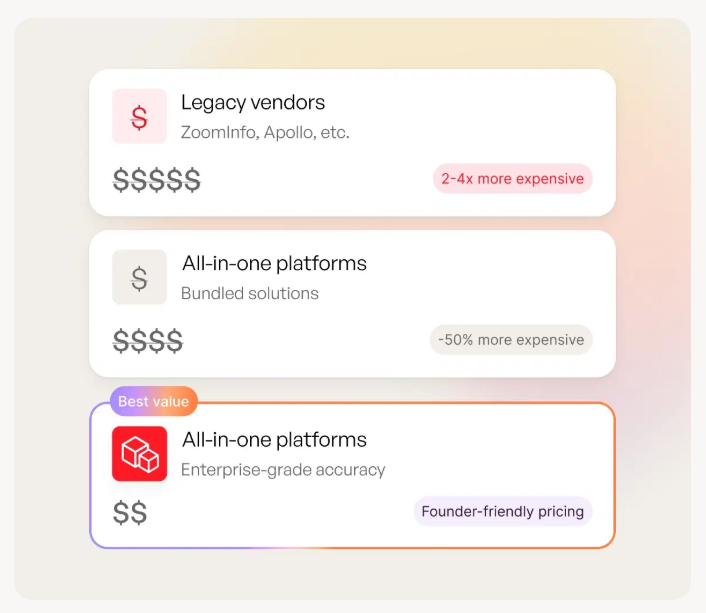
At $0.34/contact on Datanyze and $0.15-$0.40/lead on ListKit, you're overpaying for data that decays weekly. Prospeo delivers 98% accurate emails at ~$0.01 each with a 7-day refresh cycle - so your credits buy contacts that actually connect.
Stop burning credits on stale data. Start with 75 free emails.
Head-to-Head Feature Comparison
How ListKit Credits Actually Burn
Before the table, understand how ListKit credits work in practice:
- Email only = 1 credit
- Email + mobile + intent (last 24 hours) = 8 credits
- 2,000 credits = 2,000 emails or ~250 "full" leads with mobile + intent
That distinction matters more than any headline number.
| Datanyze | ListKit | Prospeo | |
|---|---|---|---|
| Monthly price | $55/mo (160 credits) | $97/mo ($83 annual) | Free tier; ~$0.01/email |
| Database size | 120M contacts | 731M contacts | 300M+ profiles (143M+ emails, 125M+ mobiles) |
| Verification | Basic | Triple-verified | 5-step verification |
| Intent data | No | Yes (21B signals) | Yes - 15,000 topics (Bombora) |
| Free tier | 10 credits/mo | 100 credits | 75 emails + 100 extension credits/mo |
| Cost per email | ~$0.34 | ~$0.05 (email only) | ~$0.01 |
| Typical cost/lead | ~$0.34 | ~$0.15-$0.40 (email+mobile+intent) | ~$0.11 (email+mobile) |
| CRM integrations | Limited | HubSpot, Salesforce, others | Salesforce, HubSpot, Smartlead, Instantly, Lemlist, Clay, Zapier, Make |
| Best for | Solo SDR reveals | Volume outbound | Accuracy-first teams |
Where Each Tool Falls Short
Datanyze
The database is strongest for tech companies - prospecting outside tech means thinner coverage. With roughly 22.5-30% of contact data decaying annually across the industry, a database that isn't aggressively refreshed means you're paying for stale records. G2 reviews consistently flag poor customer support and limited functionality beyond basic reveals. There's no intent data, no enrichment workflow, no way to build a list without clicking through profiles one by one.
ListKit
Despite triple-verification marketing, G2 reviewers still mention outdated contacts slipping through, particularly for high-turnover roles like SDRs and marketing coordinators. CRM integration setup causes friction - multiple users describe data transfer headaches that eat into the first week of any new subscription.
Support quality is inconsistent. Some users praise onboarding while others report no-shows from the success team. Let's be honest: if you're paying $97/mo and your onboarding call gets ghosted, that's a rough start.
When to Pick Which
Datanyze makes sense if you're a solo SDR who needs fewer than ~160 contact reveals per month and $60/mo is your ceiling. It's a browser tool, not a platform.
ListKit works for teams doing volume outbound who want intent signals built into list-building. Credit economics work better at scale, especially on the annual plan. For teams running 500+ prospect campaigns weekly, the per-lead cost drops to a reasonable range.
Neither is the right answer when data accuracy is the deciding factor. Both tools have documented freshness issues, and if bounces are killing your domain reputation, you need a different approach entirely - starting with email verification.
One strong opinion from our team: if your deal size sits below $10K ACV, you probably don't need ListKit's intent signals. A clean, accurate email list with good copy will outperform a "smart" list full of stale contacts every time - especially if you’re running a tight cold outreach strategy.
If Neither Fits: Consider Prospeo
Both Datanyze and ListKit struggle with data freshness. Prospeo solves this with a 7-day refresh cycle versus the industry average of six weeks. The platform delivers 98% email accuracy across 300M+ profiles and 125M+ verified mobiles - and in our testing, that weekly refresh cadence is the difference between acceptable and domain-killing bounce rates at scale.
The free tier gives you 75 verified emails plus 100 extension credits per month, no contract required. Paid plans run about $0.01 per email, which isn't even in the same ballpark as Datanyze's $0.34 per contact. If you’re evaluating the broader category, start with these free B2B lead generation tools and this breakdown of B2B data suppliers.
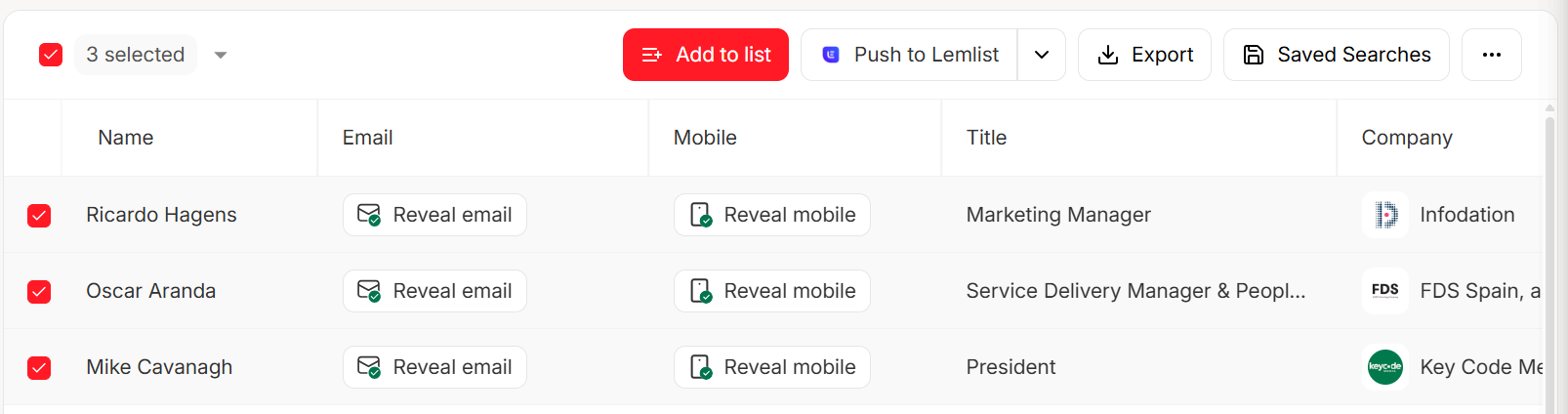
Neither Datanyze nor ListKit solves the bounce rate problem that kills domain reputation at scale. Prospeo's 5-step verification, 125M+ verified mobiles, and 15,000 Bombora intent topics give you the accuracy, reach, and signals both tools lack - without the onboarding headaches.
Clean data, intent signals, and verified mobiles - all in one platform.
FAQ
Is Datanyze still worth using in 2026?
Only if you're a solo SDR who needs a handful of contact reveals per week for under $60/month. The credit caps and thinner coverage outside tech verticals make it hard to justify for anything beyond light, occasional usage.
Does ListKit's triple verification actually work?
It catches most bad emails, and ListKit claims ~98% deliverability. But G2 reviews show outdated contacts still slip through for high-turnover roles. Layer an independent verification tool on top - your domain reputation isn't worth the gamble.
Can I use Datanyze and ListKit together?
You can, but it's an awkward pairing. Datanyze is a one-at-a-time browser tool; ListKit is a batch platform. There's no integration between them, so you'd be managing two separate workflows with two separate credit systems. Most teams pick one approach - browser-based reveals or batch list-building - and stick with it.