How to Get Started With Intent Data: The 90-Day Playbook
Your VP of Sales just forwarded a post about intent data with a two-word message: "Why aren't we doing this?" You've got two weeks to build a plan, zero budget approval, and a sales team that treats anything beyond a direct inbound lead with open suspicion.
Here's the thing: 61% of the purchase process happens before buyers ever talk to your reps. The average B2B buyer consumes 11 pieces of content before reaching out. Intent data lets you see that invisible research phase - but only if you implement it right. Most teams that try it and give up share the same story: they turned on the firehose, got overwhelmed, and never built a single activation play.
This is the antidote.
What You Need (Quick Version)
- What it costs: $0 to $150K+/year. Enterprise platforms like 6sense ($35K-$150K+) and Demandbase ($40K-$120K) typically start with annual contracts. You can start free with Google Analytics for first-party signals and a self-serve tool for third-party surge data.
- What to do first: Pick 10-15 intent topics tied to your ICP, connect a tool to your CRM, and run one activation play. Sales prioritization is the easiest win.
- When you'll see results: Measurable pipeline impact within 60-90 days if you're actually activating signals, not just collecting them. Full ROI typically lands within six months.
What Intent Data Is (and Isn't)
Intent data captures behavioral signals suggesting a company is actively researching a problem you solve. It's not a crystal ball. It's a prioritization engine - telling you which accounts to focus on right now instead of spraying outbound across your entire TAM.
There are three types, and understanding the differences matters for how you architect your stack.
First-party intent is behavior on your owned properties - pricing page revisits, demo video views, case study downloads, repeat visits to your integration docs. You're already collecting this in Google Analytics and your MAP; you just aren't scoring it. Use it for engagement scoring and on-site personalization.
Second-party intent comes from partner platforms sharing their first-party data. Think G2 comparison page visits, co-hosted webinar downloads, or engagement on a technology partner's site. These signals are gold because they catch accounts researching your category before they ever hit your website - use them to reach accounts early in the buying cycle.
Third-party intent is the big one. Providers like Bombora aggregate web behavior across a co-op of 5,000+ publisher sites and other B2B sources. When an account's research activity on specific topics spikes above its historical baseline, that's a "surge" - and that surge is your signal to act. Use third-party data to prioritize early-stage accounts that haven't discovered you yet.
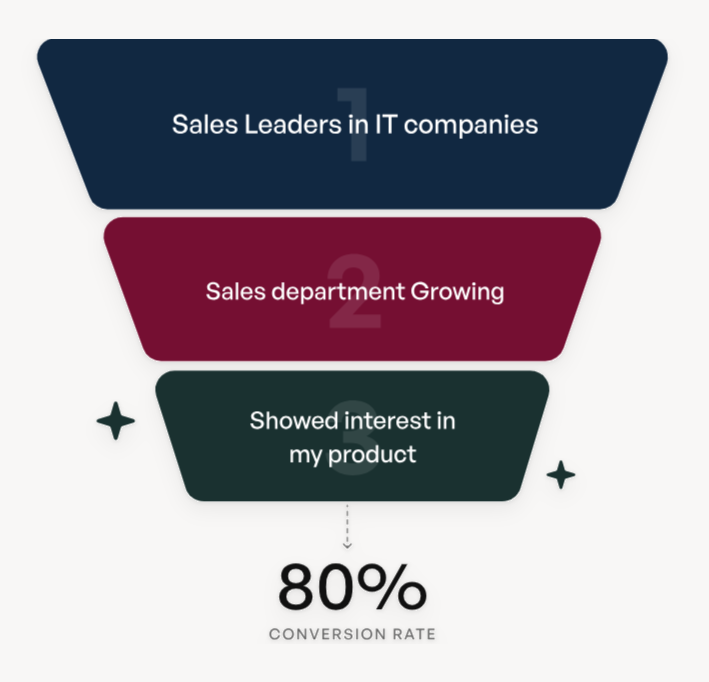
The mistake most teams make is treating intent data like a lead list. It's not. It's a timing signal layered on top of your existing ICP and contact data.
Intent without contacts is useless. Contacts without intent is just cold outbound.
How Intent Signals Are Tracked and Scored
Topic vs. Keyword Tracking
Intent providers use two primary tracking methods. Topic tracking classifies content using ML and NLP - it reads the full context of what someone's consuming and maps it to a taxonomy of topics. This reduces false positives because a page mentioning "cloud security" in passing won't trigger the same signal as a deep-dive whitepaper on zero-trust architecture.
Keyword tracking matches exact terms in content and URLs. It's more precise for niche solutions but noisier for broad categories. Use both. Topic tracking gives you context; keyword tracking gives you specificity.
Trend Scoring vs. Signal-Count Scoring
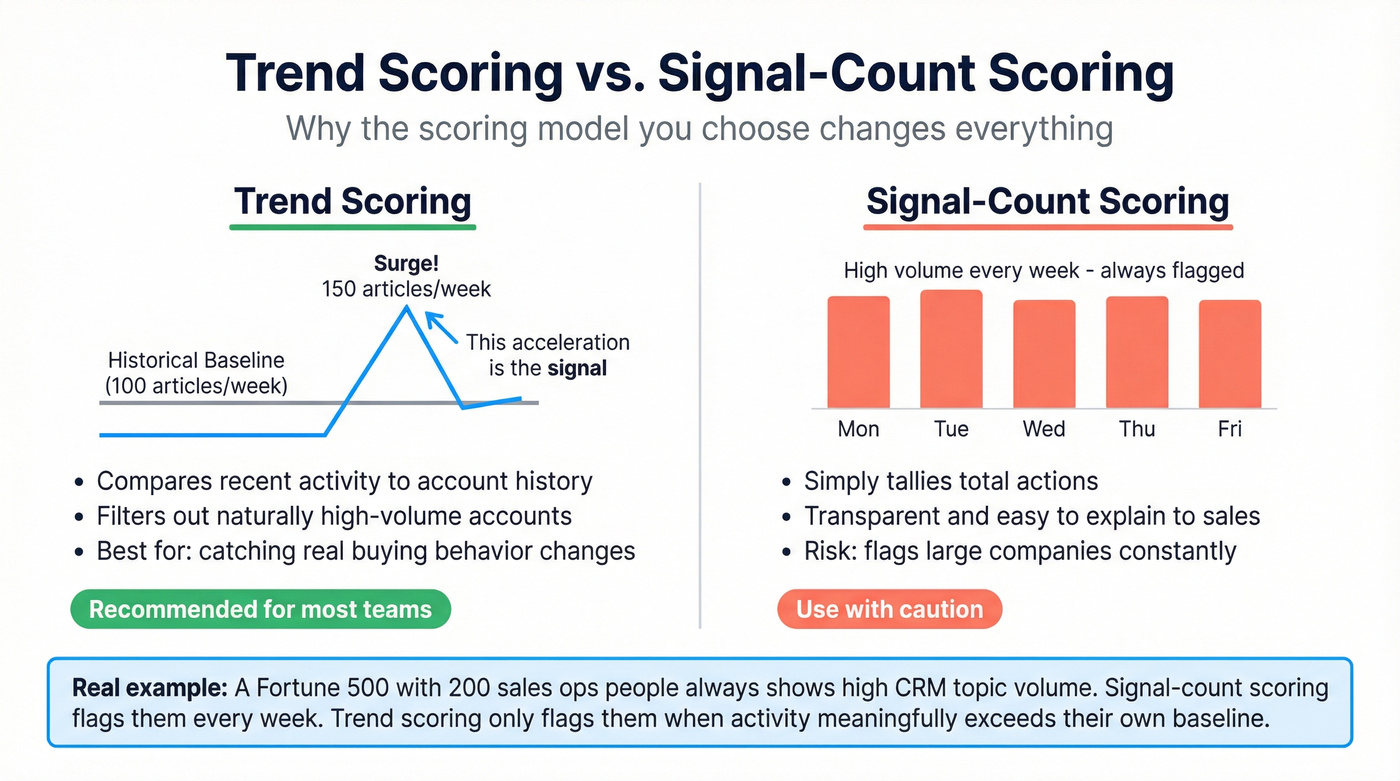
Two scoring models dominate the market. Trend scoring compares recent activity against a historical baseline - if an account typically consumes 100 pieces of content per week on "data enrichment" and suddenly spikes to 150, that acceleration is the signal, not the raw volume. Signal-count scoring simply tallies actions. It's transparent and easy to explain to sales, but it misses longer-term trend shifts.
Picture this: a Fortune 500 company might always show high volume on "CRM" topics because they have 200 people in their sales ops team reading about CRM daily. Signal-count scoring would flag them constantly. Trend scoring would only flag them when activity meaningfully exceeds their own baseline. That distinction is everything.
71% of intent data users combine three or more data sources, which means blending scoring models across providers is the norm, not the exception. Companies using AI-driven scoring see a 40% boost in sales efficiency - so the investment in getting scoring right pays for itself quickly.
Why Contact-Level Scoring Fails
This is where most first-time intent programs go wrong. Buying decisions typically involve 9-12 people, sometimes as many as 13 on larger deals. Scoring individual MQLs against intent signals misses the committee entirely. One person researching "sales engagement platforms" doesn't mean the account is in-market. Three people from the same account researching across multiple related topics over two weeks? That's a real signal.
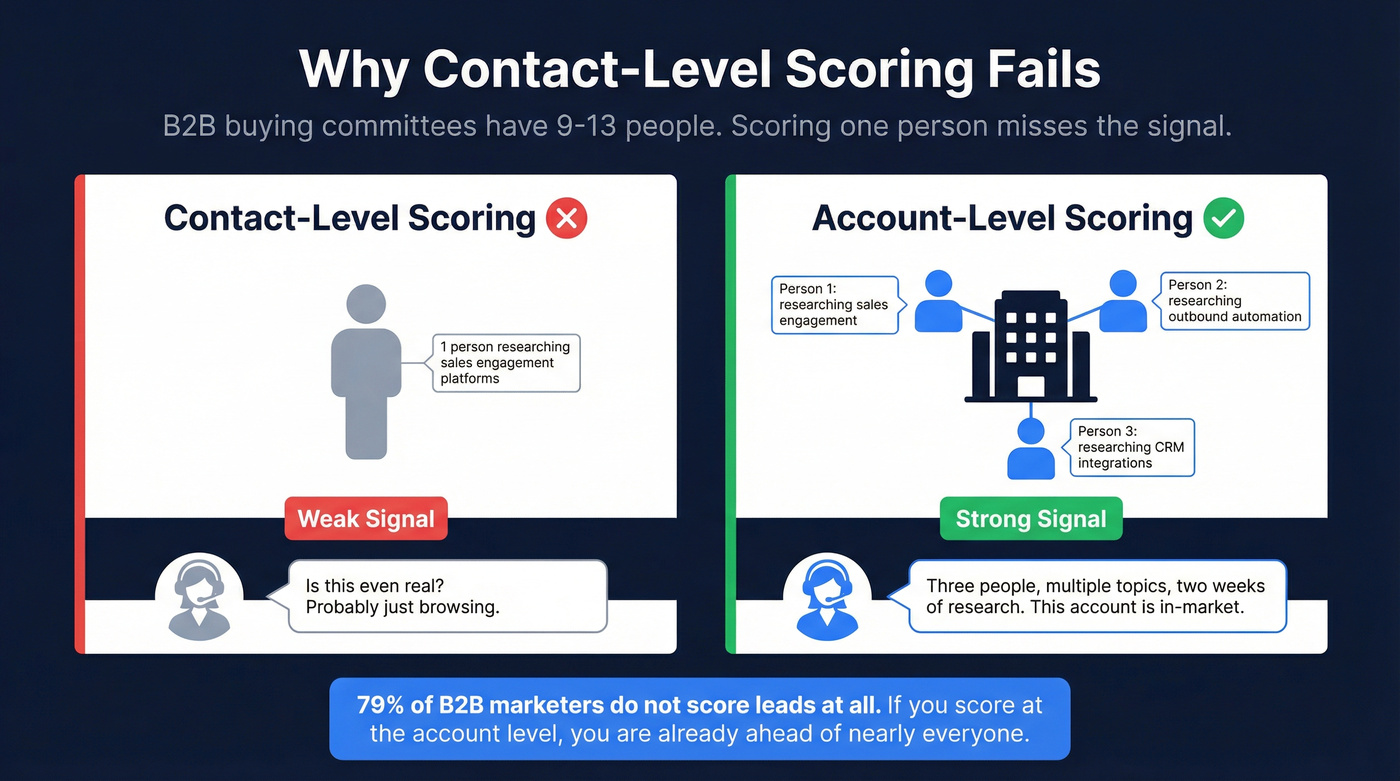
Shift to account-level qualification: track how many people from the same company show intent, across how many topics, over what timeframe. 79% of B2B marketers don't score leads at all. If you're reading this, you're already ahead.
Real Costs in 2026
Every vendor's pricing page says "Contact Sales." That tells you everything about how this market works.
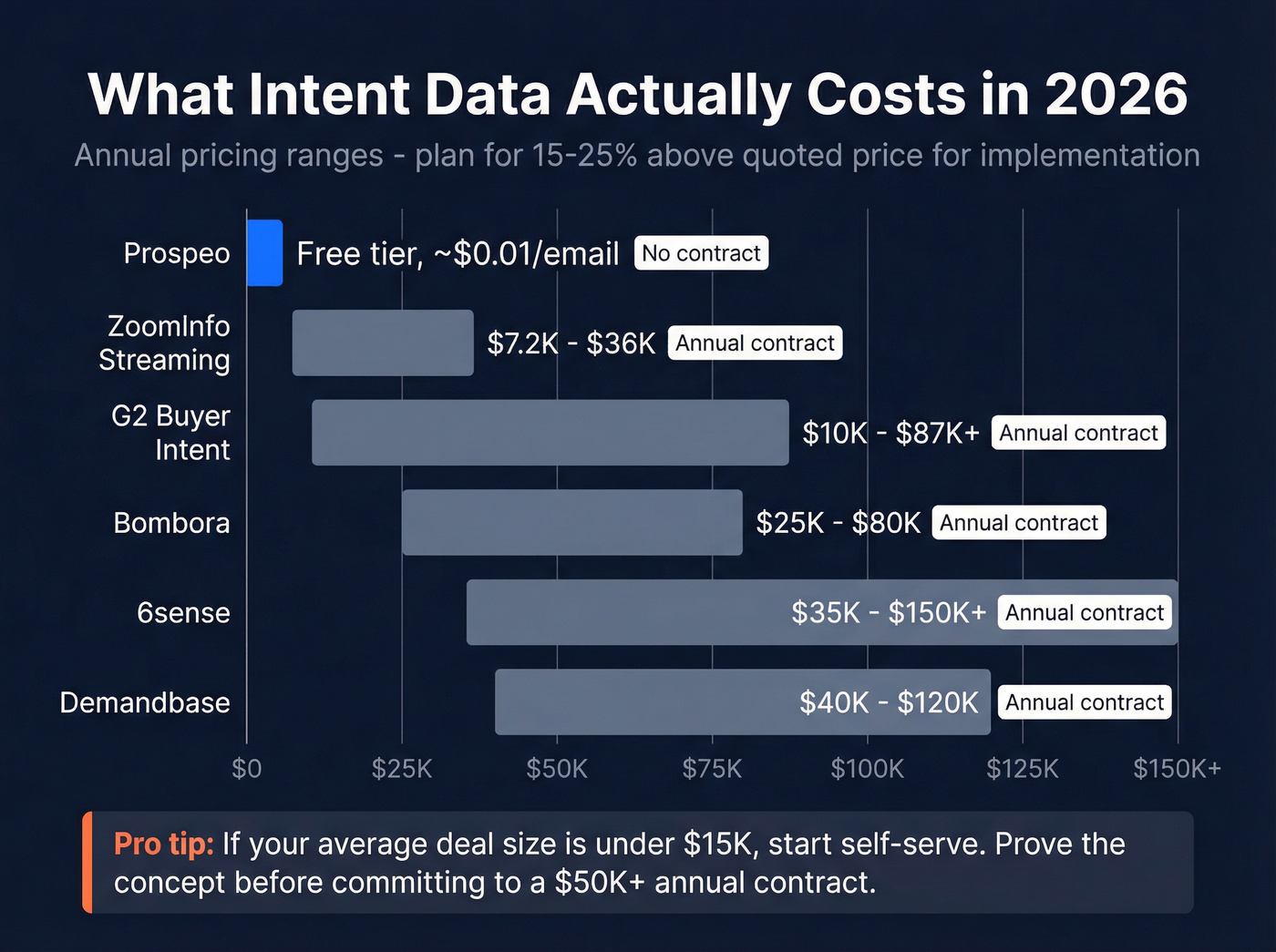
Here's what you'll actually pay:
| Provider | Annual Cost | Contract | Best For |
|---|---|---|---|
| Prospeo | Free tier; ~$0.01/email | No contract | Getting started with intent |
| ZoomInfo Streaming | $7.2K-$36K | Annual | Mid-market on ZoomInfo |
| G2 Buyer Intent | $10K-$87K+ | Annual | Bottom-funnel review signals |
| Bombora | $25K-$80K | Annual | Dedicated 3rd-party co-op |
| 6sense | $35K-$150K+ | Annual | Enterprise predictive ABM |
| Demandbase | $40K-$120K | Annual | Enterprise full-stack ABM |
Plan for 15-25% above the quoted license price for implementation, CRM integration, and ongoing optimization. A $50K Bombora contract becomes $60K+ once you factor in setup and tuning. Bombora also prices by topic - basic topics run $500-$2,000 each, premium topics $5,000-$25,000 annually.
If your average deal size is under $15K, you almost certainly don't need a $50K+ intent platform. Start self-serve, prove the concept, and upgrade when the math justifies it.

Intent data without verified contacts is just a list of company names. Prospeo layers 15,000 Bombora-powered intent topics on top of 300M+ profiles with 98% email accuracy - so you go from surge signal to personalized outreach in minutes, not weeks.
Stop collecting signals. Start activating them at $0.01 per email.
The article says it: intent without contacts is useless. Prospeo gives you both - buyer intent tracking across 15,000 topics plus verified emails and 125M+ direct dials, all refreshed every 7 days. No $50K annual contracts. No sales calls to get started.
Build your first intent-powered outbound play in under 10 minutes.
Your 30/60/90-Day Implementation Plan
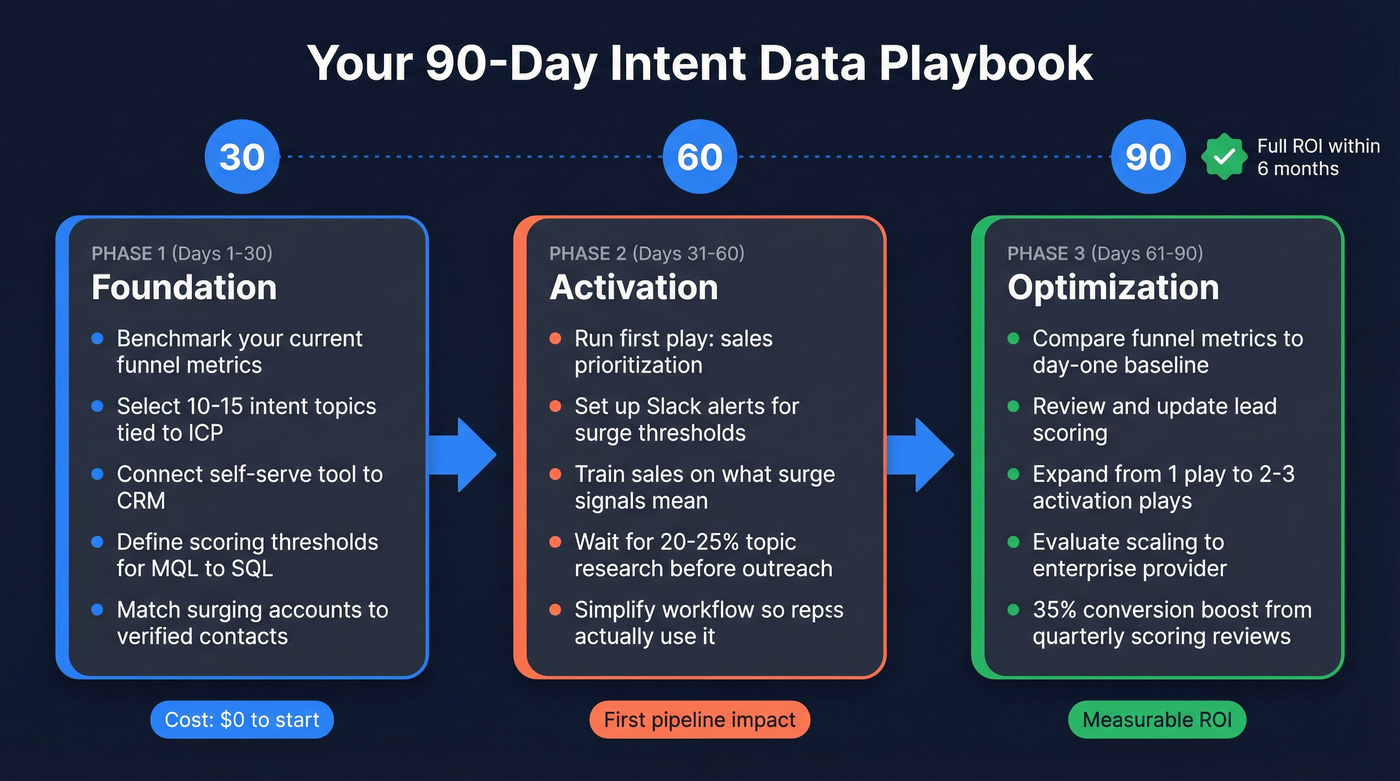
Think crawl, walk, run. Start with the basics, prove value, then scale complexity as your team builds confidence and your data proves itself.
Days 1-30: Foundation
Start by measuring what you have. Pull your current funnel benchmarks - median B2B conversion sits around 2.9%, with MQL-to-SQL conversion at roughly 15%. If you don't know your numbers, measure them before you buy anything. You need a "before" to prove the "after."
Next, select 10-15 intent topics tightly aligned to your ICP and product categories. Don't track 200 topics on day one. That's noise, not signal.
Sign up for a self-serve intent platform, select your topics, and connect to your CRM via native Salesforce or HubSpot integrations. Within the first week, you should have surging accounts matched to verified emails and mobile numbers - no procurement cycle, no annual contract. Define your scoring thresholds for MQL-to-SQL handoff: what combination of topic surge, account fit, and engagement velocity triggers a sales notification? (If you want a deeper KPI framework, see how to measure intent data.)
Days 31-60: Activation
Run your first activation play. Sales prioritization is the easiest - route surging accounts to reps with verified contact data and watch what happens. Set up Slack or email alerts when accounts cross your scoring threshold so reps don't have to live inside another dashboard.
This is also when you train sales on what intent signals actually mean. A "surge" doesn't mean someone's ready to buy tomorrow. It means they're actively researching. The McClatchy heuristic suggests waiting until prospects have researched roughly 20-25% of your tracked topics before outreach - early enough to influence, late enough to be relevant.
Here's a common frustration we've seen firsthand: teams get dozens of surging accounts in week one and sales contacts zero of them. The fix isn't better data - it's a simpler activation workflow. One Slack alert, one sentence of context, one suggested talk track. Make it impossible for reps to ignore.
Days 61-90: Optimization
Compare your funnel metrics to the baseline you captured on day one. Businesses that update their lead scoring quarterly see a 35% boost in conversion rates, so build scoring reviews into your calendar now. Expand from one activation play to two or three. Evaluate whether your current self-serve setup is sufficient or whether it's time to scale into an enterprise provider.
Five Activation Plays to Run First
Sales Prioritization
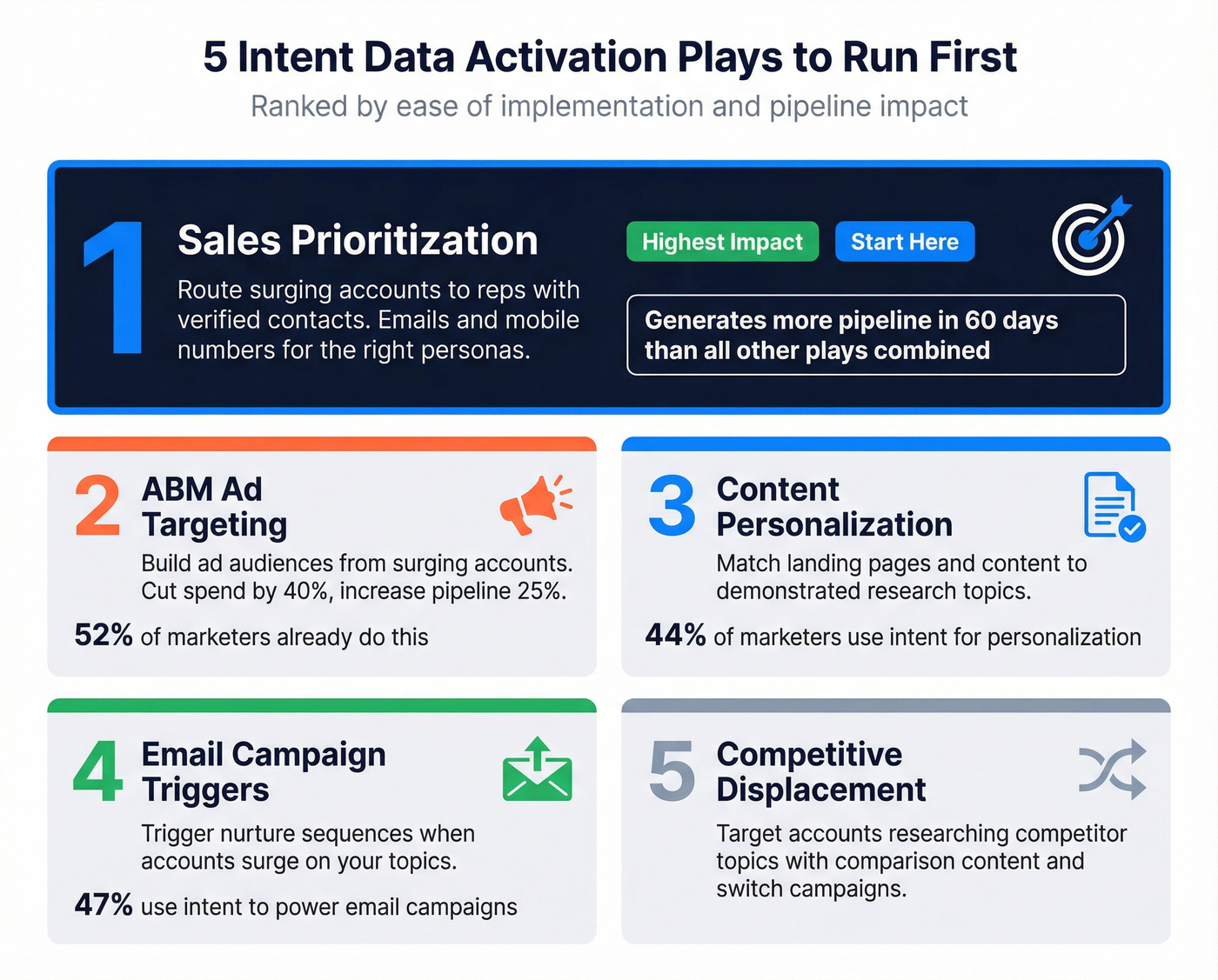
The simplest and highest-impact play. Route surging accounts to reps paired with verified contact data - emails and mobile numbers for the right personas. Intent signals tell you when self-serve research is peaking and it's time for a human touch. In our experience, this single play generates more pipeline impact in the first 60 days than all other plays combined.
ABM Ad Targeting
Build display and social ad audiences from your surging account lists. 52% of US marketers already use buyer intent signals for targeted advertising. Instead of blanketing your entire TAM with ads, you concentrate spend on accounts actively researching your category. One team we worked with cut their LinkedIn ad spend by 40% while increasing pipeline contribution by 25% - simply by narrowing their audience to surging accounts.
Content Personalization
If an account is surging on "data enrichment," don't show them your generic homepage. Route them to your enrichment-specific landing page, case study, or comparison guide. 44% of marketers use intent for personalization, and 47% use it to power email marketing campaigns. This is one of the fastest ways to improve conversion rates on existing traffic because you're matching content to demonstrated interest, not guessing.
Churn Prevention
Imagine your biggest customer - the one that makes up 8% of your ARR - suddenly starts researching alternatives to your product category. Their team is reading comparison articles, visiting competitor pricing pages, and downloading analyst reports on your space. You don't find out until the renewal call, when they tell you they've already signed a competitor's contract.
With intent data monitoring existing customers for competitor-topic surges, your CSM gets an alert weeks before that renewal conversation. Proactive outreach - a check-in call, a roadmap preview, an executive dinner - can save the deal before it's ever at risk. Skip this play if you're pre-revenue or have fewer than 50 customers; the signal volume won't be meaningful enough yet.
Outbound Sequencing
Here's the quick-reference setup for intent-triggered sequences:
- Set your threshold. Define which surge score triggers a sequence. Start conservative - top 10% of surging accounts.
- Map contacts. Pull verified emails and mobile numbers for 3-5 personas at each surging account.
- Connect your sequencer. Wire your intent platform to Outreach, Salesloft, Instantly, or Lemlist. (If you’re rebuilding your stack, compare options in our guide to cold email marketing tools.)
- Personalize the first touch. Reference the topic they're researching, not a generic pitch. "I noticed your team is evaluating [category]" beats "I'd love to show you a demo." For more examples, use these outreach email templates.
- Set a decay rule. If the surge score drops below threshold, pause the sequence. Stale intent is worse than no intent.
What Results to Expect
96% of B2B marketers report success with intent data. That's a striking number, but let's ground it.
The headline stats are aggressive: 93% conversion improvement and 220% higher CTR for intent-based campaigns versus traditional approaches. Even if your results are half these benchmarks, you're looking at a ~45% conversion lift and meaningfully higher click-through rates on outbound. We've seen teams hit those numbers within a single quarter.
The funnel stages where intent has the biggest impact:
- Lead to MQL: 35-45% baseline conversion
- MQL to SQL: ~15% baseline conversion - this is where most pipeline leaks, and exactly where intent-based prioritization shines
- SQL to Opportunity: 25-30% baseline conversion
- Opportunity to Closed-won: 6-9% baseline conversion
Teams hit measurable pipeline impact within 60 days when they actually activate signals rather than just collecting dashboards.
Five Mistakes That Kill Intent Programs
Tracking Too Many Topics
Starting with 200 topics is a recipe for noise. Generic topics like "software" or "technology" will flag half your TAM as "surging" and make the data meaningless. Start with 10-15 topics tightly mapped to your product categories and buyer pain points. Expand after you've validated which topics actually predict pipeline.
No Activation Playbook
Data without an activation playbook is just an expensive dashboard. Teams buy an intent tool, get dozens of surging accounts in week one, and sales contacts zero of them. Define your plays before you turn on the data. The consensus on r/sales is pretty clear: intent tools don't fail because the data is bad - they fail because nobody builds the workflow.
Scoring Individuals Instead of Accounts
Buying committees run 9-12 people deep. If you're scoring individual leads against intent signals, you're playing whack-a-mole. One VP researching your category isn't a signal. Three people from the same account across multiple topics over two weeks - that's a signal.
No Baseline Metrics
If you don't know your current MQL-to-SQL rate, measure it before you buy any intent tool. Without a baseline, you can't prove ROI, and without ROI proof, your program gets cut at the next budget review.
Ignoring Privacy Compliance
This one's getting more serious every quarter. GDPR fines can reach EUR 20M or 4% of global revenue. Providers can revoke data access if they discover non-compliant usage, and vendor relationships get terminated mid-contract. Treat compliance as a prerequisite, not an afterthought.
Privacy and Compliance in 2026
Chrome began phasing out third-party cookies in early 2024, joining Safari and Firefox. The cookie banner era is over. 2025 marked a shift from gray-zone compliance to serious enforcement at scale - regulators now test whether opt-outs actually work and scrutinize what happens to data after a consumer opts out.
The practical impact: server-side tracking recovers 15-30% of lost conversion signals, and contextual targeting now performs within 5-8% of behavioral targeting on conversion quality. Choose consent-based providers. Bombora's data co-op model is built on publisher consent. Prospeo is GDPR compliant with opt-out enforced globally and DPAs available. If your intent provider can't explain exactly where their data comes from, walk away. (For the outbound side of this, use our practical guide to GDPR for Sales and Marketing.)
FAQ
What's the cheapest way to start using intent data?
Combine Google Analytics for first-party signals with a self-serve platform that includes Bombora-powered intent topics. Total cost: $0/month. You won't get the depth of a $50K Bombora contract, but you'll have enough to run your first activation play and prove the concept.
How long before intent data shows ROI?
Most programs see measurable pipeline impact within 60-90 days if signals are activated - routed to sales, used in ad targeting, or triggering sequences. Full ROI typically materializes within six months. Teams that fail are the ones collecting data without building activation plays.
Do I need a dedicated RevOps team?
No. Self-serve platforms with native CRM integrations let a single marketer or SDR manager run an intent program. Enterprise platforms like Demandbase or 6sense typically require dedicated ops support for implementation, scoring configuration, and ongoing optimization.
How many intent topics should I track?
Start with 10-15 topics tightly aligned to your ICP and product categories. Expand after 60 days once you've validated which topics actually predict pipeline. Tracking too many topics too early floods your team with noise and erodes trust in the data - it's the number-one mistake that kills intent programs.
Is buyer intent data worth the investment?
For B2B teams with deal sizes above $10K and sales cycles longer than 30 days, yes. Even a conservative 20-30% improvement in MQL-to-SQL conversion on a pipeline worth $1M annually pays for a self-serve intent tool many times over. Where it fails is when teams treat it as a magic lead list instead of a prioritization layer.