

Deal Execution: The 2026 Guide (M&A + Sales)
Three months into diligence, the seller discloses a material contract you've never seen. Financing is slipping. The board wants an update by Friday. This is deal execution - and it's where most transactions die. Harvard Business Review estimates 70-90% of acquisitions fail, and the wreckage rarely traces back to bad strategy. It traces back to bad process.
The stakes keep climbing. Buyout investment value hit $602B in 2024, up 37% year-over-year, and PitchBook pegged 2025 US PE deal value at roughly $1.2T with $1.1T in dry powder still waiting to deploy. More capital chasing deals means more competition, tighter timelines, and less margin for execution mistakes. Whether you're closing an acquisition or pushing a $50K SaaS deal through procurement, execution is the discipline that separates signed term sheets from dead ones.
What Is Deal Execution?
The term means different things depending on which side of the building you sit on.
In M&A and investment banking, deal execution is everything that happens after you win the mandate. Origination is the relationship-building, the pitching, the handshake that gets you hired. Execution is the technical grind that actually closes the deal. Practitioners on Wall Street Oasis describe it bluntly: build the model, send the teaser and CIM, iterate NDAs, organize management presentations, populate the data room, field diligence questions, compare bids, narrow to finalists, negotiate the definitive agreement, and manage closing logistics. It's the unsexy half of dealmaking - and the half where value is created or destroyed.
In B2B sales, the concept covers the pipeline-to-close discipline that turns qualified opportunities into revenue. A thread in r/hubspot captured the core of it: every rep should be able to answer four questions at any moment - what do I do today, which leads do I prioritize, what accounts need work, and how do I close? It covers CRM hygiene, stakeholder mapping, mutual action plans, and the follow-up cadence that keeps deals from stalling.
Execution, in both worlds, is a chain of decisions that reduce risk over time. Each phase narrows uncertainty - from strategic fit, to financial truth, to commitment, to value capture. Miss a link, and the whole thing breaks.
Quick Summary
- M&A execution runs 8 phases: strategy, targeting, first contact, IOI/LOI, diligence, valuation/structure/financing, definitive agreement/approvals/closing, and post-merger integration. Average timeline: 255 days.
- Top pitfalls: inadequate diligence, cultural mismatch, botched PMI, flawed valuation, and poor strategic fit. These are execution breakdowns that compound over time.
- Sales execution non-negotiables: a CRM with enforced stage exit criteria, mutual action plans for every deal over $25K, and verified contact data so your cadence doesn't collapse on bounced emails.
- The universal rule: execution is a process problem. Treat it like one.
The M&A Process: 8 Phases
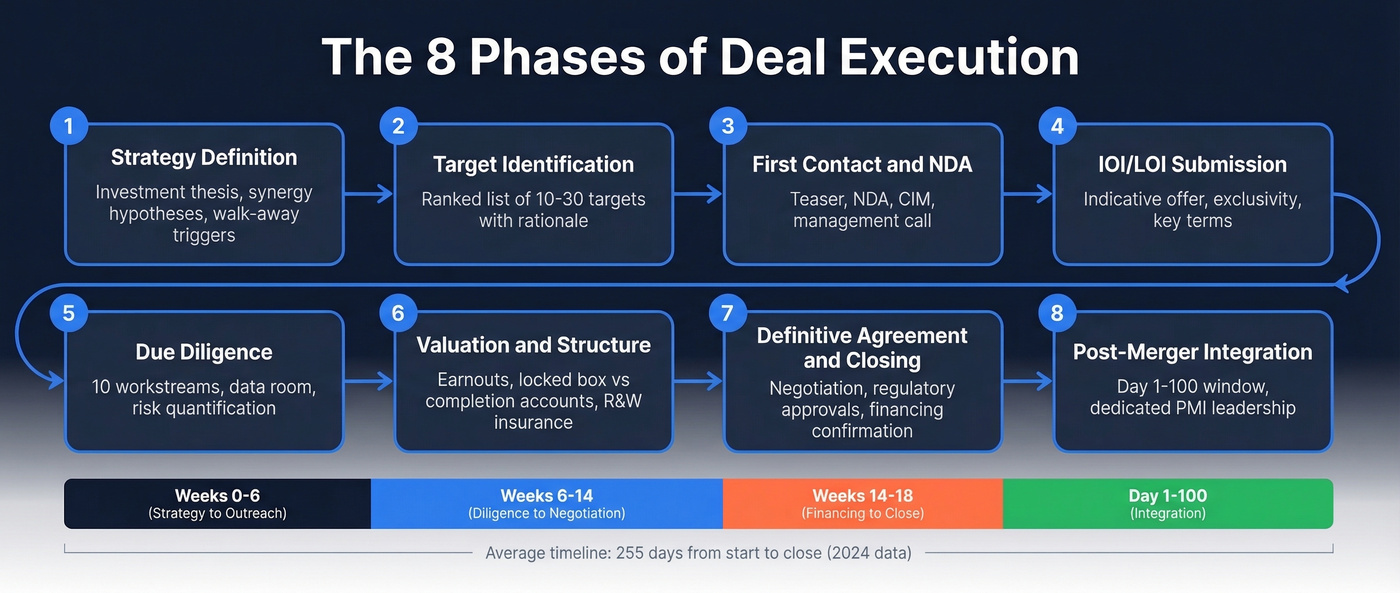
Most failures aren't strategy failures - they're process failures. The 8-phase framework below maps the actual workflow from mandate to close: strategy definition, target identification, first contact and NDA, IOI/LOI submission, due diligence, valuation and deal structuring, definitive agreement negotiation/approvals/closing, and post-merger integration.
Strategy, Targeting, and First Contact
Every deal starts with a thesis. Before you touch a data room or send a teaser, the acquirer needs a written investment memo - typically 1-3 pages - that articulates strategic intent, synergy hypotheses, non-negotiables, and walk-away triggers. This sounds basic. We've seen teams skip it and spend six months chasing targets that never fit.
From the thesis, you build a ranked list of 10-30 targets, each with a one-paragraph rationale. Then the outreach sequence begins: teaser to gauge interest, NDA to protect both sides, CIM or brief data pack to give the target enough to make an informed decision, management call, and finally the LOI. Information hygiene matters from day one. Link expiry on shared documents, identity-bound access controls, and audit trails aren't paranoia - they're standard practice. One leaked teaser can kill a deal before diligence even starts.
Diligence and Valuation
Diligence is where execution gets real. A well-organized data room covers Corporate/Cap Table, Financials, Customers/Revenue, Legal/Compliance, Product/Tech, Security/Privacy, People/HR, IP, Operations, and Integration Planning. Every folder needs an owner, a deadline, and a quality standard.
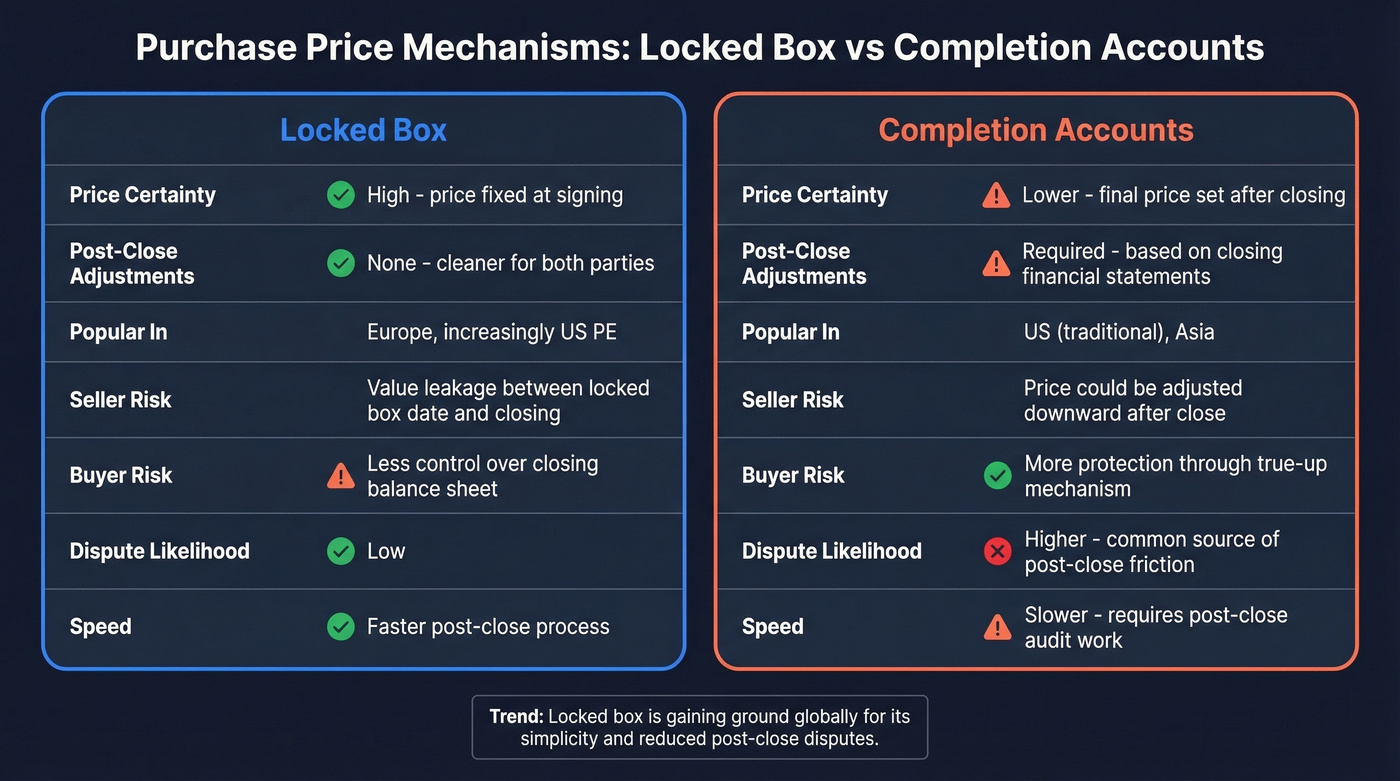
On the valuation and structure side, earnouts bridge valuation gaps when buyer and seller disagree on future performance. Two main purchase price mechanisms are completion accounts and locked box. Locked box mechanisms are increasingly popular in Europe and among American PE firms for good reason - they provide price certainty and reduce post-close disputes. Completion accounts, traditionally preferred in the US and Asia, require post-closing adjustments to finalize the purchase price based on financial statements at closing. Reps & warranties insurance is common in PE deals and requires thorough diligence to underwrite, which contributes to longer timelines.
Here's the thing: diligence isn't just about finding problems. It's about building the conviction to close. Every document reviewed, every question answered, every risk quantified moves the deal closer to a definitive agreement - or reveals why it shouldn't get there.
Closing and Post-Merger Integration
Closing is a choreography problem. The definitive agreement needs to be negotiated, regulatory approvals secured, and financing confirmed - often simultaneously. A leak contingency plan is non-negotiable. More insiders means higher leak risk, and you need an escalation process with ready messaging before it happens, not after.
Day 1 after close is where most teams underestimate the workload. McKinsey's research shows that a single "day one" can require 10-20 separate communications - legal approvals, executive messages, employee FAQs, customer notifications, translations for international teams. Going quiet after announcement creates a vacuum that competitors exploit and employees fill with anxiety.
The Day 1-100 integration window is where value capture happens or doesn't. In our experience, the teams that nail PMI staff it like a standalone project with dedicated leadership, not a side task bolted onto someone's existing role. Leadership bandwidth, decision speed, and operating cadence determine whether the acquisition thesis actually plays out.

You mapped every stakeholder, built the mutual action plan, and nailed the demo. Then your follow-up sequence bounced because the contact data was stale. Prospeo refreshes 300M+ profiles every 7 days - not every 6 weeks - so your deal execution never stalls on bad data.
Stop losing deals to bounced emails at $0.01 per verified contact.
How Long Does It Take?
Longer than you think. And getting longer.
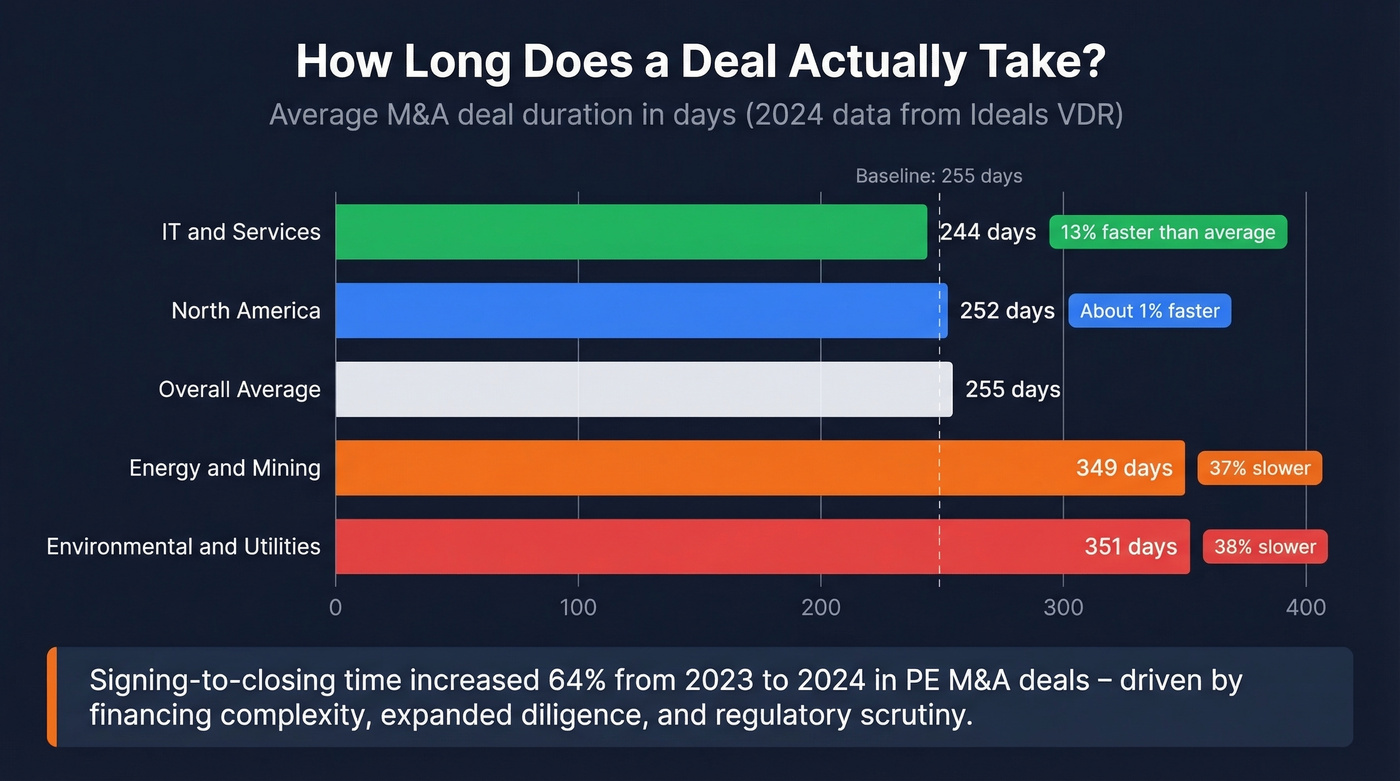
Based on Ideals VDR telemetry data, the average deal took 255 days to complete in 2024. That average hides massive variation by sector and region.
| Sector / Region | Avg. Duration (Days) | vs. Overall Avg. |
|---|---|---|
| IT & Services | 244 | 13% faster |
| North America | 252 | ~1% faster |
| Overall Average | 255 | Baseline |
| Energy & Mining | 349 | 37% slower |
| Environmental/Utilities | 351 | 38% slower |
A rough week-by-week scaffold: Weeks 0-2 for strategy and planning, Weeks 2-6 for targeting and outreach, Weeks 6-12 for due diligence (rolling), Weeks 10-14 for negotiation and structure, Weeks 12-16 for financing and approvals, Weeks 16-18 for signing and close, then Day 1-100 for integration.
What's driving timelines longer? Goodwin's Deal Terms Database shows the time between signing and closing in PE M&A increased 64% from 2023 to 2024 - a stat that deserves more attention than it gets. The culprits: financing complexity from higher cost of debt, expanded diligence scope, and regulatory scrutiny from antitrust reviews and CFIUS filings. Deals now routinely stretch three to six months between signing and closing alone.
Independent sponsors and searchers working with tighter capital use a 90-day LOI-to-close framework that demands disciplined scoping and pre-negotiated financing. It works, but only if you've done the upfront work to compress every phase without cutting corners on diligence.
7 Pitfalls That Kill Deals
That 70-90% failure rate isn't random. The same pitfalls show up deal after deal, and most of them are preventable.
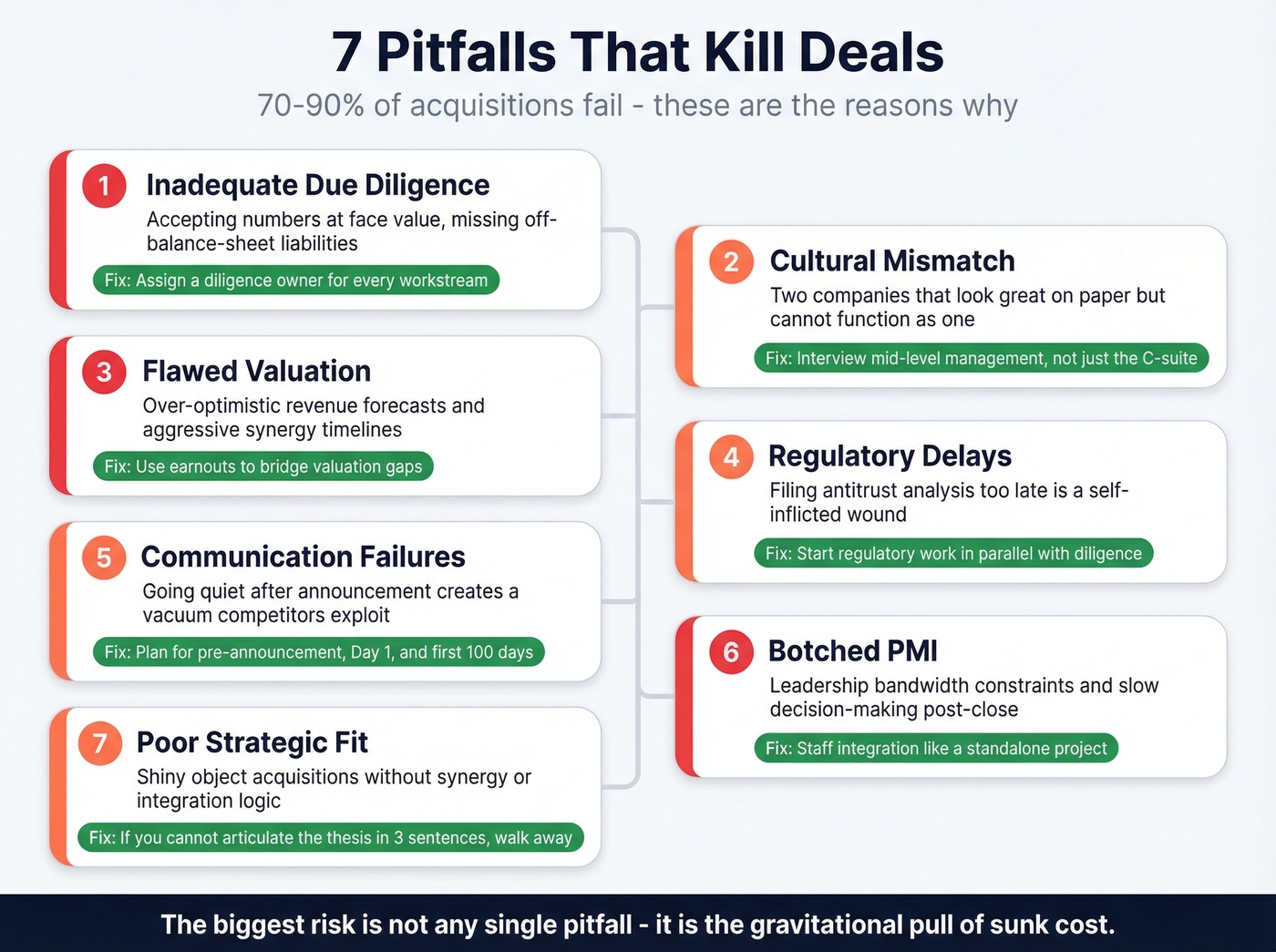
Inadequate due diligence. Accepting numbers at face value, missing off-balance-sheet liabilities, not pressure-testing synergy assumptions. The fix: assign a diligence owner for every workstream with explicit sign-off authority.
Cultural mismatch. Daimler-Chrysler is the textbook example - two companies that looked great on paper and couldn't function as one. Interview mid-level management, not just the C-suite. Culture lives in the org chart, not the boardroom.
Flawed valuation. Over-optimistic revenue forecasts and aggressive synergy timelines. Use earnouts or seller notes to bridge valuation gaps instead of paying full price on hope.
Regulatory delays. Filing antitrust analysis too late is a self-inflicted wound. Start regulatory workstreams in parallel with diligence, not after.
Communication failures. McKinsey's research is clear: going quiet after announcement creates a vacuum. Competitors poach talent. Employees disengage. Have a communications plan that covers pre-announcement, Day 1, and the first 100 days.
Botched PMI. Post-close failures often come from leadership bandwidth constraints, slow decision-making, and weak operating cadence. The plan looked great. The team couldn't execute it.
Poor strategic fit. "Shiny object" acquisitions - diversification without synergy, growth without integration logic. If you can't articulate the thesis in three sentences, you shouldn't be buying.
Let's be honest about the biggest risk: it isn't any single pitfall. It's the gravitational pull of sunk cost. Teams that have spent four months and $2M in advisory fees will talk themselves into closing a deal they should walk away from. The best dealmakers kill deals early and often. That discipline is rarer than any technical skill.
Sales Deal Execution in B2B
Deal execution isn't just an M&A concept. In B2B sales, it's the discipline that separates teams hitting quota from teams that "had a great pipeline" but missed the number.
A strong execution strategy on the sales side comes down to three non-negotiables.
A CRM with enforced stage exit criteria. If reps can drag deals to "Negotiation" without a confirmed budget holder, your pipeline is fiction. Stage gates force honest forecasting and surface stalled deals early. Skip this if you're a two-person startup selling $500 deals - but the moment your average contract value crosses $10K, you need gates.
Mutual action plans for every deal over $25K. A shared document between buyer and seller that maps every step from evaluation to signature. It forces alignment on timeline, stakeholders, and decision criteria. MEDDPICC works as the qualification framework underneath, but the mutual action plan is the artifact that keeps both sides accountable. (If you want the qualification layer tighter, use a MEDDIC variant.)
Verified contact data. This is the silent execution killer, and it's the one that frustrates us most because it's so fixable. Bounced emails, wrong phone numbers, and stale records don't just waste rep time - they break the cadence that keeps deals moving. Multi-threading into a buying committee is impossible when half your contacts are outdated. After switching to Prospeo, Snyk's 50-person AE team saw bounce rates drop from 35-40% to under 5%, AE-sourced pipeline jumped 180%, and the team generated 200+ new opportunities per month. That's not a data quality improvement - that's an execution transformation.

Deal Execution Tools
The right stack depends on which kind of transaction you're running.
M&A Tool Stack
| Category | Tool | Use Case | ~Pricing |
|---|---|---|---|
| Virtual Data Room | Datasite | VDR + AI indexing | $15K-60K+/yr |
| Deal Management | DealRoom | PM + VDR + PMI | $10K-50K+/yr |
| Sourcing | Grata | 21M+ private cos. | $15K-40K/yr |
| Market Intelligence | PitchBook | Comps + deal data + deal flow | $20K-60K+/yr |
| Relationship CRM | Affinity | Pipeline tracking | $1,500-3,000/yr/user |
For M&A, start with three things: a VDR, a sourcing platform, and a project management layer. Everything else is optimization.
Sales Execution Stack
The sales side is simpler. You need a CRM (Salesforce or HubSpot), a deal room tool for mutual action plans (Accord runs ~$6K-25K/yr), and a data platform that doesn't feed your reps garbage. Prospeo sits at the data layer - starting at ~$0.01/email with a free tier available. Pair it with your CRM and sequencer, and you've got 98% accurate emails and verified direct dials flowing into every deal without manual research.
For teams with average deal sizes under $15K, you probably don't need a $50K/year data platform. But you absolutely need accurate contact data - the cost of bounced emails and missed connections compounds faster than most teams realize. If your team is building lists at scale, data enrichment can also reduce manual cleanup.
Deal execution demands knowing exactly who to reach and when. Prospeo's 30+ filters - buyer intent, job changes, funding signals - let you map every decision-maker in the buying committee with 98% email accuracy and 125M+ verified mobile numbers.
Execute faster when every contact in your pipeline is real.
FAQ
What does deal execution mean in investment banking?
Deal execution is the post-mandate process that takes a transaction from signed engagement letter to closing - building financial models, managing virtual data rooms, coordinating diligence workstreams, organizing management presentations, comparing bids, and negotiating the definitive agreement. It's the technical half of dealmaking, distinct from origination and pitching.
How long does a typical deal take?
The average M&A transaction takes 255 days based on 2024 VDR telemetry data. IT deals close faster (~244 days), while regulated sectors like energy average 349+ days. Signing-to-closing timelines increased 64% from 2023 to 2024, driven by financing complexity and expanded regulatory scrutiny.
What's the difference between origination and execution?
Origination is winning the mandate - relationship-building, pitching, sourcing targets. Execution is everything after: diligence, modeling, negotiation, data room management, and closing logistics. Origination gets you in the room. Execution gets the deal done.
Why do most M&A deals fail?
HBR estimates 70-90% of acquisitions fail to create value. The top causes are inadequate due diligence, cultural mismatch between merging organizations, misvaluation, botched post-merger integration, and communication breakdowns that trigger talent flight and operational disruption.
How does data quality affect sales deal execution?
Stale emails and wrong phone numbers stall pipeline at every stage. Teams using verified data see bounce rates drop from 35-40% to under 5% and pipeline increases of 140-180%. Snyk's 50-person AE team generated 200+ new opportunities per month after fixing their data foundation with 98% accurate contacts.