

Demand Gen: Strategy, Google Ads Setup & Pipeline Playbook for 2026
Most B2B marketing teams are spending more on demand gen than ever and getting less pipeline to show for it. The market's projected to hit $8.35B by 2028, yet 36% of total marketing budgets still flow to lead generation activities that produce MQLs nobody closes. The gap between "running demand generation" and "generating actual revenue" keeps widening.
Here's the full playbook - the discipline, the Google Ads campaign type, and the strategy that separates pipeline from noise.
The Short Version
Demand gen is the full-funnel system of creating awareness, educating buyers, and building trust so they choose you when they're ready to buy. It's not just ads. It's not just content. It's the engine that feeds your pipeline.
Confusingly, Google also named a specific ad campaign type "Demand Gen" - it runs across YouTube, Shorts, Discover, Gmail, and (as of Google's 2025 update) expanded inventory via Google Display. Same words, different thing. We'll cover both.
What's actually working in 2026:
- Intent data + ABM targeting the 5% actively buying, while content nurtures the other 95%
- Data quality as the foundation - every campaign, outbound sequence, and syndication play depends on reaching real people at verified addresses
- Flywheel over funnel - the linear MQL handoff is dead; the best teams run closed-loop systems where customer success feeds marketing feeds sales
- If you're here specifically for Google Ads setup, jump to that section
What Is Demand Generation?
Demand generation is the discipline of creating demand for your product across the entire buyer journey - not just capturing the people already searching for a solution. That distinction matters more than most marketers realize.
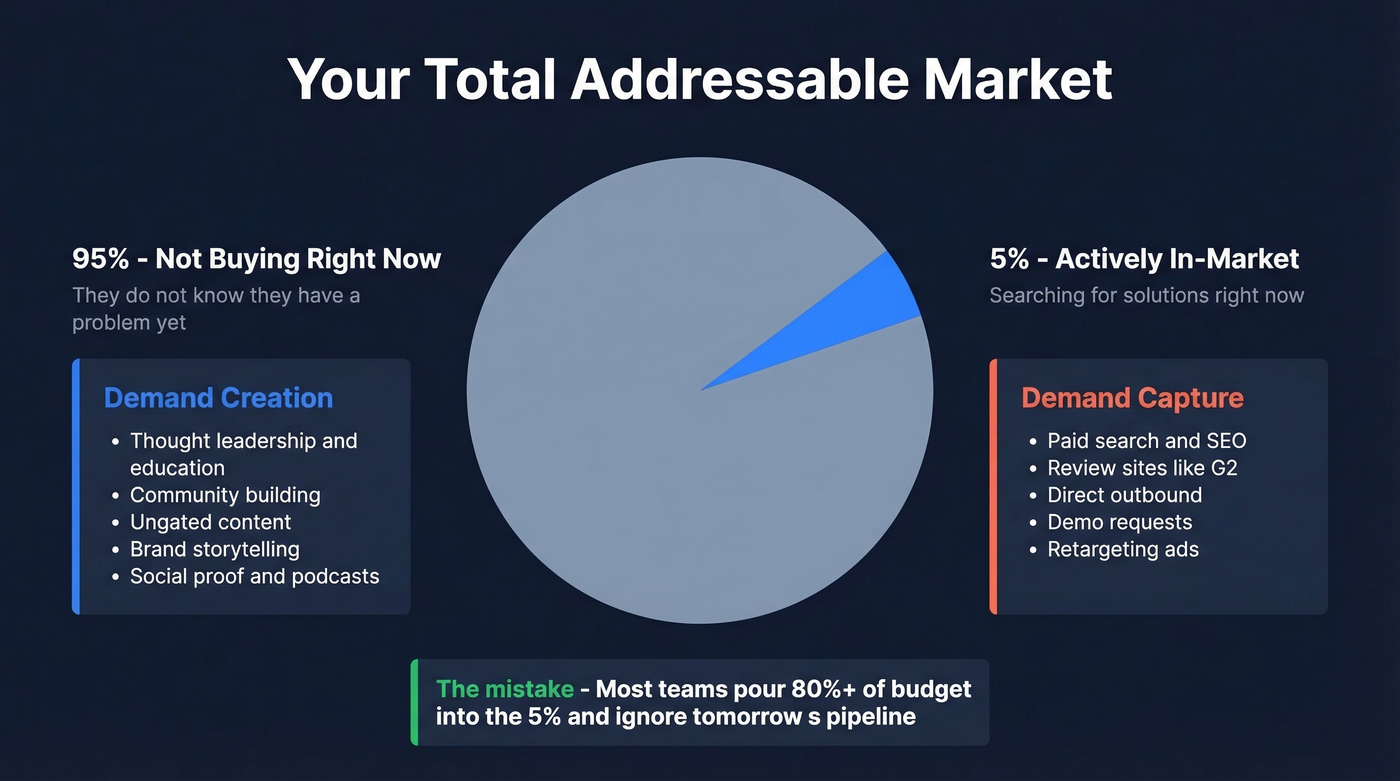
Roughly 95% of your total addressable market isn't actively looking for what you sell right now. Only about 5% are in-market at any given time. The discipline addresses both halves of that equation. Demand creation targets the 95% through education, thought leadership, community, and brand - building preference before buyers even know they have a problem. Demand capture targets the 5% through SEO, paid search, review sites, and direct outreach.
The mistake most teams make is pouring budget exclusively into demand capture - running Google Ads, buying intent data, hammering outbound - while ignoring the 95% who'll become tomorrow's pipeline. That's fishing in a shrinking pond. The teams winning in 2026 invest in both, with the balance shifting based on market maturity and deal complexity.
This isn't a department. It's a system that spans content, paid media, ABM, outbound, and customer advocacy. When someone says "we need to do demand gen," what they usually mean is "we need more pipeline." The answer is almost never a single tactic.
Demand Gen vs Lead Gen vs Brand Awareness
These three terms get used interchangeably, which creates confusion in every planning meeting. Let's make the differences concrete.
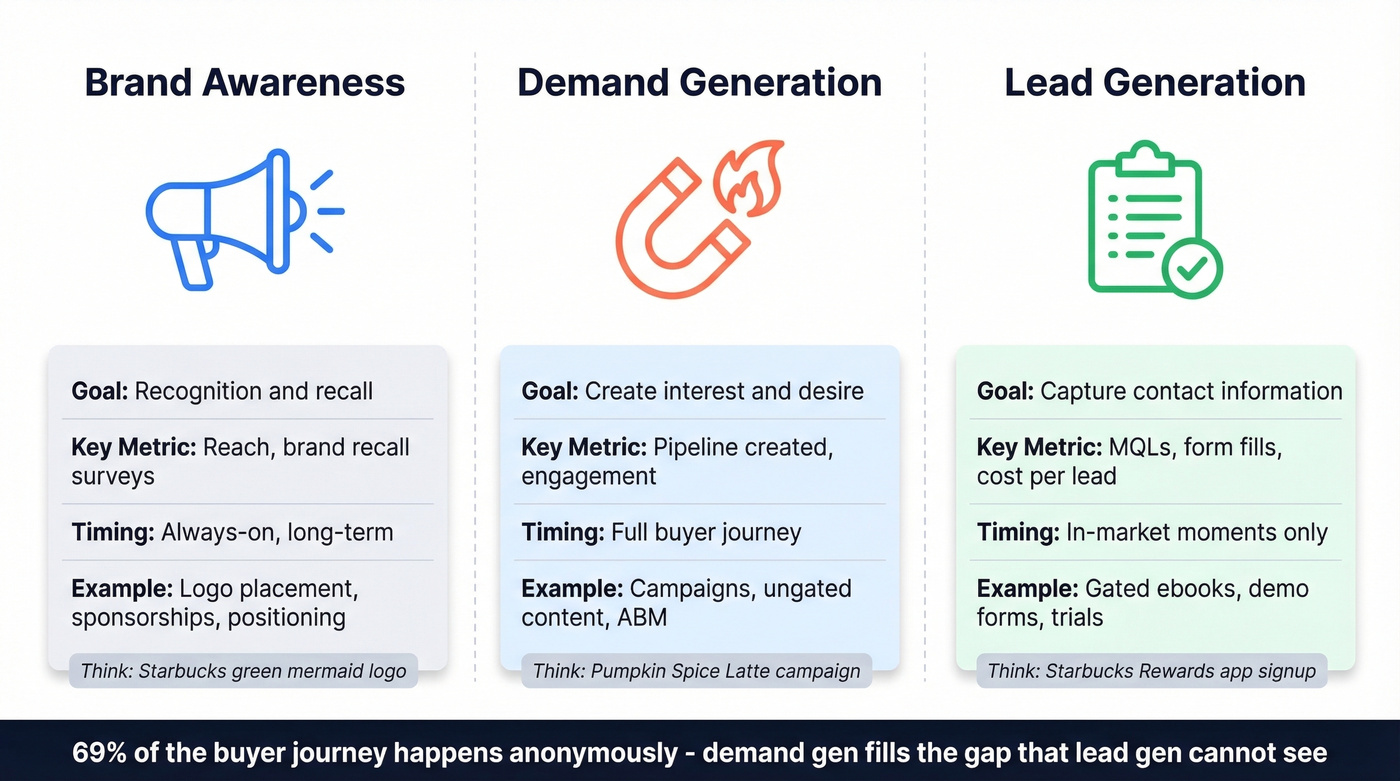
Think about Starbucks. Brand awareness is the green mermaid logo and the "third place" positioning - you recognize them instantly. Demand generation is the Pumpkin Spice Latte campaign every September - it creates desire and urgency for a specific product. Lead generation is the Starbucks Rewards app - it captures your contact info and purchase data so they can convert and retain you.
| Brand Awareness | Demand Gen | Lead Gen | |
|---|---|---|---|
| Goal | Recognition | Interest & desire | Contact capture |
| Metric | Recall, reach | Pipeline, engagement | MQLs, form fills |
| Timing | Always-on | Full journey | In-market moments |
| Example | Logo, positioning | Campaigns, content | Gated assets, demos |
Here's the critical insight: buyers complete up to 69% of their journey anonymously before ever talking to sales. If your entire strategy is lead gen - gating everything, scoring every download, handing "leads" to SDRs - you're missing the vast majority of the buying process. Demand generation fills that gap by building trust and preference during the anonymous phase.
The scoring itself matters too. The best teams use a lead ranking matrix that combines qualification level (1/2/3) with interest signals (A/B/C) and attaches response-time SLAs to each tier. A "1A" lead - high qualification, high intent - gets a call within the hour. A "3C" goes into a nurture sequence. Without this kind of structure, every lead gets the same treatment, and your SDRs burn out chasing people who downloaded one PDF six months ago.
Demand Gen Strategy in 2026
The Flywheel, Not the Funnel
The linear funnel - awareness to MQL to SQL to closed-won - is a comforting fiction. In practice, 90%+ of MQLs never turn into customers. That's not a rounding error. That's a broken model.
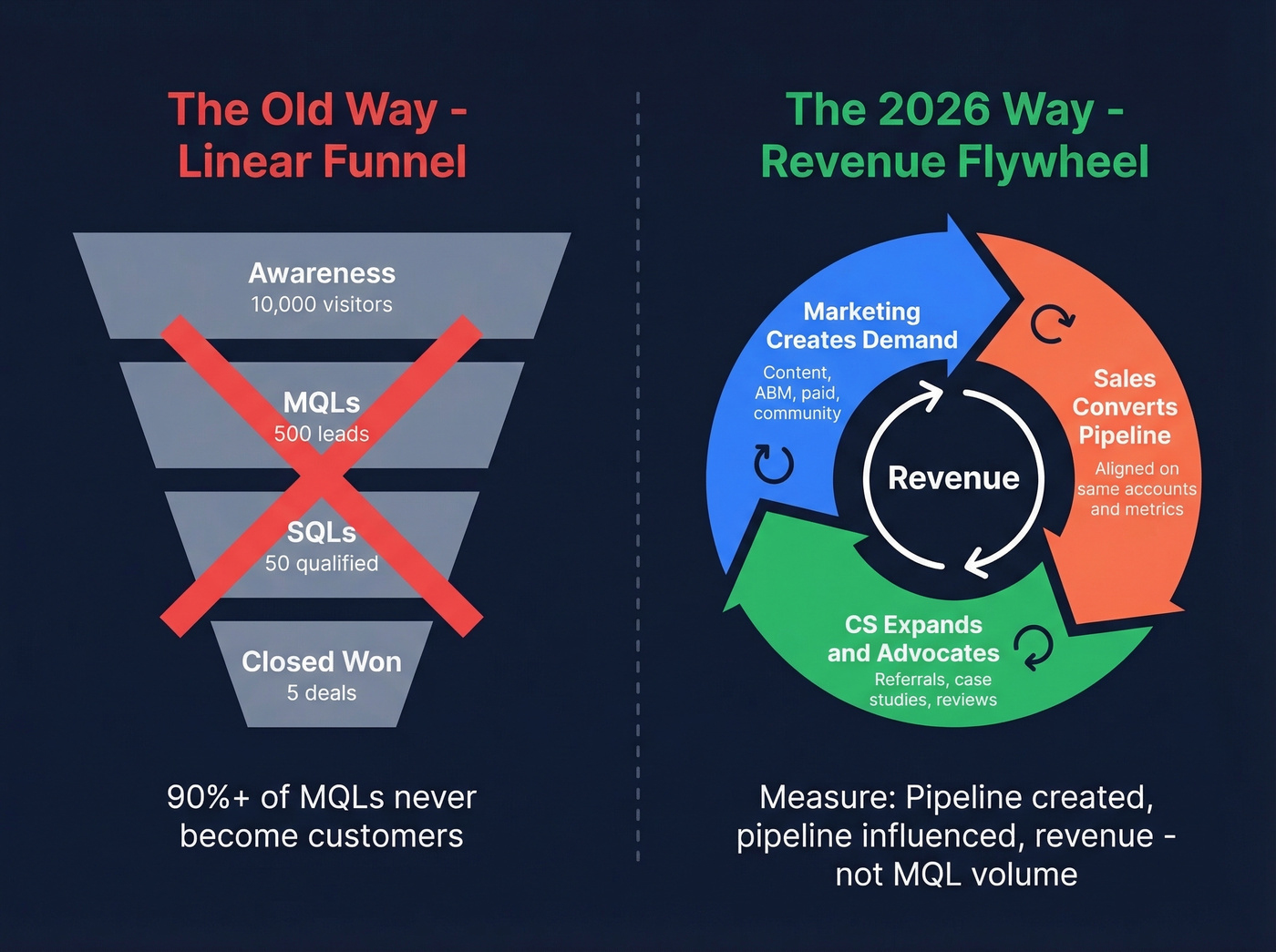
The teams producing the most pipeline in 2026 have replaced the funnel with a flywheel. Marketing creates demand. Sales converts it. Customer success expands it. Happy customers create content, referrals, and case studies that feed marketing. The loop compounds over time, and the best programs make it self-reinforcing.
Snowflake's ABM program is the clearest example we've seen. Their account-based approach drove a 300% increase in pipeline velocity by aligning marketing and sales around the same target accounts with coordinated messaging. Every function accelerated the others - marketing warmed accounts that sales closed faster, and those customers became the proof points that warmed the next wave.
The practical shift: stop measuring marketing by MQL volume. Measure by pipeline created, pipeline influenced, and revenue. When marketing and sales share the same number, the politics disappear.
Channels That Move Pipeline
Not all channels are equal, and the mix depends on your buyer. But some patterns are consistent across B2B.
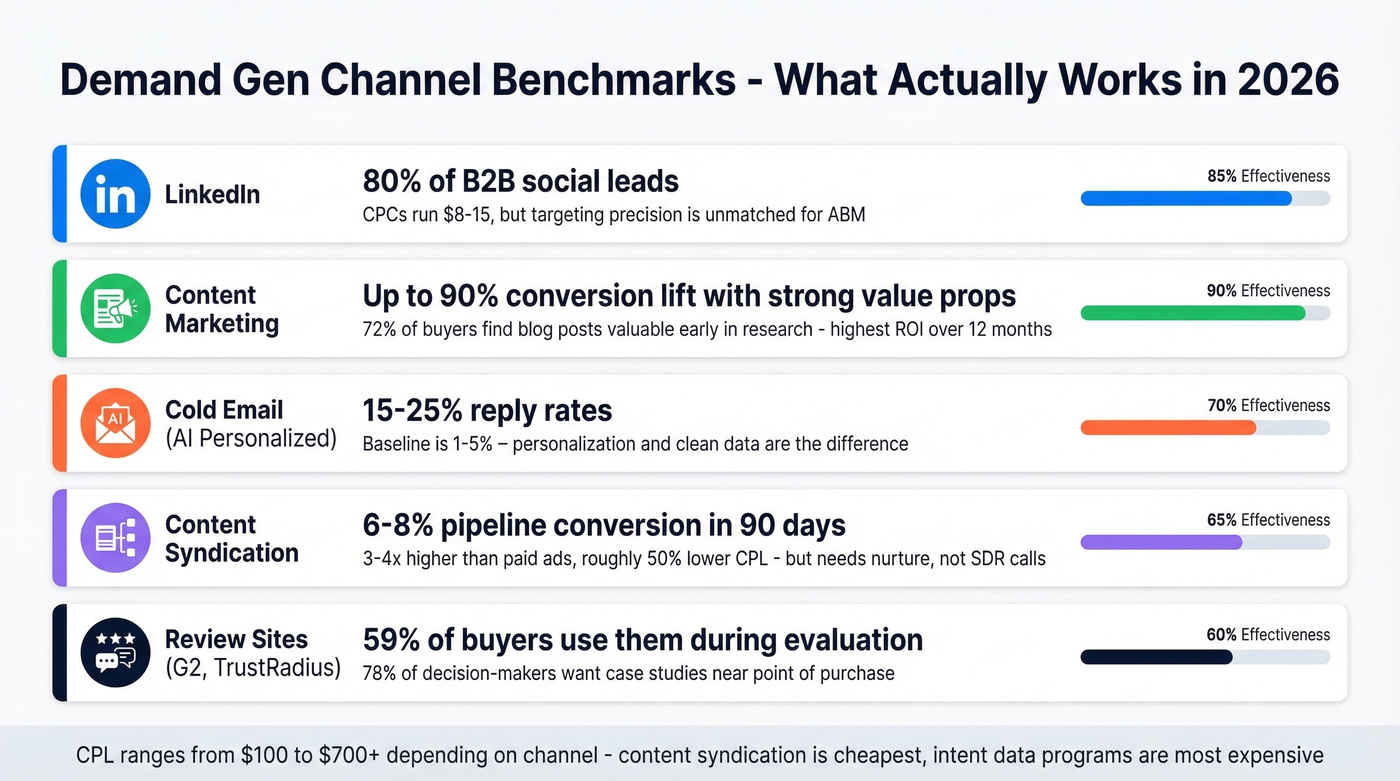
LinkedIn drives roughly 80% of B2B social media leads. It's still the highest-intent social platform for reaching decision-makers, and organic thought leadership there compounds over time. Paid LinkedIn is expensive - $8-15 CPCs are normal - but the targeting precision is unmatched for ABM.
Content marketing remains the long game that pays off. 72% of B2B buyers find blog posts valuable in the early stages of their research, and a strong value proposition on your landing pages can increase conversions by up to 90%. The key is ungated, genuinely useful content that builds trust - not thinly veiled product pitches behind a form. For most teams, this is the highest-ROI channel over a 12-month horizon.
Cold email still works when done right. Baseline reply rates sit at 1-5%, but AI-personalized campaigns are hitting 15-25% reply rates. The difference isn't the AI itself - it's that personalization forces you to actually research your prospect before hitting send. Of course, none of that matters if 30% of your emails bounce. Data quality is the prerequisite.
Content syndication converts at 6-8% to pipeline within 90 days when properly nurtured - roughly 3-4x higher than typical paid advertising and at ~50% lower CPL than intent-only programs. The catch: syndication leads need nurture sequences, not immediate SDR calls.
Review sites deserve more attention than they get. 59% of B2B buyers use platforms like G2 and TrustRadius during their evaluation process, and 78% of decision-makers want case studies near the point of purchase. If you aren't actively managing your review presence, you're invisible during the most critical phase of the buyer journey.
For context on cost, CPL ranges from $100 to $700+ depending on channel and approach. Content syndication sits at the low end, intent-data programs at the high end.
Intent Data and ABM
Prospects receive 36+ touches in two weeks after showing intent signals. Your competitors are watching the same Bombora topics, the same G2 comparison pages, the same TrustRadius reviews. The window between "showing intent" and "choosing a vendor" is shrinking fast.
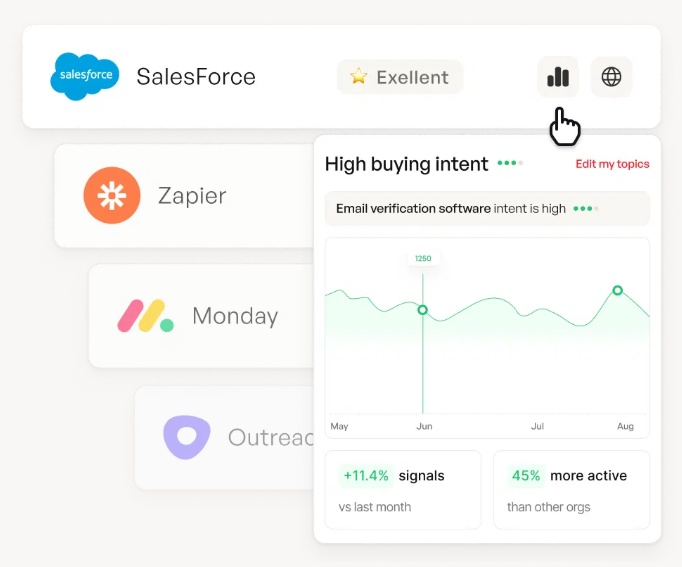
75% of B2B marketing leaders now integrate generative AI into their demand generation workflows, and roughly 90% of buyers use genAI in their own purchasing research. The most effective use of AI isn't content creation - it's signal processing. AI can synthesize intent data, technographic signals, job change alerts, and engagement patterns to prioritize accounts in real time. Companies making heavy AI investments in this area are seeing 10-20% lifts in sales ROI.
ICP focus yields 68% higher account win rates. But the ICP can't be static firmographics alone. The best programs layer behavioral signals - content consumption, product page visits, competitor research - on top of firmographic fit. A 500-person SaaS company that just visited your pricing page three times is a fundamentally different prospect than one that matches the same firmographic profile but hasn't engaged.

You just read that 30% bounce rates kill demand gen campaigns. Prospeo's 5-step email verification delivers 98% accuracy - refreshed every 7 days, not every 6 weeks. Teams using Prospeo cut bounce rates from 35%+ to under 4% and tripled pipeline output.
Stop feeding your demand gen engine with bad data.
Mistakes That Kill Pipeline
Optimizing for MQLs Over Revenue
When marketing gets measured on lead volume, they optimize for volume. That means loose scoring, low-intent form fills, and SDRs wasting time on people who downloaded a whitepaper once. The fix: align marketing metrics to pipeline and revenue, and tighten your MQL definition around intent + ICP fit.
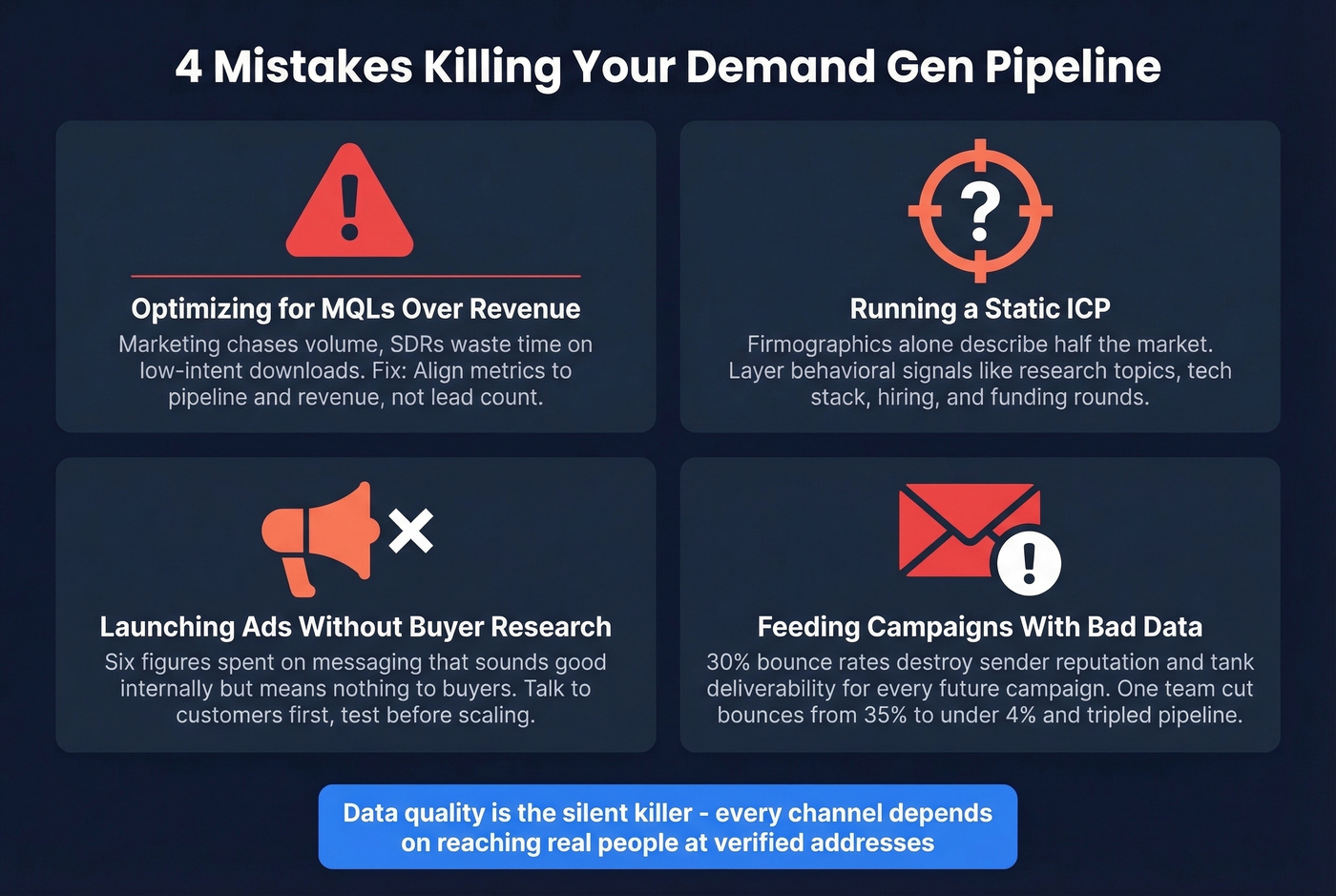
Running a Static ICP
If your ICP is "VP of Marketing at 200-1,000 employee SaaS companies," you're describing half the market. Layer behavioral signals - what are they researching, what tech do they use, are they hiring, did they just raise a round? Firmographics alone aren't a targeting strategy.
Launching Ads Without Buyer Research
We've seen teams spend six figures on campaigns built around messaging that sounds good internally but means nothing to the buyer. Talk to your customers. Use their language. Test messaging before scaling spend.
Feeding Campaigns With Bad Data
Look, this is the silent killer. You can build the perfect ABM program, write brilliant sequences, and nail your targeting - and still fail because 30% of your emails bounce. Every bounced email damages your sender reputation, which tanks deliverability for every subsequent campaign. One of our customers, Meritt, saw bounce rates drop from 35% to under 4% after switching to Prospeo - and their pipeline tripled in the same period. That's not a product pitch; it's a math problem. Bad data makes everything downstream worse.
Google Ads Demand Gen Campaigns
What Google Demand Gen Is
Demand Gen is a Google Ads campaign type (launched in 2023) that runs ads across YouTube (in-stream, in-feed, Shorts), Discover, and Gmail. In 2025, Google announced adding Google Display inventory, expanding reach across 90%+ of the global internet population via 3M+ sites and apps.
Channel controls rolled out in beta starting March 2025, letting advertisers choose specific placements - including Shorts-only targeting. This was a big deal, because the original format gave Google too much discretion over where your budget went.
The migration timeline matters: Video Action Campaigns were replaced by Demand Gen by July 2025. If you're still running legacy Discovery campaigns, those auto-migrated by March 2024. Check your account - migrated campaigns sometimes lose audience or creative settings in the transition.
Google's performance claims, backed by Nielsen analysis: Demand Gen delivers 58% higher ROAS than VAC on average, and YouTube drives 2.3x higher long-term ROAS than paid social. These are Google-commissioned studies, so take the exact numbers with a grain of salt, but the directional signal is real. YouTube's mid-funnel influence is genuinely strong for B2B when the creative is right.
Demand Gen vs Performance Max
This is the question every advertiser asks.
| Demand Gen | Performance Max | |
|---|---|---|
| Control | Granular (audience, placement) | Automated (black box) |
| Placements | YT, Shorts, Discover, Gmail, Display | Search, Shopping, YT, Display, Gmail, Discover |
| Reporting | Transparent by audience/placement | Limited visibility |
| Funnel stage | Mid-funnel awareness/consideration | Lower-funnel conversion |
| Audiences | Lookalikes, custom intent, remarketing | Automated signals |
Run both. Demand Gen handles mid-funnel awareness and consideration. PMax - ideally feed-only for ecommerce - handles lower-funnel conversions. PMax is a black box where you get results but limited insight into what's working. Demand Gen gives you the granular reporting to actually optimize.
Here's the thing: if you're forced to pick one, PMax will drive more measurable conversions in the short term. But Demand Gen builds the audience that PMax eventually converts. Skipping it is like skipping leg day - everything looks fine until you try to scale.
Setting Up a Demand Gen Campaign
Budget and Bidding
Google recommends $100/day per ad group or 20x your target CPA - whichever is higher. Underfunded campaigns never exit the learning phase and produce unreliable data. A $10/day budget targeting the entire US won't generate enough signal for the algorithm to optimize.
Start with Maximize Conversions bidding. Don't switch to target CPA until you've accumulated at least 50 conversions - the algorithm needs that volume to bid intelligently. Premature tCPA targets are the #1 reason these campaigns stall. Once you do switch, adjust in +/-20% increments and allow a two-week stability window before evaluating performance. Bigger swings reset the learning phase and waste budget.
One useful signal for when to add this campaign type: CPC resistance in your Search campaigns. If you increase budget by 10-15% and see CPCs jump 20-30% with flat conversions, your Search campaigns are saturated. That's the moment to layer in mid-funnel awareness.
Targeting and Audiences
Demand Gen supports lookalike audiences with three sizing options:
- Narrow (2.5%) - people most similar to your seed list in your target location
- Balanced (5%) - the default, and usually the right starting point
- Broad (10%) - maximum reach, lower precision
Focus your initial campaigns on in-market audiences, custom intent segments, and remarketing lists. Don't stack too many audience types - it muddies the signal and makes optimization harder.
Turn off optimized targeting for tight segments like remarketing lists, cart abandoners, or specific demographic targets. Google's optimized targeting will expand beyond your defined audience to find "similar" users, which defeats the purpose of precise targeting. Use it only when you're explicitly trying to scale reach.
Measurement That Works
Don't rely on last-click attribution for this campaign type. It's a mid-funnel format - it influences purchases that get attributed to Search, direct, or brand campaigns.
Measure account-level lift instead. Track brand search volume before and after launching. Monitor whether your Search and PMax conversion rates improve. Watch blended CPC across the account. Run geo or time-based lift tests if your budget supports it.
Demand Gen now reports view-through conversions separately, which helps compare against paid social benchmarks. But view-throughs can inflate your numbers significantly - always cross-reference against actual sales data.
What Practitioners Actually Say
The consensus on r/PPC about Google Ads Demand Gen campaigns is skeptical. And honestly, some of the skepticism is earned.
The most dramatic cautionary tale: one advertiser accidentally spent over $1M in five days due to a budget misconfiguration. The traffic volume was so massive that their IT team initially thought it was a DDoS attack. The reported conversions exceeded total webshop sales across all sources combined. No measurable long-term sales lift.
That's an extreme case, but it illustrates the core concern: conversion reporting doesn't always match reality. View-through conversions, engaged-view conversions, and Google's attribution modeling can paint a rosier picture than your actual revenue shows. We've seen this pattern repeatedly - in-platform metrics look great, but the finance team sees no change in the top line.
Other common frustrations: placement reporting groups too much traffic under "other," making it impossible to know if your ads ran on quality inventory or kids' apps. Google pushes hard for vertical video creative to "unlock" Shorts inventory, and Ad Strength stays stubbornly "poor" without multiple aspect ratios. Several advertisers report high click volume but lower conversion rates compared to legacy Discovery campaigns, with traffic described as "spammy."
None of this means the campaign type doesn't work. It means you need measurement discipline, conservative budgets during testing, and realistic expectations about what in-platform reporting actually tells you. Skip this format entirely if you don't have the analytics infrastructure to measure lift beyond last-click.
Demand Gen Tool Stack
61% of marketers say generating traffic and leads is their top challenge, and the average team uses 6-8 disconnected tools to run their programs. The goal isn't more tools - it's the right stack with clean data flowing between layers.
| Tool | Function | Starting Price |
|---|---|---|
| Prospeo | Data quality / verification | Free tier, ~$0.01/email |
| HubSpot Marketing Hub | CRM + marketing automation | Free / $890/mo Pro |
| 6sense | Intent data + ABM | ~$60K-$150K+/yr |
| Clay | Data enrichment + workflows | Free + $149/mo |
| Leadfeeder | Website visitor ID | Free + $99/mo |
| Hotjar | Behavior analytics | Free + $39/mo |
| Sprout Social | Social management | $199/mo |
The pricing contrast tells the story. 6sense runs $60K-$150K+ per year for mid-market companies, with enterprise deals north of $200K and a 3-6 month onboarding timeline. That's the right investment for large organizations running sophisticated ABM programs. But the foundation underneath all of it - the data quality layer - doesn't need to cost six figures.
Snyk's 50-person AE team is a good example of what clean data unlocks. After switching their data provider, their bounce rates dropped from 35-40% to under 5%, AE-sourced pipeline jumped 180%, and they generated 200+ new opportunities per month. That's the kind of lift that happens when your outbound actually reaches real inboxes.
The stack that works for most mid-market demand generation teams: a strong data quality and verification layer, HubSpot for automation and CRM, one intent data source (6sense if you can afford it, Bombora if you can't), and Leadfeeder for deanonymizing website traffic. Everything else is optional until you've maxed out those four.
I'll be direct: if your average deal size is under $15K, you probably don't need 6sense-level intent data. A solid data quality layer, basic automation, and disciplined outbound will outperform an expensive ABM stack that's half-implemented. Spend on data accuracy first, sophistication second.
Intent data only works when you can actually reach the buyers showing intent. Prospeo combines Bombora-powered intent signals across 15,000 topics with 143M+ verified emails and 125M+ direct dials - so your demand capture hits real inboxes, not dead ends.
Target the 5% in-market and actually connect with them.
FAQ
Is demand gen the same as lead gen?
No. Demand gen creates awareness and desire across the 95% of your market not actively buying. Lead gen captures contact info from the 5% who are ready. Without demand generation feeding the top, you're only fishing in the smallest part of the pond - and competing with everyone else for the same buyers.
What budget do I need for Google Ads Demand Gen?
Minimum $100/day per ad group, or 20x your target CPA - whichever is higher. Most B2B advertisers should budget $3,000-$10,000/month minimum for meaningful results. Underfunded campaigns never exit the learning phase and produce unreliable data.
Is Google Demand Gen better than Performance Max?
They serve different funnel stages and work best together. Run Demand Gen for mid-funnel awareness and consideration, PMax for lower-funnel conversions. Most advertisers should run both - they're complementary, not competitive.
Why do my Demand Gen conversions look inflated?
View-through and engaged-view conversions inflate reported numbers. Measure account-level lift - brand search volume, Search/PMax conversion rate changes, blended CPC - instead of relying on in-platform metrics alone. Always cross-reference against actual revenue data.
What's the most important tool for demand generation?
Your data quality layer. Every campaign - ads, outbound, content syndication - depends on reaching real people at verified addresses. Fix the foundation first, then build sophistication on top.