

The B2B Demand Generation Retargeting Playbook for 2026
Your CMO just asked why pipeline didn't move after last quarter's $80k ad spend. You ran the campaigns, hit your impression targets, and the dashboards looked green. But demand generation retargeting - re-engaging the ~98% of B2B visitors who don't convert on first visit - either wasn't in place or was running on autopilot. That's the gap, and most B2B teams are still doing it wrong.
What You Need (Quick Version)
Before you read another word, here's the 80/20:
- Set up suppression rules first. Without proper exclusions, you'll waste 15-30% of your retargeting budget showing ads to people who already converted or booked a meeting. This is the single biggest source of retargeting waste.
- Cap frequency at ~7 impressions per person. Conversion probability doesn't increase meaningfully after the 7th impression. After the 12th, you're actively damaging brand perception.
- Prove it works with an incrementality test. Allocate 5-10% of your monthly ad spend, run it for 4-8 weeks, and use ghost ads to measure causal lift - not last-click credit.
What B2B Retargeting Actually Does
Demand generation retargeting serves ads to people who've already interacted with your brand - visited your site, engaged with content, or appeared on a target account list - to pull them deeper into the buying journey. It's not about closing. It's about staying present across a buying committee of 5-10 stakeholders researching solutions over weeks or months, which means longer cycles, more stakeholders, and more emphasis on education and proof than impulse conversion.
Two core mechanisms. Pixel-based retargeting drops a cookie on visitors and serves ads as they browse other sites. List-based retargeting uploads known contacts or accounts from your CRM and matches them to ad platform audiences. Pixel-based scales easier but faces privacy headwinds. List-based is more precise but requires clean, verified contact data to work well.
Benchmarks That Matter
Retargeting display ads average a ~0.7% CTR, compared to ~0.05% for standard display. That's a 10-14x improvement. Google Ads search CTR averages 6.66% across industries, so retargeting display won't match search intent - but it's a nurture channel, not a capture channel.
| Metric | Benchmark | Notes |
|---|---|---|
| Retargeting display CTR | ~0.7% | 10-14x standard display |
| LinkedIn retargeting CPC | $4-8 | Highest B2B quality signal |
| Meta retargeting CPC (B2B) | ~$1-3+ | Lower cost, variable quality |
| Budget allocation | 10-25% of paid media | Industry standard range |
| Frequency plateau | ~7 impressions/person | No lift beyond this point |
| Frequency damage | 12+ impressions/person | Brand perception declines |

The frequency thresholds deserve emphasis. A Brixon Group analysis citing Google Ad Manager data found conversion probability doesn't increase significantly after 7 impressions, while negative perceptions rise disproportionately after 12. The same analysis references a Nielsen Marketing Institute study of 2,500+ B2B campaigns showing optimized frequency caps increase conversion rates ~27% on average. More impressions don't equal more pipeline. It's the opposite.
One more measurement trap worth flagging: optimizing retargeting to clicks rather than downstream conversions is the second most common mistake after double-counting.
Audience Segmentation by Intent Tier
Not all retargeting audiences deserve the same budget or the same ad. Segment by intent signal and recency, then allocate spend accordingly.
| Intent Tier | Page Triggers | Window | Budget Share | Creative Approach | What to Measure |
|---|---|---|---|---|---|
| High | Pricing, demo, integrations, comparison | 7 days | 50% | Direct CTA, social proof | Demo requests, pipeline created |
| Mid | Case studies, webinars, docs, 2+ product pages | 14 days | 30% | Deeper content, ROI proof | Content downloads, return visits |
| Low | Blog, homepage, single-page bounce | 30 days | 20% | Brand awareness, education | Brand recall lift, new-to-file accounts |
The 50/30/20 split is a starting point, not gospel. But it reflects a core principle: someone who hit your pricing page three days ago is worth 5x the ad spend of someone who read a blog post last month. We've seen teams blow their entire retargeting budget on a single "all visitors, 90 days" audience and wonder why nothing converts. The segmentation is the strategy.
Here's the thing: if your average deal size is under $15k, you probably don't need three tiers. Collapse to two - high-intent and everything else - and put 70% of your retargeting budget on the high-intent pool. Overcomplicating segmentation for small deal sizes burns more time than it saves.
Within each tier, rotate creatives every 7-10 days. Show a case study first, then a comparison, then a direct CTA. Repeating the same ad is the #1 creative mistake in B2B retargeting - and the easiest one to fix. If someone visited pricing, serve a comparison or ROI calculator. If they viewed a case study, serve a related customer story from a different industry. The worst thing you can do is show the same generic "book a demo" ad to every visitor regardless of where they are in the journey.

List-based retargeting only works when your CRM data is clean and verified. Prospeo's 5-step email verification delivers 98% accuracy with a 7-day refresh cycle - so your matched audiences stay current and your suppression lists actually suppress. Upload your CRM, enrich with 50+ data points, and stop wasting retargeting budget on stale contacts.
Clean data in, higher match rates out. Start enriching for $0.01 per email.
Channel-by-Channel Playbook
Google Demand Gen
Use this if you want top-of-funnel and mid-funnel reach across YouTube, Discover, and Gmail with conversion-optimized bidding.
Skip this if you expect Search-level ROAS or need granular placement control.
Google Demand Gen is inherently top/mid-funnel inventory. Google's internal data shows advertisers adopting at least 3 of 4 best practices (audiences, bid/budget, creative, data strength) saw over 40% more conversions on average. A 2025 update lets you select which channels you appear on, but this still isn't Search.
Demand Gen has no keyword targeting. Control shifts entirely to audience exclusions and conversion-quality filters. Without proper exclusions, Demand Gen can waste ~15-30% of budget on existing customers, demographic drift, and algorithmic signal drift. Build your exclusion lists before you launch a single campaign.
LinkedIn Ads
Use this if you're targeting specific job titles, industries, or account lists and can stomach $4-8 CPCs.
Skip this if your budget is under $3k/month for retargeting - you won't generate enough volume to learn.
LinkedIn is the most expensive retargeting channel in B2B and the highest-quality signal. A pilot across 2,000+ campaigns found website retargeting increased CTR by 30% and lowered post-click costs by 14%. The recommended structure: a 90-day core retargeting layer for always-on reinforcement, plus a 30-day high-intent layer for pricing/demo visitors. Monitor frequency closely - LinkedIn retargeting audiences naturally run higher frequency because the pools are smaller.
Meta Ads
Meta retargeting is typically cheaper than LinkedIn and can work well for webinar registrations, content downloads, and event retargeting with tight custom audiences. Don't expect the same audience quality for decision-maker targeting, though.
The best play is pairing both: Meta for volume, LinkedIn for precision. In our experience, teams that run both channels with shared suppression lists get better cost-per-pipeline numbers than teams that go all-in on either one.
Suppression Rules That Save Budget
68% of B2B decision-makers find excessive retargeting annoying, and 73% report negative brand perceptions from it, per Forrester research cited by Brixon Group. Your suppression rules aren't just budget optimization - they're brand protection.
- Open opportunity in CRM - Stop all generic retargeting immediately. Switch to opportunity-stage-specific creative, or pause entirely and let sales work. If an opportunity goes cold later, move it into a separate "re-open" audience with different messaging than your standard nurture.
- Meeting booked - Suppress for 14 days. They're already engaged. Ads at this point feel desperate.
- Converted/closed-won - Suppress for 30-90 days, then re-enter them into an expansion or cross-sell audience. Not the same top-of-funnel sequence.
- Existing customers - Exclude from all acquisition retargeting. This is the most common waste source in Demand Gen campaigns.
Let's be honest about attribution here. Platform dashboards double-count conversions across channels, so de-duplicate before you celebrate. One pattern we see repeatedly: teams report 40% retargeting-influenced pipeline, but half of those deals would've closed anyway.
Proving Lift With Incrementality Testing
Head-to-head retargeting vendor tests reward credit capture, not causal lift. Both vendors claim conversions that would've happened organically. The gold standard is incrementality testing - specifically, ghost ads.
Ghost ads (or ghost bidding) work like this: the platform logs when an ad would have been served to a user but withholds it, creating a matched control group without paying for control impressions. You compare conversion rates between the exposed group and the ghost group. The difference is your true incremental lift.
The simpler approach - just holding out a random group - sounds good but introduces bias. The people who see your ads aren't random; they won the auction, which means they're already different from the control group. PSA/placebo tests reduce this noise but cost real money and can skew if the delivery algorithm optimizes differently for placebo vs. real ads.
Allocate 5-10% of your monthly ad spend to the test. Run it for 4-8 weeks to account for B2B's longer consideration cycles. If your retargeting isn't showing causal lift above 10-15%, you're probably just capturing credit for organic conversions.
The Privacy-Era Retargeting Stack
Third-party cookies are far less reliable than they used to be. iOS restrictions limit tracking. Ad blockers affect 30%+ of users. Your old retargeting playbook is broken.
Here's the stack that works now:
- Consent Management Platform - Collect and manage consent signals across your properties
- Consent Mode v2 - Pass consent signals to Google so modeled conversions fill the gaps
- Enhanced Conversions - Send hashed first-party data to improve match rates
- Server-side GTM - Move tagging server-side to recover conversion data lost to iOS restrictions, ad blockers, and cookie loss
- Unified reporting - De-duplicate across platforms using a single source of truth
Teams switching to server-side tracking via server-side GTM and Meta CAPI are recovering ~15-25% of lost conversion data. That's not a nice-to-have - it's table stakes.
List-based retargeting (CRM uploads, hashed email identifiers, login-based signals) is becoming the primary mechanism as pixel-based tracking degrades. That means the quality of your contact data - verified emails, accurate match rates - determines whether your retargeting audiences actually reach the right people. Garbage data in your CRM upload means garbage audience match rates, which means you're paying for impressions that never reach your actual targets.
From Retargeting to Pipeline
Retargeting warms accounts. But the last mile - actually reaching the right person before the intent signal cools - requires verified contact data. We've watched teams run strong demand generation retargeting campaigns, generate real engagement signals, then lose deals because the SDR's follow-up email bounced or the phone number was disconnected.
Prospeo closes that gap with 98% email accuracy and a 7-day data refresh cycle, giving your sales team data they can act on the same day an account shows engagement. CRM enrichment runs at a 92% API match rate returning 50+ data points per contact, and intent data tracking 15,000 topics via Bombora lets you prioritize retargeting-warmed accounts that are also showing active buying signals.
You just spent $4-8 per click warming up that audience. Losing the deal to a bounced email is an unforced error.
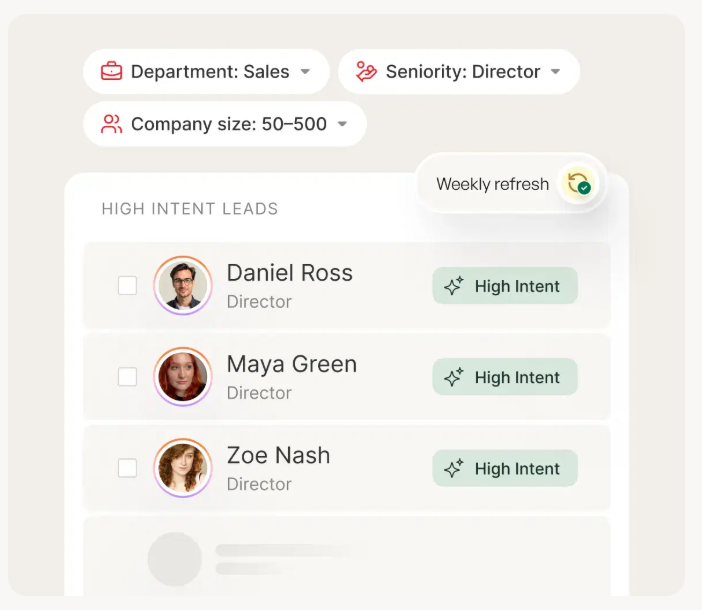
Retargeting warms accounts, but someone still has to close them. When high-intent visitors hit your pricing page, Prospeo's intent data across 15,000 topics and 125M+ verified mobile numbers let your sales team follow up directly - with a 30% pickup rate that turns ad impressions into real conversations.
Turn retargeting signals into booked meetings with verified direct dials.
FAQ
What's the difference between retargeting and remarketing?
Functionally, they're synonymous in B2B. Google uses "remarketing" in its platform terminology; most other ad platforms and the broader industry use "retargeting." Both refer to serving ads to people who've previously interacted with your brand. Don't overthink the distinction - focus on the strategy, not the label.
Does Google Demand Gen support dynamic remarketing?
Demand Gen doesn't offer a dedicated dynamic remarketing setup the way classic feed-based dynamic ads work. The primary approach is audience-based retargeting using remarketing lists and Customer Match. For dynamic product ads pulling from a feed, Performance Max or standard display campaigns are better options.
How much should I spend on B2B retargeting?
Allocate 10-25% of your total paid media budget. Within that, split 50/30/20 across high-intent, mid-intent, and low-intent audience tiers. For teams spending $20-50k/month on paid media, that means $2-12.5k/month on retargeting - enough to run meaningful campaigns across two channels.
How do I retarget accounts without third-party cookies?
First-party data is the foundation: CRM list uploads, hashed email identifiers, and server-side tagging. Build audiences from verified contact data rather than relying on browser cookies. Pair this with Consent Mode v2 and Enhanced Conversions for maximum coverage. The better your underlying contact data quality, the higher your match rates on every platform.