

How to Build a Target Account List (The Practitioner Playbook)
You've got a blank spreadsheet, a vague mandate to "do ABM," and a Slack message from your VP asking when the target account list will be ready. The honest answer? Most teams spend weeks on research, stakeholder mapping, and tiered personalization - only to find that contacts have already changed roles by launch time. That's the gap between building a list and building one that actually works.
What You Need Before You Start
To build a list that drives pipeline instead of collecting dust, you need five things:
- Documented ICP with real filters - not "enterprise companies in tech," but specific firmographic and technographic and behavioral criteria you can query against.
- A scoring model - we use a 40/35/25 split across fit, buying signals, and engagement.
- Sizing benchmarks matched to your ABM motion - a 1:1 strategic program and a programmatic campaign need radically different list sizes.
- Verified contact data for buying committees - accounts aren't people. You need names, emails, and direct dials for 3-8 stakeholders per account.
- A quarterly refresh cadence - CRM data decays roughly 30% per year. A list you built in January is already unreliable by April.
What Is a Target Account List?
A target account list is a curated, scored, and tiered set of companies your sales and marketing teams actively pursue through account-based motions. It's not a CRM dump. It's not a wish list your CEO put together on a flight. And it's definitely not "every company in our ICP."
The distinction matters because each account on a TAL gets dedicated resources - personalized content, multi-threaded outreach, coordinated ad spend. About 87% of marketers say ABM delivers a higher ROI than other types of marketing campaigns, but that ROI depends entirely on whether you're targeting the right accounts with the right intensity. A sloppy list doesn't just waste budget - it wastes the entire motion.
How Big Should Your List Be?
Everyone asks this first, and the answer is annoyingly contextual. But there are real benchmarks.
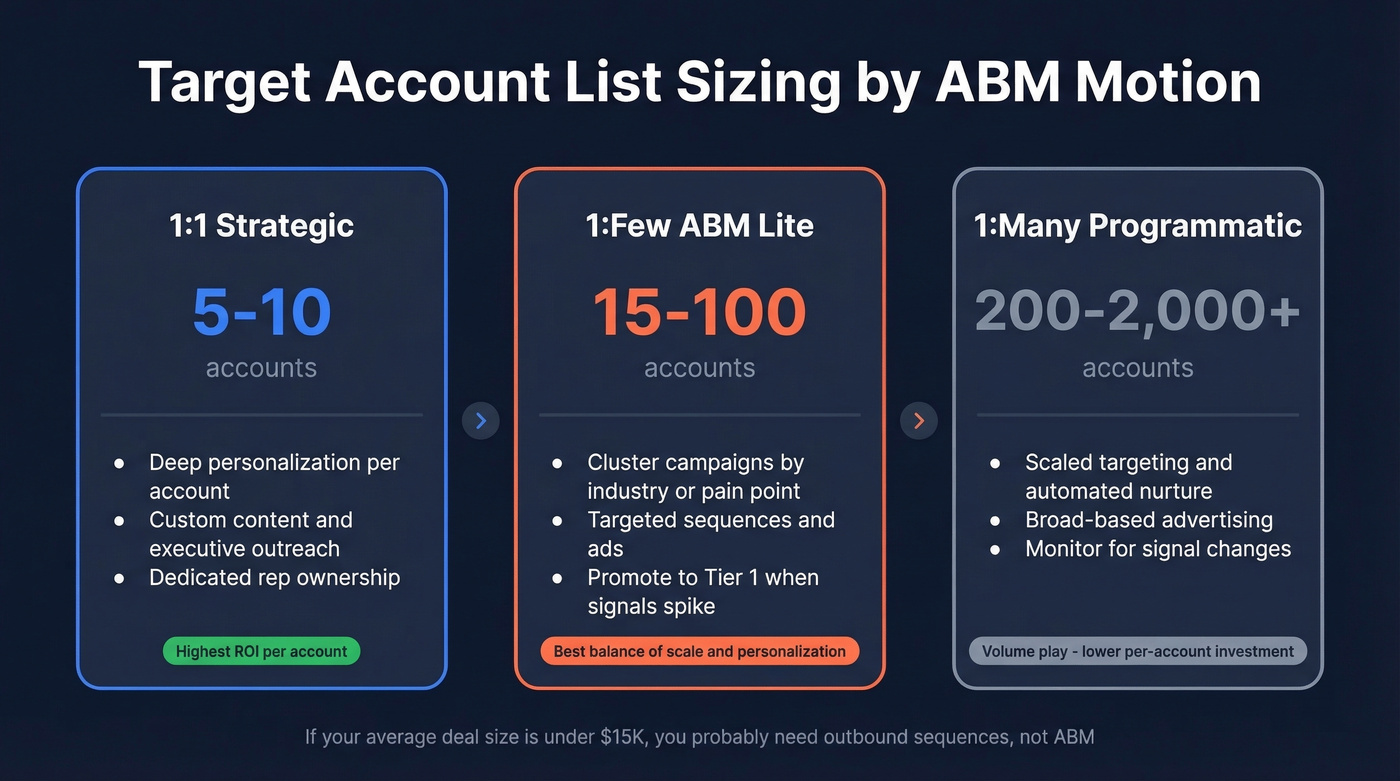
| ABM Motion | Accounts | Effort Level |
|---|---|---|
| 1:1 (Strategic) | 5-10 | Deep personalization |
| 1:Few (ABM Lite) | 15-100 | Cluster campaigns |
| 1:Many (Programmatic) | 200-2,000+ | Scaled targeting |
Those ranges come from practitioners running real programs, not theory. The mistake most teams make is defaulting to "more is better." It isn't. Fifty high-quality accounts will outperform 5,000 every time if your reps can actually work them.
Here's the thing: if your average deal size is under $15K, you probably don't need an ABM list at all - you need a good outbound sequence and a tighter ICP filter. Account-based motions only pay off when the deal economics justify the per-account investment.
Sizing From Quota, Not Vibes
Demandbase's TAL calculator is useful because it forces you to size your list from real variables. It uses inputs like annual quota per rep, average deal size, number of reps, percentage of quota expected from the TAL, and your opportunity-to-pipeline and pipeline-to-closed/won conversion rates.
A simple way to sanity-check your list size is to work backwards from quota: if a rep needs 20 closed-won deals and your team typically closes 25% of qualified pipeline, that rep needs roughly 80 qualified opportunities. From there, your TAL size depends on how many accounts it takes to generate one qualified opportunity in your motion.
How to Build a Target Account List
Define Your ICP With Real Filters
Every ABM guide tells you to define your ICP. Almost none give you real help doing it. Here's what an actual practitioner's ICP looks like, pulled from a marketer's Reddit post:
- Company size: 250+ employees
- Product team size: 8+ engineers
- Location: UK or US
- Industry: Finance, SaaS, e-commerce
- Product type: Must have a digital product
Notice the specificity. "Must have a digital product" isn't a standard firmographic filter - it's a behavioral qualifier that separates real prospects from noise. Your ICP should include at least one filter unique to your business, something you can't pull from a generic dropdown. Advanced teams also layer in technology spend and consumption data, because knowing a company actively invests in a relevant tech category is a stronger signal than knowing they simply have it installed.
Start with your best 10 closed-won deals from the last 12 months. What do they share? Industry, headcount, tech stack, growth stage, org structure - pattern-match across all of them. That's your ICP, grounded in revenue data rather than assumptions.
Source and Enrich Account Data
Once your ICP is defined, you need to turn those criteria into actual accounts with real contact data. A B2B data platform like Prospeo lets you filter by 30+ criteria and returns verified emails refreshed every 7 days. That refresh cycle matters more than most teams realize - CRM data decays roughly 30% annually, so contacts pulled in Q1 are already degrading by Q2.

If you care about deliverability - and you should - run your list through two verifiers before loading it into sequences. One pass catches the obvious invalids; the second catches catch-all domains and edge cases that still tank deliverability.
Score and Prioritize Accounts
We've used this scoring model across B2B SaaS and fintech accounts, and the 40/35/25 weighted split consistently outperforms equal weighting:
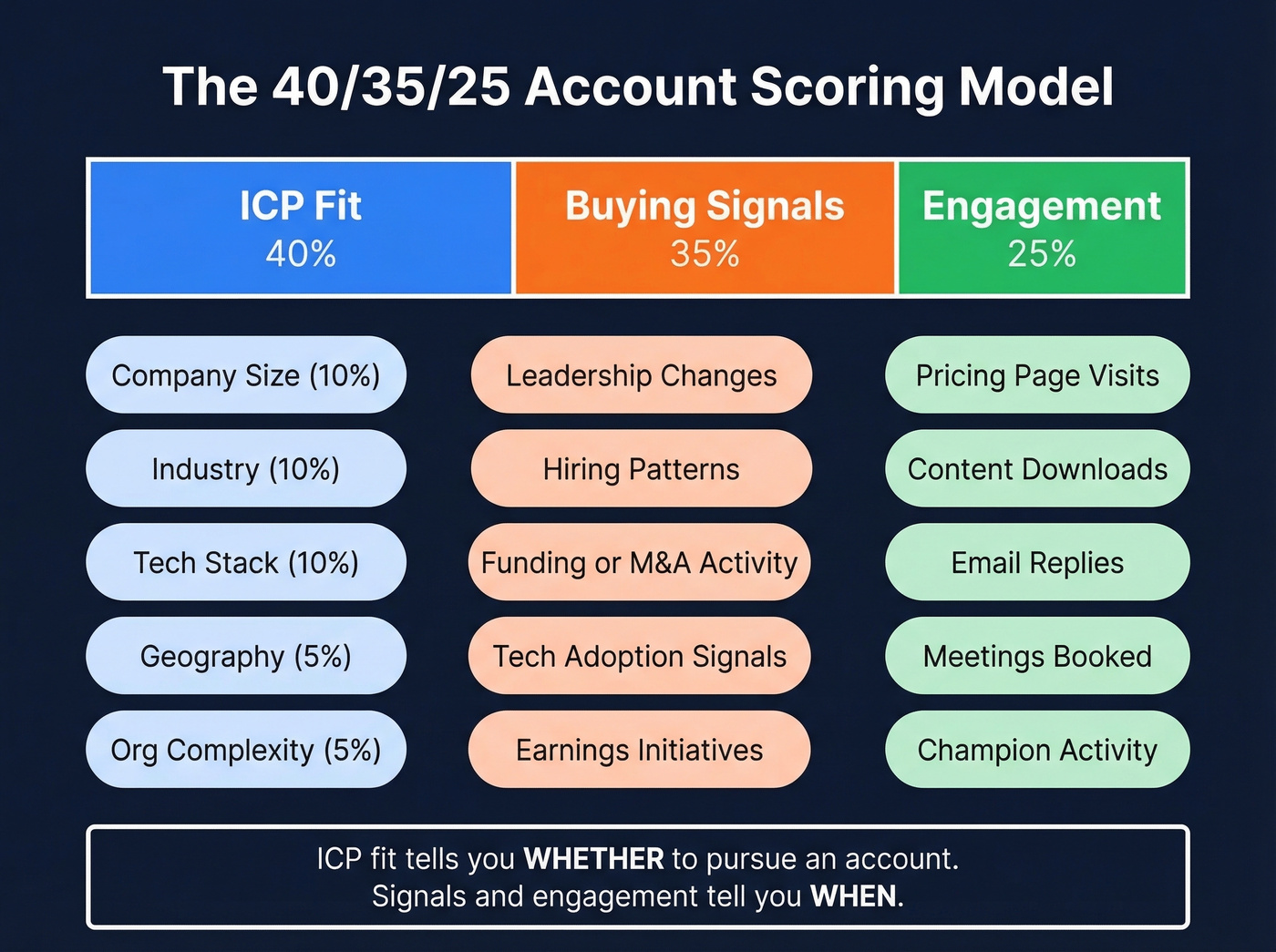
| Category | Weight |
|---|---|
| ICP Fit | 40% |
| Buying Signals | 35% |
| Engagement | 25% |
ICP Fit sub-factors: Company size (10%), Industry (10%), Tech stack (10%), Geography (5%), Org complexity (5%).
Buying Signals sub-factors: Leadership changes, hiring patterns, funding/M&A, tech adoption, earnings initiatives.
Engagement sub-factors: Pricing page visits, content downloads, email replies, meetings booked, champion activity.
ICP fit is necessary but not sufficient. A perfect-fit account showing zero buying signals and no engagement with your content shouldn't be Tier 1. Signals and engagement tell you when to pursue an account, not just whether it fits. The whole purpose of scoring is to identify high-priority accounts - the ones where fit, timing, and engagement converge - so your team allocates resources where they'll actually move pipeline.
One distinction worth making: account scoring ranks companies, lead scoring ranks people within those companies. You need both. Score accounts to decide where to focus, then score contacts within those accounts to decide who gets the first email.
Tier Your Accounts
Once scored, split your list into three tiers with a 25/50/25 distribution.
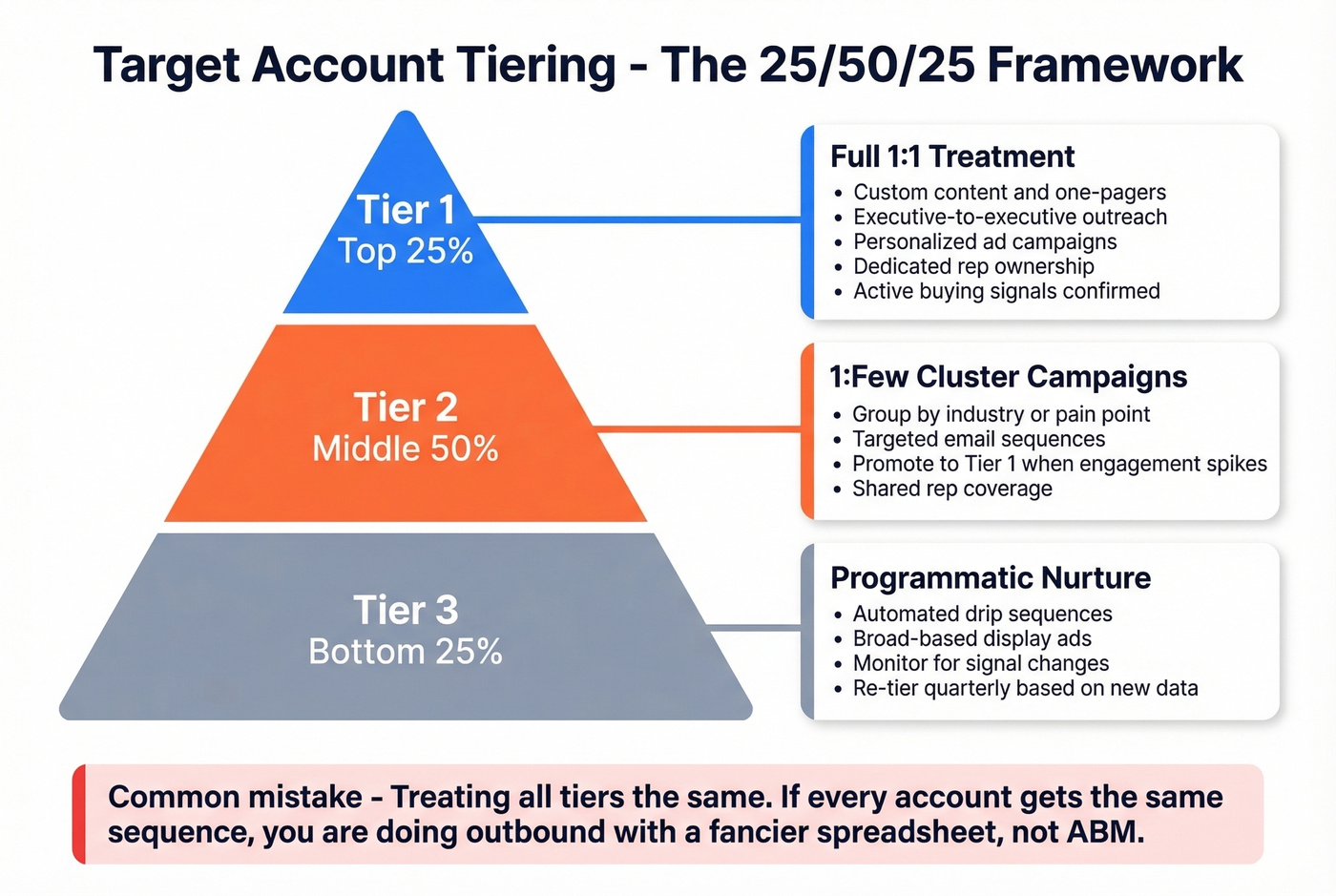
Tier 1 (top 25%) gets full 1:1 treatment - custom content, executive outreach, personalized ads, dedicated rep ownership. These are your highest-score accounts with active buying signals.
Tier 2 (middle 50%) runs 1:Few campaigns. Cluster by industry or pain point, run targeted sequences, and promote to Tier 1 when engagement spikes.
Tier 3 (bottom 25%) stays programmatic - automated nurture, broad-based ads, and monitoring for signal changes that warrant re-tiering.
The biggest resource waste in ABM is giving every account the same level of attention. A Tier 3 account shouldn't get a custom one-pager. A Tier 1 account shouldn't get a generic drip sequence. Let's be honest - if you're treating all three tiers the same, you're not doing ABM. You're doing outbound with a fancier spreadsheet.
Map the Buying Committee
This is where most account lists fail. They stop at the account level.
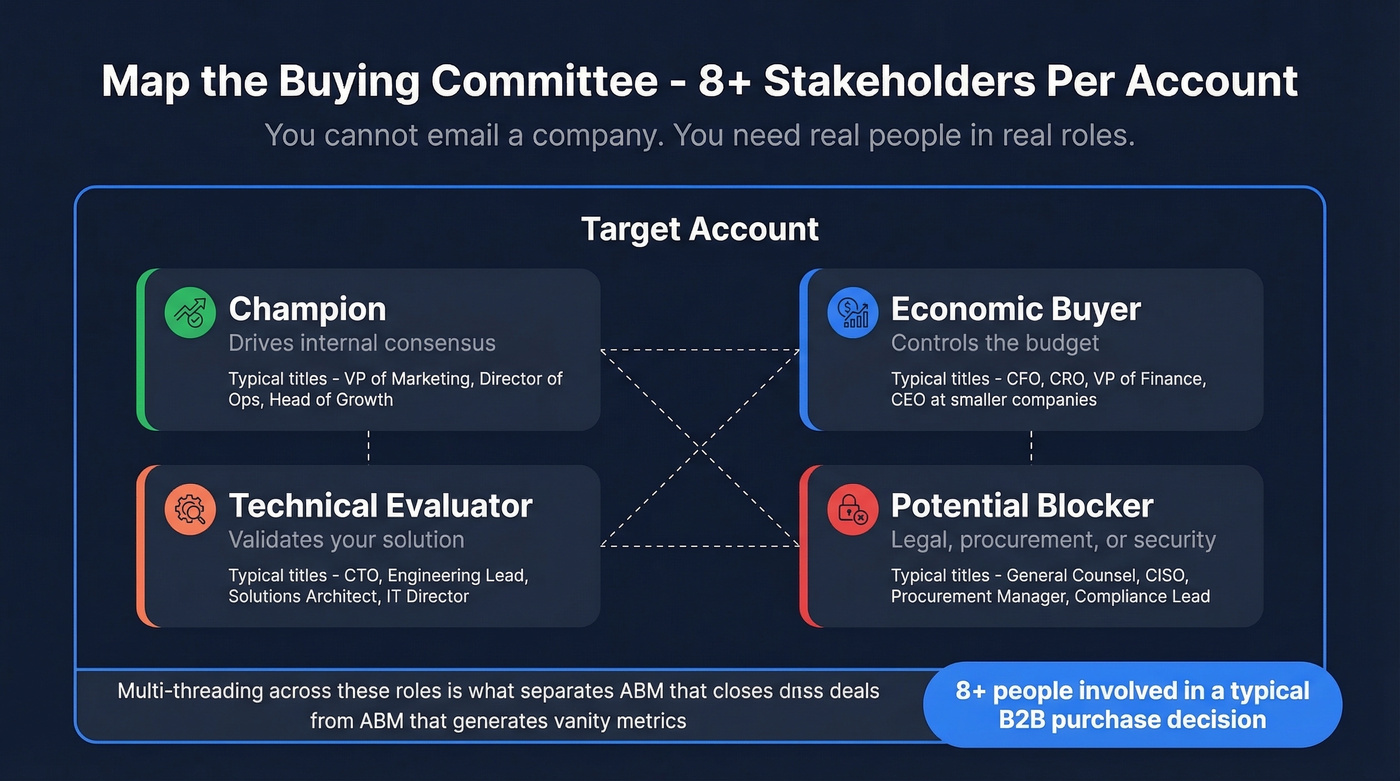
An account isn't a person. You can't email a company. You need to map the buying committee - typically 8+ people involved in a B2B purchase decision. For each Tier 1 and Tier 2 account, identify at minimum the champion who drives internal consensus and advocates for your solution, the economic buyer who controls budget, the technical evaluator who validates your solution, and the potential blocker in legal, procurement, or security. Multi-threading across these roles is what separates ABM that closes deals from ABM that generates "engagement metrics."

Your target account list is only as good as the contact data behind it. Prospeo gives you 30+ search filters - intent, technographics, headcount growth, funding - to match your exact ICP, then returns 98% accurate emails refreshed every 7 days. No more Q2 decay on Q1 lists.
Stop building target account lists on data that's already stale.
The TAL Template
Copy this column schema into a spreadsheet or build it as a CRM view:
| Column | Purpose |
|---|---|
| Company Name | Account identifier |
| Domain | For enrichment lookups |
| Industry | ICP fit filter |
| Employee Count | Size qualification |
| Revenue Range | Deal sizing signal |
| Tech Stack | Technographic fit |
| Intent Score | Buying signal strength |
| Engagement Score | Interaction history |
| Composite Score | Weighted total (40/35/25) |
| Tier (1/2/3) | Resource allocation |
| Assigned Rep | Ownership |
| Last Verified Date | Data freshness check |
| Buying Committee (%) | Coverage completeness |
| Next Action | Operational clarity |
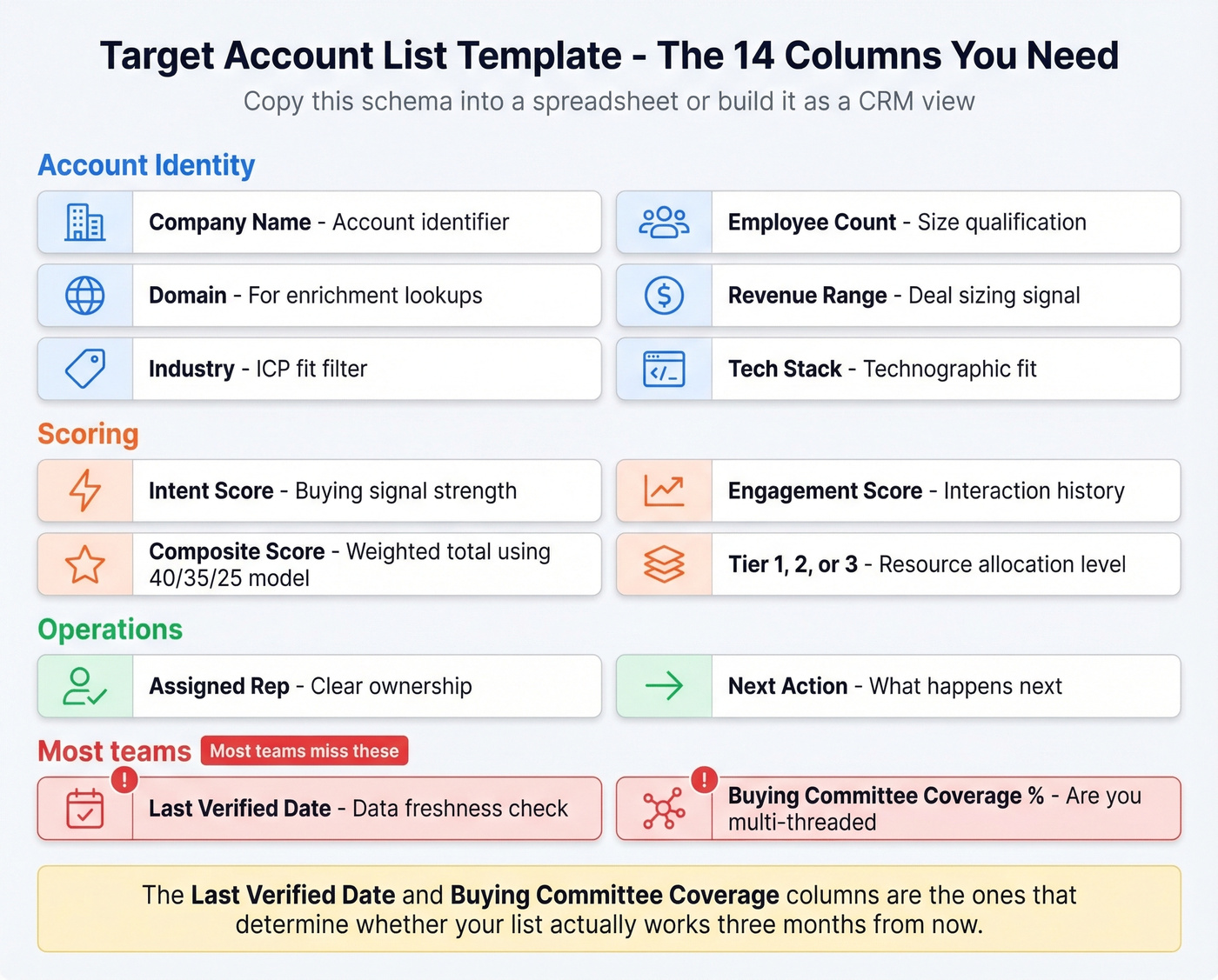
The "Last Verified Date" and "Buying Committee Coverage %" columns are the ones most templates miss - and they're the ones that determine whether your list actually works three months from now.
Don't Use ChatGPT for This
One Reddit poster openly considered using GPT-4 to generate target accounts. Don't.
LLMs hallucinate company names, fabricate employee counts, and can't verify whether a company actually exists - let alone whether it matches your ICP. We've seen outputs that include companies acquired two years ago, fictional startups, and real companies with completely wrong firmographic data. Use AI to structure your scoring model, clean messy data, or draft personalized outreach copy. Never use it to generate the accounts themselves. That's what data platforms exist for.
Mistakes That Kill Your TAL
Skipping ICP research. Using a sales-provided gut-feel list instead of data-backed criteria. Your best reps have good instincts, but instincts don't scale.
No sales-marketing alignment. Marketing builds the list in isolation, sales ignores it, and both teams blame each other when pipeline stalls. Build the TAL together or don't bother.
Static annual lists. Setting a TAL in January and never touching it again. Markets shift, companies get acquired, champions leave. We saw one team lose 40% of their Tier 1 contacts to job changes in a single quarter because nobody was monitoring.
Same effort for all tiers. Sending the same generic sequence to Tier 1 and Tier 3 accounts. That's not ABM - that's spray and pray with extra steps.
Ignoring contacts. An account-level list without buying committee mapping is a company directory, not a sales tool.
Never verifying data. This is the one that frustrates us most. Teams that skip verification see higher bounce rates in their first sequence, and unverified lists waste rep time on dead-end contacts. Two verification passes before any outreach. Non-negotiable. (If you need a process, start with an email deliverability guide and track your email bounce rate.)
Over-segmenting. Splitting your TAL into 47 micro-segments with 3 accounts each. You'll spend more time managing segments than actually selling. Keep it to 3 tiers and a handful of industry clusters.
How to Maintain Your TAL
A target account list isn't a project - it's a process. Run this quarterly:
- Re-score all accounts using updated intent, engagement, and firmographic data. Scores shift as companies grow, shrink, or change priorities.
- Swap the bottom 20%. Replace low-scoring, low-engagement accounts with new ones that match your ICP and show active signals.
- Re-verify contact data. If your data platform doesn't auto-refresh, run a manual verification pass quarterly at minimum.
- Re-run intent signals. Buying windows open and close. An account showing zero intent last quarter might be surging now.
- Audit buying committee coverage. People change roles. Champions leave. New stakeholders join. Update your contact maps.
If your TAL hasn't been updated in 90 days, it's not a working document - it's a historical artifact.
Tools for Building Your TAL
Start with three tools: a B2B data platform for sourcing and verification, a CRM, and a spreadsheet for the initial scoring model. You don't need a $60K intent platform on day one. Skip the enterprise tools until you've proven the motion works at a smaller scale.
| Tool | Best For | Key Feature | Pricing |
|---|---|---|---|
| Prospeo | Verified data, no contracts | 98% email accuracy, 7-day refresh | ~$0.01/email, free tier |
| Apollo.io | All-in-one outbound | Sequencing + data combined | From ~$49/mo per user |
| ZoomInfo | Enterprise teams | Deepest firmographic coverage | $15,000-$45,000/yr |
| Cognism | European/EMEA data | GDPR-first, strong EU mobiles | ~$1,000-$3,000/mo |
| Demandbase | Full ABM orchestration | Intent + advertising + TAL mgmt | $18,000-$110,000/yr |
| 6sense | Enterprise intent ABM | Predictive analytics + intent | $60,000-$100,000+/yr |

Prospeo is where we'd start for most teams. The 300M+ profile database with 30+ search filters - including Bombora-powered intent data across 15,000 topics, technographics, headcount growth, and funding - gives you sourcing, verification, and intent signals in one platform. Snyk's team of 50 AEs brought bounce rate down from 35-40% to under 5% using Prospeo, and Meritt tripled pipeline from $100K to $300K per week. At roughly $0.01 per email with a free tier and no contracts, it's 90% cheaper than ZoomInfo with higher accuracy (98% vs 87%).
For teams selling into EMEA, Cognism is the default pick. GDPR-first architecture and strong European mobile coverage make it the right choice for UK and EU markets, though US coverage is thinner than domestic alternatives.
Apollo.io combines sequencing and data in one platform, which means fewer integrations to manage. The database is solid, but email accuracy runs around 79% - expect to layer a separate verification step on top.
ZoomInfo typically lands in the $15K-$45K/year range depending on seats and modules. For enterprise teams that need deep US firmographic coverage and can justify the spend, the breadth is still hard to match.
At $18K-$110K/year and $60K-$100K+/year respectively, Demandbase and 6sense are investments that require mature ABM programs to justify. Don't evaluate them until you've outgrown spreadsheet-based TAL management and need intent-driven advertising, predictive scoring, and cross-channel orchestration.
If you're trying to scale this without adding headcount, it's worth looking at how to automate target account lists and a repeatable lead generation workflow.
Accounts aren't people. You need 3-8 verified contacts per account to multi-thread effectively. Prospeo's 300M+ profiles and 125M+ verified mobiles let you map entire buying committees - with a 30% pickup rate on direct dials - at $0.01 per email.
Turn your tiered account list into real conversations for a penny per contact.
FAQ
What is a target account list?
A target account list is a curated, scored, and tiered set of companies pursued through coordinated ABM motions - each vetted against your ICP, ranked by fit and intent, and assigned a tier dictating resource allocation. Unlike generic prospect lists, every account on a TAL receives dedicated personalization, multi-threaded outreach, and coordinated ad spend.
How often should you update your list?
Quarterly at minimum. Re-score accounts with fresh intent and engagement data, swap the bottom 20% for new high-signal companies, and re-verify all contact data. CRM records decay roughly 30% per year, so a list untouched for six months is already unreliable.
How many accounts should be on a TAL?
Strategic 1:1 programs run 5-10 accounts. ABM Lite works with 15-100. Programmatic scales to 200-2,000+. Size based on rep capacity and average deal value - work backwards from quota rather than picking an arbitrary number.
What's the best free tool for building an ABM account list?
Prospeo offers a free tier with 75 email credits and 100 Chrome extension credits per month - enough to build and verify a small TAL with real contact data. Apollo.io also has a free plan, though its 79% email accuracy means you'll want a separate verification step. For teams just starting ABM, either gets you moving without a contract.