

B2B Demand Generation Tactics: The Benchmark-Driven Playbook
Most B2B demand generation tactics fail for one boring reason: teams spread budget across 11-15 channels and never get good at any of them. Half of B2B companies do exactly that. Meanwhile, 70% of marketing-sourced pipeline comes from just four channels. The average B2B buying cycle runs 10.1 months, so channel sprawl doesn't just waste spend - it steals time you can't get back.
What You Need (Quick Version)
Run three or four channels max - ideally pulled from SEO, events, social media, and paid search. Put benchmarks and stop rules on every channel. If something can't generate pipeline signal in 90 days, cut it and reallocate. The best demand gen programs we've seen share one trait: they're focused enough to actually compound.
Why Demand Gen Changed in 2026
The old playbook assumed buyers would discover you, read your content, fill out a form, and politely enter your nurture sequence. That world is gone.
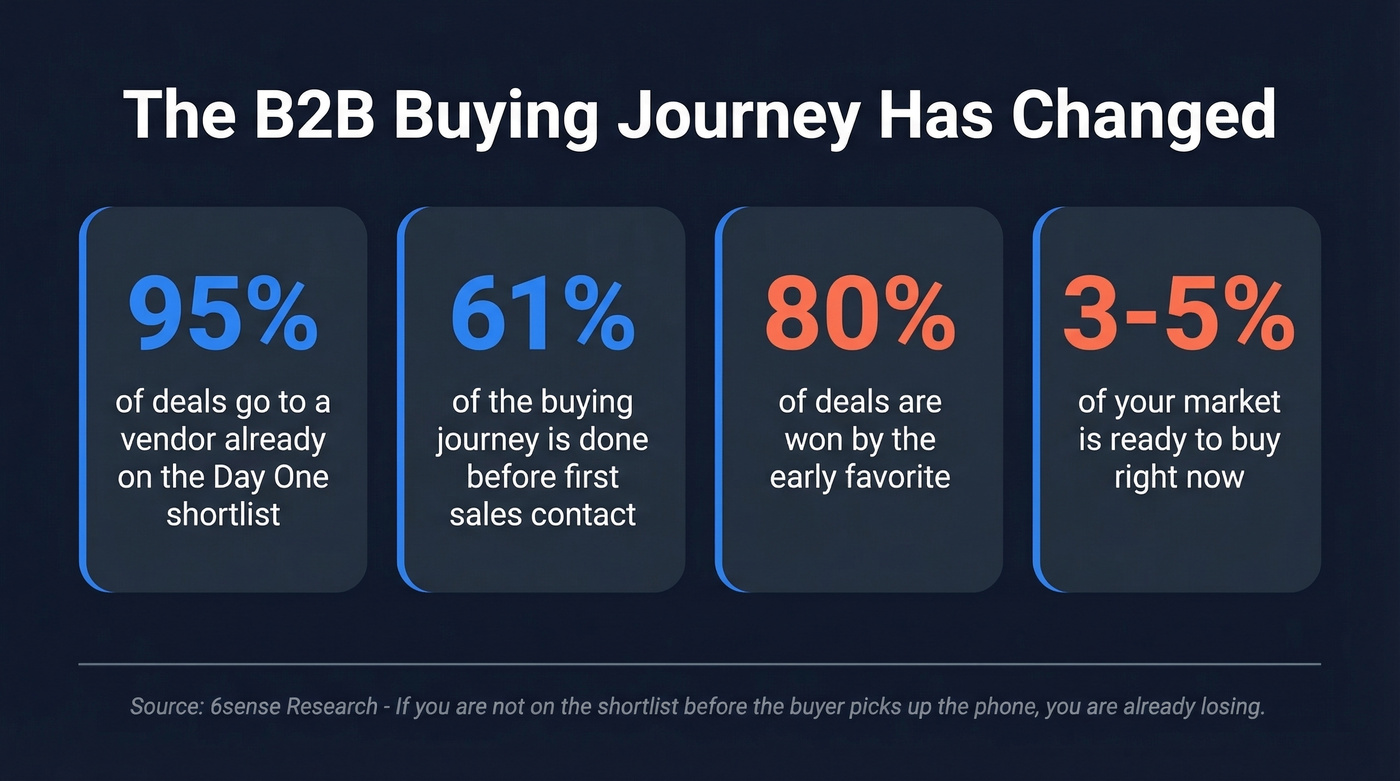
According to 6sense research, the winning vendor is on the buyer's "Day One shortlist" 95% of the time. First contact with sales happens around 61% of the buying journey, and the early favorite wins roughly 80% of deals. Let's be honest: if you're not on the shortlist before the buyer picks up the phone, you're already losing.
Only 3-5% of your market is ready to buy right now. If your marketing is built entirely around capturing that tiny slice, you're volunteering to lose the other 95% to whoever shows up earlier and more consistently.
Content didn't get easier, either. 56% of buyers say there's too much content, and 46% of companies create 6-10 content types, many of which don't meaningfully contribute to pipeline. Buyers also review 3-13 pieces of content before they'll talk to sales. So the win isn't "publish more." It's "publish fewer things that actually earn trust - and distribute them like you mean it." Cold email reply rates are down, feeds are noisier, and paid ads feel expensive and inconsistent, which is exactly why modern demand generation leans harder on signals, distribution, and being remembered rather than blasting more sequences.
Demand Gen vs. Lead Gen
These terms get used interchangeably, but they solve different problems. A useful framework splits the work into three functions: demand generation builds long-term awareness and preference, lead generation captures contact info from people already interested, and demand capture converts in-market intent.
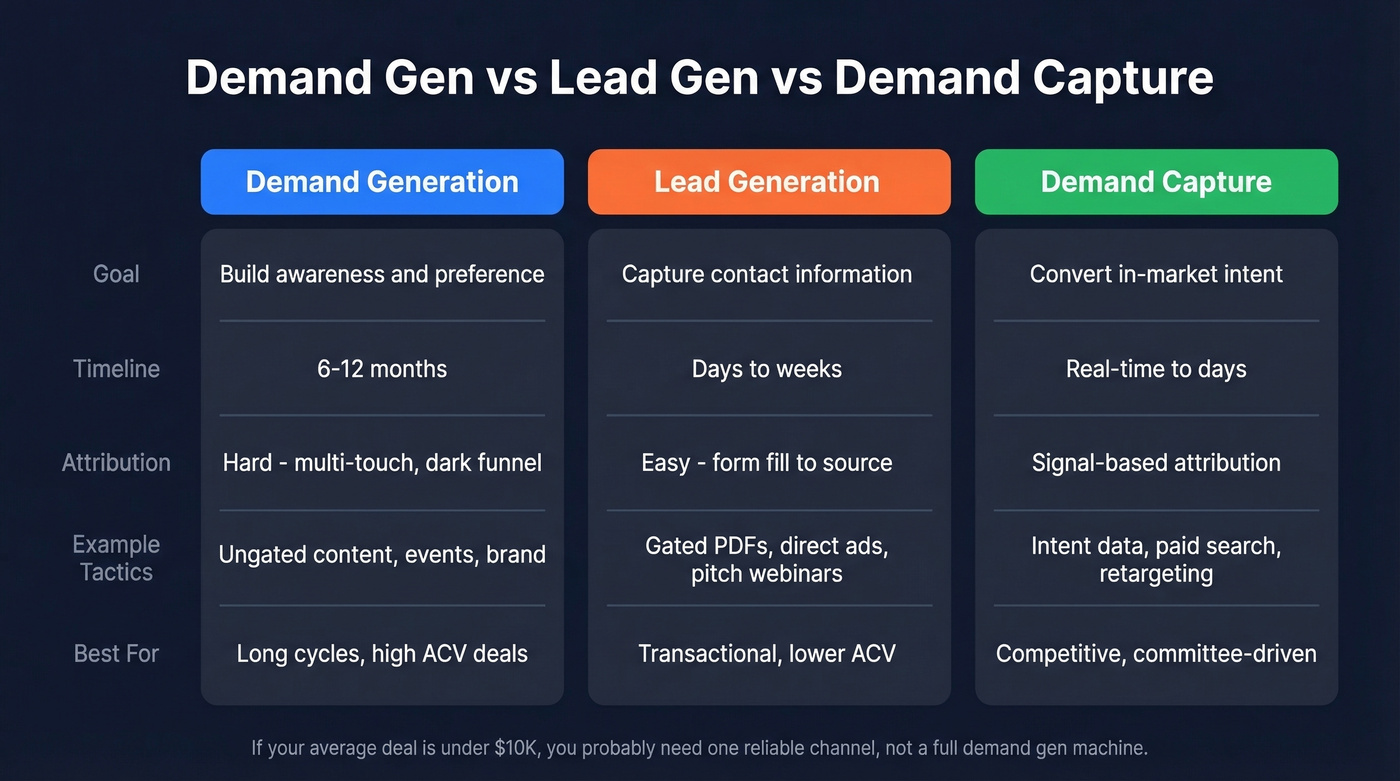
| Dimension | Demand Generation | Lead Generation |
|---|---|---|
| Goal | Build awareness + preference | Capture contact info |
| Timeline | 6-12 months | Days-weeks |
| Attribution | Hard (multi-touch, dark funnel) | Easy (form fill to source) |
| Example tactics | Ungated content, events, brand | Gated PDFs, direct ads, pitch webinars |
| Best for | Long cycles, high ACV | Transactional, lower ACV |
Here's the thing: if your average deal size is under $10K, you usually don't need a "full demand gen machine." You need one channel that reliably produces qualified conversations and a sales motion that closes. Demand gen becomes non-negotiable when deals are complex, competitive, and committee-driven.
The 4 Channels That Drive Pipeline
An Insight Partners survey of 100+ companies found that 70% of marketing-sourced pipeline comes from four channels: SEO, events, social media, and paid search. Marketing contributes nearly 50% of total pipeline across most of these companies. That's why getting demand gen right changes the whole business, not just MQL volume.
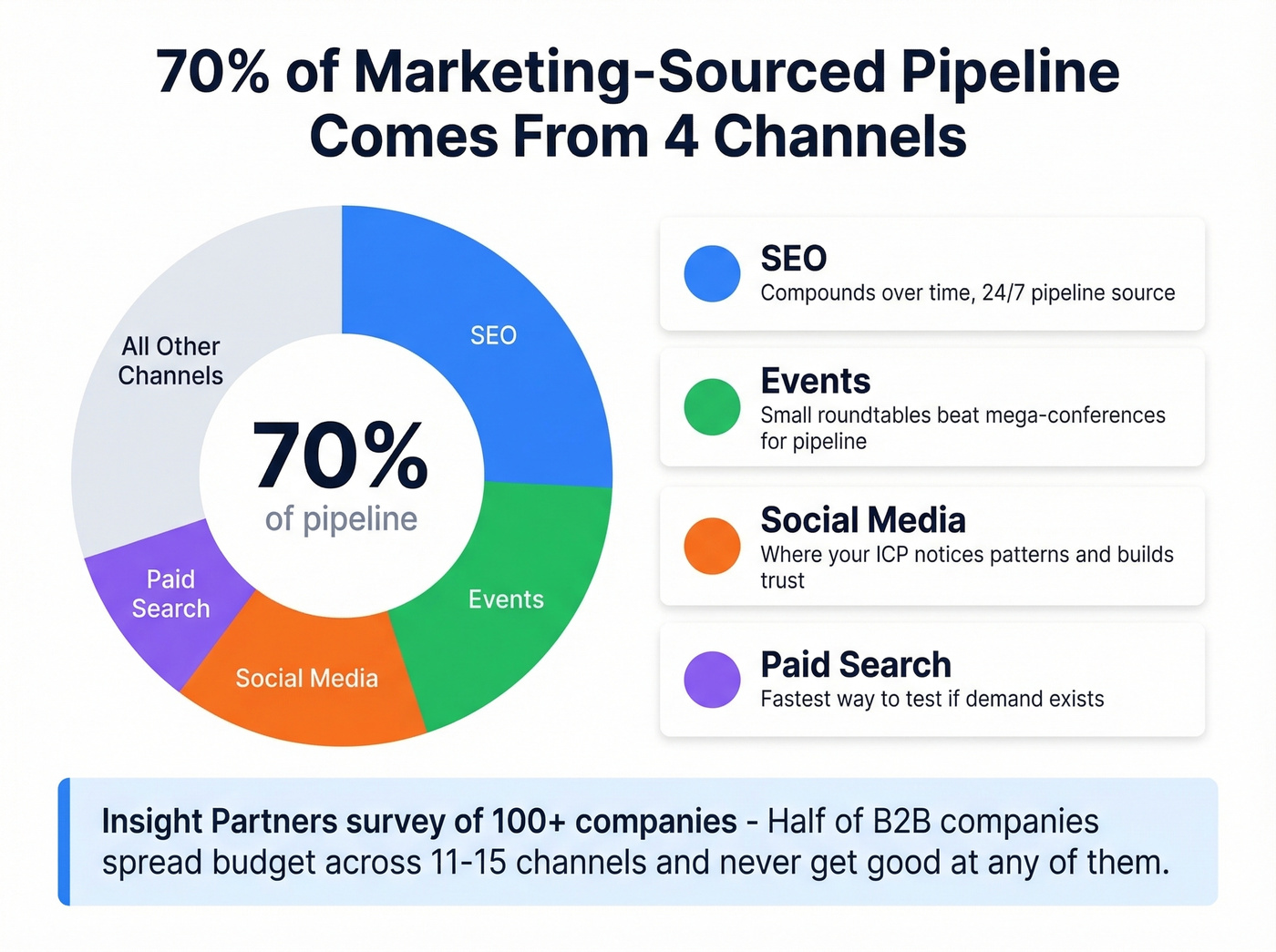
The same survey found that 72% of marketers don't have enough case studies to fuel their programs. That's not a "nice-to-have" gap - it's a pipeline gap. The content types that move deals are case studies, first-party research, and credible third-party research. Generic weekly blog churn is the easiest way to look busy while staying invisible.

Only 3-5% of your market is buying right now. Prospeo tracks 15,000 intent topics via Bombora so you can focus demand gen spend on accounts showing real buying signals - not spray budget across channels hoping something sticks.
Stop guessing which accounts are in-market. Let intent data tell you.
12 Proven Tactics (with Benchmarks)
1. SEO Content
B2B SaaS websites convert at about 1.1% on average. That's normal for high-consideration buying - plan for it instead of panicking.
If you're building this channel seriously, it helps to treat it like a pipeline system, not a traffic project - especially when you're trying to generate SEO that sales can actually work.
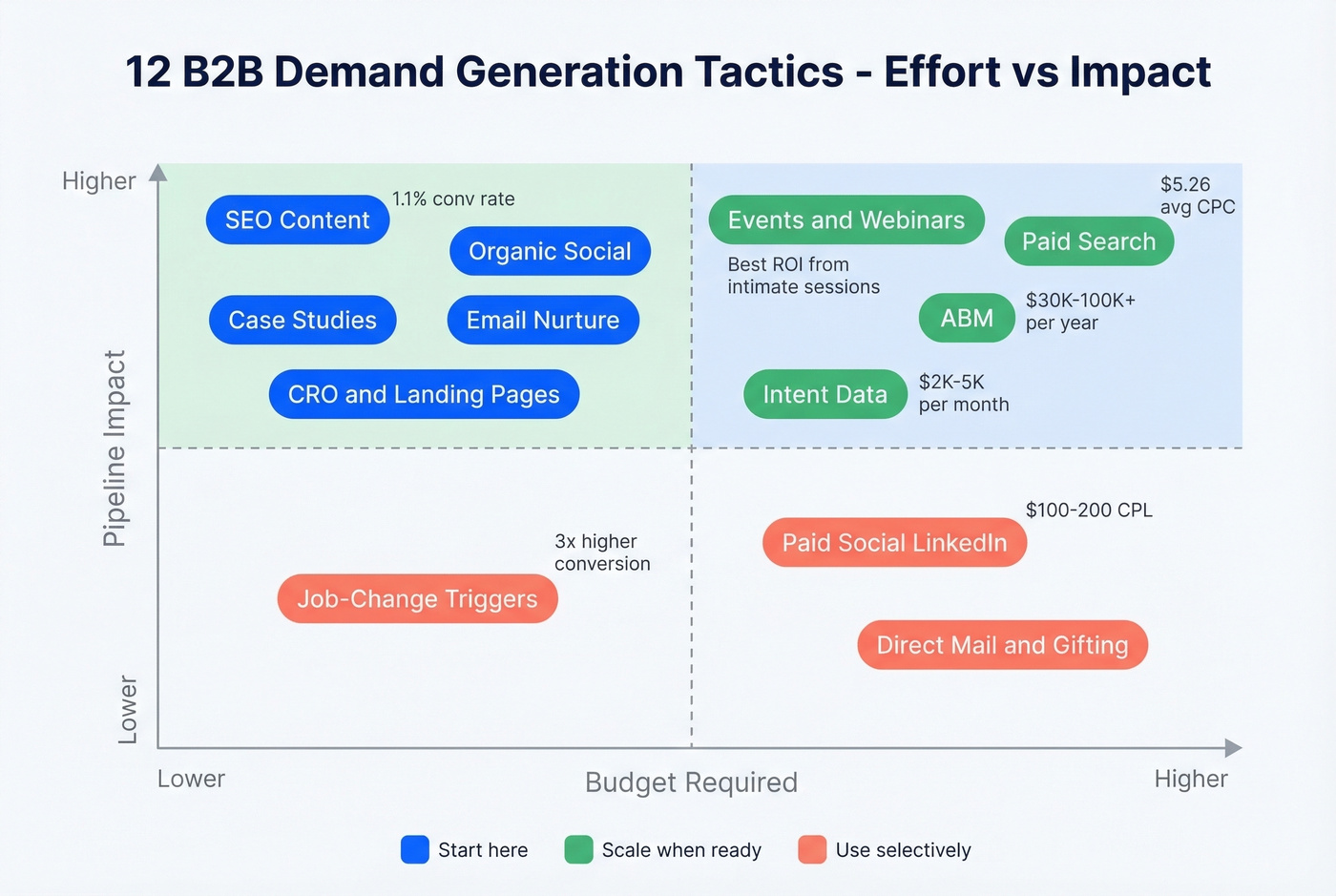
Prioritize pages that match buying intent: comparison pages, use-case pages, integration guides, and "best X for Y" pages. Use Ahrefs or Semrush (roughly $99/month and up) to track demand and rankings. SEO remains one of the most effective channels because it compounds - every page you rank is a 24/7 pipeline source that doesn't require ongoing ad spend.
Add a 2026 upgrade most teams still ignore: AI-discoverable content. Write pages so an AI assistant can quote them cleanly - tight definitions, clear "who it's for," concrete steps, and a short FAQ. If your content can't be summarized accurately, it won't get recommended.
2. Events and Webinars
Events are one of the four channels that drive the majority of pipeline, and the format matters more than the venue.
Small, high-intent roundtables and workshops beat mega-conferences for pipeline. The mega-conference is a brand play; the 20-person dinner is a pipeline play. Know which one you're running, and measure it accordingly. We've found that the best event ROI comes from hosting your own intimate sessions rather than sponsoring someone else's massive booth.
3. Paid Search
Paid search is the fastest "are we onto something?" channel because it captures existing demand. Benchmarks to plan around:
- Average CPC: $5.26
- Search conversion rate: 7.52%
- CPL: ~$70
Budget $3K-$10K/month per campaign so you get enough volume to optimize. If nobody is searching for your category, paid search won't rescue you - build demand elsewhere first.
| Channel | Avg CPC | Avg CTR | Avg CPL | Min Monthly Budget |
|---|---|---|---|---|
| Google Search | $5.26 | 6.66% | ~$70 | $3K-$10K |
| $3.94-$10+ | 0.52% | $100-$200 | $5K+ |
4. Paid Social (LinkedIn)
LinkedIn is expensive and precise. Treat it like a sniper rifle, not a leaf blower.
CPC runs $3.94 to $10+, CTR averages ~0.52%, and CPL for senior audiences is typically $100-$200. We've watched teams light up $5K/month targeting "VP+" with broad industries and get nothing but inflated impressions. Tighten targeting, tighten creative, and send clicks to a page that matches the ad's promise exactly.
5. Organic Social Distribution
Content without distribution is wasted effort.
A practical rule: spend 20% of your effort creating and 80% distributing. Organic social is where your ICP actually notices patterns - your POV, your customer stories, your product angles. If you publish and disappear, you're training the market to forget you. Among all demand gen activities, consistent organic distribution is the one most teams underinvest in relative to its impact. The consensus on r/sales and r/b2bmarketing backs this up: the teams that win aren't producing the most content, they're distributing the hardest.
6. Content Marketing (Case Studies First)
Buyers consume 3-13 pieces of content before they'll talk to sales. That's why "one great asset" beats "ten okay posts."
72% of marketers don't have enough case studies. Fix that first. One case study with real numbers and a clear before/after will outperform a month of generic content. A simple cadence that works: one strong case study per quarter, one research-backed piece per quarter, then repurpose both relentlessly across every channel you run.
If you need a tighter definition of what "content marketing" actually includes (and what to skip), align the team on a shared scope of content marketing before you scale production.
7. ABM (Operating Model)
If your average contract value exceeds $10K, ABM fits. But ABM isn't a campaign - it's an operating model.
Buying a Demandbase subscription (roughly $30K-$100K+/year) doesn't make you an ABM company. Multi-threading the buying committee, aligning on target accounts, and personalizing outreach does. In our experience, the biggest failure point is sales/marketing alignment - 42% of demand gen marketers say improving alignment is their biggest goal. That's not corporate fluff. It's the difference between "marketing got leads" and "we created pipeline."
If you're formalizing this motion, it helps to borrow from account-based selling best practices so sales and marketing run the same playbook.
8. Email Nurturing
This isn't cold outbound. It's what you do with people who already raised their hand.
MQL-to-SQL conversion rates commonly land in the 10-30% range depending on ICP fit and offer quality. The lever is segmentation: persona, buying stage, and engagement level. Cold outbound is simply harder in 2026 - realistic cold email reply rates sit around 1-3%, down from the 5-8% era. That makes warm nurture and trigger-based outreach the reliable path.
If your nurture is underperforming, the fastest fix is usually better sales follow-up rather than more emails.
9. Intent Data and Buying Signals
Intent data is how you stop guessing and start prioritizing. It tells you which accounts are actively researching topics tied to your category, and of all the approaches in this playbook, signal-based targeting delivers the highest conversion rates because you're reaching buyers who are already in-market.
Enterprise platforms like 6sense typically run $30K-$100K+/year. Bombora is often in the $2K-$5K/month range depending on package.

Prospeo pairs intent signals (powered by Bombora across 15,000 topics) with job role and company growth filters, so you can go straight from "this account is in-market" to "here are verified contacts to reach" - all self-serve with credit-based pricing starting at about $0.01 per verified email.
If you're building a scoring model around these signals, use a consistent framework for identifying buying signals so sales trusts the prioritization.

10. Job-Change Triggers
Job changes are a cheat code when you use them correctly. Past champions at new companies convert 3x higher because they already trust the tools they've used before.
Smartling reported 44x ROI in 11 months tracking job changes with UserGems. The play is simple: track champion moves, reach out fast, and be useful in the first 90 days while they're rebuilding their stack. Skip this tactic if you don't have an established customer base to mine - it only works when you have champions worth tracking.
To operationalize this, you need a repeatable process for tracking sales triggers (not just alerts).
11. Direct Mail and Gifting
Direct mail cuts through digital noise in a way another email never will.
Sendoso and Alyce typically start around $500-$2K/month plus gifting costs. Use this for named accounts and real buying committees, not as a "spray swag at a list" tactic. If the deal isn't worth the touch cost, don't do it.
If you're considering this channel, it's worth mapping it to a real direct mail workflow with benchmarks and stop rules.
12. CRO and Landing Page Optimization
Before you scale spend, know your baseline conversion rate:
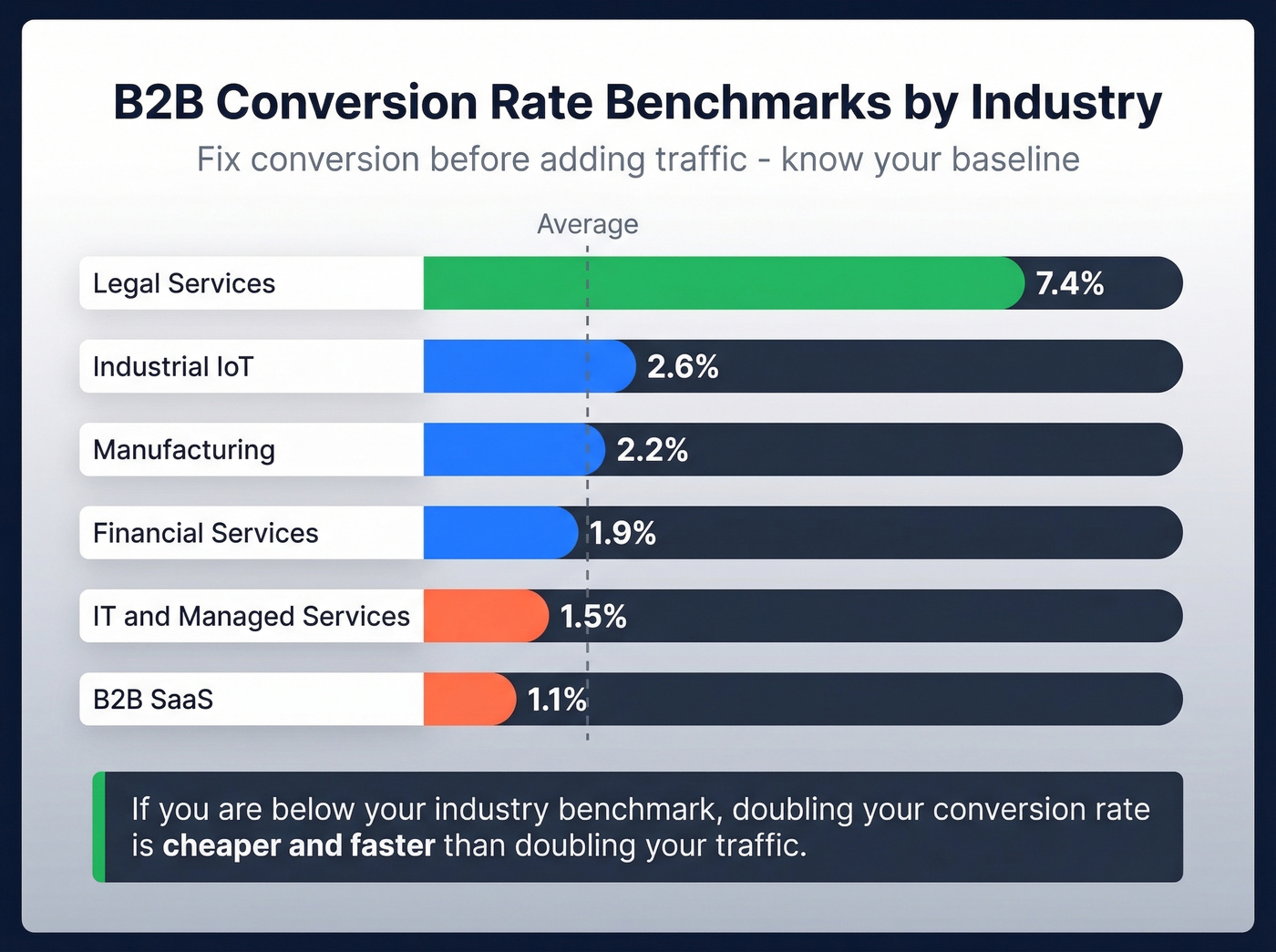
| Industry | Conversion Rate |
|---|---|
| B2B SaaS | 1.1% |
| IT & Managed Services | 1.5% |
| Financial Services | 1.9% |
| Manufacturing | 2.2% |
| Industrial IoT | 2.6% |
| Legal Services | 7.4% |
If you're below your benchmark, fix conversion before adding traffic. Doubling conversion is cheaper than doubling budget - and it compounds across every channel.
Data Quality Is Non-Negotiable
Every tactic above depends on reaching real people at real companies. 18% of B2B marketers cite incomplete or inaccurate data as their biggest barrier to confident decisions. In practice, it's often worse - we've seen teams run entire quarters on lists with 30%+ bounce rates, torching domain reputation and poisoning future deliverability.
Bad data doesn't just waste outreach. It actively makes your next campaign perform worse. No amount of clever strategy compensates for a rotten contact database.
If you're seeing bounces climb, start with the basics: measure email bounce rate and fix the root causes before you scale volume again.
Prospeo runs real-time verification with 98% email accuracy across 300M+ professional profiles, refreshing data every 7 days versus the industry average of roughly 6 weeks. That difference matters when you're running outbound at scale and can't afford bounces eating your sender reputation.
AI in Demand Gen
96% of B2B marketers now use AI in their roles, and 47% rank it as the #1 trend they're excited about. In Insight Partners' data, 65% of marketers say AI had a positive impact on at least one demand gen tactic.
AI excels at content personalization, account scoring, and signal processing. It fails when teams treat it like a strategy replacement - automating bad targeting faster doesn't make it good targeting. The real constraint is still data: scattered fields, stale titles, dead emails, and messy attribution. Fix inputs first, then let AI accelerate what already works.
If you're applying AI to outreach, make sure it supports (not replaces) proven sales prospecting techniques.
Measuring What Matters
Key Pipeline Metrics
Most teams obsess over activity metrics. Track pipeline metrics instead.
- Pipeline per 1,000 touches - the single best efficiency metric
- MQL-to-SQL conversion rate - typically 10-30%
- Pipeline velocity = (# of opportunities x average deal value x win rate) / sales cycle length in days
- CAC and LTV:CAC ratio
- Self-reported attribution - "How did you hear about us?" on every demo form
If you want a cleaner view of whether your program is actually compounding, track pipeline health alongside channel-level benchmarks.
Attribution Models
| Model | How It Works | Best For |
|---|---|---|
| First-touch | 100% credit to first interaction | Awareness channels |
| Last-touch | 100% credit to final interaction | Closing channels |
| Linear | Equal credit across all touches | Simple multi-touch |
| U-shaped | 40% first, 40% last, 20% middle | Balanced view |
| W-shaped | 30% first, 30% lead, 30% opp, 10% rest | Full-funnel B2B |
No model is perfect. Combine system attribution with self-reported attribution to capture dark funnel influence from communities, podcasts, events, and word of mouth.
Mistakes That Kill Demand Gen Programs
Channel sprawl is the #1 killer. Running 11-15 channels with a five-person team guarantees mediocrity.
A few other program-enders:
- Scaling before validating. Start with a narrow ICP wedge, prove conversion, then expand. I've seen teams pour $50K into a channel based on one good month - don't be that team.
- No stop rules. If 6-8 touches across two channels get zero engagement, exit. If you're reaching the wrong persona, ask for a redirect once, then exit. Clutch has a solid breakdown of practical stop signals.
- Tool-first thinking. Don't buy a $50K platform to avoid doing the hard work of ICP and messaging.
- Misalignment with sales. If sales won't follow up fast, won't work the target account list, or doesn't trust the scoring, your "demand gen" becomes expensive content production.
Let's break down the simplest prevention: document your ICP in one page, agree on a shared target account list with sales before launching anything, and review pipeline contribution - not lead volume - in every weekly standup. That alone puts you ahead of most teams.
If you don't have a one-page doc yet, start with an ICP template and scoring rubric.
Your demand gen drives awareness, but pipeline dies when contact data bounces. Prospeo's 98% email accuracy and 7-day data refresh mean every lead you capture actually reaches a real inbox - not a dead end.
Turn demand gen pipeline into booked meetings with data that connects.
FAQ
What is demand generation in B2B?
Demand generation is the set of marketing activities that creates awareness, trust, and preference before a buyer is ready to purchase. In B2B, it's how you get onto the shortlist early - so when the buying window opens, you're already the default option. It differs from lead gen, which captures existing interest rather than building new demand.
How long before demand gen produces pipeline?
Plan for 6-12 months. The average B2B buying cycle is 10.1 months, so expecting closed-won revenue in 60 days is fantasy. Paid search can show signal in weeks; SEO and events compound over months. Use 90-day checkpoints and cut tactics showing zero engagement.
What's a realistic budget for mid-market B2B?
Allocate 8-15% of target revenue. Budget $5K-$10K/month minimum per channel for meaningful optimization data. The biggest mistake is spreading $30K/month across ten channels instead of concentrating $10K across three.
How do we measure ROI on 10+ month cycles?
Track leading indicators monthly: pipeline per 1,000 touches, MQL-to-SQL rate, engagement velocity. Track lagging indicators quarterly: CAC, LTV:CAC, win rate on marketing-sourced opportunities. Add self-reported attribution to every demo form to capture dark funnel influence.
What tools do we need to start?
At minimum: a CRM (HubSpot's free tier works), an SEO tool like Ahrefs or Semrush from ~$99/month, a verified contact data source like Prospeo with its free tier of 75 verified emails/month, and marketing automation. Add intent data and sales engagement tools once your first three channels produce consistent pipeline.