

Demandbase vs Bombora: Which Intent Tool Is Worth the Budget?
Here's the distinction most buyers miss when evaluating Demandbase vs Bombora: Bombora is a data source that Demandbase itself integrates. This isn't a true either/or decision - it's a question of whether you need a clean intent feed or a full ABM orchestration platform built around it. Get it right and you'll save anywhere from $25k to $75k a year.
30-Second Verdict
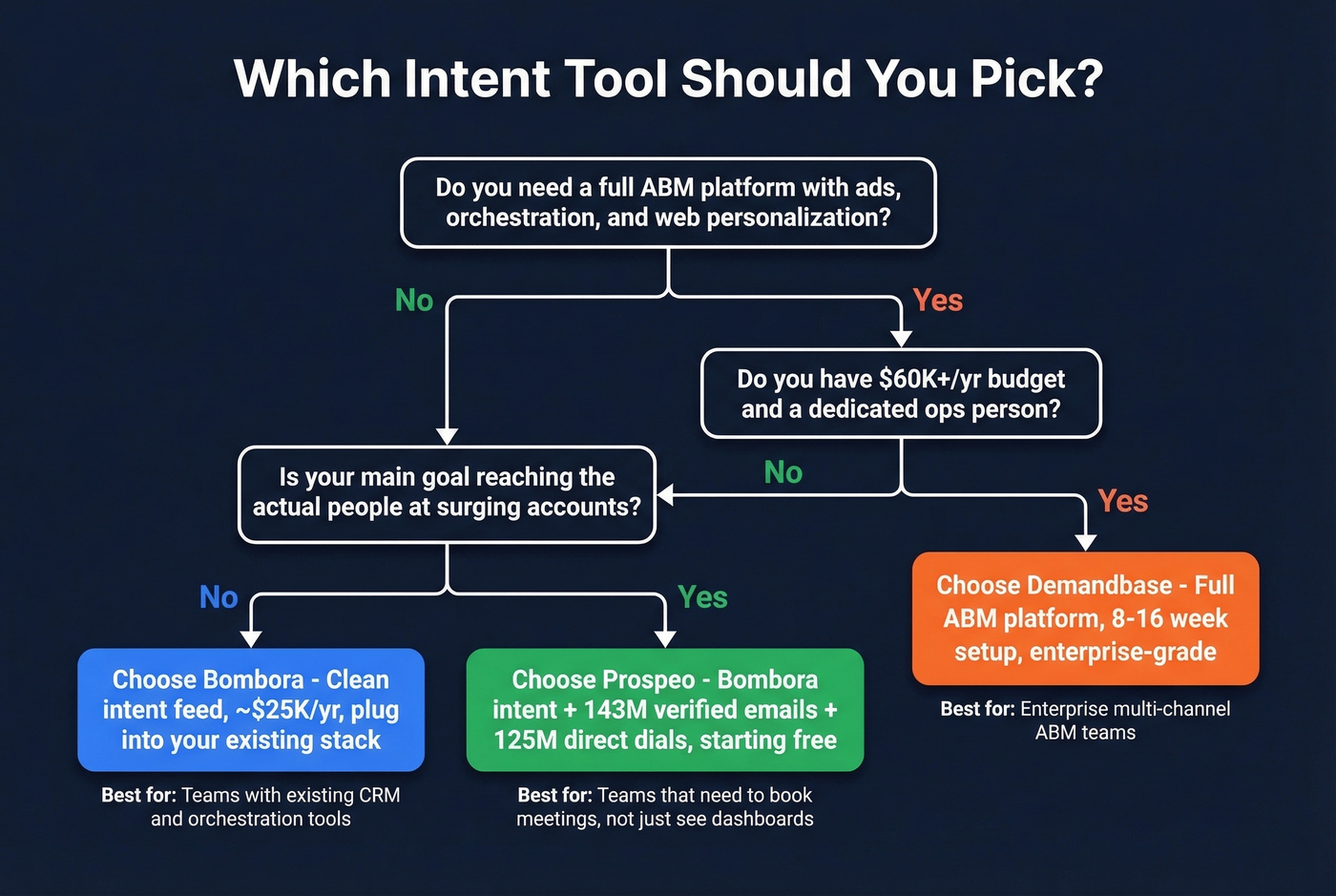
Choose Bombora if you need a transparent intent feed piped into your existing CRM or ABM stack. It's cheaper, faster to deploy, and users rate it higher on TrustRadius and most G2 usability sub-scores.
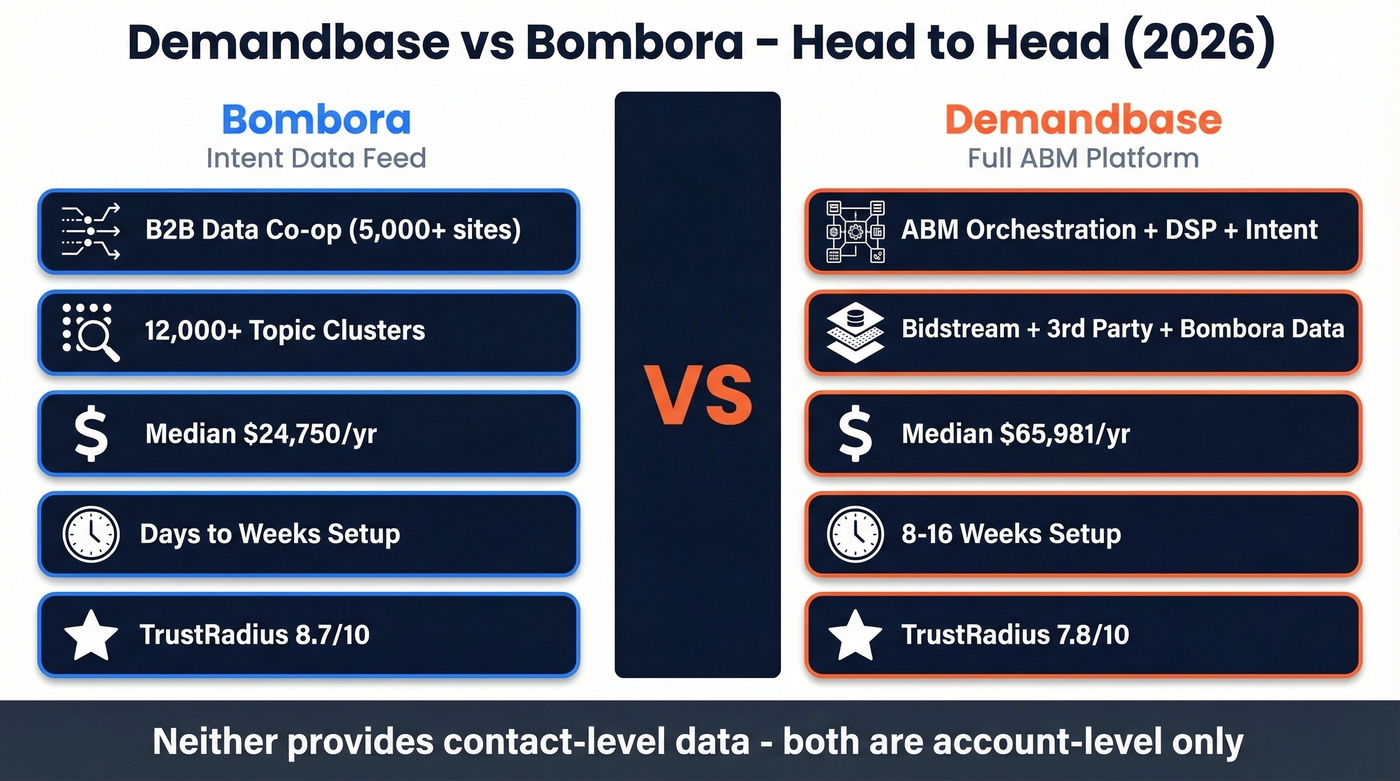
Choose Demandbase if you want a single platform handling ABM orchestration, advertising, and intent - and you've got $60k+/year plus dedicated ops resources to run it.
Skip both if your real goal is reaching the people behind surging accounts. Neither provides contact data. Pair them with a contact-level tool, or use Prospeo, which combines Bombora-powered intent signals with 143M+ verified emails and 125M+ direct dials - starting free.
What Each Tool Actually Does
Bombora Company Surge
Bombora Company Surge runs a B2B data co-op of roughly 5,000 business websites, categorizes anonymized content consumption across 12,000+ topic clusters, and flags when an account's research activity spikes above its baseline. That's Company Surge. Clean, transparent, focused.
What sets Bombora apart from most intent vendors is methodological openness - they'll tell you where the signal comes from, how it's scored, and how to operationalize it. A free trial is listed on review sites, which lowers the barrier to testing it against your ICP before committing budget.
Demandbase One
Demandbase is a full ABM platform that happens to include intent data. It blends bidstream signals, first-party data, and third-party sources - including Bombora itself - into a unified account view, then layers on advertising via a native DSP, web personalization, and sales orchestration.
The 2026 Agentbase rollout added an Intent Agent delivering AI-powered summaries of account activity, Ad Journeys for automated stage-based creative targeting, and Multi-Channel Campaign Reporting pulling LinkedIn, Google, and onsite engagement into one dashboard. These are meaningful improvements, but they also mean more complexity to manage. One TrustRadius reviewer who'd used both captured it well: "DB seemed a lot clunkier, harder to use. Salespeople didn't trust the data as much."
The tradeoff is real. Demandbase gives you breadth and workflow. Bombora gives you methodological clarity.
Pricing Breakdown for 2026
| Bombora | Demandbase | Prospeo | |
|---|---|---|---|
| Median contract | $24,750/yr | $65,981/yr | Free-low hundreds/yr |
| Low end | $12,250/yr | $22,860/yr | Free tier |
| High end | $80,525/yr | $164,265/yr | ~$0.01/email, credit-based |
| Time to value | Days to weeks | 8-16 weeks | Same day |
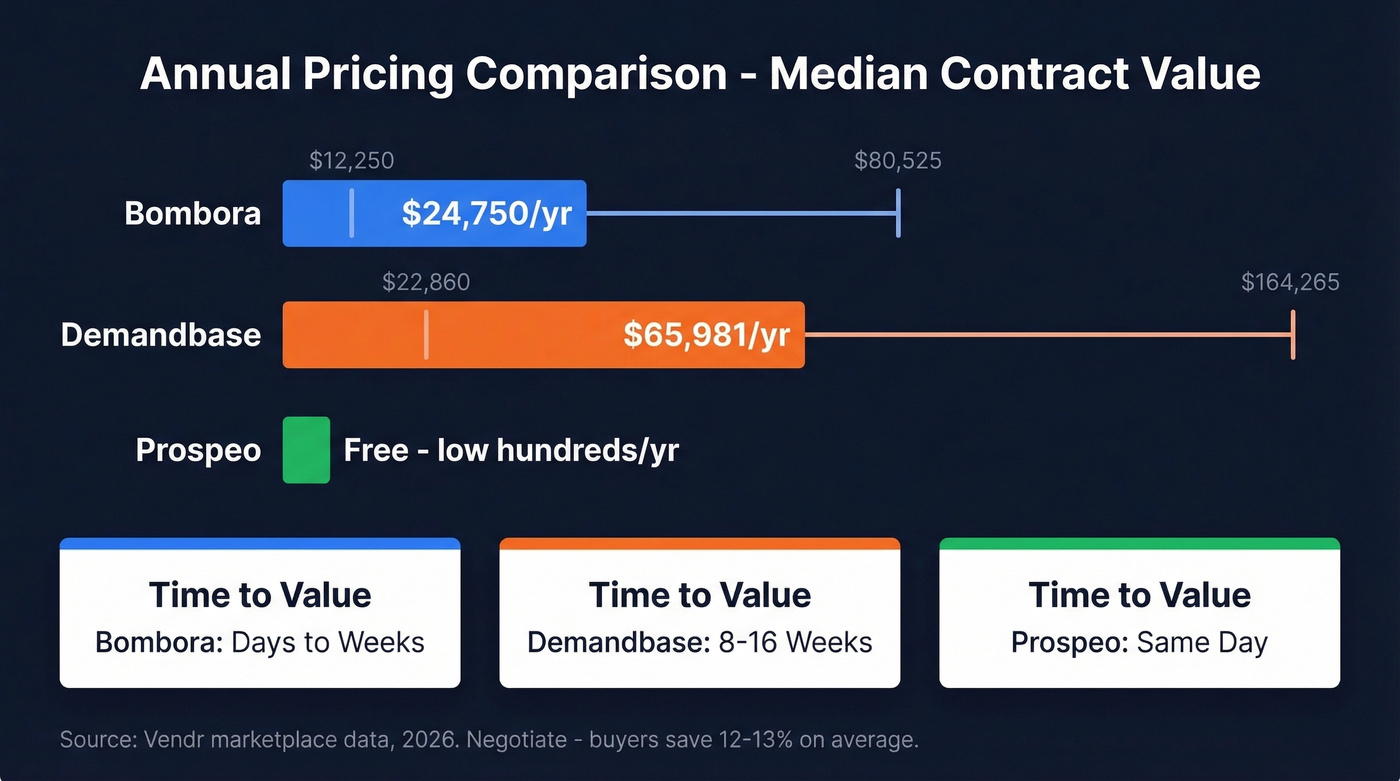
Bombora pricing is consumption-based - topics tracked, API calls, and integrations drive the number. The median across 34 Vendr purchases is $24,750/year, though mid-range deployments tracking 100-200 topics with standard CRM integrations often land $40k-$80k.
Demandbase pricing is modular: platform tier, target account volume, ad spend commitments, user seats, and data add-ons all stack. Vendr buyers save 12-13% on average for both tools through negotiation, so never accept the first quote.
Here's the thing: if your average deal size is under $15k, you almost certainly don't need a $66k/year ABM platform. A clean intent feed plus a contact data tool will outperform a bloated platform your sales team refuses to log into.

Spending $25K-$66K/year on intent signals your SDRs can't act on? Prospeo pairs Bombora-powered intent across 15,000 topics with 143M+ verified emails and 125M+ direct dials - at ~$0.01/email. No contracts, no 8-week implementation. Same-day activation.
Stop paying for signals. Start reaching the humans behind surging accounts.
What Users Actually Say
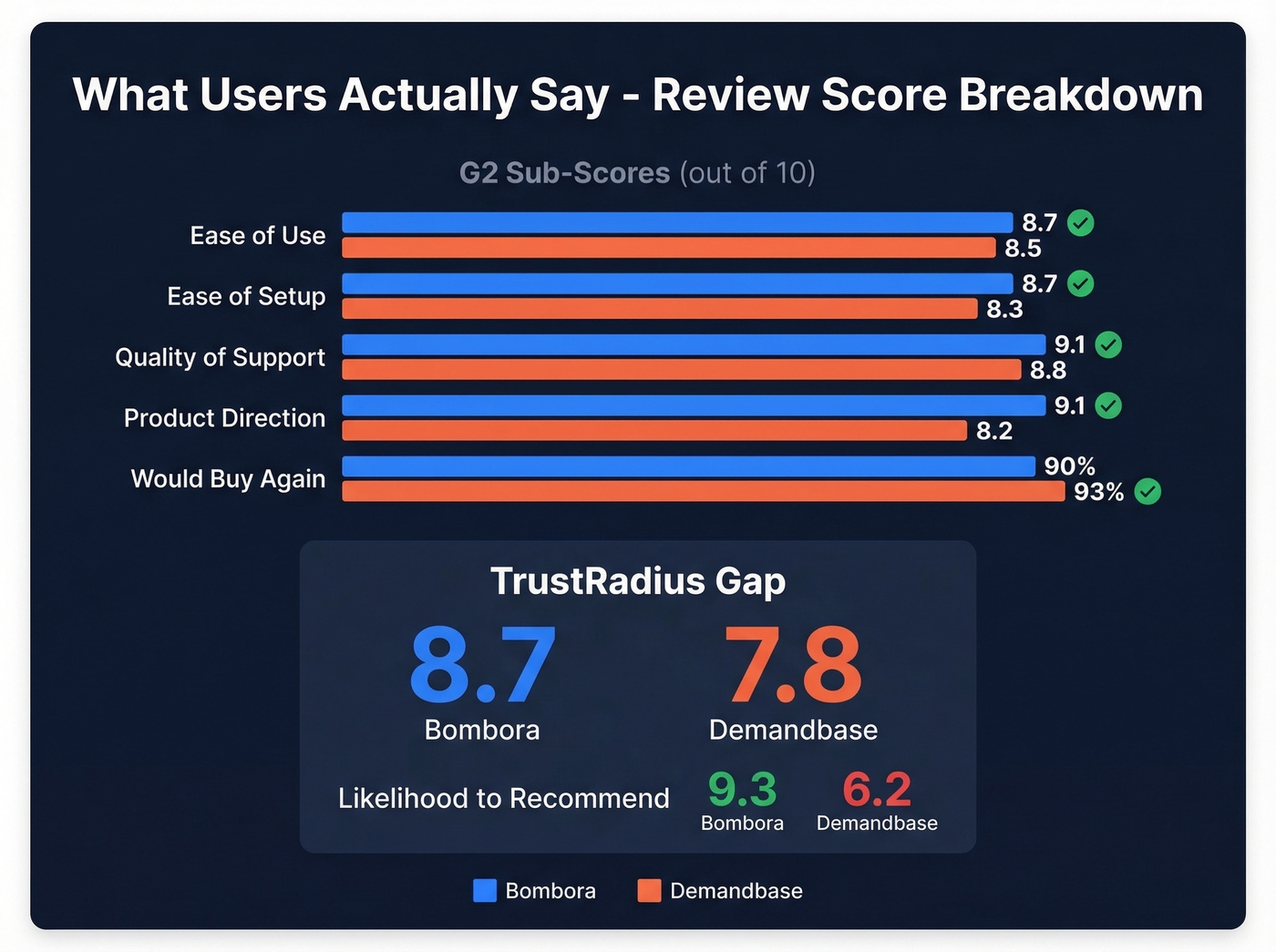
Both tools carry a 4.4/5 on G2, but the sub-scores tell a different story.
| Metric | Bombora | Demandbase | Winner |
|---|---|---|---|
| Ease of Use | 8.7 | 8.5 | Bombora |
| Ease of Setup | 8.7 | 8.3 | Bombora |
| Quality of Support | 9.1 | 8.8 | Bombora |
| Product Direction | 9.1 | 8.2 | Bombora |
| Would Buy Again | 90% | 93% | Demandbase |
TrustRadius widens the gap. Bombora scores 8.7/10 versus Demandbase's 7.8/10, and the likelihood-to-recommend numbers are striking: Bombora 9.3 vs Demandbase 6.2. Demandbase's larger review count - 1,934 versus 155 - means more variance, and plenty of happy enterprise users exist. But the pattern holds across both platforms: Bombora wins on simplicity and trust, Demandbase wins on feature scope.
When to Choose What
Choose Bombora If...
You need intent data piped into an existing stack. The methodology is transparent, and the median contract runs ~$25k/year. It integrates with major CRMs and ABM platforms, including Demandbase itself. If you already have orchestration tooling you trust, Bombora is the smarter spend.
Choose Demandbase If...
You want a single platform handling ABM orchestration, advertising, and intent - and you have $60k+/year, a dedicated ops person, and 8-16 weeks for implementation. Demandbase makes sense for enterprise teams running multi-channel ABM programs who want everything under one roof. For teams evaluating alternatives at a similar price range, 6sense is the main competitor at roughly $60k-$300k+/year.
Skip Both If...
Your real problem is reaching the people behind surging accounts. Not the accounts themselves - the humans.
A ~10-year ABM practitioner on r/b2bmarketing reported high false-positive rates from IP resolution, sales teams that refused to trust the data, and a gradual shift toward hybrid stacks. A separate r/gtmengineering thread called intent tools "noise dressed up as signal" without identity and activation built in. We've seen this play out with our own customers - the activation gap is where most intent investments stall. You buy the signal, but nobody can act on it because there's no contact data attached.
Closing the Contact Data Gap
Account-level intent without contact-level data is an incomplete product. Let's be honest - knowing that "Acme Corp is researching cloud security" doesn't help your SDR unless they can find the right VP of Security's email and phone number.
Prospeo closes this gap by running Bombora intent data across 15,000 topics and pairing it with 300M+ professional profiles, 143M+ verified emails, and 125M+ verified mobile numbers. Email accuracy runs 98% on a 7-day refresh cycle. No contracts, self-serve onboarding, starting free. We've watched teams go from "interesting intent dashboard" to booked meetings in the same afternoon - that's the difference contact-level data makes.
Account-level intent without contact data is an expensive dashboard. Prospeo closes the gap - 300M+ profiles, 98% email accuracy on a 7-day refresh, and Bombora intent built in. Teams using Prospeo book 35% more meetings than Apollo users and 26% more than ZoomInfo.
Turn surging accounts into booked meetings this afternoon.
FAQ
Can you use Bombora and Demandbase together?
Yes - Bombora is a native integration inside Demandbase One. Company Surge data feeds directly into Demandbase's scoring, journey staging, segmentation, and ad targeting. Many teams run both, using Bombora's co-op intent to supplement Demandbase's bidstream signals for broader coverage.
Is Bombora account-level or contact-level?
Account-level only. Bombora identifies which companies are researching specific topics, not which individuals. Demandbase works the same way. To find verified emails and phone numbers for the actual people at surging accounts, you'll need a separate contact data tool.
Why is Demandbase so much more expensive?
Bombora sells a single data product - intent signals. Demandbase bundles intent with a DSP for advertising, web personalization, sales intelligence, and ABM orchestration. That platform breadth drives the median contract from ~$25k to ~$66k. Whether you need all of that depends on your team's ops capacity and existing stack. Many mid-market teams get better ROI from a focused intent feed plus purpose-built tools for the rest.