

Dialpad vs Talkdesk: Which Contact Center Deserves Your Budget in 2026?
You pull up both pricing pages expecting a clean comparison. Dialpad doesn't publish Support pricing at all. Talkdesk publishes tiers but buries the mandatory three-year contract in the fine print. Welcome to cloud contact center shopping.
Let's cut through it.
30-Second Verdict
Pick Dialpad if you want AI baked into every plan, a single platform for UCaaS and CCaaS, and no multi-year lock-in. It's the better fit for teams under 200 agents who value simplicity.
Pick Talkdesk if you're running 500+ agents, need industry-specific compliance in healthcare or financial services, or want the deepest reporting suite in the category. Also worth a look if you're a tiny US/Canada team that qualifies for Express's 25 licenses free plus $100 in credits.
Skip both if your real problem is contact data quality. The fanciest dialer in the world can't fix a list full of disconnected numbers.
Pricing Breakdown
Dialpad doesn't publish its Support (CCaaS) pricing on its pricing page. The Connect UCaaS plans are public - $15 and $25/user/month - but those aren't contact center licenses. For Support, the best public data point comes from TrustRadius, which lists Essentials at $80/user/month. Higher tiers are estimated based on typical CCaaS tier spreads.
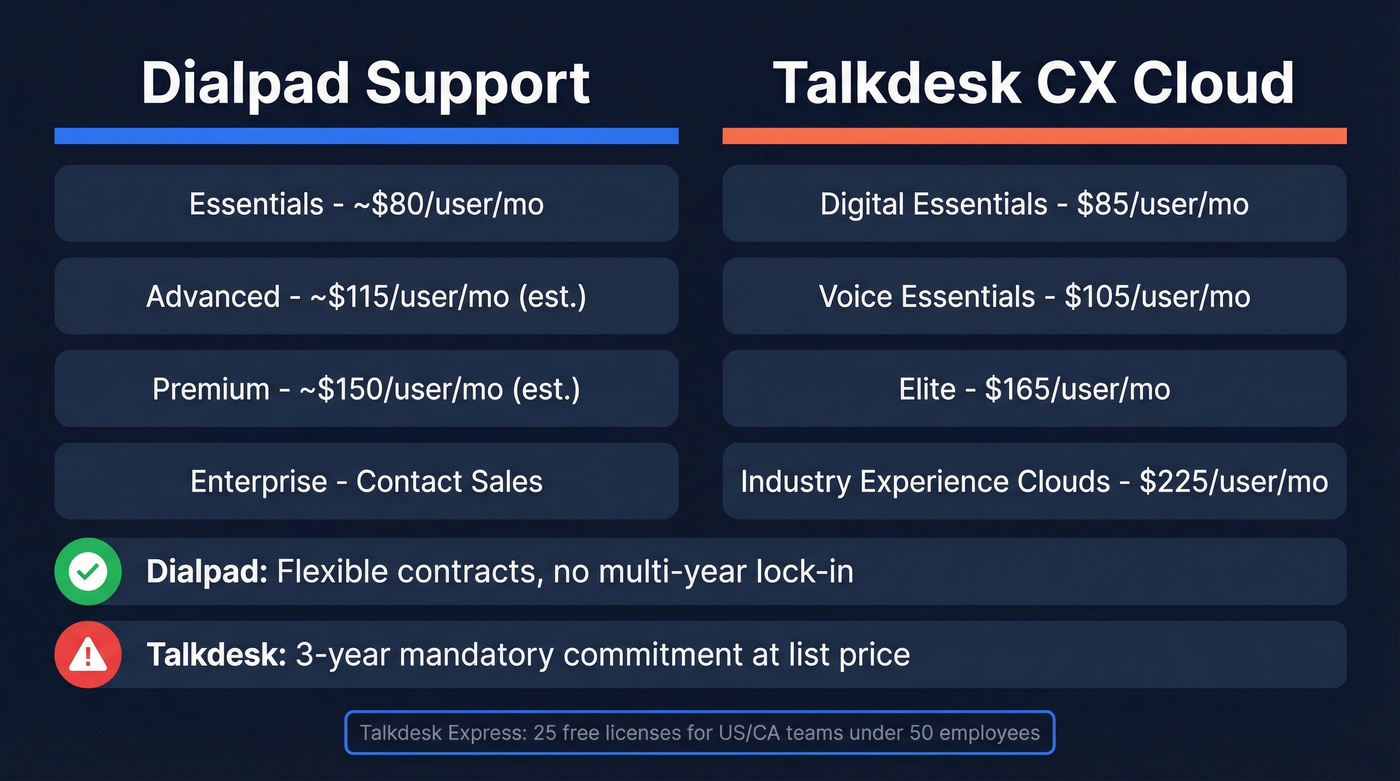
Talkdesk's pricing is better documented but comes with a catch: those list prices assume a mandatory three-year commitment. Beyond the base tiers, Talkdesk has 9 quote-based add-on packages - Local Presence, Hybrid Cloud, Phone Service, Studio Text-to-Speech, Social Messaging, Fax powered by eFax, Secure Payments, Proactive Outbound Engagement, and Workforce Management - each adding to your total spend.
| Dialpad Support | Talkdesk CX Cloud | |
|---|---|---|
| Entry tier | Essentials ~$80/user/mo | Digital Essentials $85/user/mo |
| Mid tier | Advanced ~$115/user/mo (est.) | Voice Essentials $105/user/mo |
| Top tier | Premium ~$150/user/mo (est.) | Elite $165/user/mo |
| Enterprise/vertical | Contact sales | Industry Experience Clouds $225/user/mo |
| Contract | Flexible, no mandatory multi-year | 3-year commitment at list price |
| Free/SMB option | None | Express: 25 free licenses (US/CA) |
Talkdesk Express deserves its own mention. If you're under 50 employees in the US or Canada, you get 25 licenses free plus $100 in credits. Additional users run $50/month on a pay-as-you-go basis. It's a completely different commercial model from CX Cloud, and for the right team, it's hard to beat on price.
Here's the math that matters: for a 50-seat team on Talkdesk Voice Essentials, the three-year contract means committing roughly $189,000 in per-agent licensing before telecom usage fees. Dialpad's flexible terms let you adjust headcount without that anchor. If you're growing fast or uncertain about seat count, that difference alone should drive your decision.
AI Features: Included vs Extra
This is where the two platforms diverge most sharply.
Dialpad's Approach
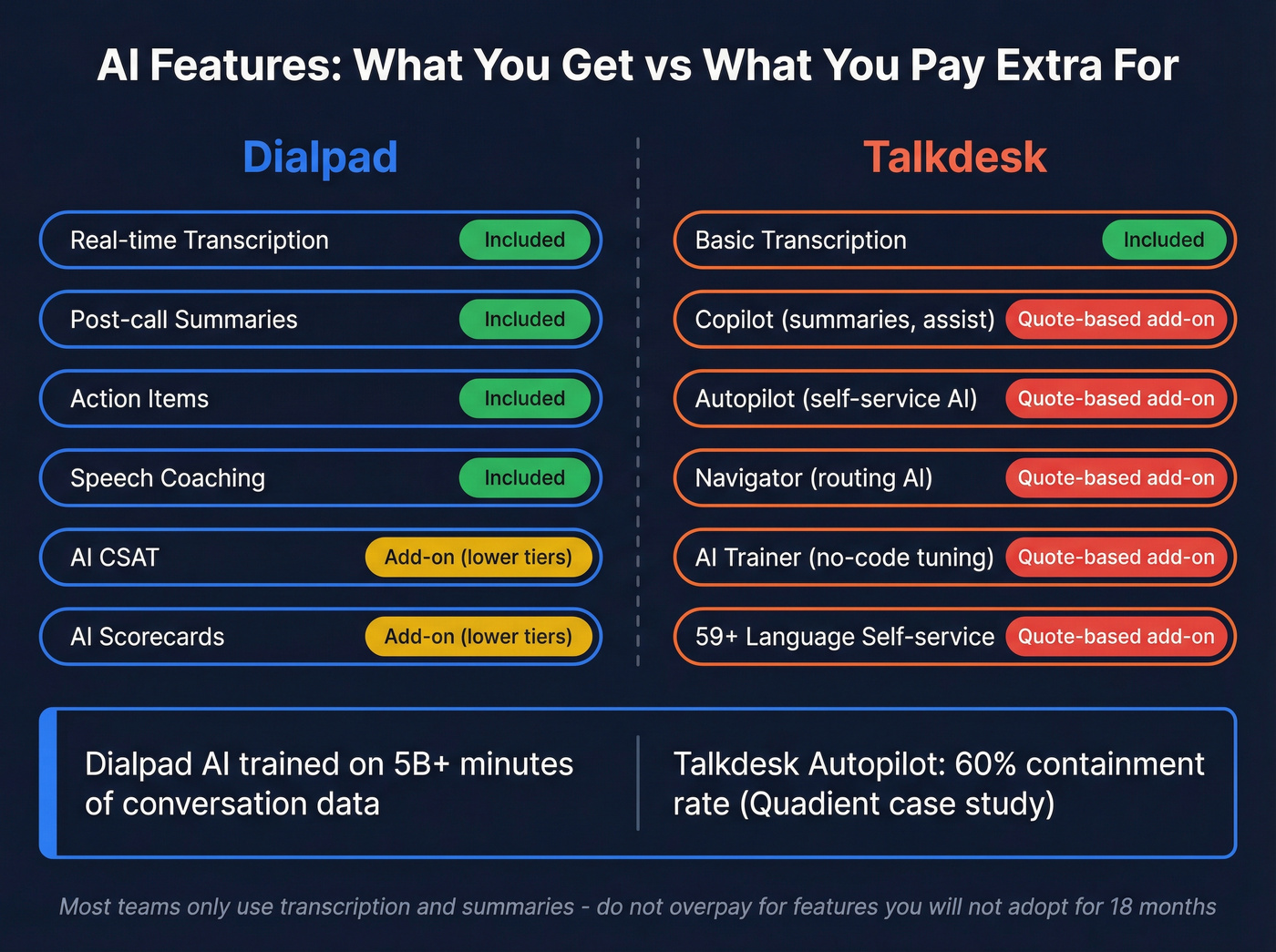
Use Dialpad if you want AI from day one without negotiating add-on pricing. Real-time transcription, post-call summaries, action items, and speech coaching are included across all Support tiers. AI CSAT and AI Scorecards are add-ons on lower tiers but included on Premium. Dialpad's AI has been trained on over 5 billion minutes of business conversation data, which gives it a meaningful edge in transcription accuracy for English-language calls.
Talkdesk's Approach
Use Talkdesk if you need agentic AI for self-service containment and you've got the budget for add-ons. Talkdesk's most powerful AI tools - Copilot, Autopilot, and Navigator - are quote-based add-ons. That's a significant hidden cost. Autopilot is impressive when it works: Quadient reported a 60% containment rate compared to 33% before deployment. Autopilot also supports 59+ languages for self-service, which partially offsets the add-on cost for multilingual operations. Talkdesk AI Trainer lets non-technical staff tune Autopilot outputs without code - useful if you don't have a dedicated AI ops team.
The trade-off is real, though. Copilot's summaries degrade on longer calls, and you won't know the price of any of these tools until you talk to sales. If you want AI without surprise invoices, Dialpad wins this category clearly.
Our take: Most teams evaluating "AI features" in their CCaaS platform will never use more than transcription and post-call summaries. If that's you, paying extra for Talkdesk's agentic AI is burning budget on capabilities your team won't adopt for another 18 months. Start with Dialpad's included AI, and upgrade when your use case actually demands it.

You're comparing dialers, but the real bottleneck isn't your phone system - it's your contact data. Prospeo gives you 125M+ verified mobile numbers with a 30% pickup rate, so every call your agents make actually connects to a real person. At $0.10/mobile, that's 90% cheaper than ZoomInfo.
Fix your list before you fix your dialer. Start with 75 free credits.
Reliability and Call Quality
Both platforms make aggressive uptime claims. Dialpad advertises a 100% uptime SLA for Enterprise customers. Talkdesk offers 99.999% uptime for Elite and Industry Experience Clouds - roughly 5 minutes of downtime per year.
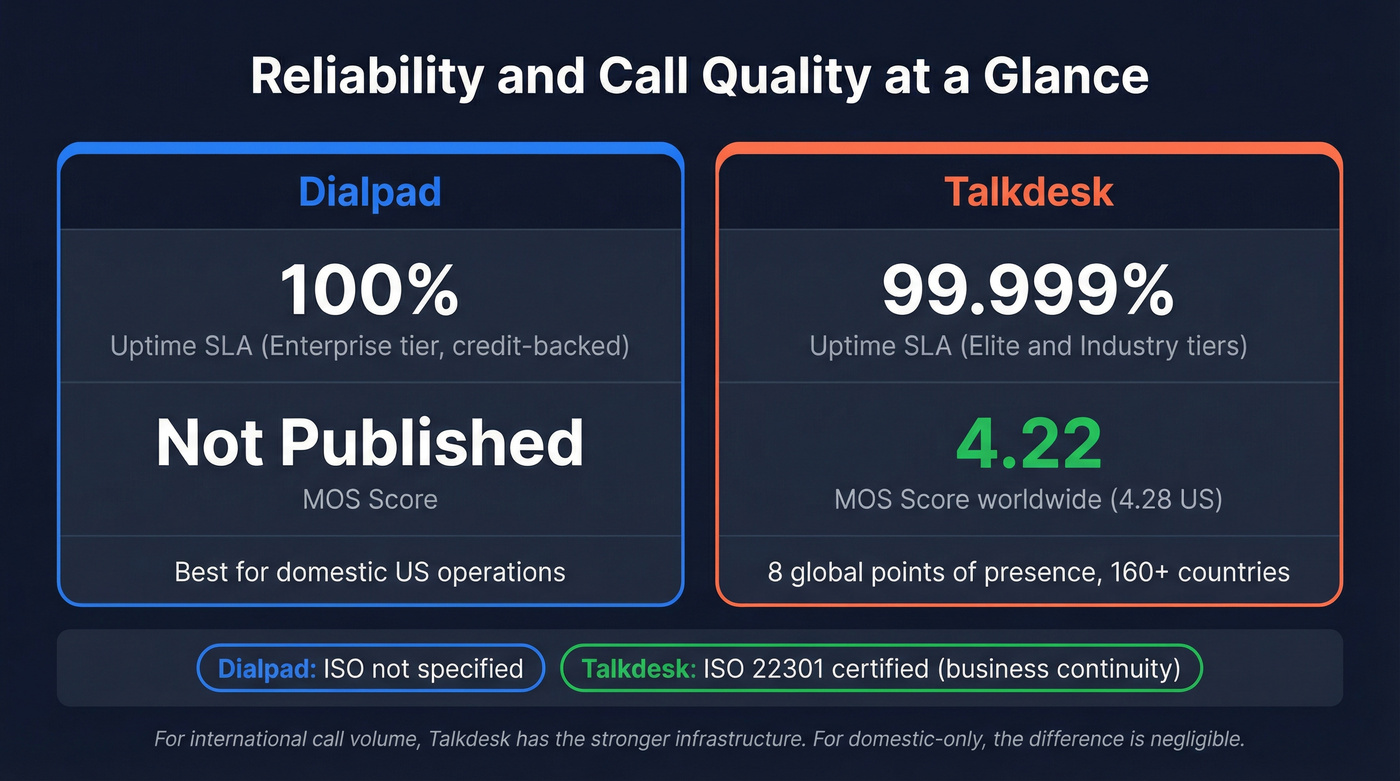
In practice, Dialpad's "100% uptime" means they'll credit you if anything breaks. Talkdesk backs its claim with 8 global points of presence, phone numbers in 160+ countries, and published MOS scores of 4.25 worldwide (4.28 in the US). Dialpad doesn't publish MOS scores. Talkdesk also holds ISO 22301 certification for business continuity management - a meaningful checkbox for enterprise procurement teams evaluating disaster recovery.
For teams with heavy international call volume, Talkdesk's global infrastructure is the stronger bet. For domestic-only operations, the difference is negligible.
What Real Users Say
User reviews on TrustRadius paint a nuanced picture. We've spent time reading through these threads, and a few patterns stand out.
Talkdesk
The praise centers on reporting depth - Aux codes, AHT breakdowns, productivity dashboards. Teams that live in reports love it.
The complaints are harder to ignore: one reviewer cycled through 5 account executives in 18 months. Stability issues force agents to restart the client, and the chat channel lags well behind voice in customization and reporting. Talkdesk Academy's training content is frequently called out as outdated. The consensus on r/sales and r/callcentre threads echoes this - great product, frustrating support experience.
Dialpad
Users consistently praise ease of use, WFH agility, and fewer dropped calls. The negatives are more cosmetic but still annoying: dashboard text is too small, agent presence states get stuck (your PC shuts down but you're still showing as "Available"), and localization support outside English - particularly Japanese - has gaps. This is a common pattern in UCaaS: strong English-language experience, weaker international support.
When to Pick Each Platform
Pick Dialpad if:
- You want core AI included without negotiating add-on pricing
- You're consolidating UCaaS + CCaaS onto one platform
- Your team is under 200 agents
- You refuse to sign a multi-year contract
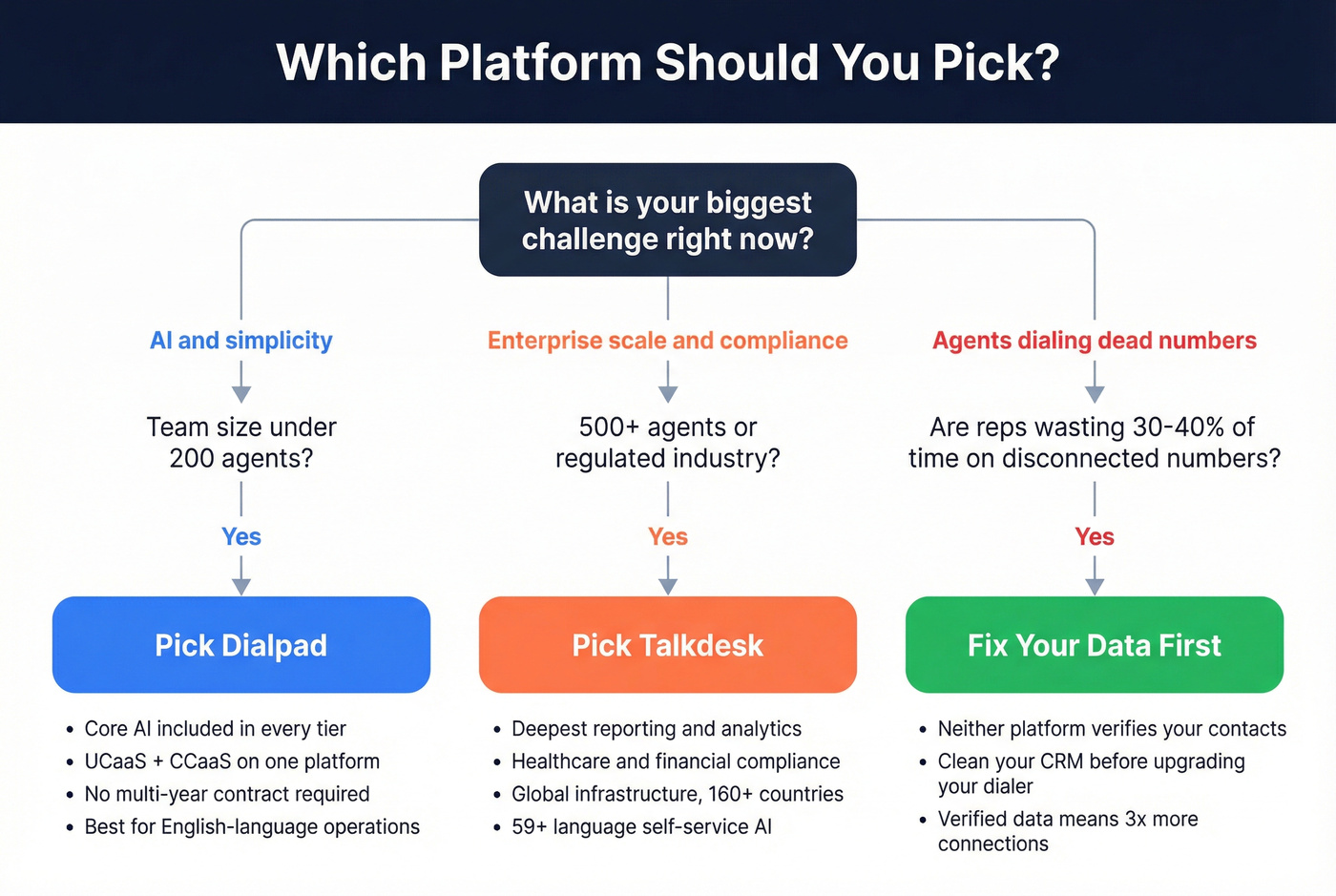
Pick Talkdesk if:
- You're running 500+ agents and need enterprise reporting depth
- Industry compliance matters in healthcare or financial services
- You're a tiny US/Canada team that qualifies for Express
- Global voice infrastructure and multilingual self-service are priorities
Pick neither if:
- Your agents are burning 30-40% of their time dialing disconnected numbers or emailing bounced addresses. That's not a platform problem - it's a data problem. Neither platform will fix it.
The Problem Neither Platform Solves
Here's the thing: neither Dialpad nor Talkdesk verifies the contact data flowing into your dialer. They assume your CRM is clean. It isn't.
Every dead number your agents dial costs you per-minute telecom fees and, more importantly, rep time that could've been a live conversation. We've seen teams where reps spend a third of their shift listening to disconnection tones - and then blame the platform. The platform isn't the problem.
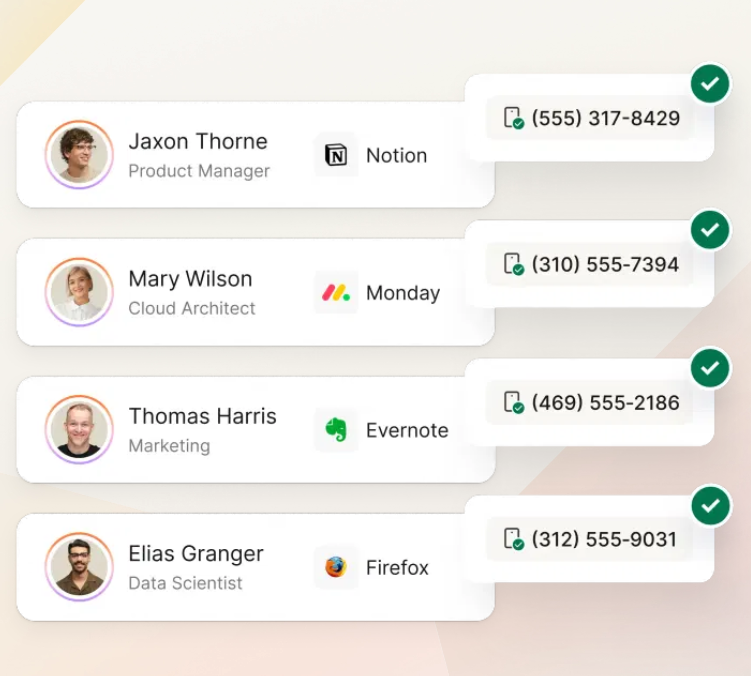
Prospeo sits upstream of whichever CCaaS platform you choose. Its database covers 125M+ verified mobile numbers with a 30% pickup rate, 143M+ verified emails at 98% accuracy, and a 7-day data refresh cycle that keeps numbers current instead of decaying over weeks. Plug it into your CRM enrichment workflow, and the data hitting your dialer is actually worth dialing. One customer, Meritt, saw their bounce rate drop from 35% to under 4% and their connect rate triple after switching their data source.
If you're trying to keep your CRM clean long-term, start with CRM hygiene and add a CRM verify step before records ever reach your dialer.
Dialpad or Talkdesk, neither platform can save a campaign built on disconnected numbers. Prospeo's 7-day data refresh cycle means your contact lists stay current - not 6 weeks stale like other providers. Teams using Prospeo book 26% more meetings because they're calling numbers that actually ring.
Stop paying per agent for calls that never connect. Fix the data first.
FAQ
Is Talkdesk really cheaper than Dialpad?
At list price, Talkdesk starts $5/user/month higher ($85 vs ~$80). But Talkdesk Express gives US/Canada teams under 50 employees 25 free licenses, making it cheaper for tiny teams. Factor in Talkdesk's mandatory three-year contract and total cost of ownership favors Dialpad for most buyers above 25 seats.
Which platform has better AI features?
Dialpad includes core AI - transcription, summaries, speech coaching - in every Support tier at no extra cost. Talkdesk's most powerful AI tools like Copilot, Autopilot, and Navigator are quote-based add-ons on top of your plan cost. For teams that want predictable AI spend, Dialpad is the safer choice.
How do I make sure my agents are dialing valid numbers?
Neither Dialpad nor Talkdesk verifies the contact data in your CRM. Use a data verification tool to validate mobile numbers and emails before they enter your dialer - a 7-day refresh cycle keeps records current so agents connect on more calls instead of hitting voicemail graveyards. Expect bounce rates to drop below 4% with proper enrichment.