

DiscoverOrg vs ZoomInfo: There's No Comparison (Literally)
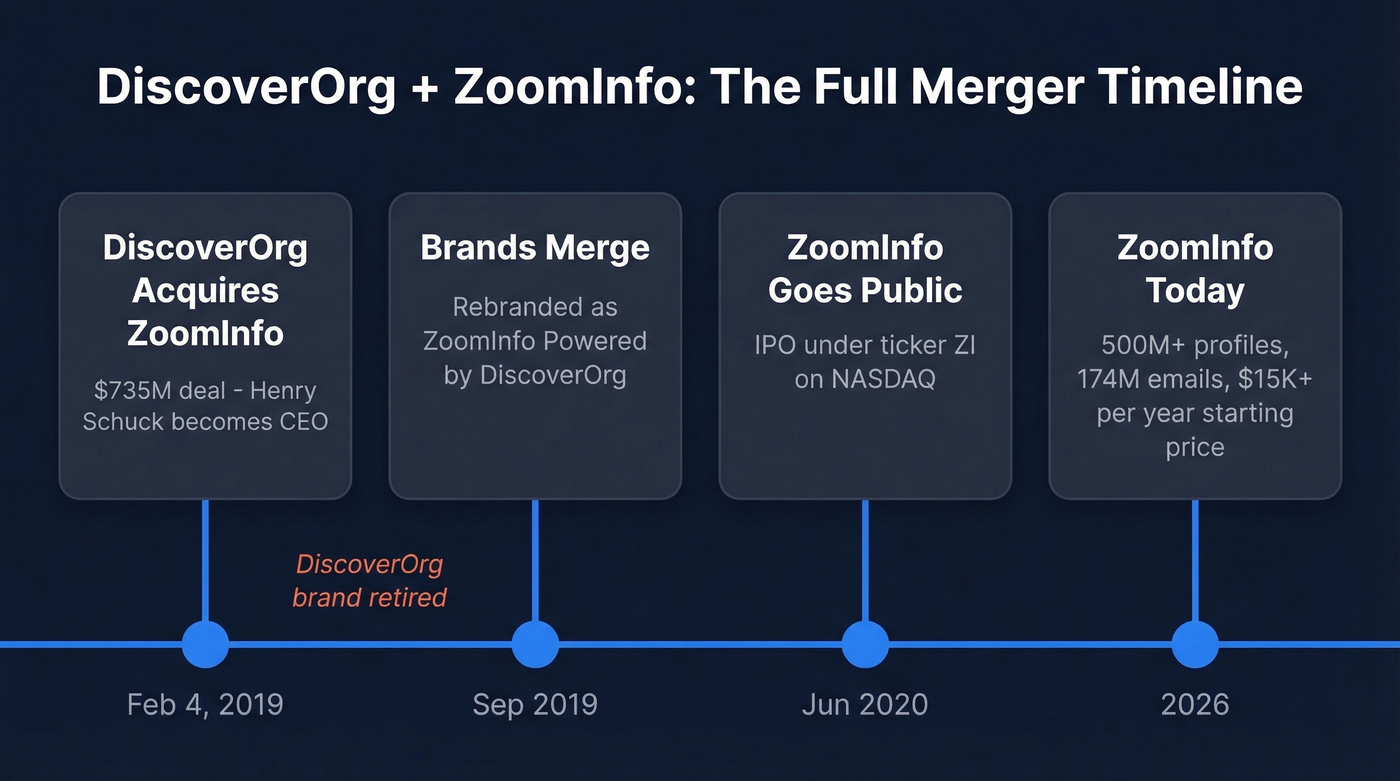
There is no DiscoverOrg vs ZoomInfo debate anymore. DiscoverOrg acquired ZoomInfo for $735 million on February 4, 2019, and the market consolidated around the ZoomInfo name. By September 2019, the two brands had merged into a single platform called "ZoomInfo Powered by DiscoverOrg." The acquirer killed its own brand - and left behind one product at enterprise pricing.
30-Second Verdict
DiscoverOrg doesn't exist. ZoomInfo starts at roughly $15,000/year with mandatory annual contracts. It's a strong platform if you've got the budget and headcount to justify it - but most teams under 10 reps don't, and independent reviews peg real-world email accuracy at 75-85%. Smaller teams get better results spending a fraction of that on tools built for data quality over breadth.
What Actually Happened
On February 4, 2019, DiscoverOrg (backed by Great Hill Partners) acquired ZoomInfo in a deal valued at $735 million. Henry Schuck, DiscoverOrg's CEO, took the helm, and the combined business ultimately operated under the ZoomInfo name. The combined company went public in 2020 under the ticker ZI.
TrustRadius still lists DiscoverOrg comparison pages. They're comparing a ghost to the company that absorbed it.
What Survived Inside ZoomInfo
Most of DiscoverOrg's core strengths made it into ZoomInfo's platform. ZoomInfo's Sales product now spans 500M+ professional profiles, 174M verified emails, and 70M+ direct dials. The features that carried over:
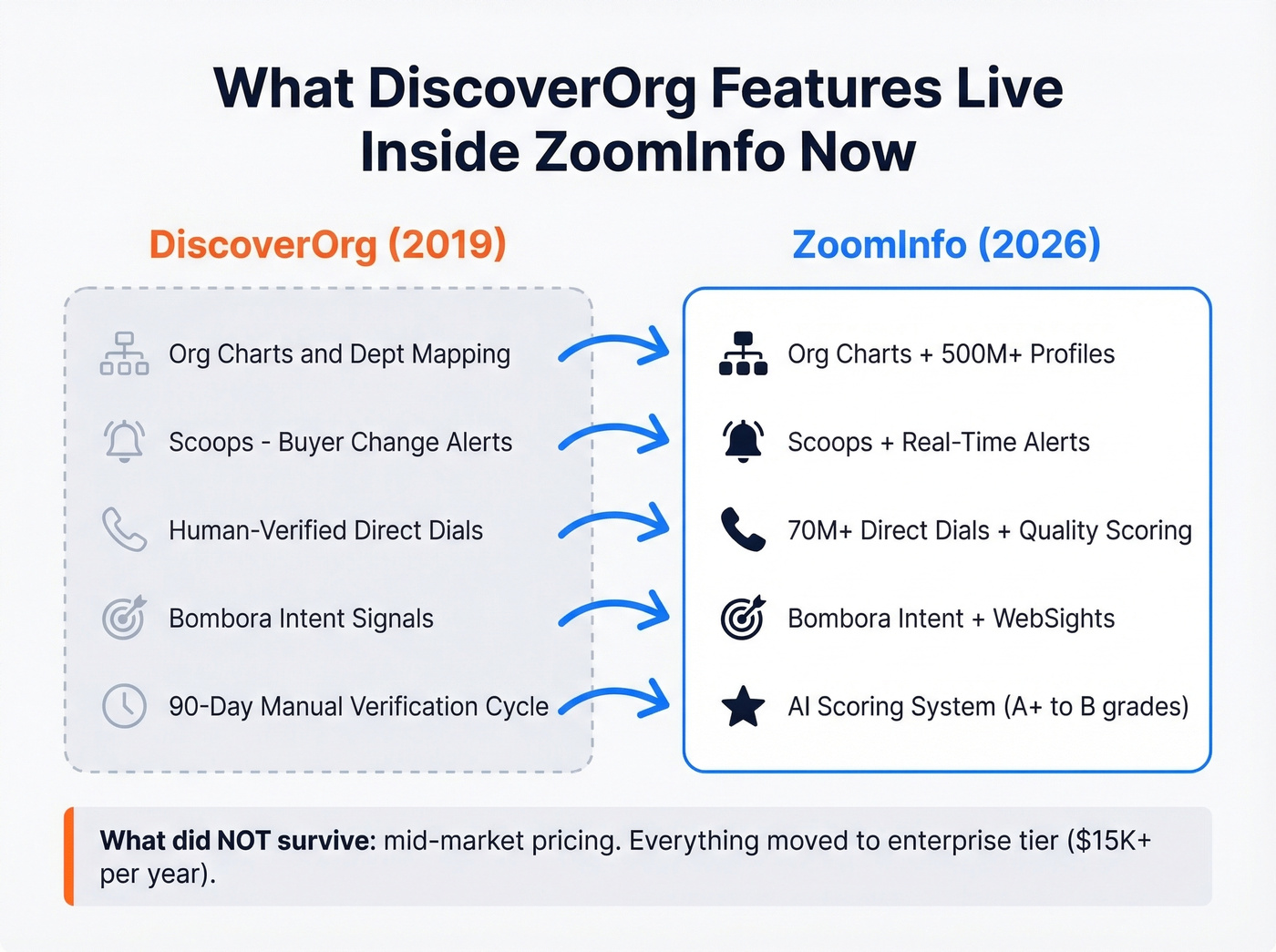
- Org charts and department-level contact mapping
- Scoops - alerts on key company and buyer changes
- Human-verified direct dials, a major DiscoverOrg differentiator
- Bombora intent signals for buyer-intent tracking
DiscoverOrg's original model hand-verified contacts every 90 days. After the datasets were combined, ZoomInfo introduced contact data quality scoring to communicate freshness and confidence at scale - contacts get a numeric score (95 means a 95% likelihood the person is still at that company with a valid email) and letter grades: A+ for 95+, A for 85-94, B for 75-84. Direct dial accuracy typically lags the contact score by about 5 points.
What didn't survive was the mid-market-friendly packaging. ZoomInfo pushed everything into enterprise territory and layered on Workflows, WebSights, and a full GTM automation suite - features that also drive up the bill. With B2B contact records decaying roughly 30% annually, that scoring model matters more than most buyers realize.

ZoomInfo absorbed DiscoverOrg and pushed pricing past $15K/year - for email accuracy that independent reviews peg at 75-85%. Prospeo delivers 98% verified email accuracy across 300M+ profiles at roughly $0.01 per lead, with a 7-day data refresh cycle and zero annual contracts.
Stop paying $3 per contact for data that bounces.
ZoomInfo Pricing in 2026
ZoomInfo doesn't publish pricing. Everything goes through sales. But between Vendr benchmarks, community reports, and independent pricing guides, we can piece together what teams actually pay.
| Tier | Annual Cost | Credits Included | Cost per Credit |
|---|---|---|---|
| Professional | $15,000-$18,000 | 5,000 | ~$3.00 |
| Advanced | $24,000-$30,000 | ~12,000 | ~$2.00 |
| Elite | $40,000-$45,000+ | Custom | ~$0.60 (bulk) |
Those are starting points. Most teams end up paying $30k-$75k+ once add-ons stack up. Enrich runs $10,000-$15,000/year. Global Data is another ~$10,000+. NeverBounce email verification adds ~$3,000. Additional seats cost $2,000-$5,000 each.
What companies actually pay:
| Company Size | Annual Range |
|---|---|
| ~200 employees | $24,800-$44,200 |
| ~1,000 employees | $50,200-$113,800 |
| 1,000+ employees | $83,200-$161,900 |
Credit overages hit at $0.25-$0.50 per credit, and unused credits don't roll over. At the Professional tier, you're paying roughly $3 per contact. That math gets uncomfortable fast for teams running high-volume outbound.
Contract Gotchas
Here's the thing: $15,000 is a lot of money for email accuracy that lands around 75-85% in the real world. The contract structure makes it worse.
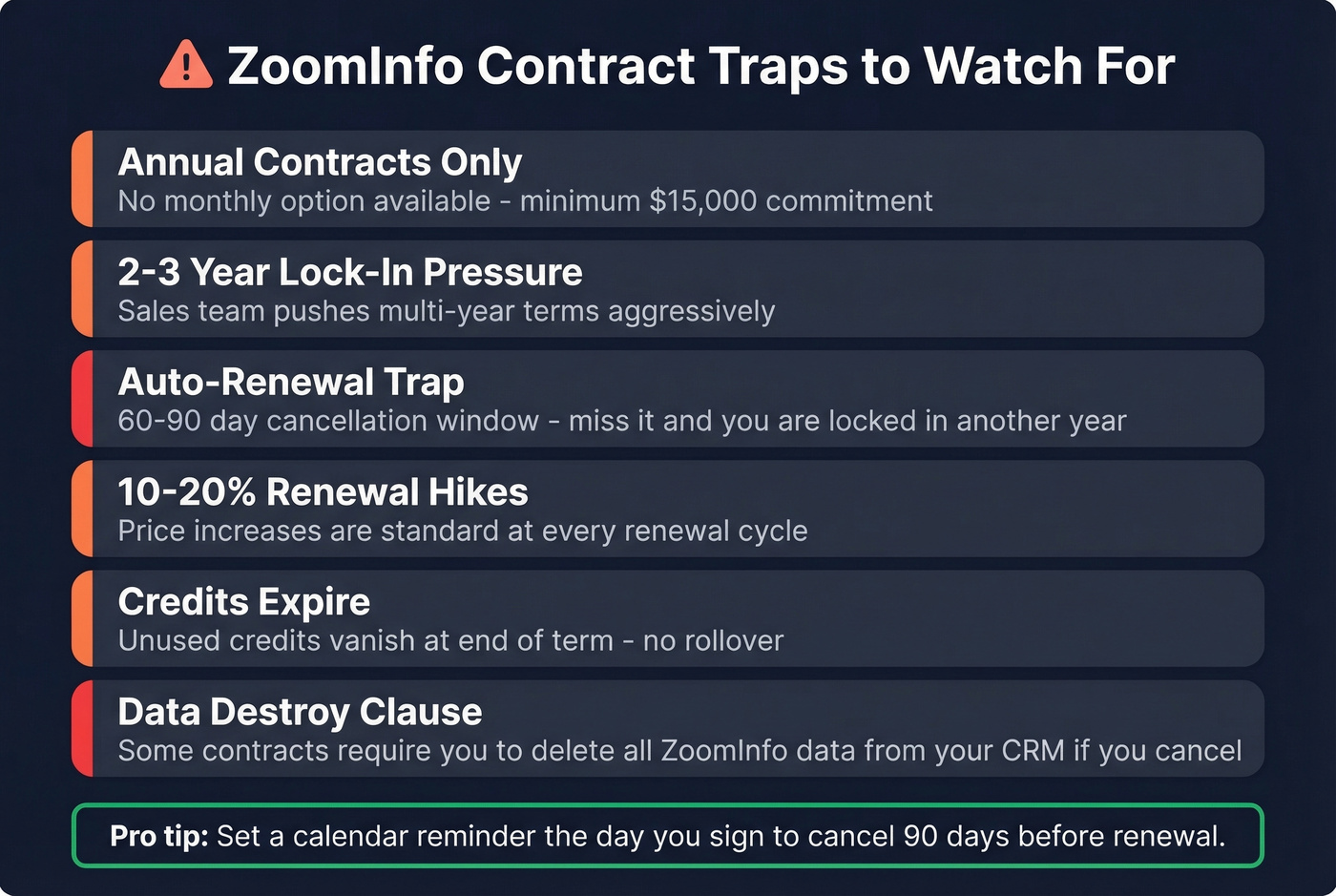
Annual contracts only. No monthly option. ZoomInfo pushes hard for 2-3 year terms. Auto-renewal with a 60-90 day cancellation window - miss it and you're locked in for another year, so set a calendar reminder the day you sign. Renewal price hikes of 10-20% are standard practice. Unused credits expire at the end of your term with no rollover. And some contracts include a data destroy clause requiring you to delete all ZoomInfo-sourced data from your CRM if you cancel.
The fact that canceling a data subscription requires a 60-90 day heads-up and a formal written notice is genuinely frustrating.
What Users Actually Say
ZoomInfo holds a 4.5/5 on G2 from 9,035 reviews - genuinely strong. The most-cited pros are contact information quality (413 mentions) and ease of use (403 mentions). Data accuracy gets 384 positive mentions too. When ZoomInfo's data is fresh, users rate it highly.
The cons tell a different story. "Outdated data" and "inaccurate data" each appear 232 times in G2 reviews. In practice, many teams see closer to 75-85% email accuracy than the 95 their scoring suggests - a gap between database scores and actual deliverability. Job-title decay hits 10-20% of exported lists because people change roles faster than any database can keep up.
On r/sales, the #1 complaint is price - $15k+ annually is "insane for solo consultants and small teams." The #2 complaint? Aggressive sales tactics. One poster chose a competitor with a weaker product specifically because ZoomInfo's reps were calling from rotating numbers multiple times a day. When your sales process drives buyers to worse products, something is broken.
Alternatives Worth Considering
Let's be honest: ZoomInfo is still the broadest all-in-one B2B data platform. But most teams don't need all-in-one. They need accurate emails, working phone numbers, and the freedom to cancel when something isn't working.
Prospeo
If you need ZoomInfo-grade accuracy without the contract, this is where we'd start. Email accuracy hits 98% across 300M+ profiles, with 125M+ verified mobile numbers delivering a 30% pickup rate. Data refreshes on a 7-day cycle instead of the 6-week industry average, and you're paying roughly $0.01 per lead versus ZoomInfo's ~$3 per credit. The free tier gives you 75 verified emails per month to test before committing anything. Layer in intent data tracking 15,000 Bombora topics, 30+ search filters (technographics, job changes, funding signals), and native integrations with Salesforce, HubSpot, Instantly, and Smartlead - and you've got an enterprise-grade stack without enterprise pricing. No contracts, no cancellation windows, no data destroy clauses.
Apollo.io
The best all-in-one option for small teams that want sequencing, a dialer, and a contact database in one tool. Free tier available, paid plans from $49/month. Email accuracy runs 65-70% per user reports - you'll want to verify before sending. Skip this if accuracy matters more than feature breadth.
Lusha
Good for quick contact lookups, especially if your workflow starts on professional profiles. Starts at $29/month. The catch: credits expire monthly, so use them or lose them. Best suited for reps who need five or ten contacts a day, not teams building large lists.
Hunter.io
Domain search is Hunter's strength - paste a company URL and get every associated email. Starts at $49/month, and unlike Lusha, credits roll over. Less useful for building large prospect lists, but solid for targeted account research when you already know which companies you're going after.
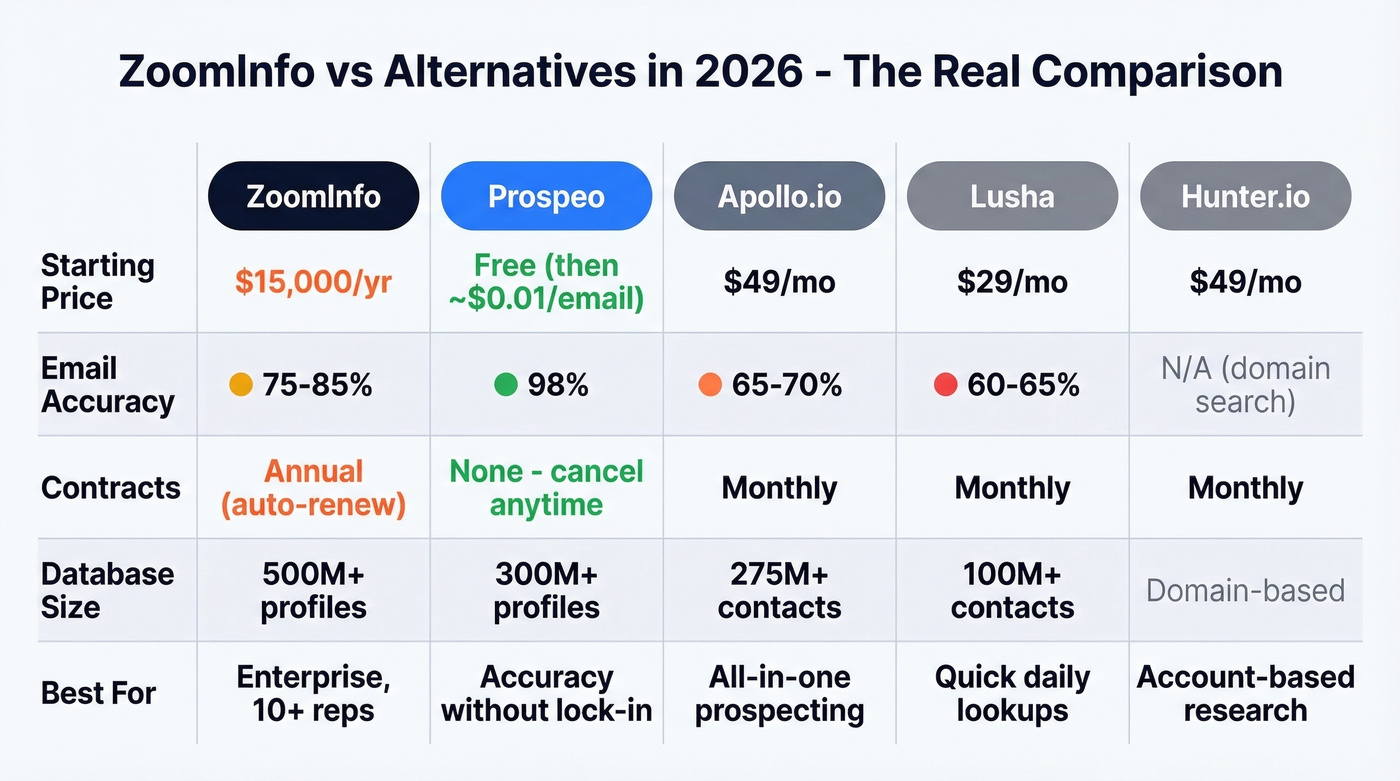
Quick comparison:
| Tool | Starting Price | Email Accuracy | Contracts | Best For |
|---|---|---|---|---|
| ZoomInfo | $15,000/yr | 75-85% | Annual (auto-renew) | Enterprise teams, 10+ reps |
| Prospeo | Free (~$0.01/email) | 98% | None | Accuracy without lock-in |
| Apollo.io | $49/mo | ~65-70% | Monthly | All-in-one prospecting |
| Lusha | $29/mo | ~60-65% | Monthly | Quick daily lookups |
| Hunter.io | $49/mo | N/A (domain search) | Monthly | Account-based research |
Reddit threads also mention RocketReach for niche exec targeting and Anymailfinder for pay-per-verified-email models - both worth a look if none of the above fit. If you're building lists at scale, start with a dedicated B2B lead list tool and pair it with email list verification before you send.
ZoomInfo's contract traps - auto-renewals, 60-day cancellation windows, data destroy clauses - exist because the product can't retain you on merit alone. Prospeo gives you 125M+ verified mobiles with a 30% pickup rate, intent data across 15,000 Bombora topics, and native CRM integrations. Cancel anytime. No strings.
Enterprise-grade B2B data without the enterprise hostage situation.
FAQ
Can I still buy DiscoverOrg?
No. DiscoverOrg acquired ZoomInfo for $735 million on February 4, 2019, and the brands merged in September 2019 under "ZoomInfo Powered by DiscoverOrg." All legacy features - org charts, Scoops, department-level contacts, human-verified dials, and Bombora intent signals - now live inside ZoomInfo's platform under ZoomInfo's pricing.
Is ZoomInfo worth $15,000 a year?
For enterprise teams running 10+ reps with budget to match, ZoomInfo's data breadth - 70M+ direct dials, 500M+ profiles - is hard to beat. For teams closing deals under $20k ACV, the ROI math rarely works. We've seen smaller teams get far better results at a fraction of the cost with tools like Prospeo, which delivers 98% email accuracy at ~$0.01 per lead with no annual commitment.
What's the cheapest alternative with good data?
Prospeo's free tier includes 75 verified emails per month, and paid plans run roughly $0.01 per lead - no sales call required. Apollo.io starts at $49/month with its own free tier. Both are self-serve with no annual contracts, a fraction of ZoomInfo's $15,000+ entry point.
Did the DiscoverOrg-ZoomInfo merger improve data quality?
The merger combined DiscoverOrg's human-verified contacts with ZoomInfo's broader database, creating the largest B2B contact platform by volume. But G2 reviews show "outdated data" and "inaccurate data" each appearing 232 times - suggesting scale came at the cost of consistent freshness. Platforms with shorter refresh cycles (7 days vs. weeks) tend to outperform on deliverability.