

The Best CRM for Sales Teams - Ranked by People Who Sell, Not Market
You've got a color-coded Google Sheet with 47 columns, three tabs named "Q2 Pipeline," "Old Leads," and "DO NOT DELETE," and a rep who just asked which row belongs to their deal. That spreadsheet was your CRM. It just broke.
The best CRM for sales teams returns $8.71 for every $1 spent. But 43% of CRM users activate fewer than half the features they're paying for. You don't need to evaluate 10 platforms. You need to shortlist two or three, run a focused trial, and commit. CRM selection is harder than it looks because most teams evaluate on feature count instead of daily workflow fit - and that mismatch is why adoption craters after month two.
Our Picks (TL;DR)
| Team Size | Recommended CRM | Why |
|---|---|---|
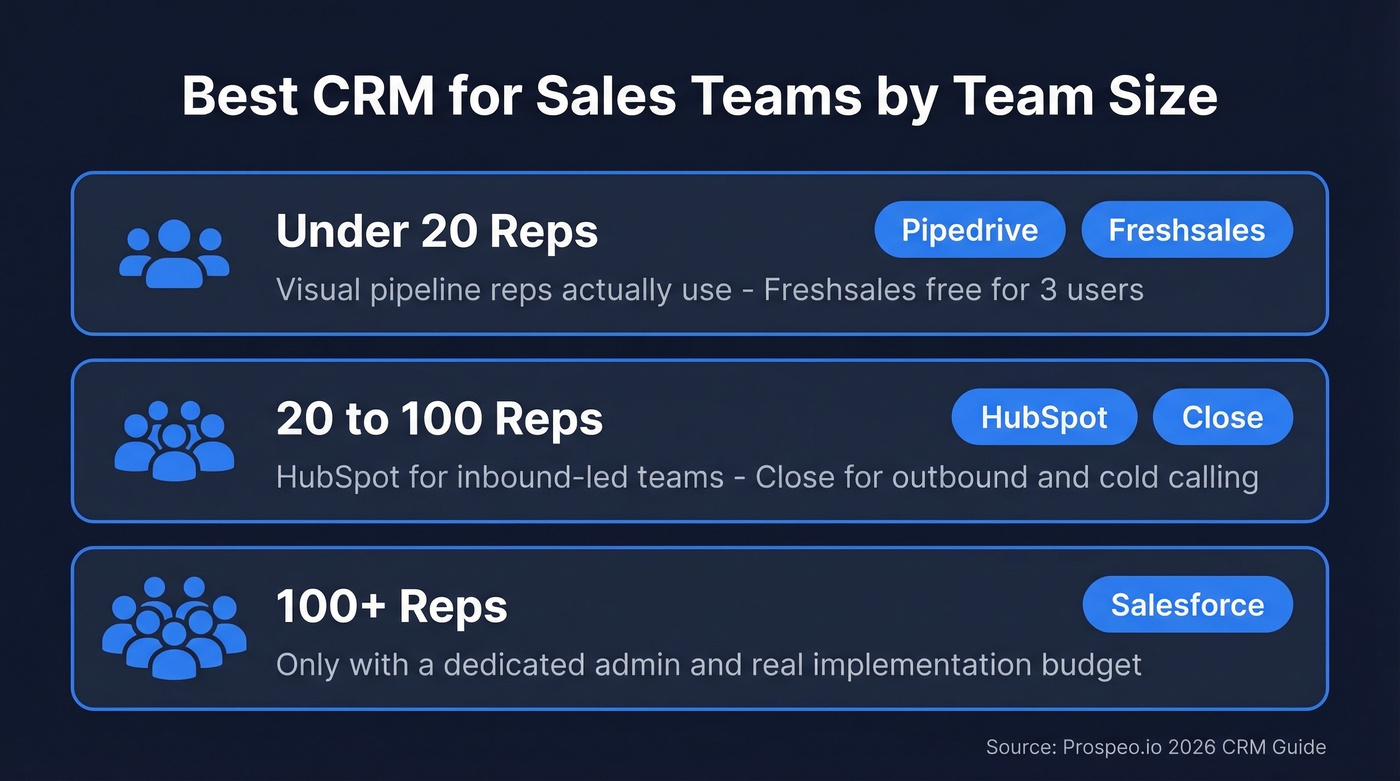
| Under 20 reps | Pipedrive or Freshsales | Visual pipeline reps love; Freshsales is free for 3 users |
| 20-100 reps | HubSpot (inbound) or Close (outbound) | Marketing alignment vs calling speed |
| 100+ reps | Salesforce | Only with a dedicated admin and budget |
How Much Should a Sales CRM Cost?
Per-seat pricing is only part of the story. Onboarding fees, implementation costs, and add-ons can double the bill before your first rep logs in.
If you're still mapping what a CRM should cover, start with these examples of a CRM to sanity-check your shortlist.
| Company Size | Typical Cost |
|---|---|
| Small (1-50 employees) | $10-$30/user/mo |
| Mid-market (51-250) | $40-$100/user/mo |
| Enterprise (250+) | $150-$650/user/mo |
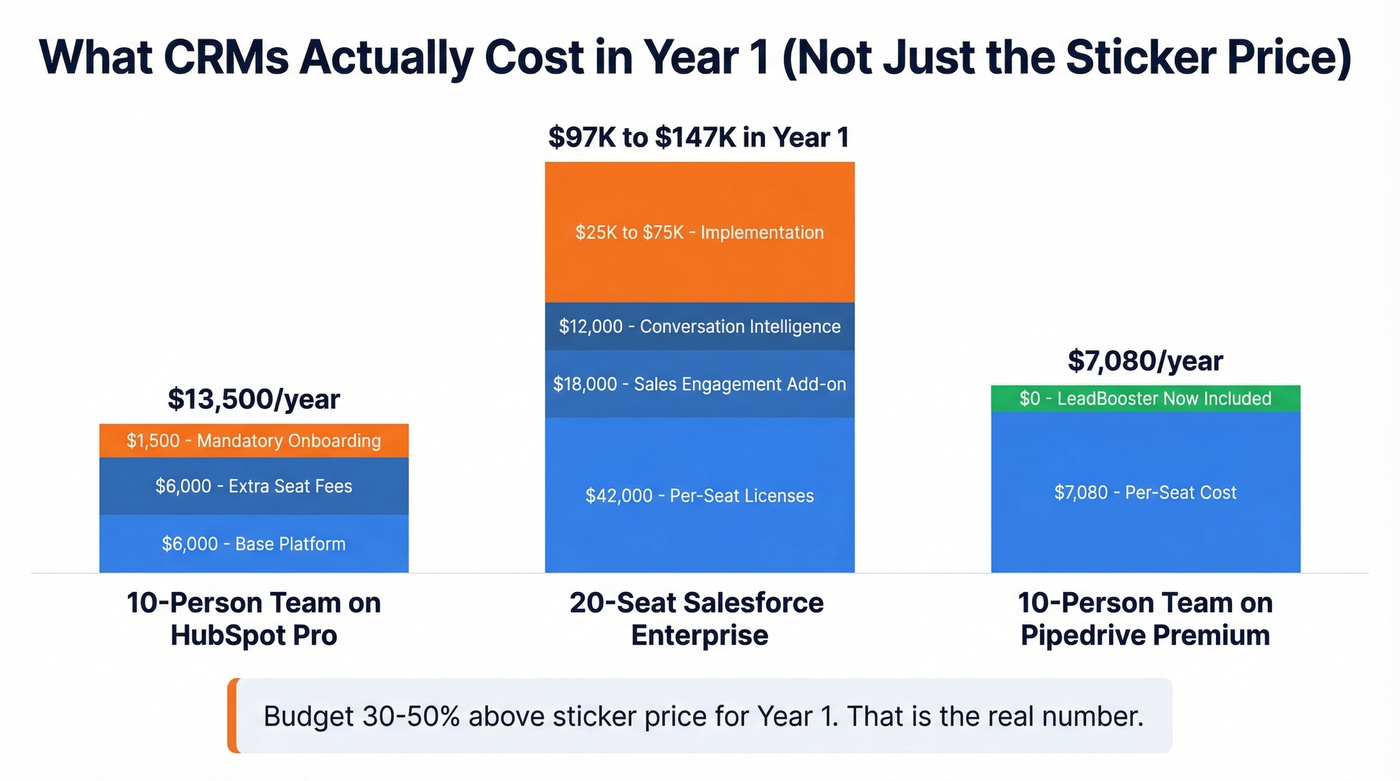
Let's make this concrete. A 10-person team on HubSpot Professional pays $500/mo base plus $100/seat for five extra seats - that's $12,000/year before the mandatory $1,500 onboarding fee. Year 1 total: $13,500. Salesforce Enterprise at $175/user/mo looks straightforward until you add implementation costs ranging from $5K for a basic setup to $300K+ for enterprise deployments, plus add-ons like Sales Engagement at $75/user/mo and conversation intelligence at $50/user/mo.
Budget 30-50% above the sticker price for your first year. That's the real number.
The 8 Best CRM Tools for 2026
Pipedrive - Best for Sales-First Teams

Pipedrive restructured its plans in 2025, moving to Lite ($14/seat/mo), Growth ($39), Premium ($59), and Ultimate ($79) - all billed annually. Premium now bundles LeadBooster, which includes chatbot, live chat, prospector, and web forms that used to be a separate add-on starting at $32.50. That's a meaningful upgrade for teams doing any outbound.
Use it if you want a CRM your reps will actually open voluntarily. Pipedrive's visual pipeline is the best in the business for deal-stage management, and the activity-based selling philosophy keeps reps focused on next steps rather than data entry. We've seen teams hit full adoption in under two weeks - that almost never happens with other platforms.
Skip it if you're running complex marketing attribution or need deep reporting across multiple business units. Pipedrive is a sales tool, not a GTM platform, and it doesn't pretend otherwise.
HubSpot Sales Hub - Best Free Starting Point
HubSpot's free CRM is genuinely useful - contact management, deal tracking, pipeline management, meeting scheduling, and basic email integration. It's the obvious starting point for teams that aren't ready to commit budget. The problem is what happens next.
Use it if you're inbound-led and want marketing and sales on the same platform. The Starter tier at $20/seat/mo is reasonable. HubSpot's reporting improves dramatically at Professional, and the ecosystem of integrations is massive.
Skip it if you're a small team that needs automation and doesn't want to pay enterprise prices for it. The jump from Starter to Professional is brutal: $500/mo base for five seats, $100 for each additional seat, plus $1,500 mandatory onboarding. Teams outgrow the free tier fast, then discover paid tiers escalate steeply for features they assumed would be included.
Here's the thing: HubSpot's free tier is the cheese in the mousetrap. Budget the Year 1 math before you commit, not after your team's already built workflows on the free tier.
Salesforce Sales Cloud - Best for Enterprise
Salesforce starts at $25/user/mo (Starter Suite) and scales to $175 (Enterprise) and $350 (Unlimited). There's also a Free Suite for up to 2 users. Those per-seat numbers look manageable until you add the real costs.
Use it if you have 100+ reps, a dedicated Salesforce admin or budget for one, and complex workflows spanning multiple departments. Salesforce's customization depth is unmatched. The AppExchange ecosystem solves almost any integration need. For large orgs with the resources to implement it properly, nothing else comes close.
Skip it if you're under 50 reps and don't have a full-time admin. Salesforce is right for about 10% of teams that buy it. The rest end up paying enterprise prices for a tool their reps use as a glorified contact database.
TCO reality check. A mid-market implementation runs $25K-$75K. Enterprise deployments hit $75K-$300K+. Add data migration ($5K-$25K), training ($2K-$10K), and ongoing admin costs. A 20-seat Enterprise contract with Sales Engagement and conversation intelligence add-ons can clear about $72K/year before implementation.
Close - Best for Outbound Teams

Close is criminally underrated. If your team lives on the phone and runs cold outbound, this is the CRM that was built for exactly that workflow - built-in dialer, power dialer, SMS, email sequences, all native, no integrations required.
Close's internal testing shows it's over 50% faster than Pipedrive, HubSpot, and Salesforce across core workflows like inbox, pipeline, and lead views. G2 reviewers consistently praise the fewer-clicks philosophy. Pricing runs $29-$149/user/mo depending on tier. For outbound-heavy teams under 50 reps, I'd pick Close over HubSpot every time. The calling infrastructure alone saves you from bolting on a separate dialer.
If your average deal size is under $10K and you're running outbound, you don't need a platform - you need a phone-first CRM. Close is that CRM. Stop overthinking it.
If outbound is your motion, pair your CRM decision with proven sales prospecting techniques so reps have a repeatable system.
Freshsales - Best Budget CRM with AI
Freshsales hits a sweet spot that's hard to argue with: a free plan for 3 users, paid tiers starting at just $9/user/mo (Growth), and Freddy AI for lead scoring and deal insights baked into the Pro tier at $39/user/mo. Enterprise tops out at $59/user/mo. There's a 21-day free trial with no credit card required.
For teams under 20 reps who want AI-powered scoring without paying HubSpot or Salesforce prices, Freshsales is the obvious pick. The interface is clean, onboarding is fast, and the Freshworks ecosystem - Freshdesk, Freshmarketer - gives you room to grow without switching vendors. It won't match Salesforce's customization depth, but most teams don't need that depth. We've recommended it to several early-stage teams and the feedback is consistently positive.
Zoho CRM - Best Budget All-in-One
Zoho CRM starts around $14/user/mo and runs up to about $60/user/mo across tiers, with a free plan for 3 users. The real value is the Zoho ecosystem: CRM, marketing automation, helpdesk, invoicing, and project management from one vendor at SMB-friendly prices. Zia, Zoho's AI assistant, handles lead scoring, anomaly detection, and workflow suggestions.
If you want the broadest feature set per dollar spent and don't mind a slightly steeper learning curve than Pipedrive, Zoho deserves a serious look. The consensus on r/sales and r/smallbusiness is that Zoho punches well above its price point - the main gripe is that the UI feels dated compared to newer tools.
Monday Sales CRM - Best for Monday.com Users
Monday Sales CRM makes sense if your team already lives in Monday.com for project management - the visual interface is familiar and the data flows naturally. Pricing runs $12-$28/seat/mo.
If you're not already a Monday.com shop, skip it. The sales-specific features are thin compared to purpose-built tools like Pipedrive or Close: no built-in dialer, no email sequences, no lead scoring. It's a project management tool with a CRM skin, not the other way around.

Every CRM on this list is only as good as the contacts you put in it. Prospeo enriches your CRM with 50+ data points per contact at a 92% match rate - verified emails, direct dials, job titles, intent signals. Native integrations with Salesforce and HubSpot mean zero manual imports.
Stop feeding your new CRM stale data. Enrich it from day one.
Pricing Comparison
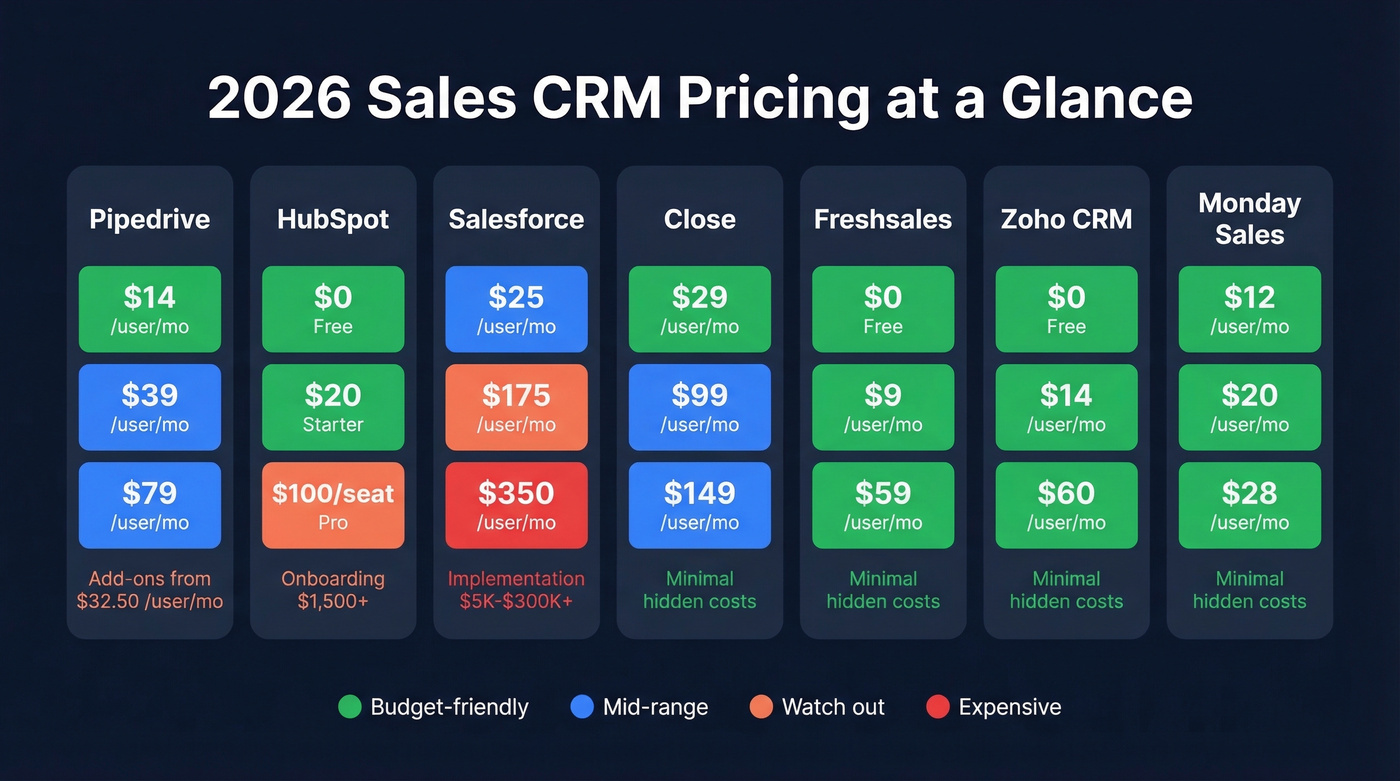
Prices shown are annual billing where available. Monthly billing typically runs 20-30% higher.
| Tool | Entry Price | Mid-Tier | Enterprise | Hidden Costs |
|---|---|---|---|---|
| Pipedrive | $14/seat/mo | $39/seat/mo | $79/seat/mo | Add-ons from $32.50 |
| HubSpot | $20/seat/mo (free tier available) | $500/mo (5 seats) | $1,200/mo (10 seats) | Onboarding $1,500-$3,500 |
| Salesforce | $25/user/mo (free for 2) | $175/user/mo | $350/user/mo | Implementation $5K-$300K+ |
| Close | $29/user/mo | $99/user/mo | $149/user/mo | Minimal |
| Freshsales | $9/user/mo (free for 3) | $39/user/mo | $59/user/mo | Minimal |
| Zoho CRM | $14/user/mo (free for 3) | $35/user/mo | $60/user/mo | Minimal |
| Monday Sales | $12/seat/mo | $20/seat/mo | $28/seat/mo | Minimal |
Clean Data Beats Feature Count
That 43% feature underutilization stat? It's not really about features. It's about trust.
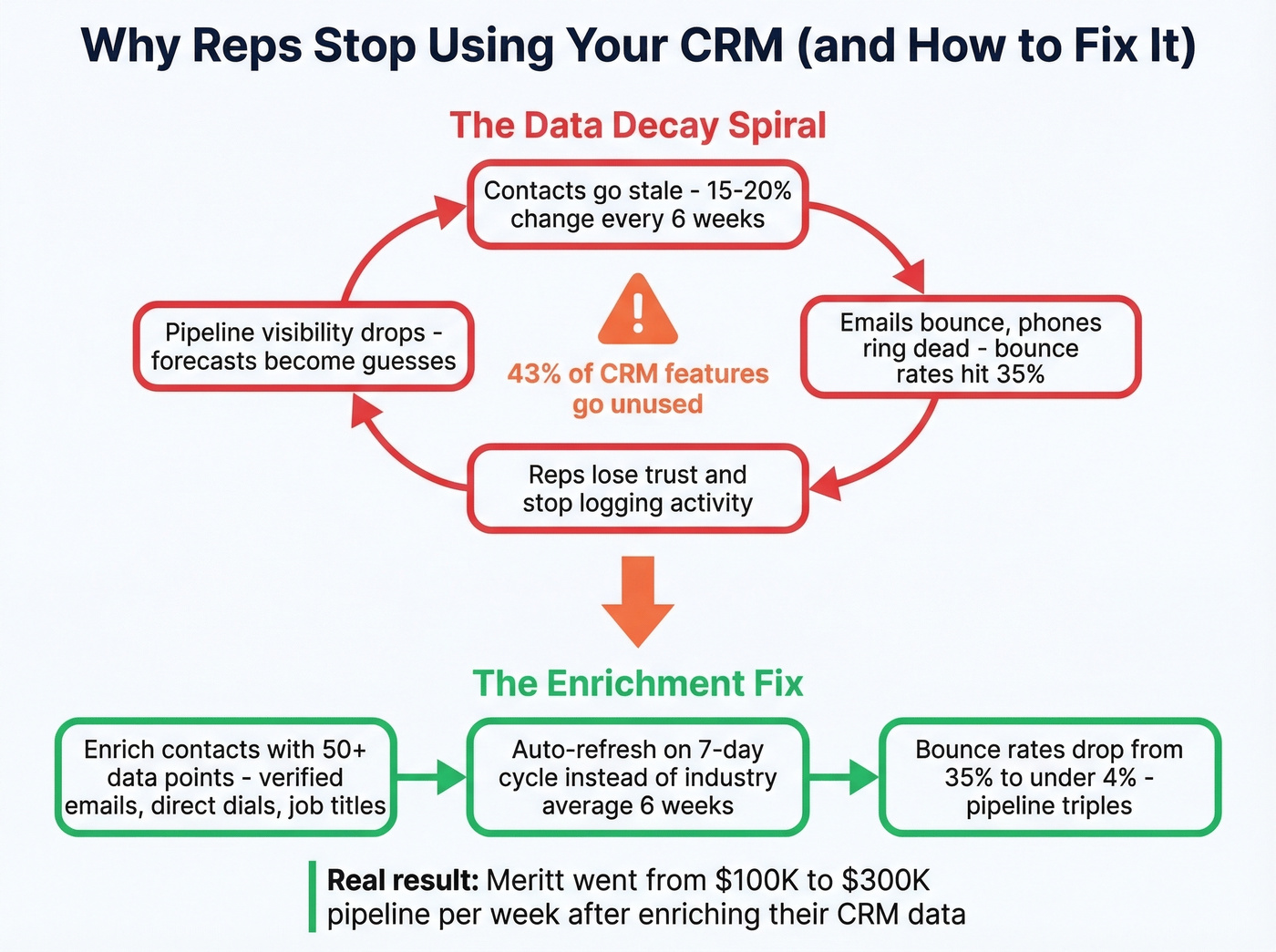
Reps stop using their CRM when the data inside is wrong - when emails bounce, phone numbers ring dead, and contact records show someone's job title from two years ago. The tool isn't broken. The data is. In six weeks, 15-20% of your contacts have changed jobs, gotten promoted, or left the company entirely. If your CRM data isn't refreshing on a regular cycle, your reps are calling ghosts.
If you're evaluating vendors, compare options side-by-side in our guide to data enrichment services.

This is where a data enrichment layer changes the equation. Prospeo's CRM enrichment returns 50+ data points per contact at a 92% match rate, with 83% of leads coming back with verified contact data, and every record refreshes on a 7-day cycle - the industry average is six weeks. Meritt's sales team saw their pipeline triple from $100K to $300K per week after cleaning their CRM data through enrichment, while bounce rates dropped from 35% to under 4%. That's not a marginal improvement - it's the difference between an outbound program that works and one that burns your domain reputation.
Prospeo integrates natively with Salesforce, HubSpot, Smartlead, Instantly, Lemlist, and Clay, so the enriched data flows straight into whichever CRM you pick from this list.
If you're seeing bounces spike, use these email bounce rate benchmarks to diagnose what’s normal vs. broken.
You just picked a CRM. Now you need pipeline. Prospeo's database gives you 300M+ profiles with 30+ filters - buyer intent, technographics, headcount growth, funding - so your reps spend time selling, not searching. At $0.01 per verified email, it costs less than one unused CRM seat.
Your CRM needs deals, not empty fields. Build pipeline for a penny per lead.
5 Mistakes That Kill CRM Adoption
1. Dirty data on day one. If you migrate garbage contacts into your shiny new CRM, reps will lose trust immediately. Run your contact list through an enrichment tool before migrating. Start clean or don't start.
2. Skipping role-based training. Your SDRs, AEs, and managers use the CRM differently. One generic training session doesn't cut it. Build role-specific workflows and train each group on their actual daily tasks - not a feature tour.
If you're onboarding new reps at the same time, align CRM training with a 30-60-90 day plan so adoption sticks.
3. Rushing the rollout. Pilot with 5 reps for 2-3 weeks. Collect feedback. Fix the friction points. Then roll out company-wide. We've seen teams waste months recovering from a botched full-org launch that could've been avoided with a simple pilot.
4. Ignoring integrations. Test your email, calendar, and dialer connections before committing. A CRM that doesn't sync with your sequencer or calendar is dead on arrival. Check the integration depth, not just the logo wall.
If you're stitching tools together, follow this guide to connect outreach tool to CRM so data doesn’t break between systems.
5. No post-implementation review. Schedule check-ins at 30, 60, and 90 days. Measure adoption rates, data quality, and rep satisfaction. If usage drops after week three, something's broken - and it's usually a workflow problem, not a tool problem.
Choosing the Best CRM for Your Sales Team
What's the best free CRM for a small sales team?
HubSpot free gives you strong contact and deal tracking but limited automation. Freshsales free caps at 3 users but includes more functionality out of the box. For teams under 5 reps who need automation, Freshsales wins. For larger teams that just need basic contact and deal tracking, HubSpot wins on flexibility.
How much does a CRM cost for a 10-person team?
Expect $140-$1,750/month depending on the tool. Pipedrive Growth: about $390/mo. HubSpot Professional: around $1,000/mo plus $1,500 onboarding. Salesforce Enterprise: $1,750/mo before implementation costs. Budget 30-50% above sticker price for Year 1.
Do I need Salesforce?
Probably not. Unless you have 100+ reps, a dedicated admin, and budget for $25K+ implementation, a lighter CRM like Pipedrive or HubSpot will serve you better. Salesforce's power comes from customization - if you aren't customizing heavily, you're overpaying.
How do I keep my CRM data clean?
Use an enrichment tool to verify emails and phone numbers before importing. Deduplicate on import, enforce required fields, and audit data quality quarterly. Stale data kills outbound productivity faster than any missing CRM feature.
What's the biggest CRM implementation mistake?
Buying the most feature-rich platform instead of the one your reps will actually use. 43% of CRM users activate fewer than half their features. Pick based on daily workflow fit - not feature count - and pilot with a small group before a full rollout.