

Best Email List Verification Tools in 2026
Your ESP just flagged your account. Bounce rate hit 8% on the last campaign, and now you're one send away from domain throttling. Email list verification isn't optional anymore - it's the difference between landing in the inbox and getting throttled. That list you bought six months ago? It's already rotting. ZeroBounce's analysis of 11+ billion emails shows at least 23% of any email list degrades every year, and with average professional turnover sitting around 41%, B2B lists decay even faster.
Every verification tool on the market claims "99% accuracy." We've tested enough of them to know that number is marketing, not math. The real differentiator isn't how well a tool handles valid Gmail addresses - it's what happens when 28% of your list sits on catch-all domains and the tool just shrugs and returns "unknown."
Our Picks
| Use Case | Pick | Price Anchor |
|---|---|---|
| Best B2B accuracy + catch-all | Prospeo | ~$0.01/email |
| Best standalone list cleaner | Bouncer | ~$45/10K |
| Best on a tight budget | MillionVerifier | ~$6/10K |
| Most integrations | Emailable | ~$50/10K |
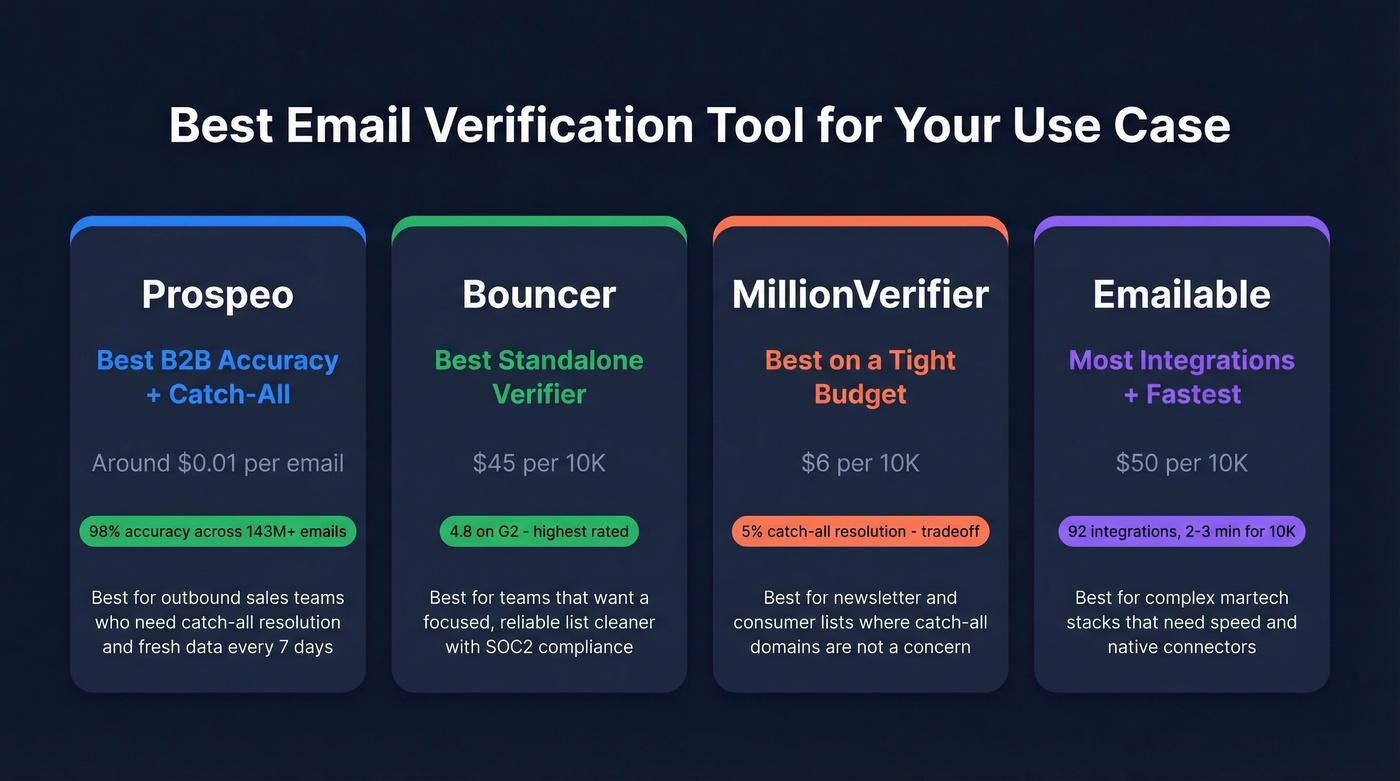
If you're running B2B outbound and catch-all resolution matters (it does), Prospeo is the pick. For pure list-cleaning volume on a budget, MillionVerifier can't be beat on price - just know you're trading catch-all accuracy for savings. Bouncer is the best all-around standalone verifier with the highest G2 rating in the category.
How Email List Verification Works
Most people treat verification as a black box: emails go in, green/red labels come out. Understanding the pipeline matters because it explains why tools produce wildly different results on the same list.
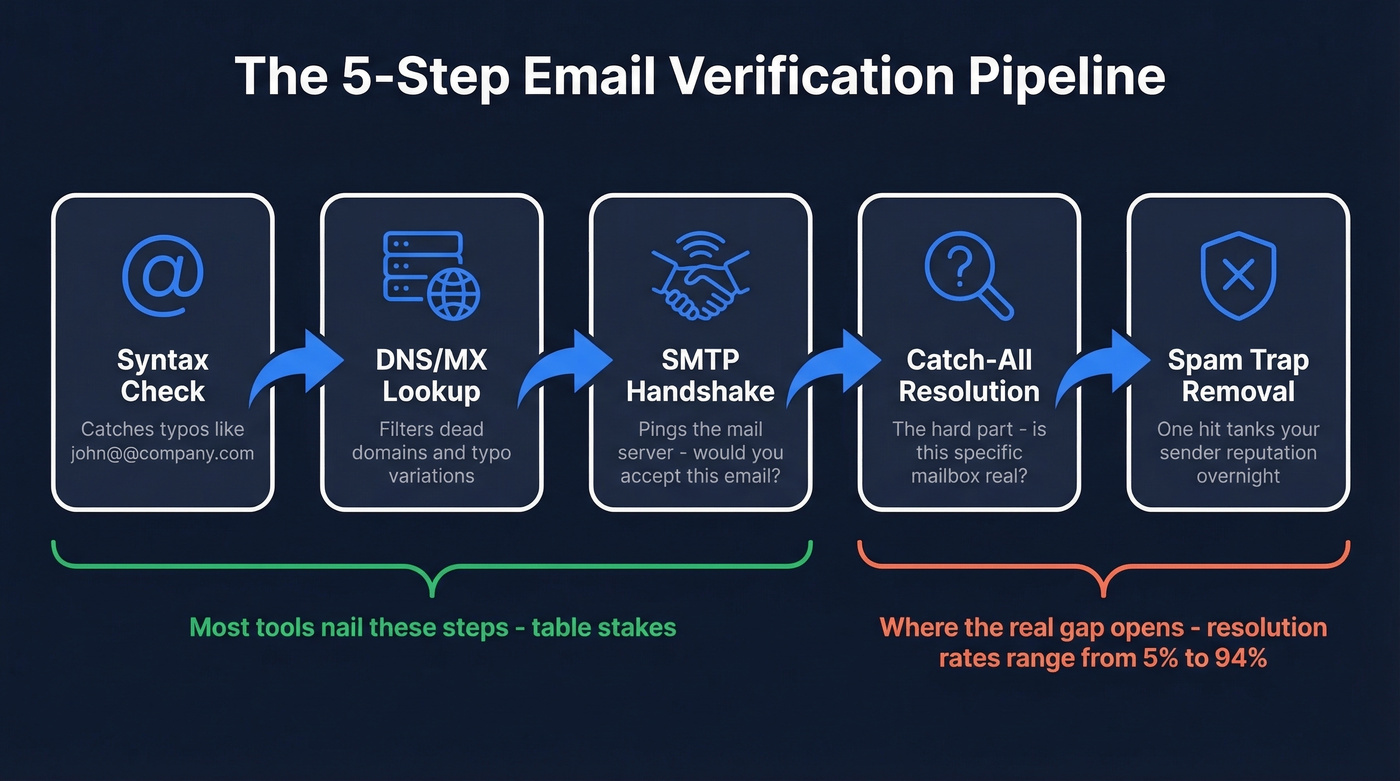
The process runs in five steps:
- Syntax check - does the email follow valid formatting rules? Catches typos like "john@@company.com."
- DNS/MX lookup - does the domain exist and accept mail? Filters out dead domains and typo variations.
- SMTP handshake - the tool pings the mail server and asks "would you accept a message for this address?" without actually sending one. This is where most verification happens.
- Catch-all resolution - if the server accepts everything (a catch-all configuration), the tool needs secondary methods to determine whether the specific mailbox is real. This is the hard part.
- Spam-trap and honeypot removal - identifying addresses that exist solely to catch spammers. Hit one of these and your sender reputation tanks overnight.
Most tools nail steps 1-3. The gap opens at step 4. In an independent benchmark of 10,000 real B2B emails, 28% of the test list sat on catch-all domains. Catch-all resolution rates across tools ranged from 5% to 94%. That's not a rounding error - it's the difference between cleaning your list and guessing.
Accuracy Benchmarks
Every tool claims 99% accuracy. Here's what happened when someone ran the same 10,000 emails through 10 tools.
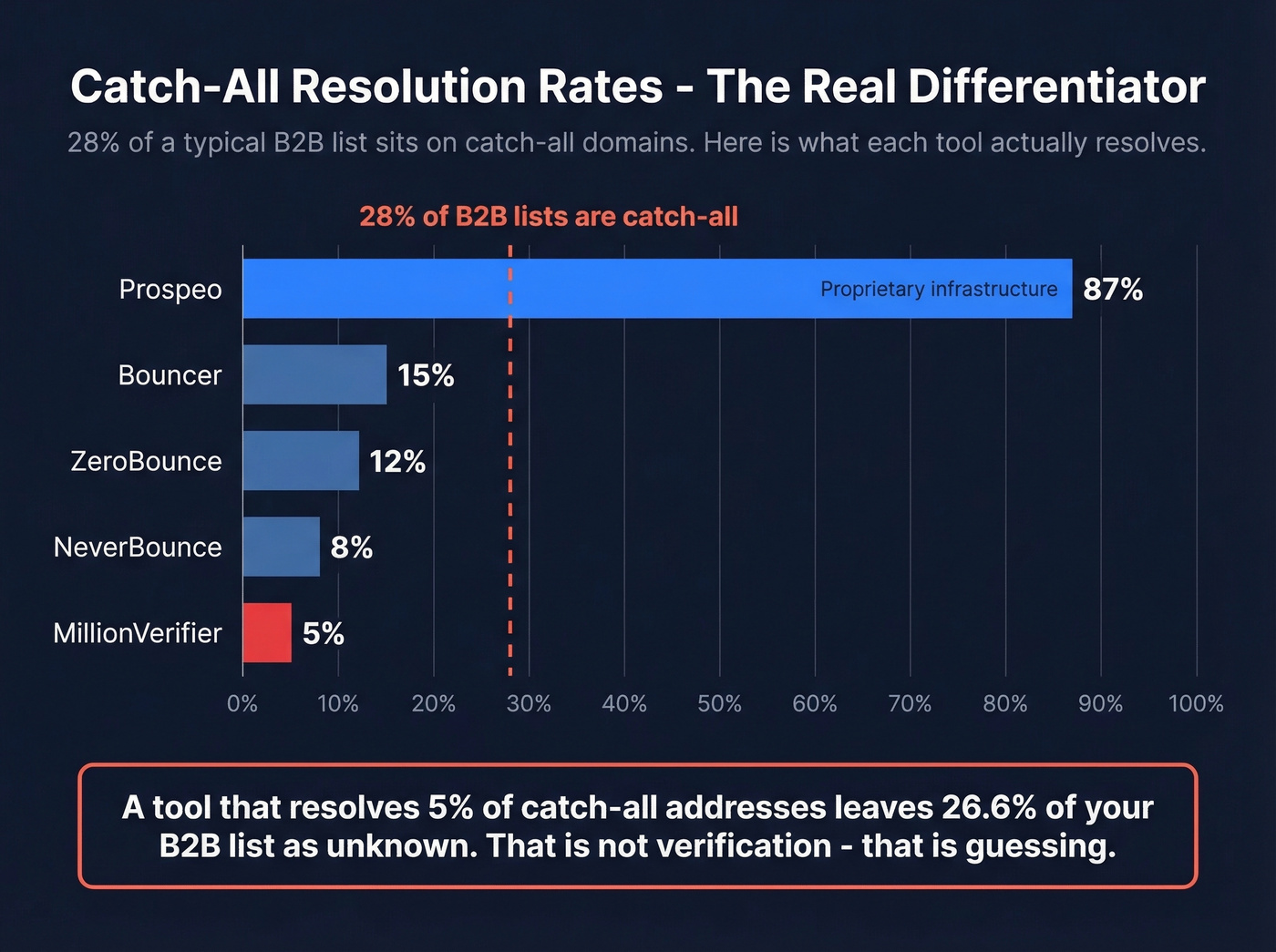
LeadMagic published a head-to-head benchmark using real B2B emails pulled from outbound campaigns across SaaS, financial services, healthcare, and manufacturing. The test list was deliberately constructed to stress-test tools: 42% corporate, 28% catch-all, 15% known invalid, plus disposable, role-based, and typo domains.
| Tool | Accuracy | Catch-All Resolution |
|---|---|---|
| ZeroBounce | 97.8% | 12% |
| NeverBounce | 96.9% | 8% |
| Bouncer | 96.5% | 15% |
| MillionVerifier | 95.8% | 5% |
Disclosure: LeadMagic ranked itself #1 at 99.5% accuracy with 94.2% catch-all resolution. Take that with appropriate skepticism - it's their blog and their benchmark.
The benchmark also measured false positive rates - valid emails incorrectly flagged as invalid. This metric rarely gets published, but it directly impacts your revenue when legitimate leads get suppressed.
Here's the thing: accuracy on easy addresses is table stakes. ZeroBounce scored well overall but only resolved 12% of catch-all addresses. MillionVerifier resolved just 5%. The real question is what a tool does with the hard 28%.
Full Comparison Table
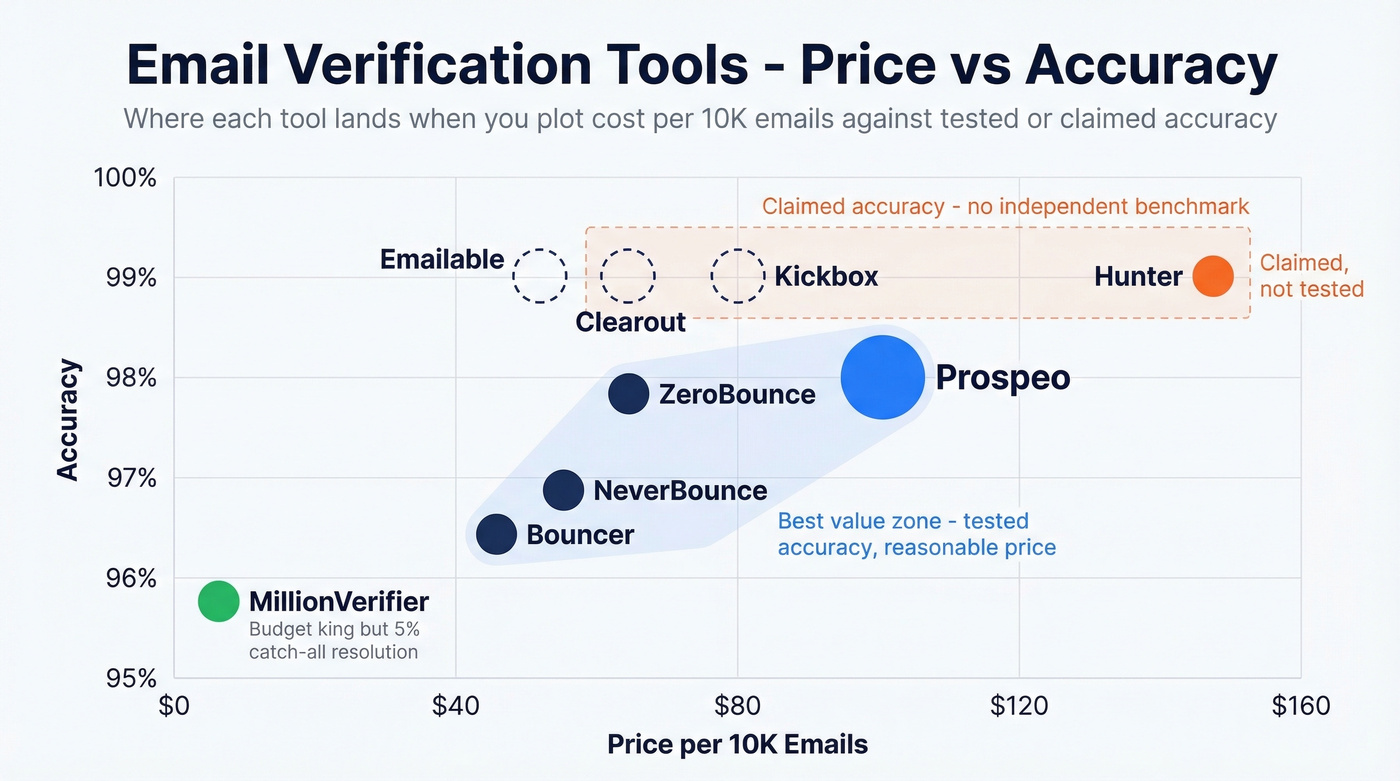
| Tool | Accuracy | Price/10K | Free Tier | G2 Rating |
|---|---|---|---|---|
| Prospeo | 98% (143M+) | ~$100 | 75/mo | - |
| ZeroBounce | 97.8% tested | $64 | 100/mo | 4.7 (1,361) |
| Bouncer | 96.5% tested | $45 | 100 | 4.8 (332) |
| NeverBounce | 96.9% tested | $50 | 10 | 4.2 (141) |
| Emailable | 99%+ claimed | $50 | 250 | - |
| Kickbox | 99%+ claimed | $80 | 100 | - |
| MillionVerifier | 95.8% tested | $6 | - | - |
| Hunter | 99%+ claimed | $149 | 50 | - |
| Clearout | 99%+ claimed | $58 | 100 | - |
Speed and integrations at a glance: Emailable is the speed king at 2-3 minutes for 10K emails, while Bouncer takes 25 minutes and Clearout often clocks in around 45 minutes for 100K. For integrations, Emailable leads with up to 92, NeverBounce sits around 88, and ZeroBounce offers roughly 45-49 direct connectors. Prospeo connects natively to Salesforce, HubSpot, Smartlead, Instantly, Lemlist, Clay, Zapier, and Make.
Hunter at $149/10K is 25x more expensive than MillionVerifier. And the gap between "tested" and "claimed" accuracy should make you skeptical of any tool that hasn't been independently benchmarked.

28% of B2B lists sit on catch-all domains - the exact segment most tools punt on. Prospeo's 5-step verification resolves catch-alls, strips spam traps, and filters honeypots using proprietary infrastructure. 98% accuracy across 143M+ verified emails, refreshed every 7 days.
Stop guessing on catch-all domains. Start verifying at $0.01/email.
Top Verification Tools Reviewed
Prospeo - Best B2B Accuracy
Use this if you're running B2B outbound and need emails verified at the point of collection, not cleaned up after the fact. Every email runs through a 5-step process including catch-all resolution, spam-trap removal, and honeypot filtering - all on proprietary infrastructure that doesn't rely on third-party email providers. The 98% email accuracy across 143M+ verified emails is backed by a 7-day data refresh cycle versus the six-week industry average.
Meritt, a recruiting agency, went from a 35% bounce rate to under 4% after switching. Stack Optimize, an outbound agency, maintains under 3% bounce across all clients with zero domain flags. The free tier gives you 75 emails per month plus 100 Chrome extension credits - enough to test before committing. Paid plans run ~$0.01/email with no contracts.
If you only need a one-time bulk list clean, a pure-play verifier like Bouncer is a simpler starting point - though you'll miss the ongoing data freshness that prevents the list from rotting again.
Meritt cut bounce rates from 35% to under 4%. Stack Optimize runs zero domain flags across every client. The difference is verification that happens before emails hit your list - not after your ESP flags your account.
Get 75 free verifications per month - no contracts, no sales calls.
ZeroBounce - Deepest G2 Review Base
ZeroBounce is the safe, enterprise-friendly choice. It scored 97.8% accuracy in independent testing, has a deep G2 review base - 4.7/5 from 1,361 reviews - and offers 45+ direct integrations.
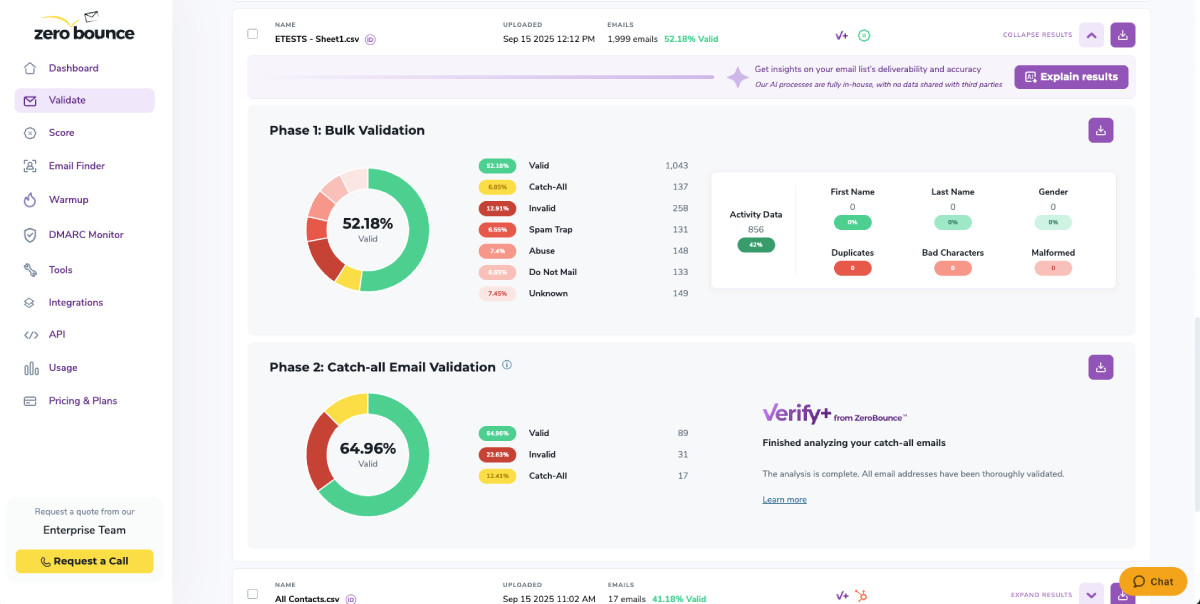
The integration library is excellent. If you're connecting verification to a complex martech stack, ZeroBounce probably has a native connector. Processing 10K emails takes about 22 minutes, and the 100 free monthly credits let you test without commitment.
The downsides: at $64/10K, it's one of the more expensive mainstream options. The recurring complaint on G2 is price. And catch-all resolution at 12% means you're getting "unknown" back on a lot of B2B addresses - which is frustrating when you're paying premium rates for ambiguity.
Great if integrations and brand trust matter more than per-email cost.
Bouncer - Best Standalone Verifier
Bouncer earns the highest G2 rating in the category at 4.8/5 from 332 reviews, and it deserves it. This is a focused, no-nonsense list cleaning tool that does one thing well.
It scored 96.5% in independent testing, processes 180K emails per hour with bulk uploads up to 250K, and is SOC2 and GDPR compliant - which matters if you're in regulated industries. Data gets deleted after 60 days, a nice security touch. At $45/10K with volume pricing (smaller batches start around $7-8/1K), it's cheaper than ZeroBounce while scoring comparably on accuracy.
The tradeoff: only 16 integrations, a fraction of the biggest libraries. Catch-all resolution at 15% is better than most but still leaves a lot of unknowns. If you want a reliable standalone verifier without platform lock-in, Bouncer is the pick.
NeverBounce - Solid All-Rounder
NeverBounce scored 96.9% accuracy in independent testing and prices at $50/10K. Processing speed in the benchmark was 18 minutes for 10K emails. Competitive across the board.
The free tier is tiny though - just 10 credits. G2 reviews (4.2/5 from 141 reviews) consistently flag credit system issues and pricing frustrations. Catch-all resolution sits at just 8%, which means nearly all catch-all addresses come back as "unknown." For B2B lists heavy on corporate domains, that's a real problem. Skip this one if catch-all resolution is a priority.
Emailable - Fastest Processing
Emailable processes 10K emails in 2-3 minutes. If you're running time-sensitive campaigns and need results now, nothing else comes close on speed. At high volume, pricing drops to $0.00135/email, and the 250 free credits are the most generous free tier in the category. The integration count - up to 92 - is one of the largest available.
The catch: Emailable claims 99%+ accuracy but hasn't appeared in the LeadMagic benchmark. You're betting on speed over independently published accuracy results.
MillionVerifier - Budget King
$6 per 10,000 emails. $389 for a million. MillionVerifier is an order of magnitude cheaper than everything else on this list, and credits don't expire - a nice touch for irregular verification schedules. They also offer EverClean, an automated monthly cleaning service for ongoing hygiene without manual uploads.
The tradeoff is clear: 95.8% tested accuracy is respectable, but 5% catch-all resolution is the worst in the benchmark. On a B2B list where 28% of addresses are catch-all, a huge chunk comes back as "unknown." For consumer and newsletter lists where catch-all isn't a factor, MillionVerifier is a steal. For B2B outbound, spend more.
Kickbox, Hunter, and Clearout
Kickbox ($80/10K) goes beyond pass/fail with its Sendex score, which rates email quality on a granular scale rather than binary valid/invalid. Useful for teams that want nuance in their segmentation, but without independent accuracy data it's a harder sell.
Hunter ($149/10K) is the most expensive option by a wide margin. You're not paying for verification - you're paying for the platform. If you're already using Hunter for email finding and outreach sequences, verification is a natural add-on. As a standalone verifier, the economics don't work.
Clearout ($58/10K) differentiates with AI-based deliverability confidence scoring. Interesting concept, but unproven at scale compared to traditional SMTP verification - and like Emailable, it claims 99%+ without independent test data.
Also Worth Knowing
EmailListVerify runs just $24/10K - the cheapest option after MillionVerifier. No frills, but solid for basic syntax, domain, and SMTP checks. MailerCheck is built by MailerLite, making it the obvious choice if you're already on that platform. Verifalia offers a free email validator and paid plans built for organizations with strict data handling requirements.
Why Catch-All Domains Break Verification
Catch-all domains are where verification tools go to die.
A catch-all mail server is configured to accept messages sent to any address at that domain - whether the mailbox exists or not. When a verification tool pings the server and asks "does john@company.com exist?", the server says "sure, send it over" regardless. The tool can't tell if John is real. This isn't a niche problem. In the independent benchmark, 28% of the test list sat on catch-all domains, and ZeroBounce data shows 9%+ of all emails they verified were catch-all. For B2B lists targeting mid-market and enterprise companies, the percentage is often higher.

Here's what frustrates us: most tools charge you credits for returning "unknown." You asked a question and the tool said "I don't know" - that's not a verification, it's a shrug. Resolution rates in the benchmark ranged from 5% to 94%. ZeroBounce managed 12%. NeverBounce hit 8%.
Let's be honest about when this matters and when it doesn't. If your average deal size is modest and you're running high-volume outbound, you probably don't need 94% catch-all resolution - segment the unknowns, send cautiously, and monitor bounces. But if you're targeting enterprise accounts where most domains are catch-all configured, the difference between 5% and full resolution is the difference between a useful list and an expensive spreadsheet of maybes.
What to do with "unknown" results: Segment them. Either send cautiously with throttled volume and monitor bounces in real time, or skip them entirely. Never mix unknowns into your main send - that's how you tank deliverability.
Real-Time vs. Bulk Verification
These aren't competing approaches - they solve different problems, and you probably need both.
Real-time verification happens at the point of capture. A visitor fills out your form, the API checks the email in sub-second time, and bad addresses get rejected before they ever enter your database. This is prevention. It keeps your list clean from day one and stops typos, disposable addresses, and fake signups at the door.
Bulk verification is cleanup. You upload an existing list as a CSV, the tool processes it - anywhere from 2 minutes to 45 minutes depending on the tool and volume - and you get back a file with valid/invalid/unknown tags. Run this before every campaign and on a quarterly schedule to catch decay.
The complete strategy uses both. Real-time on forms and signup flows prevents garbage from entering your CRM. Bulk before campaigns catches the contacts who've changed jobs, abandoned domains, or been flagged as spam traps since your last clean. In our experience, teams that run both see bounce rates stay consistently under 2%, while teams that only do bulk cleaning before sends tend to hover around 3-5%.
Best Practices for List Hygiene
Verification is one piece of a broader hygiene discipline. Here's the checklist that actually matters:
- Check for bounces after every campaign. Hard bounces should be suppressed immediately - don't wait for the next send.
- Keep hard bounces under 0.5%. One bad campaign above 2% can damage your domain reputation for weeks.
- Verify before every major campaign. With 23% annual decay, quarterly is the floor, not the ceiling. For high-turnover industries, monthly isn't overkill.
- Deduplicate before verifying. Don't waste credits checking the same address three times because it exists in multiple lists. Merge first, verify second.
- Authenticate with SPF, DKIM, and DMARC. Verification cleans your list; authentication proves you're a legitimate sender. You need both. (If you need a quick check, start with DKIM and DMARC alignment.)
- Segment catch-all and unknown results separately. Never mix them into your primary send.
- Clean dormant segments before re-engaging. Any segment you haven't contacted in 90+ days decays fastest and carries the highest bounce risk.
The best email list verification is not needing one. If your data source refreshes weekly instead of every six weeks, you're starting with clean data rather than cleaning up someone else's mess. If you're building lists from scratch, start with a tighter lead generation workflow and better data enrichment so fewer bad emails enter the system.
FAQ
How often should I verify my email list?
Every 3-4 months at minimum, or before each major campaign if you send weekly. ZeroBounce data shows 23% of lists decay annually, and B2B lists degrade even faster due to job turnover. Monthly verification isn't overkill for high-volume outbound teams.
What's a good bounce rate for cold email?
Under 0.5% for hard bounces. Run every list through a verification tool before hitting send - one bad campaign above 2% can damage your domain reputation for weeks.
Can I verify catch-all emails?
Most tools can't - they return "unknown" and still charge you for the credit. Resolution rates in independent testing ranged from 5% to 94%. Check the catch-all resolution benchmarks in the comparison table above before choosing a provider, especially for B2B lists.
What's the difference between verification and validation?
Functionally identical for most purposes. "Validation" sometimes refers to syntax and format checks only, while "verification" includes the full SMTP mailbox-level check. Every tool in this roundup does both, regardless of which term they use in marketing.
Do I need both real-time and bulk verification?
Yes. Real-time verification prevents bad emails from entering your list through forms and signups. Bulk verification cleans existing lists before campaigns. Skipping either one leaves a gap - real-time stops garbage at the door, bulk catches the natural decay that happens between sends.