

The Data-Backed Discovery Call Structure Top Reps Actually Use
You just ran a 30-minute discovery call that ended with "this is really interesting - send me some info." That's not a next step. That's a polite rejection.
The problem isn't your product or your prospect. It's your structure. And fixing it doesn't require a personality transplant or some expensive coaching program - it requires a framework you can actually follow when you're live on the phone and your brain wants to start pitching.
Why Most Discovery Calls Fail
96% of buyers research before they ever talk to a rep. They already know your features. When you spend 20 minutes walking through capabilities they've already read about on your website, you're wasting the one thing discovery is supposed to do: uncover whether there's a real problem worth solving together.
Discovery-to-close conversion rates sit in the 10-30% range for most B2B teams. That means 70-90% of these conversations go nowhere. No time discipline, no clear exit criteria, no repeatable framework. Learning how to run a discovery call with intention is the single biggest lever most reps ignore.
What You Need (Quick Version)
A high-performing 30-minute sales discovery call follows this framework:
- 11-14 targeted questions spread evenly through the call
- 43:57 talk-to-listen ratio - you talk 43%, they talk 57%
- A "menu of pain" opener instead of "so, tell me about your challenges"
- A pre-close question before you ever mention pricing
- A concrete next step with a date, time, and attendees - or a clean disqualification
The 30-Minute Discovery Call Flow
Here's the minute-by-minute breakdown, informed by [Gong Labs' analysis of 519,000+ B2B calls](https://www.gong.io/resources/guides/discovery-call-checklist) and the language patterns top practitioners actually use.
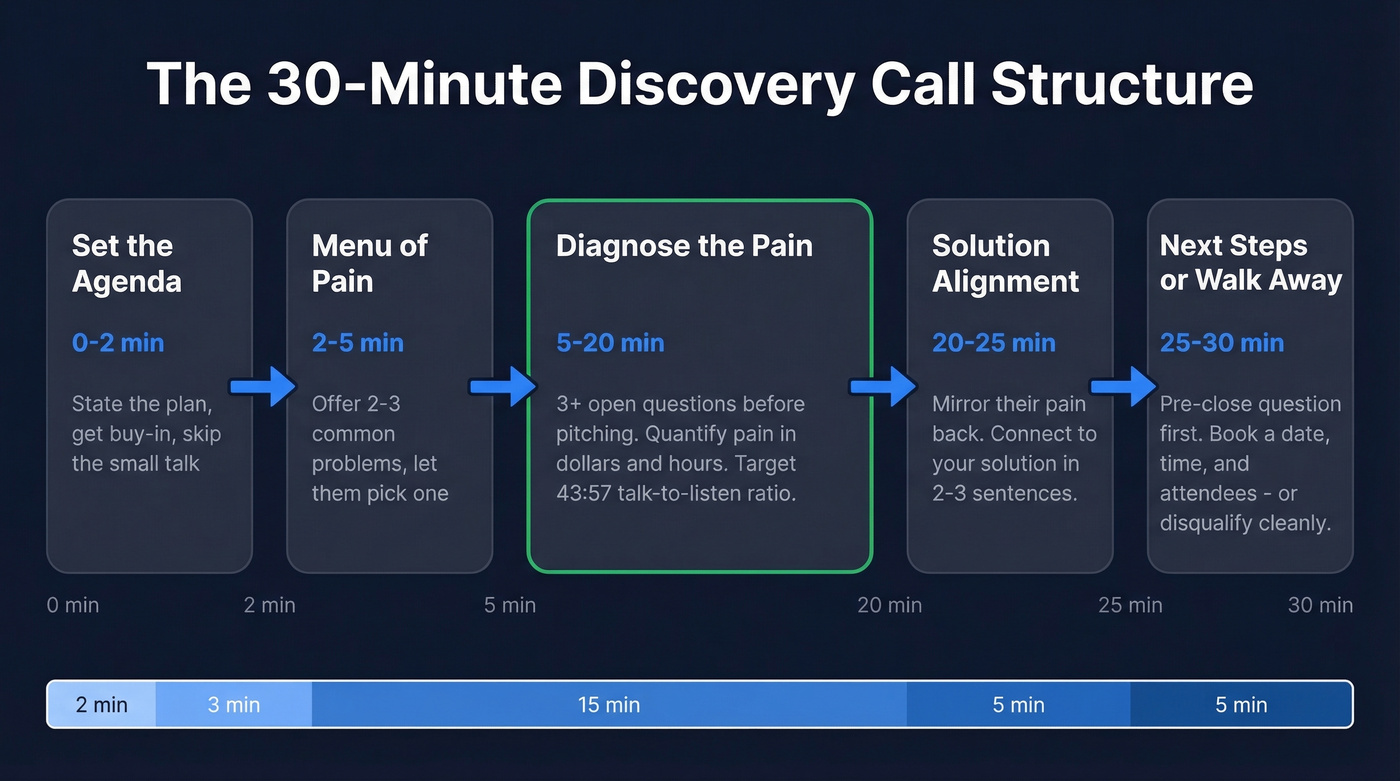
Minutes 0-2: Set the Agenda
Don't small-talk your way through the first five minutes. State the agenda, get buy-in, and move.
"I'd love to understand your situation, share a bit about how we might help, and if it makes sense, talk next steps. Sound fair?"
Two sentences. You've set expectations and given them an out.
Minutes 2-5: Menu of Pain
Instead of the open-ended "what are your biggest challenges?" - which forces the prospect to do all the thinking - offer a menu of pain. Present two or three common problems and let them pick:
"Most VPs of Sales we talk to are dealing with one of three things: reps can't get enough qualified meetings, pipeline is there but deals stall in stage two, or forecasting is a mess. Which one hits closest?"
This reduces cognitive load, builds instant credibility, and gets you to the real conversation in under a minute. Tailor the menu by persona - executives care about strategic outcomes, managers care about tactical execution. These pain points should reflect patterns you've validated across your ICP, not generic industry problems you pulled from a blog post.
Minutes 5-20: Diagnose, Don't Interrogate
Follow up on whichever pain they chose with open-ended process questions. Don't ask "what are your pain points?" - that's lazy and prospects hate it. Ask "How are you handling X today? What breaks in the process?" and "How many hours a week does your team spend on that?"
Here's the thing: ask at least three open-ended questions before you say anything about your product. The moment you start pitching, the diagnosis is over.
Quantify the pain in dollars and hours - that's what turns vague frustration into a business case their CFO can act on. If one person spends 6 hours a week on manual research at $50/hour, that's $15,600 a year walking out the door. Put that number on the table. Twist the knife a little. That's how you build urgency without manufacturing it.
The 43:57 talk-to-listen ratio matters most during this phase. If you're talking more than 43% of the time here, you're pitching, not diagnosing. Close rates increase by up to 20% when reps let prospects do most of the talking. We've seen this pattern hold across our own team's calls - the reps who talk less consistently close more.
Minutes 20-25: Solution Alignment
Connect their specific pain to your solution in two or three sentences. This isn't a feature walkthrough - it's a mirror.
"You mentioned your team spends 6 hours a week manually verifying contact data. Here's how we eliminate that step entirely."
Then check: "Does this match what you're looking for?" If they hesitate, you've got more diagnosing to do. Don't push through the hesitation - go back and ask what's missing.
Minutes 25-30: Next Steps or Walk Away
Before you mention pricing, ask the pre-close question: "Based on everything we've discussed, do you feel this is what you're looking for? If not, it may not make sense to go over pricing."
If the call is going sideways, be disarmingly blunt. A line from 30 Minutes to President's Club that works well: "I feel a little awkward saying this, but I feel like this call isn't really going so great - am I totally off base with that?" That kind of transparency either saves the deal or saves your time. Always end with a concrete next step - date, time, and who needs to be in the room.

You just spent 10 minutes quantifying a prospect's pain in dollars and hours. Don't let that momentum die because your contact data bounces. Prospeo delivers 98% email accuracy and 125M+ verified mobile numbers - so the follow-up call you booked in minutes 25-30 actually connects.
Bad data kills more deals than bad discovery. Fix that in seconds.
Key Benchmarks for 2026
| Benchmark | Number | Source | Sample Size |
|---|---|---|---|
| Optimal questions | 11-14 | Gong Labs | 519,000+ calls |
| Talk-to-listen ratio | 43:57 | CloudTalk | 25K calls |
| Host talk sweet spot | 40-60% | Demodesk | 328 meetings |
| Question ceiling | >14 drops to average | Gong Labs | 519,000+ calls |
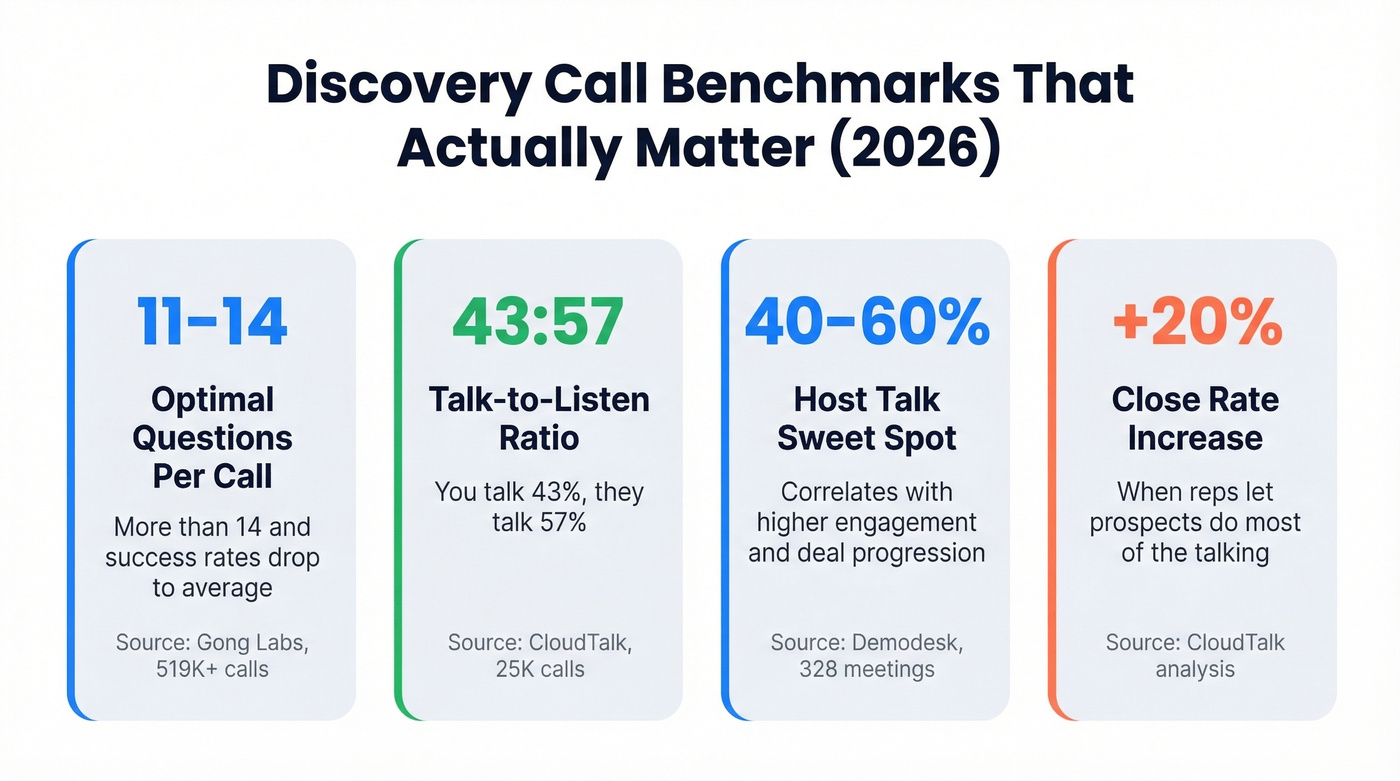
The pattern is clear: more than 14 questions and success rates drop to average. A host talk ratio between 40-60% correlates with higher engagement and deal progression. In our experience, the 11-14 question range holds up even for complex enterprise deals - the questions just get sharper.
10-Minute Pre-Call Prep
Let's be honest: 60 minutes of research per discovery call is the gold standard. Almost nobody does it. The realistic approach is deep prep for whale accounts, speed prep for everything else. Here's a 10-minute checklist that actually works:
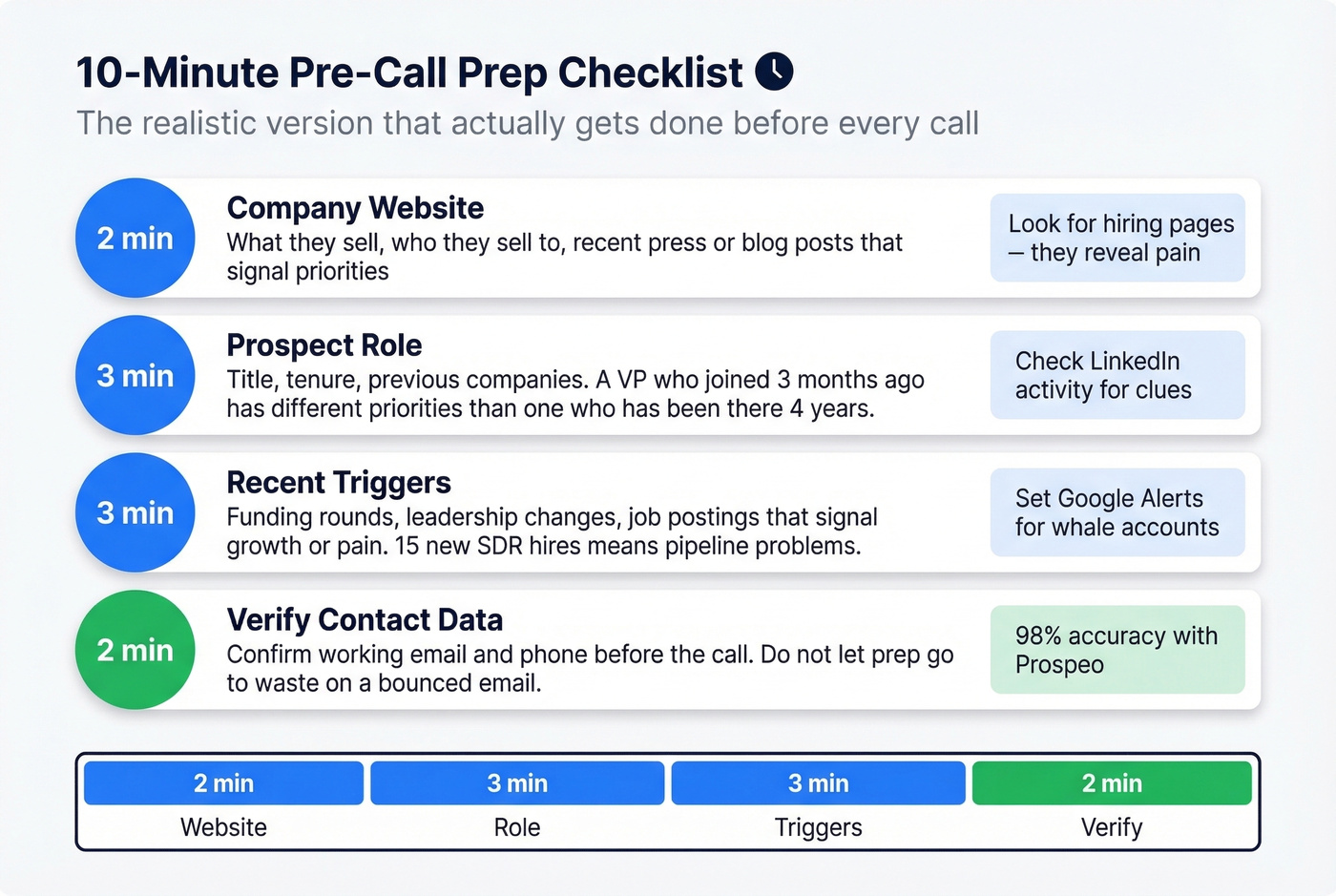
Company website (2 min) - what they sell, who they sell to, recent press releases or blog posts that signal priorities.
Prospect's role (3 min) - title, tenure, previous companies, anything that tells you what they care about. A VP who just joined 3 months ago has different priorities than one who's been there 4 years.
Recent triggers (3 min) - funding rounds, leadership changes, job postings that signal growth or pain. A company hiring 15 SDRs is a company with pipeline problems they're trying to solve with headcount.
Verify contact data (2 min) - confirm you've got a working email and phone number before the call. Prospeo handles this in seconds with 98% email accuracy and verified mobile numbers, so the meeting actually happens instead of bouncing. (If bounces are a recurring issue, fix the root cause with these email bounce rate benchmarks and remediation steps.)

Use SPICED, Not BANT
If you're still qualifying on budget in the first call, you're filtering out deals that haven't figured out their budget yet - which is most of them. The consensus on r/sales backs this up: BANT was built for a world where buyers didn't research before calls. That world is gone.
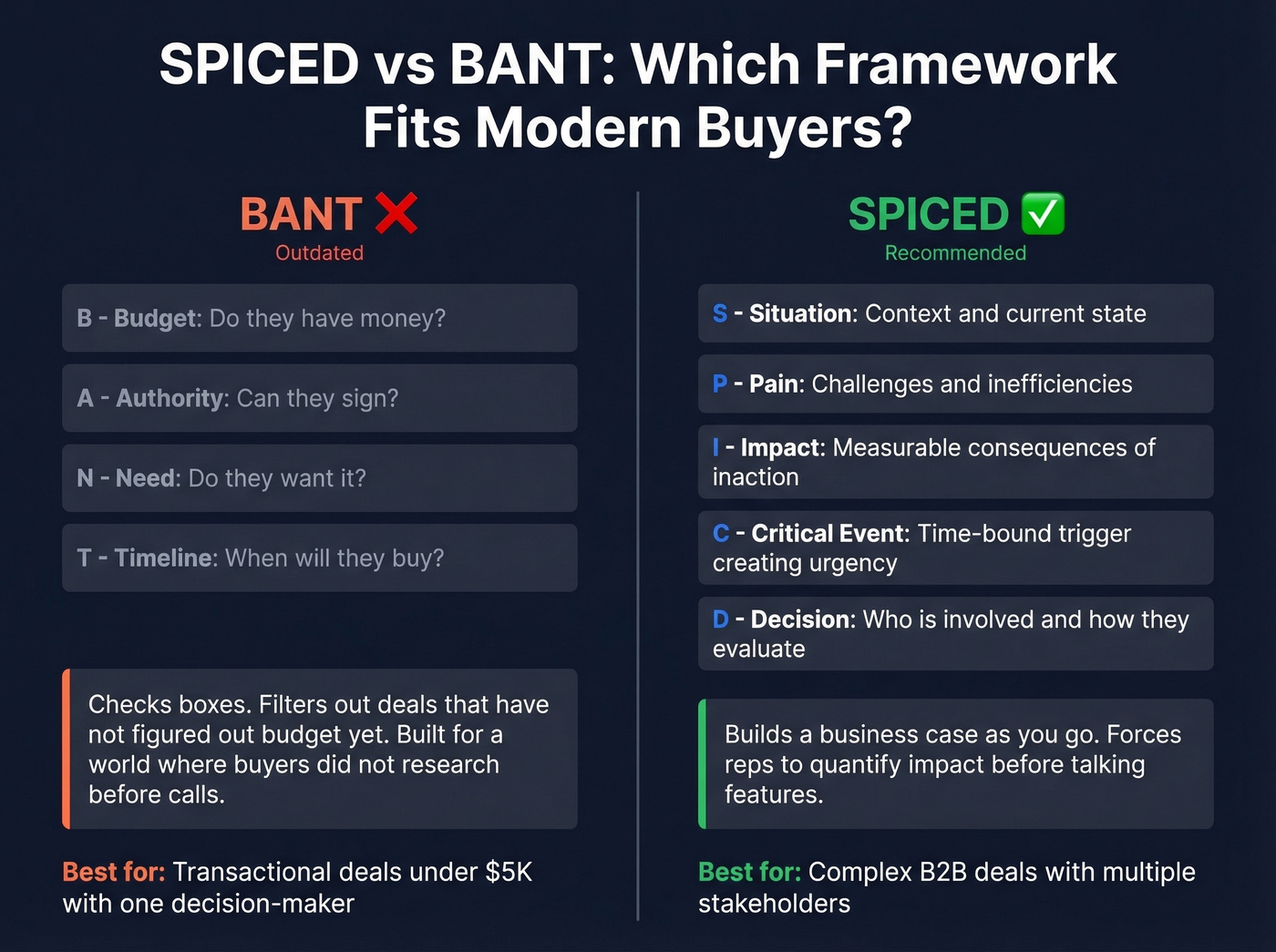
SPICED, from Winning by Design, maps to how modern buyers actually evaluate:
- Situation - context and current state
- Pain - challenges and inefficiencies
- Impact - measurable consequences of inaction
- Critical Event - the time-bound trigger creating urgency
- Decision - who's involved and how they'll evaluate
SPICED builds a business case as you go. BANT just checks boxes. We've moved our internal discovery to SPICED and haven't looked back - it forces reps to quantify impact before they ever talk about features, which is exactly where most discovery calls fall apart. For teams figuring out how to structure a sales call that actually advances pipeline, SPICED gives you a repeatable spine to build around.
Skip SPICED if you're running transactional sales with deal sizes under $5K and one decision-maker. In that case, a simpler pain-solution-next-steps flow is enough. Don't overcomplicate short sales cycles.
Your 10-minute pre-call prep checklist ends with 'verify contact data.' Prospeo's Chrome extension does it in one click - 98% accurate emails and direct dials from any LinkedIn profile or company site. 40,000+ reps already use it to make sure their discovery calls happen.
Stop prepping for calls that never connect. Start with verified data.
FAQ
How long should a discovery call be?
30 minutes is the sweet spot - long enough to diagnose pain and qualify, short enough that prospects stay engaged. Reserve 60-minute slots for complex enterprise deals with multiple stakeholders, but for standard outbound meetings, 30 minutes consistently outperforms longer calls.
Discovery call vs demo - what's the difference?
Discovery uncovers the problem; demos show the solution. Keep discovery to 15-30 minutes and demos to 45-60. If you're combining both into one meeting, never skip the diagnosis phase - reps who jump straight to demo close at significantly lower rates because they're solving a problem they haven't confirmed exists.
How many questions should I ask?
Aim for 11-14 targeted questions spread evenly through the call. More than 14 and success rates drop to average across 519,000+ analyzed B2B calls. Quality beats quantity - each question should build on the previous answer, not feel like a checklist.
How do I handle a guarded prospect?
Lead with the menu of pain to show you understand their world before asking deeper questions. Framing the conversation around their priorities - not your qualification checklist - is what gets reluctant buyers to open up. If they stay closed, name it directly: "I want to respect your time - would it be more helpful if I shared what we're seeing with similar teams first?"