

Do Cold Emails Work in 2026? What the Data Says
You sent 500 emails last month. Three replies. Your domain reputation is tanking, your sequences are landing in spam, and you're starting to wonder if cold email is dead.
It's not - but the version you're running probably is.
So do cold emails work? Yes. The gap between cold email that prints pipeline and cold email that wastes money has never been wider, though. Here's what the data says, then the playbook that separates the top 10% from everyone else.
The Short Answer
Cold email works. The 2026 average reply rate sits at 3.43%. Top quartile campaigns hit 5.5%+. Elite senders exceed 10.7%.
The difference between those tiers isn't copywriting talent. It's three things, in this order: data quality, sending infrastructure, and message quality. Most teams obsess over the third while ignoring the first two. That's backwards.
2026 Cold Email Benchmarks
Three major datasets paint a consistent picture of cold email effectiveness right now.
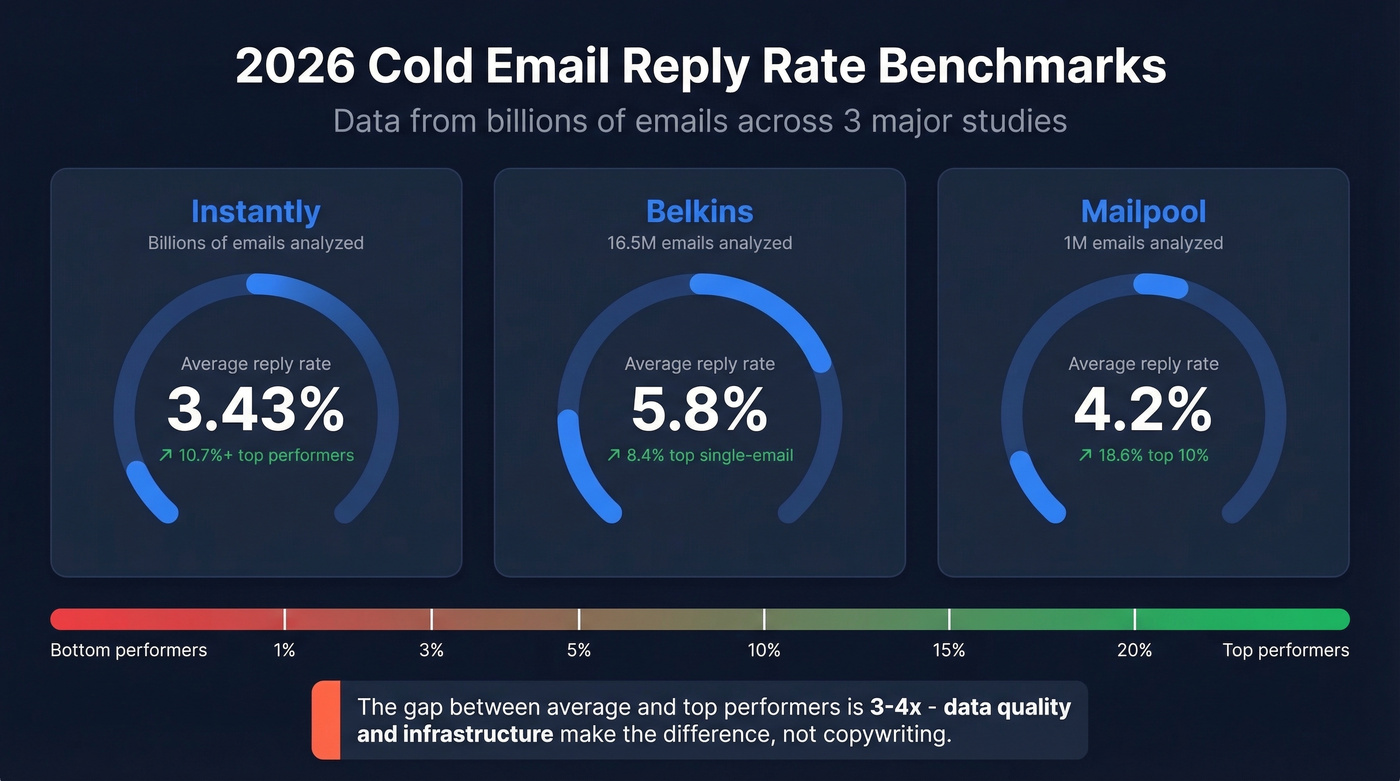
| Source | Dataset Size | Avg Reply Rate | Top Performer Reply Rate |
|---|---|---|---|
| Instantly | Billions of cold email interactions | 3.43% | 10.7%+ |
| Belkins | 16.5M emails | 5.8% | 8.4% (single-email) |
| Mailpool | 1M emails | 4.2% | 18.6% |
The Belkins data deserves attention: their 2024 average of 5.8% was down from 6.8% in 2023, a 15% decline. Reply rates are compressing. The bar for "good enough" keeps rising. They also tracked open rates rising to 46% early in 2024, then crashing to 31-32% - and stopped tracking opens mid-year entirely. Opens are noise. Replies are signal.
Mailpool's top 10% numbers look aggressive at 18.6%, but those campaigns also report 98.2% deliverability. The best campaigns aren't just well-written - they're reaching inboxes that actually exist, from domains that mailbox providers trust.
Why Most Cold Email Fails
It's not your subject line. The #1 killer of cold email campaigns is bad data, and it's not close.
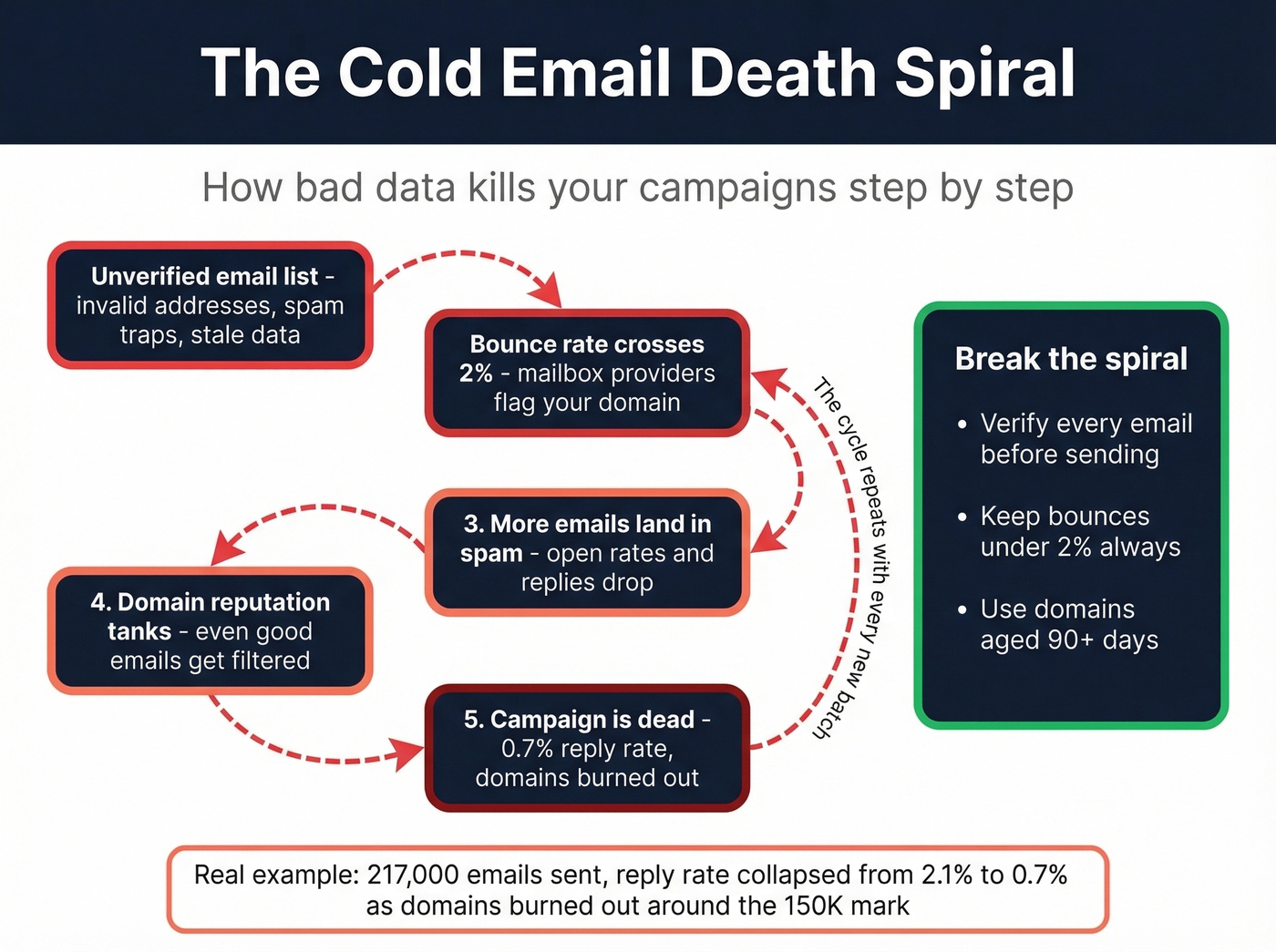
When your list has invalid addresses, every bounce chips away at your sender reputation. Mailbox providers track this. Once your bounce rate crosses 2%, you're in a death spiral: more emails land in spam, fewer get opened, your domain reputation drops further, and the next batch performs even worse.
In 2025, one practitioner on r/b2bmarketing documented this in painful detail - after sending 217,000 cold emails, their reply rate collapsed from 2.1% to 0.7% as domains burned out. Deliverability fatigue set in around the 150,000 mark. The infrastructure simply couldn't keep up with the volume. Whether cold emailing works for you depends entirely on whether your infrastructure can survive what you're pushing through it.
The second killer is volume abuse. Sending 1-20 emails per day per inbox delivers 96% deliverability in the 1-million-email dataset. Push past 100/day and you're at 67%. Domain age matters too - domains under 30 days old hit just 73% deliverability versus 95% for domains aged 90+ days.
That's why list verification matters more than any other variable. Prospeo verifies emails with 98% accuracy on a 7-day refresh cycle - Stack Optimize used it to maintain 94%+ deliverability with zero domain flags across all their clients.
The Deliverability Playbook
Before you write a single word of copy, nail these fundamentals. Every item here is non-negotiable in 2026.
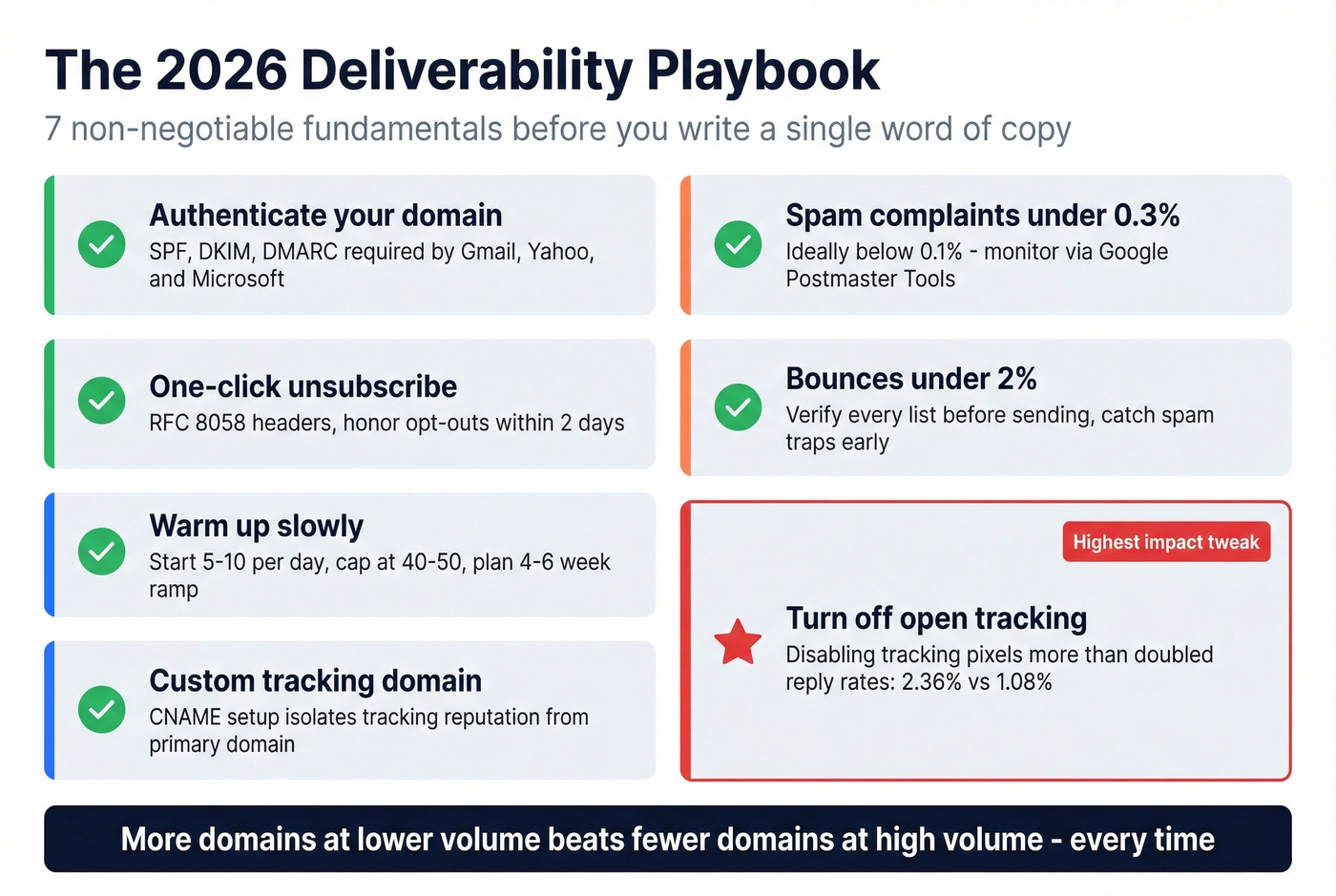
- Authenticate your domain. SPF, DKIM, and DMARC (at minimum p=none) are required by Gmail and Yahoo for bulk senders, and enforced by Microsoft as of mid-2025. No authentication means no inbox.
- Set up one-click unsubscribe. RFC 8058 compliance means List-Unsubscribe and List-Unsubscribe-Post headers. Gmail and Yahoo enforce this. Honor opt-outs within 2 days.
- Warm up new domains slowly. Start at 5-10 emails/day. Week 1: 10-20/day. Week 2: 20-40/day. Cap at 40-50/day once healthy. Plan a 4-6 week ramp; at minimum start 2-4 weeks before production sends. Use domains aged 90+ days when possible. One r/Entrepreneur practitioner recovered their reply rate from 3% to 6% by scaling from 3 domains to 7, each sending a max of 26 emails/day. More domains at lower volume beats fewer domains at high volume every time.
- Use a custom tracking domain. Set up a CNAME so link and pixel tracking reputation stays isolated from your primary domain.
- Keep spam complaints under 0.3%. Ideally below 0.1%. Google tracks this in Postmaster Tools.
- Keep bounces under 2%. Verify every list before sending. Catch spam traps and honeypots before they wreck your sender reputation.
- Turn off open tracking. A Snov.io analysis of 44 million emails found that disabling open tracking more than doubled reply rates: 2.36% vs 1.08%. Tracking pixels trigger spam filters. This single change is the highest-impact tweak most senders ignore.

The data is clear: cold email campaigns die when bounce rates cross 2%. Prospeo's 5-step email verification delivers 98% accuracy on a 7-day refresh cycle - so every address you send to actually exists. Stack Optimize used it to hold 94%+ deliverability with zero domain flags.
Stop burning domains. Start with data that's verified this week.
What to Write
Email length has a sweet spot, and it's shorter than you think. Across 1 million cold emails, 75-125 words hit a 22% reply rate. Under 50 words dropped to 12%. Over 250 words crashed to 8%. That same recovery story from r/Entrepreneur? They cut email length from 141 words to under 56 and saw their reply rate double.
Question-based subject lines outperform statements by 34% on open rate. But "Quick question" without context actually hurts opens by 23% - the question needs to be specific enough to earn curiosity.
Personalization That Moves the Needle
Not all personalization is equal. The 1-million-email dataset broke down reply rate lift by type, and the hierarchy is clear:
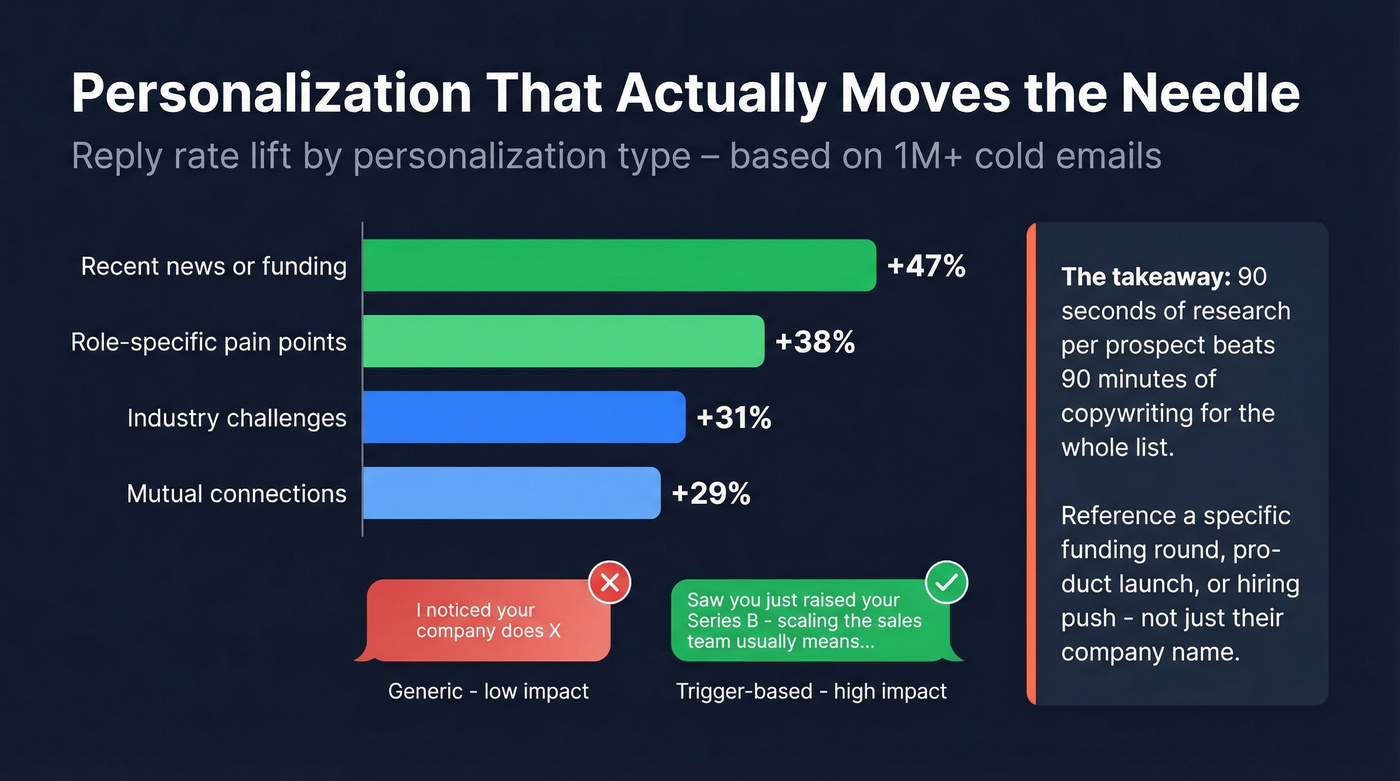
| Personalization Type | Reply Rate Lift |
|---|---|
| Recent news or funding | +47% |
| Role-specific pain points | +38% |
| Industry challenges | +31% |
| Mutual connections | +29% |
Referencing a company's recent funding round or product launch nearly doubles your chances compared to a generic "I noticed your company does X." This is where most senders leave the biggest gains on the table. Spending 90 seconds on research per prospect beats spending 90 minutes on copy for the whole list.
The Template That's Working
The format winning right now is ultra-short and value-first. Here's a template at 47 words:
Hi [Name],
Saw you're hiring for [role] - usually means [specific pain point] is on the radar.
We help [ICP companies] [specific outcome] in [timeframe]. I'll [concrete value offer - e.g., audit your top 3 landing pages and send a Loom with fixes].
Worth a conversation?
"I'll audit your top 3 landing pages and send you a Loom with fixes" beats "Can we schedule a call to discuss how we can help?" every single time. Give before you ask.
When to Send and Follow Up
Timing matters more than most people realize. Three optimal windows emerge from the data: Tuesday at 10:47 AM, Wednesday at 9:15 AM, and Thursday at 2:23 PM - all in the recipient's local timezone. Monday mornings and Friday afternoons are dead zones.
Instantly's benchmark data shows 58% of all replies come from step 1 of a sequence. Follow-ups contribute the remaining 42%, with a sweet spot of 4-7 total touchpoints. Beyond 7, diminishing returns kick in hard.
Here's the thing most guides won't tell you: spam complaints escalate with every follow-up. Belkins tracked this across 16.5 million emails - spam complaints jumped from 0.5% on the first email to 1.6% by the fourth. Unsubscribes went from 0.1% to 2% by round 4. Each follow-up is a calculated bet against your domain reputation.
One more data point that should change your targeting: contacting 1-2 people per company produced a 7.8% reply rate. Contacting 10+ people at the same company dropped it to 3.8%. Precision beats saturation.
Cold Email vs. Other Channels
Email alone underperforms. Here's how it stacks up:
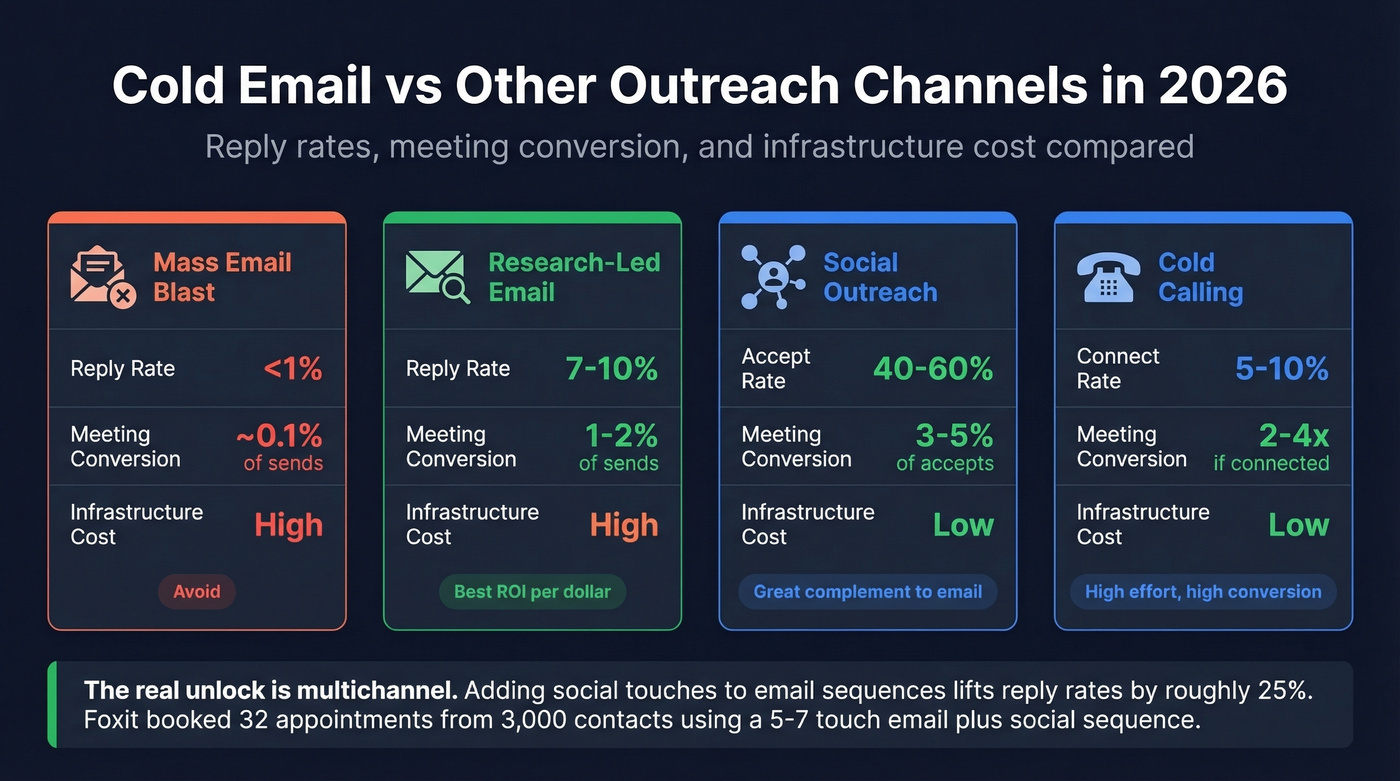
| Channel | Reply/Connect Rate | Meeting Conversion | Infrastructure Cost |
|---|---|---|---|
| Mass email blast | <1% | ~0.1% of sends | High |
| Research-led email | 7-10% | ~1-2% of sends | High |
| Social outreach (personalized) | 40-60% acceptance | ~3-5% of acceptances | Low |
| Cold calling | 5-10% connect | 2-4x higher if connected | Low |
The real unlock is multichannel. Adding a social touch to an email sequence lifts reply rates by roughly 25%. Foxit's case study illustrates this well: they booked 32 sales appointments from 3,000 researched contacts using a 5-7 touch sequence blending email and social over 10-14 business days.
We've seen this pattern repeatedly - teams that run email-only campaigns leave meetings on the table. The infrastructure overhead for email is real, but the cost per meeting is still hard to beat when the data is clean.
How to Test This Yourself
Don't take the benchmarks on faith. Start with 500 prospects. Split them into 5 cohorts of 100. Test one variable per cohort - subject line, email length, offer type, send time, or personalization depth. Run for 2 weeks. Double down on the winner. This is how you find what works for your ICP instead of blindly copying someone else's playbook.
The Real Cost (and ROI)
Let's be honest: if your average deal size is under $5k, you don't need ZoomInfo-level data. A lean cold email stack can run for under $500/month and outperform bloated enterprise setups.
One Reddit practitioner broke down their entire stack: $420/month generating 16 qualified leads - roughly $26 per lead. That's cheaper than almost any paid channel for B2B. When the economics look like that, cold outreach is the highest-ROI channel available for most B2B teams.
The math shifts dramatically based on data costs. Many email verification tools land around $0.002-$0.01 per email, while some workflows cost more once you factor in enrichment credits and bundled pricing. On a 5,000-contact campaign, that's the difference between paying $10-$50 versus hundreds of dollars on a pricier credit model. Most cold email failures start with expensive, stale data. The economics change completely when verification costs a penny per email and the data refreshes weekly instead of sitting in a database for months.
In our experience, the revenue impact compounds fast once deliverability is solved. Meritt tripled their pipeline from $100K to $300K per week after switching to verified data and dropping their bounce rate from 35% to under 4%. That's not a reply rate metric - that's real pipeline dollars.
Personalization lifts reply rates up to 47%, but only if you're reaching real inboxes first. Prospeo gives you 300M+ profiles with 30+ filters - buyer intent, funding, job changes, headcount growth - so you target the right people with the right trigger, at $0.01 per email.
Find prospects showing buying signals and reach them on the first try.
FAQ
Is cold email legal?
Yes. CAN-SPAM allows unsolicited commercial email with proper sender identification and opt-out mechanisms. In the EU/UK, GDPR requires a lawful basis (often legitimate interest for B2B) and compliant opt-outs. One-click unsubscribe is enforced by Gmail, Yahoo, and Microsoft for bulk senders.
What's a good cold email reply rate?
The 2026 average is 3.43%, and top quartile hits 5.5%+. Consistently above 5% means you're outperforming most senders. Deliverability and relevance drive the gap - nail both and double-digit reply rates are achievable.
How many cold emails can I send per day?
Under 50 per inbox per day. Data shows 1-20/day delivers 96% deliverability. Scale volume by adding multiple inboxes and domains rather than pushing higher sends from a single account.
How long should a cold email be?
75-125 words hits a 22% reply rate across 1M emails analyzed. Under 50 drops to 12%, over 250 crashes to 8%. Lead with value and end with a soft CTA - skip the filler paragraphs.