

Best DocSend Alternatives in 2026 (Honest Picks)
You're a solo founder raising a seed round. You've got 30 investors on your list, a pitch deck that's finally ready, and DocSend wants $45/month just to let you share it with page-level analytics. The $10 Personal plan exists, but it caps you at basic controls and four e-signatures. Reddit threads from founders in the same spot don't mince words - DocSend "costs way more than I'm comfortable paying" for what's essentially a PDF link with a tracking pixel.
The good news: DocSend alternatives have gotten genuinely good. Some are free. Some do things DocSend still doesn't - AI document chat, open-source self-hosting, interactive web proposals. And one category most "alternatives" articles ignore entirely - finding verified contact data for the investors you're sharing with - matters more than the document tool itself.
Let's break it down.
Our Top Picks (TL;DR)
| Tool | Best For | Starting Price |
|---|---|---|
| Papermark | Free/open-source deck tracking | €0/mo |
| Prospeo | Verified investor emails for follow-up | Free (75 emails/mo) |
| Sizle | Tracking + deal rooms + e-sign | $20/mo (annual) |
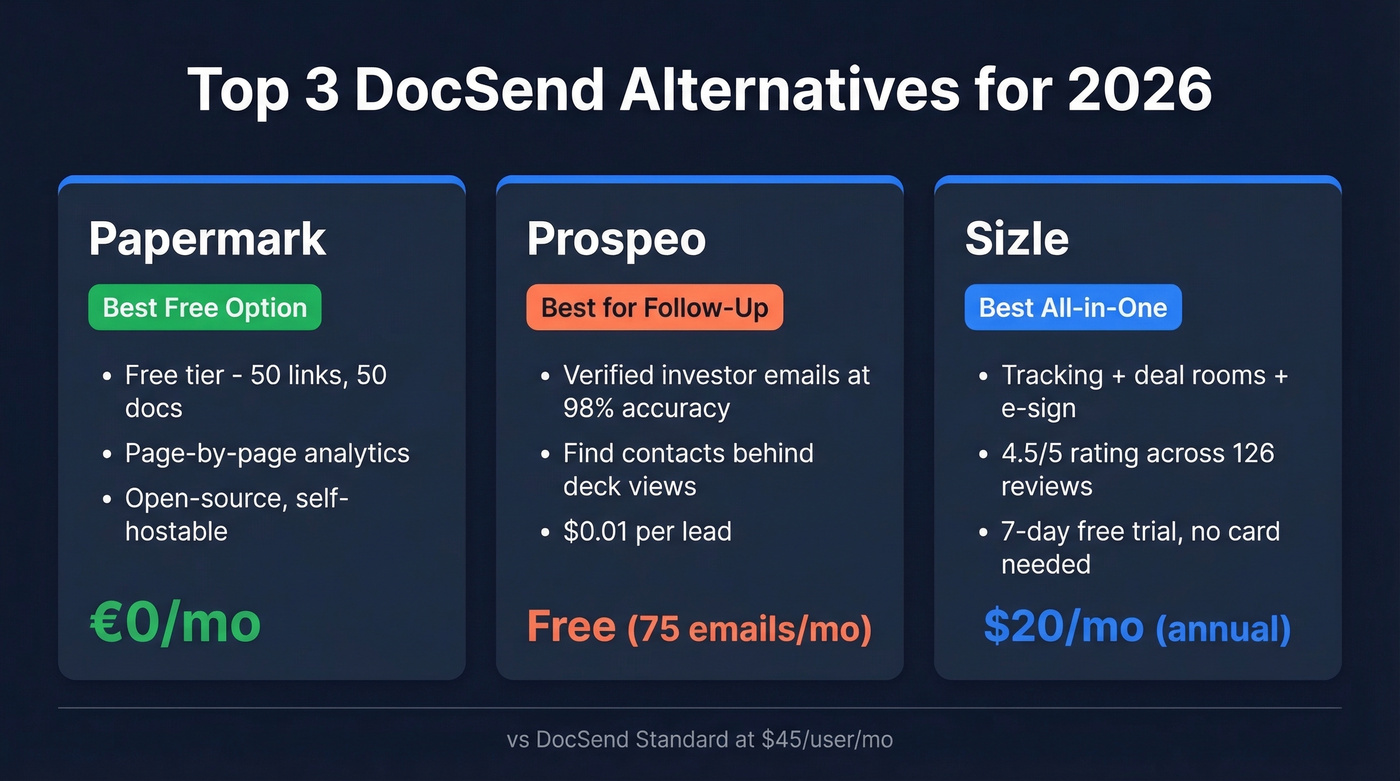
Papermark gives you page-by-page analytics plus 50 links, 50 documents at zero cost - enough for most fundraising rounds. Prospeo handles what happens after you share the deck: finding verified emails for the people who actually read it. Sizle bundles tracking, deal rooms, and e-signatures into a single tool at a price that won't make your CFO flinch.
What DocSend Costs in 2026
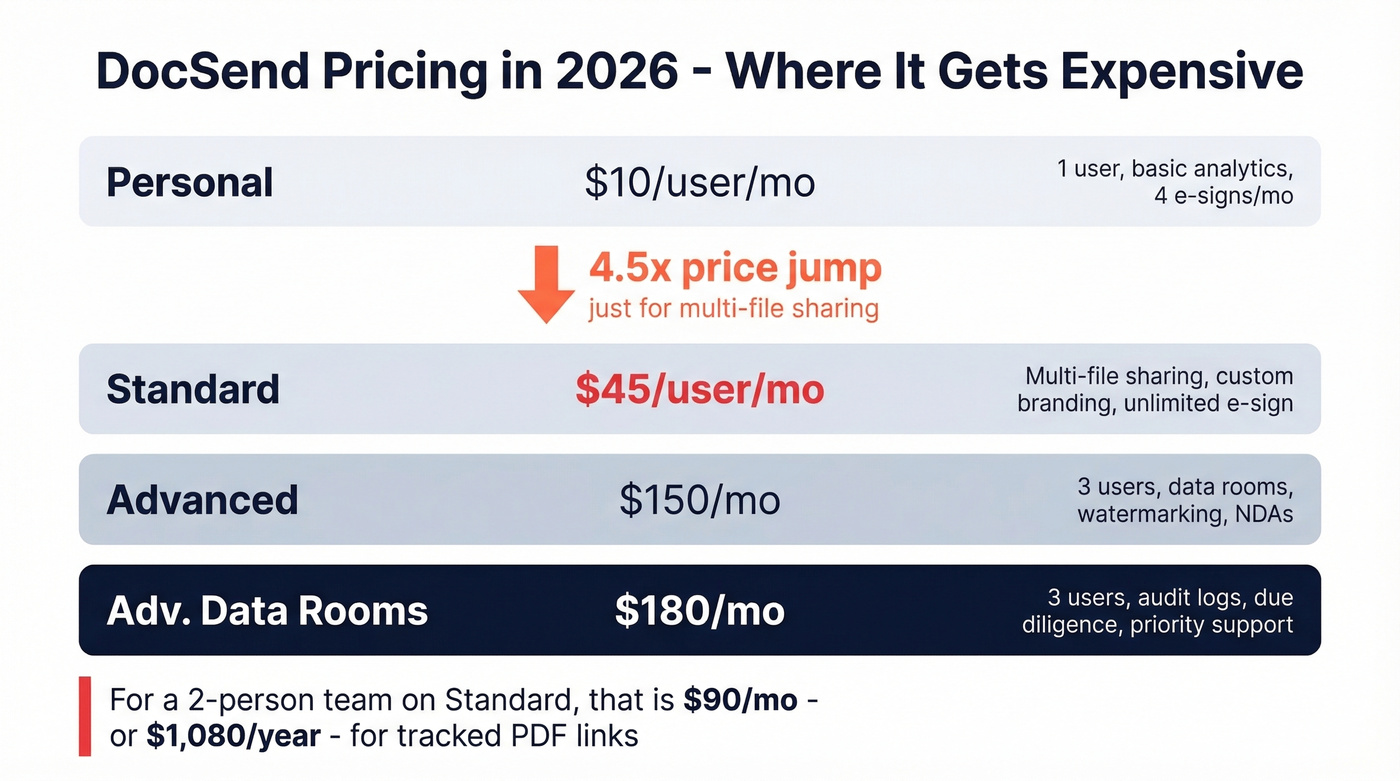
DocSend's pricing page shows four tiers, but the jump from Personal to Standard is where most founders feel the sting.
| Plan | Price | Users | Key Features |
|---|---|---|---|
| Personal | $10/user/mo | 1 | Basic sharing controls, document-level analytics, 4 eSignatures/mo, unlimited visitors |
| Standard | $45/user/mo | 1 | Multi-file sharing, video & rich media analytics, file requests, customizable branding, unlimited eSignature |
| Advanced | $150/mo | 3 | Data rooms (Spaces), watermarking, NDAs/gating agreements, email authentication, allow/block lists |
| Adv. Data Rooms | $180/mo | 3 | Enhanced data rooms, audit log, due diligence tracking, priority email support |
That $10 Personal tier looks reasonable until you realize it doesn't include multi-file sharing, custom branding, or unlimited e-signatures. The moment you need any of those, you're at $45/month per user. For a two-person founding team, that's $90/month for tracked PDF links.
You'll also see $65/month referenced in older blog posts and competitor comparisons. That's legacy pricing from before Dropbox restructured the tiers.
One more thing: the 14-day free trial is for Advanced Data Rooms only, and "Unlimited visitors not available on free trials." You can't stress-test the product with a live fundraise during the trial window.
Why People Switch
Three reasons come up over and over.
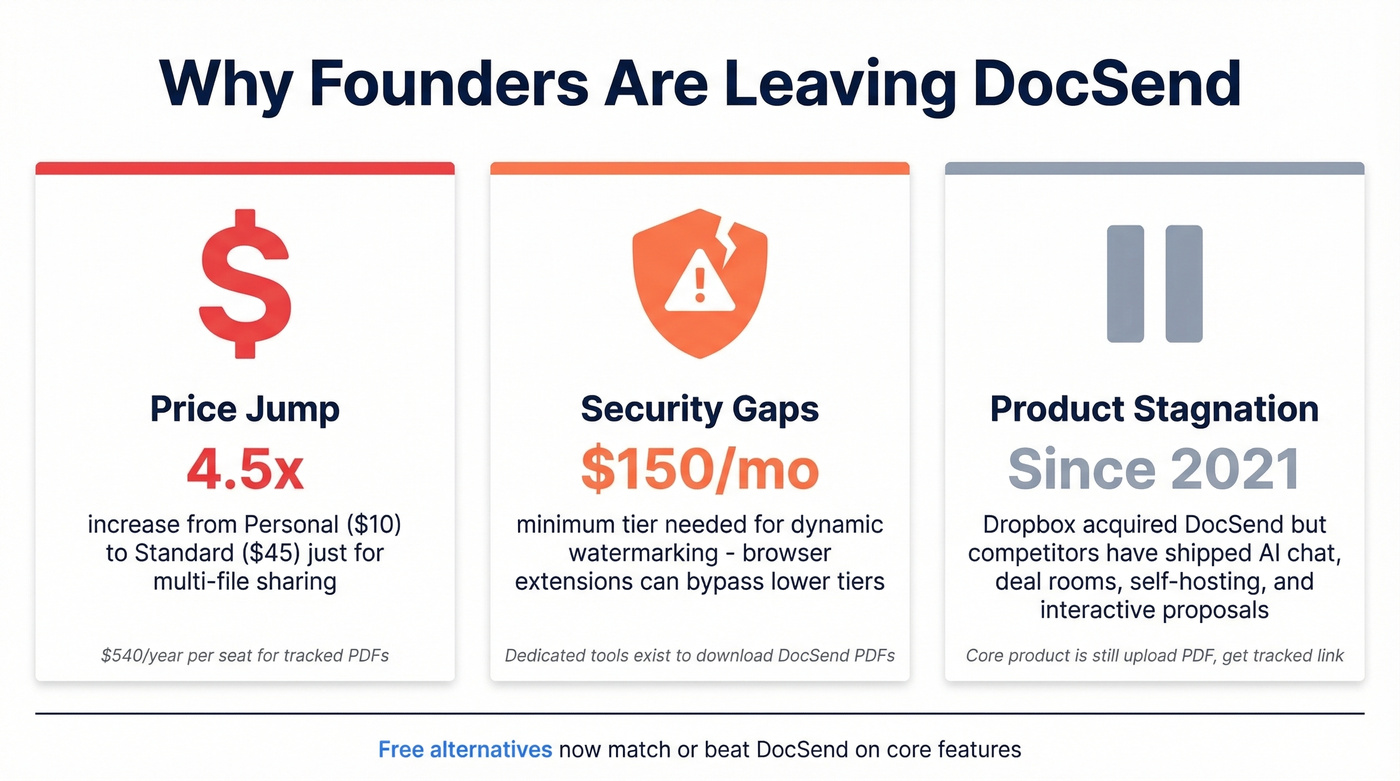
The price jump is brutal for early-stage teams. Going from $10 to $45/user/month just to get multi-file sharing and unlimited e-signatures is a 4.5x increase. For a pre-revenue startup, that $540/year per seat adds up fast - especially when free alternatives offer comparable analytics.
The security isn't as airtight as you'd think. Dedicated websites and browser extensions exist specifically to download PDFs from DocSend links. Dynamic watermarking only kicks in at the $150/month Advanced tier. If you're on Personal or Standard, your "protected" deck can still end up as a regular PDF on someone's desktop.
Post-Dropbox stagnation. Dropbox acquired DocSend in 2021, and the product hasn't evolved dramatically since. The core experience - upload a PDF, get a tracked link - works fine. But competitors have added deal rooms, AI-powered chat, interactive proposals, and self-hosting options while DocSend has mostly stayed put.
The Best DocSend Alternatives Compared
Papermark
Use this if: You want free, open-source deck tracking with real analytics and don't mind a few rough edges.
Skip this if: You need enterprise-grade security certifications today or want a polished self-hosting experience out of the box.
Papermark's free tier is genuinely generous - €0/month gets you 50 links, 50 documents, page-by-page analytics, and sharing controls. That's enough for a full fundraising round. The Pro tier scales to €24/month with 100 documents and 1-year analytics retention. Business runs €59/month with 1,000 documents and screenshot protection. Data Rooms at €99/month adds dynamic watermarking, NDAs, and unlimited data rooms.
The platform is trusted by 53,000+ companies and has powered over 1.35 million link views with $5B in transaction volume. It's open-source, which is a real differentiator - you can inspect the code and self-host it. In practice, Reddit users report that self-hosting requires code modifications and the docs lack clarity. If you're not a developer, stick with the hosted version.
Infrastructure includes AES-256 encryption, 38+ data centers, and GDPR/CCPA/HIPAA compliance. Papermark also offers AI-powered document chat - a feature DocSend doesn't have. Two things to know: analytics retention is only 30 days on the free plan, and SOC 2 compliance is in progress, not certified. For most seed-stage founders, neither is a dealbreaker.
Sizle
Sizle hits the sweet spot for founders and small sales teams who need more than tracked links but don't want to pay PandaDoc or GetAccept prices. The Pro plan at $55/month on annual billing gives you unlimited documents and Smart Links, 10 deal rooms, full viewer analytics, and unlimited e-signatures. That's roughly what DocSend Standard costs - but with deal rooms and e-sign included.
The Starter plan at $20/month annual is the budget entry point, though it limits you to 1 deal room - fine for a single fundraise, tight for anything more. Monthly pricing jumps significantly ($29/$79/$199) if you don't commit annually. Growth tier at $139/month is required for custom branding and branded URLs. Sizle carries a 4.5/5 on Software Advice across 126 reviews, and the 7-day free trial doesn't require a credit card.
PandaDoc
PandaDoc is a pickup truck when you need a bicycle. Essentials runs ~$19/user/month, Business ~$49/user/month. There's a free tier, but it's limited to e-signatures only.
The platform shines for sales teams sending proposals and closing contracts. If all you need is to share a pitch deck with analytics, you'll be paying for a dozen features you'll never touch. But if your workflow already includes proposals, contracts, and e-signatures, PandaDoc consolidates all of that into one place - and the document tracking comes along for the ride.
Brieflink
Brieflink has a free plan, and it's built by NFX (the site is owned by NFX Capital). The workflow is dead simple: upload deck, email-gate access, track views.
Here's the thing: you're uploading a confidential pitch deck into a tool owned by a VC firm. No watermarking, no screenshot protection, no data rooms, no e-signatures, no CRM integrations. If you're raising from NFX competitors, think twice about where your deck is sitting.
Qwilr
Qwilr is a different animal entirely. Instead of sharing static PDFs, you build interactive, web-based proposals that look like landing pages - embedded pricing calculators, video, live content blocks. The Business plan runs $35/user/month with e-sign, analytics, and HubSpot integration.
But viewer identification - knowing who looked at your proposal - is gated behind Enterprise at $59/user/month with a 10-user minimum. That's a $590/month floor just to see names. Analytics retention is 120 days on Business, 5 years on Enterprise. Great for sales teams sending interactive proposals; wrong tool for sharing a pitch deck PDF.
GetAccept
Use this if: You're building digital sales rooms for complex B2B deals with multiple stakeholders.
Skip this if: You're a founder sharing a pitch deck. This is a sales team tool.
The eSign plan starts at $25/user/month. Professional is $49/user/month with a 5-user minimum ($245/month floor) and annual billing required. AI features come with usage limits unless you pay for the unlimited add-on. GetAccept is powerful for mid-market sales teams running multi-touch deal cycles, but it's wildly overbuilt for document sharing.
Digify
Digify positions itself as an enterprise-grade virtual data room, and the pricing reflects that - starts around $140/month based on third-party sources. Official pricing requires contacting sales. This is the tool for M&A due diligence and compliance workflows where audit trails and granular permissions matter more than price. If you're sharing a seed-stage pitch deck, look elsewhere.
Dropbox and Google Drive
Dropbox owns DocSend (acquired 2021) and starts at $9.99/user/month for Business. It handles file sharing fine, but there's no page-by-page analytics, no deck tracking, and no viewer engagement data. It's a file storage tool, not a document tracking replacement.
Google Drive is free for personal use, $6/user/month for Business Standard. No analytics, no access controls beyond basic sharing permissions. Sharing an investor deck via Google Drive tells investors you didn't care enough to use a proper tool. For anything external-facing, use literally anything else on this list.

Tracking who viewed your deck is step one. Step two is following up with a verified email - not a LinkedIn connection request that sits unread for weeks. Prospeo gives you 98% accurate emails for investors, partners, and VCs at $0.01 per lead.
Turn deck views into real conversations. Start free with 75 emails/month.
Feature Comparison: Side-by-Side
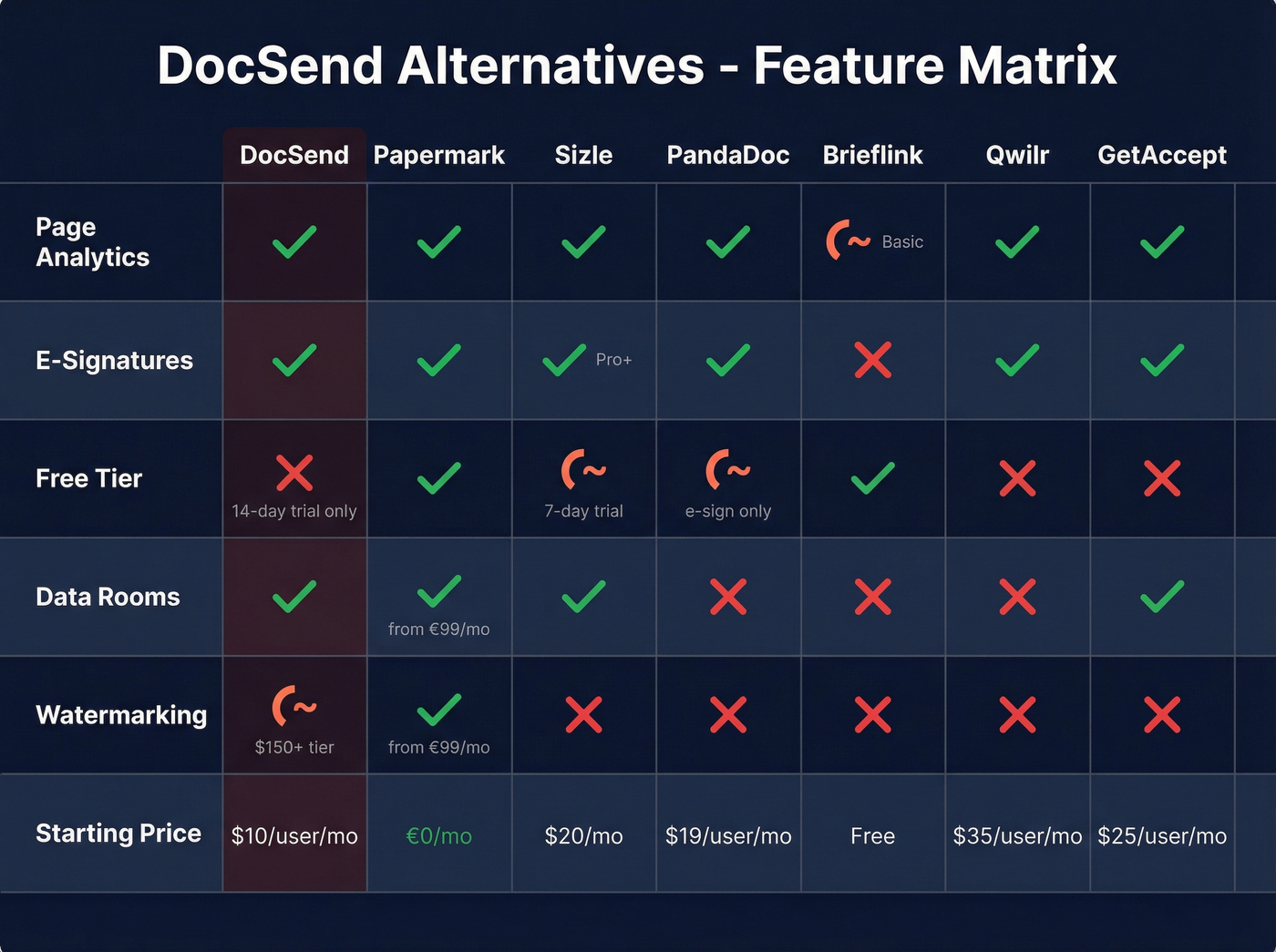
If a tool checks the box on analytics and e-sign, it handles 90% of what founders actually use DocSend for. Data rooms and watermarking only matter if you're running due diligence or sharing genuinely sensitive materials.
Core Features
| Tool | Starting Price | Page Analytics | E-Sign | Free Tier |
|---|---|---|---|---|
| Papermark | €0/mo | ✅ | ✅ (NDA) | ✅ |
| Sizle | $20/mo (annual) | ✅ | ✅ (Pro+) | 7-day trial |
| PandaDoc | ~$19/user/mo | ✅ | ✅ | E-sign only |
| Brieflink | Free plan | Basic | ❌ | ✅ |
| Qwilr | $35/user/mo | ✅ | ✅ | ❌ |
| GetAccept | $25/user/mo | ✅ | ✅ | ❌ |
| Digify | ~$140/mo | ✅ | ✅ | ❌ |
| Dropbox | $9.99/user/mo | ❌ | ❌ | ❌ |
| Google Drive | Free/$6/user/mo | ❌ | ❌ | ✅ |
Advanced Features
| Tool | Data Rooms | Watermark | Notes |
|---|---|---|---|
| Papermark | ✅ (€99/mo) | ✅ (€99/mo) | Open-source, AI doc chat |
| Sizle | ✅ | ❌ | Deal rooms from Starter |
| PandaDoc | ❌ | ❌ | Best for proposals + contracts |
| Brieflink | ❌ | ❌ | VC-owned tool tradeoffs |
| Qwilr | ❌ | ❌ | Interactive web proposals |
| GetAccept | ✅ | ❌ | 5-user min on Professional |
| Digify | ✅ | ✅ | Enterprise M&A focus |
| Dropbox | ❌ | ❌ | File storage, not tracking |
| Google Drive | ❌ | ❌ | No analytics at all |
The Security Reality
Something most alternatives articles skip: none of these tools are truly leak-proof. DocSend has dedicated browser extensions and websites built to bypass its download protection. That's not a bug in one product - it's a fundamental limitation of sharing PDFs over the web.
Here's what actually moves the needle on security:
Dynamic watermarking embeds the viewer's identity into every page. DocSend offers this at $150/month (Advanced). Papermark includes it at €99/month (Data Rooms).
Screenshot protection makes screen captures harder. Papermark enables this at the Business tier (€59/month). Brieflink doesn't offer it at all.
Image-tile rendering serves pages as randomized image fragments instead of a downloadable PDF. This is the strongest anti-exfiltration approach available, though few tools implement it yet.
Email verification/gating is the baseline - require a verified email before anyone sees page one.
If security genuinely matters for your use case - M&A, sensitive financials, pre-IPO materials - you need watermarking plus screenshot protection at minimum. For a standard pitch deck going to 30 VCs, email gating and basic analytics are usually enough. The investors aren't trying to steal your deck. They're trying to decide if it's worth a 30-minute call.
After You Share the Deck
Here's the scenario nobody talks about: an investor spent four minutes on your financials slide, skimmed the team page, and then... nothing. No reply to your DocSend notification. No response to the email you sent through your fund's intro.
You need their direct email. Not the generic partners@ address. Not the associate who forwarded the link. The actual person who read your deck.
We've seen founders pair a free Papermark account with Prospeo's free tier and run an entire fundraise without paying for any software. The deck tracking tells you who's interested. The email finder tells you how to reach them (and how to find a direct email address when LinkedIn isn’t enough).
How to Choose the Right Tool
Your use case determines the right tool. Don't overthink it.
Fundraising founders on a budget: Start with Papermark's free tier. If you outgrow it, upgrade to Sizle Starter ($20/month) for deal rooms and e-sign.
Sales teams sending proposals and contracts: PandaDoc if you want a cleaner proposal workflow. GetAccept if you need digital sales rooms for multi-stakeholder deals.
M&A and due diligence: Digify (~$140/month) or DocSend Advanced Data Rooms ($180/month). Both offer audit trails and granular permissions.
Maximum value, zero budget: Papermark Free plus 75 verified investor emails per month from the free email finder. Page-by-page analytics and direct follow-up, all at $0.
We've run the numbers on team pricing, and the gap is wider than most founders realize. A 3-person team on DocSend Standard pays $135/month. The same team on Sizle Pro pays $55/month total on annual billing. Papermark Business runs €59/month for up to 3 users.
Look, the document-sharing tool matters less than most founders think. I've watched teams agonize over Papermark vs. Sizle vs. DocSend for weeks while their actual problem was that they didn't have direct emails for half their investor list. Pick a sharing tool that fits your budget, make sure you can actually reach the people who read your deck, and focus your energy on the pitch itself (and your sales deck storytelling).
No document tool solves your real problem: reaching the right investors in the first place. Prospeo's database covers 300M+ professionals with 30+ filters - search by role, company size, funding stage, and industry to build a targeted investor list before you ever share a link.
Build your investor outreach list in minutes, not weeks.
FAQ
Is there a completely free DocSend alternative?
Papermark's free tier gives you 50 links, 50 documents, and page-by-page analytics at €0/month - enough for a full fundraising round. Brieflink also offers a free plan, though it's owned by NFX Capital. For investor follow-up emails, Prospeo's free tier adds 75 verified contacts per month at no cost.
Which alternative has the best data rooms?
For lightweight data rooms, Papermark (€99/month) and DocSend Advanced ($150/month) both cover NDA-style gating and watermarking. For enterprise-grade M&A due diligence, Digify (~$140/month) is purpose-built around audit trails and granular compliance permissions.
Can people bypass DocSend's download protection?
Yes. Dedicated browser extensions and websites exist specifically to download PDFs from DocSend links. Tools with dynamic watermarking, screenshot protection, and image-tile rendering reduce risk - but no solution is 100% bulletproof for web-shared documents.
Can I migrate documents from DocSend easily?
Most alternatives accept direct PDF uploads, but DocSend doesn't offer a bulk export for analytics history or link settings. You'll need to re-upload documents and recreate sharing links manually - plan for an afternoon of admin work, not a one-click migration.