

How to Find Anyone's Direct Email Address
You've got a name, a company, and a product they need. What you don't have is a way past the shared inbox. Finding a direct email address - the actual person's mailbox, not info@ or sales@ - is the step that moves the needle most in any outbound workflow (especially in modern sales prospecting).
This guide covers finding someone else's direct email for outreach, not setting up your own business email. Let's get into it.
What Is a Direct Email Address?
A direct email address routes to one person's inbox. Think sarah.chen@acme.com versus info@acme.com. Role-based addresses dump your message into a shared queue where it competes with vendor pitches, customer tickets, and internal noise. A direct address? That's the mailbox belonging to one human being - the person you actually want to reach.
The format is more predictable than you'd think. A Hunter study of 12M+ email addresses found that 49.9% of companies use the simplest pattern: {first}@domain. That predictability is what makes every method below work (and why name to email workflows scale).
Why Direct Emails Outperform Generic Inboxes
Cold email open rates average around 27.7%, with reply rates at just 3.43%. Roughly 17% never reach the inbox at all. Those numbers crater when you're sending to generic addresses nobody owns personally (see the broader email deliverability picture).
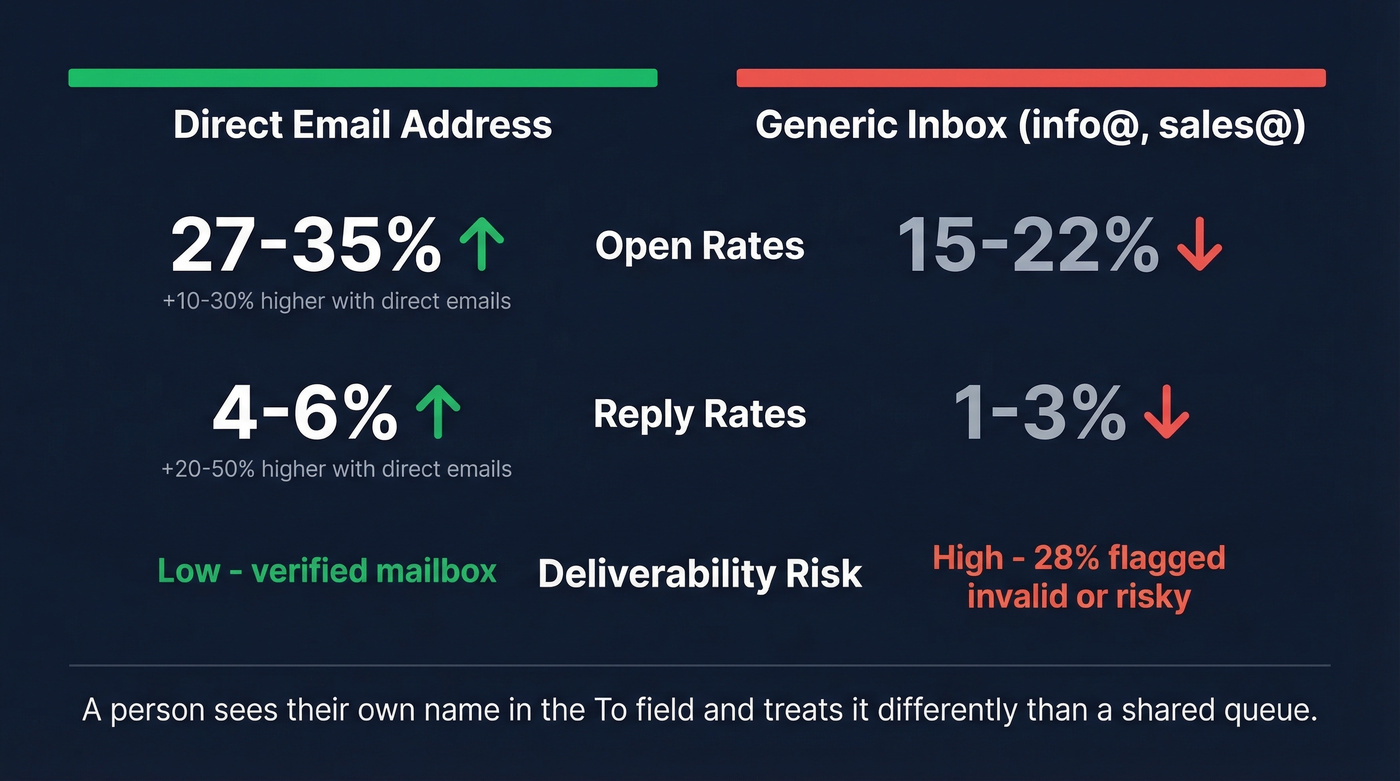
In our experience, reaching someone at their personal work mailbox outperforms shared inboxes by 10-30% on opens and 20-50% on replies in B2B cold outreach. A person sees their own name in the "to" field and treats it differently than a shared queue - there's a sense of accountability that info@ simply doesn't carry. In 2026, nearly 28% of all emails checked were flagged as invalid or risky, so sending to the right address matters more than ever (and keeping bounce rate low is non-negotiable).
Five Ways to Find a Direct Email Address
1. Use an Email Finder Tool
This is the fastest, most scalable method. Paste a name and company domain into an email finder, and it cross-references multiple data sources, then runs verification checks against the mail server without actually sending an email. You get a verified or unverified result back. Only send to verified ones (more on how to check if an email exists).
2. Guess the Pattern and Verify
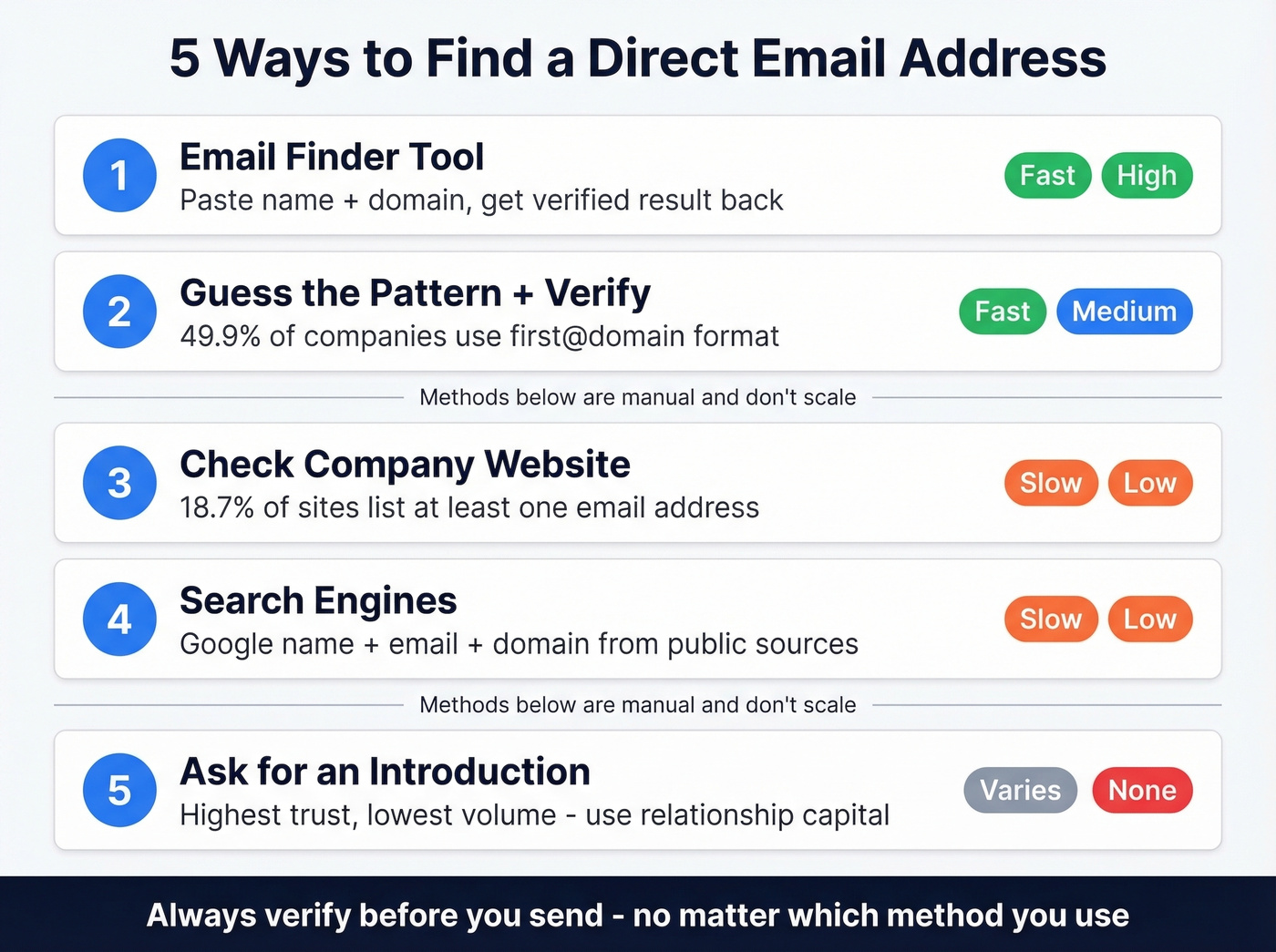
Since 49.9% of companies use {first}@domain, you can often guess correctly. Common patterns: first.last@, firstinitial.last@, first_last@.
Here's the thing: never send to a guessed address without running it through a verification tool first. One bad guess tanks your sender reputation, and rebuilding domain trust takes weeks (use a process like how to improve sender reputation).
3. Check the Company Website
Hunter's analysis of roughly 905,000 company websites found that 18.7% mentioned at least one email address. Check About pages, team bios, and author bylines on the blog. Smaller companies are more likely to list individual contacts - sometimes right in the footer.
4. Search Engines
A targeted Google search like "Jane Smith" email @acme.com can surface emails from conference speaker bios, press releases, and PDF whitepapers. It's slow and manual, but free. We've found it occasionally turns up addresses that tools miss, especially for executives who've spoken publicly or published research.
5. Ask for an Introduction
The lowest-tech method, but the highest-trust one. A warm intro from a mutual connection bypasses every deliverability concern and lands with built-in credibility. If you've got the relationship capital, use it before anything else. Skip this if you're running outbound at any real volume - it doesn't scale (for scalable outreach, see AI cold email outreach).

You just read that guessing email patterns without verification tanks your sender reputation. Prospeo's proprietary email-finding infrastructure verifies every direct email address through a 5-step process - no third-party providers, 98% accuracy, data refreshed every 7 days. That's why teams switching from other tools cut bounce rates from 35% to under 4%.
75 free email lookups per month. No credit card, no contracts.
Verify Before You Send
Finding an email and verifying it are two different steps. Skip the second one and you'll wreck your domain (and your email velocity headroom).
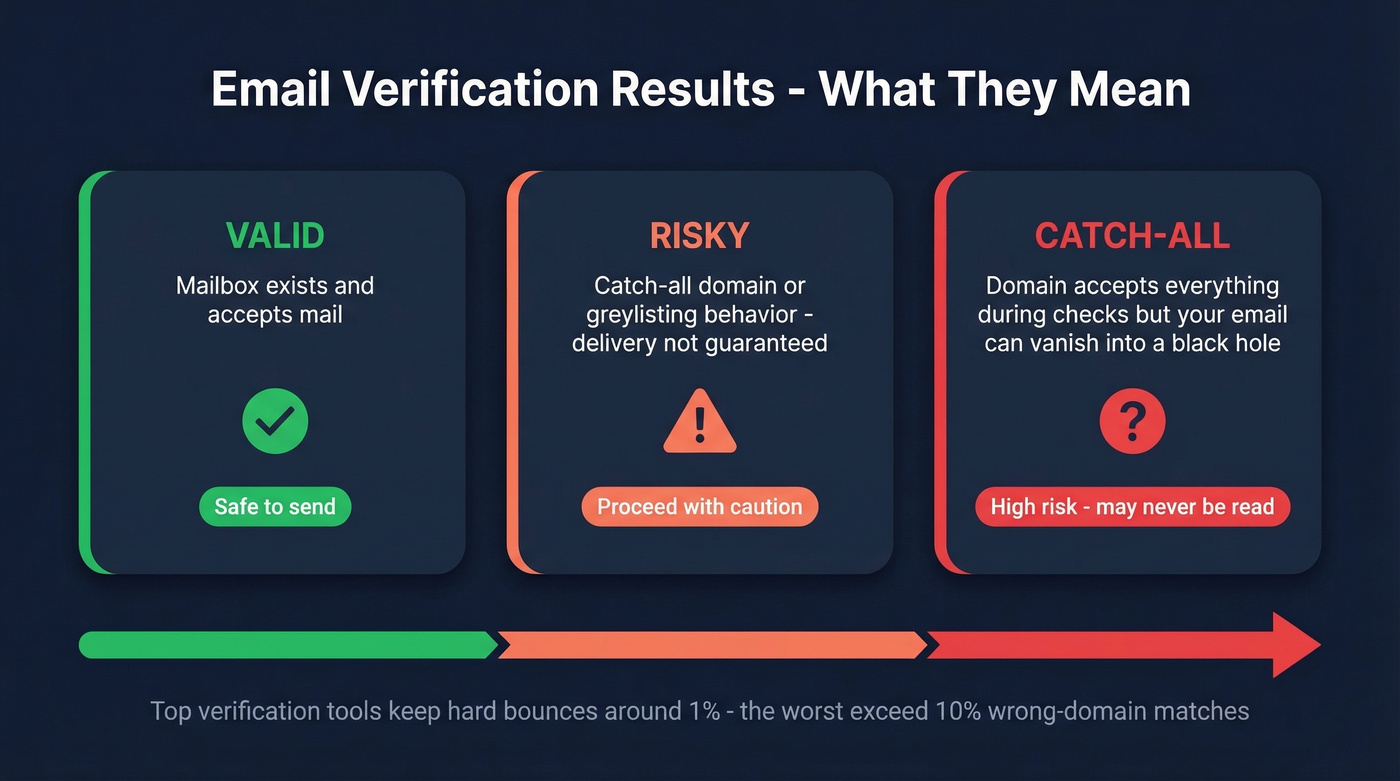
A Dropcontact benchmark testing 15 tools across 20,000 contacts found that top performers keep hard bounces around 1%, while the worst exceed 10% wrong-domain matches. The gap is enormous, and it's the difference between a healthy sending domain and one that's blacklisted within a month.
Three terms to know:
- Valid means the mailbox exists and accepts mail. Safe to send.
- Risky usually means a catch-all domain or greylisting behavior, so you can't confirm the specific address will reliably deliver.
- Catch-all domains won't bounce during checks, but your email can still disappear into a black hole.
Look, if your average deal size is under $10k, you probably don't need a full prospecting platform. But you absolutely need verification. A $39/month tool that verifies well beats a $500/month platform with stale data every time (here are email reputation tools worth knowing).
Best Tools for Finding Direct Emails
| Tool | Accuracy | Free Tier | Starting Price | Best For |
|---|---|---|---|---|
| Prospeo | 98% | 75 emails/mo + 100 extension credits | ~$0.01/email | Accuracy + freshness |
| Hunter | High | 50 credits/mo | $49/mo | Pattern verification |
| Snov.io | Good | Limited | ~$39/mo | International leads |
| Apollo | Varies | Yes | ~$49/user/mo | Volume prospecting |
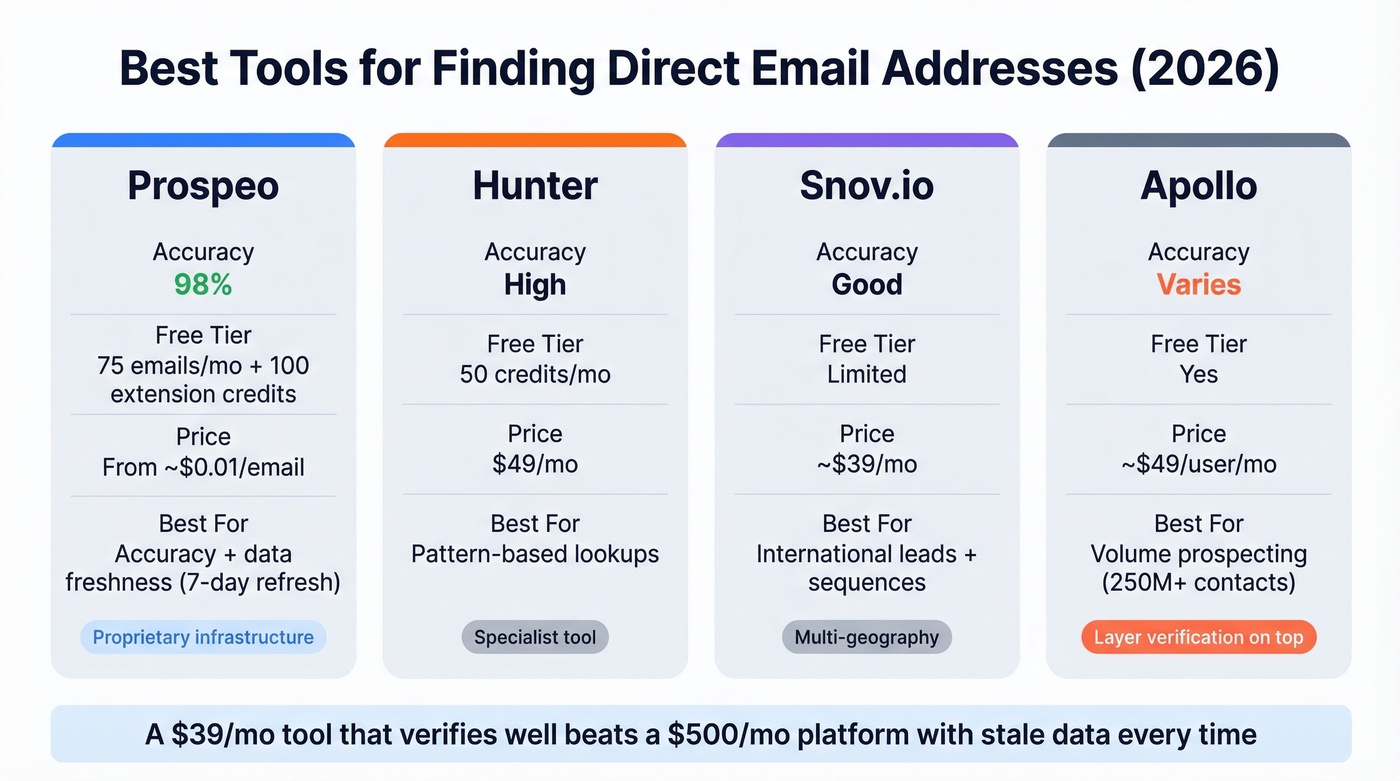
Prospeo stands out for data freshness - a 7-day refresh cycle versus the 4-6 week industry average. Its proprietary email-finding infrastructure doesn't rely on third-party providers, which is why it consistently hits 98% accuracy. For teams that have burned domains on bad data from other providers, it's the fastest way to recover deliverability.
Hunter is the go-to for pattern-based lookups. Its database is smaller, but the verification engine is solid. Think of it as a specialist, not a full prospecting platform (compare options in our Hunter alternatives roundup).
Snov.io earns its spot for international coverage and built-in automation sequences. Worth a trial if you're prospecting across multiple geographies.
Apollo has a massive database of 250M+ contacts, but practitioners on r/sales regularly flag bounce issues with older contacts. Great for volume, less reliable for accuracy. If you're running high-volume campaigns, plan on layering a separate verification tool on top (see Bouncer alternatives for verification options).
Bad data doesn't just waste credits - it blacklists your domain. Prospeo's 300M+ profiles are verified through catch-all handling, spam-trap removal, and honeypot filtering on a 7-day refresh cycle. At ~$0.01 per email, it costs less than one bounced message costs your reputation.
Find any direct email address and verify it before you hit send.
CAN-SPAM and GDPR: What You Need to Know
CAN-SPAM applies to all commercial email, including B2B cold outreach. There aren't exemptions for "just prospecting."
Every email must include a valid physical postal address and a clear opt-out mechanism. Honor unsubscribe requests within 10 business days, and the opt-out mechanism must work for 30 days after sending. Penalties run up to $53,088 per email in violation - per message, not per campaign.
For EU contacts, GDPR adds stricter consent requirements with fines up to EUR20M or 4% of global annual revenue. The consensus on r/sales is that most teams handle this by segmenting EU prospects into separate sequences with documented legitimate interest.
Compliance isn't optional, and it isn't hard. Include your address, add an unsubscribe link, honor opt-outs. The tools handle the finding - you handle the sending responsibly.
FAQ
What's the difference between a direct and generic email address?
A direct email address reaches one person (john@company.com), while a generic address like info@ or sales@ goes to a shared inbox monitored by multiple people. Your message competes with hundreds of others in shared queues, which is why reply rates drop 20-50% compared to personal mailboxes.
How do I verify a direct email before sending?
Run it through a verification tool that checks the mail server without sending a message. A "valid" result means the mailbox exists and accepts mail. "Risky" usually indicates a catch-all domain where delivery isn't guaranteed - Prospeo's 5-step verification flags these automatically so you can decide whether to skip them or proceed with caution.
Can I legally cold email someone whose address I found with a tool?
Yes, under CAN-SPAM - as long as you include a physical address, a clear opt-out link, and honor unsubscribes within 10 business days. For EU contacts, GDPR requires documented legitimate interest. Penalties reach $53,088 per violating message, so compliance isn't something you can wing.