

How to Write an Elevator Pitch That Actually Works
You're at a conference. Someone asks what you do. You open your mouth, and somewhere around the 90-second mark, you watch their eyes glaze over. They're scanning for the nearest exit. You've lost them - not because your work isn't interesting, but because you buried the interesting part under a pile of context nobody asked for.
That moment is fixable. The fix isn't charisma or confidence - it's structure. A strong elevator pitch runs roughly 75 words, follows a simple Hook - Value - Proof - Ask framework, and changes based on who you're talking to. Skip to the section that matches your situation: job interview, startup fundraising, sales outreach, or written pitch.
What Is an Elevator Pitch?
An elevator pitch is a persuasive summary of who you are, what you do, and why it matters - delivered in 30 to 60 seconds. The name comes from the idea that you should be able to deliver it during a short elevator ride with someone important. Some trace the concept to Ilene Rosenzweig and Michael Caruso at Vanity Fair; others point to Philip Crosby's quality management work. The origin doesn't matter. The constraint does.
A common benchmark is around 75 words for ~30 seconds. For a full 60-second version, you're usually in the 130-150 word range. That's tight. Many people's natural "tell me about yourself" answer runs several minutes, which is exactly why the pitch exists as a discipline. It forces you to decide what actually matters.
Why Your Pitch Matters
The Science of Snap Judgments
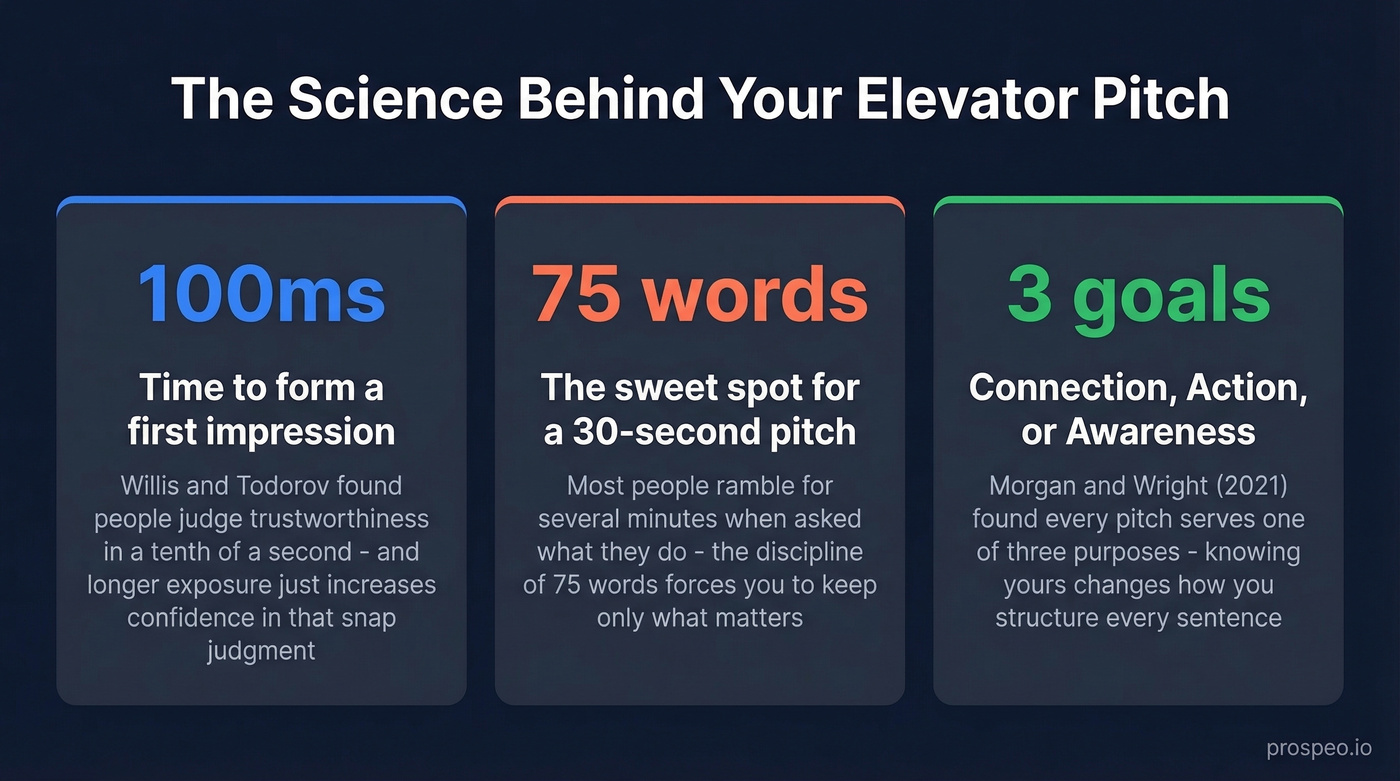
People don't give you 30 seconds to make a first impression. They give you 100 milliseconds. Research by Willis and Todorov found that people form trait judgments from faces in a tenth of a second - and longer exposure didn't significantly change those initial impressions. It just made people more confident in them. Trustworthiness was the fastest-judged trait.
You've probably seen the "humans have an 8-second attention span" stat floating around. It's widely repeated, but it's also poorly sourced. The real takeaway is simpler: people decide whether to keep listening almost instantly, and then they decide whether to care. Your pitch needs to survive both filters.
A peer-reviewed framework by Morgan and Wright (2021) breaks pitch goals into three categories: creating connection through shared values, encouraging action like collaboration or a meeting, and generating awareness about your work. Knowing which one you're going for changes everything about how you structure the delivery. Aristotle called these levers ethos, pathos, and logos - credibility, emotion, and logic. Twenty-four centuries later, the framework still holds. Weaving a brief narrative around your value proposition makes it memorable in ways that a list of facts never can.
How Long Should It Be?
The answer depends on the channel:
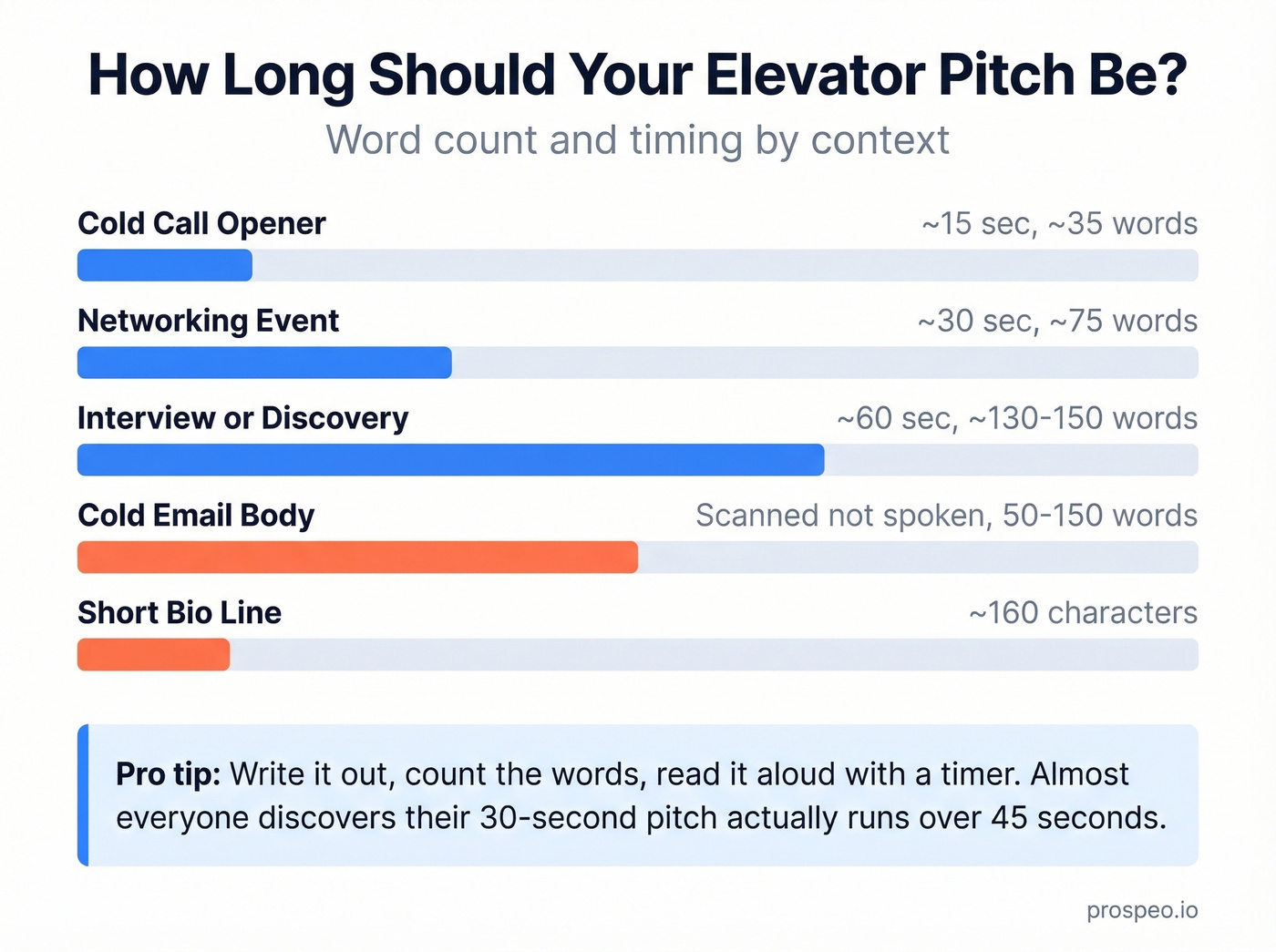
| Context | Time | Word Count |
|---|---|---|
| Cold call opener | ~15 sec | ~35 words |
| Networking event | ~30 sec | ~75 words |
| Interview / discovery | ~60 sec | ~130-150 words |
| Cold email body | N/A | 50-150 words |
| Short bio line | N/A | ~160 characters |
Write your pitch out. Count the words. Then read it aloud with a timer. Almost everyone discovers their "30-second pitch" actually runs long. Trim until it fits - the constraint is the point, because it forces you to cut the filler and keep only what earns the next conversation.
Writing Your Elevator Pitch
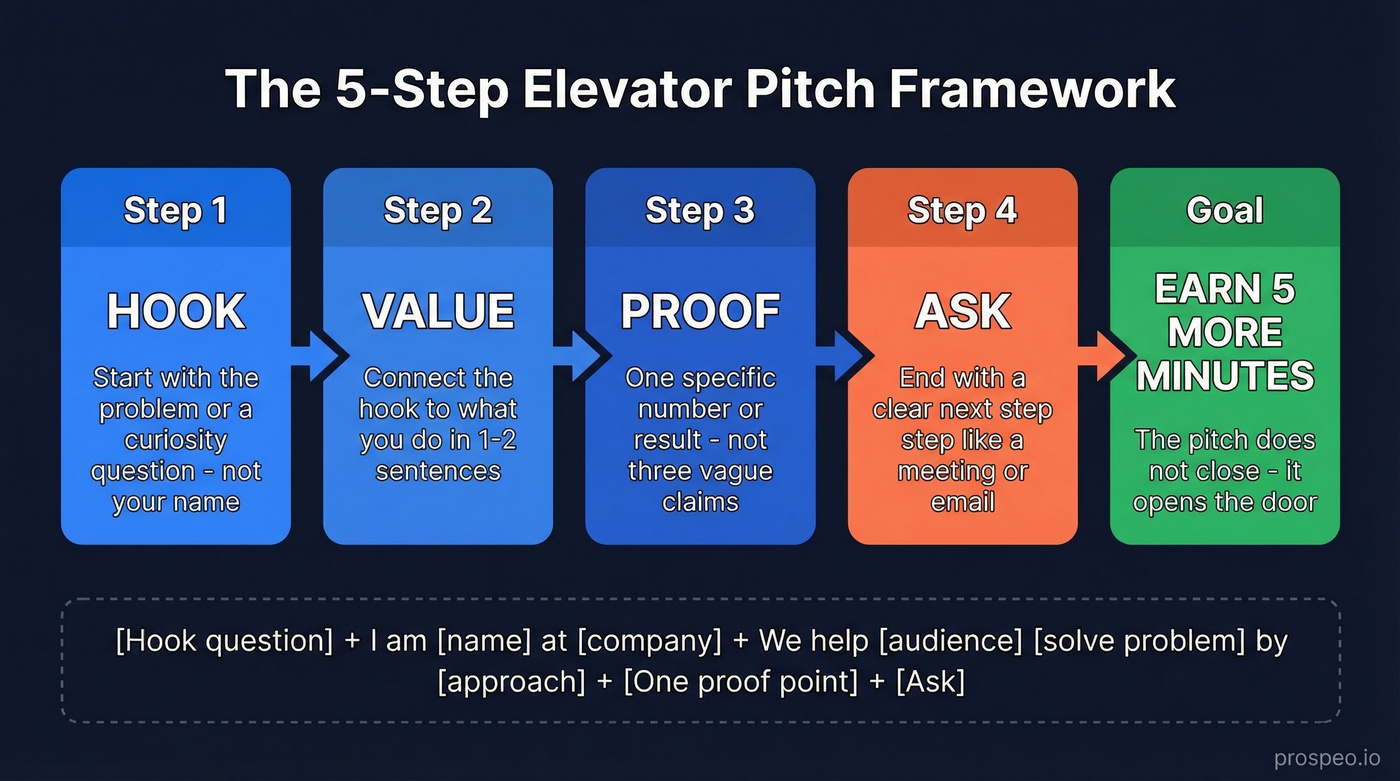
Most advice tells you to "be concise and compelling." That's like telling a chef to "make it taste good." You need a structure. Let's build one.
Step 1: Define Your Goal
Before you write a word, decide what you want to happen after the pitch ends. A job seeker wants a follow-up interview. A founder at a dinner party might just want the investor to remember them. A sales rep wants a booked meeting. The goal shapes every sentence - it's what separates a generic introduction from a focused pitch for sales.
Step 2: Open With a Hook
Don't start with your name and title. Start with the problem you solve or a question that creates curiosity. "Quick question - are you still doing [painful thing] manually?" is more engaging than "Hi, I'm Sarah, I work at a product company." Your name comes second. The hook comes first.
Step 3: Bridge to Your Value
Now connect the hook to what you actually do. Keep it to one or two sentences. The Founder Institute's one-sentence template is a useful skeleton: "My company is developing [offering] to help [audience] solve [problem] with [secret sauce]." You don't have to use this exact format, but notice what it forces you to include: who benefits, what problem, and what makes your approach different.
Step 4: Add One Proof Point
A single specific number or result beats three vague claims. "We cut bounce rate from 35% to under 4%" lands harder than "we help companies improve their outreach." Pick your strongest proof point and let it do the heavy lifting.
Step 5: Close With an Ask
This is where most pitches fall apart. People deliver a solid 25 seconds and then just... stop. Or they say "so, yeah." End with a clear next step: "Could I send you a one-pager?" or "Would it make sense to grab 15 minutes this week?" Research shows that asking for a time commitment upfront - "Could I take three minutes to explain?" - reduces listener anxiety because it sets a boundary.
Here's the contrarian reframe worth internalizing: the goal of a pitch isn't to close. It's to earn the next five minutes. If you try to cram your entire value proposition into 30 seconds, you'll sound desperate. Create enough curiosity to continue the conversation, and you've won.
Fill-in Template
[Hook question or surprising statement]. I'm [name] - [one-line role/company]. We help [audience] [solve specific problem] by [your approach]. [One proof point: number, result, or name]. [Ask: meeting, email, follow-up].

Step 4 says add one proof point. Here's one you can steal: "We cut bounce rate from 35% to under 4%." That's a real Prospeo case study. 98% email accuracy, 300M+ verified contacts, $0.01 per lead.
Build the pipeline that makes your pitch worth delivering.
Elevator Pitch Examples
Job Interview Pitch
The "tell me about yourself" question is a pitch in disguise. One Reddit user on r/interviews described giving a five-minute answer - two minutes on their "personal brand," then another two to three connecting experience to the role. That's not a pitch. That's a monologue.
A tight version:
"I've spent the last six years in product marketing, mostly in B2B SaaS. My specialty is turning complex technical products into messaging that sales teams actually use - at my last company, I rebuilt the positioning for their enterprise tier and pipeline from that segment grew 40% in two quarters. I'm here because this role sits at exactly that intersection, and I'd love to dig into how your team thinks about it."
That's about 65 words. It covers experience, a specific result, and a reason for being there. Everything else is follow-up material.
Networking Event Pitch
The surprise-exec-in-an-elevator scenario is a real anxiety people have. Here's the thing: the best move is often to not pitch at all - ask a question first. "I saw your talk on [topic] - what made you focus on that area?" opens a conversation. Then, when they ask what you do, you have context for a tailored response.
"I run growth at a fintech startup - we help small businesses get paid faster by automating their invoicing. We just crossed 2,000 customers this quarter. What's your take on embedded payments?"
Notice the question at the end. It turns a monologue into a dialogue, and it signals that you're interested in them, not just broadcasting about yourself.
Startup / Investor Pitch
Antler's startup pitch guide includes a great before-and-after example that we'll break down in the rewrite section below. The key insight: investors hear hundreds of pitches, and the ones that stick use language a smart twelve-year-old could follow.
Your pitch needs five elements: who you are, what you do, how you do it, who it's for, and why now. The "why now" is what most founders forget - it's the market timing that makes your idea urgent rather than theoretical. As Bill Gurley of Benchmark puts it, a great pitch walks the listener through an argument like a structured scientific proof.
"We're building AI-powered quality inspection for food manufacturers. Visual defects still slip through on production lines, and that creates expensive waste and risk. Our computer vision system catches defects in real time - we're already running in three plants. We're raising a seed round to expand into dairy and meat processing."
Sales Cold Outreach Pitch
The monday.com sales framework breaks this into five components: Hook - Problem - Solution - Social proof - CTA. For a cold call, you're working with a 15-second opener before someone decides whether to hang up. Your hook and problem statement need to land in the first two sentences.
"Hi [Name], quick question - how much time does your team spend manually verifying prospect data before outreach? Most teams we talk to lose 5-10 hours a week on it. We built a platform that automates that and cuts bounce rates below 4%. Companies like [reference customer] saw their pipeline triple. Worth a 15-minute call this week?"
It takes an average of 5 touches to engage a prospect, and reaching executives often requires nine or more. Your pitch only lands if it reaches the right person. Tools like Prospeo verify emails before you send, so a carefully crafted cold outreach message doesn't bounce - it actually arrives.
Written Pitch (Email, DM, Bio)
A cold email is a written pitch with the same structure but tighter constraints - people scan rather than listen. Keep connection request notes around 250-300 characters. First DMs should stay around 500-1,000 characters.
Cold email opener template:
Subject: [Specific result] for [their company]
Hi [Name],
[One-sentence hook tied to their company or role]. We help [audience] [solve problem] - [one proof point]. Would it make sense to grab 15 minutes this week?
And here's a Twitter/X bio example using the same principles:
"Helping B2B sales teams cut bounce rates from 35% to under 4%. 2,000+ customers. DM me for a free audit."
Hook, proof point, CTA - all in one line.
Before-and-After Rewrites
We've reviewed a lot of pitches over the years, and the pattern is always the same: people bury the interesting part. Here are three common failure modes and their fixes.
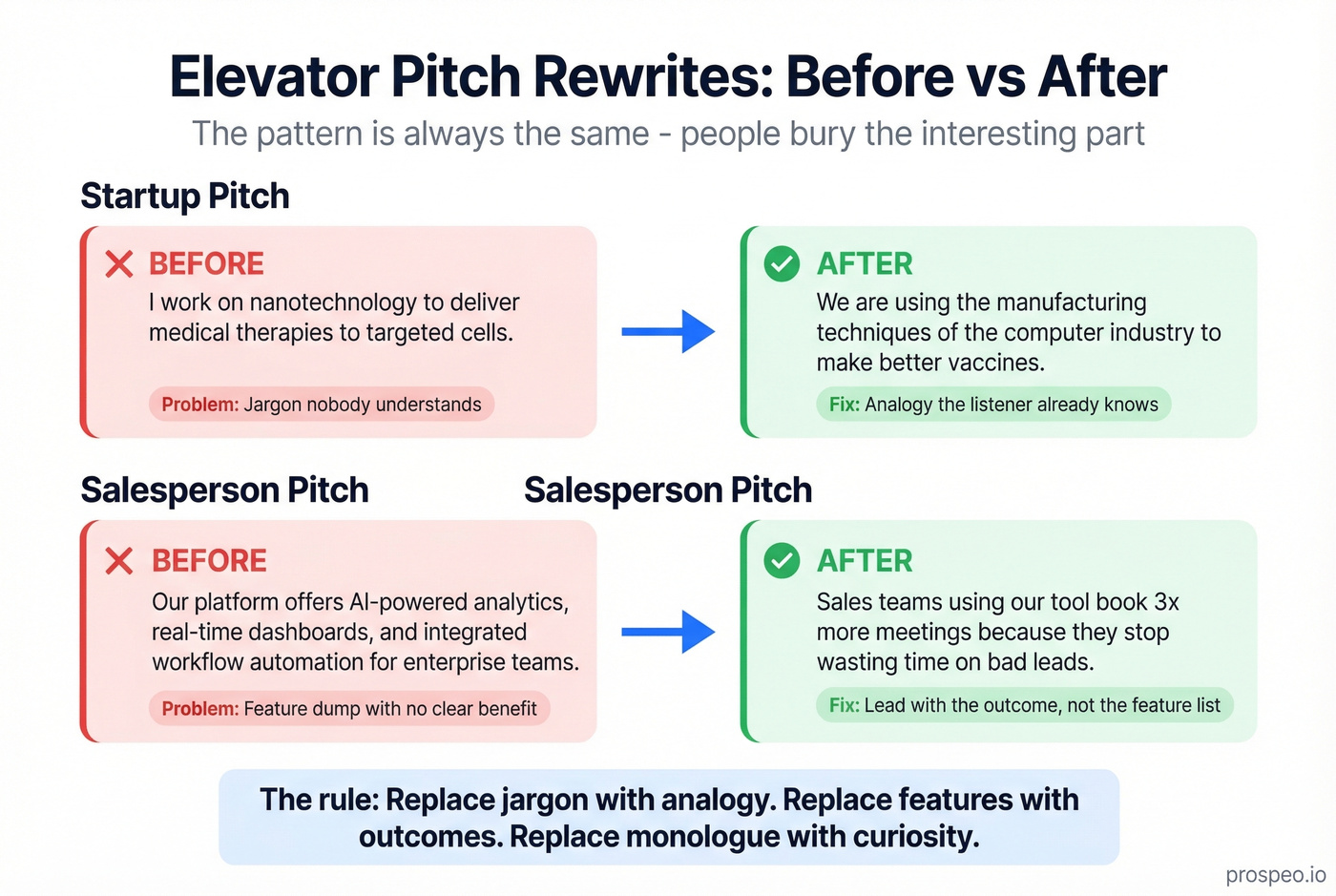
Startup pitch (from the Antler guide):
Before: "I work on nanotechnology to deliver medical therapies to targeted cells."
After: "We're using the manufacturing techniques of the computer industry to make better vaccines."
The fix: replace jargon with an analogy the listener already understands. "Nanotechnology" means nothing to most investors. "Manufacturing techniques of the computer industry" creates a mental model they can build on.
Salesperson pitch:
Before: "Our platform offers AI-powered analytics, real-time dashboards, customizable reports, automated alerts, and integrations with over 50 tools to help your team make better decisions."
After: "Most ops teams we talk to spend Monday mornings building the same reports by hand. Our platform automates that - one customer cut their reporting time from 12 hours a week to 45 minutes. Can I show you how it works for [their industry]?"
The fix: lead with the problem, not the feature list. Nobody cares about "AI-powered analytics" until they understand the pain it solves.
Beyond the Classic Format
Writing a great pitch is half the battle. Delivering it is the other half - and sometimes the classic format isn't the right tool. Alternatives like a short case study, a quick demo, or a provocative question can work better depending on the setting. At a trade show booth, a 20-second live demo often outperforms any verbal pitch.
Bullet points beat scripts. Memorize the structure - Hook, Value, Proof, Ask - not the exact words. A pitch that sounds memorized sounds robotic. Know your key points and let the phrasing flex naturally.
Research on pitch delivery confirms that posture, eye contact, strategic pauses, and vocal dynamics all signal confidence. A monotone delivery kills even the best-written pitch. For virtual meetings and Zoom calls, compensate for the energy loss that screens create - sit slightly closer to the camera, make sure your lighting doesn't wash you out, and bring a bit more vocal energy than feels natural in person.
The best test? Say your pitch to a stranger - not a friend, not a colleague - and watch their face. If they lean in or ask a follow-up question, it's working. If they nod politely and change the subject, it's not. In our experience, this "stranger test" catches problems that no amount of mirror practice reveals.
Keep a back-pocket pitch ready at all times. The best opportunities are unplanned - a conference hallway, a flight delay, a mutual friend's dinner party. If you have to think about what to say, you've already lost the moment.
Biggest Mistakes
The five-minute ramble. This is the most common failure mode. That Reddit user who gave a five-minute "tell me about yourself" answer? They're not unusual. Many people default to chronological autobiography when they're nervous. Fight the instinct. Pick one thread and pull it.
Jargon overload. If your pitch includes "synergistic cross-functional paradigm" or anything close, you've lost the room. Use words your listener already knows. The Antler example above proves this - same company, radically different clarity.
No ask. A pitch without a call to action is just a fun fact about yourself. Always end with a next step, even if it's soft: "Would it be okay if I sent you a quick email?"
Sounding scripted. People detect a memorized script fast. It triggers the same mental alarm as a telemarketer reading from a card. Know your structure, not your script.
Pitching the wrong person. The most polished pitch in the world is worthless if you're delivering it to someone who can't act on it. Do your homework - know who you're talking to and what they care about before you open your mouth.
How to Test and Improve
Your elevator pitch isn't a final draft. It's a living document that gets better every time you use it. One r/Entrepreneur thread captured this perfectly - founders who shared their pitches publicly found the feedback "eye opening" and used it to fine-tune what they said next.
Record yourself delivering your pitch on video. It's uncomfortable, but it reveals filler words, pacing issues, and energy drops that you can't feel in the moment. A/B test different versions in real conversations - try a question-first hook one week and a stat-first hook the next, then see which one generates more follow-up questions.
Here's my hot take: most people don't need a better elevator pitch. They need to give their existing pitch to more strangers. The feedback loop from real conversations is worth more than any template. Templates get you to version one. Reps get you to version ten.
When you're ready to graduate from a verbal pitch to a visual one, Guy Kawasaki's 10/20/30 rule is the bridge: 10 slides, 20 minutes, 30-point font minimum. The pitch earns you the meeting. The deck closes it.
A great elevator pitch earns you the next five minutes. But you still need verified contact data to reach the right people. Prospeo gives you 143M+ verified emails and 125M+ mobile numbers - refreshed every 7 days.
Stop pitching into the void. Start reaching real decision-makers.
FAQ
How many words should an elevator pitch be?
About 75 words for a 30-second pitch and 130-150 words for 60 seconds. Write it out, count the words, and read it aloud with a timer. Almost everyone's first draft runs long - trimming is where the real work happens.
Can I use AI to write my elevator pitch?
Yes, as a starting draft - but never as the final product. AI tools generate decent structure with generic language. Always rewrite in your own voice and test it aloud. A pitch that sounds like ChatGPT sounds like everyone else's.
What if I have too much experience to fit in 30 seconds?
Pick one achievement and one value statement that match what the listener cares about. Everything else becomes follow-up conversation material - which is the entire point of keeping it short.
How do I make sure my cold pitch reaches the right person?
Verify contact data before you send. Bounced emails and wrong numbers waste your best material on empty inboxes. We've seen teams cut bounce rates from 35% to under 4% just by running their lists through a verification step before hitting send.