

The 12 Best Email Check APIs in 2026 - Benchmarks, Pricing & Honest Picks
Your "verified" email list decays by nearly 28% every year. People change jobs, domains expire, IT admins reconfigure mail servers - and suddenly a quarter of your pipeline is bouncing. One practitioner on r/email reported 96% fewer invalid emails after adding an email check API to their signup flow. Cross the 2% bounce threshold and your sending domain takes the hit.
We've evaluated dozens of email verification APIs over the years, and the gap between tools is wider than most teams realize. The API you pick determines whether you catch bad addresses before they damage your reputation - or after.
Our Picks (TL;DR)
1. Prospeo - Best for B2B accuracy + data freshness. 98% email accuracy through a 5-step verification pipeline that includes catch-all handling, spam-trap removal, and honeypot filtering. Finds and verifies emails in one platform, so you're not stitching together two tools. ~$0.01/email, free tier at 75 emails/month.
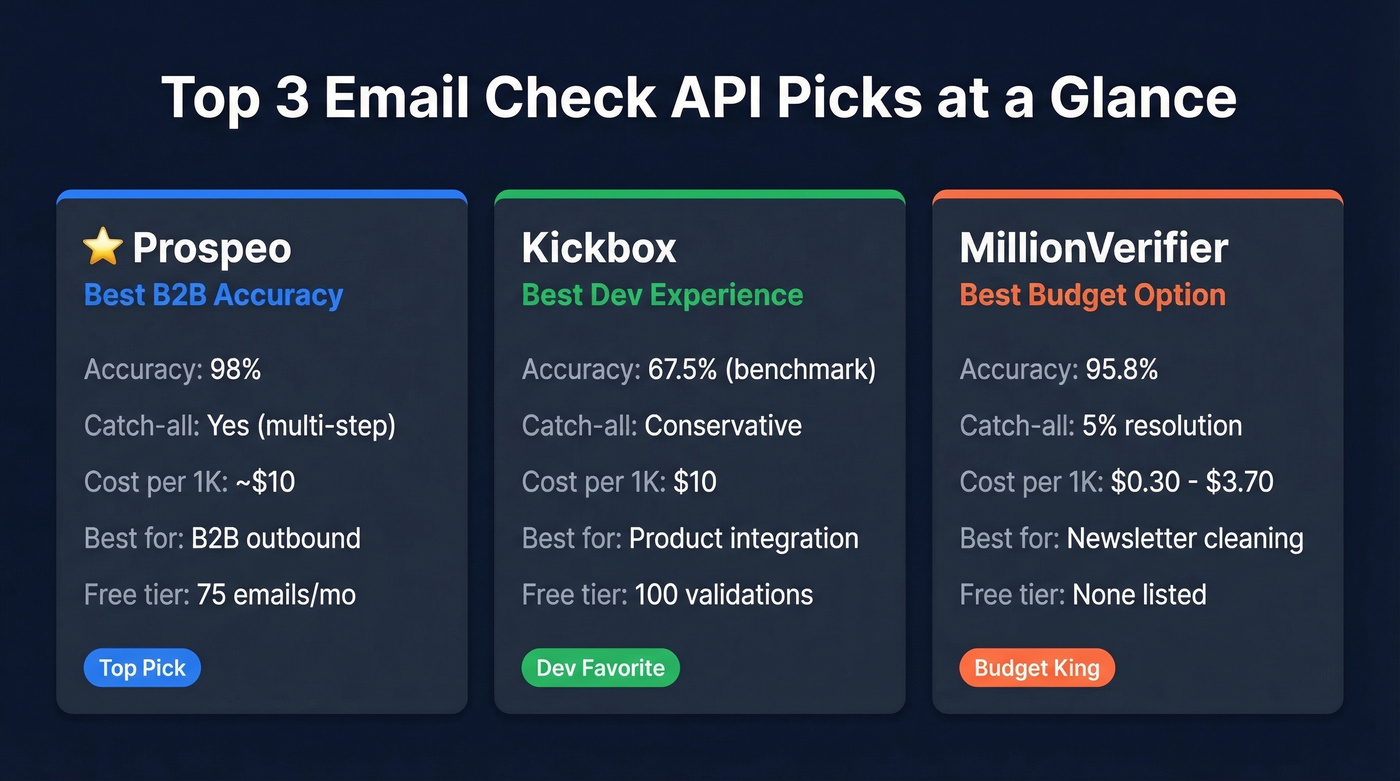
2. Kickbox - Best developer experience. Interactive docs, sandbox mode, ~350ms average response time, and a 99.99% uptime SLA. If your engineering team is building verification into a product, this is the one they'll actually enjoy working with. $5/500 verifications.
3. MillionVerifier - Best budget option. Around $0.30-$3.70 per 1,000 emails depending on volume tier - dramatically cheaper than most alternatives. Solid for high-volume newsletter cleaning. But catch-all handling is weak at 5% resolution, so it's risky for B2B outbound.
How to Choose an Email Check API
Stop evaluating on accuracy claims. Every tool says 97-99% and none of them mean the same thing. Some measure against their own test sets. Others count "unknown" results as neither right nor wrong. The number that matters is how many valid emails the tool correctly identifies in a real-world B2B dataset - and that's hard to find without running your own test.
Here's what actually separates a good email verification service from a mediocre one.
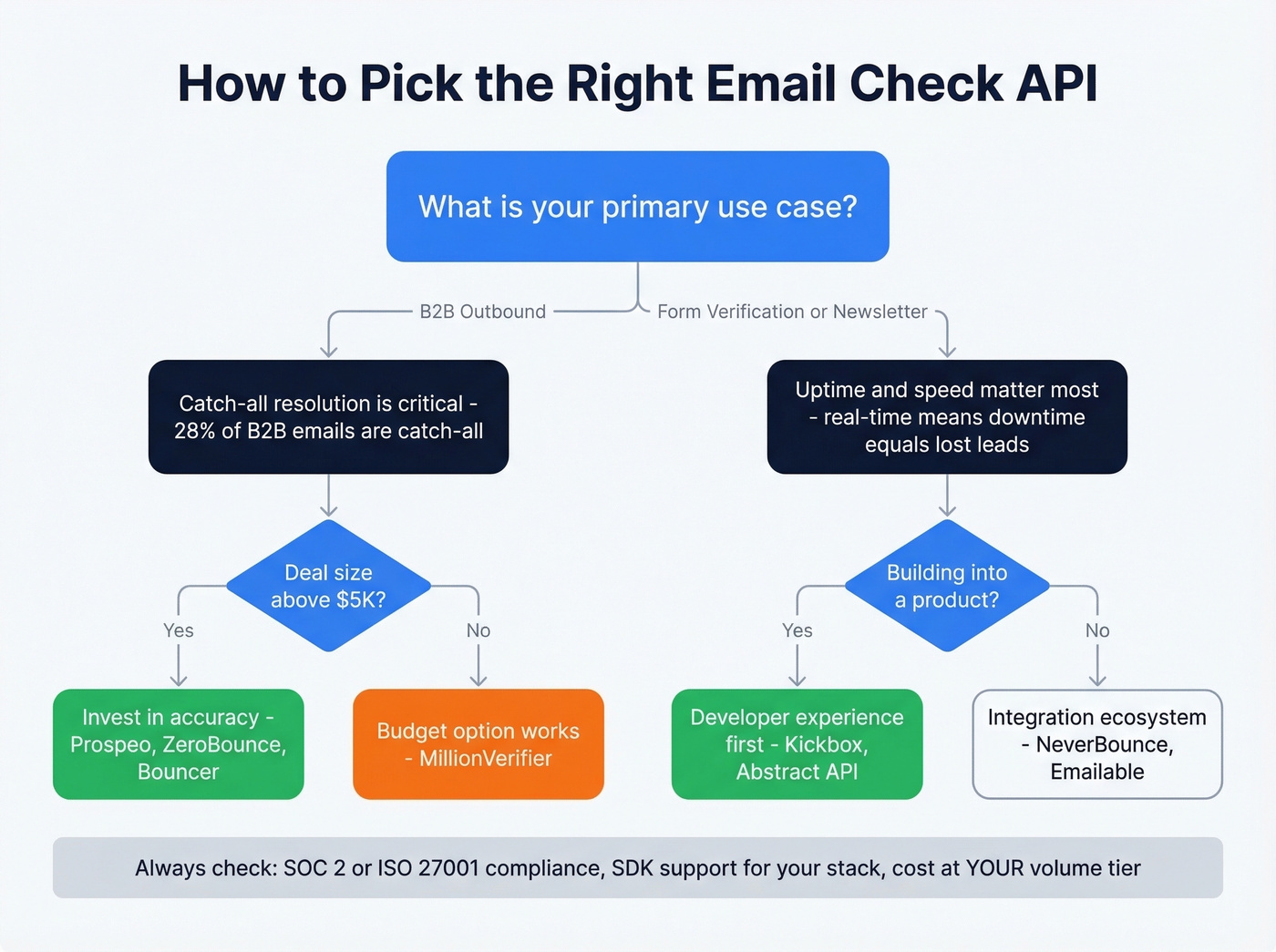
Catch-all resolution rate is the single most important metric for B2B verification. Around 28% of B2B emails sit on catch-all domains. If your API just labels them "unknown" and charges you anyway, you're flying blind on a quarter of your list.
False positive rate deserves more attention than it gets. A tool that marks invalid emails as valid is worse than one that's overly conservative. False positives bounce. Bounces kill your domain.
Cost per 1,000 at your actual volume shifts dramatically between tiers. A tool that's $10/1K at low volume might drop to $4/1K at scale - or it might not. Model your real volume before committing.
SDK and language support matters more than people think. If you're integrating into a Node.js app and the API only offers cURL examples, you're writing boilerplate for weeks. Check for official SDKs in your stack.
For production use, demand at least a 99.9% uptime SLA. Real-time verification on signup forms means downtime equals lost leads. And if you're processing customer emails through a third-party API, your security team will want SOC 2 Type II, ISO 27001, or GDPR compliance documentation before signing off.
Here's what a typical verification request looks like:
curl -X GET "https://api.example.com/v1/verify?email=john@company.com" \
  -H "Authorization: Bearer YOUR_API_KEY"

# Response
{
  "email": "john@company.com",
  "result": "deliverable",
  "is_catchall": false,
  "is_disposable": false,
  "confidence": 97
}
Every tool on this list follows a similar pattern. The differences are in what happens between the request and the response.
The 12 Best Email Checker APIs in 2026
Prospeo
Prospeo runs every email through a 5-step verification pipeline: syntax check, MX record validation, SMTP handshake, catch-all domain resolution, and spam-trap/honeypot filtering. The result is 98% email accuracy across 143M+ verified addresses. Because Prospeo is a full B2B data platform with 300M+ professional profiles, you can find and verify emails in a single workflow instead of chaining two separate tools - and every email comes back already verified whether you upload a CSV, search by 30+ filters, or hit the API (92% match rate for enrichment).
Use this if you're running B2B outbound and want pre-verified emails from a single platform. Integrations with Salesforce, HubSpot, Clay, Lemlist, Instantly, Smartlead, Zapier, and Make mean the data flows straight into your stack. Snyk's 50-person sales team dropped bounce rates from 35-40% to under 5% after switching to Prospeo's verified data.
Skip this if you only need standalone verification for an existing list with no enrichment needs.
Pricing: ~$0.01/email. Free tier gives you 75 emails/month. No contracts, cancel anytime. Data refreshes every 7 days - the industry average is 6 weeks.
Kickbox
Kickbox is the email checker API that developers actually want to integrate. Sandbox mode means you can build and debug without burning credits, and ~350ms average response time keeps real-time form verification snappy. The 99.99% uptime SLA is the highest published number in this category.
Official SDKs cover PHP, Ruby, Python, Node.js, and Java. Rate limits sit at 10 requests/second on standard plans - generous enough for most form-based use cases.
In a 3,000-email benchmark by Hunter, Kickbox scored 67.53% accuracy. The methodology penalizes tools that return "unknown" for catch-all domains, which Kickbox handles conservatively. In our experience, conservative catch-all handling is the right call for form verification where you'd rather reject a questionable address than let it through.
Use this if your engineering team is building verification into a product and needs strong docs, predictable performance, and high uptime. Skip this if you need aggressive catch-all resolution for B2B outbound lists.
Pricing: $5 for 500 verifications, scaling to $4,000 for 1M. 100 free validations to start.
ZeroBounce
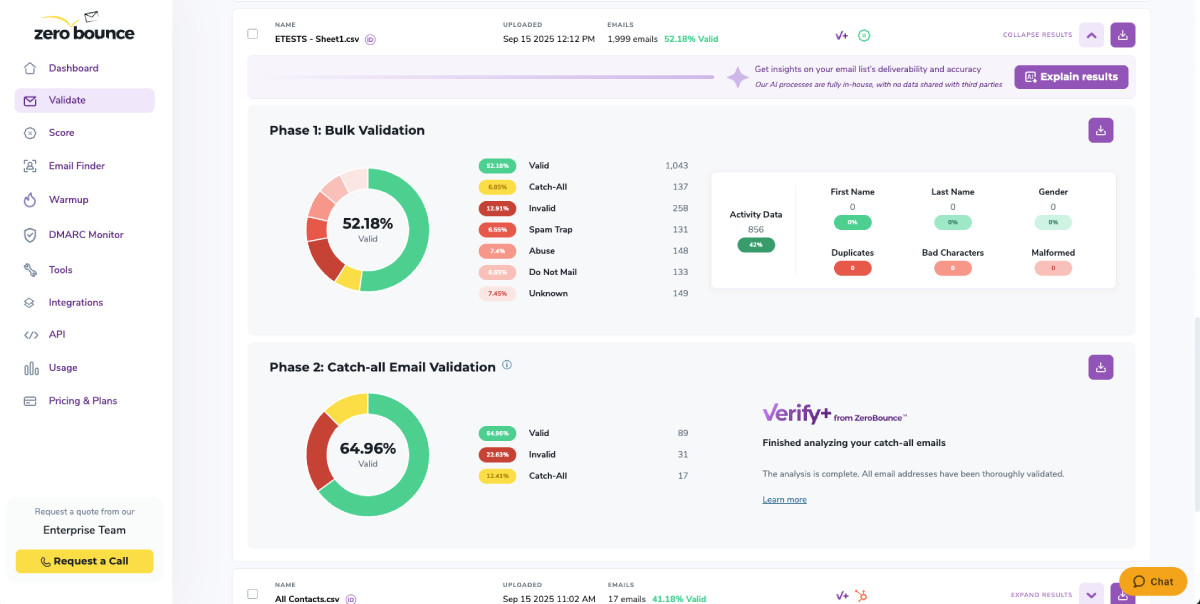
ZeroBounce is the mature, well-documented standalone email address verification API that most teams end up shortlisting. In a 10,000-email test by LeadMagic, it hit 97.8% accuracy with a 0.9% false positive rate. Catch-all resolution came in at 12% - not market-leading but better than many competitors.
The API runs at ~450ms average response time with a 99.9% uptime SLA. SDKs span PHP, Python, Java, C#, Ruby, and JavaScript. Rate limits are tighter at 5 requests/second, so high-concurrency real-time use cases might need a plan upgrade.
Where it beats Kickbox: higher benchmark accuracy and broader SDK coverage. Where Kickbox still wins: rate limits, uptime SLA, and sandbox-first developer workflow.
Pricing: $0.008/email pay-as-you-go ($10/1K at 2K minimum), or $15/month for 2,000 verifications. 100 free monthly credits.
NeverBounce
NeverBounce scored 96.9% accuracy in the same 10K-email test with a 1.4% false positive rate and 1.7% false negative rate - solid but not spectacular. The vendor claims 99.9%, which tells you everything about the gap between marketing and reality. Where NeverBounce genuinely shines is the integration ecosystem: 80+ native connections mean it plugs into almost any marketing or sales stack without custom work. The 99.95% uptime SLA and 8 req/s rate limit make it reliable for production use, and SDKs cover PHP, Python, Ruby, and Node.js with ~500ms average response time.
Use this if you need a verification API that connects to everything and "just works." Skip this if catch-all handling is critical - 8% resolution means most catch-all addresses come back as unknown.
Pricing: $0.008/email ($8/1K). Up to 1,000 free credits to start.
Clearout
Clearout leads on compliance: ISO 27001:2013, SOC 2 Type II, and full GDPR compliance. The verification pipeline covers catch-all detection, spam-trap identification, role-based filtering, disposable domain checks, and 20+ additional validations. They monitor 10,000+ disposable domains - useful if you're verifying signup forms where throwaway emails are a problem.
SDK support includes cURL, PHP, Java, Node.js, Python, C#, Go, and R. In Hunter's benchmark, Clearout placed near the top at 68.37% accuracy. If your security team is the bottleneck on vendor approvals, Clearout's compliance stack will speed that conversation up.
Pricing: Typically mid-market range (~$4-8/1K). Check their site for current tiers.
Bouncer
Bouncer posted the highest catch-all resolution rate among the standalone tools in the 10K-email test: 15%. That's a meaningful edge if your B2B list is heavy on corporate catch-all domains. Overall accuracy hit 96.5%, and the tool processed 10,000 emails in 25 minutes. GDPR compliant.
Pricing: $7/1K with 1,000 free credits to start. Straightforward.
MillionVerifier
Here's the thing about MillionVerifier: at roughly $0.30-$3.70 per 1,000 emails depending on volume tier, it's dramatically cheaper than everything else on this list. If you're cleaning a 500K newsletter list, you're looking at roughly $150-$1,850 instead of $4,000+ with many $8-$10/1K tools. The math is compelling.
But the tradeoffs are real. In the 10K-email test, accuracy came in at 95.8% - lowest of the tools tested - and catch-all resolution was just 5%. Processing 10,000 emails took 35 minutes, the slowest in the benchmark. For newsletter hygiene where catch-all domains don't matter much, MillionVerifier is a no-brainer. For B2B outbound? Dangerous.
If your average deal size is under $5K, MillionVerifier's accuracy gap probably won't hurt you enough to justify paying 10x more. Above that threshold, every bounced email is a missed deal worth investigating - spend the money on a better verification API.
Abstract API
Abstract API takes a tiered approach: Free (100 requests), Starter at $17/month, Standard at $37/month, Professional at $39/month, and Enterprise custom. It advertises real-time SMTP verification in <50 milliseconds and a 99.99% uptime SLA. Disposable email detection screens against 3,000+ disposable domains. The REST API is clean and well-documented - a solid pick for developers who want simple validation without feature bloat.
Emailable
Emailable offers 250 free credits and straightforward documentation with code snippets in Node.js, Ruby, and Python. It supports batch operations and webhooks and returns granular status codes. Pricing typically lands around $5-10/1K based on volume tier. A no-frills verification API that does the basics well - best for teams that want reliable verification without a learning curve or platform lock-in.
Mailgun
Mailgun is an email delivery platform first, with verification built in. If you're already sending through Mailgun, adding verification to the same pipeline eliminates a vendor and simplifies billing. They position their validation as returning results in under 200ms. Free to get started.
Skip it if you don't use Mailgun for sending - the verification alone isn't enough reason to add a new vendor.
Verifalia
Verifalia offers both a free online validator and API access - handy for teams that need occasional web-based verification alongside programmatic access. It runs a 30+ step verification process. Best for low-volume or intermittent verification needs where you don't want to maintain a dedicated integration.
MailerCheck
MailerCheck returns granular statuses: valid, invalid, typo, mailbox not found, mailbox full, catch-all, unknown, disposable. At $0.01/credit ($10/1K) with 10 free credits, it's priced in the middle of the pack. Best for MailerLite users who want verification inside their existing ecosystem.
Hunter
Hunter bundles email finding and verification into unified credits. It topped its own benchmark at 70% accuracy - and it's transparent that the dataset labeling uses Hunter's own activity, which may advantage Hunter. At ~$24.50/1K, it's the most expensive option here for verification-only use. 50 free verifications/month.
Pricing Comparison
Prices below reflect cost per 1,000 email verifications - the only number that matters for budgeting.
| Tool | Cost/1K | Free Tier | Model | Best For |
|---|---|---|---|---|
| Prospeo | ~$10* | 75/mo | Credits | B2B find + verify |
| Kickbox | $10 | 100 | Pay-as-you-go | Developer DX |
| ZeroBounce | $10 | 100/mo | PAYG + sub | Standalone B2B |
| NeverBounce | $8 | 1,000 | PAYG + sub | Integration-heavy |
| Clearout | ~$4-8 | Varies | PAYG | Enterprise compliance |
| Bouncer | $7 | 1,000 | PAYG | Catch-all handling |
| MillionVerifier | $0.30-3.70 | None | PAYG + bulk | Newsletter cleaning |
| Abstract API | ~$5-10 | 100 | Tiered sub | Simple REST API |
| Emailable | ~$5-10 | 250 | PAYG | No-frills verify |
| Mailgun | Not public | Free start | Platform | Mailgun users |
| Verifalia | Not public | Free online | PAYG | Occasional use |
| MailerCheck | $10 | 10 | Credits | MailerLite users |
| Hunter | $24.50 | 50/mo | Unified credits | Prospecting + verify |
*Prospeo's ~$0.01/email includes email finding, not just verification. Every other tool on this list charges for verification only - finding the email is a separate cost. The industry average for verification-only hovers around $7-10/1K.

Most email check APIs verify addresses you already have. Prospeo's API finds and verifies in one call - 98% accuracy, 92% match rate, catch-all handling included. At ~$0.01/email with a 7-day data refresh, you skip the stale-data bounces that kill your domain.
Stop chaining two tools when one API does both.
Accuracy Benchmarks
Every provider claims 97-99% accuracy. None of those numbers mean the same thing. Two independent benchmarks tell a more honest story.
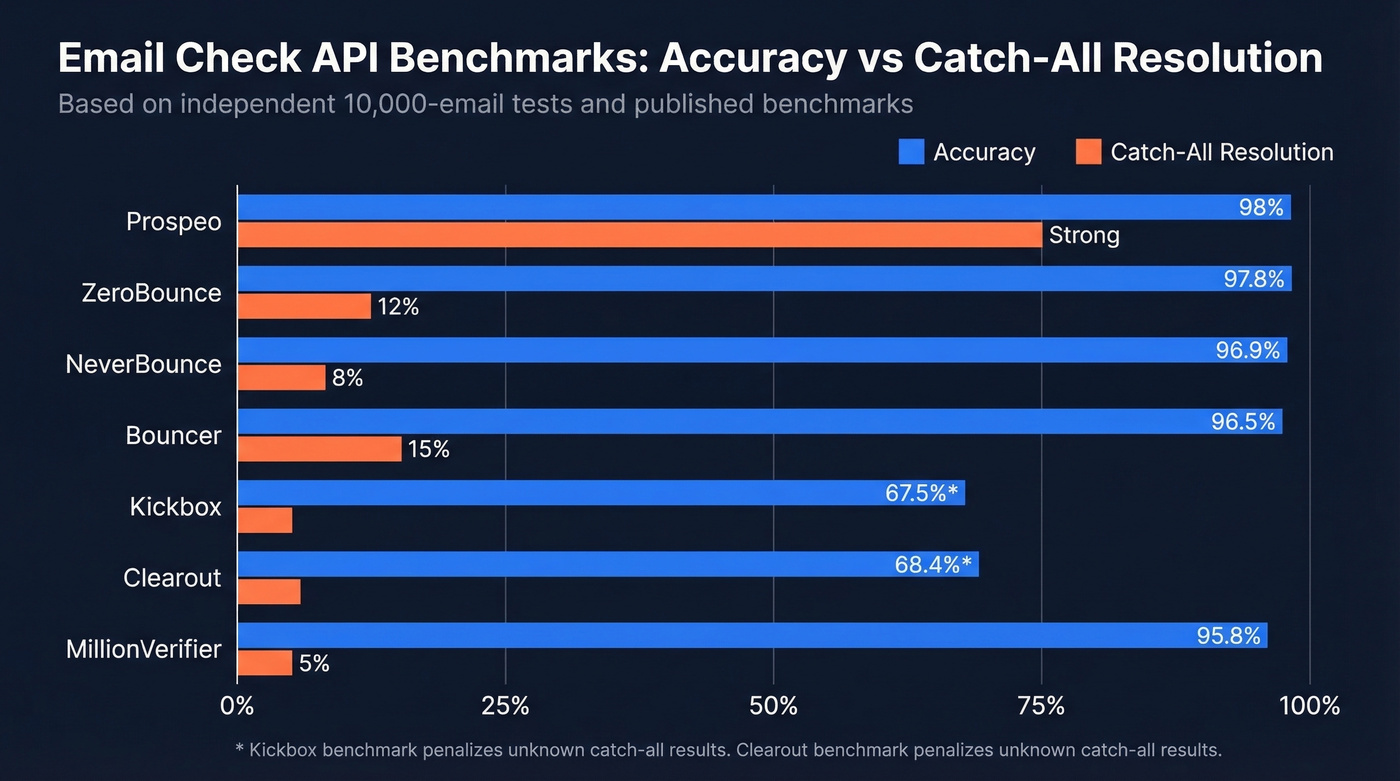
Hunter's benchmark tested 15 tools against 3,000 real business emails segmented by company size, using Clay integrations to standardize conditions. The top four: Hunter (70.00%), Clearout (68.37%), Kickbox (67.53%), and UseBouncer (65.43%). These numbers look low because the methodology penalizes "unknown" results - tools that conservatively label catch-all addresses as unknown get dinged. Hunter ran this benchmark on its own tool and explicitly notes the dataset labeling may advantage Hunter.
The 10K-email test from LeadMagic used emails from real B2B outbound campaigns and measured differently:
| Tool | Accuracy | False Positive Rate | False Negative Rate | Catch-All Resolution |
|---|---|---|---|---|
| ZeroBounce | 97.8% | 0.9% | 1.3% | 12% |
| NeverBounce | 96.9% | 1.4% | 1.7% | 8% |
| Bouncer | 96.5% | 1.2% | 2.3% | 15% |
| MillionVerifier | 95.8% | 2.1% | 2.1% | 5% |
Higher numbers, different methodology. The 10K-email test focused on whether the tool correctly identified known-valid and known-invalid addresses, with catch-all handling scored separately.
The gap between 65% and 98% isn't about tool quality - it's about what you're measuring. The 3K-email benchmark rewards conservative tools. The 10K-email test rewards aggressive ones. Let's be honest: the only benchmark that truly matters is the one you run on your own data.

Developer Experience Compared
If you're building a verify email address endpoint into a product, the developer experience matters as much as accuracy.
| Tool | Avg Response Time | Rate Limit | SDK Languages | Uptime SLA |
|---|---|---|---|---|
| Kickbox | ~350ms | 10 req/s | PHP, Ruby, Python, Node, Java | 99.99% |
| ZeroBounce | ~450ms | 5 req/s | PHP, Python, Java, C#, Ruby, JS | 99.9% |
| NeverBounce | ~500ms | 8 req/s | PHP, Python, Ruby, Node | 99.95% |
| Clearout | <1ms (free domains) | Not published | cURL, PHP, Java, Node, Python, C#, Go, R | Not published |
Kickbox is the clear developer experience leader. Sandbox mode and the 99.99% uptime SLA make it a safe bet for production integrations. ZeroBounce has broader SDK coverage (six languages vs five), but the lower rate limit and slightly higher response time make it less forgiving for high-concurrency real-time verification.
Clearout's sub-millisecond response for free domains is interesting but narrow - business domain verification takes longer. Their SDK coverage across eight languages is one of the widest in the category, which matters if your stack includes Go or R.
Catch-All Detection Explained
A catch-all domain is configured to accept email for any address - real or fake. When a normal mail server receives a message for a nonexistent user, it returns a 550 error ("user not found"). A catch-all server returns 250 OK regardless. That means your standard SMTP verification handshake can't tell whether john@company.com is a real person or a black hole.
Here's how most verification APIs detect catch-all domains: they generate a random, obviously fake address (something like xq7m9k2p@company.com) and run an SMTP check. If the server accepts it, the domain is catch-all. Simple in theory. The resolution step - figuring out which real addresses on that domain are actually active - is where tools diverge dramatically.
From the 10K-email test, catch-all resolution rates tell the story: Bouncer resolved 15%, ZeroBounce 12%, NeverBounce 8%, MillionVerifier just 5%. Even the best standalone tool is leaving most catch-all addresses unresolved. With 28% of B2B emails sitting on catch-all domains in that test dataset, a tool that punts on catch-all is punting on a big chunk of your pipeline.
The difference between "unknown" and "verified despite catch-all" is the difference between guessing and knowing. If catch-all resolution matters to your workflow - and for B2B outbound, it should - prioritize tools that attempt resolution rather than those that simply flag and move on.
How to Pick the Right API
You're building verification into a product. Latency, documentation quality, and uptime matter more than catch-all resolution. Kickbox is the obvious choice.
You're cleaning a large marketing list on a budget. MillionVerifier is unbeatable on price. Accept that catch-all handling will be weak and that processing will be slower. For newsletter hygiene, that's a fine tradeoff. For outbound, it isn't.
You need enterprise compliance. Clearout's ISO 27001 + SOC 2 Type II combination is one of the strongest compliance pairings on this list. Your security team will thank you.
You're already locked into an ecosystem. Mailgun users should use Mailgun's built-in verification. MailerLite users should use MailerCheck. NeverBounce's 80+ integrations make it the best "glue" tool for complex stacks.
The right email check API depends on your use case, volume, and tolerance for catch-all ambiguity. For most B2B teams, accuracy and catch-all resolution justify paying a premium. For marketing list hygiene, price wins.
Catch-all domains hide 28% of your B2B emails in limbo. Prospeo's 5-step verification pipeline resolves catch-alls, strips spam traps, and filters honeypots - the same pipeline that dropped Snyk's bounce rate from 35-40% to under 5% across 50 AEs.
Get 98% email accuracy at a penny per verification.
FAQ
Is there a free email check API?
Yes - most tools offer free tiers. NeverBounce and Bouncer each provide up to 1,000 free credits. Prospeo offers 75 free emails/month with full 5-step verification. Kickbox and Abstract API each give 100 free validations. These are enough to benchmark accuracy on your own data before committing budget.
What's the difference between email verification and validation?
Validation checks syntax and format - is this structured like a real email address? Verification goes further, confirming the mailbox can receive mail via an SMTP handshake. Most modern APIs do both in a single call, so the distinction is mostly academic at this point.
How accurate are email verification APIs really?
Independent benchmarks show top performers anywhere from ~65% to ~98% depending on test methodology and dataset composition. Vendor claims of 95-99.9% are measured against proprietary test sets. Catch-all domains are the main accuracy killer - any tool's numbers look worse when a big chunk of the test set is catch-all.
Can these APIs handle catch-all domains?
Most mark them "unknown" and move on. Bouncer resolves about 15%, ZeroBounce 12%, NeverBounce 8%, MillionVerifier just 5%. With roughly 28% of B2B emails sitting on catch-all domains, a tool that punts on resolution is leaving a large share of your pipeline unverified.
Are email verification APIs GDPR compliant?
Most major providers - Clearout, Bouncer, ZeroBounce - are GDPR compliant. For additional assurance, look for SOC 2 Type II and ISO 27001 certifications. Clearout holds both. If you're processing EU personal data through a verification API, request a Data Processing Agreement before signing.