

Why Your Email Open Rates Are Declining (And What to Do About It)
A newsletter operator shared on Reddit that their 6,000-subscriber beehiiv list went from ~35% open rates to ~18% after July 2024. DMARC was set up, authentication was clean, content hadn't changed. The audience didn't leave - the tracking pixel just stopped firing the way it used to. HubSpot users reported similar drops, from 30%+ to under 9% over a few months. If your dashboard looks like this and you're worried about email open rates declining, your measurement probably got more honest. Your audience is likely fine.
Quick Triage
Before you overhaul anything, check three things.
Look at Google Postmaster Tools for domain reputation and spam complaint rates. Compare click and conversion trends - if clicks and conversions are stable, your engagement didn't collapse, your open tracking did. Then clean your list, because bad data tanks deliverability faster than bad subject lines ever will.
If clicks and conversions haven't moved, stop panicking about opens.
What Actually Changed
Open rates didn't collapse in one event. A cascade of platform changes across 2024 and 2025 compounded into what feels like a cliff, and it explains why your numbers look so different from a year ago.
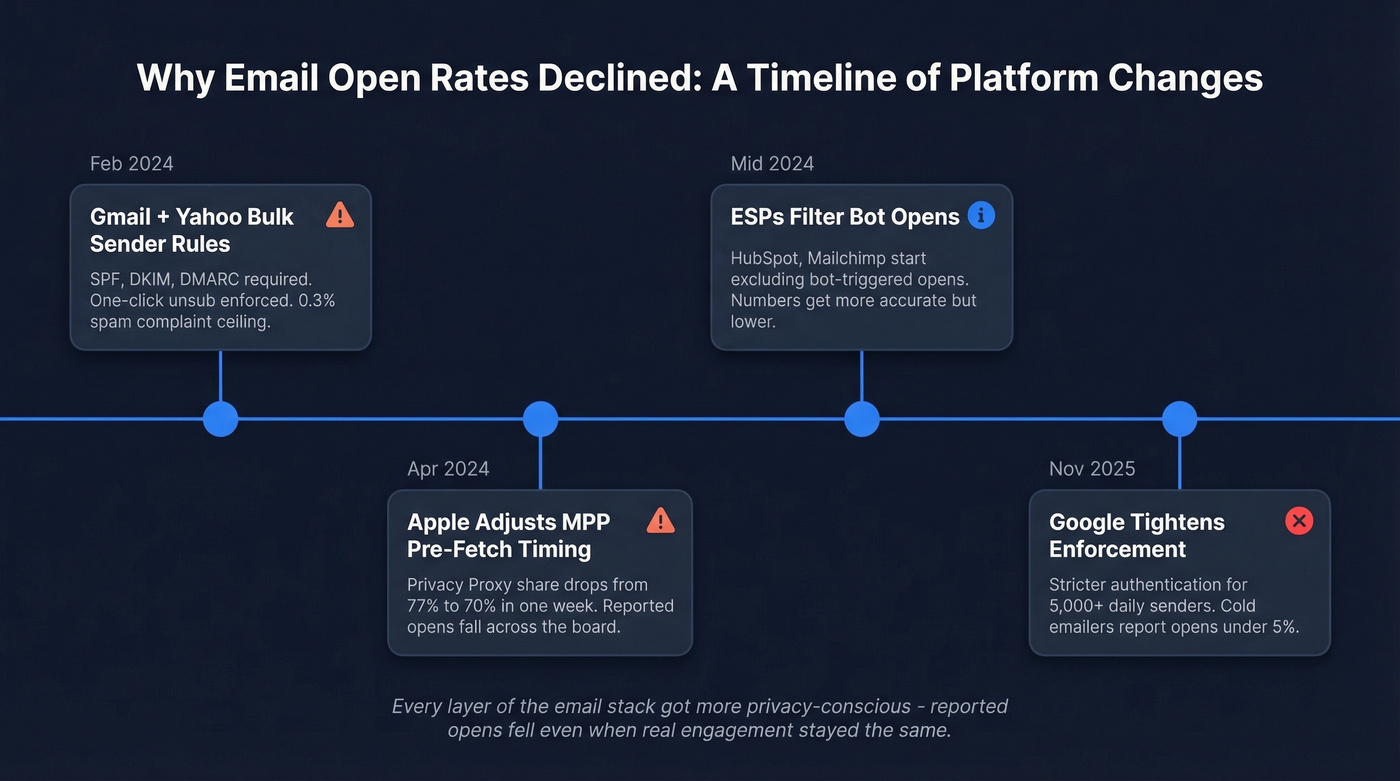
April 2024 - Apple Adjusts MPP Pre-Fetch Timing
Apple's Mail Privacy Protection had been pre-loading tracking pixels since 2021, inflating open rates for everyone. In April 2024, Apple changed the pre-fetch timing, reducing pixel-firing events. Apple's Privacy Proxy accounted for 73.11% of pixel-firing events in Validity's dataset from January through August 2024. That share dropped from ~77% to ~70% in the first week of April alone - reported opens fell across the board even though nothing changed about actual reader behavior.
February 2024 - Gmail and Yahoo Enforce Bulk Sender Rules
The "Yahoogle" requirements hit: mandatory SPF, DKIM, and DMARC authentication (at least p=none), one-click unsubscribe honored within two days, and a hard spam complaint ceiling of 0.3%. Senders who didn't comply started landing in spam. Spam means zero opens.
2024 - ESPs Tighten What Counts as an "Open"
In the HubSpot thread linked above, a HubSpot employee explained that opens may look lower because HubSpot started filtering out bot-triggered opens tied to Apple and Google scanning. Numbers got "more accurate" but lower.
November 2025 - Google Tightens Enforcement
After a soft period, Google moved to stricter authentication enforcement. For bulk senders hitting 5,000+ messages per day, that includes SPF and DKIM alignment, From-domain alignment, a DMARC record at minimum p=none, one-click unsubscribe honored within two business days, and keeping spam complaints below 0.3% (ideally under 0.1%). Cold emailers on r/coldemail described deliverability as "absolutely brutal," with some seeing opens drop under 5%.
The net effect: every layer of the email stack got more privacy-conscious and more aggressive about filtering. Reported opens fell because the systems that counted "reads" changed how they count.
Tracking Deflation vs. Real Deliverability Problem
Not every open-rate drop is a measurement artifact. Sometimes deliverability actually broke. Here's how to tell the difference.
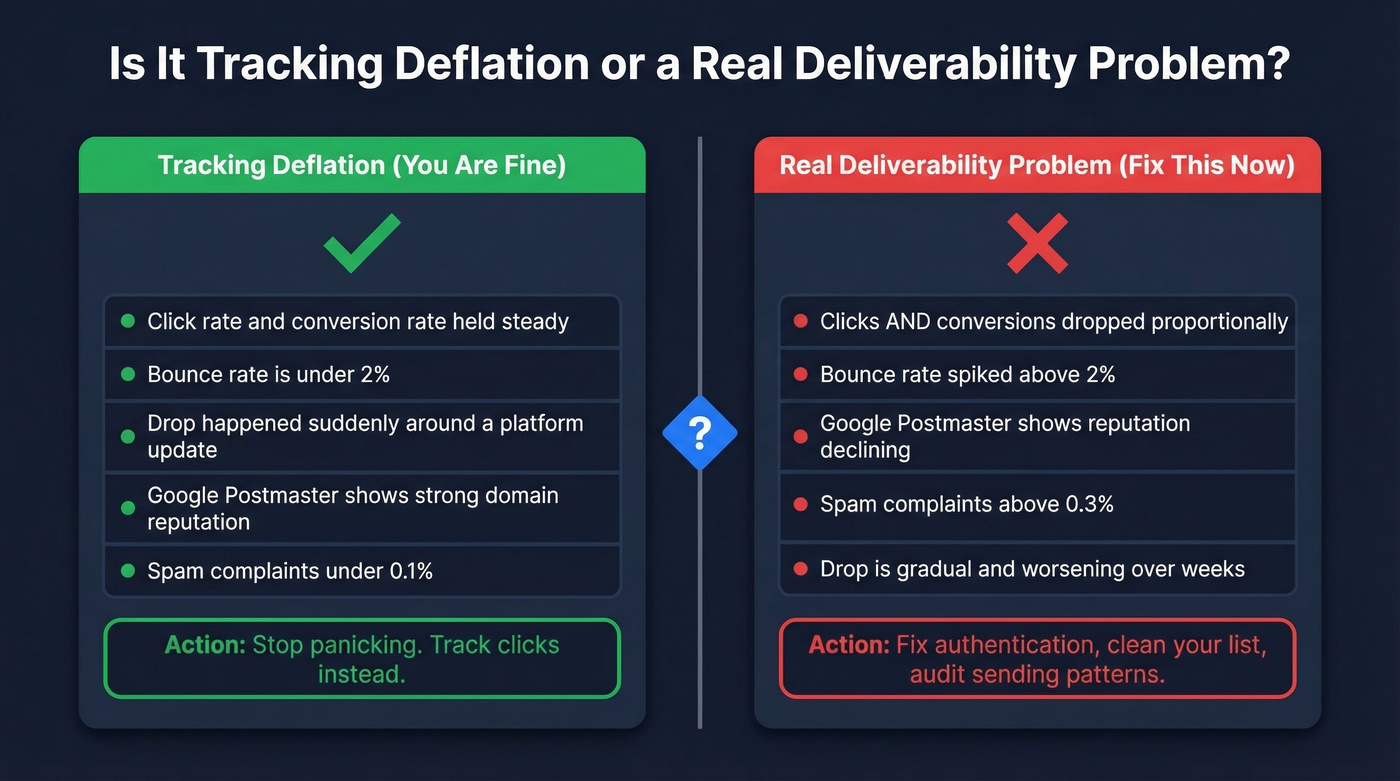
It's tracking deflation if your click rate and conversion rate held steady, your bounce rate is under 2%, and the drop happened suddenly around a platform update. Check Google Postmaster Tools - if your domain reputation is strong and complaints are under 0.1%, you're fine. The pixel just isn't firing. Break down opens and clicks by inbox provider (Gmail vs. Outlook vs. Yahoo) to isolate whether a specific provider is filtering you.
It's a real deliverability problem if clicks and conversions dropped proportionally, your bounce rate spiked above 2%, or Postmaster Tools shows reputation declining. That means you're landing in spam, and you need to fix authentication, list hygiene, or sending patterns.
I've watched teams spend weeks A/B testing subject lines to "fix" open rates that were never broken. Check deliverability first. Always.

Most open rate drops trace back to one upstream cause: bad data. Invalid addresses, spam traps, and honeypots tank sender reputation silently. Prospeo's 5-step verification catches them at 98% accuracy - for roughly $0.01 per email.
Fix deliverability at the source. Verify your list before your next send.
What "Normal" Looks Like in 2026
Here's the thing: a "good" open rate in 2026 is whatever number correlates with stable clicks and conversions. The benchmarks below are useful for context, but they aren't targets.
These Mailchimp benchmarks (last updated December 2023) are the most widely cited in the industry, though they're inflated by Apple MPP auto-opens, so treat them as ceilings:
| Industry | Open Rate | Click Rate | Unsub Rate |
|---|---|---|---|
| All Users | 35.63% | 2.62% | 0.22% |
| Ecommerce | 29.81% | 1.74% | 0.19% |
| Business & Finance | 31.35% | 2.78% | 0.15% |
A more realistic post-MPP range for engaged lists is 20-30%. For bounce rates, keep it under 2%. Under 1% is ideal.
What to Track Instead of Opens
Open rate is a directional signal, not a KPI. Here's what actually tells you whether email is working.
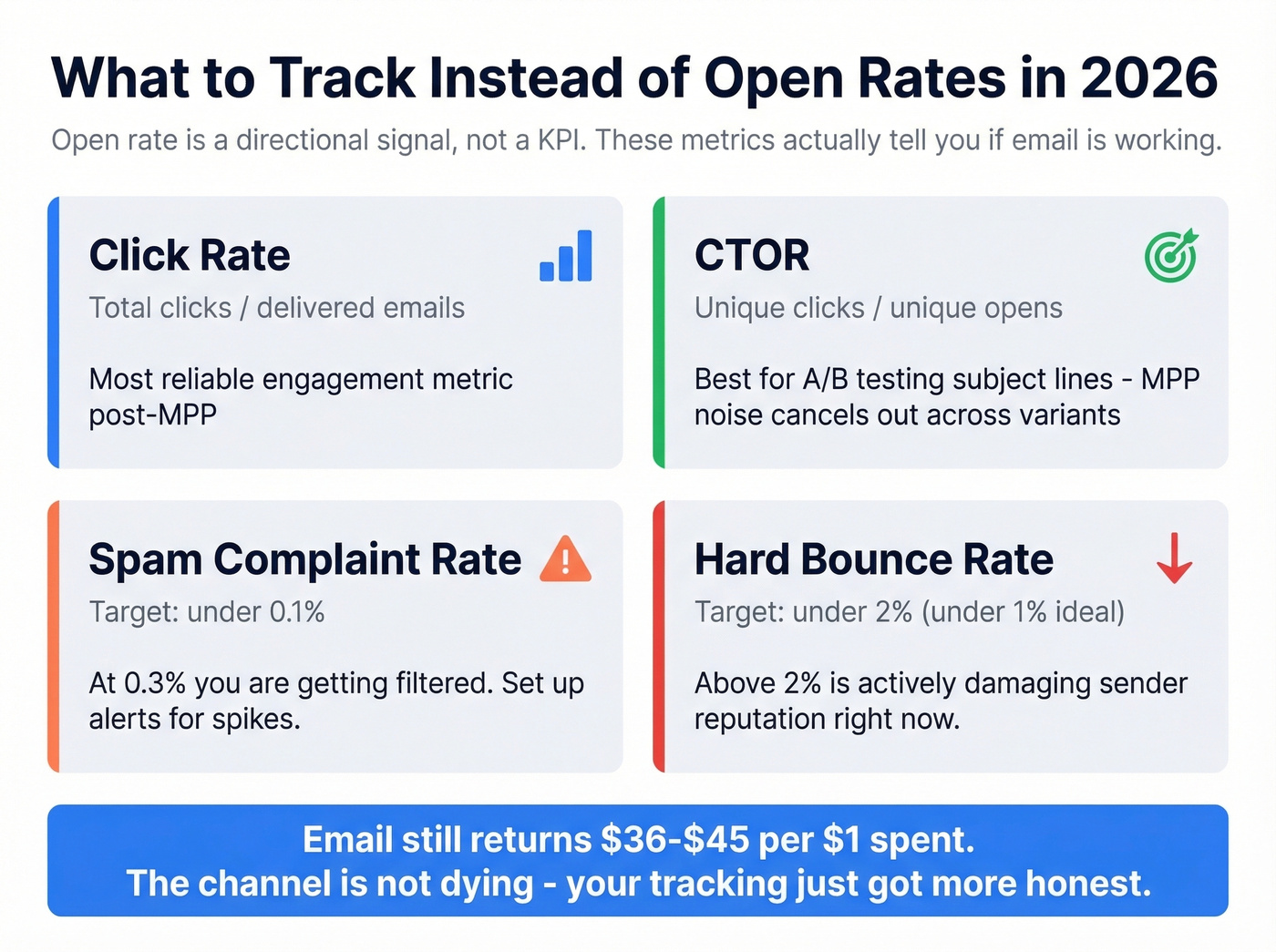
Click rate - total clicks divided by delivered emails - is the most reliable engagement metric post-MPP. CTOR (unique clicks divided by unique opens) still works for A/B testing subject lines within the same segment, since MPP noise cancels out across both variants. Spam complaint rate needs to stay under 0.1%; at 0.3%, you're getting filtered. And hard bounce rate above 2% is actively damaging your sender reputation right now.
Email marketing still returns $36-$45 per $1 spent. The channel isn't dying. But over-indexing on opens pushes teams toward clickbait subject lines that juice a vanity metric while hurting deliverability long-term. Track what correlates with revenue.
How to Fix Declining Open Rates
Work through this in order. Don't skip ahead.
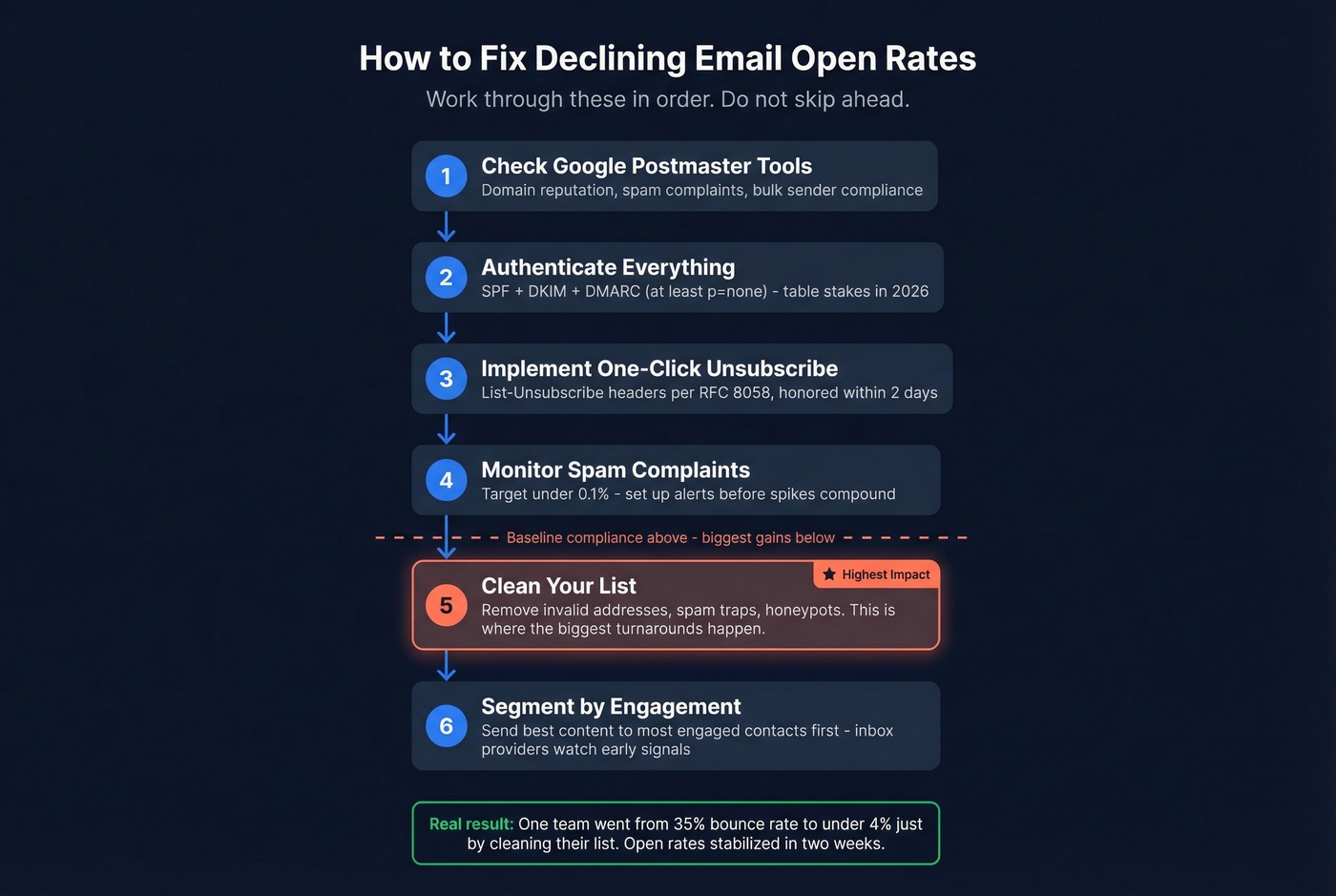
- Check Google Postmaster Tools. The compliance dashboard tells you if your domain meets bulk sender requirements and flags reputation issues.
- Authenticate everything. SPF, DKIM, and DMARC at minimum p=none. This is table stakes in 2026. (If you need a refresher on alignment, see DMARC and SPF.)
- Implement one-click unsubscribe. List-Unsubscribe and List-Unsubscribe-Post headers per RFC 8058, honored within two days.
- Monitor spam complaints. Target under 0.1%. Set up alerts so you catch spikes before they compound.
- Clean your list. Invalid addresses, spam traps, and honeypots silently destroy sender reputation. We've run dozens of deliverability audits, and this is consistently where the biggest gains hide - bad list data is the upstream cause that makes every other fix less effective. Run your list through Prospeo's 5-step verification before major sends to catch invalids and spam traps at 98% accuracy, at roughly $0.01 per email. (If you're diagnosing bounces, start with bounce rate benchmarks and fixes.)
- Segment by engagement. Send your best content to your most engaged contacts first. Inbox providers watch early engagement signals to decide whether to deliver the rest of your batch.

Steps 1-4 are baseline compliance. Step 5 is where we've seen the most dramatic turnarounds - one client went from a 35% bounce rate to under 4% just by cleaning their list before sends, and their open rates stabilized within two weeks.
Bounce rates above 2% are actively destroying your sender reputation right now. Prospeo refreshes 300M+ profiles every 7 days - not every 6 weeks like competitors - so you're never emailing stale contacts that trigger hard bounces.
Stop sending to dead addresses. Start with data that's 7 days fresh.
FAQ
Are open rates still useful?
They work for A/B testing subject lines within the same segment - MPP noise cancels out when you're comparing two variants sent to similar audiences. As a standalone KPI, they're unreliable post-2024. Click rates and spam complaint rates give you a far more accurate picture of real engagement.
How much did Apple MPP inflate open rates?
Apple's Privacy Proxy accounted for 73.11% of pixel-firing events in Validity's 2024 dataset. Expect 5-15 percentage points of artificial decline depending on how Apple-heavy your subscriber base is. This is the single biggest driver behind the drop senders noticed after mid-2024.
How do I prevent bounce damage to sender reputation?
Verify your list before every major send. Keep bounce rates under 2% - under 1% is better. If you're running cold outbound, skip this step at your own risk. A burned domain takes weeks to recover, and some inbox providers never fully trust you again.
What's a good open rate in 2026?
For engaged, permission-based lists, 20-30% is realistic after accounting for Apple MPP and ESP bot filtering. But the number that matters is whether your click rate and conversions are stable. If they are, your audience is engaged regardless of what the open rate dashboard says.