

Email Profiling: The Complete Guide for Fraud, OSINT, and B2B Sales
A single email address - jsmith@acme.com - can tell you whether that person is a real buyer, a fraud risk, a breach victim, or a ghost account created ten minutes ago. Email profiling is the practice of extracting that intelligence, and the depth of what you uncover depends entirely on your intent and your tooling.
What follows: techniques, tools, and legal boundaries across the four major use cases - fraud detection, OSINT investigations, B2B sales enrichment, and marketing compliance.
What Is Email Profiling?
This discipline starts with a single data point - an email address - and builds outward. You run it through enrichment checks and get back a layered profile: who this person is, where they're active online, whether the address is legitimate, and what company or role they're tied to.
The term means different things depending on who's using it. A fraud analyst profiles emails to catch synthetic identities before they drain accounts. An OSINT investigator maps a target's digital footprint across social platforms, breach databases, and domain records. Pen testers and journalists use the same techniques to verify sources or probe attack surfaces. A B2B sales team profiles emails to enrich a lead list with job titles, company data, and intent signals. A compliance officer profiles to ensure the address is valid, opted-in, and safe to send to.
The core workflow is straightforward: submit an email, run checks, get a composite picture - from SMTP validity and disposable domain detection to social media presence and breach exposure. What matters is matching the right technique and tool to your specific use case.
What You Need (Quick Version)
Fraud detection: SEON. Real-time risk scoring, disposable email detection, and social profiling across 50+ data modules. Free tool limited to 5 lookups per day; enterprise pricing is custom.
OSINT investigations: Holehe for account enumeration across 120+ sites, Google dorking for public document pivots, and Behind the Email for deep identity search. Holehe is free and open-source; the rest of the stack is mostly free or low-cost.
B2B sales enrichment: Prospeo. 98% email accuracy, 7-day data refresh cycle, and 50+ data points returned per contact. Free tier gives you 75 emails/month; paid plans run about $0.01/email.
Email validation: ZeroBounce. Dedicated list cleaning with bounce detection, spam-trap removal, and abuse detection. 100 free validations/month; paid plans start around $15-$20/month.
No single tool covers all four use cases. Pick based on your intent.
What an Email Address Reveals
A common privacy concern: can a work email be used to discover linked online accounts? Yes. And that's just one layer.
| Signal Category | What It Reveals | Example |
|---|---|---|
| SMTP verification | Whether the mailbox exists | Valid / invalid / catch-all |
| Disposable detection | Temporary email service | Guerrilla Mail, Mailinator |
| Domain metadata | Free vs corporate, domain age | Gmail (free) vs acme.com (est. 2014) |
| Social media presence | Registered accounts | Active on 6 platforms |
| Data breach exposure | Compromised credentials | Found in 3 known breaches |
| Blacklist status | Known bad actor | Flagged on 2 spam lists |
| Username heuristics | Patterns in the local-part | "john.smith2024" vs "xk7q9z" |
| Behavioral signals | Login frequency, device patterns | 12 logins/week, 2 devices |
| WHOIS / corporate data | Company, role, industry | VP Sales at Acme, SaaS, 200 employees |
Tools like SEON, Holehe, and Behind the Email cover the first seven categories. Behavioral signals - login frequency, device usage, geographic patterns - are primarily accessible to fraud prevention platforms that track user sessions over time. Corporate data like job title, company size, revenue, and tech stack comes from data enrichment platforms that cross-reference the email's domain against business databases.
Here's the thing: a corporate email like jsmith@acme.com yields dramatically more business intelligence than a Gmail address. The domain alone tells you the company, and from there, enrichment tools can append headcount, funding, revenue, tech stack, and intent signals. A free email still returns social media matches, breach history, and username analysis - but you lose the corporate layer entirely.

Corporate emails unlock the richest profiles. Prospeo turns addresses like jsmith@acme.com into 50+ data points - job title, department, company revenue, tech stack, and buyer intent signals - with 98% email accuracy and a 7-day data refresh cycle. No stale records, no guesswork.
Profile any B2B email into a complete buyer dossier for $0.01.
Profiling by Use Case
Fraud Detection
A new user signs up with a Gmail address. Everything looks normal on the surface. But an email risk assessment reveals the domain is actually a disposable email service, the address was created 48 hours ago, it's registered on zero social media platforms, and the username follows a random-string pattern. Four red flags from a single data point.
Fraud costs businesses roughly 5% of revenue annually, per ACFE estimates. False declines are equally damaging - recent PYMNTS Intelligence data puts $157B at risk in the US alone, with $81B expected to be lost even after recovery efforts. Nearly 70% of businesses report fraud is getting more complex, not simpler.
The workflow: user submits email at signup or checkout, the fraud platform runs SMTP checks, disposable detection, social media lookups, breach queries, and behavioral analysis, then a composite risk score determines whether to approve, flag, or block. The goal isn't to catch every fraudster. It's to make the cost of fraud higher than the cost of prevention.
OSINT & Investigations
OSINT-focused email analysis starts with the same address but goes deeper and more manual. You're not scoring risk - you're building an intelligence picture.
Google dorking is the first move. Wrap the email in quotes and search:
"target@example.com" filetype:pdf
"target@example.com" site:github.com
"target@example.com" site:pastebin.com
These queries surface public documents, code repositories, and paste dumps where the email appears. Add filetype:xlsx or filetype:csv to find spreadsheets where the address was inadvertently published.
One overlooked technique: if the target uses Gmail, try adding them on Google Calendar. The service sometimes reveals their name, profile photo, and other linked accounts - all without sending a notification.
Account enumeration tools like Holehe automate the tedious work, checking 120+ websites for account registration tied to an email address. Password reset endpoint probing works similarly - initiating a reset flow on a service often reveals whether an account exists and sometimes leaks partial phone numbers or recovery email hints.
A critical legal warning: unauthorized access to systems or accounts can violate the CFAA in the US, GDPR in the EU, and the Investigatory Powers Act in the UK. Enumeration of public-facing endpoints is generally legal; actually accessing accounts or bypassing authentication is not. Document everything.
B2B Sales Enrichment
An SDR comes back from a conference with 500 business cards. Half are scribbled, a quarter have personal Gmail addresses, and the rest have corporate emails that may or may not still be valid. This is where B2B email enrichment earns its keep.
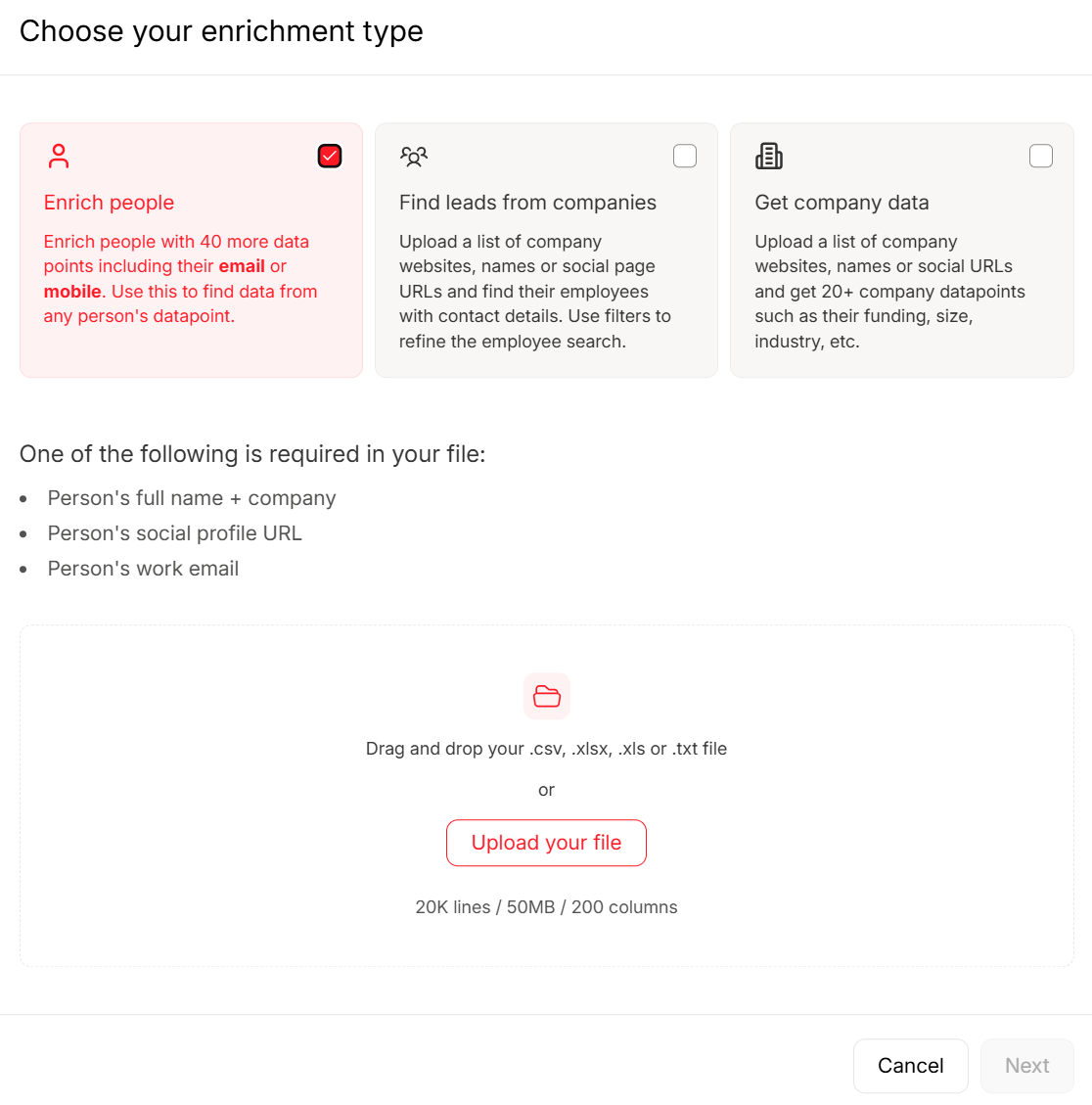
Upload the list as a CSV, the platform verifies each email, appends company name, job title, direct dial, company size, revenue, tech stack, and intent signals, then exports a clean, enriched list ready for sequencing. The difference between a good enrichment tool and a bad one comes down to accuracy and freshness.
Here's the problem most teams don't see coming: roughly 2.5% of any contact database goes outdated every month. And accuracy and coverage are inversely correlated - a 9,806-contact test across 10 providers found that providers finding the most emails often had the worst accuracy. Wiza hit 67-85% coverage but validity as low as 15% in some segments. Hunter ranged 89-96% validity but with lower coverage. One practitioner on r/coldemail running about 1M lookups per month put it bluntly: the provider with the biggest database isn't the one that keeps your domain alive.
Look, if your average deal size sits below five figures, you probably don't need ZoomInfo-level data. A tool with 98% accuracy at $0.01/email will outperform a $1/lead platform that bounces 15% of the time - because bounces kill your sender reputation, and a dead domain costs you every deal in the pipeline.
Tools Compared
| Tool | Best For | Key Capability | Quality Signal | Starting Price |
|---|---|---|---|---|
| Prospeo | B2B enrichment | 50+ data points, CSV/API | 98% accuracy, 7-day refresh | Free (75/mo); ~$0.01/email |
| SEON | Fraud detection | Risk scoring, disposable detection | Real-time, 50+ modules | Free (5/day); custom enterprise |
| Behind the Email | OSINT investigations | Deep identity, work history | Conservative, no false positives | ~$20-$200/mo |
| Hunter | Email finding + verification | Domain search, verification | 89-96% validity range | Free (50 searches/mo); from ~$49/mo |
| ZeroBounce | Email validation | List cleaning, spam-trap removal | Dedicated validation focus | 100 free/mo; ~$15-$20/mo |
| Holehe | OSINT enumeration | Checks 120+ sites | Open-source, community-maintained | Free |
The accuracy-coverage tradeoff is real and persistent. We've seen teams chase the highest-coverage provider, only to torch their sender reputation with 25-35% bounce rates on the first campaign. In our testing across most of these tools side by side, the gap between claimed accuracy and real-world deliverability is wider than any vendor will admit. Start with the highest-accuracy provider for your top-priority accounts, then waterfall to broader-coverage tools for lower-tier targets.
Skip SEON if you're purely doing B2B outreach - it's built for fraud, not sales. And skip Holehe if you're not comfortable with command-line tools; it's powerful but not exactly user-friendly.
Email profiling for sales means nothing if the data is wrong. Prospeo's 5-step verification with catch-all handling, spam-trap removal, and honeypot filtering delivers 98% accuracy - compared to 87% at ZoomInfo and 79% at Apollo. Teams using Prospeo book 26% more meetings because their emails actually land.
Stop profiling against stale data refreshed every 6 weeks.
Data Freshness and Decay
Let's do the math. If 2.5% of your database decays every month, a list of 10,000 contacts loses 250 valid records in month one. By quarter's end, 750 are stale. After a year, roughly 2,600 of your original contacts have changed jobs, switched emails, or left the company entirely.
You're emailing ghosts.
Three freshness models exist in the market. Batch enrichment refreshes on a fixed schedule - monthly or quarterly - and is what most legacy platforms use. Real-time enrichment queries live sources at the moment of request, which is more accurate but slower and more expensive per lookup. Waterfall enrichment chains multiple providers sequentially to improve find rates, but doesn't inherently solve freshness; you're just getting stale data from more sources.
Independent testing tells the story. A Crustdata analysis of Apollo-sourced lists found 25-35% bounce rates versus Apollo's claimed ~91% accuracy. In our experience, the accuracy gap between weekly and monthly refresh cycles is even wider than those numbers suggest - especially for fast-moving segments like tech startups where turnover runs 20%+ annually. Weekly refresh is the gold standard. Anything slower compounds into a deliverability problem that gets harder to fix the longer you wait.
Legal and Compliance Rules
Email profiling touches personal data, which means regulation applies regardless of your use case.
GDPR governs any processing of EU residents' data, regardless of where your company is based. Over EUR 2.8B in fines have been issued since 2018. The two relevant legal bases are consent (explicit opt-in) and legitimate interest - Recital 47 acknowledges that direct marketing can qualify, but you need to document your balancing test. Operational requirements include explicit opt-in, double opt-in where practical, easy consent withdrawal, unsubscribe links in every communication, and thorough recordkeeping.
CAN-SPAM in the US is an opt-out model: you can email someone without prior consent, but you must honor unsubscribe requests within 10 business days, include a valid physical address, and avoid deceptive headers or subject lines. Penalties run up to $51,744 per email.
CPRA in California adds another layer for businesses meeting revenue or data-processing thresholds - requiring a "Do Not Sell or Share My Info" link and honoring access/delete/correct requests within 45 days. Penalties are $2,500 per unintentional violation and $7,500 per intentional violation, with no cap.
For OSINT practitioners: the line between "checking if an account exists" and "unauthorized access" is thinner than most investigators realize. Document everything and get legal sign-off before profiling at scale.
FAQ
Is email profiling legal?
Yes, provided you use publicly available data and comply with applicable privacy laws - GDPR, CAN-SPAM, CPRA, and local equivalents. OSINT techniques cross legal lines when they involve unauthorized system access under the CFAA. Document your lawful basis before profiling at scale.
What can someone find from just my email address?
Your name, employer, job title, social media accounts, breach history, approximate location, and domain metadata. The depth depends on your digital footprint - how many services you've registered with that email and whether those profiles are public.
What's the most accurate email enrichment tool?
Prospeo delivers 98% email accuracy across 300M+ professional profiles with a 7-day data refresh cycle. Hunter ranges 89-96% validity depending on the segment. Prioritize precision for high-value targets and waterfall to broader tools for the rest.
Can you profile a Gmail or free email address?
Yes, but you'll get less business intelligence than from a corporate email. Free domains don't reveal company info, but social media checks, breach databases, and username heuristics still return useful signals. Fraud detection tools are particularly effective on free emails since disposable and temporary addresses are a primary red flag.
How often does enrichment data go stale?
About 2.5% of any contact database becomes outdated every month - roughly a quarter of your data per year. Choose tools with weekly refresh cycles and re-verify any list older than 30 days before launching outbound campaigns.