

You Don't Need 13 Segments. You Need 3 Good Ones.
You sent last Tuesday's campaign to your entire list. Open rate looked fine - 34%. Then you checked clicks: 0.8%. That's batch-and-blast math, and it's the reason your revenue-per-send keeps flatlining.
Every email segmentation strategy guide hands you 13 tactics and tells you to "test what works." That's not a strategy. That's a homework assignment. Start with three segments, get them right, and add complexity only when the data tells you to.
What You Need (Quick Version)
Three segments: engaged vs. cold, customers vs. leads, and one behavioral trigger like cart abandonment or content interest. Before you segment anything, verify your list - bad data makes every segment unreliable and tanks your sender reputation. And measure CTR, not open rates. Apple Mail Privacy Protection killed open-rate accuracy, and it's not coming back.
What Email Segmentation Actually Is
Email segmentation is grouping your subscribers by shared traits - behavior, demographics, purchase history, engagement level - so you can send relevant content to each group instead of the same message to everyone. Each segmented email should feel like it was written for that specific group, not copy-pasted from a generic template.
It's not personalization. Personalization tailors content within a segment: using someone's first name, referencing their last purchase, adjusting product recommendations. Segmentation decides who gets what email. Personalization decides what that email says. You need segmentation first. Without it, personalization is just a first-name token on a mass blast.
Why Segmentation Matters More in 2026
Two infrastructure changes made a deliberate email segmentation strategy non-optional.
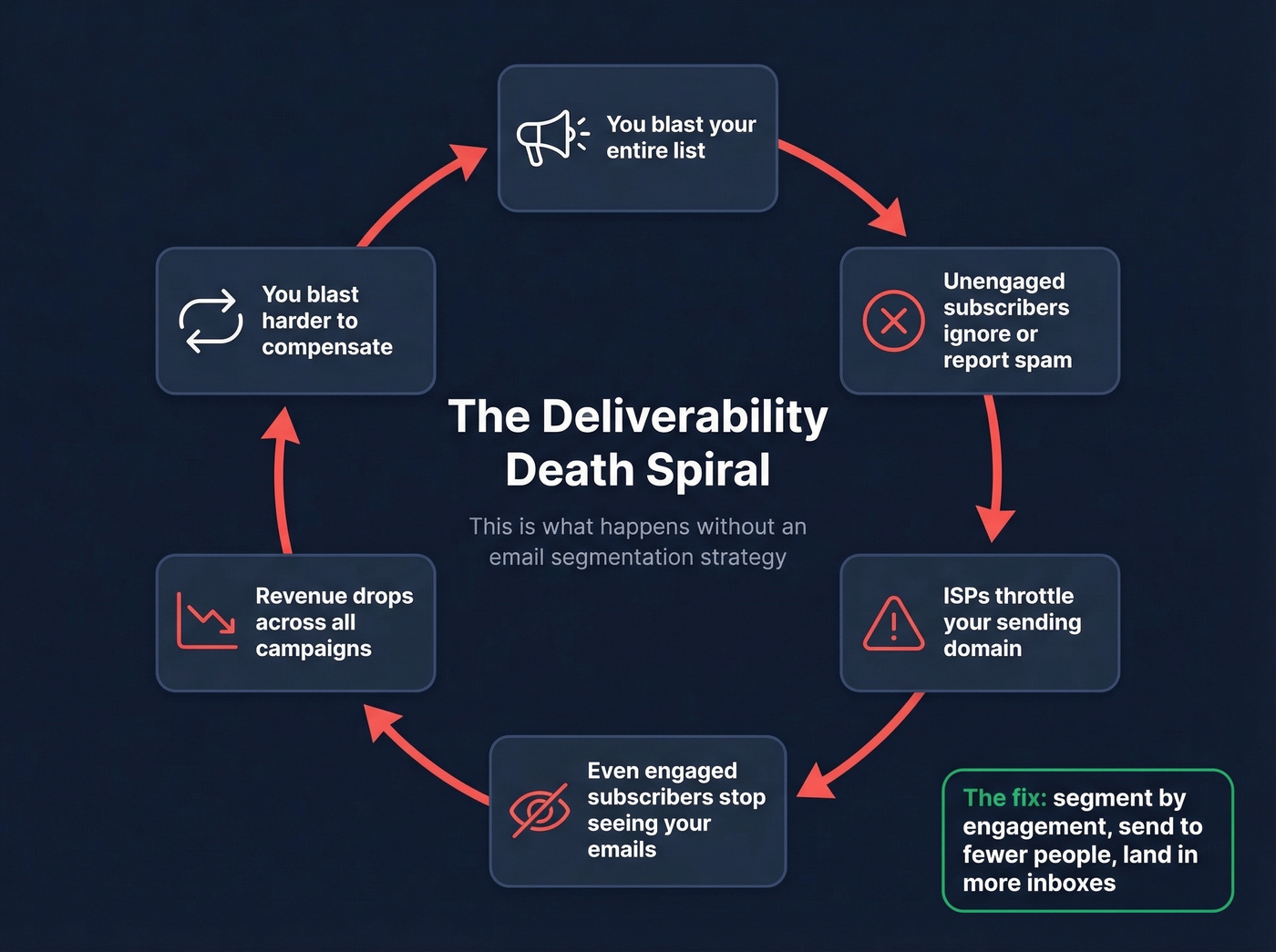
Yahoo and Gmail now require spam rates below 0.3% and proper authentication. Cross that threshold consistently and your deliverability craters - not just for that campaign, but for your entire sending domain. Blasting your full list is the fastest way to trip that wire, because unengaged subscribers hit "report spam" instead of scrolling past.
Apple Mail Privacy Protection inflates open rates and makes opens a ghost metric. CTR is the engagement signal you can trust, and Salesforce's benchmark guidance recommends shifting emphasis toward CTR and CTOR as primary engagement metrics.
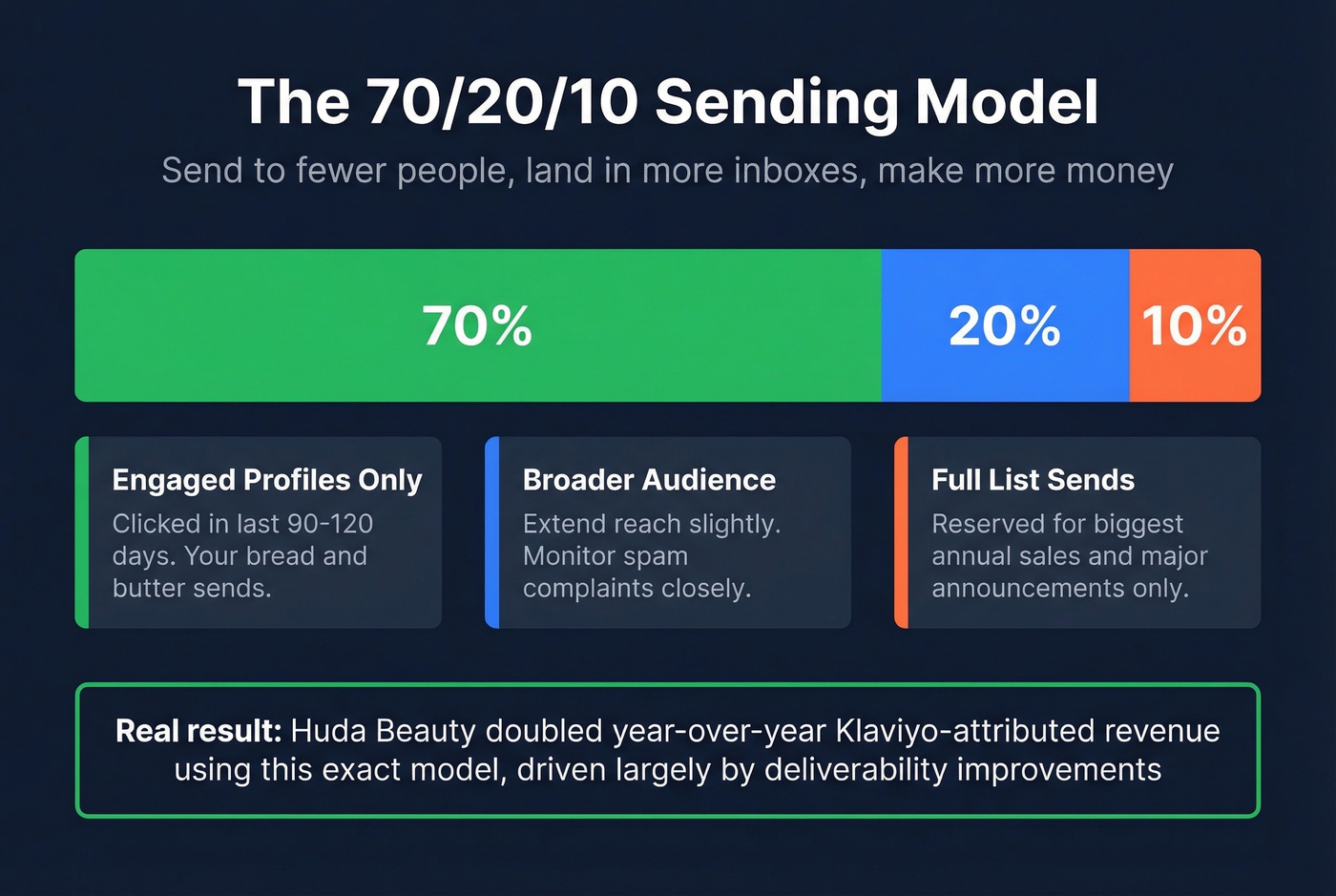
Here's a real example. Huda Beauty shifted to sending regular campaigns only to subscribers engaged within the last 120 days, reserving full-list sends for major annual sales. They used a 70/20/10 model - 70% of campaigns to engaged profiles, 20% to a broader audience, 10% to the full list. The result: double year-over-year growth in Klaviyo-attributed revenue, driven largely by deliverability improvements.
The cost of not segmenting is a deliverability spiral. You blast everyone, unengaged subscribers ignore or report, ISPs throttle your sends, even engaged subscribers stop seeing your emails, revenue drops, and you blast harder to compensate. It's a death loop.
2026 Email Benchmarks
Before you can measure whether segmentation is working, you need to know what "normal" looks like.
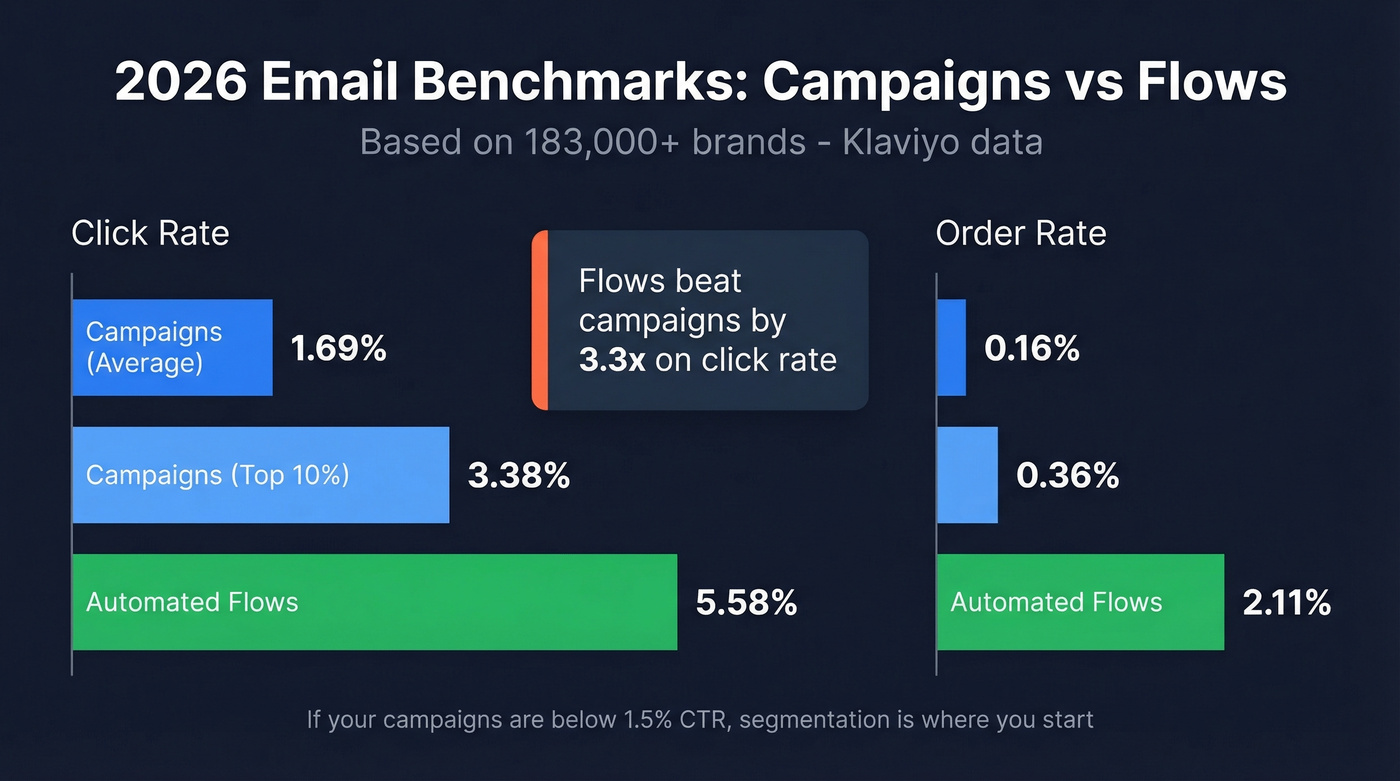
| Metric | Klaviyo Avg | Klaviyo Top 10% | ActiveCampaign Avg |
|---|---|---|---|
| Open Rate | 31% | 45.1% | 39.26% |
| Click Rate (Campaigns) | 1.69% | 3.38% | 6.21%* |
| Order Rate (Campaigns) | 0.16% | 0.36% | - |
| Click Rate (Flows) | 5.58% | 10.48% | - |
| Order Rate (Flows) | 2.11% | 4.3% | - |
*ActiveCampaign's click rate includes transactional + marketing emails, which inflates the number.
The Klaviyo benchmarks draw from 183,000+ brands. The gap between average and top 10% is massive - top performers get 2x the click rate and about 2.25x the order rate on campaigns. That gap is largely segmentation and automation discipline. Automated flows crush campaigns on every metric: 5.58% flow click rate vs. 1.69% campaign click rate. Behavioral triggers outperform batch sends by roughly 3.3x on click rate.
Salesforce puts a "good" CTR at 2-5% for general emails, 1-3% for promos, and 5%+ for transactional. If your campaigns are below 1.5% CTR, segmentation is where you start.
Before You Segment: Fix Your Data
Look, segmenting a dirty list is like organizing garbage into labeled bins. You'll have beautifully named segments full of invalid emails, spam traps and honeypots, and addresses that haven't existed in two years.
Bounces damage your sender reputation directly, and segments built on invalid emails produce unreliable performance data. You can't tell if a segment is underperforming because the messaging is wrong or because 12% of the addresses are dead. A solid rule of thumb: once bounce rate creeps above 5%, your deliverability is at risk. Most teams don't check until it's already a problem.
We've seen teams spend weeks building elaborate segmentation logic on top of lists they haven't cleaned in a year - then wonder why their "engaged" segment has a 6% bounce rate. Run your list through Prospeo's email verification before you build a single segment. The 5-step verification process handles catch-all domains, removes spam traps and honeypots, and delivers 98% email accuracy - and you only pay for valid addresses. Upload a CSV, get results in minutes, and start segmenting data you can actually trust.


You just read it: segmenting a dirty list is organizing garbage into labeled bins. Prospeo's 5-step email verification catches spam traps, honeypots, and catch-all domains - delivering 98% accuracy so every segment you build is based on data you can trust.
Clean your list before you segment it. 75 free verifications, no credit card.
Building your engaged vs. cold segment? You need valid emails first. Teams using Prospeo cut bounce rates from 35%+ to under 4% - the kind of fix that keeps you below Gmail's 0.3% spam threshold and out of the deliverability death spiral.
Stop segmenting dead addresses. Start with data that's 7 days fresh.
3 Minimum Viable Segments
Every segmentation guide assumes you have clean data, a CDP, and a team of three. Most of you have a Mailchimp account, a messy spreadsheet, and 45 minutes. These three segments are where you start.
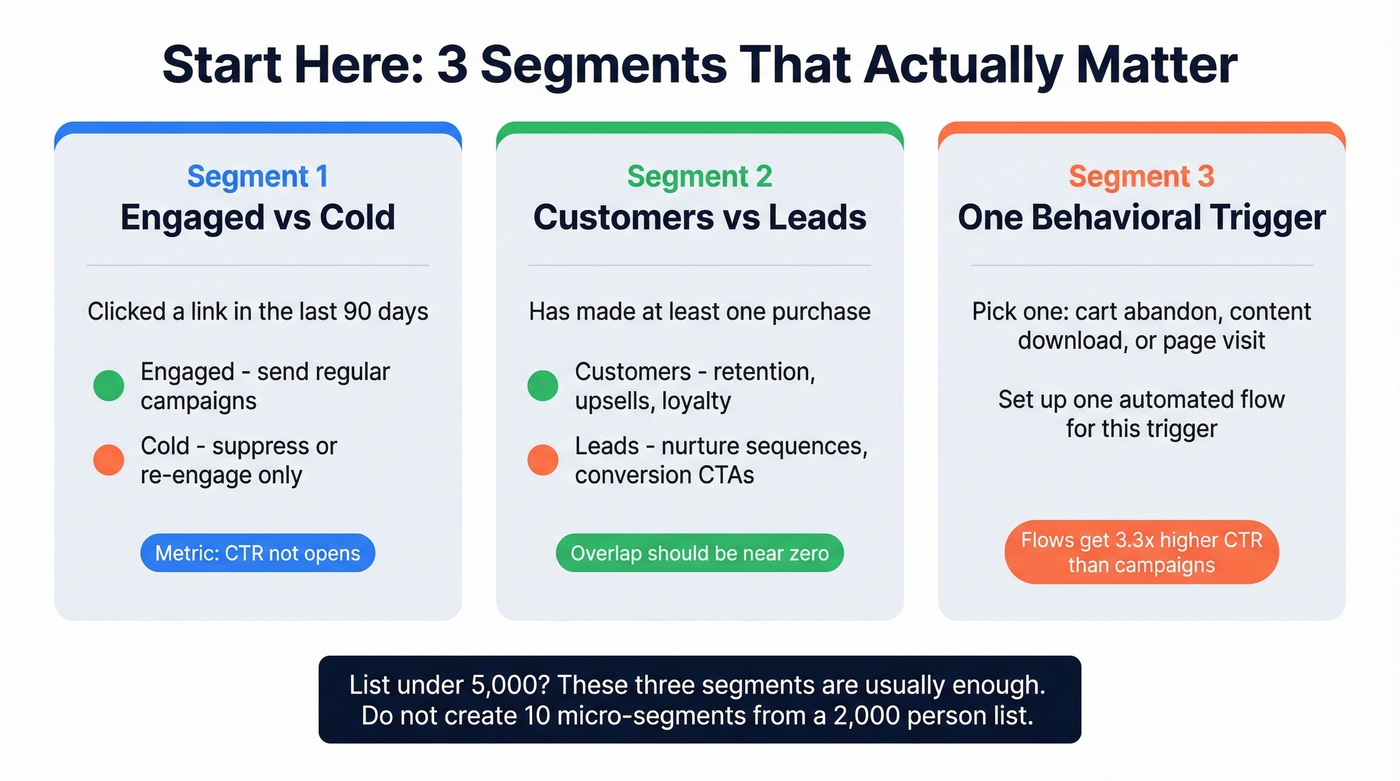
Segment 1: Engaged vs. Cold. Define "engaged" as anyone who clicked a link in the last 90 days. Not opened - clicked. Opens are unreliable thanks to Apple MPP. A 90-day active window is the most common practitioner baseline, and it's the first segment worth maintaining because it immediately cuts dead weight from your sends.
Segment 2: Customers vs. Non-Customers. A simple purchase history flag. Customers get retention messaging, upsells, and loyalty content. Non-customers get nurture sequences and conversion-focused campaigns. The messaging overlap between these two groups should be close to zero. This is customer segmentation for email campaigns at its most fundamental - and it's often all you need to see a meaningful lift.
Segment 3: One Behavioral Trigger. Pick one: cart abandonment, content download, or product page visit. Set up an automated flow for it. Flows outperform campaigns by about 3.3x on click rate per Klaviyo's data, so even a single behavioral trigger will move your numbers.
If your list is under 5,000, these three segments are usually enough. Don't create 10 micro-segments from a 2,000-person list - you'll end up with groups too small to learn from and too fragmented to manage.
Hot take: If your average deal value is under $50 or you're closing contracts below $10k annually, you don't need a CDP or a fancy segmentation tool. Your ESP's native segmentation plus clean data will get you 80% of the results at 10% of the cost. Complexity is a luxury you earn with list size.
8 Segmented Campaigns That Drive Results
Once your three foundational segments are performing, layer in additional strategies based on your data maturity and list size. Not all of these apply to every business - pick the ones that match your situation. Briana Torres at Injectco reported a 12% year-over-year open rate boost from engagement-based segmentation alone, and that's consistent with what we've seen across accounts.
A note on verticals: the strategies below skew ecommerce because that's where the best public data exists, but the principles translate. SaaS companies should weight lifecycle stage and product usage data most heavily. B2B services should prioritize firmographic and intent-based segments. Ecommerce should double down on purchase behavior and browse abandonment.
Engagement Tiers (70/20/10)
This is the single highest-ROI segmentation framework we've seen in practice. Send 70% of your campaigns to engaged profiles only, 20% to a broader audience, and reserve full-list sends for 10% of campaigns - your biggest promotions and annual events. Huda Beauty's results with this model aren't an outlier. Sending to engaged subscribers improves deliverability, which improves inbox placement for everyone on your list, which lifts revenue even when you're sending to fewer people. Let's be honest: most teams resist this because sending to fewer people feels wrong. The math says otherwise.
Lifecycle Stage
Map subscribers to stages: Awareness (0-7 days), Activation (8-30 days), Engagement (31-90 days), Retention (90+ days active), At-risk (declining engagement), and Win-back (180+ days inactive). Each stage gets different content, frequency, and CTAs. Adrian Nikolov at MobiSystems reported that lifecycle-stage segmentation boosted open rates by at least 20% compared to batch-and-blast. That tracks - lifecycle segmentation forces you to think about where someone is, not just who they are.
Purchase Behavior
Segment by recency, frequency, and average order value. The most overlooked tactic here is exclusion: don't send promotional emails to someone who bought in the last 7 days. They just converted - hitting them with another discount feels tone-deaf and trains them to wait for sales. Compass Coffee used a conditional incentive approach (15% discount for photo reviews) and saw a 3.7x quarter-over-quarter increase in customer photo submissions.
Browse and Cart Abandonment
Cart abandonment flows, browse abandonment flows, and product-view retargeting consistently outperform scheduled campaigns. If you're only running campaigns and ignoring flows, you're leaving the easiest revenue on the table.
Acquisition Source
Use this if you're running multiple lead magnets or acquisition channels. Skip it if all your subscribers come from one signup form. Where someone signed up tells you what they care about - webinar leads have different intent than free-tool signups, who have different intent than paid ad conversions. Tagging acquisition source at signup and adjusting your welcome sequence accordingly is a 30-minute setup that pays off for months.
Preferences and Zero-Party Data
Collect preferences via preference centers, quizzes, or progressive profiling. A 65-account audit found that collecting zero-party data and never using it is one of the most common segmentation mistakes. If you're asking subscribers what they're interested in, you'd better segment on those answers. Otherwise you're adding friction to the signup process for no reason.
Geographic and Timezone
Send-time optimization by timezone is the lowest-effort version - most ESPs support it natively. The higher-value play is localized offers: regional promotions, weather-triggered campaigns, or location-specific product recommendations. This matters most for global lists where a single send time means half your audience gets your email at 3 AM.
B2B Firmographic Segmentation
For B2B teams, segment by company size and tech stack before job title. Title-based segmentation is the least predictive dimension in B2B - a "VP of Marketing" at a 20-person startup has nothing in common with one at a Fortune 500. Layer in firmographic data: industry, headcount, funding stage, technology stack. For advanced teams, tools like Prospeo can layer intent data across 15,000 topics so you're segmenting by who's actively researching your category, not just who matches a demographic filter.
Advanced Tactics for Mature Lists
These three techniques are for teams with 10,000+ subscribers, clean data, and the foundational segments already running.
RFM Scoring
Recency, Frequency, Monetary - score each dimension on a 1-5 scale. Weight recency highest (multiply by 3), frequency by 2, and monetary by 1. A subscriber who bought yesterday but only once is more valuable than someone who bought five times but not in six months. RFM works best with 1,000+ customers and gives you a quantitative way to prioritize your highest-value segments. The limitation: it doesn't capture preferences or category interest on its own, so pair it with behavioral data for a complete picture.
Waterfall Segmentation
This solves the frequency anxiety that comes up constantly on r/Emailmarketing: when subscribers qualify for multiple segments, who gets priority? Waterfall segmentation assigns each subscriber to the highest-priority segment they qualify for. A VIP customer in a cart abandonment flow doesn't also get the weekly newsletter and a win-back sequence. This prevents over-mailing and keeps your cadence clean - many teams aim for 1-2 emails per week regardless of how many segments someone qualifies for. A common refrain on that subreddit: "just because you can segment doesn't mean you should."
Predictive and AI-Driven Segmentation
ESPs like Klaviyo and ActiveCampaign now offer predictive segments: predicted customer lifetime value, churn risk, next purchase date. These are genuinely useful for prioritizing outreach, but they require sufficient historical data - typically 6+ months of purchase history across a meaningful customer base. Deepak Shukla reported that intent-based segmentation increased open rates 20-25%, which aligns with what predictive models enable: reaching people when they're most likely to act.
5 Mistakes That Kill Deliverability
These come from a 65-account audit and match the patterns we've seen repeatedly.
Over-segmenting into groups too small to test. If a segment has fewer than 200 subscribers, you can't draw meaningful conclusions from its performance. Merge it or wait until it grows.
Under-segmenting (blasting the entire list). The 70/20/10 model exists for a reason. Full-list sends should be rare events, not your default.
No exclusion logic. Exclude soft bounces from the last 30 days, subscribers with 3+ lifetime soft bounces, recent purchasers (7-day window), and anyone with an active support ticket. Exclusion segments are as important as targeting segments.
Collecting preference data but never using it. If your signup form asks "What topics interest you?" and you send the same emails to everyone regardless, you've broken a promise. That erodes trust and drives unsubscribes.
Ignoring segment-level deliverability. Most ESPs show bounce rates and spam complaints at the campaign level, not the segment level. Build custom reports that track bounce rate and spam complaints per segment - a segment with a 4% bounce rate is dragging down your entire domain reputation even if your overall rate looks fine.
Compliance: What You Can't Ignore
Segmentation requires collecting and processing personal data, which means privacy law applies directly.
GDPR requires explicit opt-in consent for EU residents, regardless of where your company is based. It's extraterritorial - if you're segmenting subscribers in Germany from a server in Texas, GDPR still applies. Maximum fines reach EUR 20M or 4% of global turnover, whichever is higher. CAN-SPAM operates on an opt-out model with penalties up to $53,088 per violation. CCPA allows fines up to $7,500 per intentional violation.
A Cisco survey found that 81% of consumers believe how an organization handles personal data reflects how it respects customers. Compliance isn't just about avoiding fines. Collect what you need, use what you collect, and make unsubscribing easy.
How to Measure Your Results
Stop looking at open rates. With Apple MPP inflating opens, open rate is a vanity metric in 2026. CTR is your primary engagement signal.
Set up a control group: send your unsegmented version to a 10% holdout and compare CTR, conversion rate, and revenue per recipient against your segmented sends. This is the only way to prove your email segmentation strategy is actually working and not just feeling like it should.
Track these metrics at the segment level, not just the campaign level: CTR, conversion rate, bounce rate, spam complaints, and revenue per recipient. A segment that looks great on clicks but has a 3% bounce rate is a net negative for your domain.
Document your baseline metrics, implement your three foundational segments, and run a 30-day comparison. Re-evaluate segments quarterly - engagement windows shift, subscriber behavior changes, and lists decay at 2-3% per month.
FAQ
Is email segmentation worth it for lists under 5,000?
Yes, but use fewer, broader segments. Engaged vs. cold, customers vs. leads, and one behavioral trigger are enough for small lists. Groups under 200 subscribers are too small to learn from. Three well-maintained segments will outperform 10 half-built ones on a 2,000-person list.
How many segments should I start with?
Three. Add more only after you've confirmed the first three improve CTR or conversions. Most marketers see diminishing returns past 5-7 active segments unless they have 50,000+ subscribers and the data infrastructure to support more.
Which segmentation criteria matter most?
Engagement recency and purchase history deliver the highest impact for most businesses. After those, behavioral triggers like cart abandonment and browse activity produce the strongest returns. Demographic data like age or location matters less unless you're running region-specific promotions.
How do I keep segments accurate over time?
Re-evaluate quarterly - lists decay at 2-3% per month, and engagement windows shift. Run your list through a verification tool every 90 days to catch invalid addresses before they inflate bounce rates and drag down domain reputation across all segments.
Should I use open rates or click rates to define "engaged"?
Click rates. Apple Mail Privacy Protection inflates open rates, making them unreliable as an engagement signal. Define "engaged" as anyone who clicked a link in the last 60-90 days - that gives you an action-based metric that isn't contaminated by privacy proxies.