

Best Email Validation Tools in 2026
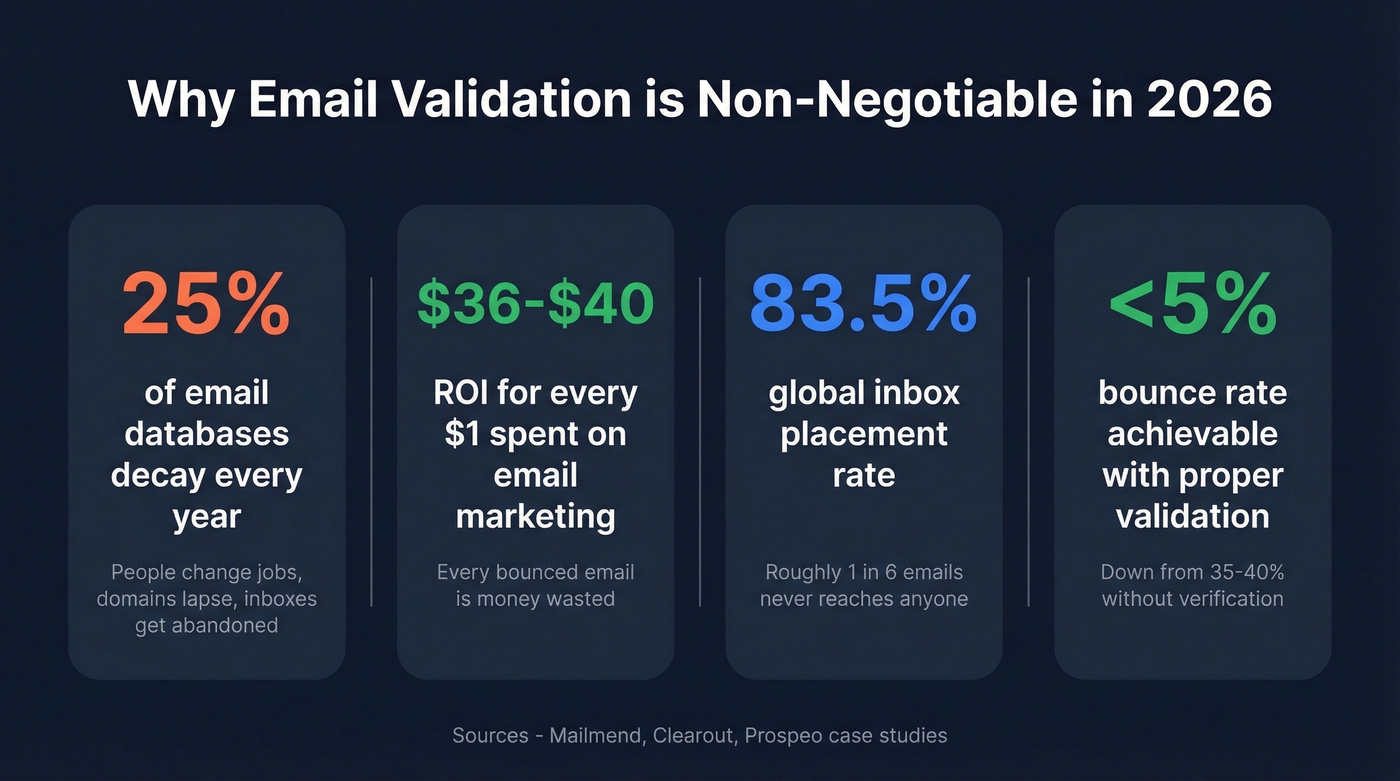
Your email list is decaying right now. At least 25% of email databases rot annually - people change jobs, domains lapse, inboxes fill up and get abandoned. Meanwhile, email marketing still returns $36-$40 for every $1 spent, so every bounced email is money you're lighting on fire. The global inbox placement rate sits around 83.5%, meaning roughly one in six emails never reaches anyone.
Email validation tools aren't optional anymore. They're infrastructure.
The difference between tools is bigger than most teams realize. Some charge you for unknowns. Some let credits expire. Some can't handle catch-all domains at all. Here's what actually matters when you're choosing the right verifier.
Our Top Picks
If you don't want to read 2,500 words, here's the short version:
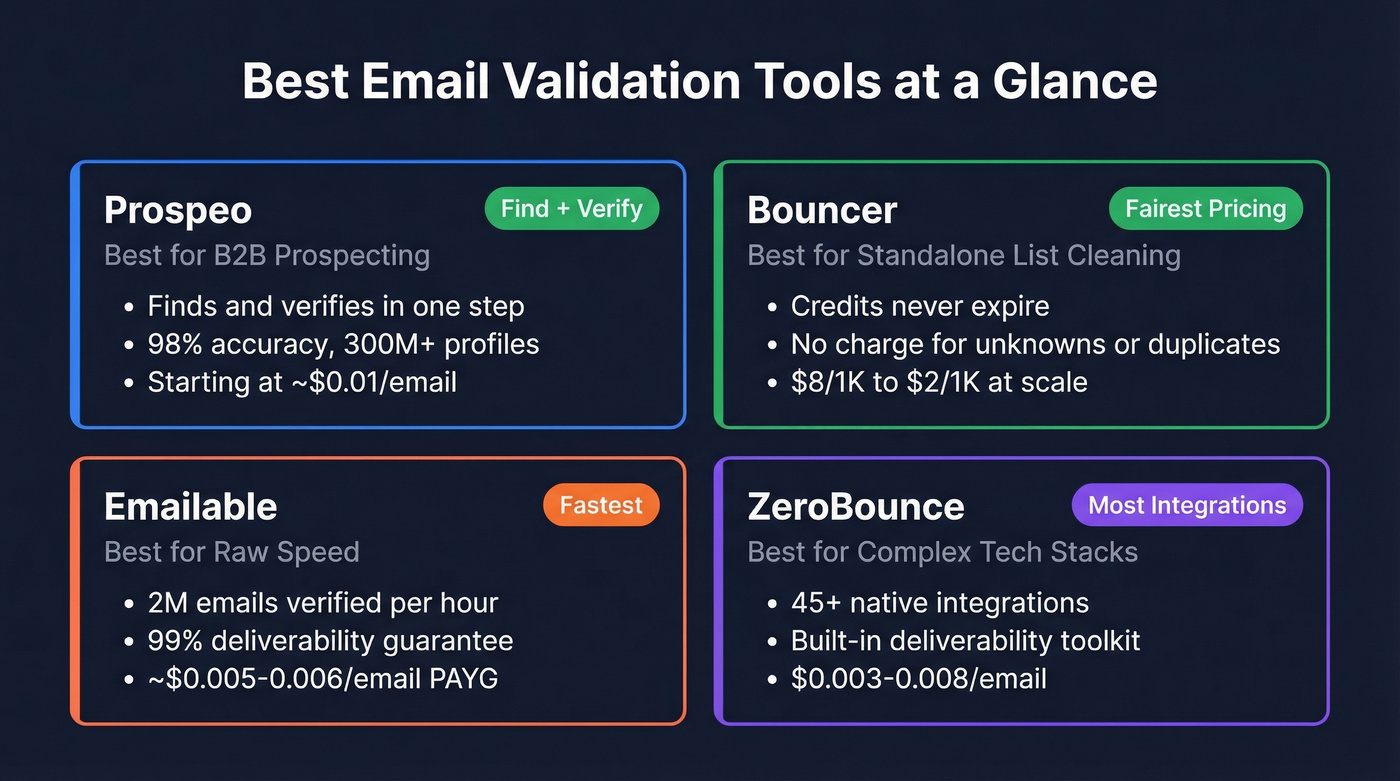
| Use Case | Tool | Why |
|---|---|---|
| B2B prospecting | Prospeo | Finds and verifies in one step, 98% accuracy |
| Standalone list cleaning | Bouncer | Credits never expire, no charge for unknowns |
| Raw speed | Emailable | 2M emails/hour, 99% deliverability guarantee |
| Complex tech stacks | ZeroBounce | 45+ integrations, deliverability toolkit built in |
These four cover most scenarios. If you're running cold outbound and need emails you don't already have, Prospeo eliminates the two-tool workflow entirely. If you've already got a list and just need it cleaned, Bouncer's pricing model is the fairest in the category. Emailable wins when you're processing massive lists on a deadline. ZeroBounce is the play when your stack has a dozen tools that all need to talk to each other.
Here's the thing: if your average deal size is under $10K and your team is fewer than five reps, you probably don't need a full deliverability suite. A solid finder-verifier combo or a simple bulk cleaner will get you 90% of the way there at a fraction of the cost.
How Email Validation Works
Every verifier on this list runs some version of the same pipeline. Understanding it helps you spot which ones cut corners.
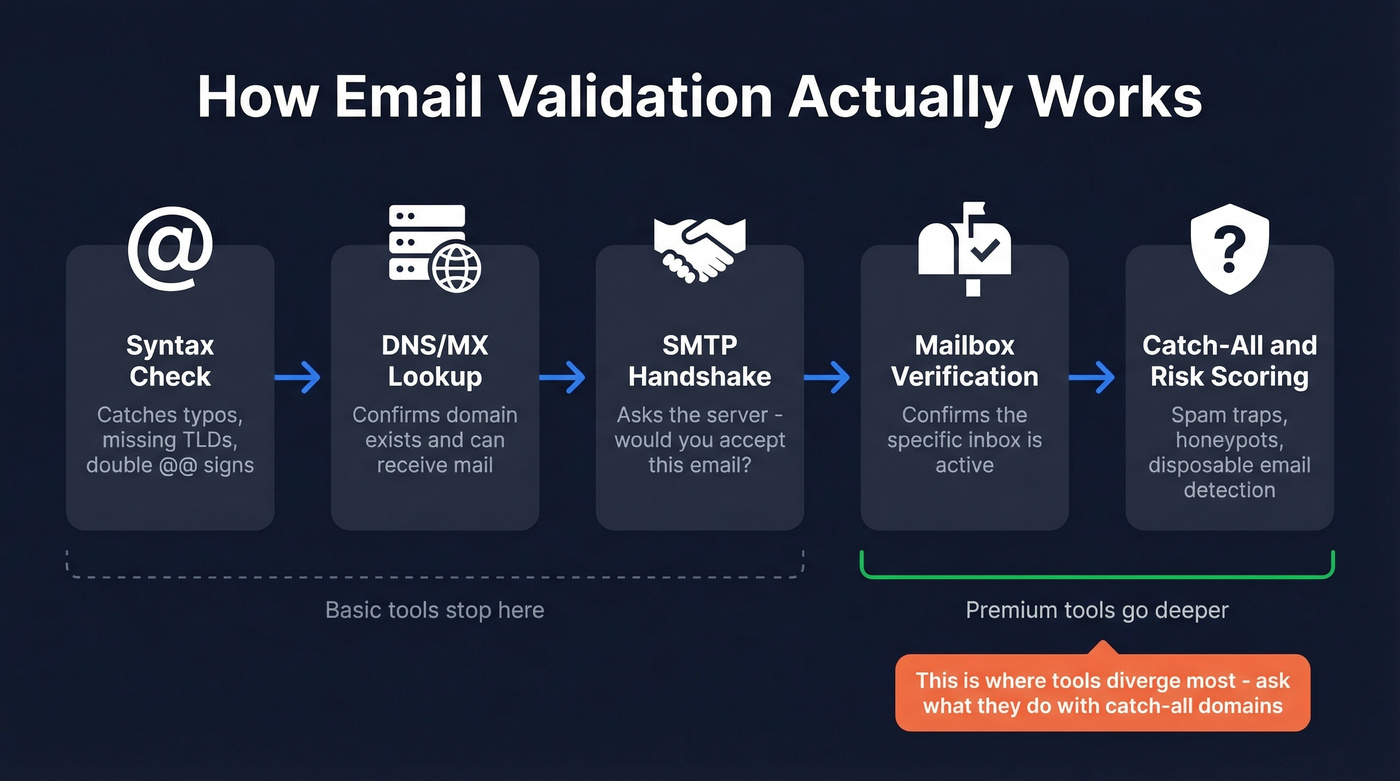
The process has five stages:
- Syntax check - does the address follow valid formatting rules? Catches typos like "john@@company.com" or missing TLDs.
- DNS/MX lookup - does the domain exist, and does it have mail exchange records configured to receive email?
- SMTP handshake - the tool connects to the mail server and asks "would you accept a message for this address?" without actually sending one.
- Mailbox-level verification - confirms the specific mailbox exists and is active, not just that the domain accepts mail.
- Catch-all and risk scoring - this is where tools diverge most. Catch-all domains accept mail for any address, making it impossible to confirm a specific mailbox via SMTP alone.
Some tools stop at step 3 and call it verified. The good ones layer on spam-trap detection, honeypot filtering, and disposable email detection on top of the full pipeline. One independent test by Lemlist ran 800 known-good and 200 known-bad emails through multiple tools - results varied wildly on catch-all handling. When you're comparing verifiers, ask one question first: what do they do with catch-all domains? If the answer is "mark them as risky and charge you a credit anyway," that tells you everything.
Best Email Verifier Tools in 2026
Prospeo
Prospeo is the only tool on this list that finds and verifies B2B emails in a single workflow. Most teams cobble together a finder and a separate verifier - Prospeo collapses that into one step, running every address through a proprietary 5-step verification pipeline with catch-all handling, spam-trap removal, and honeypot filtering.
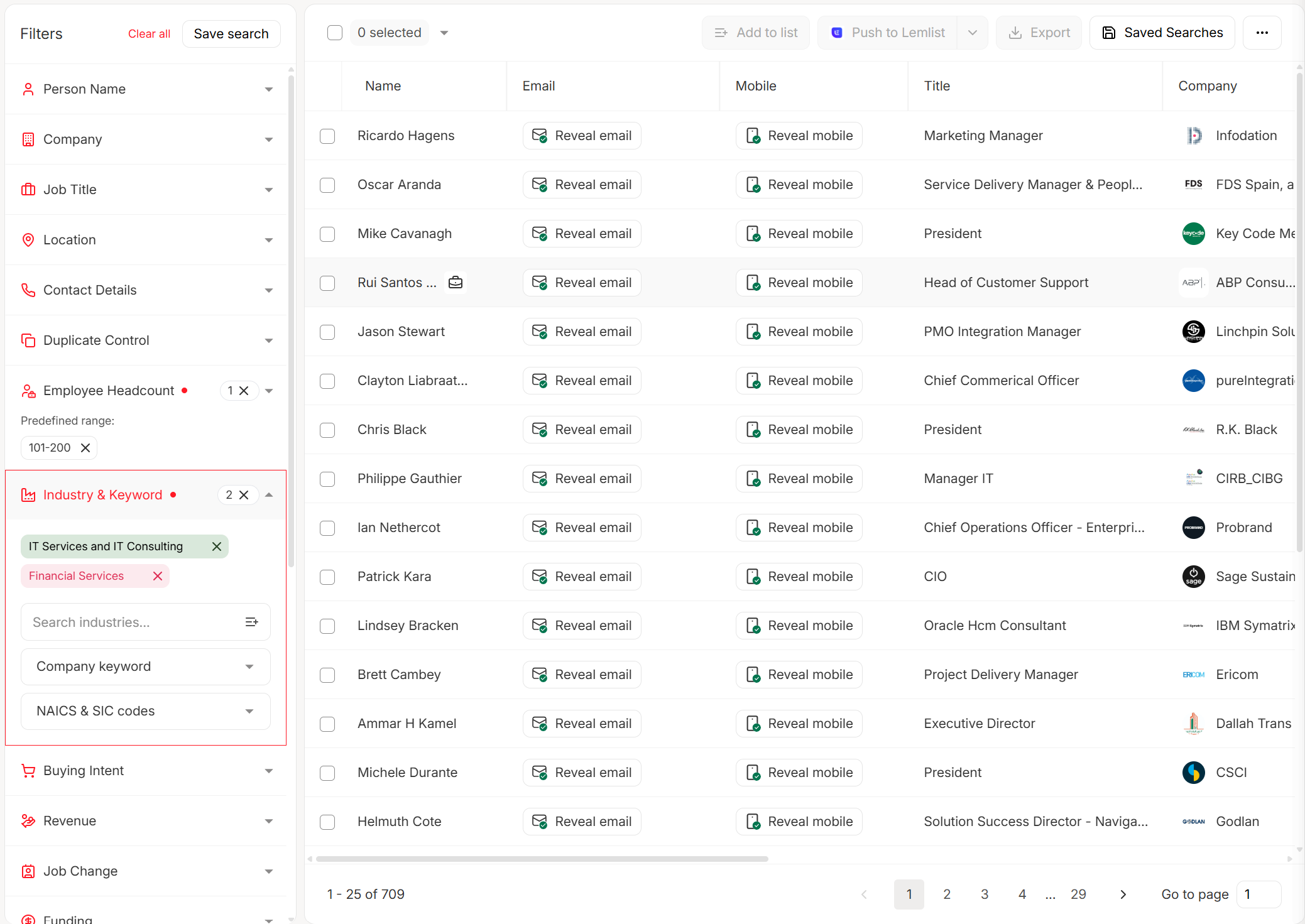
The database covers 300M+ professional profiles with 143M+ verified emails, refreshed on a 7-day cycle. That refresh cadence matters. The industry average is six weeks, which means most databases are already stale by the time you pull a list. Snyk's team went from a 35-40% bounce rate to under 5% after switching, and Stack Optimize maintains under 3% bounce across all clients.
Use it if you're running B2B outbound and want one platform for finding, verifying, and exporting contacts - with native pushes to Salesforce, HubSpot, Smartlead, Instantly, Lemlist, Clay, Zapier, and Make.
Skip it if you already have a clean list and just need a standalone cleaner. Prospeo's biggest advantage is the combined find-and-verify workflow, which you won't need in that case.
Pricing starts free (75 emails/month), with paid plans at roughly $0.01/email. No contracts, no sales calls.
Bouncer
Bouncer has quietly become the default recommendation in cold email communities, and the pricing model is a big reason why. Credits never expire. You don't get charged for unknowns or duplicates. The consensus on r/coldemail is that the most common complaints about verification software aren't about accuracy - they're about getting charged for unknowns and losing credits to expiration policies. Bouncer sidesteps both.
The platform has processed 4B+ emails with a sub-2% unknown rate. Their deep catch-all verification is genuinely useful - Bouncer attempts to resolve catch-all addresses rather than just flagging them as "risky" and moving on. Beyond core verification, Bouncer offers Shield for real-time form protection and a Toxicity Check for identifying high-risk addresses before they enter your database. The Deliverability Kit add-on ($25-$250/mo depending on tier) includes inbox placement testing and blacklist monitoring, and monthly subscription plans start at $50/mo for teams that prefer predictable billing.
Use it if you clean lists regularly and hate wasting credits on unknowns. The PAYG model - starting at $8/1K, scaling to $2/1K at a million - is the fairest in the category.
Skip it if you need email finding built in. Bouncer is verification-only.
Reviews are strong: G2 4.8 (232 reviews), Capterra 4.9 (279 reviews).
Emailable
Two million emails verified per hour. That's the number that matters.
If you're cleaning a massive list before a campaign launch and the clock is ticking, nothing else comes close on throughput. The 99% deliverability guarantee is the real differentiator: if more than 1% of emails Emailable marks as "deliverable" actually bounce, you get a refund. That's a meaningful commitment most competitors won't make. The platform includes anti-greylisting technology, disposable email detection, SEG detection for Proofpoint, Mimecast, and Barracuda, plus an email quality score from 0-100 that helps you segment borderline addresses.
Use it if speed and guaranteed deliverability matter more than anything else. At ~$0.005-0.006/email on PAYG with 250 free credits to start, it's competitively priced for the throughput you get.
Skip it if you need deep integrations or a deliverability monitoring suite - Emailable is built purely for verification speed.
ZeroBounce
With 45+ integrations, ZeroBounce slots into virtually any marketing or sales stack without custom API work. That integration count is the headline, but the built-in deliverability toolkit is what keeps teams subscribed - blacklist monitoring, inbox placement testing, and email server testing mean you're getting verification plus ongoing reputation management in one subscription.
Use it if your tech stack is complex and you need a checker that plugs into everything natively. Pricing runs $0.003-$0.008/email depending on volume, with subscriptions from $15/mo. The 100 free monthly verifications require a business domain.
Skip it if you want the absolute cheapest per-email cost or you're a solo operator who doesn't need 45 integrations. You're paying a premium for the ecosystem breadth.
G2 4.7 (515 reviews), Capterra 4.7 (458 reviews) - the largest review footprint in the category.
NeverBounce
NeverBounce runs a proprietary 20+ step cleaning process, verifying each email up to 75 times across multiple global servers. Its 80+ integrations put it ahead of most competitors for stack compatibility, and the dashboard/API/JavaScript widget options give you flexibility on implementation.
PAYG runs $0.008/email, with a Growth plan at $49/mo covering up to 10K emails. Credits expire 12 months after purchase. Buy 100K credits in January, use 60K by December, and you lose the remaining 40K. That's a dealbreaker for some teams and a non-issue for others - but you should know about it before buying.
Clearout
Clearout runs 20+ validation checks with particularly strong performance on Yahoo and AOL domains, where it achieves 96%+ accuracy. That's a niche advantage, but if your list skews consumer-heavy, it matters. The platform includes anti-greylisting, DNSBL/URIBL block verification, and spamtrap detection. Form Guard handles real-time validation on web forms, catching bad addresses before they enter your database. Bounce rate guarantee of 3% or less. Pricing sits around ~$0.007/email on PAYG. G2 4.7 (307 reviews), Capterra 4.7 (83 reviews).
Hunter
Hunter's verification works best as a feature within its email-finding platform, not as a standalone list cleaning service. If you're already using Hunter to find emails, the built-in verification saves you from exporting to a separate tool. The free plan includes 100 verifications/month, paid plans start at $49/mo for 1K verifications and scale to $149/mo for 10K. It's not the cheapest or most feature-rich option, but the outreach-first workflow - find, verify, send - makes it convenient for small teams already in the Hunter ecosystem.
Kickbox
Kickbox is the developer's choice. The API-first design and strong documentation make it the easiest verifier to integrate into custom applications. The Sendex score provides a quality rating per email that goes beyond simple valid/invalid buckets, which is useful for building sophisticated lead-scoring logic. Starts at $5 for 500 verifications, roughly $0.01/email at low volume and cheaper at scale, with 100 free credits to test. If you're building verification into a product rather than cleaning marketing lists, Kickbox deserves a look.
Snov.io
Snov.io bundles email finding, verification, and outreach sequences into one platform starting at $39/mo for 1,000 credits. It's the all-in-one play for teams that want a single tool for prospecting through sending. The tradeoff: verification is a feature here, not the core product. Teams with serious email hygiene needs will want a dedicated verifier alongside it.
EmailListVerify
The budget leader at roughly $0.0004-0.004/email depending on volume, with 100 free verifications and 11 integrations. Best for high-volume list cleaning when cost matters more than bells and whistles. If you're processing millions of records and accuracy on catch-alls isn't critical, this is the cheapest path.
Verifalia
Verifalia offers a free tier, stealth verification mode, and a real-time form validation widget. Best for privacy-conscious teams or developers building sign-up form protection where verification needs to happen invisibly. Paid plans start around $49/mo.
Pricing, Accuracy & Speed
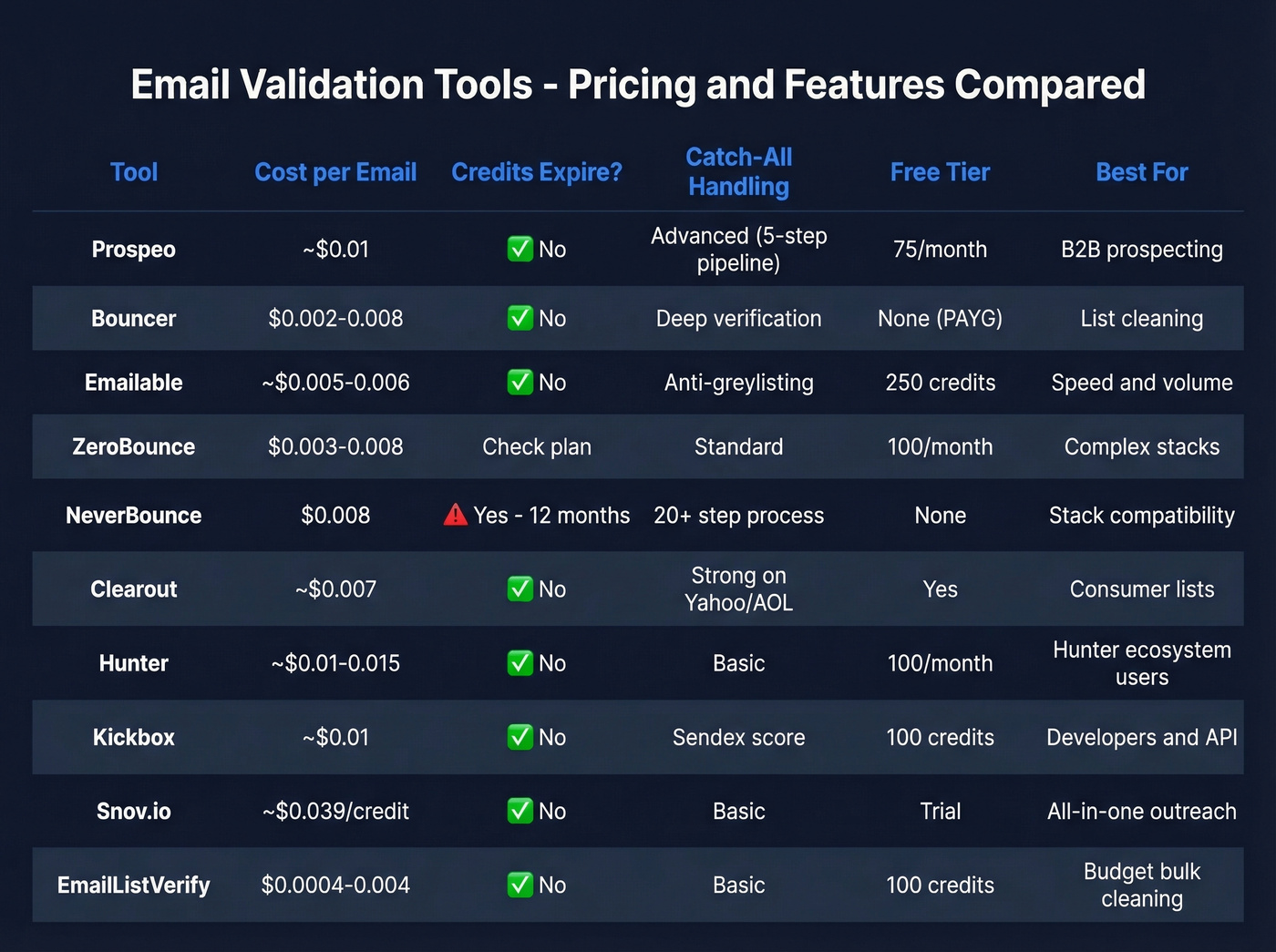
| Tool | Accuracy | Price/10K | Free Tier | Speed |
|---|---|---|---|---|
| Bouncer | 99%+ | ~$60 | 100 | 180K/hr |
| Emailable | 99%+ | ~$50 | 250 | 2M/hr |
| ZeroBounce | 99% | ~$64 | 100/mo | 133K/hr |
| NeverBounce | 97% | ~$80 | 10 | 100K/hr |
| Clearout | 99% | ~$58 | 100 | 160K/hr |
| Hunter | Not public | ~$149* | 100/mo | Not public |
| Kickbox | Not public | ~$50 | 100 | Not public |
| Snov.io | Not public | ~$39/mo* | Trial | Not public |
| EmailListVerify | 97% | ~$24 | 100 | Not public |
| Verifalia | Not public | ~$49/mo* | Yes | Not public |
*Hunter, Snov.io, and Verifalia use subscription pricing rather than pure per-email PAYG. All accuracy figures are vendor-reported.

Most teams chain together a finder and a separate validation tool - and still end up with 20%+ bounce rates. Prospeo's 5-step verification pipeline handles catch-all domains, spam traps, and honeypots in a single workflow. 98% email accuracy. 7-day data refresh. Under $0.01/email.
Find and verify B2B emails in one step - no second tool needed.
Features & Credit Policies
| Tool | Integrations | Credits Expire? | Charges for Unknowns? | Standout Feature |
|---|---|---|---|---|
| Prospeo | 10+ native | No | No | Find + Verify |
| Bouncer | 16 | Never | No | Fair pricing model |
| Emailable | 22 | No | Yes | 99% guarantee |
| ZeroBounce | 45+ | No | Yes | Deliverability suite |
| NeverBounce | 80+ | 12 months | Yes | 75x multi-server |
| Clearout | 38 | No | No | Yahoo/AOL accuracy |
| Hunter | 15+ | No | No | Find + verify + send |
| Kickbox | 10+ | No | No | Sendex score + API |
| Snov.io | 15+ | No | N/A | All-in-one outreach |
| EmailListVerify | 11 | No | No | Lowest cost/email |
| Verifalia | API | No | No | Stealth mode |
Hidden Costs to Watch For
The sticker price per email is misleading. Let's break down why.
When you verify 10,000 emails, a chunk will come back as "unknown" - the tool couldn't determine validity. In many lists, 5-15% of results fall into this bucket. If the tool charges you a credit for unknowns, your effective cost-per-usable-email jumps significantly. A tool charging $0.008/email that returns 12% unknowns actually costs you ~$0.0091/usable result. That adds up fast when you're cleaning lists of 50K or more every month, and it's the kind of math that separates teams who control their outbound costs from those who wonder where the budget went.
Then there's credit expiration. NeverBounce credits expire after 12 months. Buy 100K credits in January, use 60K by December, and you lose the remaining 40K. Bouncer credits never expire - a meaningful difference if you verify in bursts rather than on a fixed schedule.
The fact that most tools bury these policies in their terms rather than their pricing pages is genuinely frustrating. Always calculate your effective cost-per-usable-email, not just the headline rate.
Cold Email vs. Marketing Needs
Cold emailers and marketing teams need verification for fundamentally different reasons, and the tolerance for risk is night and day.
For cold email, you need the strictest possible verification. A single campaign with a 5%+ bounce rate can damage your sender reputation fast - you need to remove all catch-all addresses (not just flag them), risk-score everything, and verify immediately before sending. Not last week. Not last month. We've seen teams torch a domain in a single afternoon because they trusted a list that was "verified" 60 days prior.
Marketing teams cleaning opt-in lists have more breathing room. These contacts opted in, so deliverability baselines are better. Mailchimp's benchmark puts average hard bounce at 0.21%, with software/web apps running higher at 1.04%. Ecommerce lists average just 0.29% bounce - well within safe territory for quarterly cleaning. You can tolerate "risky" addresses in a marketing list and re-verify quarterly rather than before every send.
The practical takeaway: if you're doing cold outbound, spend more per verification and use the strictest settings. For maintaining a marketing list, a cheaper bulk cleaner with quarterly cadence works fine.
How Often Should You Verify?
Here's the cadence that keeps bounce rates under control.
At point of entry, use real-time form validation - Clearout's Form Guard, Verifalia's widget, or API-based checks - to catch bad addresses before they hit your database. Any real-time check at the moment of capture saves you credits downstream.
Before every cold email campaign, if the list hasn't been touched in 30+ days, re-verify. Period.
Full list clean quarterly. That 25% annual decay means a list verified in January is roughly 6.25% stale by April. For teams running high-volume outbound across multiple segments, we've found that monthly verification of your most active lists and quarterly passes on everything else hits the sweet spot between cost and deliverability.
After any major event - layoffs, acquisitions, or industry shifts accelerate decay in specific segments. If a company you're targeting just went through a round of layoffs, assume half those contacts are dead.
Segment your results into Valid, Risky, and Invalid buckets. Remove invalids immediately. Quarantine risky addresses and re-verify them on a shorter cycle.
Look, most teams verify once and forget about it. That's how you end up with a 15% bounce rate six months later wondering what happened. Build verification into your workflow as a recurring process, not a one-time cleanup.
Snyk cut their bounce rate from 35-40% to under 5%. Stack Optimize holds under 3% across every client. The difference isn't luck - it's a 7-day refresh cycle vs. the 6-week industry average. Stale data is the #1 reason validation tools fail you downstream.
Get emails that are actually valid next week, not just today.
FAQ
What's the difference between email validation and verification?
They're used interchangeably across the industry. Technically, "validation" checks format and syntax while "verification" confirms the mailbox exists via SMTP - but every tool on this list does both. Don't overthink the terminology when evaluating options.
Are free email verification tools accurate enough?
Free tiers of 75-250 emails are excellent for testing accuracy against your specific list, but not for production use. Paid tools consistently outperform free-only options on catch-all handling and risk scoring. Test 2-3 tools on the same 500-email sample and compare bounce rates - that's the only reliable way to evaluate.
How many emails can I verify for free each month?
Emailable gives 250 free credits, Bouncer offers 100, ZeroBounce provides 100/month (business domain required), Prospeo includes 75/month, and Hunter offers 100/month. EmailListVerify and Verifalia also have free tiers. Most are generous enough to test whether a tool meets your accuracy needs before committing.
Do I need separate tools to find and verify emails?
Not necessarily. Prospeo finds and verifies B2B emails in one step - 300M+ profiles, 98% accuracy, 7-day data refresh - eliminating the two-tool workflow most teams run. Standalone verifiers like Bouncer or Emailable are better if you already have a list that just needs cleaning, since they're purpose-built for that job.
How often should I re-verify my email list?
Re-verify at minimum once per quarter. Email databases decay 25% annually, so a list verified six months ago has roughly 12.5% bad addresses. For cold outbound, re-verify before every campaign if the list is older than 30 days. For marketing lists, quarterly cleaning keeps bounce rates safely under 2%.