

Email Verification Generator: Throwaway Inboxes vs. Real Verification
"Email verification generator" means two completely different things depending on who's typing it. Half the people searching want a throwaway inbox - a disposable address to sign up for something without getting spammed forever. The other half need to verify that a list of real email addresses won't bounce when they hit send.
Most articles only cover one interpretation. This one covers both.
What You Need (Quick Version)
Two paths, two different tools:
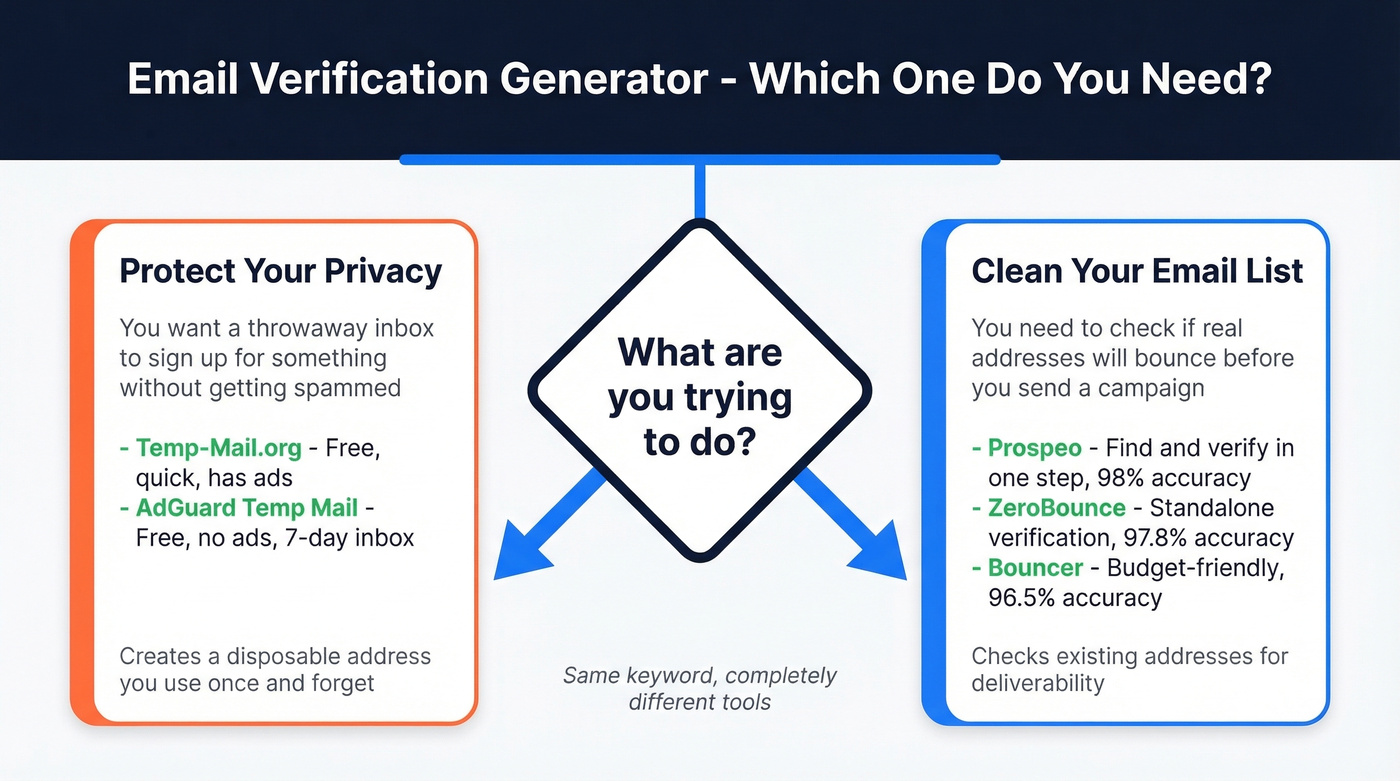
- Need a throwaway inbox? Temp-Mail.org is free and quick. AdGuard Temp Mail does the same thing without ads.
Pick your path and skip the section that doesn't apply.
Best Temp Email Generators
These tools create a disposable inbox that lasts minutes to days (and sometimes longer with regular use). You use it, grab your confirmation code, and walk away.
| Tool | Cost | Inbox Duration | Ads? |
|---|---|---|---|
| Temp-Mail.org | Free | Time-limited (varies) | Yes |
| AdGuard Temp Mail | Free | 7 days inactivity (up to 6 months with regular use) | No |
Common complaints about free temp mail: slow loading, lots of ads, and inboxes that stop working randomly. For something more permanent, SimpleLogin ($30/yr) and IronVest ($39/yr) create persistent email aliases that forward to your real inbox. PCMag gave IronVest its Editors' Choice for this category.
One caveat worth knowing: major platforms increasingly block disposable domains. LALAL.AI, for example, explicitly rejects them with a "please enter your permanent email" warning. A 272-test benchmark across 17 detection services found an average detection rate of just 59% - meaning temp emails still slip through most filters, but the gap is closing. Gmail-based services like Emailnator remain nearly undetectable because they ride on Gmail's own domains.

Most verification tools only check emails you already have. Prospeo finds and verifies B2B emails in one step - 143M+ verified addresses, 5-step verification with catch-all handling, spam-trap removal, and honeypot filtering. All at $0.01 per email.
Skip the two-tool workflow. Find and verify in one click.
How Email Verification Works
Email verification runs three layers of checks. Syntax validation comes first, confirming the address follows RFC 5322 formatting rules - no missing @ signs, no illegal characters. Then an MX record lookup checks whether the domain's DNS is configured to receive mail. Finally, an SMTP handshake pings the recipient's mail server to ask if it'll accept delivery without actually sending anything.
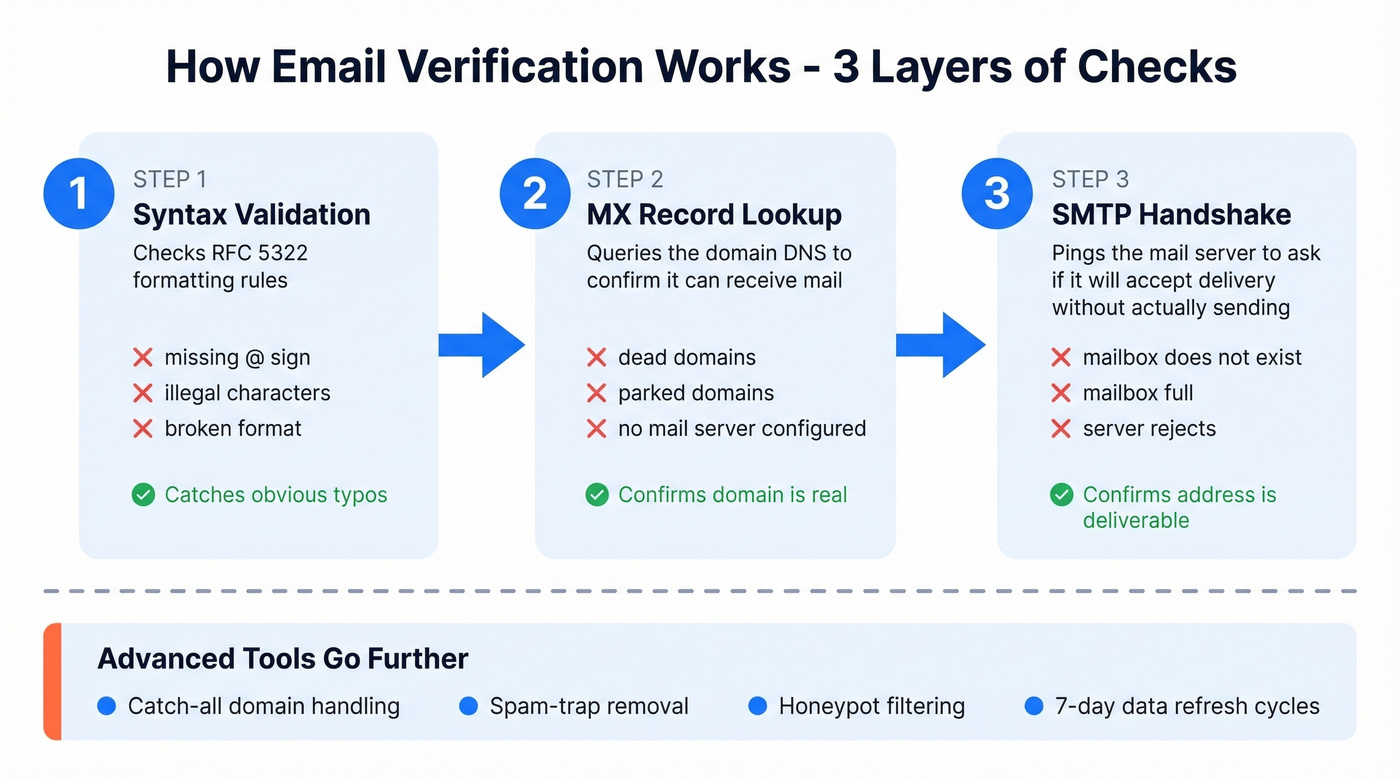
That three-step process catches the obvious invalids. Better tools go further with catch-all domain handling - identifying whether a server accepts everything, which makes individual addresses unverifiable through standard checks - plus spam-trap removal and honeypot filtering. We've run lists through multiple verifiers, and the accuracy gap between a $6/10K budget tool and a 98%-accuracy platform is real. It comes down to how they handle the ambiguous cases.

Best Tools to Find and Verify Addresses
| Tool | Accuracy | Free Tier | Cost/10K | Catch-All Resolution |
|---|---|---|---|---|
| Prospeo | 98% | 75 emails/mo | ~$100 | Yes (5-step) |
| ZeroBounce | 97.8% | 100 emails | $64 | 12% |
| Bouncer | 96.5% | 100 emails | $45-55 | 15% |
| NeverBounce | 96.9% | 10 emails | $50 | 8% |
| MillionVerifier | 95.8% | None | $6 | 5% |
| EmailListVerify | 97% | 100 emails | $24 | Not public |
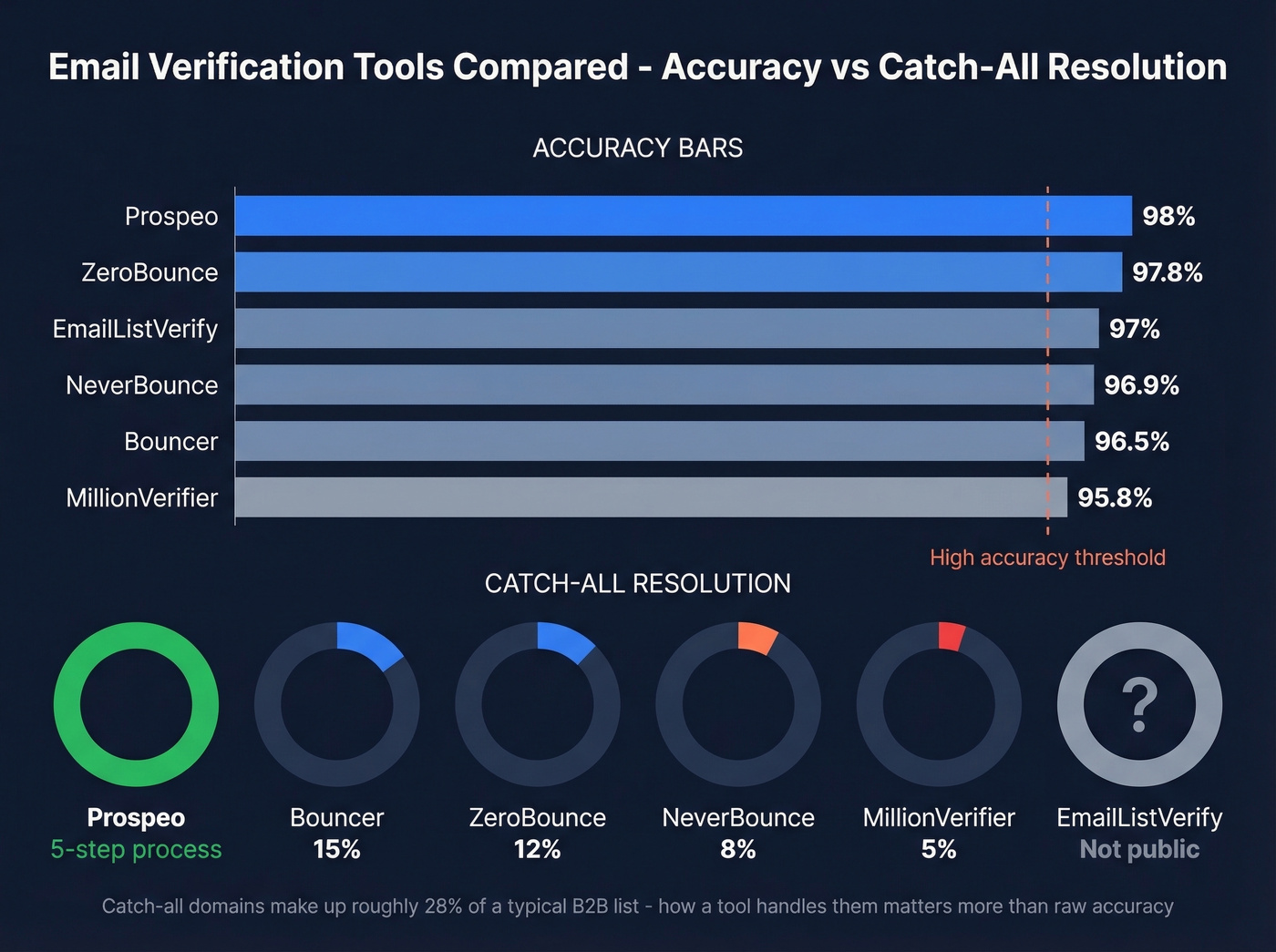
Here's the thing: if your average deal size sits below five figures, you probably don't need the most expensive verifier on this list. But you absolutely need some verification. Sending to a dirty list tanks your email deliverability, and recovering from that costs more than any tool on this page.
Prospeo
Use this if you're building prospect lists from scratch and need emails found and verified in one workflow. Most verification tools only check addresses you already have. That's a critical distinction.
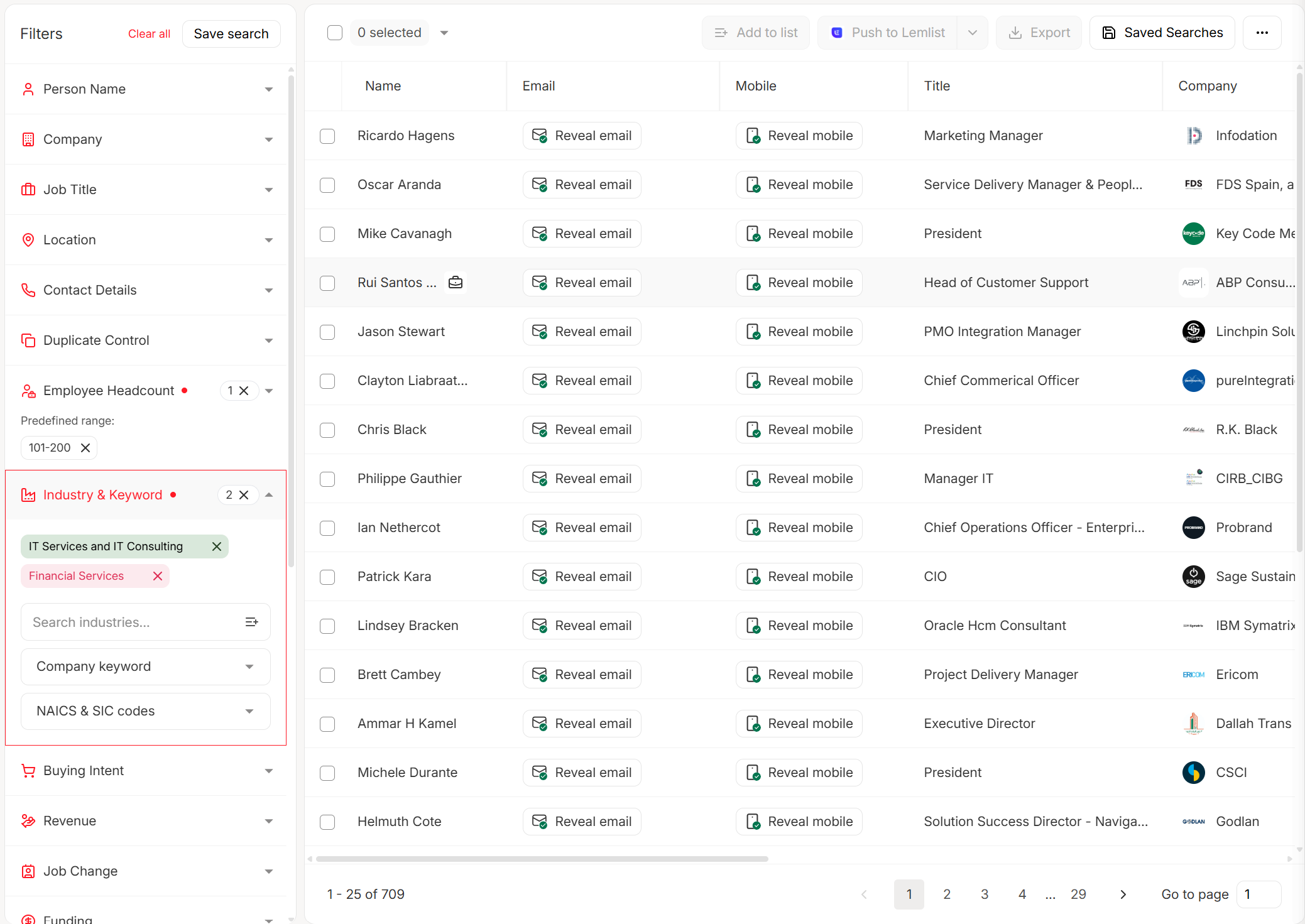
Prospeo's Email Finder matches against 143M+ verified emails across 300M+ professional profiles and runs every result through a 5-step verification process - catch-all handling, spam-trap removal, honeypot filtering - before you ever see it. At roughly $0.01/email, it's a fraction of what you'd pay combining a separate finder with a separate verifier. The free tier gives you 75 emails/month to test with no contracts and no sales calls required.
For outbound teams, the real value is that finding and verifying happen in one step. You're not exporting from one tool, uploading to another, and reconciling the results. The 7-day data refresh cycle means you're not emailing someone who changed jobs six weeks ago, which is a problem we ran into constantly with tools that refresh monthly or less. One of our users, Stack Optimize, built from $0 to $1M ARR while maintaining 94%+ deliverability and under 3% bounce rates across all their clients - that's the kind of downstream impact clean data has.
Skip this if you already have a clean list and just need bulk verification at the lowest possible cost per email.
Dirty lists destroy domain reputation. Prospeo's 7-day data refresh cycle means you're never emailing stale contacts - unlike tools that refresh every 6 weeks. Stack Optimize hit $1M ARR with under 3% bounce rates using Prospeo data.
98% email accuracy. No contracts. No sales calls required.
ZeroBounce
ZeroBounce is the safe enterprise pick for standalone verification. 97.8% accuracy in benchmark testing, SOC 2 Type II and ISO 27001 compliance, and 45 integrations that plug into almost any stack. At $64 per 10K, it's mid-range on price. The 100 free verifications let you test before committing.
The weakness is catch-all handling - only 12% resolution in benchmark testing. That matters because catch-all domains make up roughly 28% of a typical B2B list. If you're sending to a lot of corporate domains that accept everything, ZeroBounce will mark them "unknown" and leave you guessing. For pure verification on standard domains, though, it's hard to beat.
Bouncer
Bouncer hits a sweet spot between price and quality at $45-55 per 10K depending on plan and volume. Capterra reviewers gave it a 4.9 across 233 reviews - unusually high for a verification tool. SOC2 and GDPR compliant, with 180K emails/hour throughput for bulk jobs.
Catch-all handling is where most cheap tools fall apart, and Bouncer's 15% resolution rate won't blow you away either. But for teams processing under 50K emails/month who want good-enough accuracy at a fair price, it delivers. The 96.5% accuracy sits below ZeroBounce and NeverBounce in benchmarks, but the price difference makes it worthwhile for smaller lists.
Budget and Other Options
NeverBounce ($50/10K, 96.9% accuracy) is a reliable mid-tier option that processes about 18 minutes per 10K batch, though its 8% catch-all resolution is weak and credits expire after one year. MillionVerifier is the budget king at just $6 per 10K - but you get what you pay for with only 5% catch-all resolution and 95.8% accuracy.
Let's be honest about the budget approach: we've seen teams use MillionVerifier as a first pass and then run the "unknown" results through a better tool. That's a smart way to cut costs without tanking deliverability. EmailListVerify splits the difference at $24/10K with 97% accuracy and 100 free verifications to start.
Which Type Do You Need?
Searching for an email verification generator gives you a wall of temp mail services even when you need the opposite. Three questions settle it:
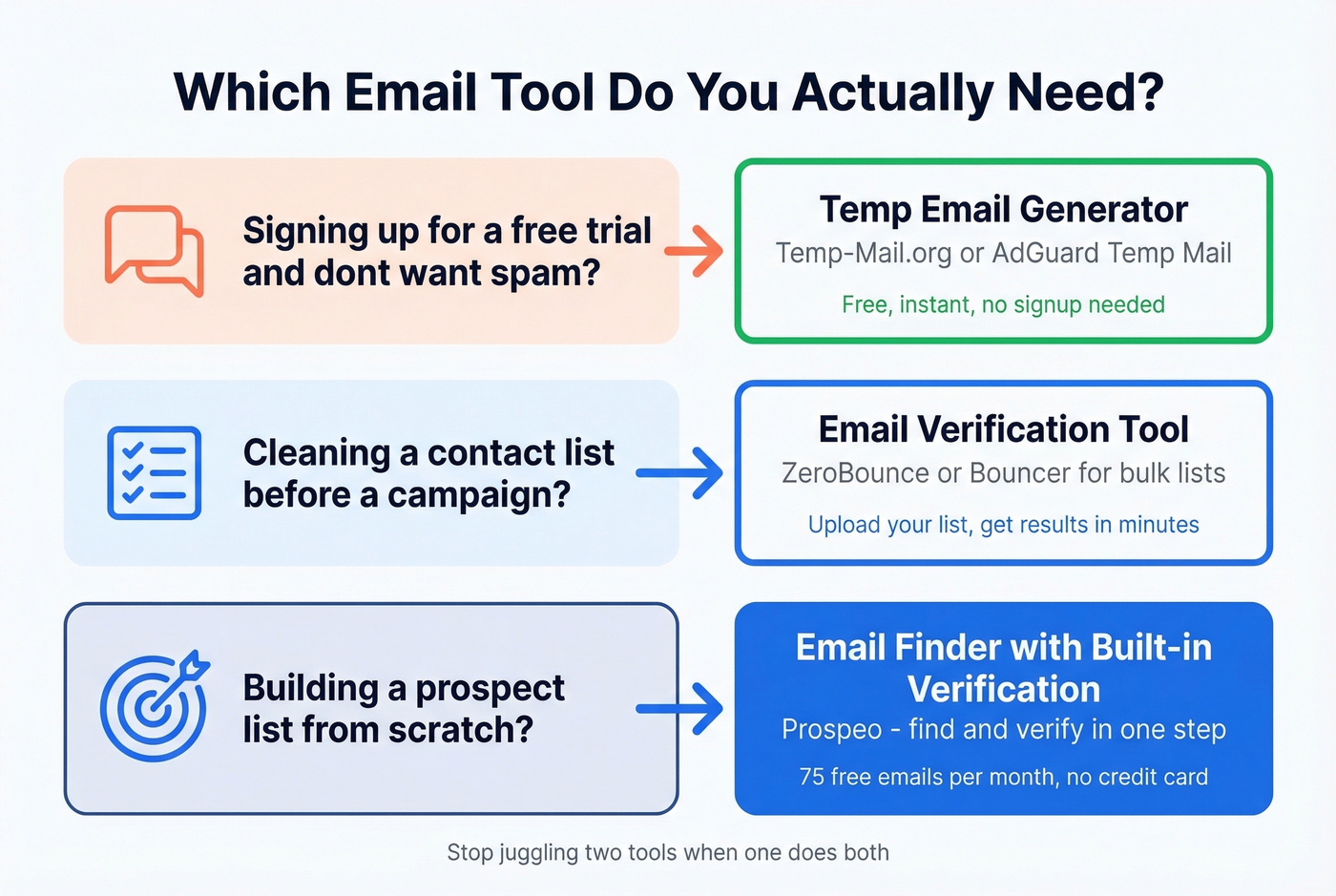
Signing up for a free trial and don't want spam? Temp email generator. Temp-Mail.org or AdGuard.
Cleaning a contact list before a campaign? Email verification tool. ZeroBounce or Bouncer for bulk.
Building a prospect list from scratch? Email finder with built-in verification. Find the address and verify it in one step instead of juggling two tools.
FAQ
Is using a disposable email legal?
Yes. Disposable emails are legal for privacy protection and spam avoidance in virtually every jurisdiction. The line is intent - using them for fraud, identity theft, or circumventing a service's terms of service crosses into illegal territory. The tool itself is neutral.
What's the difference between a temp email and a verification tool?
A temp email generator creates a throwaway inbox so you can receive messages without exposing your real address. An email verification tool checks whether an existing address is real and deliverable. Completely different tools solving completely different problems - they just share an awkward keyword.
Can verification tools detect disposable emails?
Poorly, on average. A 272-test benchmark across 17 detection services found an average detection rate of just 59%. Only 1 of 17 services caught all 16 disposable providers tested. Gmail-based temp services like Emailnator are nearly undetectable.
What's the most accurate email verification tool in 2026?
Prospeo delivers 98% accuracy with a 5-step process including catch-all handling, spam-trap removal, and honeypot filtering - and it finds emails, not just verifies them. ZeroBounce (97.8%) and NeverBounce (96.9%) also perform well for standalone verification. Catch-all resolution is the biggest differentiator between tools.
Is there a free tool that finds and verifies emails?
Prospeo offers 75 free verified emails per month with no credit card or contract required. ZeroBounce and Bouncer each give 100 free verifications for addresses you already have. For throwaway inboxes, Temp-Mail.org and AdGuard Temp Mail are completely free with no signup.