

EmailBison vs Apollo.io: Different Tools, Different Jobs
Comparing EmailBison to Apollo.io is like comparing a commercial kitchen to a meal kit service. One gives you industrial-grade infrastructure to cook at scale - but no ingredients. The other hands you ingredients, a recipe, and a microwave.
30-Second Verdict
Pick Apollo.io if you want one platform for finding contacts and sending sequences. You're a small team doing under 50K emails/month and you value convenience over infrastructure control.
Pick EmailBison if you're an agency sending 150K+ emails/month and need dedicated, isolated sending infrastructure. You already have a data source.
What Each Tool Actually Does
Apollo.io is a sales intelligence platform first, sequencer second. Its 250M+ contact database is the main draw - you search for prospects, build lists, and send sequences from one interface. It rates 4.7/5 across 9,512 G2 reviews and integrates with popular CRMs and outbound tools. The trade-off: shared sending infrastructure, no built-in warmup, and data accuracy that's become a recurring complaint in the cold email community.
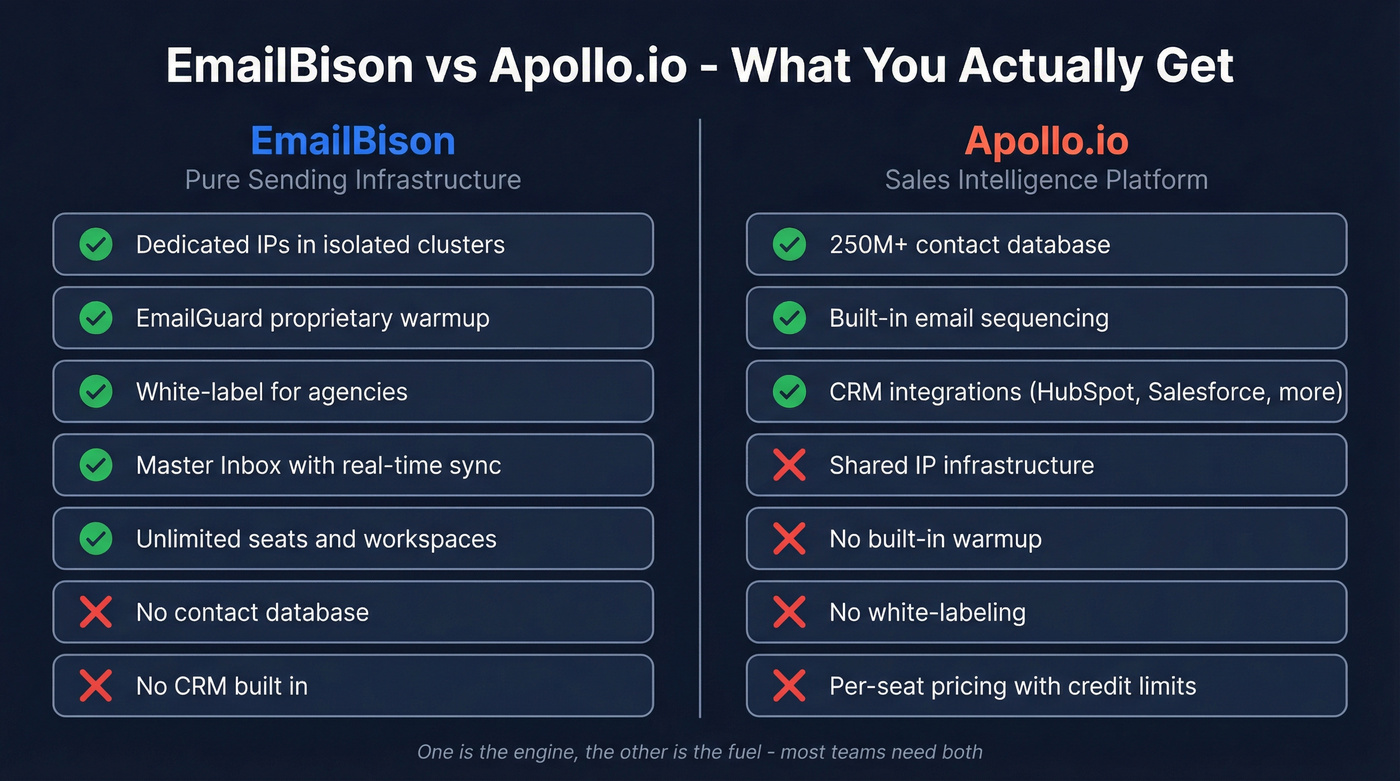
EmailBison is pure sending infrastructure. No database, no contact search, no CRM. You get dedicated IPs in isolated single-tenant clusters, a proprietary warmup system called EmailGuard, white-labeling, and a Master Inbox that syncs in real time. It's built for agencies pushing serious volume through their own data sources. Independent reviews are scarce - EmailBison has limited presence on major review platforms, and Reddit threads mostly ask whether the deliverability claims actually hold up.
| Feature | EmailBison | Apollo.io | Edge |
|---|---|---|---|
| Contact database | ✗ | ✓ (250M+) | Apollo |
| Email sequencing | ✓ | ✓ | Tie |
| Built-in warmup | ✓ (EmailGuard) | ✗ | EmailBison |
| Infrastructure | Dedicated IPs | Shared | EmailBison |
| White-labeling | ✓ | ✗ | EmailBison |
| CRM integrations | HubSpot, Salesforce | HubSpot, Salesforce + others | Apollo |
Pricing Breakdown
Apollo offers a free tier with limited credits and features. Here's how the paid plans stack up:
| Apollo Basic | Apollo Pro | Apollo Org | EmailBison | |
|---|---|---|---|---|
| Annual billing | $49/user/mo | $79/user/mo | $119/user/mo (3-user min) | $599 flat |
| Monthly billing | $59/user/mo | $99/user/mo | $149/user/mo | $599 |
| Per-seat fees | Yes | Yes | Yes | None |
| Volume cap | Credit-based | Credit-based | Credit-based | 500K/mo |
Credits expire each billing cycle with no rollover. Overages cost $0.20 each with a 250-credit minimum. Honestly, Apollo's credit system is needlessly complex for what should be straightforward sales prospecting.
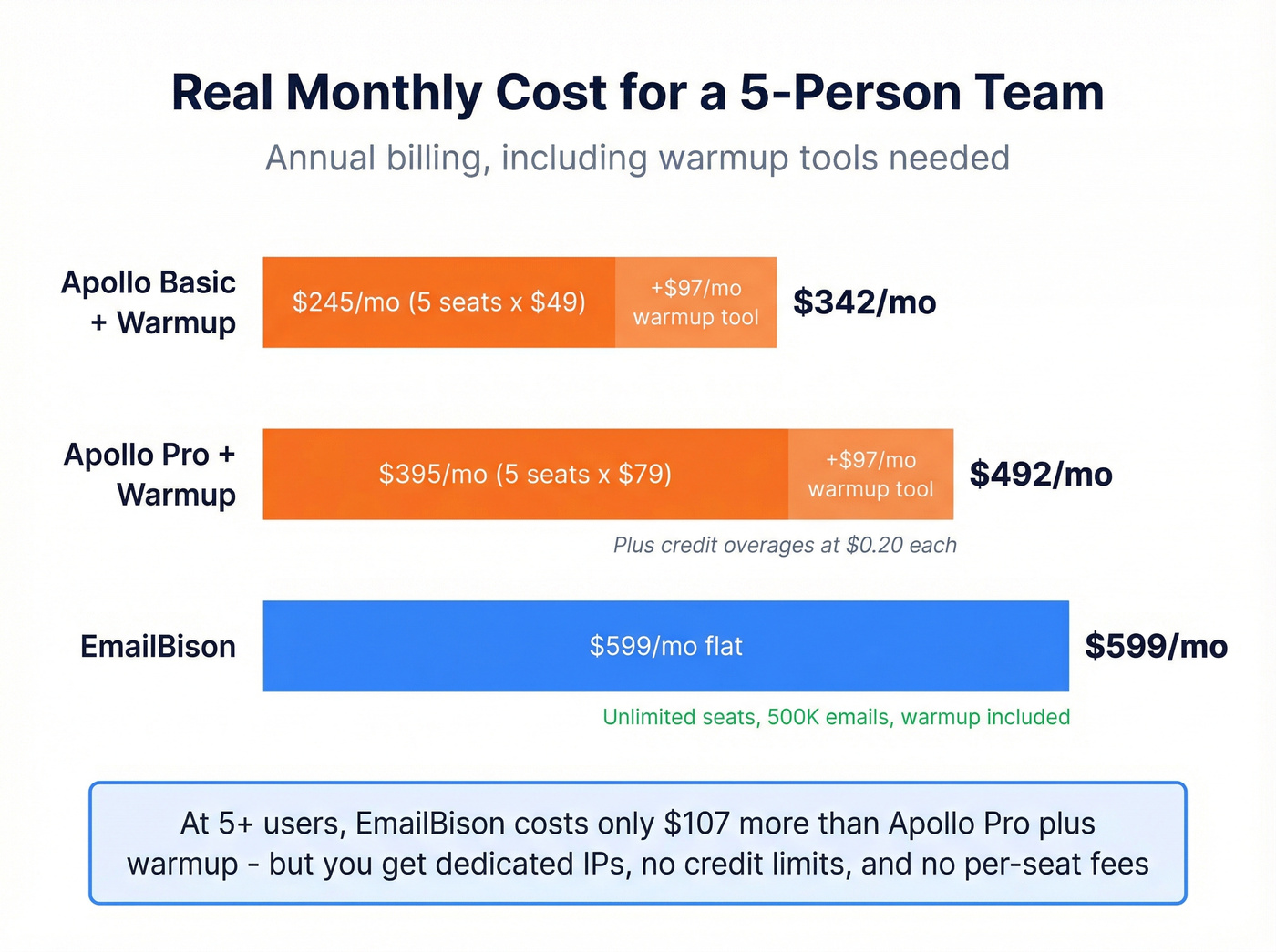
Let's do the math on a real scenario. A 5-person team on Apollo Pro (annual) pays $395/month - before adding a warmup tool like Instantly ($97/mo for 5 accounts) and before credit overages. That stack runs $500-550/month easily, and you're still on shared infrastructure.
EmailBison's $599/month is flat: unlimited seats, unlimited workspaces, 500K emails included.
One thing that frustrated us during research: EmailBison has no free trial. You need a qualification call just to get started, which feels like unnecessary friction for a tool that should sell itself on infrastructure quality alone.

EmailBison gives you the engine. Apollo gives you the fuel. But 15-25% bounce rates mean that fuel is contaminated. Prospeo's 98% email accuracy and 7-day data refresh give you verified contacts that won't torch your dedicated IPs or your sender reputation.
Stop importing Apollo's bounce problem into better infrastructure.
Deliverability and Infrastructure
85-90% of cold emailers use shared IP infrastructure, which works fine until a "noisy neighbor" on the same IP pool tanks your sender reputation. That's the core risk with Apollo's shared setup.
EmailBison's pitch is isolation: dedicated IPs, single-tenant clusters, no shared reputation risk. Their EmailGuard warmup is designed to maintain inbox placement rates above 85%. Dedicated IP setups typically run $350-$650/month, so EmailBison's $599 sits right in that range - you're paying market rate for the infrastructure, not a premium.
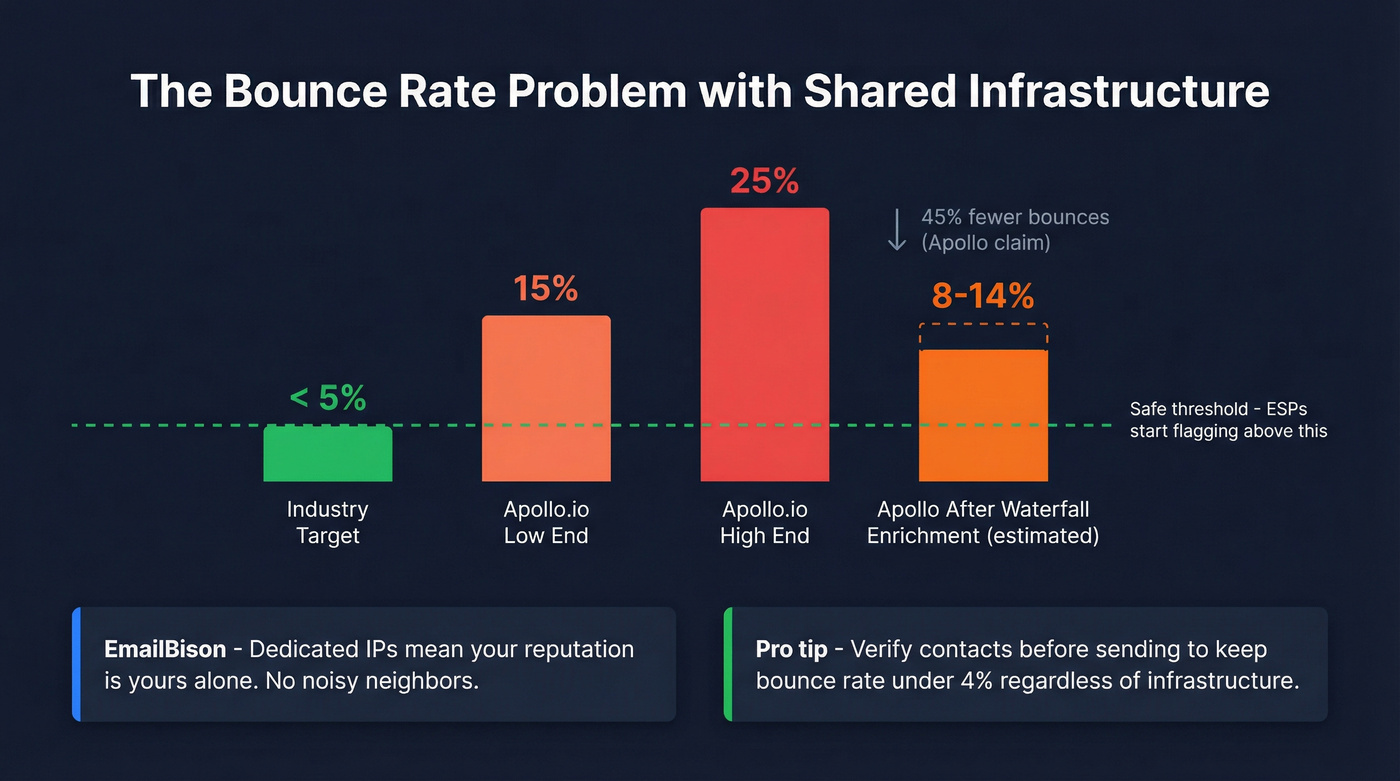
Apollo users report 15-25% bounce rates, with one Reddit user claiming 35% bounces on Apollo-sourced contacts. The industry target is under 5%. Apollo's Waterfall Enrichment update claims 45% fewer bounces - but 45% fewer from a 15-25% baseline still leaves you at 8-14%. That's still well above the threshold where ESPs start flagging your domain.
Use EmailBison if you're above 150K emails/month and deliverability directly impacts revenue. Skip it if you're under 50K/month - at that volume, Instantly (~$30/mo) or Smartlead (~$39/mo) cost a fraction of $599/month with warmup included.
Data Quality: The Real Bottleneck
Here's the thing neither tool wants to talk about: data is where campaigns actually break.
Apollo has a massive database, but across those 9,512 G2 reviews, "Inaccurate Data" is a persistent negative theme. Real-world accuracy hovers around 65-70%, with job titles going stale 6-12 months after changes. Chrome extension instability and poor support are also recurring complaints.
The consensus on r/coldemail is that Apollo lists are overused - everyone's hitting the same prospects, and saturation is dragging reply rates down across the board.
EmailBison has zero data. By design. But if your data source is Apollo, you're importing the same accuracy problems into better infrastructure. A Ferrari engine doesn't help if the fuel is contaminated.
Our take: EmailBison is the better product for agencies, but Apollo is the better business for most teams - because most teams don't have a separate data source, and infrastructure without data is an engine without fuel.
Solving the Data Gap
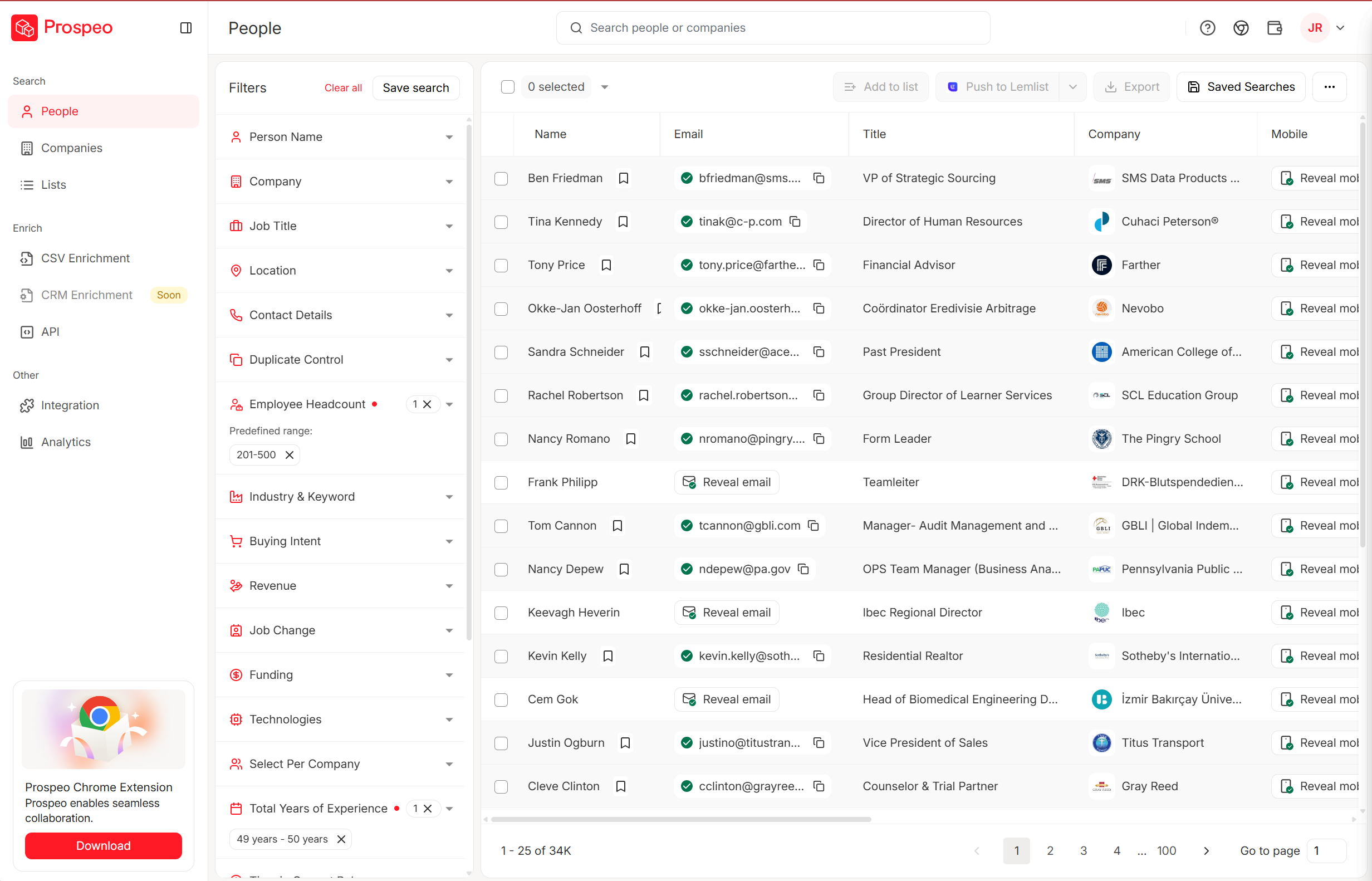
The article's verdict is clear: neither tool solves the data quality gap alone. Prospeo's 300M+ profiles with 5-step verification and catch-all handling keep your bounce rate under 4% - whether you send through EmailBison, Instantly, or Smartlead. No contracts, no qualification calls.
Clean data in, clean campaigns out. Start free today.
Who Should Pick Which
Agency sending 150K+/month with an existing data source: EmailBison. The dedicated infrastructure justifies $599/month at that volume.
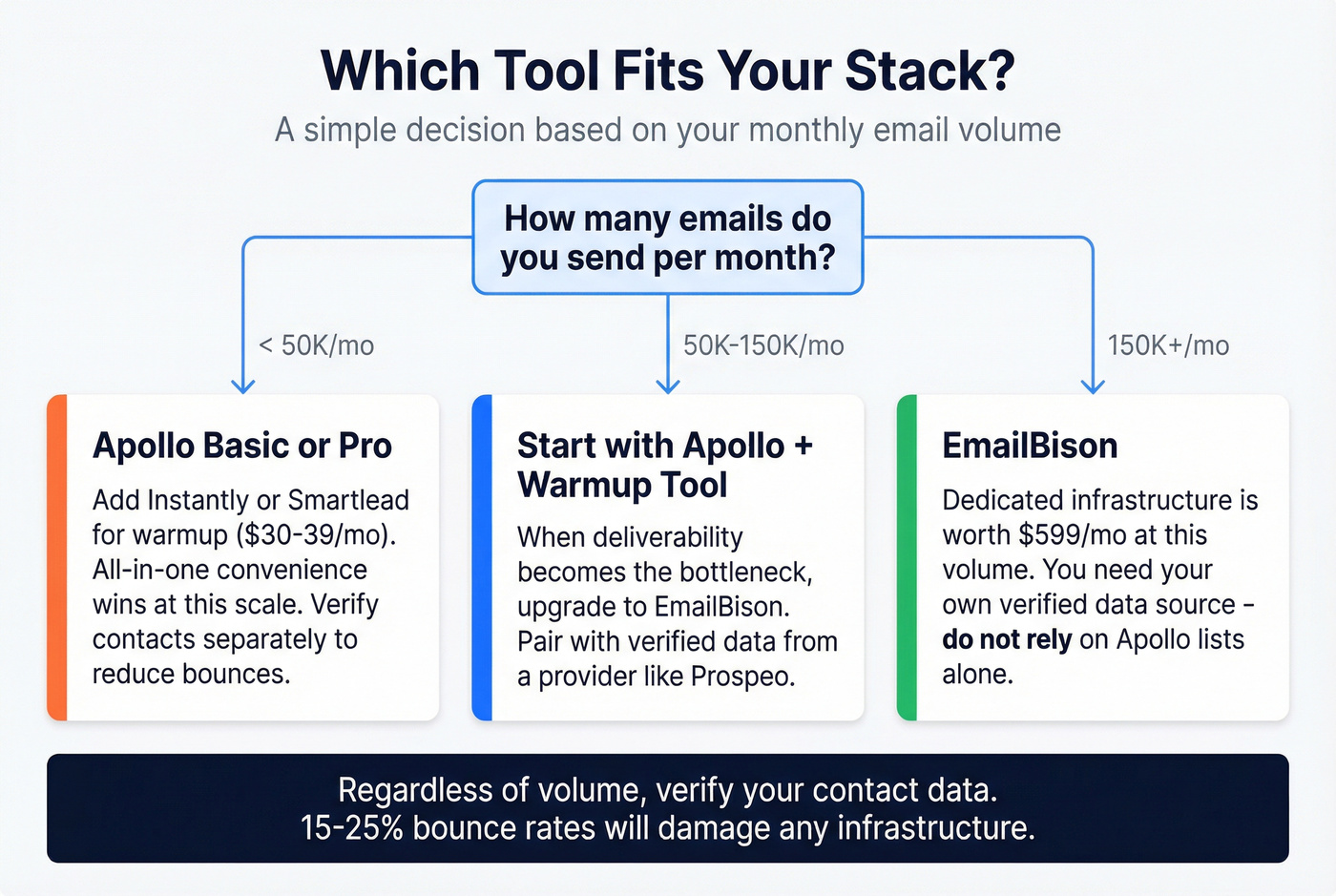
Small sales team under 50K/month wanting all-in-one: Apollo Basic or Pro, plus a separate warmup tool. The convenience of database-plus-sequencer in one platform is hard to beat at this scale, even with the data quality caveats.
Mid-market team at 50-150K/month: Start with Apollo plus Instantly for warmup. When deliverability becomes the bottleneck - and it will - upgrade to EmailBison with verified data from a provider like Prospeo. That's the stack that scales without the bounce-rate tax.
FAQ
Can you use EmailBison and Apollo.io together?
Yes, and many agencies do. Use Apollo to find contacts, verify them through a tool like Prospeo to eliminate bounce risk, then send via EmailBison's dedicated infrastructure. You get Apollo's database depth with EmailBison's deliverability and accurate data in between.
Is EmailBison worth it under 50K emails/month?
No. At that volume, shared infrastructure handles the load fine. Instantly (~$30/mo) or Smartlead (~$39/mo) include warmup at a fraction of $599/month. EmailBison's value kicks in above 150K/month where shared IP reputation risk becomes a real revenue problem.
Why does Apollo.io have high bounce rates?
Apollo's database refreshes more slowly than job changes happen. Email deactivations and role changes create stale records faster than updates occur. Their Waterfall Enrichment helps - Apollo cites 45% fewer bounces - but teams still report 15-25% bounce rates, well above the sub-5% industry target.