

Cold Email in 2026: The Practitioner's Playbook
A RevOps lead we know ran the same cold email playbook from 2023 into late 2025. Reply rates dropped from 8% to 3% in eighteen months. Nothing changed on his end - Gmail tightened, Microsoft started rejecting, and the old infrastructure math stopped working. That 3% wasn't a blip. It was the new floor for anyone who hadn't rebuilt.
Here's what the rebuild looks like.
The State of Outbound by the Numbers
The Instantly 2026 benchmark report analyzed billions of cold email interactions across thousands of active workspaces. The headline: 3.43% average reply rate. Top quartile senders hit 5.5%+, and the elite top 10% exceed 10.7%.
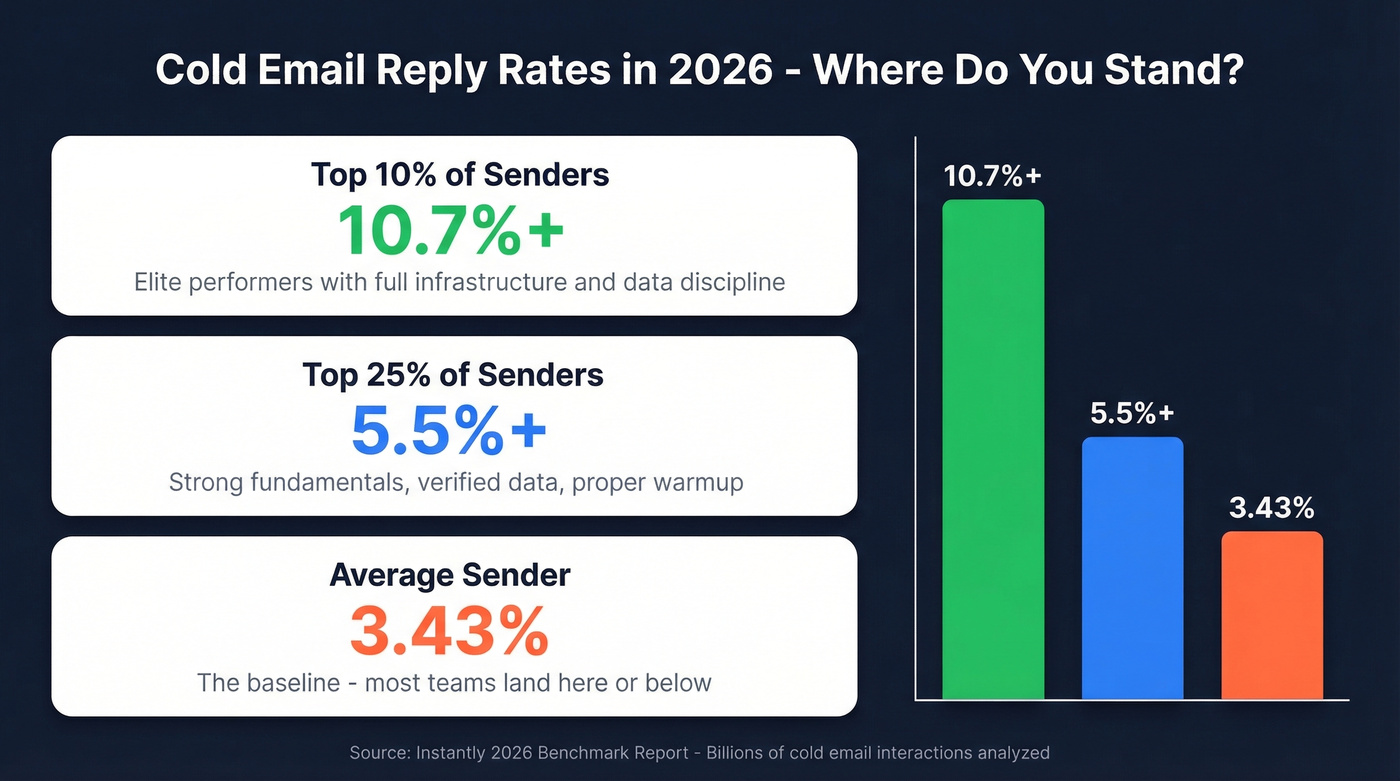
The gap between those numbers isn't better copy. It's infrastructure, data quality, and sequence discipline - in that order.
Here's the baseline funnel math: 400 sends/day at a 3.43% reply rate gives you roughly 14 replies per day. What you do with those replies depends on your conversion process, but the upstream inputs are what separate teams booking 15 meetings a month from teams booking 3. For budgeting, track Cost Per Meeting: monthly outbound spend divided by meetings booked. A common benchmark is $797/month for 15 meetings, or about $53 each.
What You Actually Need
Outbound in 2026 runs on three layers:
- Verified contacts at roughly $0.01/email through a tool like Prospeo
- A sending platform like Instantly or Smartlead for inbox rotation and warmup
- Domain infrastructure with 7+ secondary domains, all authenticated and warmed for 14-21 days
A typical functional setup - domains, mailboxes, sending software, and verification - lands around $400-600/month for small teams. The exact number depends on how many inboxes and domains you run.
Infrastructure That Avoids Spam Filters
Google and Yahoo enforced bulk sender requirements in February 2024 for anyone sending 5,000+ emails per day. Microsoft started rejecting non-compliant messages in May 2025. Gmail ramped enforcement to include permanent 550 rejections in November 2025.
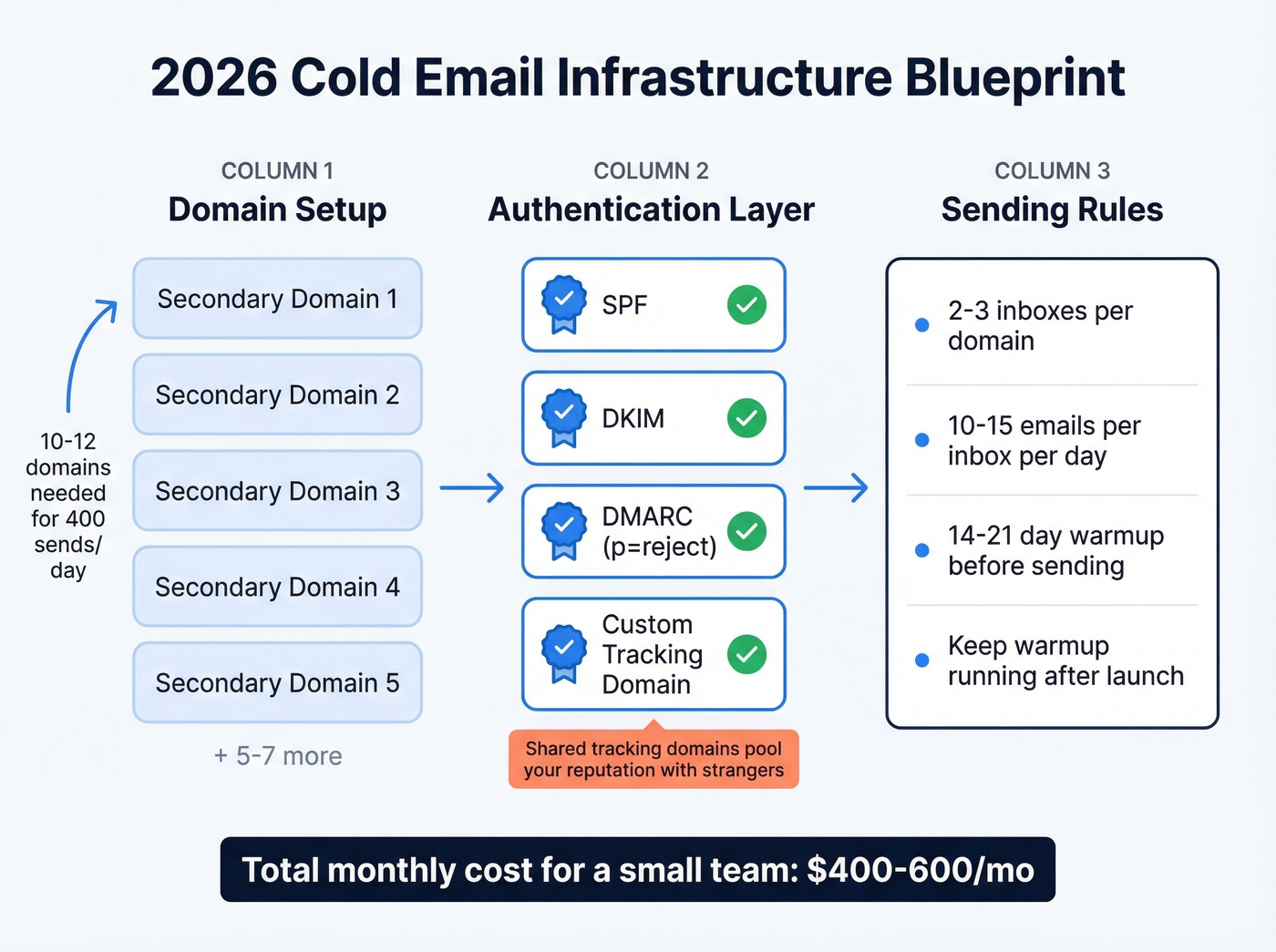
By 2026, full enforcement is the baseline across all three providers. And here's the part most guides skip: inbox filters now learn from engagement. Ignores and deletes train future filtering against you. Every cold send is an audition.
The infrastructure checklist that actually matters:
- Secondary domains only. Never send from your primary domain. Ever.
- 2-3 inboxes per domain, 10-15 emails per inbox per day. To send 400/day, you need roughly 10-12 domains.
- SPF, DKIM, and DMARC on every domain. DMARC at minimum p=none; best practice is p=reject.
- Custom tracking domains. Shared tracking domains pool your reputation with everyone else on the platform.
- 14-21 day warmup before any cold sends. Keep warmup running after launch.
The r/coldemail consensus is blunt: sending without DNS authentication in 2026 is "basically guaranteeing" spam placement. And avoid ultra-cheap $3/inbox resellers - the suspensions aren't worth the savings.
List Quality Is the Whole Game
You can nail every infrastructure detail and still crater deliverability with bad data. One practitioner on r/Entrepreneur documented exactly this - bought lists, ran 11% bounce rates, watched reply rates bleed to 3%. After rebuilding with verified contacts and scaling from 3 to 7 domains at 26 sends/day each, bounce rates dropped under 2% and reply rates climbed back to 6% in 62 days.
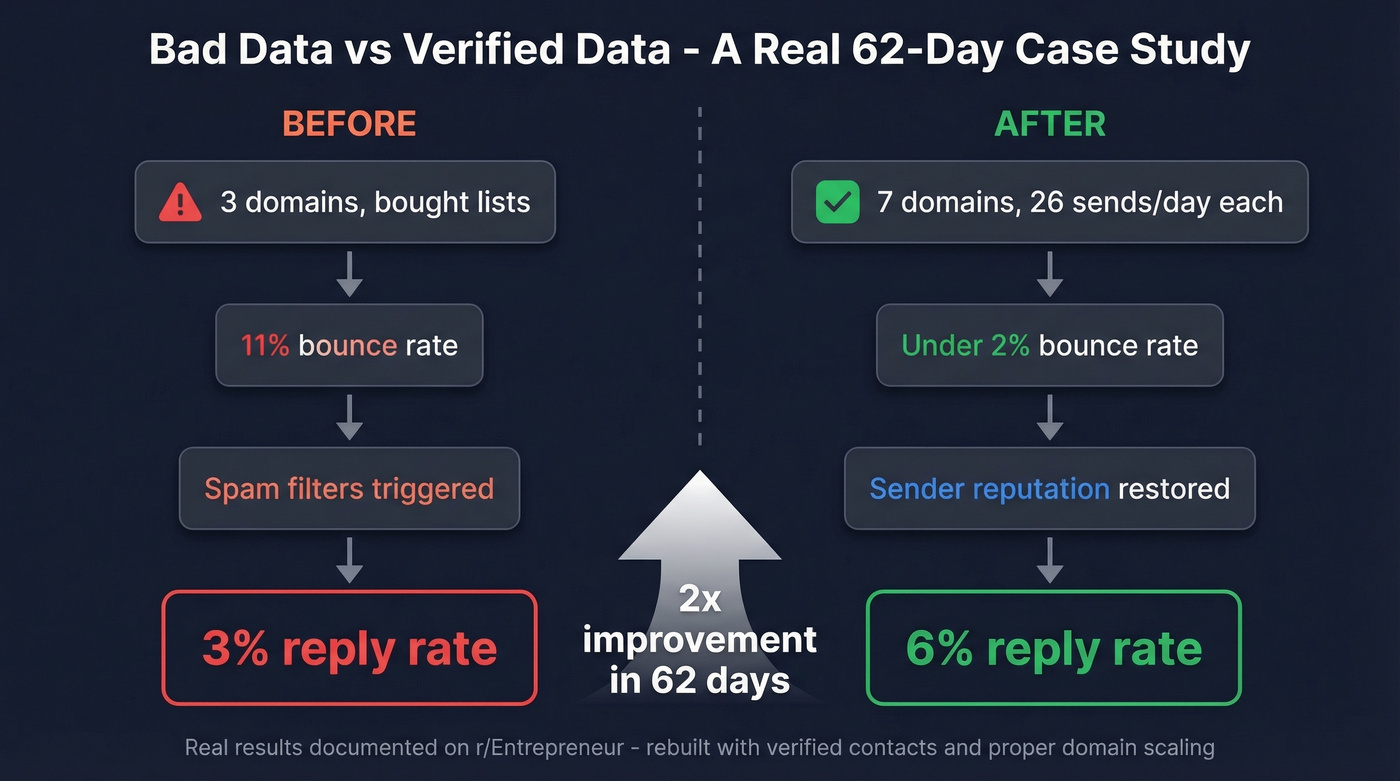
Bad data poisons everything downstream. High bounces trigger spam filters. Spam traps burn domain reputation permanently. Catch-all addresses inflate send volume without generating replies.
We've seen this pattern dozens of times: a team blames their copy, rewrites it three times, then discovers the real problem was a 9% bounce rate torching their sender reputation. Fix the data first.

The article makes it clear: bad data is the #1 reason cold email campaigns fail in 2026. Prospeo's 5-step verification and 7-day data refresh cycle keep bounce rates under 2% - while competitors running 6-week refresh cycles feed you stale contacts that torch your sender reputation. At ~$0.01/email with 98% accuracy, fixing your data layer is the highest-ROI move you'll make this quarter.
Stop rewriting copy when the real problem is a 9% bounce rate.
That r/Entrepreneur case study? Rebuilt with verified contacts across 7 domains and hit 6% reply rates in 62 days. Prospeo gives you the same foundation: 143M+ verified emails, catch-all domain handling, spam-trap removal, and proprietary verification that doesn't depend on third-party providers. Free tier included - 75 emails, no credit card, no contracts.
Build your 2026 outbound stack on data that actually connects.
What's Actually Working Right Now
Do this:
- Keep emails under 80 words. One practitioner cut from 141 words to under 56 as part of a full rebuild and saw reply rates double from 3% to 6%.
- Turn off open tracking. Snov.io's analysis of 44 million emails found disabling open tracking more than doubled reply rates: 2.36% vs 1.08%. Tracking pixels are a spam signal now.
- Personalize around company context - recent funding, hiring patterns, tech stack changes. "I noticed you're scaling your SDR team" beats "I saw your LinkedIn post about leadership."
Skip this: Referencing someone's recent social media post. In 2026, practitioners on r/SaaS flag it as a scraping tell that immediately kills trust. Same goes for heavy HTML with multiple links and long intros explaining who you are. Plain text wins. Lead with their problem.
Sequence Strategy That Earns Replies
58% of all replies come from the first email.
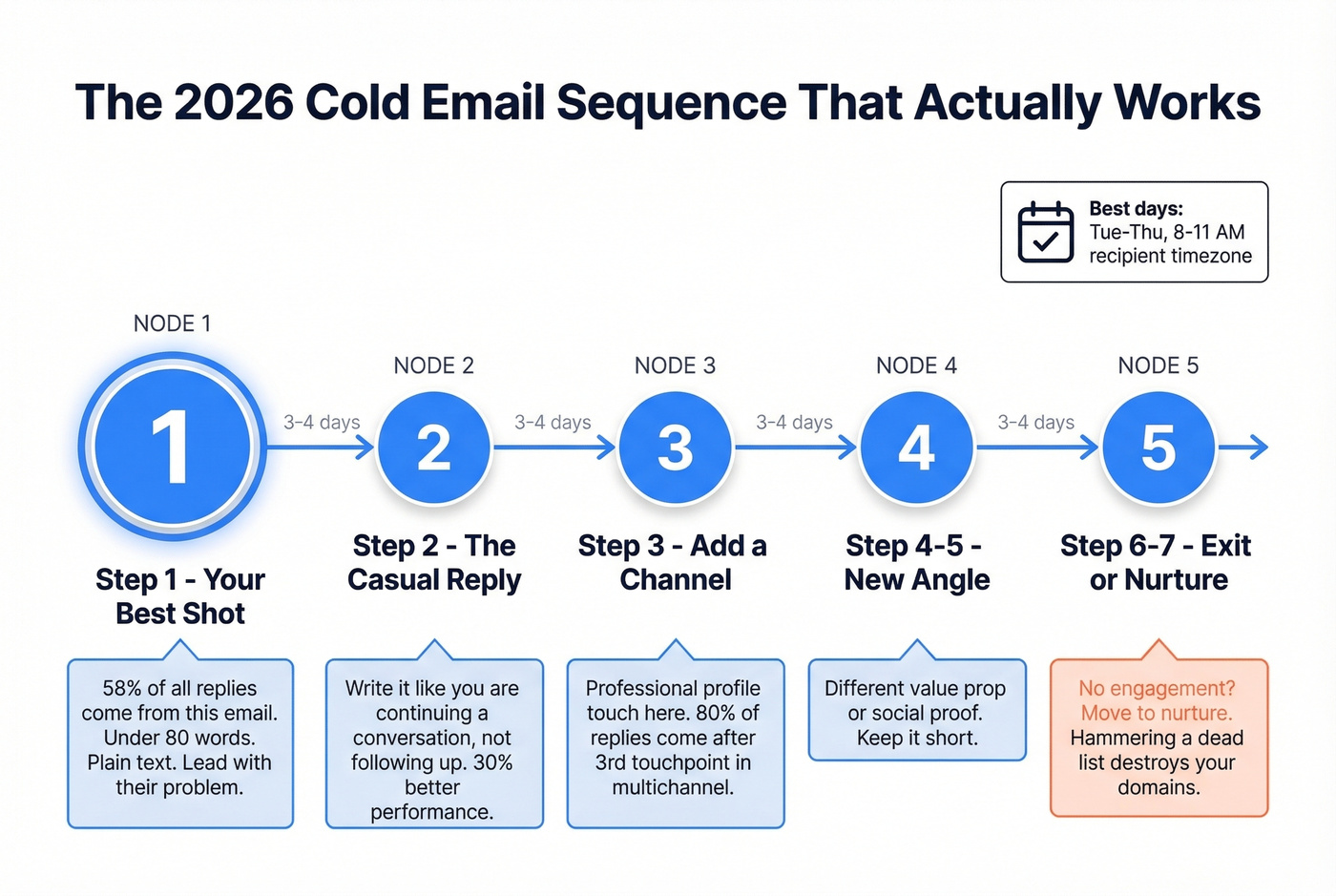
That's not an argument against follow-ups - it's an argument for making Step 1 count. Most teams over-invest in sequence length and under-invest in that first message. If your opening email doesn't earn a reply, steps 4 through 12 are just accelerating domain damage.
The sweet spot is 4-7 touchpoints with 3-4 day spacing. Send Tuesday through Thursday, 8-11 AM in the recipient's timezone. For follow-ups, the best-performing tactic from the Instantly data: make Step 2 feel like a reply, not a formal follow-up. Drop the "just following up" opener. Write it like you're continuing a conversation - this outperforms structured sequences by roughly 30%. If you need examples, pull from proven follow-ups rather than improvising.
Don't ignore multichannel. Email to professional profile touchpoint back to email outperforms email-only sequences. One r/SaaS practitioner reported 80% of replies coming after the third touchpoint in a multichannel sequence. Even a single non-email touch between steps changes the dynamic entirely.
Set clear exit criteria. If someone hasn't engaged after 5-6 touches, move them to a nurture track or drop them. Continuing to hammer a dead list is how you end up rebuilding infrastructure from scratch.
The 2026 Outbound Tool Stack
| Tool | Category | Starting Price | Best For |
|---|---|---|---|
| Prospeo | Data + Verification | Free tier; ~$0.01/email | Verified contacts, low bounce rates |
| Instantly | Sending | ~$30-$100+/mo | Inbox rotation, warmup, benchmark data |
| Smartlead | Sending | ~$30-$100+/mo | Deliverability-first teams |
| Apollo | List Building | Free tier; paid ~$49-$99/user/mo | Starting out, budget plays |
| Lemlist | Sending | ~$40-$100+/mo | Personalization features |
| Woodpecker | Sending | ~$30-$60+/mo | Simple, no-frills sending |
| Clay | Enrichment | ~$150+/mo | Signal-based workflows |
Let's be honest about the Reddit sentiment on sending tools. Instantly gets praise for its UI but complaints about domains tanking after three weeks. Smartlead delivers better inbox placement but its AI writing features are weak. We've tested both extensively, and the real answer is the sending platform matters far less than your infrastructure and data quality. Pick one, set it up right, and move on. A full B2B outbound stack - data, sending, plus 7-10 domains - runs $400-600/mo total. If you're comparing options, start with a ranked list of SDR tools and narrow from there.
Trends Shaping the Channel
Engagement-based filtering is the big one. Mailbox providers now weigh recipient behavior - opens, replies, deletes - when deciding whether to deliver your next batch. This means every email you send to someone who ignores it makes your next email slightly harder to deliver. Volume without quality is now actively self-destructive. If you're troubleshooting, use a dedicated email deliverability guide instead of guessing.
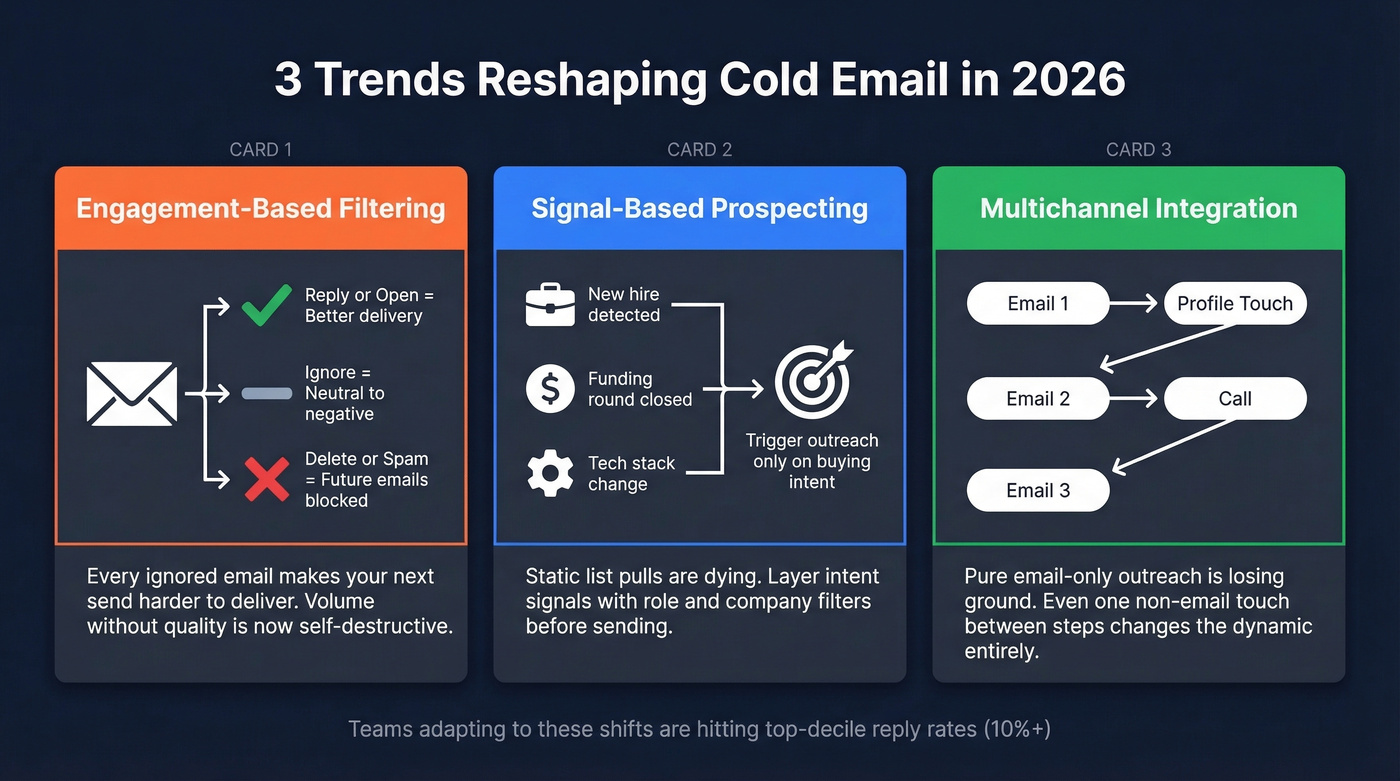
Signal-based prospecting is replacing static list pulls. Teams using Clay or similar enrichment tools trigger outreach only when a prospect shows buying intent: a new hire, a funding round, a tech adoption signal. Prospeo's intent data tracks 15,000 topics via Bombora, so you can layer buying signals with job role and company growth filters before a single email goes out. This is easiest when you formalize your lead enrichment workflow and define buying signals up front.
The future also points toward tighter multichannel integration. Pure email-only outreach is losing ground to workflows that layer in professional profile touches, calls, and even direct mail between email steps. Teams adapting to these shifts are the ones hitting top-decile reply rates.
Compliance in 60 Seconds
CAN-SPAM (US): Cold email is legal. Include a physical address, honor unsubscribes within 30 days. Penalties run $51,744+ per violation.
GDPR (EU): B2B cold email is permitted under Article 6(1)(f) legitimate interest - document an assessment and include an unsubscribe mechanism.
CASL (Canada): Implied consent exists for existing business relationships with a 24-month window, or for conspicuously published work emails. Honor unsubscribes within 10 business days.
Always include an unsubscribe link. It's not just legal compliance - it also helps keep spam complaints under the 0.1% threshold that keeps you out of trouble with mailbox providers. If you're scaling volume, align your sending limits with safe email velocity and monitor bounce rate as a first-order metric.
FAQ
Will cold email still work in 2026?
Yes, but only for senders who invest in infrastructure and data quality. Average reply rates sit at 3.43%, while top performers exceed 10%. The channel rewards disciplined execution and punishes lazy volume plays harder than ever before.
Is cold outreach still legal?
Yes. CAN-SPAM allows it with an opt-out mechanism. GDPR permits B2B outreach under legitimate interest. CASL requires implied or express consent. Every jurisdiction requires an unsubscribe link - include one in every message.
What's a good reply rate right now?
The average is 3.43%. Top 25% hit 5.5%+, top 10% exceed 10.7%. If you're below 2%, fix infrastructure and data quality before touching copy - that's where the real gains are.
How do I keep sending domains from getting flagged?
Use secondary domains, limit to 10-15 emails per inbox per day, and verify every contact to keep bounce rates under 2%. Authenticate with SPF, DKIM, and DMARC. A 7-day data refresh cycle - rather than the typical 6-week lag most providers offer - keeps bounce rates low enough to protect domain reputation long-term.