

The Best CRM Database Software for 2026
A RevOps lead we know ran a CRM audit last quarter. The database held 140,000 contacts. Thirty-one thousand had invalid emails, outdated job titles, or belonged to people who'd left the company over a year ago. The CRM wasn't broken - the data inside it was.
That's the real story behind most CRM failures, and it's the lens we used for this roundup of CRM database software. The CRM market is projected to hit $126.17B in 2026, and companies that adopt CRM report 47% higher customer retention. But that ROI only shows up when the database underneath is clean, enriched, and current. Picking the right platform isn't a features decision - it's a data decision.
Our Picks at a Glance
| Tool | Best For | Starting Price |
|---|---|---|
| Zoho CRM | Overall value | Free (up to 3 users) / $14/user/mo |
| HubSpot CRM | Free starting point | Free |
| Pipedrive | Sales simplicity | $14/user/mo (annual) |
| Salesforce | Enterprise scale | $25/user/mo |
| SuiteCRM | Open-source control | Free (self-hosted) |
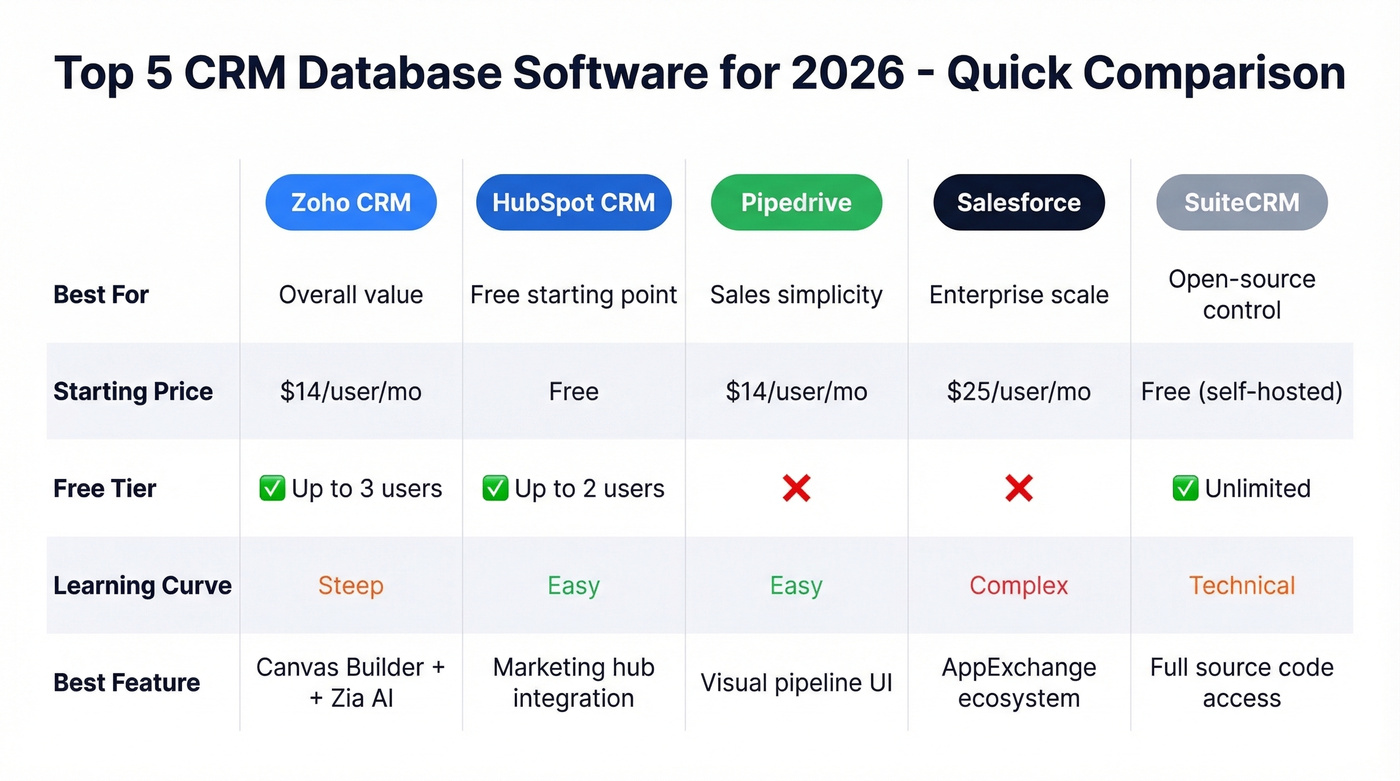
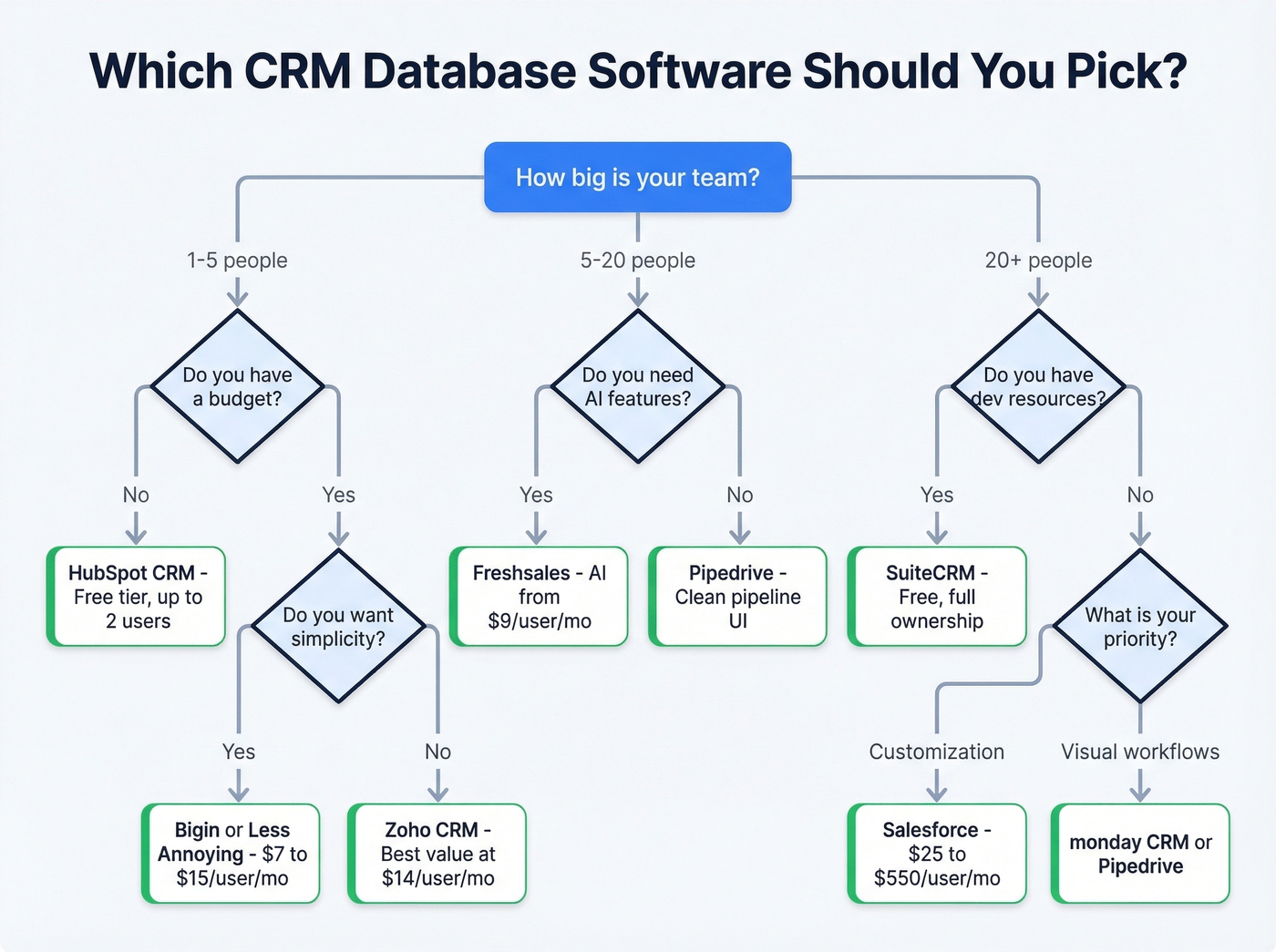
Zoho gives you the deepest feature set per dollar. HubSpot gets you live fastest. Pipedrive keeps things visual and lean. Salesforce is the platform you grow into over a decade. SuiteCRM is for teams with dev resources who want full ownership.
The CRM Data Problem Nobody Talks About
B2B contact data decays at roughly 2.1% per month. That's about 22% of your database going stale every year - job changes, company moves, new email domains, disconnected phone numbers. The downstream cost is brutal: 44% of companies lose more than 10% of annual revenue due to low-quality CRM data, and IBM pegs the total cost of bad data at $3.1 trillion annually across U.S. businesses alone.
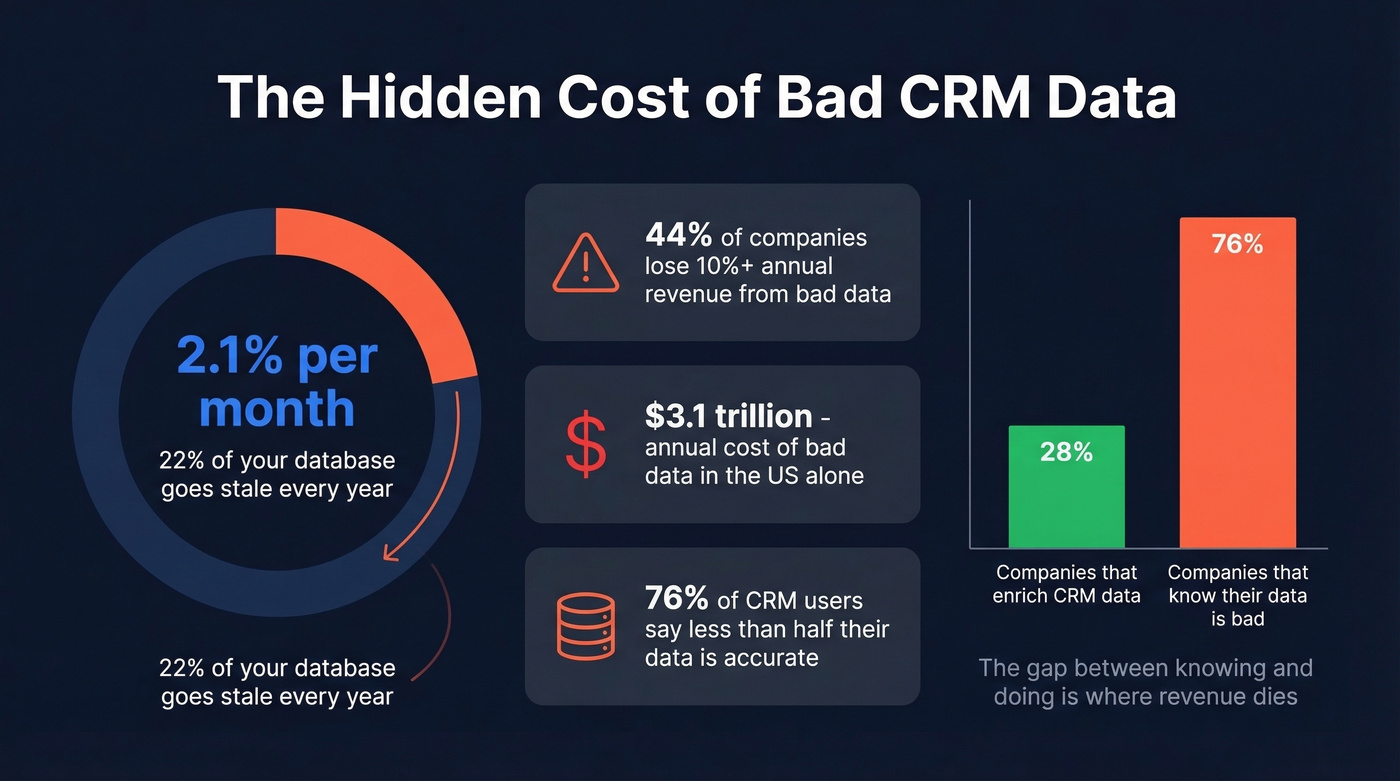
Here's the thing: 76% of CRM users say less than half their data is accurate and complete. Yet only 28% of organizations actively enrich their CRM with third-party sources. That gap - between knowing the data is bad and actually doing something about it - is where revenue goes to die. If you're comparing vendors, start with data enrichment and how it plugs into your stack.

The six dimensions of data quality worth tracking:
- Accuracy - target 90%+ correct records
- Completeness - target 90%+ coverage on critical fields
- Consistency - 97%+ standardized formatting
- Timeliness - data refreshed within weeks, not quarters
- Validity - 98%+ records pass format/logic checks
- Uniqueness - minimal duplicates across the database
Most teams obsess over accuracy and ignore the rest. And 45% say their CRM data isn't even prepared for AI use - which means all those shiny AI features are running on garbage inputs.
The CRM you choose matters far less than whether you have a system to keep its data fresh. A $14/month Zoho instance with enriched, verified contacts will outperform a $550/month Salesforce deployment sitting on 30% stale records every single time. If your CRM is mostly a rolodex today, you may also want to evaluate contact management software before you overbuy.
10 Best CRM Database Software for 2026
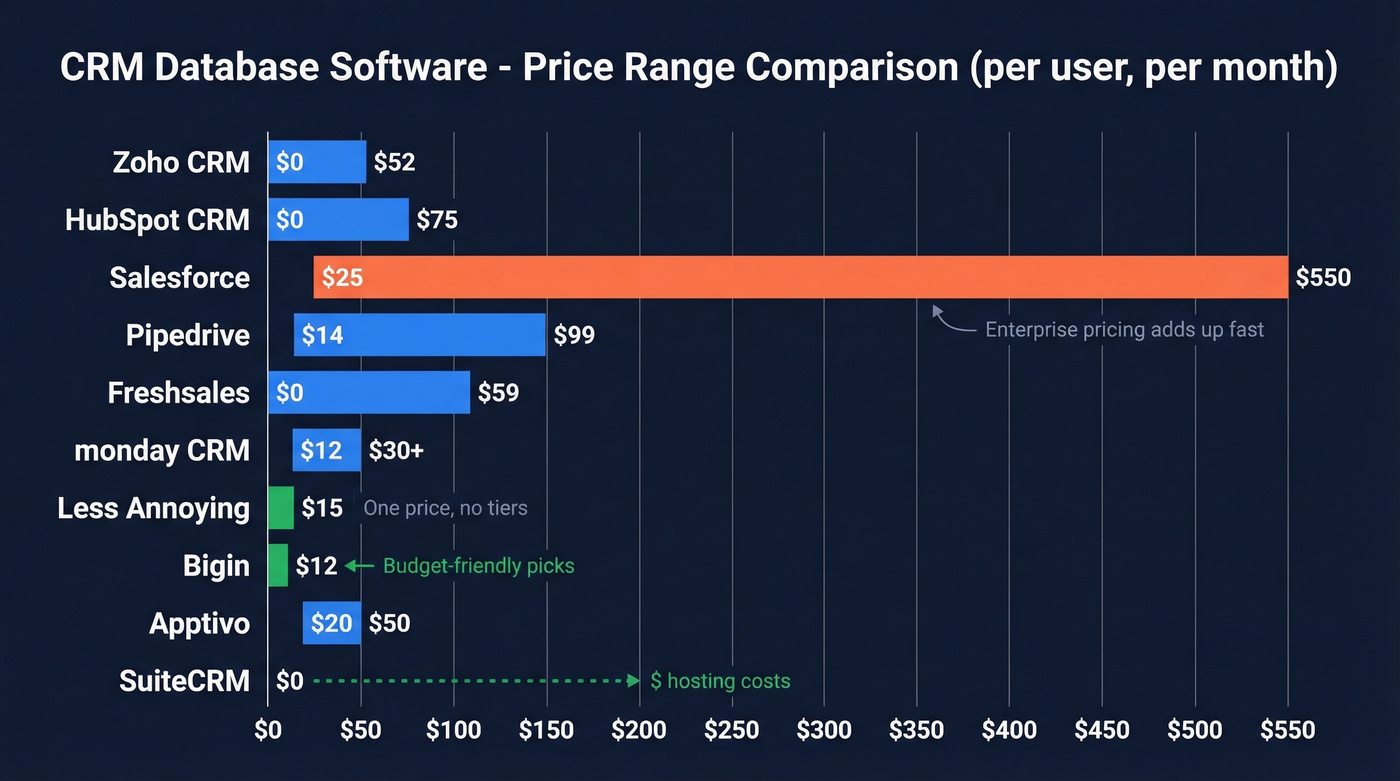
| Tool | Free Tier | Starting Price | Up To | Best For |
|---|---|---|---|---|
| Zoho CRM | Up to 3 users | $14/user/mo | $52/user/mo (annual) | Overall value |
| HubSpot CRM | Up to 2 users | Free | $75/seat/mo | Free start |
| Salesforce | No | $25/user/mo | $550/user/mo | Enterprise scale |
| Pipedrive | No | $14/user/mo | $99/user/mo | Sales simplicity |
| Freshsales | Yes | ~$9/user/mo | ~$59/user/mo | AI on a budget |
| monday CRM | No | $12/user/mo | Quote-based | Visual workflows |
| Less Annoying | No | $15/user/mo | $15/user/mo | Simplicity |
| Bigin | 1 user | $7/user/mo | $12/user/mo | Micro-teams |
| Apptivo | No | $20/user/mo | $50/user/mo | Flexibility |
| SuiteCRM | - | Free (self-hosted) | Free + hosting | Full ownership |
Zoho CRM - Best Overall Value
Zoho CRM is the tool we'd recommend to any team that wants depth without enterprise pricing. It earned PCMag's Editors' Choice with a 4.5 rating, and the feature set justifies it - Canvas Builder for custom layouts, Zia AI at higher tiers, and gamification features that actually get reps to log activities.

Pricing scales from free (up to 3 users) through Standard at $14/user/mo on annual billing, up to Ultimate at $52/user/mo. Monthly billing bumps those numbers: Standard is $20/user/mo, Professional is $35/user/mo, Enterprise is $50/user/mo, and Ultimate is $65/user/mo. The free plan is usable for real work, not just a demo in disguise.
The honest tradeoff: Zoho's learning curve is steep. Advanced features like workflow automation and territory management are locked behind higher tiers, and file storage caps at 100MB per user. For teams that need power and are willing to invest the setup time, it's the best value in the category. For teams that want to be live by Friday, look at HubSpot.
HubSpot CRM - Best Free Starting Point
If you're a startup or small team that needs a CRM running today, not next month, this is it. HubSpot's free tier gives you up to 2 users, 1,000 contacts, deal tracking, and a surprisingly functional contact management system. The onboarding is the easiest in the category - PCMag labels it "Easiest to Use."
Skip this if you're planning to scale past the free tier without a real budget. The jump from free to Professional ($50/seat/mo) is jarring. Starter at $15/seat/mo softens the blow, but the features that make HubSpot powerful - custom reporting, sequences, workflows - live at Professional and above. Enterprise runs $75/seat/mo.
The marketing hub integration is HubSpot's real superpower. If your marketing team already lives in HubSpot, adding the CRM creates a single view of the funnel that's hard to replicate with other tools. Breeze AI handles contact enrichment and content drafting, though for deeper enrichment - verified direct dials, tech stack data, company financials - you'll want a dedicated data platform feeding records into HubSpot via native integration. Prospeo connects natively and returns 50+ data points per contact on a 7-day refresh cycle, so records stay current between manual audits. If you're building outbound alongside HubSpot, pair it with proven sales prospecting techniques.
Salesforce Starter Suite - Enterprise Scale
This is the platform you pick when you're building a 50+ person sales org and need it to grow with you for a decade. Salesforce starts at $25/user/mo for Starter Suite and scales up to $550/user/mo depending on tier. The sales tools are best-in-class, and the integration ecosystem - thousands of apps on AppExchange - is unmatched.
Skip this if your team is under 20 people. Implementation typically takes one to three months for mid-market deployments. Admin overhead is real - you'll want a dedicated Salesforce admin once you pass 20-30 users. And the fact that Salesforce still won't show you full pricing without a sales call, for a $300B company, is a choice. Reviewers love the customization depth but consistently cite complexity and cost as pain points. If you're doing a deeper cost/fit check, see our breakdown of Salesforce pricing.
Pipedrive - Best for Sales Simplicity
If Zoho is too complex and Salesforce is too expensive, Pipedrive is your answer. The pipeline-first visual UI is the cleanest in the category - reps see their deals as cards on a board, drag them between stages, and get prompted on next actions. Setup takes hours, not weeks.
Pricing runs $14/user/mo on annual billing for Essential. Ultimate is $79/user/mo annually, or $99/user/mo monthly. The catch: the best lead management features sit on higher tiers. For small sales teams that want a tool reps will actually use without training, Pipedrive is the pick. If you're comparing CRMs head-to-head, our Copper vs Pipedrive guide can help.
Freshsales - AI on a Budget
Freshsales includes Freddy AI at lower tiers than most competitors, giving you deal scoring, next-best-action suggestions, and auto-enrichment starting around $9/user/mo. Built-in phone and email mean fewer integrations to manage. The free tier works for solo operators, and the top tier runs around $59/user/mo.
The limitation is ecosystem. Freshsales has fewer third-party integrations than HubSpot or Salesforce, so if your stack is complex, you'll feel the gaps. If you're weighing it against Salesforce specifically, see Freshworks vs Salesforce.
monday CRM - Visual Workflows
monday CRM inherits the drag-and-drop DNA of monday.com's project management platform. If your team already uses monday for operations, adding the CRM module creates a unified workspace - that's the entire value proposition. Basic plans start at $12/user/mo, with email sync kicking in at Standard ($17-$20/user/mo). Enterprise pricing is quote-based and often lands around $30+/user/mo.
The CRM is newer and less mature than dedicated platforms, with reporting and automation depth lagging behind Zoho and HubSpot. But for teams that think visually and want pipeline management alongside project tracking, it's a natural fit.
Less Annoying CRM
Single plan. $15/user/mo. No tiers, no upsells. Contact management and pipeline tracking, nothing more. Does exactly what the name promises - ideal for small businesses that find Salesforce terrifying and don't need AI, automation, or a 200-page feature list.
Bigin by Zoho
Zoho's lightweight CRM for teams of one to five. Free for one user, paid plans run $7-$12/user/mo. Outgrow it? Migrate to Zoho CRM seamlessly. If you're a freelancer or micro-business and Zoho CRM feels like bringing a firehose to water a plant, start here.
Apptivo
PCMag rates Apptivo "Most Flexible" for good reason - it's highly configurable through modules and customization. Plans run $20-$50/user/mo. No AI tools, which keeps the interface clean and the learning curve shallow. Best for teams with unusual workflows that don't fit standard CRM templates.
SuiteCRM - Best Open-Source Option
SuiteCRM is one of the most established open-source CRMs with active community development. Zero license fees, full source code access. The tradeoff is everything else: you need dev resources for setup, hosting ($50-$200/month), and ongoing maintenance. For technical teams that want complete data ownership and customization freedom, it's unbeatable. For everyone else, it's a project, not a product.

The article says 76% of CRM users report less than half their data is accurate. Prospeo's CRM enrichment returns 50+ verified data points per contact at a 92% match rate - emails, direct dials, tech stack, intent signals - refreshed every 7 days, not every quarter.
Stop running your CRM on stale data. Fix it for $0.01 per email.
Open-Source CRM Alternatives
Beyond SuiteCRM, three open-source alternatives are worth evaluating. Twenty is the modern newcomer with a clean API-first architecture and a developer-friendly approach. EspoCRM offers solid customization with a lighter footprint - faster to deploy than SuiteCRM for smaller teams. Odoo bundles CRM with ERP modules for teams that need sales, inventory, and accounting in one system.
Let's be honest: open-source is license-free but not cost-free. Budget $50-$500/month for hosting, plus ongoing developer time for customization and maintenance. The consensus on r/selfhosted and r/CRM is that these tools are great for technical teams but a nightmare for founders who just want something that works out of the box.
Evaluating AI in CRM Software
Every CRM now markets "AI-powered" features. Most of them are thin wrappers around basic automation.
The way to cut through the noise is to get specific: do you need deal scoring, email drafting, or forecasting? "AI" is too vague to evaluate. Test the summary quality by asking the AI to summarize a real deal - if the output is generic, the feature is decorative. Demand transparency from any AI feature, too. When a deal is flagged "at risk," you should be able to see why. Black-box predictions erode trust faster than they build it. If forecasting is a priority, compare dedicated sales forecasting solutions.
The uncomfortable truth: AI in CRM is only as good as the database underneath it. Clean data first, add AI second. No model can compensate for garbage inputs, and no amount of machine learning will fix a database where a quarter of the emails bounce.
5 Database Mistakes That Cost Revenue
1. Ignoring dirty data. 44% of companies lose over 10% of annual revenue to bad CRM data. Duplicate records, invalid emails, and outdated job titles compound silently until your pipeline metrics stop making sense.
2. No enrichment workflow. Only 28% of organizations enrich CRM data with third-party sources. Run quarterly enrichment passes to catch job changes and updated contact info. The data decays whether you watch it or not - at 2.1% per month, waiting a year means a quarter of your database is wrong. If you're building a repeatable process, start with a documented lead enrichment workflow.
3. Not using reporting. Only 20% of small business owners use CRM analytics weekly. If you aren't looking at conversion rates by stage, average deal velocity, and win/loss reasons, you're flying blind. The data is already in your CRM - the crime is not looking at it. For what to track, use these sales operations metrics.
4. No cleanup cadence. Schedule CRM cleanups at minimum twice a year. Deduplicate, validate emails, archive dead contacts. Treat it like changing the oil - boring, essential, catastrophic if you skip it. If email bounces are part of the mess, monitor your email bounce rate alongside CRM hygiene.
5. Overbuying features nobody uses. We've seen teams pay for Salesforce Enterprise when they use three features. Audit usage before renewal. Most teams are paying for modules they never activate - reviews for nearly every enterprise CRM echo this complaint.
HubSpot and Salesforce are only as good as the data inside them. Prospeo connects natively to both and keeps every record current with 98% email accuracy, 125M+ verified mobiles, and a 7-day refresh cycle that beats the 6-week industry average.
Plug verified, enriched contacts directly into your CRM - no manual audits needed.
CRM Database Software FAQ
What is a CRM database?
A CRM database is a centralized system that stores customer data - contacts, interactions, deals, purchase history, and support tickets - so sales, marketing, and support teams work from one source of truth. Every modern CRM platform includes a database layer, but the quality of what's stored determines whether the tool delivers ROI.
What's the best free CRM?
How often should you clean your CRM database?
At minimum twice a year, though quarterly is better. B2B contact data decays at roughly 2.1% per month - about 22% of your database goes stale within a year. Pair scheduled cleanups with an enrichment tool running on a weekly refresh cycle for ongoing accuracy between major audits.
When should you switch from a spreadsheet to CRM software?
Once you have more than 50 contacts or two people accessing the data. Spreadsheets can't track interaction history, automate follow-ups, deduplicate records, or enforce data quality standards. Most teams recoup the cost in hours saved within the first month.