

The 7 Best Enterprise Sales CRMs in 2026 (With Real Pricing)
You just got the renewal quote. $42,000 for 8 seats, and your CFO wants to know why reps only use the search bar and the activity logger. Buying an enterprise sales CRM is a minefield - nearly 60% of CRM users are enterprise-level businesses, and CRM adoption lifts sales by 29%, productivity by 34%, and forecast accuracy by 42%. But those gains only materialize if you pick the right platform and keep the data inside it clean. The market's shifting fast: in the 2025 Gartner SFA Magic Quadrant, Freshworks dropped off entirely, and monday.com entered for the first time.
Here are seven picks worth your shortlist, with real pricing and the hidden costs nobody puts on the landing page.
Our Picks at a Glance
| Tool | Best For | Starting Price | Gartner 2025 SFA |
|---|---|---|---|
| Salesforce Sales Cloud | Max customization | $175/user/mo | Leader |
| Dynamics 365 Sales | Microsoft shops | $65/user/mo | Leader |
| Prospeo | Keeping CRM data accurate | From $0 (free tier) | Not evaluated |
| HubSpot Sales Hub | Fast adoption | $100/seat/mo | Not evaluated |
| Oracle Sales | Regulated industries | $65/user/mo | Leader |
| Creatio | No-code flexibility | $55/user/mo | N/A |
| Zoho CRM | Budget enterprise | ~$40-$55/user/mo | Not evaluated |
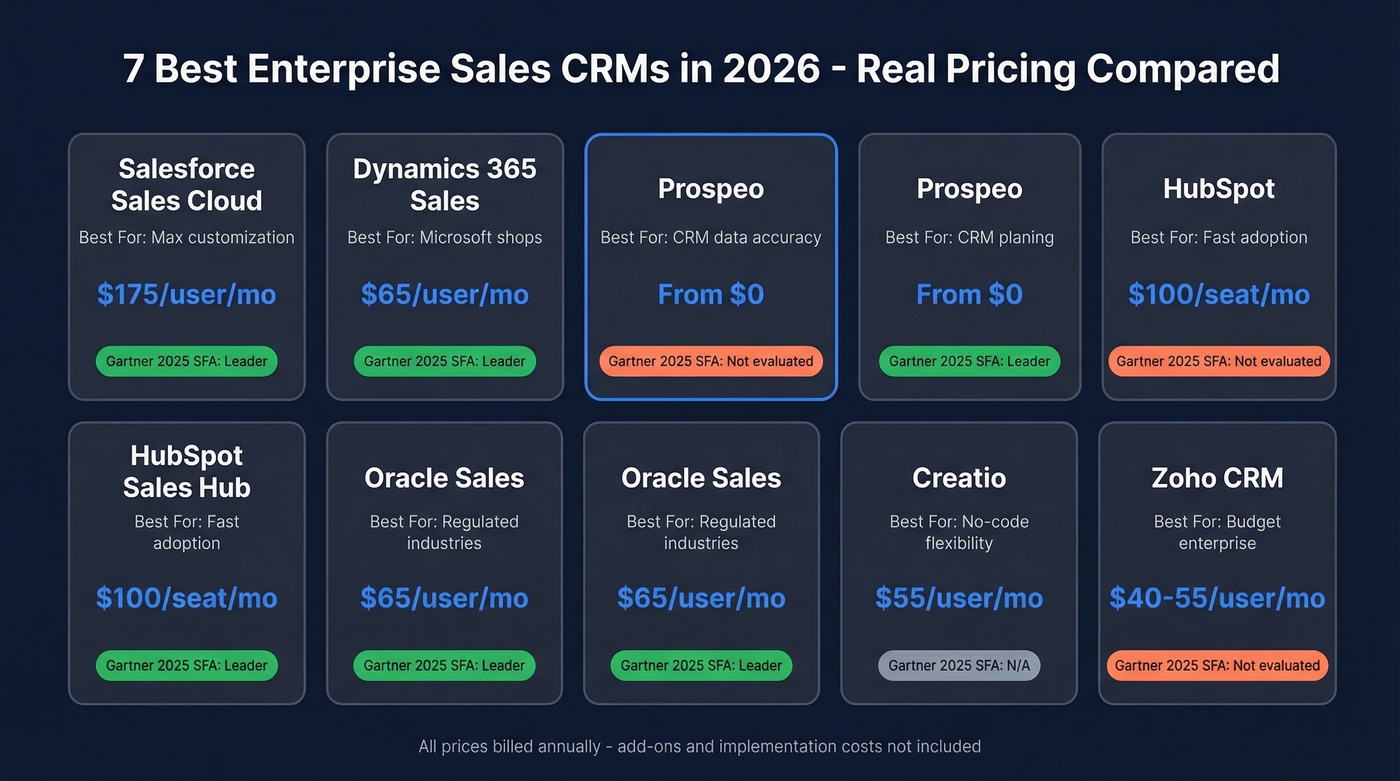
The 7 Best CRMs for Enterprise Sales
Salesforce Sales Cloud
Use this if you need maximum customization, a massive AppExchange ecosystem, and your org can absorb the admin overhead. Salesforce holds 23.8% of the global CRM market for a reason - nothing else matches its workflow flexibility or third-party integration depth. Einstein AI is maturing fast, and the new Agentforce tier is Salesforce's bet on agentic automation. For many teams evaluating the best CRM for large companies, Salesforce is still the default starting point.
Skip this if you don't have a dedicated admin or budget for one. The license is just the starting line. Enterprise runs $175/user/mo, Unlimited $350, and Agentforce 1 hits $550/user/mo - all billed annually. Then add Sales Engagement (~$75/user/mo), Conversation Intelligence (~$50/user/mo), and CPQ (up to $150/user/mo). Implementation ranges from $25k for mid-market to $300k+ for complex deployments. We've seen teams budget $175/user/mo and end up paying $400+ once add-ons and admin time are factored in. The sticker price is a fiction.
Microsoft Dynamics 365 Sales
Use this if you're already a Microsoft shop. Dynamics 365 integrates tightly with Teams, Outlook, Power BI, and the Power Platform. Professional starts at $65/user/mo, Enterprise at $105, and Sales Premium at $150. Microsoft's been a Gartner SFA Leader for 15 consecutive years, and Copilot AI is embedded across the stack.
Skip this if you're not in the Microsoft ecosystem. The value proposition weakens dramatically without Outlook and Teams as your daily drivers. Implementation commonly runs $15k-$100k depending on scope, and you'll still need a partner for anything beyond a vanilla deployment.
Prospeo
Prospeo isn't a CRM - it's the data layer that makes your enterprise CRM actually work. Every enterprise CRM suffers from the same disease: data decay. Contacts change jobs, emails go stale, phone numbers disconnect. Prospeo solves this with 300M+ professional profiles, 143M+ verified emails, and 125M+ verified mobile numbers, all refreshed on a 7-day cycle. The industry average is six weeks.
98% email accuracy. An 83% match rate on CRM enrichment, returning 50+ data points per contact. Native integrations with Salesforce and HubSpot mean enriched records flow directly into your CRM without manual imports.
When Snyk rolled Prospeo out across 50 AEs, their bounce rate dropped from 35-40% to under 5%, AE-sourced pipeline jumped 180%, and they started generating 200+ new opportunities per month. Pricing starts free - 75 verified emails per month, no credit card. Paid plans run roughly $0.01 per email with no annual contracts.

HubSpot Sales Hub
HubSpot delivers one of the fastest time-to-value of any platform on this list. The UI is intuitive, onboarding is measured in days rather than months, and the marketing-to-sales handoff is tight if you're already on Marketing Hub. Professional runs $100/seat/mo, Enterprise $150/seat/mo.
The catch: that $150/seat/mo comes with a mandatory $3,500 onboarding fee. Marketing Hub Enterprise starts at $3,600/mo plus a $7,000 onboarding charge. HubSpot also hits a customization ceiling for complex enterprise workflows - if you need multi-entity data models, advanced CPQ, or deeply custom reporting, you'll outgrow it. For teams under 50 reps with straightforward sales processes, though, it's hard to beat on speed of deployment.
Oracle Sales
A Gartner Leader alongside Salesforce and Microsoft, with four pricing tiers: Professional at $65, Standard at $100, Enterprise at $200, Premium at $300/user/mo. Oracle's security posture makes it a natural fit for regulated industries like financial services and healthcare.
But G2 reviewers give it 3.8/5 from 148 reviews, and the consistent criticism is complexity. One TrustRadius user put it bluntly: "The cost incurred by using a 3rd party implementer is more expensive than using Oracle Sales Cloud itself." Performance can slow with large datasets, and the learning curve is steep. Unless you're in a heavily regulated vertical or already deep in Oracle's stack, there are easier paths.
Creatio
Creatio offers Salesforce-level workflow flexibility without the consulting dependency, thanks to its no-code platform. Enterprise starts at $55/user/mo, Unlimited at $85/user/mo, and AI capabilities are included at no extra cost. If your team wants to build custom processes without writing Apex, Creatio deserves a serious look.
Zoho CRM
The budget enterprise option that actually works. Zoho's Enterprise tier runs around $40-$55/user/mo - a fraction of Salesforce or Dynamics. You'll trade ecosystem depth and some customization for that savings, but for budget-conscious teams that don't need the full Gartner Leader feature set, it's a legitimate contender. We've talked to teams running 100+ reps on Zoho without major issues, though they tend to supplement it with third-party tools for reporting and enrichment.

You're spending $175-$550/user/mo on your enterprise CRM. But stale contacts and bounced emails make that investment worthless. Prospeo enriches your Salesforce or HubSpot with 98% accurate emails and 125M+ verified mobiles - refreshed every 7 days, not every 6 weeks.
Stop paying enterprise prices for decaying data.
What Enterprise CRM Software Really Costs
License fees are the tip of the iceberg. Here's what a Salesforce deployment looks like for a 10-person SDR team on Agentforce 1: roughly $13,500/mo in licenses, add-ons, and admin time. Then add first-year implementation ($25k-$300k+), data migration ($5k-$25k), CPQ ($150/user/mo if you need quoting), Premier Support (~20% of license cost), training ($2k-$10k), and ongoing optimization ($10k-$50k/year). You'll also need one full-time admin for every 100-300 users.
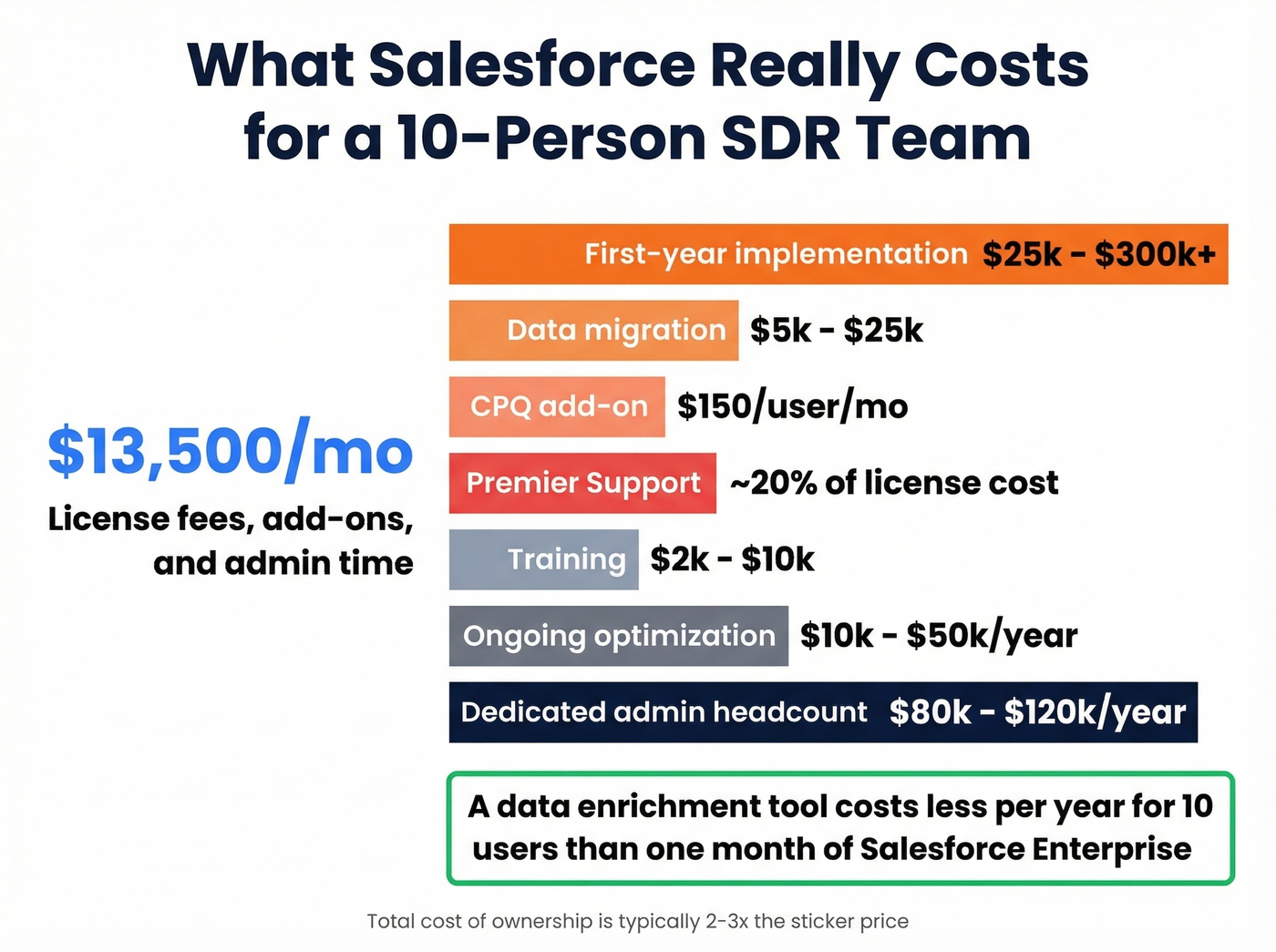
Here's the thing: a data enrichment tool's entire annual cost for a 10-person team is less than one month of Salesforce Enterprise. Your CRM is expensive. Keeping its data accurate shouldn't be.
How to Choose the Right Platform
For Microsoft shops, go with Dynamics 365 - the ecosystem integration alone justifies it. When marketing drives your pipeline and you want fast adoption, HubSpot is the move, but budget for the onboarding fees and know the customization ceiling exists. For teams that need maximum flexibility and can absorb admin overhead, Salesforce remains unmatched. We excluded SAP Sales Cloud - it's a Gartner Challenger, but pricing is opaque and the CRM is typically bundled with broader SAP ERP deployments.
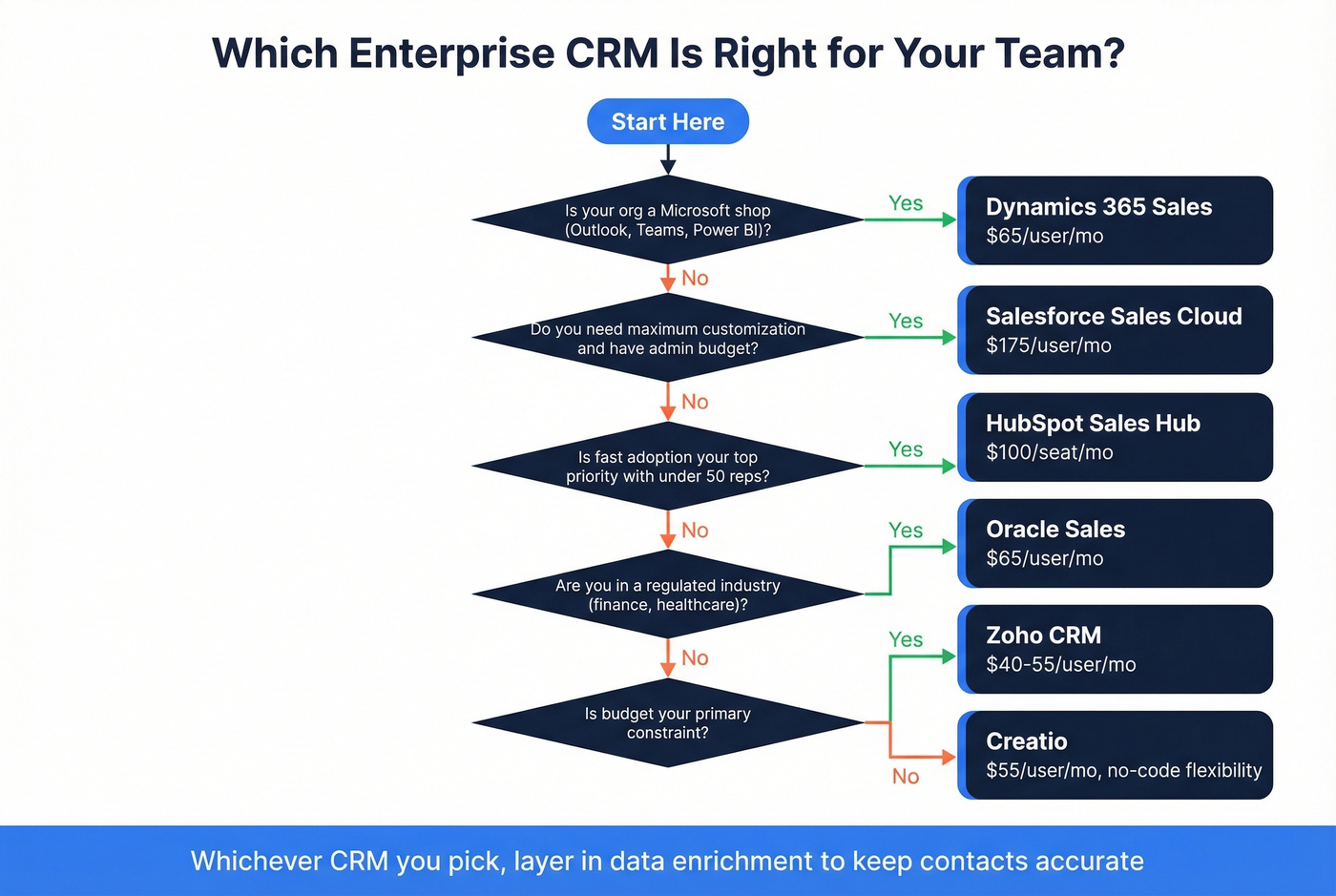
Let's be honest: most teams buying an enterprise sales CRM are over-buying. If your average deal size is under $25k and you have fewer than 50 reps, HubSpot or Zoho will do 90% of what Salesforce does at a third of the total cost. The enterprise tax is real, and it compounds every year.
Regardless of which CRM you pick, treat security certifications - SOC 2, GDPR, HIPAA - as table stakes, not differentiators. Run a 4-6 week pilot with 5-10 reps before committing. Track adoption rate, pipeline velocity, and forecast accuracy. In our experience, data decay is the number one reason CRM deployments underperform. Gartner predicts 15% of day-to-day work decisions will be autonomous via agentic AI by 2028, and AI agents are only as smart as the data they're trained on.
CRM Data Quality: The Hidden Killer
You've spent $75k implementing Salesforce, trained 50 reps, and launched your first outbound sequences. Half the emails bounce. Phone numbers are disconnected. Reps spend a huge chunk of their week on manual research instead of selling. Garbage in, garbage out - and it doesn't matter how sophisticated your CRM is.
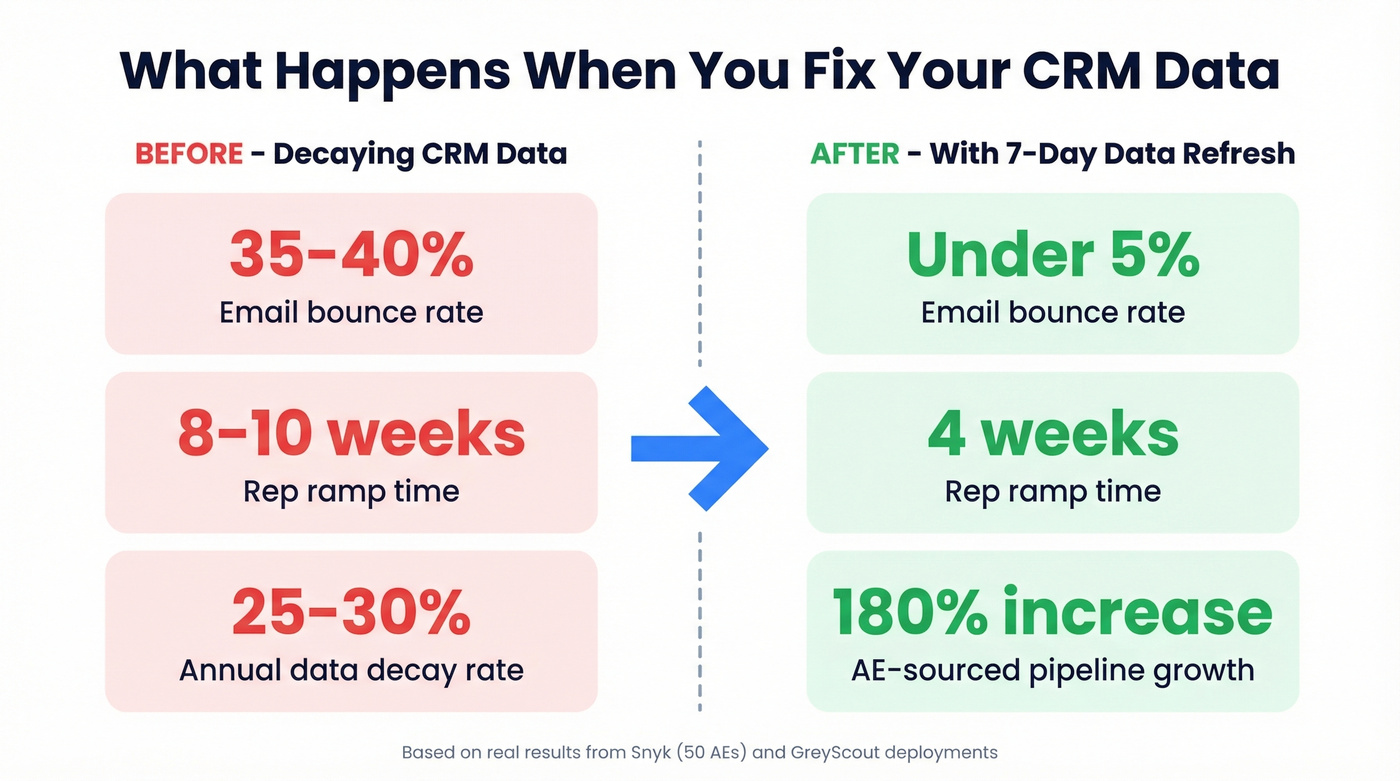
GreyScout saw this firsthand: bounce rates at 38%, pipeline stalling. After layering in a data enrichment workflow with a 7-day refresh cycle, bounces dropped to under 4%, pipeline jumped 140%, and rep ramp time was cut from 8-10 weeks to 4. Your CRM tracks the relationships. The data layer underneath makes sure the contact information behind them is actually correct.
Snyk deployed Prospeo across 50 AEs and cut bounce rates from 35-40% to under 5%. AE-sourced pipeline jumped 180%. Your enterprise CRM already cost six figures - Prospeo's entire annual cost for a 10-person team is less than one month of Salesforce Enterprise.
Make your CRM worth what you're paying for it.
FAQ
What makes a CRM "enterprise-grade"?
Enterprise-grade CRMs support multi-department deployments, advanced security certifications (SOC 2, GDPR, HIPAA), role-based permissions, custom workflows, API access, and thousands of concurrent users. Gartner's SFA Magic Quadrant is the standard benchmark for evaluating enterprise readiness across these dimensions.
How much does an enterprise sales CRM really cost?
License fees range from $40-$550/user/month, but total cost of ownership typically runs 2-3x the sticker price. Budget $25k-$300k+ for first-year implementation on platforms like Salesforce, plus ongoing admin headcount ($80k-$120k/year) and annual optimization spend.
How do I keep CRM data accurate at scale?
Layer a dedicated data enrichment tool on top of your CRM. A 7-day refresh cycle returning 50+ data points per contact at 98% email accuracy is the current gold standard - compared to the 6-week industry average. Without active enrichment, expect 25-30% data decay annually, which tanks outbound deliverability and forecast reliability.
What's the difference between enterprise and SMB CRM?
Enterprise CRMs offer deeper customization, advanced analytics, multi-currency and multi-language support, and enterprise security certifications. SMB CRMs prioritize ease of setup and lower cost - they're faster to deploy but hit ceilings sooner. The key differentiator is workflow complexity and the ability to support hundreds of users without performance degradation.