

How to Build an Enterprise Sales Team That Actually Hits Quota
The average B2B purchase involves 13 stakeholders, and 89% of those buying groups cross multiple departments. Meanwhile, average quota attainment across B2B sales sits at a brutal 47%.
Most enterprise sales teams aren't understaffed. They're structurally broken. Here's how to build one that isn't.
Quick version: Pick a structure model (Island, Assembly Line, or Pod) based on your stage and deal complexity. Don't hire until the founder has closed 5-10 deals. Implement MEDDPICC before you scale headcount - that 47% attainment number means most teams need better process, not more bodies.
What Counts as Enterprise Sales?
Enterprise sales means selling to organizations with 1,000+ employees and $1B+ in revenue. Cycles run 6-18 months. Deals involve procurement, legal, security, and a buying committee that spans departments - 89% of the time, those committees cross multiple business units. SMB and mid-market deals can close in days or weeks. Enterprise reps orchestrate consensus across a dozen stakeholders over many months, and the team you build needs to reflect that complexity.
Choosing the Right Team Structure
There's no single right org chart, but there are three proven patterns.
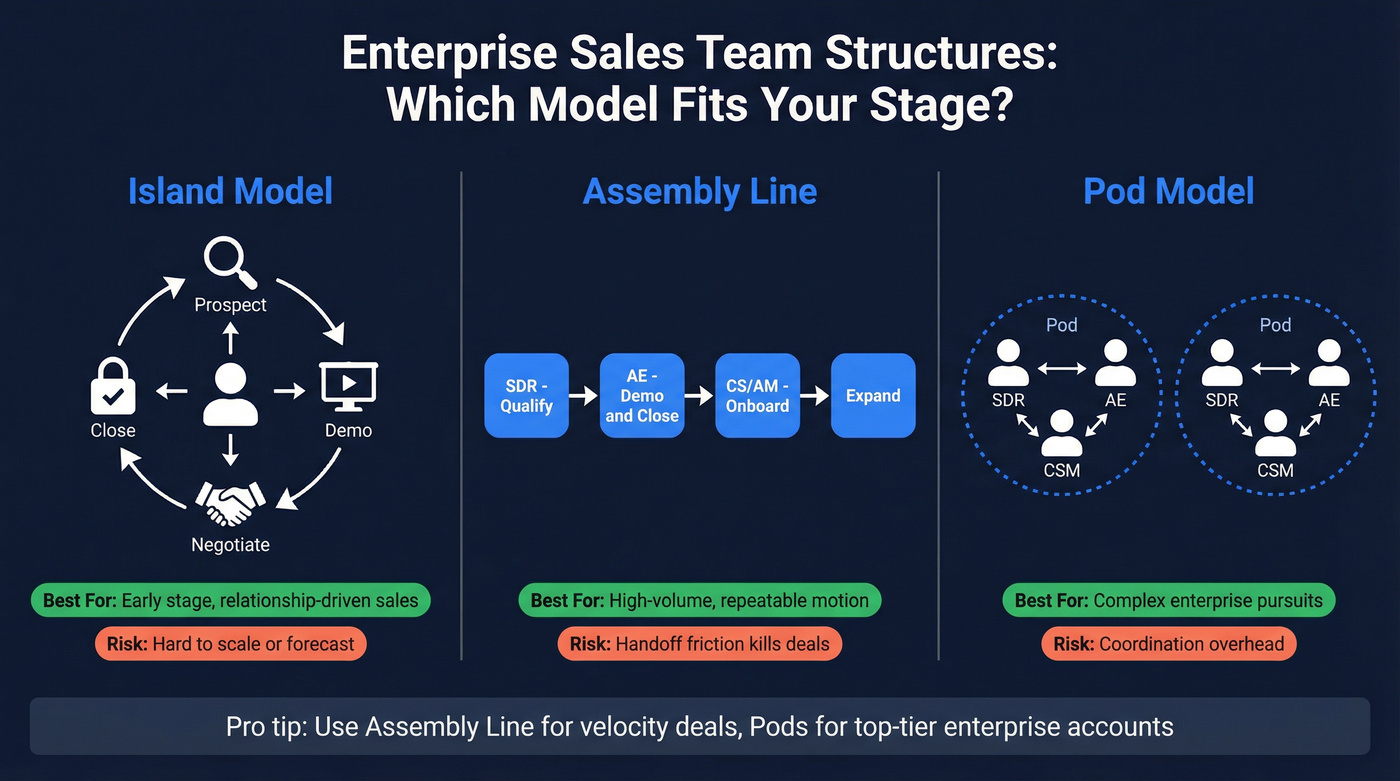
| Model | How It Works | Best For | Watch Out For |
|---|---|---|---|
| Island | One rep owns the full cycle | Early stage, relationship sales | Hard to scale or forecast |
| Assembly Line | SDRs → AEs → CS/AM handoffs | High-volume, repeatable motion | Handoff friction kills deals |
| Pod | SDR + AE + CSM unit | Complex enterprise pursuits | Coordination overhead |
The pattern that works best for teams going enterprise: Assembly Line for your velocity segment, Pods for your top-tier accounts. Your AE becomes the quarterback - orchestrating SEs, legal, and customer success without formal authority over any of them. That's the hardest skill to hire for and the one most job descriptions ignore.
Common ratios: 2-4 SDRs per AE in outbound-heavy motions, and 1 SE for every 2-4 AEs in technical sales. A typical SDR handles about 15 leads per day. Getting the structure right at this stage prevents costly re-orgs later, because most teams that restructure mid-scale lose a full quarter of pipeline momentum.
When to Hire (and Who First)
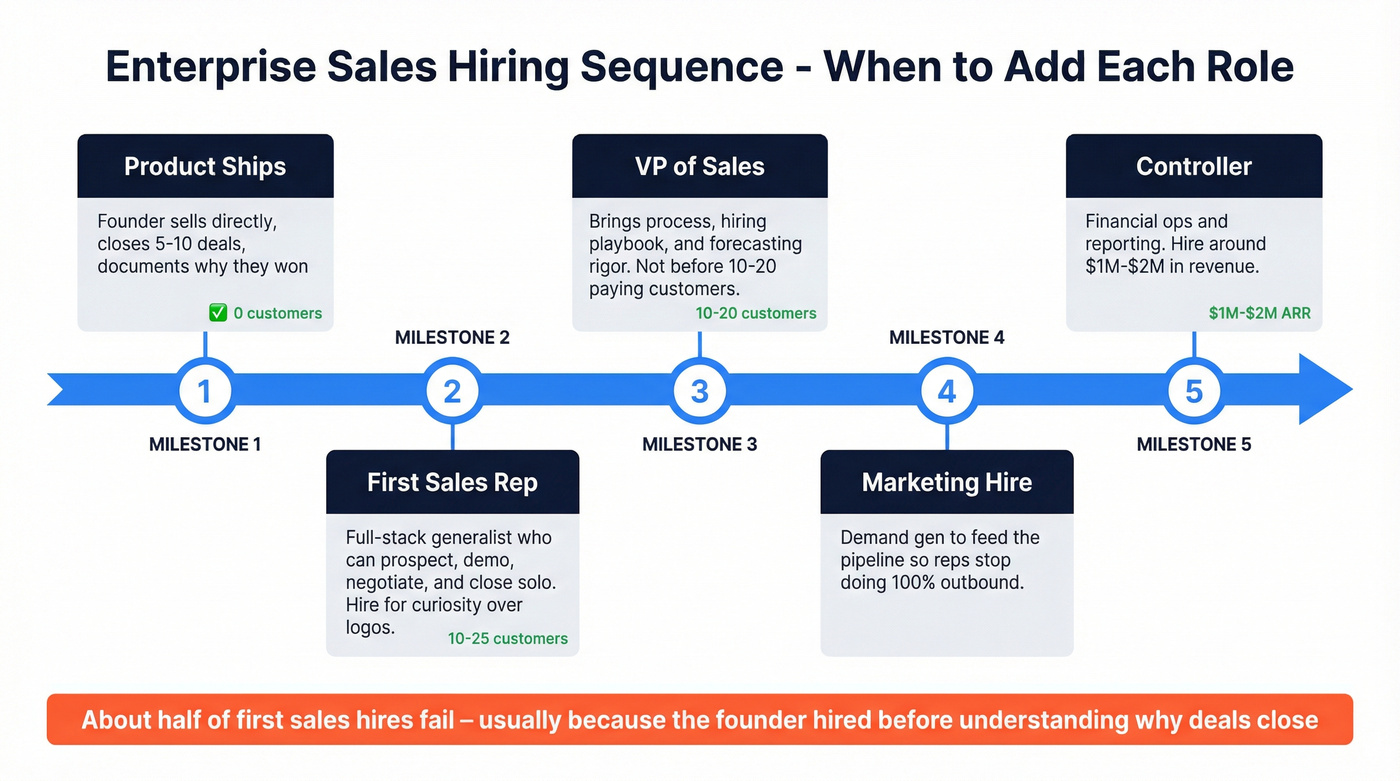
About half of first sales hires don't make it past year one. The biggest reason? Hiring too early - before the founder understands why deals close.
Before you post that AE job listing, check these boxes:
- Founder has personally closed 5-10 deals and can articulate why they won
- You have 10-25 paying customers (10 customers who are all your friends doesn't count)
- Founder is spending 50%+ of their time on sales and it's become a bottleneck
- You have a documented pitch, demo script, and pricing model
Sequoia's classic sequencing still holds: product ships → first rep (full-stack generalist) → VP Sales at 10-20 customers → marketing hire → controller at $1M-$2M in revenue. Your first rep should be a missionary who can prospect, demo, negotiate, and close without an SDR team feeding them. A polished resume from a logo company matters far less than intellectual curiosity and coachability. We've seen scrappy reps from 50-person startups outperform ex-Oracle AEs in early-stage environments, simply because they didn't wait around for inbound.
Compensation Benchmarks for 2026
Enterprise AE OTE runs $230K-$270K, with top performers clearing $300K. The standard quota-to-OTE ratio is 4x-5x, meaning a $250K OTE rep carries a $1M-$1.25M quota.
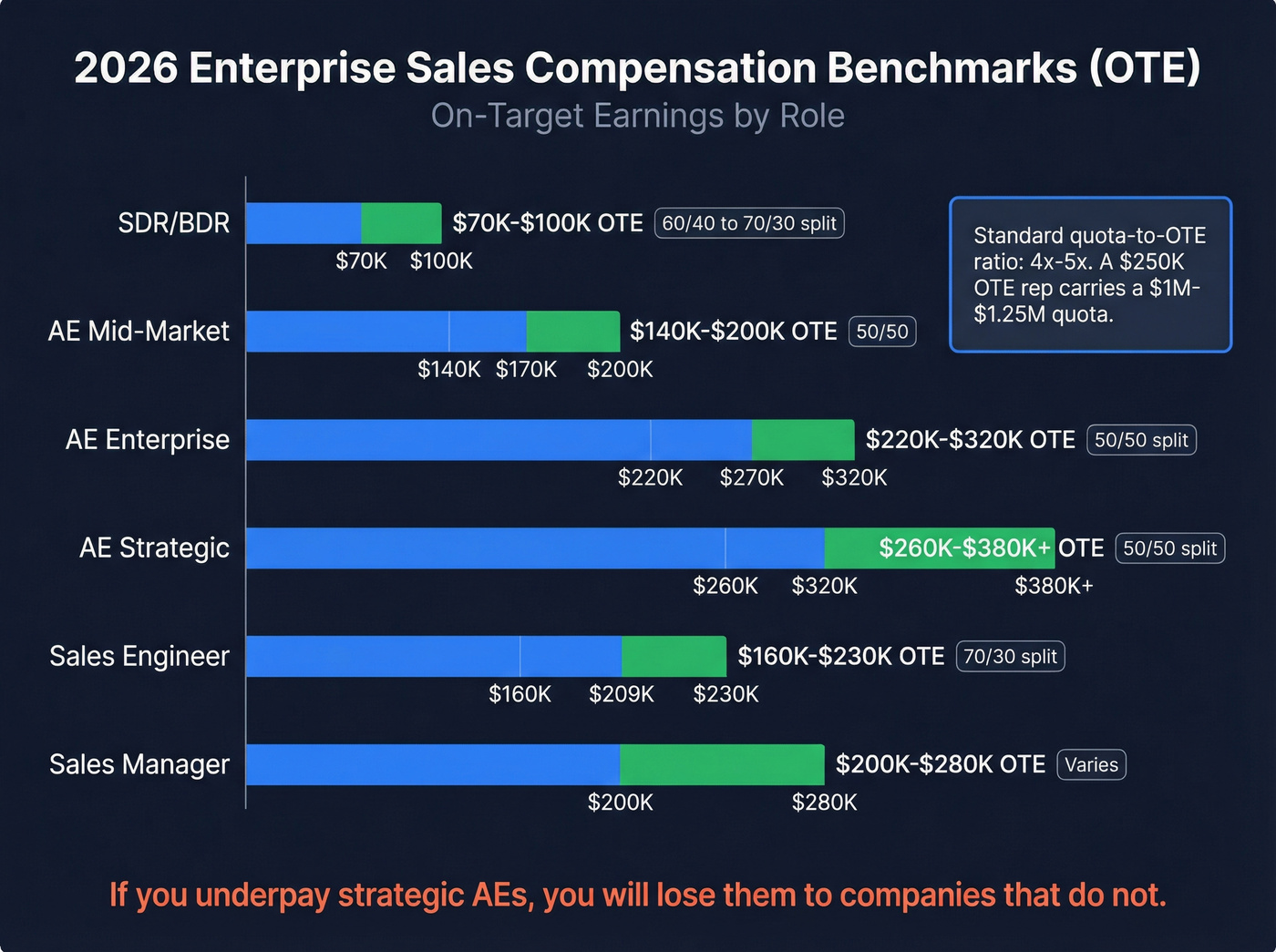
| Role | Base Range | OTE Range | Typical Split |
|---|---|---|---|
| SDR/BDR | $45K-$65K | $70K-$100K | 60/40 to 70/30 |
| AE Mid-Market | $75K-$95K | $140K-$200K | 50/50 |
| AE Enterprise | $110K-$140K | $220K-$320K | 50/50 |
| AE Strategic | $130K-$160K | $260K-$380K+ | 50/50 |
| Sales Engineer | $110K-$140K | $160K-$230K | 70/30 |
| Sales Manager | - | $200K-$280K | Varies |
Strategic account AEs command the highest OTE because they're managing multi-threaded relationships across entire buying committees for 12+ months at a time. If you're underpaying this role, you'll lose your best people to companies that aren't.

Enterprise AEs earning $250K+ OTE shouldn't spend hours hunting for contact data. Prospeo gives your team 300M+ profiles with 30+ filters - buyer intent, headcount growth, technographics - so reps reach the right stakeholders in those 13-person buying committees. At $0.01/email with 98% accuracy, you scale outbound without burning your domain.
Stop paying enterprise AE salaries for manual prospecting work.
MEDDPICC: The Qualification Standard
73% of SaaS companies selling above $100K ARR use some version of MEDDPICC. Organizations that fully adopt it report +18% win rates and +24% larger deal sizes. Those numbers make sense - the framework forces rigor on the eight elements that actually predict whether a deal closes: Metrics, Economic Buyer, Decision Criteria, Decision Process, Paper Process, Implicate the Pain, Champion, and Competition.
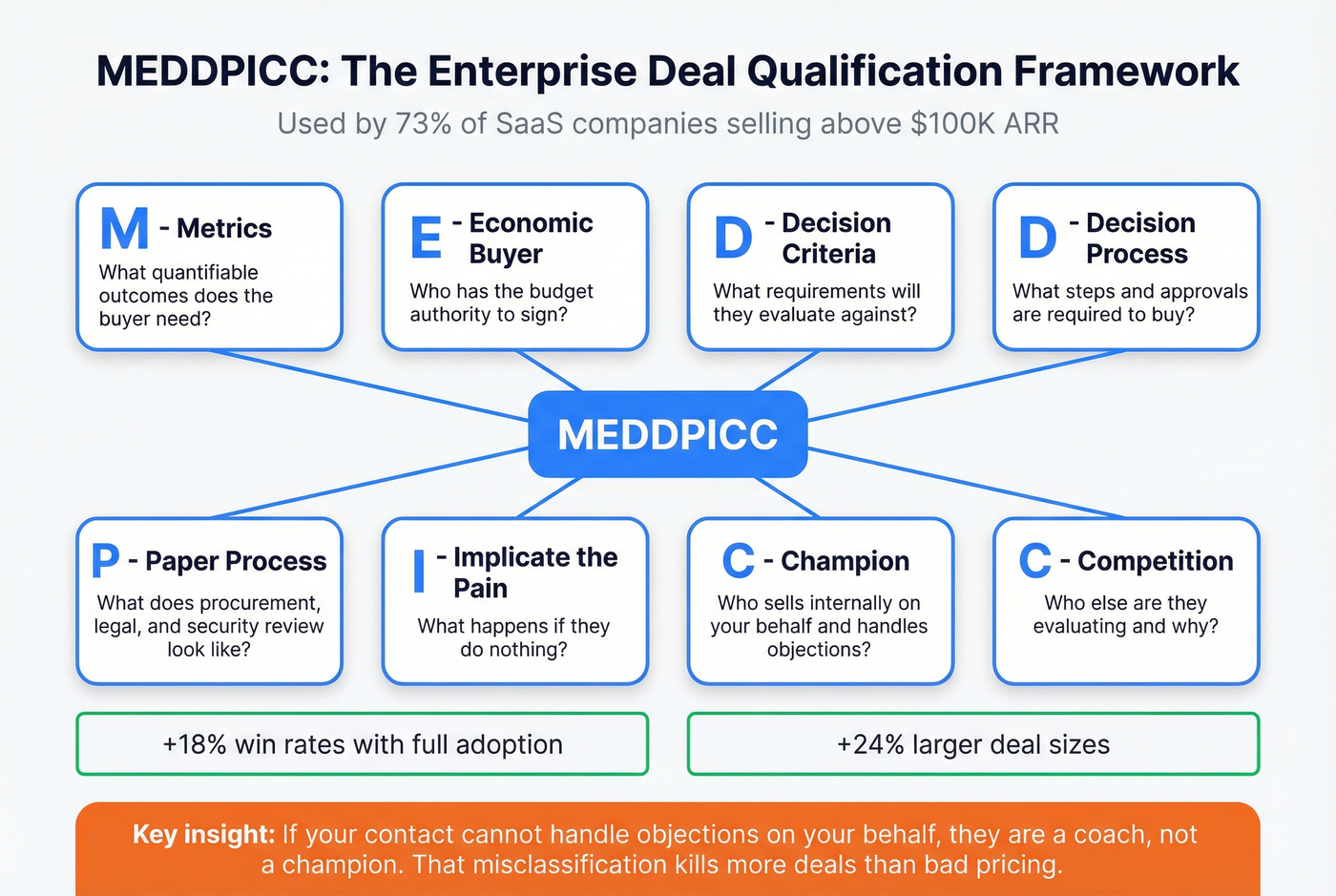
Here's the thing most sales leaders won't say out loud: MEDDPICC's primary value is disqualification. 86% of B2B purchases stall at some point in the process. The framework tells you "no" early so your reps stop wasting months on deals that were never going to close. And the most critical distinction in the whole methodology: if your internal contact can't handle objections on your behalf, they're a coach, not a champion. That single misclassification has killed more enterprise deals than bad pricing ever has.
Performance Benchmarks
Sales Cycle by Deal Size
| ACV Band | Median Days | Top Quartile | Drag Signal |
|---|---|---|---|
| $10K-$25K | 38 | 26 | >55 |
| $25K-$50K | 72 | 51 | >100 |
| $50K-$100K | 128 | 94 | >175 |
| $100K+ | 187 | 142 | >250 |
If your deals consistently exceed those drag-signal thresholds, the problem isn't the buyer - it's your process. The $50K-$100K band typically adds 30-45 days from procurement, legal, and security alone. Top performers front-load those steps with mutual close plans instead of scrambling at the finish line.
Enterprise win rates land between 15-25%, well below the 20-30% B2B average. Plan your 3x-4x pipeline coverage accordingly.
Enterprise vs. SMB/MM Funnel
| Stage | Enterprise | SMB/Mid-Market |
|---|---|---|
| Visitor → Lead | 0.7% | 1.4% |
| MQL → SQL | 31% | 39% |
| SQL → Opp | 36% | 42% |
| Opp → Close | 31% | 39% |
Enterprise conversion rates are lower at every stage. That's the cost of selling to 13-person buying committees, and it's why pipeline generation can't be an afterthought.
The AI Shift in 2026
A human SDR costs $100K-$130K/year fully loaded and takes 3-6 months to ramp. An AI SDR costs $2K-$8K/year and ramps in days.
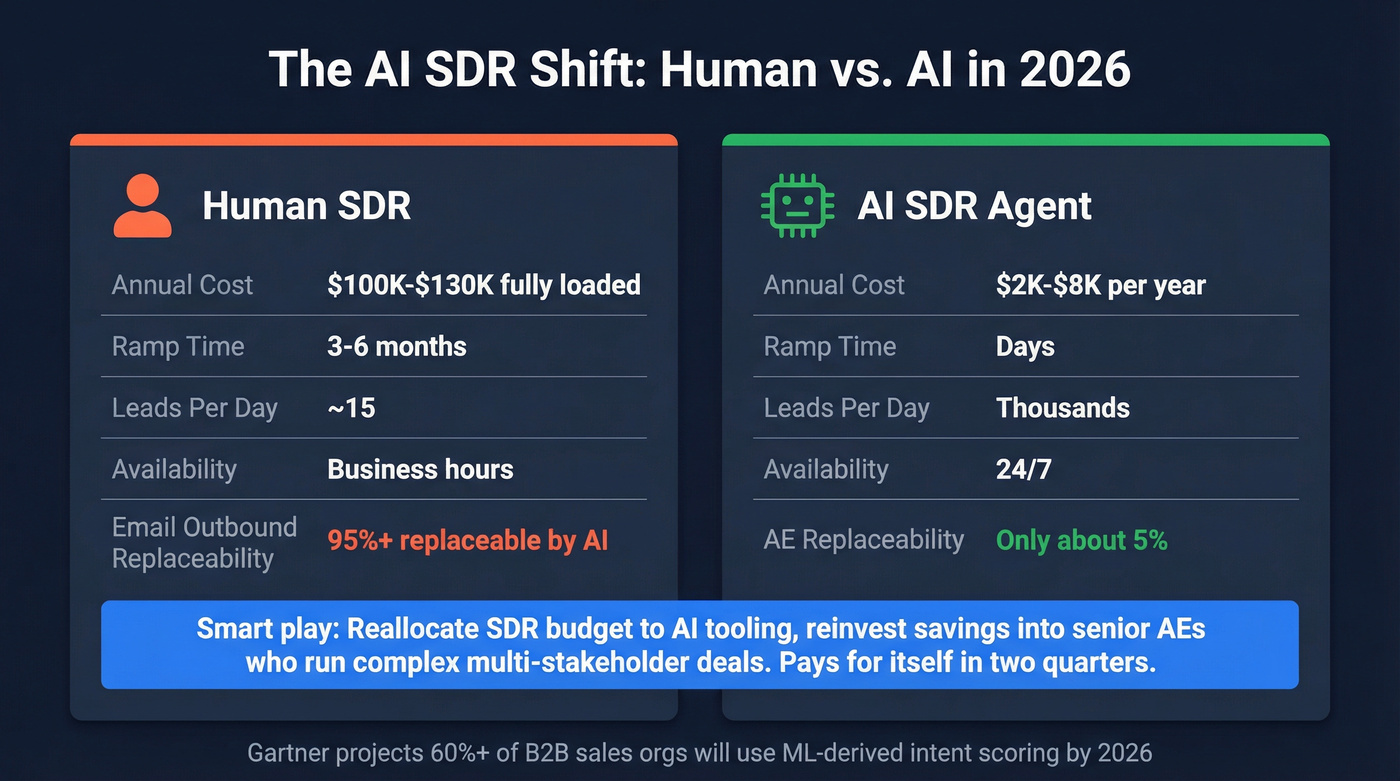
Let's be honest about what this means: for email-based outbound, SDRs are 95%+ replaceable by AI agents right now. AEs? Maybe 5%. The consensus on r/sales leans the same direction - practitioners are questioning whether "hitting the phones" still works as a standalone motion, shifting toward omnichannel sequences layered with intent signals. Gartner projects 60%+ of B2B sales organizations will use ML-derived intent scoring for pipeline qualification by 2026.
Don't cut AE headcount. Cut the manual prospecting work that burns their time. The companies seeing the fastest growth right now are reallocating SDR budget toward AI tooling and reinvesting the savings into senior AE hires who can run complex, multi-stakeholder deals. In our experience, that reallocation pays for itself within two quarters.
The Enterprise Sales Tech Stack
Your stack needs to cover the full enterprise motion - CRM, engagement, data, intelligence, and forecasting. Skip this section if you're pre-revenue; you don't need Clari or 6sense until you have pipeline worth forecasting.
| Category | Tool | Starting Price |
|---|---|---|
| CRM | Salesforce Sales Cloud | $165/user/mo+ |
| Engagement | Outreach | ~$100-$150/user/mo |
| Data & Contact | ZoomInfo | $15K+/yr |
| Conversation Intel | Gong | ~$20K-$50K+/yr |
| Forecasting | Clari | ~$30K-$80K+/yr |
| ABM/Intent | 6sense | $60K+/yr |
Bad data is the silent killer of enterprise pipeline. When Snyk rolled out Prospeo across 50 AEs, their bounce rate dropped from 35-40% to under 5%, and AE-sourced pipeline jumped 180%. That's what happens when reps can actually reach all 10-13 stakeholders in an enterprise buying committee - 300M+ professional profiles, 98% email accuracy, a 7-day refresh cycle, at roughly $0.01 per lead versus $1+ per lead on legacy platforms. For teams running ABM plays with intent data, layering in buyer-intent signals tracking 15,000 topics means your reps know which accounts are actively researching before they pick up the phone.
FAQ
How big should an enterprise sales team be?
Start with 1-2 full-cycle reps, then add SDRs at a 2-4:1 ratio as pipeline demand grows. Layer in SEs at a 1:2-4 AE ratio and CSMs as deal complexity justifies it. Most Series A companies run 3-5 reps; by Series C, expect 15-30+.
What's the average enterprise sales cycle?
Median cycles range from 38 days at $10K-$25K ACV to 187 days at $100K+ ACV. Top-quartile teams close $100K+ deals in 142 days by front-loading procurement and legal reviews with mutual close plans.
How do you find contact data for enterprise buying committees?
Use a verified data platform with high accuracy and frequent refresh cycles, then validate emails before sequencing to protect domain reputation. Prospeo offers 98% email accuracy with a 7-day refresh cycle at roughly $0.01 per email, making it practical to map all 10-13 stakeholders in a typical buying committee without blowing your data budget.
Is MEDDPICC worth it for smaller deal sizes?
Below $25K ACV, full MEDDPICC adds overhead that slows reps down. Use a lighter framework like BANT or MEDDIC (without the extra P and C) for deals under $50K, and reserve the full methodology for six-figure pursuits where multi-threading and procurement complexity justify the rigor.
MEDDPICC tells you who the economic buyer is. Prospeo gets you their verified email and direct dial. With 125M+ verified mobiles (30% pickup rate) and intent data tracking 15,000 topics, your reps multi-thread into accounts that are actually in-market - not guessing which committees to target.
Identify the buying committee. Reach every stakeholder. Close faster.