

How to Write an Executive Summary for a Sales Proposal That Wins
The average RFP win rate sits around 45%. Top-performing teams hit 60% or higher. The gap isn't proposal quality - it's the executive summary in your sales proposal.
A 2023 Diligent study found that 70% of board members base decisions solely on summaries. Most decision-makers spend under five minutes reading yours. Your VP of Operations flipped to the executive summary, read two paragraphs about your founding year and office locations, then skipped straight to pricing. That's not a failure of attention. It's a failure of writing.
The word "summary" is the problem. Stop summarizing your proposal. Start arguing for the deal.
The 6-Part Framework That Wins Deals
This structure merges Dock's 7-part recipe, FranklinCovey's 4-part structure, and Shipley's Four-Box Template into one executive-ready flow. Write for the economic buyer - often the CFO - who cares about ROI, risk, and timeline. Order matters because each component builds on the last.
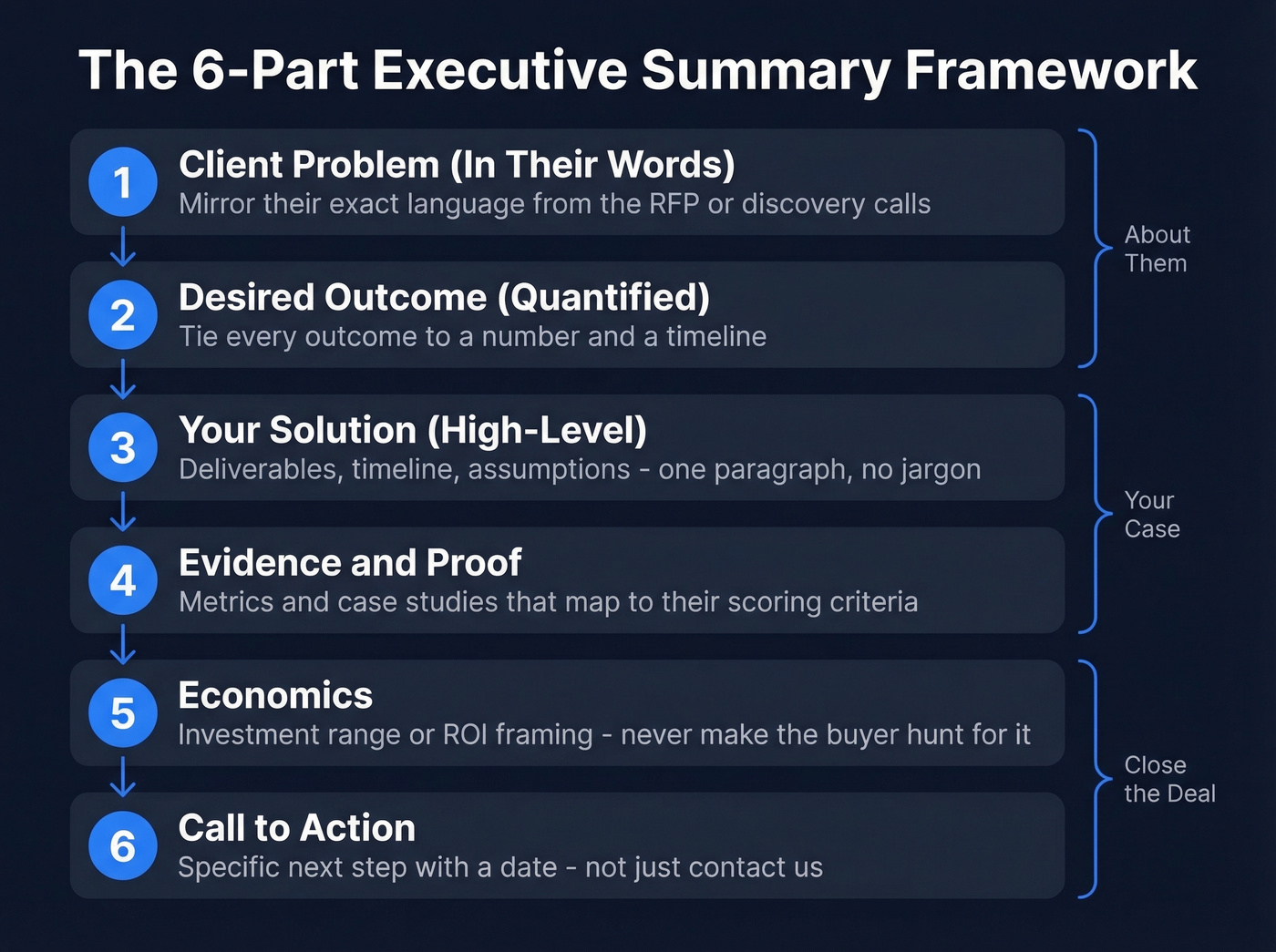
1. Client's Problem (In Their Words)
Use the client's exact language from the RFP or discovery calls. If the RFP says "reduce time-to-hire," you write "reduce time-to-hire" - not "accelerate talent acquisition." FranklinCovey emphasizes using "client speak," and it's non-negotiable. The moment you paraphrase, you signal that you didn't listen. In scoring discussions, mirrored language consistently beats polished vendor copy.
2. Desired Outcome (Quantified)
Tie every outcome to a number and a timeline. Not "improve efficiency" - "reduce proposal turnaround from 25 hours to under 10 within 90 days." The average proposal already takes 25 hours to complete. Show the buyer you understand the math.
3. Your Solution (High-Level)
Deliverables, timeline, assumptions. One paragraph. No technical jargon. If a non-technical executive can't understand your solution description in a single read, rewrite it.
4. Evidence and Proof
Metrics, case studies, differentiators - but only the ones that map to the buyer's evaluation criteria. ProLibrary puts it bluntly: if it can't be scored, it literally doesn't count. Every sentence in this section should survive the "so what?" test. Remove anything that's there to impress rather than prove.
5. Economics
Here's where most teams lose nerve. Include pricing or ROI framing - period. If your summary doesn't address economics, you're making the buyer hunt for it, and they won't. FranklinCovey treats that omission as a deal-killer, and Dock's structure brings economics forward deliberately. We've reviewed hundreds of proposals across our team, and economics buried deep gets ignored every single time. Provide at minimum an investment range or grouped categories.
6. Call to Action
Specific next step, not "contact us." Example: "Schedule a 30-minute implementation planning session for March 14th." Give them a date. Make it easy to say yes.
Same Line, Different Audience
The same economics line shifts depending on who's reading. For a CFO: "Projected 14-month payback period with $420K annual savings against a $180K investment." For a VP of Operations: "Your team reclaims 12 hours per week currently spent on manual requisition routing - live within 60 days." Same deal, different win theme. Always tailor to the signer.
Copy-Paste Proposal Summary Template
This template uses the PAS (Pain-Agitate-Solution) framework as its persuasion engine. Each line maps to one framework component. Fill in the brackets and you've got a draft worth editing.
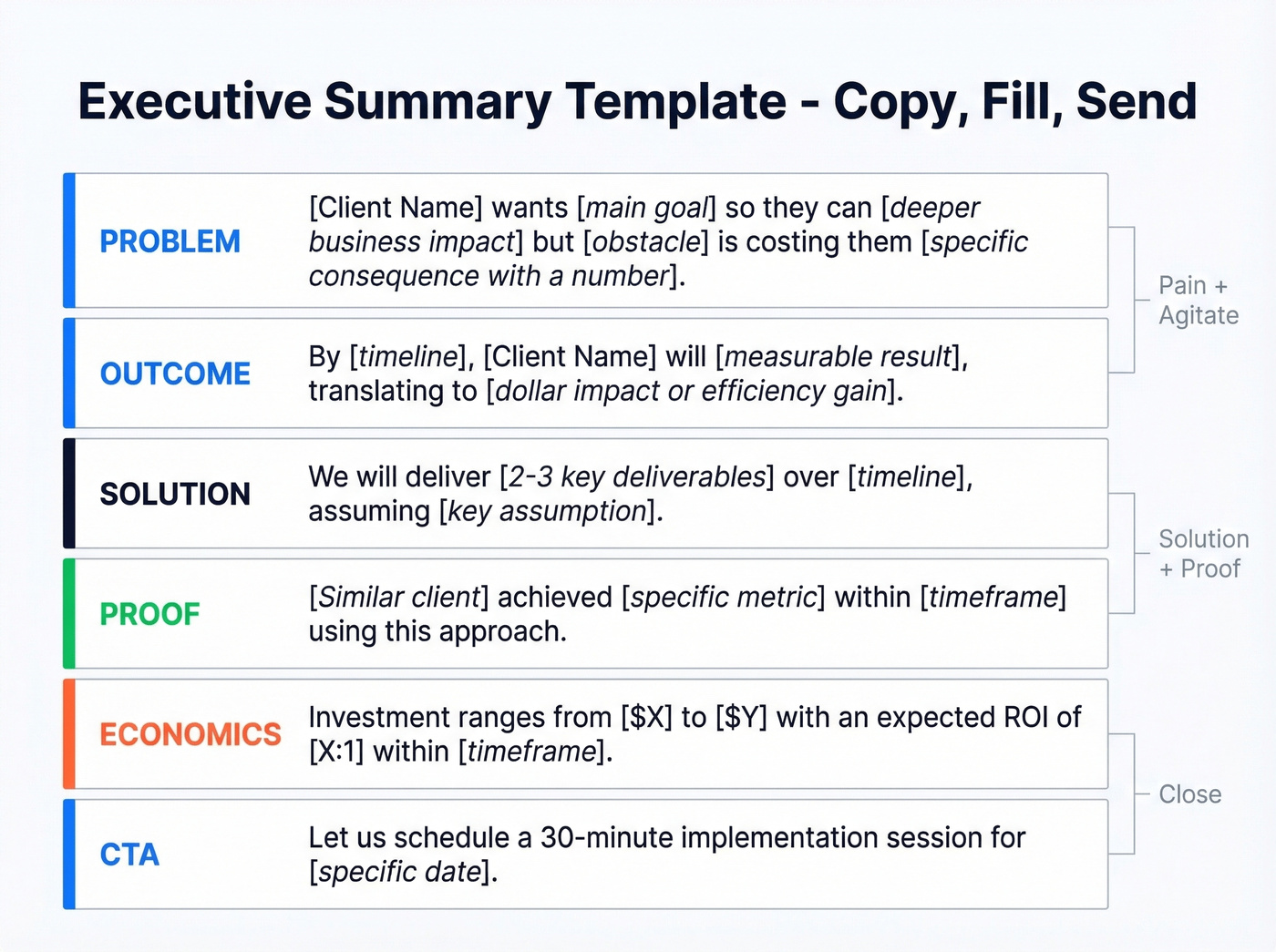
Problem: [Client Name] wants [main goal] so they can [deeper business impact] - but [obstacle] is costing them [specific consequence with a number].
Outcome: By [timeline], [Client Name] will [measurable result] - translating to [dollar impact or efficiency gain].
Solution: We'll deliver [2-3 key deliverables] over [timeline], assuming [key assumption].
Proof: [Similar client] achieved [specific metric] within [timeframe] using this approach. [Second proof point or differentiator].
Economics: Investment ranges from [$X] to [$Y] depending on [scope variable], with an expected ROI of [X:1] within [timeframe].
CTA: Let's schedule a 30-minute implementation session for [specific date] to align on scope and timeline.
Save this template. The structure stays; the words change with every proposal.

Your proposal's proof section is only as strong as the deals you close - and deals start with reaching the right buyer. Prospeo gives you 98% accurate emails and 125M+ verified mobile numbers so your outreach actually lands with the decision-maker reading that executive summary.
Stop writing proposals for people you can't reach.
Before and After: Same Deal, Different Summary
Let's look at the same fictional deal - a mid-market SaaS company pitching HR software to a 2,000-person manufacturer.
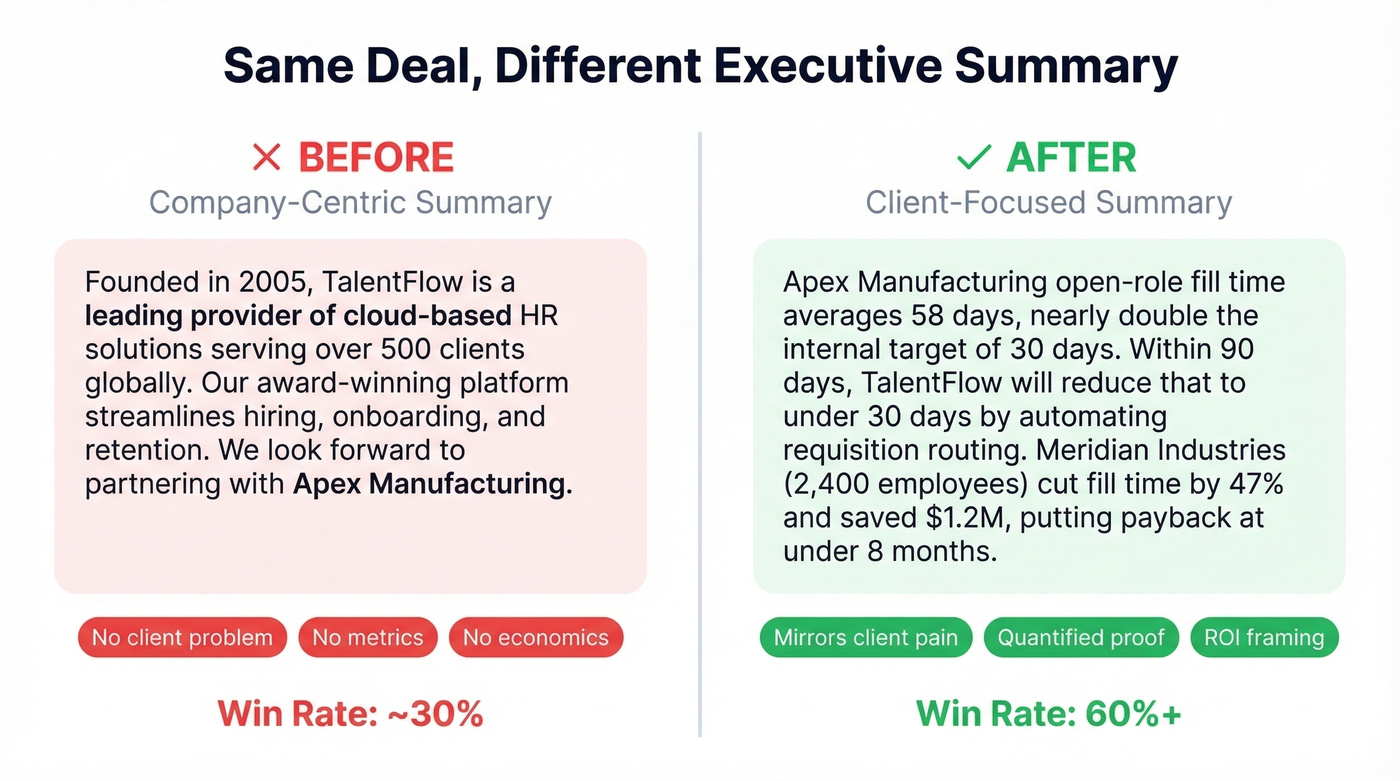
Before (company-centric):
"Founded in 2005, TalentFlow is a leading provider of cloud-based HR solutions serving over 500 clients globally. Our award-winning platform streamlines hiring, onboarding, and retention. We look forward to partnering with Apex Manufacturing."
After (client-focused):
"Apex Manufacturing's open-role fill time averages 58 days - nearly double Apex's internal target of 30 days. Within 90 days of deployment, TalentFlow will reduce that to under 30 days by automating requisition routing and interview scheduling. Apex's peer, Meridian Industries (2,400 employees), cut fill time by 47% in Q1 and saved $1.2M in contractor backfill costs - putting the projected payback period at under 8 months."
The "before" tells the buyer about you. The "after" tells the buyer about them. That's the entire difference between a summary that gets skimmed and one that gets the deal moving.
Five Mistakes That Kill Proposals
Research cited by Inventive AI found that 55% of people spend less than 15 seconds actively reading a page. Your executive summary needs to survive a scan. These five mistakes guarantee it won't.
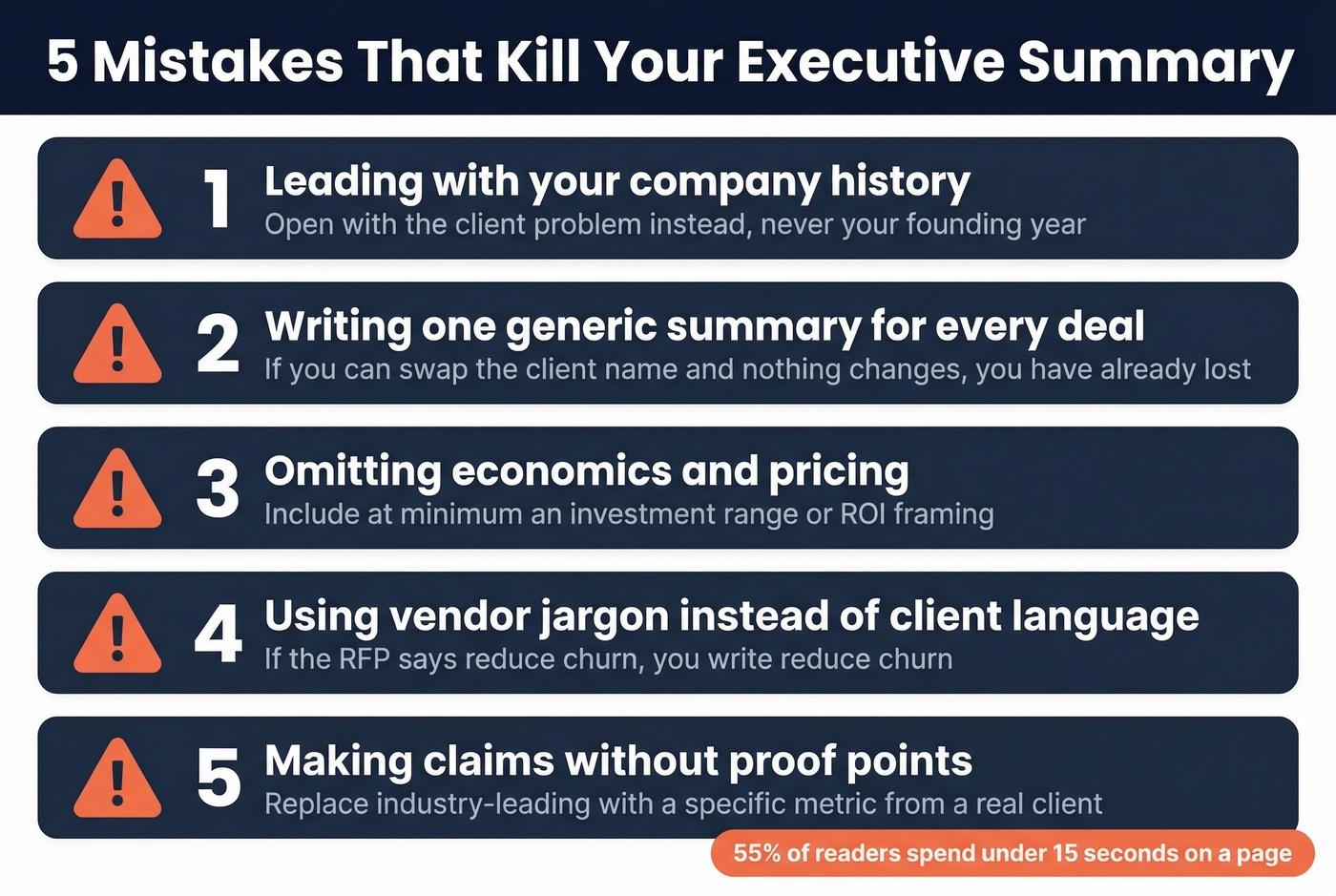
Leading with your company history. "Founded in 2005" is the fastest way to lose a reader. The buyer doesn't care about your origin story - they care about their problem. In proposal-writing communities on Reddit, the most repeated complaint is "it's all vendor fluff." Don't prove them right.
Writing one generic summary for every proposal. If you can swap the client's name and nothing else changes, you've already lost. This is the single most common failure we see, and it's almost always fixable in under an hour.
Omitting economics. Making the buyer hunt for pricing is making the buyer do extra work. They won't do it. They'll just score you lower.
Using vendor jargon instead of the client's language. If the RFP says "reduce churn," don't write "optimize customer lifecycle management." Mirror their words exactly.
Making claims without proof points. "Industry-leading" means nothing. "Reduced churn by 31% for a 1,500-seat SaaS company" means everything. If it can't be scored, cut it.
Here's the thing: most teams don't lose deals because their solution is worse. They lose because their executive summary reads like a brochure instead of a business case. Fix the summary and your win rate moves - even if nothing else about your proposal changes.
Personalization Starts Before the Proposal
You can't write a client-focused executive summary if you don't know who's reading it. The framework demands writing in the economic buyer's language, which means you need to know who that person is, what they care about, and how to reach them before you ever open a blank document.
That's where a tool like Prospeo fits in. Use 30+ search filters to find the actual signer by job title, department, or seniority, then pull their verified email and direct dial so you're writing for a real person - not a generic inbox or "selection committee." When you know the CFO's name and priorities, your summary stops being a template and starts being a conversation.
If you want a tighter way to define who you're writing for, start with an Ideal Customer Profile and align it to your lead scoring model.
FAQ
How long should a proposal executive summary be?
One page is ideal - roughly 500 to 1,000 words for most deals, up to two pages for complex RFPs. The "10% of total proposal length" rule is lazy advice. Decision-makers spend under five minutes on it, so make every sentence scorable.
Should you write the executive summary first or last?
Write it last. You need the full proposal drafted to identify your strongest arguments and proof points. Shipley recommends outlining early during capture planning, but the final polished version should always be the last thing you write.
Should pricing appear in the executive summary?
Yes. Include at minimum an investment range or ROI framing. Omitting economics forces the buyer to hunt for numbers, and top frameworks treat that omission as a deal-killer. Even a grouped cost range beats silence.
How do I find the right decision-maker before writing?
Use a B2B data platform to identify the economic buyer by title and seniority. Search by department, job title, or company size to find the CFO or VP who'll actually sign off, then write directly to their priorities. Skip this step and you're guessing who reads your summary - which defeats the entire point of personalization.
You just learned to write an executive summary that wins. Now make sure it reaches the economic buyer - not a gatekeeper. Prospeo's 30+ search filters let you target by job title, buyer intent, funding stage, and headcount growth at $0.01 per verified email.
Send your best proposal to the person who signs the check.