

How to Find Company Information in 2026 (Free & Paid)
They sent you a proposal, but something feels off. The company name doesn't match what's on their website, the address leads to a coworking space, and nobody on the team has a verifiable work history. You need to find company information fast - and you need it to be accurate.
The gap between public and private companies makes this harder than most people expect. Public companies file with the SEC, so data is abundant. Private companies? You're stitching together fragments from five different sources and hoping they agree.
What You Need (Quick Version)
Here's how to research a company based on your goal:
- Verifying a company exists: Start with your state's Secretary of State registry for any registered U.S. business. For public companies, SEC EDGAR is the gold standard. Both are free.
- Researching a company in depth: Crunchbase covers startup and funding basics, and paid plans unlock advanced filtering. OpenCorporates covers 200M+ companies globally with transparency scores by jurisdiction.
What Type of Info Do You Need?
Your use case determines your workflow.
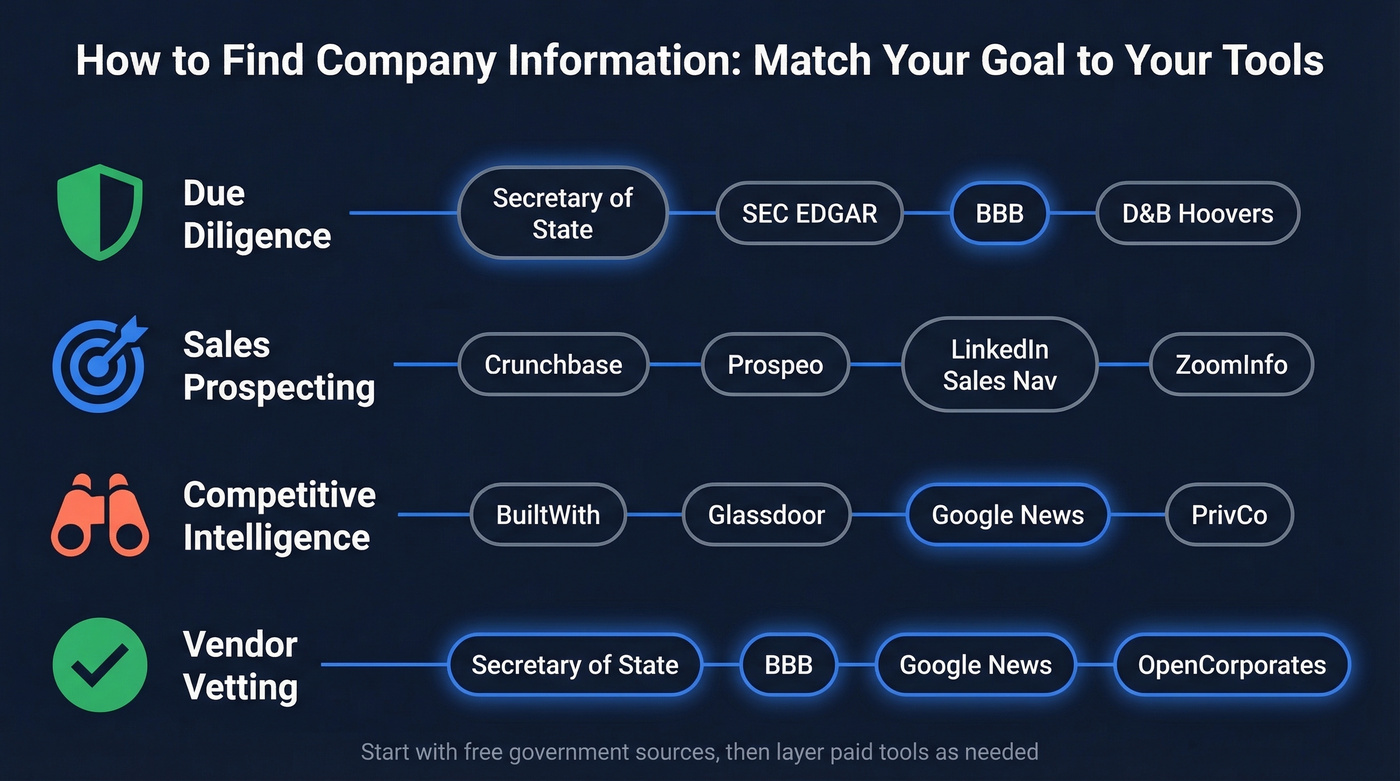
Due diligence - you're vetting a potential partner, acquisition target, or vendor. You need legal status, registration history, financials if available, and any red flags. A company information lookup through government registries and BBB is the right starting point.
Sales prospecting - you've got a target account list and need to understand company size, tech stack, funding stage, and who to contact. Crunchbase plus a B2B data platform gets you there.
Competitive intelligence - you want to understand a rival's growth trajectory, hiring patterns, tech choices, and market positioning. Combine BuiltWith for tech stack analysis, Glassdoor for employee sentiment, and Google News for recent moves.
Vendor vetting - someone's pitching you, and you want to confirm they're legitimate and stable. Secretary of State filings, BBB, and a quick news search usually surface anything concerning within 10 minutes.
Free Government Sources
Government databases are the most reliable starting point. They're free, authoritative, and updated regularly. The tradeoff: they're clunky to navigate and limited in scope.
SEC EDGAR (Public Companies)
If the company is publicly traded, EDGAR is your first stop. Search by company name or CIK number to pull 10-K annual reports, 10-Q quarterly filings, proxy statements, and insider transaction records. The Financial Statement Data Sets page gives you structured numeric data from every public filing - useful if you want to run your own analysis rather than reading through PDFs.
EDGAR is comprehensive for public companies, but it won't help with private ones.
State Secretary of State Registries
Every U.S. state maintains a database of registered business entities. A Secretary of State search typically reveals the entity name, status - active, inactive, or dissolved - along with entity type, registered agent, and filing history. Some states provide full-text filings; others give you bare-bones citations. This is also the fastest way to see who owns a company, since most states list the registered agent and, in many cases, the officers or members on file.
State-by-state variation is real. Nevada offers free entity searches by name, entity ID, or DBA, but reserving a business name costs $25 for 90 days. California's system works differently. There's no single portal covering all 50 states, so you'll need to find the right state website for each search.
BBB, USPTO, and Other Federal Sources
The Better Business Bureau won't tell you much about financials, but it's useful for spotting complaint patterns and verifying that a company is operational. The U.S. Small Business Administration offers market research guidance and competitive analysis frameworks that help contextualize what you find.
For intellectual property, the USPTO trademark and patent databases reveal what a company has registered - useful for competitive intelligence and due diligence. The Census Bureau's SUSB data breaks down establishment counts and payroll by industry and employee-size class, which helps you gauge whether a company's claimed headcount is realistic for its sector.
How to Research Private Companies
Private companies aren't required to file with the SEC. That single fact makes them dramatically harder to research.
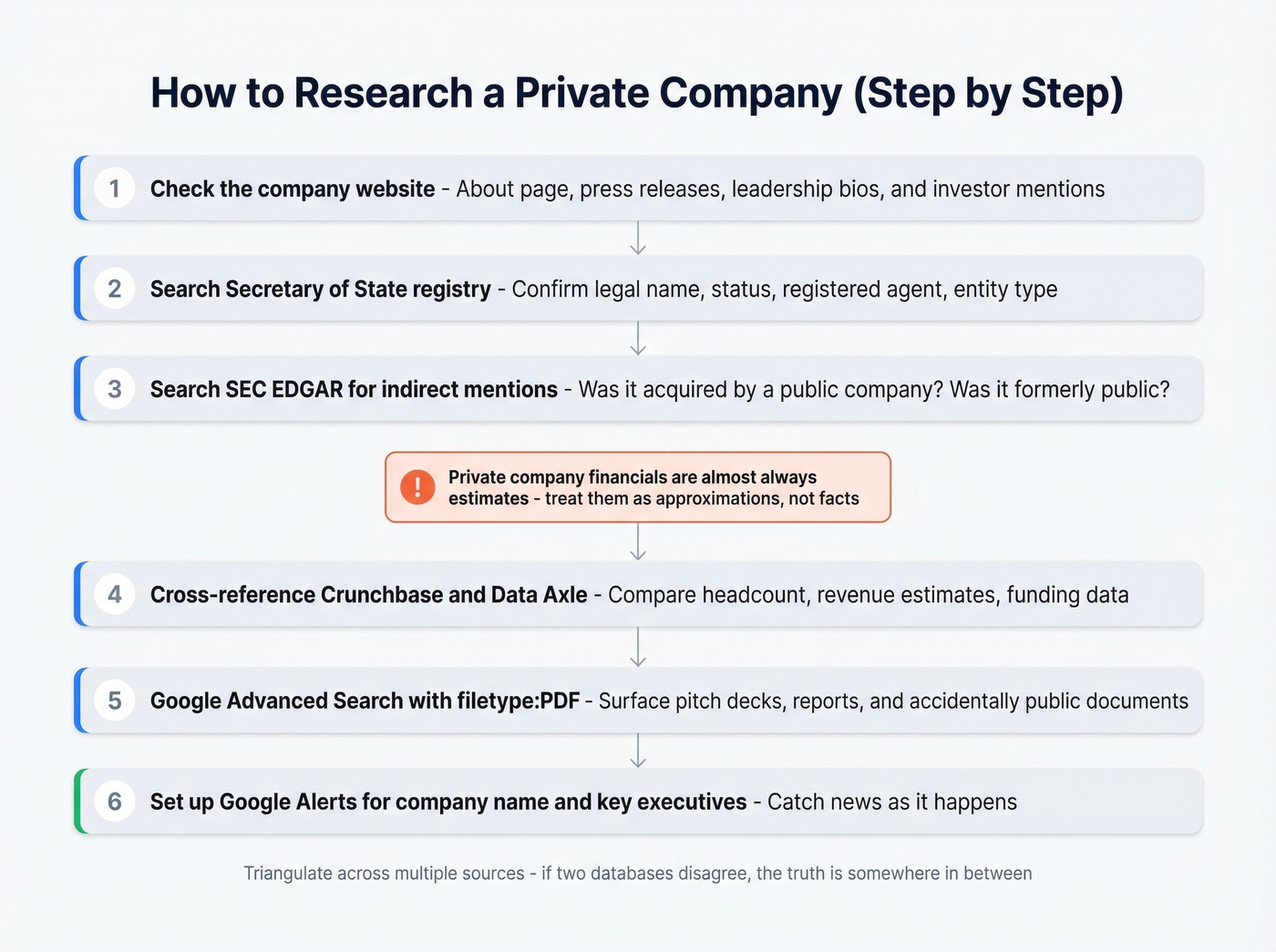
The audited financials, executive compensation disclosures, and material risk statements you're used to seeing for public companies simply don't exist for most private firms. Two exceptions worth knowing: if a private company was acquired by a public company, the acquirer's SEC filings often disclose deal details, revenue figures, and integration plans. And if a company was formerly public before going private, its historical SEC filings remain accessible on EDGAR.
Important caveat: Financials for private companies are almost always estimates and are often outdated by a year or more. Treat any revenue or valuation figure you find as an approximation, not a fact.
In our experience, the company's own website is the single richest source for private firm research - About pages, press releases, and leadership bios often reveal more than any database. Then triangulate across multiple sources. If Crunchbase says a company has 200 employees and Data Axle says 150, the truth is somewhere in between.
Here's a trick that's saved us hours: use Google Advanced Search with the filetype:PDF filter to surface reports, pitch decks, and documents that companies have posted publicly (sometimes accidentally). Set up Google Alerts for the company name and key executives to catch news as it happens.

You're researching companies to find the right people to contact. Prospeo's B2B database covers 300M+ professional profiles across 30+ filters - including technographics, funding stage, headcount growth, and buyer intent - so you go from company research to verified contact data in one workflow.
Find the company. Find the decision-maker. Get the verified email. One platform.
Free Company Search Tools
Beyond government sources, several free tools fill important gaps.
OpenCorporates
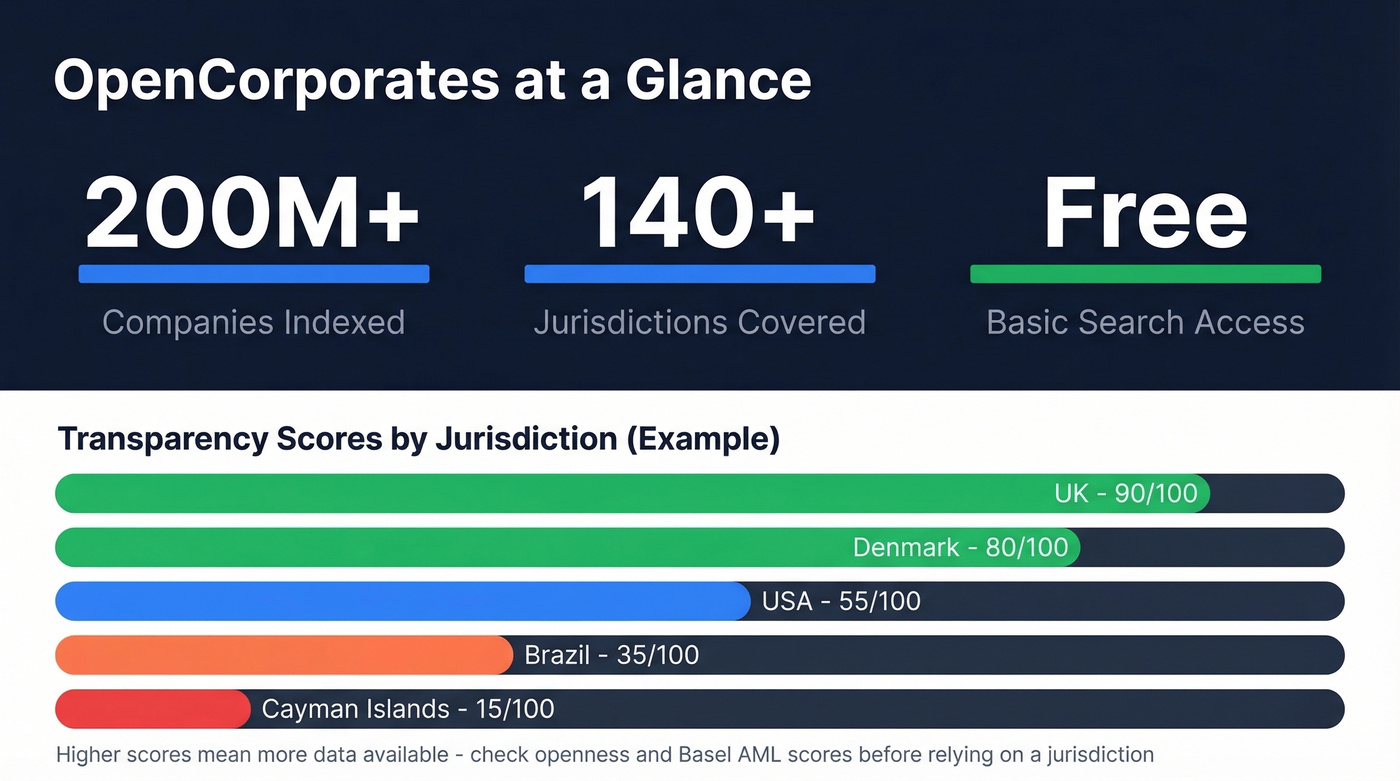
OpenCorporates indexes 200M+ companies across jurisdictions worldwide. What makes it genuinely useful is the transparency layer - each jurisdiction gets an openness score out of 100 and a Basel AML score, so you can immediately see how much data you're likely to find for a company registered in Brazil versus the UK. You can also filter results by jurisdiction to narrow down entities in a specific country or state.
Crunchbase (Free Access)
Crunchbase is the go-to for startup and growth-stage company research. Funding rounds, investor names, founding dates, and basic headcount data are available on the free tier. Paid plans unlock deeper data and advanced filtering. Expect Crunchbase Pro to run around $50+/mo per user.
Other Free Resources Worth Bookmarking
Google News surfaces recent coverage faster than any database. For smaller private companies, local and trade publications are often the only media covering them.
Glassdoor provides employee sentiment data that no official source will give you. If reviews mention layoffs, leadership turnover, or culture problems, that's intelligence you won't find in a filing.
Data Axle Reference Solutions - accessible free through many public libraries - contains 66M+ U.S. businesses with competitor lists, sales estimates, and employee counts. We've found this to be one of the most underrated free resources available, and almost nobody talks about it. Check your local library's website; many offer remote access with just a library card.
CorporateInformation aggregates data on 38,000+ public companies across 75+ countries, including financial snapshots and peer comparisons. Solid free complement to EDGAR for international public company research.
BuiltWith reveals a company's tech stack from its website. The free tier shows current technologies; paid plans add historical data and competitive analysis.
For complex corporate structures, tools like D&B Hoovers and Mergent Intellect map parent-subsidiary relationships - critical when the entity on a contract isn't the entity you think you're dealing with.
Paid Tools for Deeper Research
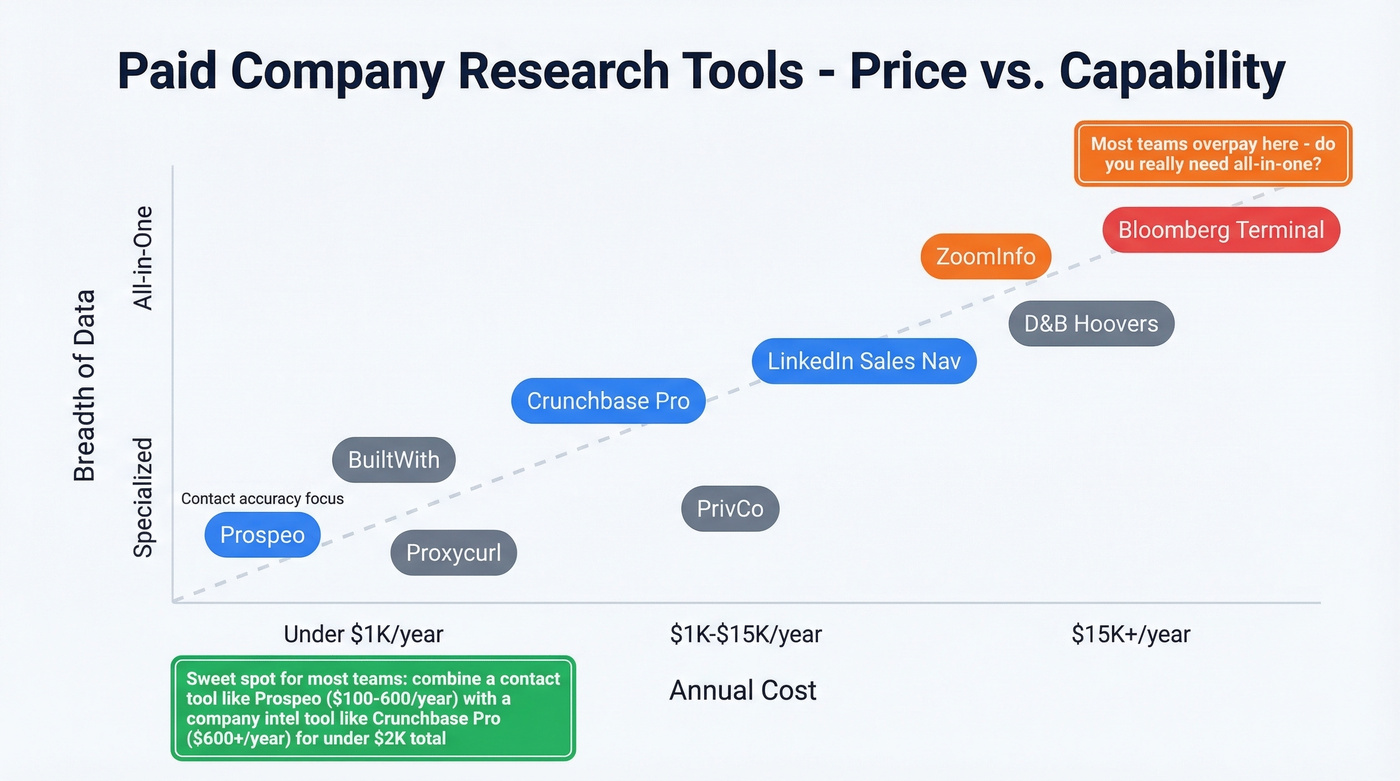
When free sources aren't enough, paid tools fill the gaps. The market splits into two categories: company intelligence platforms (what's happening at this company?) and contact databases (who works there and how do I reach them?). Most teams need both.
| Tool | Best For | Starting Price | Free Tier? | Key Limitation |
|---|---|---|---|---|
| Prospeo | Verified contacts + enrichment | ~$0.01/email | Yes (75 emails/mo) | Focused on contact accuracy |
| Crunchbase Pro | Startup/funding intel | ~$50+/mo per user | Yes (basic) | Weak on non-VC-backed firms |
| LinkedIn Sales Navigator | Account-level prospecting | ~$80-110/mo | No | No email export |
| ZoomInfo | Full GTM platform | ~$15-25K+/year | No | Expensive, annual contracts |
| D&B Hoovers | Enterprise due diligence | ~$5-15K/year | No | Clunky UI, dated feel |
| PrivCo | Private company financials | ~$1-3K/year | No | Narrow focus, smaller DB |
| BuiltWith | Tech stack intelligence | ~$295/mo | Yes (basic) | Only tech data |
| Proxycurl | API-first enrichment | $49-$2,000/mo | 10 credits on sign-up | Developer-oriented |
| Bloomberg Terminal | Financial deep dives | ~$20-25K/year | No | Overkill for most teams |
Let's be honest: ZoomInfo is still the most comprehensive all-in-one platform. But most teams don't need all-in-one. We've seen companies pay $20K+ for the full suite when they really only needed a reliable contact database and a separate company search tool - at a combined cost under $2K/year.
On Reddit's r/sales and r/LeadGeneration, a recurring complaint is that tools like Apollo and Crunchbase show outdated headcount and decision-maker data. That freshness problem compounds over time, which is why the refresh cycle of any tool you choose matters more than the raw size of its database.
Researching Companies Outside the U.S.
International company research is harder because disclosure requirements vary wildly by country.
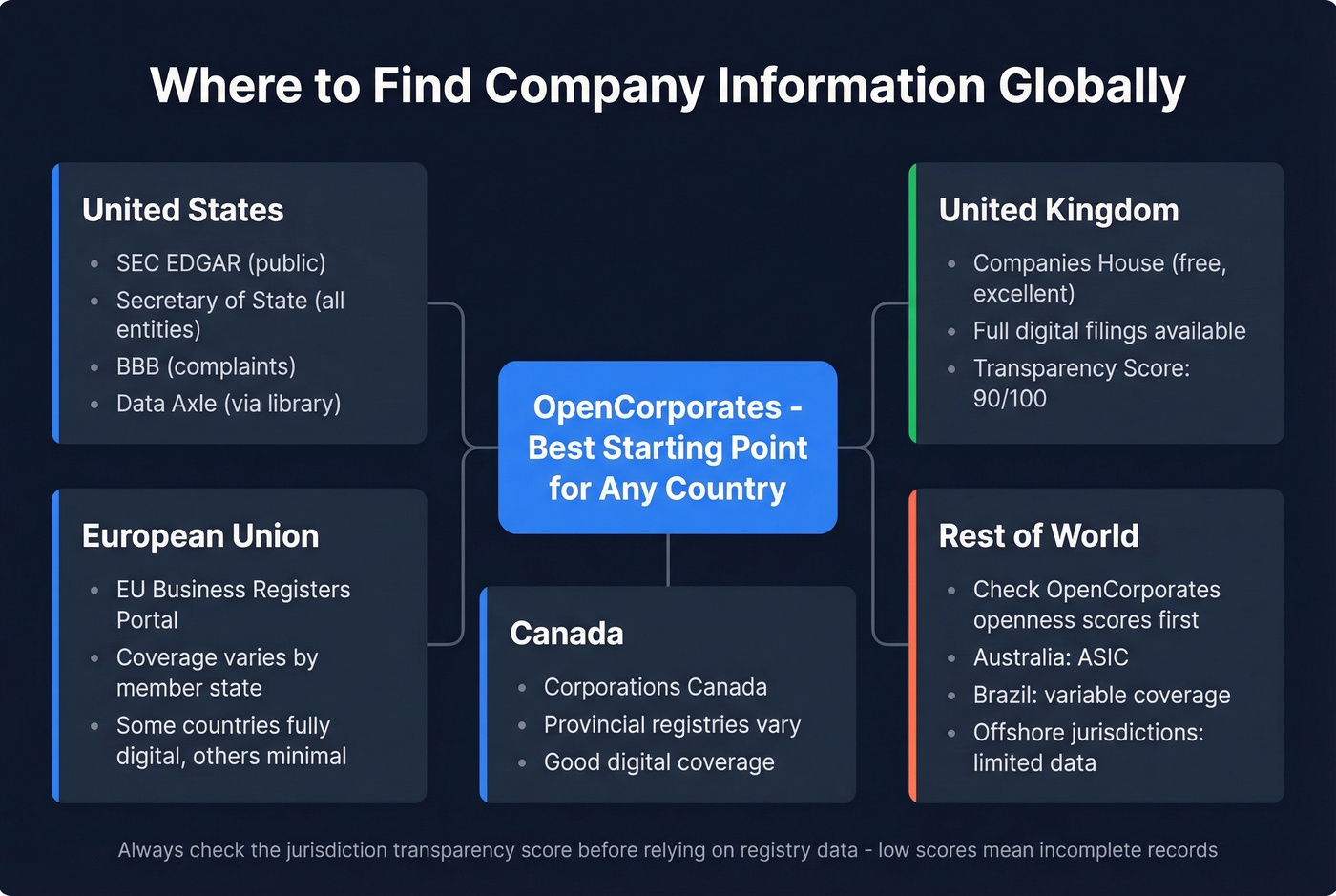
The EU Business Registers portal provides access to member-state registries, but coverage differs - some countries offer full digital filings, others barely have a searchable index. OpenCorporates is the best starting point for international research. Its registry directory covers jurisdictions from Australia (ASIC) to Canada (Corporations Canada) to Brazil, each with company counts and openness scores.
The UK's Companies House is a standout - completely free, with detailed filing histories, director information, and financial statements for most registered companies. I wish every country's registry worked this well.
For countries with low openness scores, expect to hit walls. Some jurisdictions charge fees for basic searches, others restrict access to in-person requests. OpenCorporates' Basel AML scores help you gauge how transparent a jurisdiction is before you invest time searching.
From Company Research to Contact Data
You've identified your target accounts. You know their industry, size, funding stage, and tech stack. But you can't find a single direct email for the VP you need to reach.
This is the bridge problem - company research tools tell you about the organization, but not who to contact or how to reach them. Prospeo bridges that gap. Search by company name or paste a URL, and it returns verified emails and mobile numbers from 300M+ professional profiles. The Chrome extension lets you pull contact data from any website or CRM in one click.

B2B data decays at about 2.1% per month, which means after six months, roughly 12% of your contact database is wrong. Prospeo's 7-day refresh cycle addresses this directly, compared to the 6-week industry average. The free tier gives you 75 verified emails per month - enough to test the data quality before committing.
Stitching together Crunchbase, OpenCorporates, and state registries gives you company context - but not the contacts you need. Prospeo returns 50+ data points per contact with 98% email accuracy and 125M+ verified mobile numbers, all refreshed every 7 days.
Turn company research into booked meetings at $0.01 per verified email.
Keeping Your Data Fresh
Company information has a shelf life. That 2.1% monthly decay rate means a perfectly clean database of 10,000 contacts will have roughly 1,200 bad records after six months. People change jobs, companies move offices, phone numbers get reassigned, and email addresses get deactivated.
Two practical tactics keep your data usable. First, set up Google Alerts for your key accounts and competitors - it's free and catches leadership changes, funding rounds, and acquisitions as they happen. Second, run regular enrichment cycles through your CRM or via CSV upload using a tool with a short refresh cycle.
Skip this if you're only doing one-off research. But if you're maintaining an ongoing prospect or vendor database, quarterly refreshes are the bare minimum. The tools exist to automate this. Use them.
FAQ
What's the best free way to look up a U.S. company?
SEC EDGAR for public companies - search by name or CIK number to access all filings. For any registered business, public or private, your state's Secretary of State registry provides entity status, registered agent, and filing history at no cost.
Can I find private company revenue figures?
Sometimes, but they're almost always estimates. Databases like PrivCo and Crunchbase provide revenue approximations that can be outdated by a year or more. Cross-reference multiple sources and treat any number as a rough approximation, not audited fact.
How do I research international businesses?
Start with OpenCorporates, which indexes 200M+ companies globally with transparency scores by jurisdiction. For European companies, the EU Business Registers portal connects you to member-state registries. The UK's Companies House is completely free and unusually detailed.
How do I see who owns a company?
For U.S. businesses, the Secretary of State registry in the incorporation state typically lists the registered agent and, depending on the state, the officers or members. For UK companies, Companies House provides full director and shareholder details. OpenCorporates can point you to the right registry for other jurisdictions.
What's a good free tool for getting contact data after company research?
Prospeo's free tier includes 75 verified emails and 100 Chrome extension credits per month at 98% accuracy - enough to validate a prospect list or vet a vendor's team without paying anything. For comparison, Hunter offers 25 free searches per month with more limited enrichment.